Showing posts with label crime. Show all posts

Saturday, August 3, 2024

So... whatever happened to serial killers?

Are serial killers a thing of the past?

Remember serial killers? Those sweaty, shifty-eyed men who used to dominate the news cycle? Sure, you do.  They used to be the stuff of nightmares. They were all over TV. Remember TV? Serial killers were huge on there. Movies, too. And books, magazines, and newspapers. You youngsters may not remember, but us older folks will never forget.

For a few decades, serial killers dominated popular culture. We needed something to fill the void after The Beatles broke up, and apparently they were it. You'd see them being taken away in handcuffs after the police discovered their crawlspace full of human torsos. Later, they'd spout some wackadoo gibberish while defending themselves in court. Sometimes, they'd have three names, like John Wayne Gacy or Henry Lee Lucas. 

Enjoy the '90s while they last, pal.
We'd be horrified by their crimes, but we'd be compelled, too. They became antiheroes. People wrote them fan letters. In the '90s, you'd occasionally see their intense faces staring at you from magazine covers and T-shirts. Your "edgy" friend might name his terrible band after one of them. There were tasteless jokes and SNL sketches about them.

So what happened to those guys? From roughly the 1970s to the '90s, you could count on a new serial killer every few years. They were an important part of the news cycle. We depended on them, if only for reassurance that we ourselves weren't so bad. "At least I'm not that guy," you could think.

And then... what? We just collectively stopped serial killing? You're asking me to believe that serial killing was just some kooky phase we went through as a society and got over? People got bored with it? Moved on to something else? I can't even remember the last new serial killer to become a media sensation. It's been decades. Where are the Bundys and Dahmers of tomorrow coming from? I ask you.

I refuse to believe that the human race has evolved beyond serial killing. We're not one bit better than we were in the '80s and '90s. If anything, we're worse. Like, a lot worse. We're more violent, delusional, and narcissistic than we ever were. I guess, in the 21st century, we've shifted from serial killing to mass murder. Which, like, sure. It's more efficient. I get it. You can kill a bunch of people at one time and become just as notorious, feared, and hated.

But there was a certain artistry, if you want to call it that,  to serial killing. If you, as a killer, spread your crimes out over a period of months or even years, you could create compelling narrative that wouldn't be possible with just a single afternoon of bloodshed. You could develop a mystique. Hollywood understood this. Think of Norman Bates, Michael Myers, Hannibal Lecter—serial killers all, not a mass murderer in the bunch.

You know who I think ruined it? The BTK guy. First off, his nickname makes you think of Burger King. Secondly, when they finally found him, he looked like an assistant manager at Denny's. Hardly the kind of guy to wind up on a T-shirt. A lot of the mystique was gone. And then, after Oklahoma City, Columbine, and 9/11, serial killers were yesterday's news. They seemed quaint. In recent decades, sex-related crimes have arguably eclipsed murder in the public imagination.

It's obvious that we're still fascinated with serial killers in the 21st Century. There are plenty of movies and TV shows about them being made, but the killers themselves are either fictional or decades-old. Bundy's used up. Gacy's used up. Dahmer is beyond used up. Maybe the age of serial killers is gone forever. It's not that I want them to come back, exactly. But it is strange that they vanished from the scene, isn't it?

Sunday, November 2, 2014

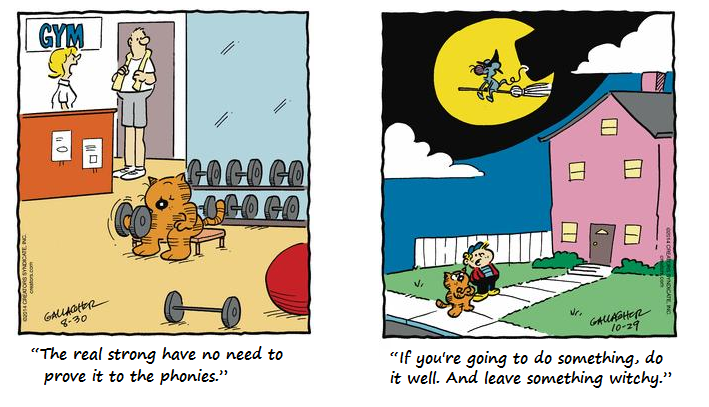
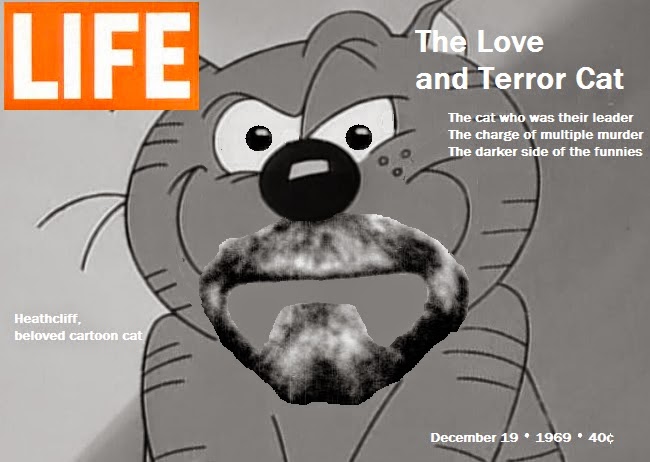
What if 'Heathcliff' were written by Charles Manson? I think it would go SOMETHING like this...

If you don't know what this is referencing, then congratulations on being young and well-adjusted.

"Heathcliff, Heathcliff, no one should terrorize the neighborhood."
-lyrics to the Heathcliff theme song from the 1980s

Typical Heathcliff nonsense.
Heathcliff is often dismissed as an off-brand, downmarket Garfield wannabe, but this comparison is unfair for a couple of reasons. First, George Gately's orange striped cat debuted in American newspapers five years before Jim Davis' finicky feline followed suit. Secondly and more importantly, the strip, which is now carried on by Gately's nephew Peter Gallagher, is one of the most insane, proudly meaningless, and defiantly absurd things you'll find on the funny pages.

Quite simply, Heathcliff makes The Far Side at its most opaque look like The Family Circus at its most obvious. While Garfield is about the relationship between cats and their owners and has some basis in real-life observation, Heathcliff is about pure dadaist lunacy and has its apparent basis in three-day-long peyote trips. The central narrative which emerges from the daily panels of Gatley's strip is that of a casually dictatorial cat who has both a family and an entire suburban community under his sway. Heathcliff is basically a totalitarian conceptual artist who routinely dons elaborate costumes, raises various custom-made banners, and creates large-scale outdoor sculptures, often out of garbage, as a means of personal expression. He is devoted to chaos for its own sake and will gladly cause massive public disruptions with his inscrutable behavior, even if it means bringing dangerous wild animals into his suburban environment.

Like the kowtowed residents of Peaksville, Ohio from the "It's a Good Life" episode of The Twilight Zone, the humans in Heathcliff have simply built their lives around the nonsensical whims of one all-powerful, mad deity. At most, they will flatly acknowledge or describe what the capricious cat is doing, but they will not attempt to stop him or alter his behavior. While Garfield noodges Jon Arbuckle for more lasagna, Heathcliff would be more apt to turn a swimming pool into a giant lasagna pan and then dive in headfirst, surrounding himself with the delectable noodles, cheese, and sauce therein.

Since Heathcliff can be described as a kind of cult leader whose authority extends to both humans and animals, I only thought it fitting that his comic strip should be authored by one of the most terrifying Svengali figures of the 20th Century, Tate-LaBianca mastermind Charles Manson. Toward that end, I have taken some representative Heathcliff panels and paired them with quotes from the notoriously verbose Manson himself. Please do enjoy.


Tuesday, May 27, 2014

'Taxi Driver' predicted Elliot Rodger before Seth Rogen was even born

"God's lonely man": Robert De Niro as cab driver turned vigilante/assassin Travis Bickle.

In case you haven't been following along, it turns out that the blame for Elliot Rodger's misogynistic killing spree in Santa Barbara, CA, can all be laid at the feet of Seth Rogen and Judd Apatow and their movies about schlubby guys scoring with beautiful women. Thanks for sorting that out for us, Ann Hornaday. I trust that the proper authorities, once they read your Washington Post op-ed piece, will put out a warrant for the arrests of Mr. Rogen and Mr. Apatow immediately and that these two men will be in custody soon. As sad as this information is, it's at least good to know that we've gotten to the bottom of this whole thing. And so quickly, too! Ms. Hornaday has certainly earned her Crime Stoppers Badge of Honor this week. 

How curious, though, that the movies of Seth Rogen and Judd Apatow have not inspired similar massacres in the dozens of other countries around the world where they've been released. It's almost as if Rodger's actions were guided by circumstances, both personal and social, infinitely more powerful than any fictional movie comedies.

Curiously, neither Neighbors nor Knocked Up came immediately to mind as I sifted through the horrifying news updates coming from California and tried to make sense of the twisted, tragically-misguided rhetoric of Rodger's so-called "manifesto." Instead, I was thinking about Martin Scorsese's Taxi Driver (1976), an unnerving urban fable about a profoundly alienated, deeply unbalanced cab driver, Travis Bickle (Robert De Niro) who becomes a merciless vigilante and a would-be political assassin after he is rejected by a beautiful campaign worker, Betsy (Cybill Shepherd), with whom he has become romantically infatuated. 

Throughout the film, we are made privy to Bickle's warped thought process through his chilling yet strangely poetic voice-over narration. These passages, which supposedly derive from a journal or diary which Bickle is keeping of his activities, are remarkably similar to Elliot Rodger's ravings. In particular, while reading the manifesto, I was reminded of a scene from Taxi Driver in which Travis arrives, unwanted, at Betsy's workplace, and she has him thrown out. Travis' parting words to Betsy are: "You're in a hell, and you're gonna die in a hell like the rest of them!" As if to clarify this vaguely-worded threat, we then hear a strikingly prescient quote from Travis' narration:
"I realize now how much she's just like the others. Cold and distant. And many people are like that. Women for sure. They're like a union."
This line could have come word-for-word from Rodger's manifesto, with its sullen, self-pitying paranoia and horrendous misconceptions about women. And it comes from a movie which was released six years before Seth Rogen was even born. Perhaps Martin Scorsese and his screenwriter, Paul Schrader, were giving us a warning with Taxi Driver, one we utterly failed to heed.

Friday, September 23, 2011

(today's zomby) AND THE CHILLING WORDS OF A MADMAN

With today's Zomby, I wanted to try an experiment: what if this cartoon were written by notorious would-be assassin Arthur Bremer?


Bremer's diary
A little history for those not in the know: In 1972, the emotionally-troubled Arthur Bremer (b. 1950) made an attempt on the life of controversial segregationist politician George Wallace. The former Alabama governor was not killed by Bremer's four shots at close range, but he was confined to a wheelchair for the rest of his life before dying in 1998 at the age of 79. Bremer spent the next few decades in prison but was ultimately released in 2007. Besides the assassination attempt, Bremer is most famous for his bizarre, error-filled journals which were published under the title An Assassin's Diary in 1973. (Note: The dialogue in the cartoon above comes directly from that book.) So what's the connection to this feature? Well, to me, Arthur Bremer is very much the Ziggy of assassins -- not just because he failed but also because of his almost touchingly pathetic motives. Bremer was not a political extremist but instead was a nonentity, a nobody who thought that the assassination of a famous politician like George Wallace or Richard Nixon would give his life meaning or purpose. The poor schmuck even kind of looked like Ziggy, with his bland, rounded, nonthreatening features.

Harmless-looking Arthur Bremer

Personally, I think Ziggy is a very dangerous little man. The world treats him terribly, and yet he just stands there passively absorbing it all. But each mishap, each insult, each slight pushes him closer to being the next Arthur Bremer. May god have mercy on the snotty waiters, pushy salesman, and grouchy cashiers of the Ziggyverse when that happens. Incidentally, Bremer's diary was the partial inspiration for Martin Scorsese's film Taxi Driver and for Peter Gabriel's song "Family Snapshot."


Perhaps someday, I will do a long-form mashup of Ziggy and An Assassin's Diary. For now, this cartoon will have to serve as the pilot. I wish it were Ziggy himself speaking the punchline and not that goddamned parrot of his, but I have to work with the cartoons I'm given.