Showing posts with label racism. Show all posts

Tuesday, May 14, 2024

Podcast Tuesday: "Ancient Chinese Secret, Huh?"

Fonzie (Henry Winkler) seems pretty chummy with the villainous Ming Fu.

This week marks what I'd call a milestone in the history of our humble podcast. We are finally releasing our 255th episode, meaning that we have tied Happy Days (1974-84) in terms of sheer quantity. But, wait, since we reviewed every episode of Happy Days already, shouldn't we have reached the 255 milestone months ago? Not quite. 

See, the original ABC sitcom did a lot of multi-episode stories. In syndication, two-parters count as two separate episodes, three-parters count as three, etc. But we would sometimes review those stories all at once, meaning that we "only" amassed 247 episodes by the time we got to the finale. Thanks to the animated series, however, we've managed to reach our 255th episode and will soon surpass it. I don't know about my cohost, but I plan to keep this show going indefinitely. Who knows? It may reach 300 or 400 episodes someday.

But what do we have for this milestone installment of These Days Are Ours: A Happy Days Podcast? Well, we're reviewing the December 1980 episode "Ming Fu to You, Too." It's an adventure set vaguely in "ancient China" in which Fonzie (Henry Winkler) and his pals meet the villainous Ming Fu, an obvious ripoff of Fu Manchu. How embarrassingly racist does it get? You'll just have to click to find out.

Wednesday, January 17, 2024

Ed Wood Wednesdays, week 175: Young, Black and Gay (1968)

Is this Ed Wood's most incendiary novel?

Nowadays, we would probably demand that the author of a book called Young, Black and Gay be at least two of those adjectives. But I guess authenticity wasn't as important back in 1968, when Edward D. Wood, Jr. penned a novel with that bold title for a company called P.E.C., which published it as part of its French Line imprint with the catalog number FL-38.

I'd say the author of this novel was zero for three. At 44, Ed Wood wasn't terribly young when he wrote Young, Black and Gay. He was decidedly not Black either. As for being gay, while Eddie's sexuality was labyrinthine to say the least, I would never be comfortable calling him strictly homosexual. If you've read A Fuller Life (2008), the autobiography of Eddie's live-in lover and leading lady Dolores Fuller,  you'll know just what I mean. In that book, Dolores is quite candid in describing her intense physical relationship with Ed. 

Was Ed Wood qualified to write this?
So maybe Ed wasn't the most qualified author for Young, Black and Gay (hereafter YB&G), but he must have taken some pride in his work since this is one of the novels he wrote under his own name. It comes from what I'd call the most productive era of Ed Wood's life: 1968 to 1972. (If you want to expand that from 1967 to 1973, I wouldn't argue.) Simply put, Eddie was writing like a madman during these years, churning out books, articles, and film scripts at a pace that is superhuman. And yet, most of this material (including YB&G) is highly indicative of Eddie's signature style. Hurried though he was, Ed Wood usually found time to work his own obsessions, kinks, and quirks into what he wrote.

I suppose we could categorize this novel as one of Ed Wood's "Black" books and file it alongside Black Myth (1971, written under the pseudonym Dick Trent), Toni: Black Tigress (1969), and the two Rocky Alley novels, Watts... The Difference (1966) and Watts... After (1967). And indeed, YB&G has much in common with them, stylistically and thematically, even referencing the Watts riots. But what this novel really reminded me of was Ed's 1967 book Drag Trade, his rambling treatise on transvestism and crime. If you took one of the (manufactured) case studies from that book and expanded it to novel-length, you'd get YB&G.

What we have here is the turbulent, violence-plagued story of Charles Sttanze (yes, that's how his last name is spelled for some reason), a young Black man who grows up in abject Southern poverty in a world that seems little changed from the days of antebellum slavery. He and his family pick cotton and live together in a foul-smelling, barely-furnished shack. Charles learns about the facts of life very early, since his parents unashamedly make love in front of their children. His sisters go naked at home on hot days, so he's well-acquainted with female anatomy.

Charles' life takes a turn when, as a teenager, he meets a field worker named Clyde. Initially rivals, Charles and Clyde are thrown into confinement together after getting into a fistfight and soon embark upon an intense homosexual relationship. Under Clyde's tutelage, Charles develops a female alter ego named Charlene. (Compare this to the case of Charles/Charlotte in Drag Trade.) Eventually, our protagonist identifies as female and uses the name Charlene exclusively. And here, Ed Wood does something subtly revolutionary. After a few chapters, he consistently refers to his main character as Charlene and switches the character's pronouns from he/him to she/her. And this is in 1968!

But let's not go overboard praising Ed Wood for his progressive politics. Charles/Charlene is a largely negative character, and there is little doubt that YB&G is tainted by Wood's own deeply-ingrained racism. Once he escapes from his family, the work-averse Charles embarks upon a life of petty crime and spends much of his time in jail.  He begins a relationship with a white cellmate named Bobert, and when Bobert is killed by another white prisoner, Rance (one of Ed's favorite character names), our hero switches allegiances without too much hesitation. His only real complaint is that Rance is a quickie artist (another major sin in the Wood-iverse).

Once on the outside and living completely as a woman, Charlene reunites with Rance, and together, they form a sort of interracial, transgender Bonnie-and-Clyde-type duo, robbing liquor stores and killing whenever they need to. Ultimately, they arrive in Los Angeles and plan a big-time caper that will finally bring in some real money. But this job will require bringing in a third party, possibly jeopardizing the special chemistry between Charlene and Rance. It doesn't help that the experienced crook that Rance recruits, Moe, is a crude, ill-tempered, mean-spirited brute who immediately antagonizes Charlene.

Saks on Wilshire: Charlene's happy place.
Meanwhile, Charlene starts frequenting a Black gay bar called the Joint Affair and meets a mysterious man named Jeff, who represents a Black Power group known only as "the organization." This is the same name Ed Wood gave to a very similar group in Toni: Black Tigress, and his views on the subject of Black Power are identical in both novels. Charlene seems to have no particular political ideas but is drawn to Jeff because she likes the way he talks. Like all Black organizers in Ed Wood novels, Jeff is selfish and untrustworthy, but our protagonist barely seems to notice his flaws. In the latter stages of the book, Charlene bounces back and forth between Rance and Jeff until YB&G reaches its violent apotheosis.

If Wood depicts his Black characters like Charlene and Jeff negatively, does that mean the novel's white characters are the true heroes? Nope. All through the novel, Charlene is plagued by racist vigilantes, many of them members of the Ku Klux Klan, and Wood depicts these characters as violent, cruel, and hateful. Arguably, the book's most shocking passage comes when the KKK kidnaps and tortures a fairly benign Black character, a genial ex-con turned flophouse owner. They even nail the man's testicles to a tree trunk. Fearing reprisal, Charlene does nothing to help. So it's safe to say that YB&G depicts a world without heroes. The best one can do here is survive.

Like Rocky Alley in the Watts books, Charles does wonder why Blacks are so stigmatized in society. After witnessing the Klan attack, he ponders the issue at some length:
Long ago his aged grandmother had told him white was for purity and good. After that he couldn’t help but wonder if that meant black was vile and bad. The few times, after leaving the plantation that he had seen a cowboy movie on some store window television set, he’d always found the good guys wore white hats and the bad guys wore black hats.
But these thoughts do not occupy Charles' mind for long. After all, there are crimes to commit and money to be made. The character seems to have no moral compass whatsoever.

Earlier, I mentioned Ed Wood's personal obsessions and stylistic quirks. They're all over YB&G, even though this novel is one of his more disciplined long-form works. This book is not laden with Eddie's trademark ellipses, and it lacks the dreamy, free-associative quality of some of Ed's weirdest and most extreme writing. For the most part, he avoids the lengthy flashbacks and philosophical asides that often clutter up (or enhance) his fiction. Who knows? Eddie may have been semi-sober when he spent a day or two typing this book. He tends to stick to the main storyline and keep the plot moving forward.

And yet, all of Eddie's main motifs are present here, including his four principal muses: sex, death, booze, and women's clothing. There is no angora in YB&G, sadly, but there are plenty of sweaters and nightgowns, and seemingly everything Charlene wears is described in excruciating detail. It's treated as a major event when she's finally able to buy an outfit at Saks Fifth Avenue on Wilshire Blvd. And there's plenty of alcohol consumption here, too. In particular, Charlene develops a taste for gin before Jeff angrily informs her, "Gin is a n----r drink!" Not coincidentally, this same exact issue arises in the Watts novels. Ed Wood definitely had some thoughts on the racial implications of drinking gin.

By the way, if you're wondering whether Ed Wood uses the n-word in YB&G, please be aware that this infamous racial slur appears (by my count) 43 times in the text. Four of those are in the very first paragraph, so Ed Wood was clearly looking to shock readers with his use of extremely harsh language. One wonders who the intended audience for this book was. Gay people? Black people? Or straight white men looking for something exotic? Try as I might, I can't imagine anyone finding this book remotely erotic, even though the frequent gay sex scenes are written with Ed's usual passion.

Today, even though it bears the man's own name on the cover, Young, Black and Gay is among the least-known of Ed Wood's novels. As I read it (twice!), I found myself asking if the book could ever find a larger audience if it were reissued today. Frankly, I have grave doubts. The novel's crossdressing angle will make it interesting to fans of Ed's film Glen or Glenda (1953), and Woodologists will find numerous parallels between the two works. But the ugly racism of the book makes it a tough sell to modern readers, especially those outside the cult of diehard Wood fans. It seems destined to remain an obscurity among obscurities.

Wednesday, May 10, 2023

Ed Wood Wednesdays: The Ed Wood Summit Podcast #32 by Greg Dziawer

This week, we're tackling one of Ed Wood's more obscure adult paperbacks.

By 1969, Ed Wood had spent the better part of the previous decade writing adult paperbacks. He was then transitioning into an incredibly prolific stint writing short stories and articles for various Pendulum/Calga magazines, published by Bernie Bloom. Pendulum would ultimately publish many of Ed Wood's full-length books as well, including both novels and nonfiction works.

But Eddie was writing for other publishers during this busy time in his career, too, including a mostly-forgotten company called Private Editions. This was a relatively obscure imprint even in its heyday, connected to the publisher Columbia (per Ed's own resume). Private Editions released Ed's salacious paperback Night Time Lez (1968) as well as the novel that is our focus this week: the truly remarkable and politically-charged Toni: Black Tigress (1969). Interestingly, the publisher's address listed in Toni—7805 Deering Ave in Canoga Park, CA—is the same as that of adult magazine publisher Press Arts, Inc. Today, it's the home of Ferguson Plumbing Supplies.

These days, Toni: Black Tigress remains one of Ed Wood's rarer books, infrequently turning up at online auctions (and at times for exorbitant prices) and perhaps, until now, never reviewed. We aim to change that with the latest edition of The Ed Wood Summit Podcast. Expert Woodologists Joe Blevins, James Pontolillo and Rob Huffman graciously join me for the task.

FAIR WARNING: Please note that this book covers racial and sexual matters in a highly insensitive, in fact offensive, manner.


Special thanks must go to Rob Huffman for painstakingly scanning his rare, valuable copy of Toni: Black Tigress so that we could read it for this podcast.

Tuesday, December 13, 2022

Podcast Tuesday: "Abraham, Martin & Fonz"

David Hubbard, Gary Grubbs, Henry Winkler, and Al Molinaro on Happy Days.

Black characters rarely have much fun on Happy Days, largely because the sitcom only seems to bring them on when it wants to make a point about racism. 

As early as Season 1, there was "The Best Man," an episode in which Howard Cunningham (Tom Bosley) has misgivings about being the best man at the wedding of his Black former army buddy, Fred (Nashville star Robert DoQui). In Season 3, there was "Fonzie's New Friend," in which a young drummer named Sticks Downey (Jack Baker) can't perform with Richie's band at Arnold's because of the color of his skin. And Season 5 gave us "Fonzie for the Defense," in which Fonzie (Henry Winkler) and Howard serve as jurors at a trial where the defendant, Jason (Ralph Wilcox), has been falsely accused of robbery at least partially because of his race.

Then, in Season 9, Happy Days made its ultimate statement about racism: "Southern Crossing," an episode in which Fonzie and his business partner Al (Al Molinaro) head down South in 1962 to protest segregated lunch counters. There, in some unspecified city, they clash with but ultimately befriend a young Black man named Charles (David Hubbard aka David Raynr), who wonders what these meddling white folks from Milwaukee are really trying to accomplish.

On the one hand, it's understandable that Happy Days would want to do an episode like this. After all, Season 9 of the show is set in the early 1960s, a time when the headlines were dominated by stories of the civil rights movement and protests in the South. If you're really looking back on this era of American history, you have to acknowledge this subject matter to some extent. 

On the other hand, Happy Days is a featherweight family comedy that has done such amusing but less-than-realistic episodes as "My Favorite Orkan," "The Evil Eye," "Fonzie's Funeral," and "Hollywood (Part 3)." How do you go from shark jumping to civil rights? Can you?

This week on These Days Are Ours: A Happy Days Podcast, we try to find out as we review "Southern Crossing." We hope you join us for what should be a very interesting episode.

Wednesday, August 10, 2022

Ed Wood Wednesdays: The Ed Wood Summit Podcast #26 by Greg Dziawer

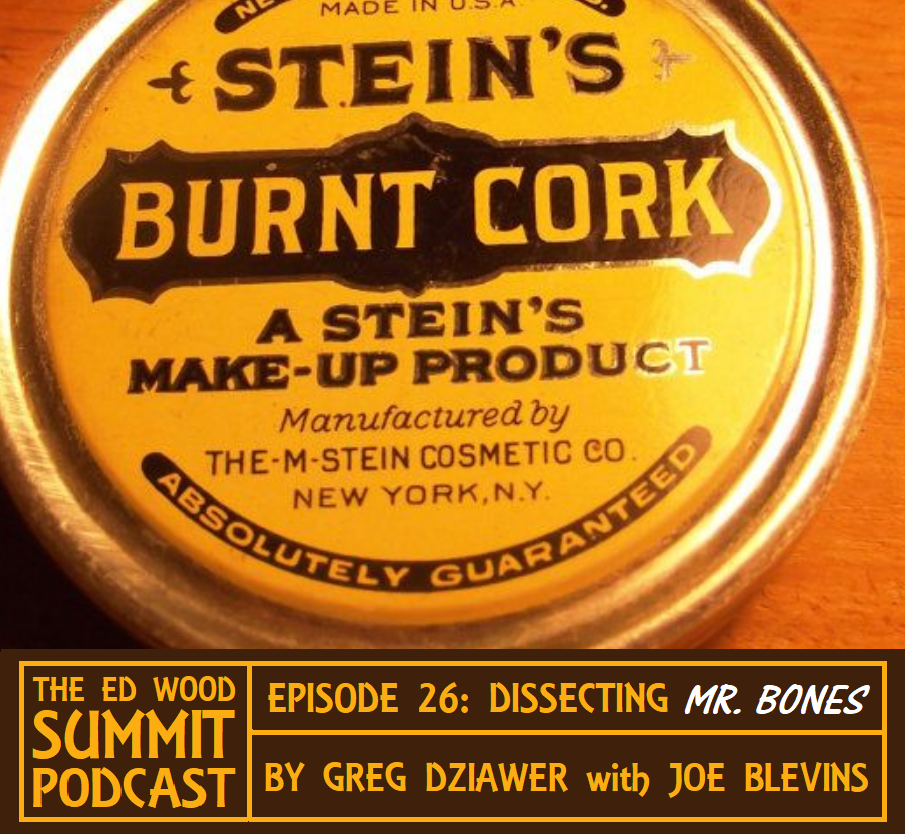
Burnt cork makeup plays a major role in the film we are discussing this week.

This week on The Ed Wood Summit Podcast, I'm joined by Joe Blevins to discuss Ron Ormond's infamous 1951 blackface film Yes Sir, Mr Bones. While there's no suggestion that Ed Wood had anything to do with this film, it is well-known to be the source of the "comic" routine playing in the theatre immediately before the heist sequence in Ed's Jail Bait (1954).
Note: Due to the controversial nature of this 71-year-old film, we will be discussing subject matter that everyone will find offensive. Please proceed with caution.

Those who wish to check out the film in its entirety can do so here.

Wednesday, February 3, 2021

Ed Wood Wednesdays: The Wood Summit Podcast #3 by Greg Dziawer and Joe Blevins

Are you ready for socially conscious Ed Wood?

For this week's Ed Wood Summit Podcast, I sat down with blogger Joe Blevins to discuss Watts... The Difference, the first of Eddie's two Watts paperbacks, both originally published by Pad Library in 1967. (Watts... The Difference was also reprinted in 1969 by Selected Adult Library as Burn Baby Burn and credited to the nonexistent Ray Jones.) While Ed wrote many erotic novels during this time, the Watts books stand out because of their connection to historic events.

Following the adventures of an African-American actor named Rocky Alley and told largely in flashbacks, Watts...The Difference is set in South Central Los Angeles during the Watts Uprising of August 1965. For nearly a week, the Watts neighborhood was the site of intense civil unrest, with the destruction eventually spreading across 46 square miles of L.A. At the time, newscasters compared the area to a warzone. While the violence in Watts was rooted in longstanding racial inequality, it was a traffic stop that set it all ablaze.

Apparently, Ed Wood's imagination was also set ablaze by these events. Curious what Ed will make of this incendiary backdrop? Watch the review to find out!


The original cover art.
And just to give you a little flavor for this astonishing book, here's a selection of memorable quotes from Watts... The Difference:
  • "I carry an angora sweater with me all the time."
  • "Lover...I believe you're an advocate of the bottomless bathing suit also..."
  • "One day you're standing around on a street corner looking at everybody, then the next there is only the big black."
  • "You might be causing them a time of it in their jeans..."
  • "...money IS control!"
  • "Good Christ, man, I knowed it was you all the time."
  • "The girl was a petite little negro with long raven black hair which fell lavishly down the back of her yellow mohair slipover sweater."
  • "Her little butt rode the yellow stretch capris like jello in a perfect mold."
  • "Rape me Rocky...Hurt me Rocky...Rape Me...Rape...me...Rape me..."
  • "He was never in male attire if he could help it and absolutely never without panties..."
  • "...loot - burn - kill - burn Whitey to his knees..."


ADDENDUM: To provide further insight into this era, I have uploaded this 1967 sermon by pastor and politician Adam Clayton Powell entitled "Burn, Baby, Burn." Powell talks about the Watts rioters and explains why he sympathizes with their plight but does not endorse their actions. - J.B.

Tuesday, June 30, 2020

Podcast Tuesday: "A Fonz and His Dog"

(from l to r) Henry Winkler, Scruffy, Ron Howard, and Erin Bunt.

"Never work with children or animals." That was supposedly the motto of legendary screen comedian W.C. Fields, though I can find no evidence that the famously misanthropic Fields ever said such a thing. The idea behind the saying is that children and animals tend to get all the laughs and attention from audiences, and they're notoriously unpredictable performers who don't stick to the script. Onscreen, Fields was occasionally paired with bratty children, since they tended to bring out the hilarious worst in him. One of his most memorably irritating foils, for instance, was child star Baby LeRoy.

Today, on These Days Are Ours: A Happy Days Podcast, my cohost and I look at "Spunky, Come Home," a 1977 episode in which Fonzie (Henry Winkler) shares the screen with both a child and a dog. The child in question is prolific '70s film and TV star Erin Blunt, probably best known today for his work in the Bad News Bears movie franchise, though he also turned up in everything from The Waltons to Get Christie Love! back then. The dog is Scruffy, a well-trained terrier who had previously starred on The Ghost and Mrs. Muir and who would go on to shill for Chuck Wagon.


This is the first new podcast we recorded since the nationwide protests over police brutality, and the timing was either perfect or horrendous. In "Spunky, Come Home," Fonzie acquires and then quickly loses a dog named Spunky (played by Scruffy). Erin Blunt's character, a wisecracking black kid named Wilbur, is falsely accused of having stolen the dog and is arrested and nearly charged. Fortunately, Ralph (Donny Most) and Potsie (Anson Williams) reluctantly come forward and admit they accidentally let Spunky get away from them while building a pen for the animal. No charges are filed against Wilbur, and Fonzie even vows to get the child another dog as a reward. All's well that ends well.

Under the current circumstances, though, it's difficult to escape the conclusion that Wilbur was largely arrested because he was black. The episode's one policeman, Officer Porter (Tom Dever), seems very willing to believe the worst about Wilbur. Fortunately, a potential tragedy was averted in this case, but it shouldn't have even gotten this close. "Spunky, Come Home" is a very cute episode, but it has some disturbing subtext.

Thursday, March 12, 2020

Why was Beast Man demoted from lead villain to sidekick? I have a theory.

Beast Man was almost the main villain in the Masters of the Universe franchise.

Beast Man was among the earliest MOTU figures.
Now poised to make a comeback on Netflix, Masters of the Universe (or MOTU) was one of the dominant multimedia franchises of the 1980s, with a successful toy line from Mattel and a hit syndicated cartoon series from Filmation. And the character of Beast Man—a bright orange, gorilla-like villain with dominion over the animal kingdom—has been a key part of the franchise since the very beginning. Beast Man was among the first four Mattel figures released in 1982, and he was a major character in the 1983 TV series, where he was voiced by John Erwin. As portrayed by Tony Carroll, he also turned up in the live-action 1987 movie from Cannon.

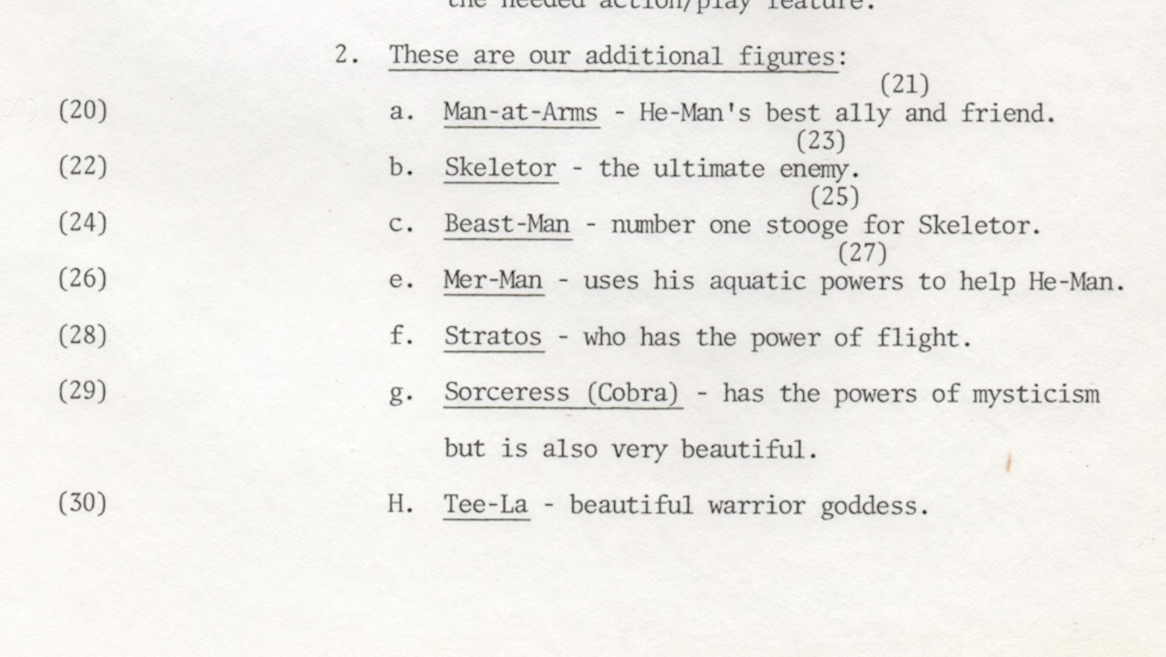
In all these forms, Beast Man has consistently been portrayed as the right-hand man of the franchise's main villain, the demonic sorcerer Skeletor, as the latter fights the heroic warrior He-Man for control of the far-away planet Eternia. Prominent as Beast Man is, he's always been a mere sidekick, deemed a "savage henchman" on Mattel's toy packaging. One early '80s document from Mattel describes Beast Man as the "number one stooge for Skeletor." That word "stooge" gives you some indication of the character's IQ.

But another internal document from Mattel shows that Beast Man was originally intended as MOTU's main antagonist. A wonderful MOTU site called Battle Ram: A He-Man Blog recently shared a fascinating early MOTU story treatment called "The Fighting Foe-Men" written by sci-fi/fantasy author Don Glut. Here is how Beast Man is described in that document:
Each of the villains is out for his own gain, usually to obtain the Power Gem for himself, but they occasionally accept one of them as their leader — Beast-Man 
BEAST-MAN — Another native of Eternia’s jungles whose tribe — or pack — has seemingly always been at war with their natural enemies, the human tribe of He-Man. Beast-Man has formidable strength, but it is his ferocity that makes him a natural leader. He has the agility of a gorilla. But when he dons his various costumes, he takes on the powers of other animals — the speed of a gazelle, the charging force of a rhino, etc. Beast-Man, though he despises He-Man’s tribe, yearns to take one or more of its females as a bride. He is totally evil and corrupt. His only redeeming quality is the “love” he bears for his own race, though it is actually more like instinct than any real emotion. His voice is guttural, almost a growl.
When I saw this passage, I was taken aback because it seemingly confirmed some suspicions I'd had while revisiting the Filmation Masters of the Universe TV series from the '80s. Namely, I began to wonder if Beast Man were being subtly (or not so subtly) coded as African, to serve as the opposite of the blond, Nordic-looking hero, He-Man. And "The Fighting Foe-Men" demonstrates that this was not merely my imagination. Note the terminology Don Glut uses in his description of Beast Man: "native," "jungle," "tribe," "race," etc. These can be neutral terms, but they are also the building blocks of hateful racist stereotypes. Note, too, that Beast Man is denied humanity and is likened to a gorilla. In particular, he is held apart from "the human tribe of He-Man."

Glut's story outline acknowledges Beast Man's athletic ability and brute strength but not his intellect. More alarming, though, is the detail that the villain "yearns to take one or more [human] females as a bride." Is this a reference to the stereotype about African men lusting after white women? Maybe the most disturbing sentence in this entire description is: "His only redeeming quality is the 'love' he bears for his own race, though it is actually more like instinct than any real emotion." Glut feels obligated to put quote marks around the word "love" and again makes it clear that Beast Man acts on mere "instinct." The message here is clear: Beast Man is not like us. He is apart from us, less than us. He is a thing to be hated and feared.

Here is my theory. Someone at Mattel recognized that the company could not possibly build its flagship toy line around a blond-haired white man battling a gorilla-like jungle denizen. The ugly implications of this match-up would be impossible to miss, and the company would be accused of spreading racist propaganda to children. Beast Man, therefore, was demoted to a subservient role. Is this, in a way, actually worse? This way, Skeletor and Beast-Man have a master/slave relationship, with Skeletor sitting in a throne, giving commands to his underlings like the interlocutor in a minstrel show. And still, on the other side of Eternia, you have a hero who looks like the poster child for the master race.

Perhaps, when I was playing with my Masters of the Universe action figures in the early-to-mid-1980s, I was also unknowingly getting a lesson in racial politics. And I haven't even started talking about Jitsu yet.

Tuesday, March 29, 2016

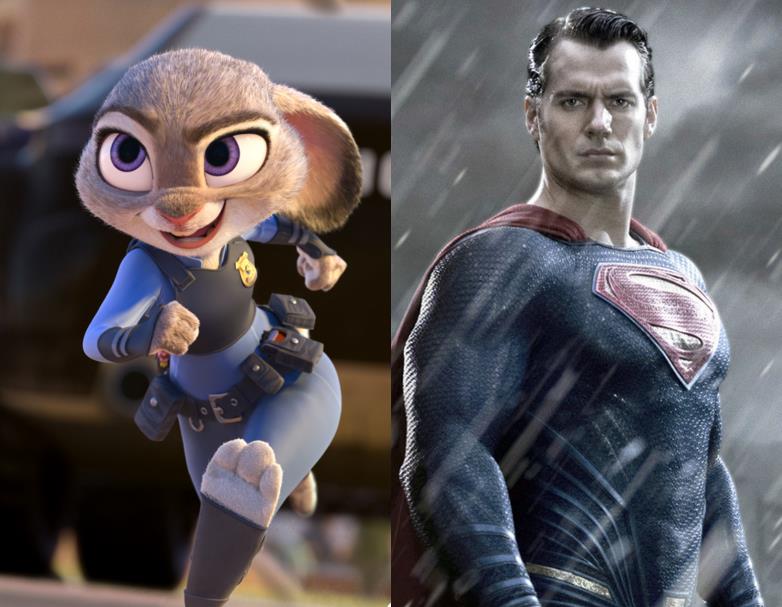
Are 'Zootopia' and 'Batman V Superman' the same movie? Sort of, yeah.

Officer Judy Hopps and Superman: which one is which?

Okay, hear me out on this. Over Easter weekend, while visiting with my family, I got to catch up on two recent movie blockbusters: Disney's Zootopia and Warner Bros' Batman V Superman: Dawn Of Justice. For the record, I basically liked both of them. Zootopia is an extremely cute, attractively animated family film with a good message about tolerance and the dangers of stereotyping. It's a little preachy and on-the-nose for my taste, but it's still enjoyable. Dawn Of Justice is drawn-out and dour with too limited a color palate and too noisy a sound design, but the critics calling it an unmitigated disaster are exaggerating. I wasn't bored by it. It's perfectly fine. I'd never want to sit through it again, but it'll do. Both Zootopia and Dawn are worth your time. But what I noticed is that there are a lot of parallels between these two seemingly dissimilar films. Like what? Well...

(SPOILER ALERT IN EFFECT FROM HERE ON OUT.)

Saturday, July 25, 2015

All roads, even the weird ones, lead inexorably to Spinal Tap

This is NOT Spinal Tap, but it sure looks like it.

Don't ask me why, but I decided to Google "Billy Crystal + blackface" today, and guess what I found? A clip from Billy's 1986 HBO special, Don't Get Me Started, featuring the comedian doing his famous/infamous Sammy Davis, Jr. impression, opposite Rob Reiner. Of course, Crystal and Reiner have worked together on a number of film projects, including The Princess Bride and When Harry Met Sally, but this clip is special in that it features Reiner as his pompous "Marty DiBergi" character -- a composite of Martin Scorsese, Brian De Palma, and Steven Spielberg -- from the classic 1984 mockumentary This Is Spinal Tap. Reiner, who directed and cowrote Tap, has reprised this role in The Return of Spinal Tap and some DVD extras, but Don't Get Me Started came out just two years after the original Spinal Tap movie. In other words, this is prime DiBergi, right down to the nautically-themed ballcap. Enjoy.

Sunday, June 14, 2015

A thumb-sucking article about the whole Rachel Dolezal mess

Rachel Dolezal giving a speech and pretending to be black.

You all know the story. If you're reading this, it means you have a functioning Internet connection, so you could not possibly have missed it. Rachel Dolezal, president of the Spokane, Washington chapter of the NAACP, has been "outed" as white by her baffled biological parents. Apparently, by altering her hair texture and skin color, Ms. Dolezal has been falsely but successfully presenting herself as African-American for years. Now, the truth has come out, and the Internet is up in arms about it. Wherever you go on social media, there is Rachel Dolezal's face, usually accompanied by scolding editorials. Time and again, we see side-by-side photographs which document Ms. Dolezal's shocking metamorphosis from fair-haired, pale-skinned little girl to kinky-coiffed, mocha-complected woman. And then, of course, the questions arise. Why? How? A quick search on Google Trends shows that the previously-obscure term "transracial," which had been seriously waning after peaking in popularity in April 2005, has shot up to unprecedented heights in June 2015. This must be attributable to the Dolezal story. Currently, Ms. Dolezal is being pilloried from one end of the web to the other, from Twitter to BuzzFeed to the Huffington Post.

While I do not endorse Rachel Dolezal's actions, I do think it's worthwhile to pause during this Internet feeding frenzy and ask ourselves a few basic questions. Had you even heard of Rachel Dolezal a week ago? Have her actions directly harmed you or someone you know? Has the Rachel Dolezal story shaken you to your core? Are you truly, in your heart of hearts, outraged by what this woman has done? If you answered any of these questions with "Nah, not really," it might be time to cut Ms. Dolezal some slack. I think this story is less about race and more about our desire to feel better about ourselves by shaming the shit out of someone we don't know. As modern media consumers, we're all like bloodthirsty lions with insatiable appetites. We need a continual supply of fresh meat to keep us satisfied: hippos, antelopes, giraffes, baby elephants, you name it. In that context, Rachel Dolezal isn't a person; she's a buffet. Dig in, everybody! Plenty to go around!

I'm sure you've said and done stupid things, too. My own life is a never-ending blooper reel. The difference is, I'm not famous or important, so the rest of the world didn't really care. But, still, that doesn't change the fact that I did these stupid things. I'll own up to being a moron. Won't you? So before you read -- or perhaps even write -- the latest "Rachel Dolezal is worse than Hitler" article, remember that stupidity is the bond between us all. We are all brothers and sisters under the dunce cap.

Saturday, March 14, 2015

Tsk, tsk, tsk: The allure of the scolding pop culture editorial

That thing you enjoy? Well, you shouldn't. Shame on you!

I think I have discovered the truest gauge of success in  America today. You know that your movie, TV show, book, album, game, or podcast is a hit when someone is inspired to write a scolding, humorless pop culture editorial (or SHPCE for short) about it. You'll recognize it instantly when it happens, because the article will be called "The Problem With ______," "The Case Against ____," or "The Trouble With ____." Generally, the objections will be one or more of the following.

  • The thing isn't as good as it used to be. This used to be a much more common complaint, but it has waned in recent years. Why? Well, it requires someone to actually wait a few years, rather than a few weeks, before writing a SHPCE. Where's the fun in that? If you want to get on your high horse and complain about something, you don't want to actually wait around and accumulate years worth of actual evidence, do you? Hell, no! By that time, hundreds of other TV shows, movies, books, and podcasts have already come along and stolen the national spotlight away. The choice, then, is clear. You have to write your SHPCE while the PC in question is still hot. If, by some chance, the PC object in question is still at peak popularity after several years, then you can write this kind of story if you really insist on it. It's an Internet classic, after all.
  • The thing is just derivative of some other, better thing that came before. Now, this takes a little more research, but it can be quite satisfying if you have enough evidence to support your thesis statement. Of course, you can apply this to TV shows or movies or whatever you'd like, since everybody's always copying everyone else anyway, but it really works best for music. Pop music does a lot of the work for you, since much of it is really derivative and lazy. As evidenced by the the recent "Blurred Lines" lawsuit, pop musicians don't really even try that hard to keep their influences hidden. It's not difficult to take whatever's at the top of the charts currently and find something from ten, twenty, or even thirty years ago which sounds just like it. I mean, have you heard "Uptown Funk" a few dozen times yet?
  • The thing has some logical loopholes or plot inconsistencies, rendering it worthless. I'm not sure why, but this seems to be the especial domain of Cracked.com and about half a million different hyperactive YouTubers. An army of Comic Book Guy wannabes (except slimmer and better groomed), Cracked's ever-snarky writers seem genuinely outraged when fantasy films with completely impossible plots somehow fail to conform to rigorous fact-checking and logical scrutiny. Time travel doesn't work that way, they tell us! Elves would never say something like that, they want us to know! Even if the central premise of a work is complete, made-up bullshit involving magic and super powers, the plot needs to be airtight. Or so the angry nerds of the Internet would have us believe.
  • The thing may seem good now but will have problems in the future. Oh, this is just perfect for first-season TV shows. If a show is just starting to gain momentum, here's how to let the air out of the tires pronto. What are they going to do when so-and-so grows up, for instance? Huh? What then? And that running joke seems hilarious now, but will it seem hilarious after 40 or 50 episodes? Can the show possibly keep all its narrative plates spinning? Probably not. And it'll probably get cancelled before they've resolved everything anyway. You might as well just give up on this show now.
  • (by far the most popular and definitely the one you should use) The thing is somehow sexist, racist, classist, ageist, homophobic, xenophobic, or in some other way prejudicial (often in a sly, non-obvious way) and will, therefore, cause any viewer, listener, or reader to become prejudiced as well. Ah, now we're cookin'. This right here is the heart of any good SHPCE in 2015. There is no horse higher than this one. Netflix's The Unbreakable Kimmy Schmidt is deeply offensive to Native Americans. The podcast Serial promoted stereotypes about immigrants. And Mike Judge's Idiocracy? Well, buddy, if you've ever even watched that movie, you've more or less endorsed Hitler's final solution, because that's what that movie was really all about. I learned all of these things through deeply-impassioned, progressive-minded SHPCEs. Thank god, right? I mean, without the guidance of these enlightened editorial writers, I might have been swayed by the evils of popular culture and become a gay-bashing, woman-abusing Nazi plantation owner. It's a good thing I clicked on that BuzzFeed link, huh? That was a close one!
And there you have it. You may think of the pop culture you consume as mere entertainment. Your favorite TV show or game or whatever may just be a little day-brightener for you. But the authors of SHPCEs know better. It's racist and derivative and just all around evil. In short, you should not be enjoying that thing you enjoy. And, frankly, you should feel ashamed of yourself for ever having enjoyed it in the first place. There. Now don't you feel just terrible about yourself? Good. Mission accomplished. Once again, the Internet has saved the goddamned day.

Sunday, June 2, 2013

Mill Creek comedy classics #3: "Freckles Comes Home" (1942)

Clearly, the fun never stops in Freckles Comes Home. Actually, this is the funniest scene.

The flick: Freckles Comes Home (Monogram Pictures, 1942) [buy the set]

Current IMDb rating: 5.0

Director: Jean Yarbrough (The Devil Bat, Jack and the Beanstalk, TV's The Abbott and Costello Show)

Actors of note
  • Johnny Downs (The Crowd, Babes in Toyland)
  • Gale Storm (It Happened on Fifth Avenue, TV's My Little Margie)
  • Mantan Moreland (The Palm Beach Story, Spider Baby, the Charlie Chan series)

The gist of it: An impetuous young man, "Freckles" Winslow, returns home from college to tiny Fairfield, IN (pop. 500) to help his gullible friend Danny, who's purchased some real estate with money that wasn't strictly his to invest. To further complicate matters, "Freckles" has also unwittingly convinced a fugitive mobster to hide out in Fairfield. One bad apple soon attracts others to the town who hope to fleece a local banker, and before you know it, there are shootings, stabbings, and robberies galore. Meanwhile, poor "Freckles" has to win back the affection of his girl, who's fallen for one of the gangsters, and ensure that a highway runs through Fairfield. Luckily, a car accident solves everything.

My take: As you can see from that plot summary -- which doesn't even cover half of it -- Freckles Comes Home is quite a busy little picture. Somehow, it still manages to find time for a few totally gratuitous musical numbers and extended comedy sequences in which Mantan Moreland squares off against fellow black menial Laurence Criner. The title implies that the film is a sequel, and the script takes it for granted that we already know and care about most of these characters. As it turns out, the original Freckles was a 1904 novel by Gene Stratton-Porter which has been adapted into a movie at least four times (and also inspired 1992's City Boy), but none of the actors from those films are present in Freckles Comes Home. Instead, this sequel is based on a 1929 novel by Gene's daughter, Jeannette Stratton-Porter, who continued the Freckles saga after her mother died in 1924. I was unfamiliar with any of this, and Freckles Comes Home did not exactly leave me hungry for more.

As the title character, Johnny Downs (who has no freckles that I could see) comes across like a bargain-basement substitute for Jimmy Stewart. The plot twists come fast and furious, but the whole thing seems very contrived, and there is very little sense of what small town life is like.

One of Mantan Moreland's "party records."
Is it funny: Only fitfully. Freckles himself is something of a cipher, and neither pal Danny nor love interest Jane is particularly compelling either. Jane's dad, money-hungry Mr. Potter, is somewhat fun in a Milburn Drysdale kind of way, particularly in a scene in which "Freckles" visits the Potter home with one of the gangsters in tow, only to see the pencil mustache-wearing crook charm the father and the daughter instantly, leaving "Freckles" himself the odd man out.

I'd say the best character in the film is the town's ornery yet totally ineffectual constable, Caleb Weaver, played by the awesomely-named Irving Bacon who appeared as a bit actor in some of Hollywood's greatest classics. Caleb is sort of a proto-Barney Fife, suspicious of everyone and quick to accuse others but never on the right track and not much of a credible threat. He gets what, to me, is the film's funniest line: "Gosh all fishhooks!"

Then we must consider the servile role played in this film by Mantan Moreland, a comedian and actor who was directly influenced by the infamous Stepin Fechit. Moreland is clearly a talented  performer with great comic timing and an expressive face he uses to its best advantage. In his highly-recommended book, Toms, Coons, Mulattoes, Mammies, & Bucks: An Interpretive History of Blacks in American Films, historian Donald Bogle credits him with having "the fastest eyes in the West."

 But Moreland's style of comic buffoonery has definitely gone out of style in 2013. It had, in fact, fallen out of favor during the actor's own lifetime. His character here -- a hotel porter -- is both slow-witted and dishonest (he buys a fraudulent "gold-divining machine" and then tries to sell it), not to mention cowardly, selfish, and inarticulate. Let's not judge him too harshly, though. Moreland was giving white audiences what they wanted because that's what paid the bills. Incidentally, he had a second career as a stand-up comic catering to the black audience. One of his bits, involving carnal relations with mashed potatoes, has become a classic in some circles.

My grade: C+