|
| Ed appears in one of his own commercials, circa 1949. |
When Edward D. Wood, Jr. arrived in Hollywood in 1947 at the age of 23, he'd already had plenty of life experience. Or at least he
said he did. The ambitious young man claimed to have seen heavy combat action in World War II and been decorated for gallantry in action, though his actual military record suggests otherwise. (In truth, his duties were mostly of a clerical nature.) Eddie also boasted that he'd traveled with a freak show as a "half-man, half-woman" and studied the dramatic arts at the prestigious Frank Lloyd Wright Institute in Washington, D.C. None of that has ever been confirmed either.
It's difficult to know what is true and untrue when discussing the early life of Ed Wood. He took an active role in cultivating his own myth, and even his widow Kathy described him as a consummate "bullshitter."
The son of a mailman and a jewelry buyer, Ed was born into a middle class family in Poughkeepsie, NY on October 10, 1924. His mostly unremarkable childhood was changed forever when his father gave him a movie camera for his eleventh birthday. Eddie also claimed that his penchant for dressing in drag stemmed from his childhood. Supposedly, his mother Lillian would dress him as in girls' clothes as a peculiar form of punishment throughout his formative years. This is yet another unsubstantiated story in the legend of Ed Wood.
The camera fueled Eddie's obsession with cinema that had begun with his viewing of
Dracula starring Bela Lugosi in 1931. The cross-dressing, meanwhile, became a lifelong habit for Ed and a major theme in his work as both a director and writer. One could argue that the fetishizing of all things feminine -- not only women's clothing, but their hair, makeup, jewelry, movement, physiognomy and physical contours -- is
the defining characteristic of Ed's films and novels. While a few of Ed's characters dealt with the issue of transvestism directly (e.g. Glen in 1953's
Glen or Glenda?), many more had an obsession with "feathers, furs, and fluff," to borrow a phrase from Ed's script for
Orgy of the Dead (1965).
 |
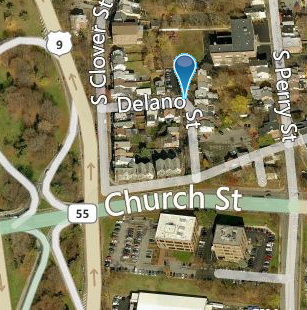
| Ed Wood's birthplace, 115 Franklin Street in Poughkeepsie, NY. |
Patriotic and hungry for action, Ed joined the Marines at the age of 17 in 1942, America's first full year as a belligerent in the Second World War. He was finally discharged in 1946.
The war had not extinguished the romantic, movie-loving side of Ed Wood's personality. Far from it. He was still an enthusiastic "idea man" and a handsome, dapper young gentleman in the Errol Flynn tradition when he made the trip west to California to pursue his show business aspirations in the late '40s. With no connections whatsoever in Hollywood, Ed began his new life as a stage actor. Within a year, he had made two very important professional associations: one with Monogram Pictures cameraman Ray Flin, who would become the first major cinematographer of Ed's career, and the other with fellow actor John Crawford Thomas, with whom Ed briefly formed a production company.
It is with Flin and Thomas that Ed made his first film in Hollywood (he'd made home movies as a child, but nothing of significance), so it is there we begin our journey into the filmography of Edward D. Wood, Jr.
CROSSROADS OF LAREDO (1948)
 |
| Don Nagel as Tex in Crossroads of Laredo (1948). Ruth McCabe comforts him. |
Alternate title: The Streets of Laredo
Availability: The Haunted World of World of Edward D. Wood, Jr. (Image DVD, 1996)
[buy it]
The backstory: As a child, Ed was especially interested in cowboy movies and attended them regularly, so it is natural that his first attempt at filmmaking would be in the western genre. Ed wrote, directed, co-produced, and acted in this feature, but it would never be completed or released in his lifetime. Ed shot the film without sync sound and, according to all participants, got every bit of footage he needed to tell the story. He intended to add, according to Rudolph Grey's book, "cowboy ballads and sparse dubbed dialogue" on the soundtrack, but this was never carried out. Stories differ as to why. Actor Chuck La Berge, who played the Sheriff in the film, claimed that producer and financier John Crawford Thomas was "nutty as a fruitcake" and "on dope" at the time. Thomas says that he simply ran out of money (which embarrassed his family) and that Ed just left the fledgling production company without even saying goodbye.
Though Eddie was proud of
Crossroads and would speak of it often to friends and associates, this film would not see the light of day for nearly half a century. In 1996, the "completed"
Crossroads of Laredo, assembled into its final form by Thomas, finally surfaced as a special feature on the DVD of a documentary about Ed. To the existing silent footage, Thomas added a credits sequence, an introduction featuring himself and Dolores Fuller, Ed's longtime girlfriend and occasional star, plus a new soundtrack with a few sound effects, narration by country singer
Cliffie Stone (who died just two years later) and a few songs written by Fuller and sung by the eccentric
Elvis Aaron Presley, Jr., who claims to be the illegitimate child of Elvis Presley.
 |
| An effective image: Tex's death. |
The viewing experience: Crossroads is very primitive and somewhat of a chore to watch, even at 23 minutes. One commentator, director-actor Ted Newsom, astutely observed that, while filmed in 1948, the production looks like it was made in 1918. Very often, Cliffie Stone's folksy voice-over is the only thing which gives the film any narrative cohesion at all. It feels like someone showing home movies of a family vacation and trying to explain the footage to people who weren't there.
Viewers will probably be most interested in the participation of two actors who would become regular members of Ed Wood's repertory company. The hero, Lem, is played by Duke Moore, who would turn up in five more Wood films, with very prominent roles in
Plan 9 from Outer Space, Final Curtain, and
Night of the Ghouls. Nagel would return in
Jail Bait, Bride of the Monster, and more. Unlike Moore, Nagel actually got acting jobs outside of Ed Wood's films, appearing on episodes of
The Bob Newhart Show and
The Rockford Files.
The basic plot revolves around a conflict between Moore and Nagel's characters. Nagel is Tex, a murderous thief who marries sweet Barbara (Ruth McCabe) and has a child with her but then ignores her and spends all his time boozing and womanizing at the saloon. Moore is Lem, the honest man who truly loves Barbara and despises Tex. Lem kills Tex in a gunfight, then must go into hiding. He boldly appears at Tex's funeral and is taken into custody. Just as he's about to be hanged, a witness corroborates Lem's story that Tex drew his gun first, and Lem and Barbara walk into the sunset together.
Clumsy as the film is, there are one or two effective shots. I liked, for instance, an image of the dying Tex on a makeshift stretcher fashioned from a wooden door, and there is a nice moment near the end when Barbara stands alone and is silhouetted against the western skyline.
While the musical soundtrack is well-intended and a sweet attempt by Fuller to pay tribute to Ed Wood, the electric guitars and synthesizers are all wrong for a 1948 production, as is the Las Vegas crooning style of Presley, Jr. These songs should have been performed in a traditional cowboy style with only acoustic guitar as accompaniment. It is perhaps significant that the character name "Barbara" would be reused in Wood's 1953 feature debut,
Glen or Glenda?, and that part would be played by Dolores Fuller herself.
Undeterred by the failure of
Crossroads of Laredo, Ed Wood returned to the stage until his next screen venture and the next stop on our tour...
THE STORY-AD FILMS (1949)
Availability: YouTube
[link]
The backstory: Not much is known about Ed Wood's advertising career, but Rudolph Grey's book does contain a September 18, 1949 article from a Poughkeepsie newspaper about it. The piece claims:
Edward D. Wood, Jr., former resident of Poughkeepsie, has just completed negotiations with Rene Lenoir of Switzerland, Robert Ganon, photographer of the Nazi war trials and Jack Ganon, sound technician, for the incorporation of 'Story-Ad Films,' in Hollywood, Calif. Mr. Wood, the quarter owner of the new firm, is the writer and director of all films produced by the establishment. He previously has done custom work for such national sponsors as the Dudley Steel Corp., The Aluminum Body Works, and the Crosley automobile manufacturers.
Given Ed Wood's reputation as a notorious "bullshitter" (in the words of his own wife, Kathy), it's impossible to know how much of that story is true. But at least four commercials do exist from this era. You'll notice that they conspicuously avoid mentioning any actual brand names.
The viewing experience: These are a lot of fun -- eccentric, inventive, and naive in the best Wood tradition. Wood has made tremendous technical advances from the
Crossroads of Laredo days, though the dialogue and acting are stilted in that strange way of seemingly all Ed's projects. True to the name of the company, these commercials tell miniature stories, and each has its own title. There are four little vignettes:
Surprise (for used cars),
Treasure and Curves (jewelry),
The Bestest (footwear), and
Magic Man (men's clothing).
The last is the most intriguing, as it features Wood himself in the role of a dapper magician, clearly having fun with the role. But there are amusing little details in all of them. Note that the bride-to-be in the first film is named Babs, a variation on Barbara.
Treasure and Curves has a band of all-female pirates, led by the brash "Captain Kitty." And then there's
The Bestest, yet another western with yet another Tex. In this one, though, instead of fighting over a girl, the two cowboys ditch the girl and go off to the shoe store together! By the way, I recognized some of the stock music in the background as having also been used by the great radio comedy team of Bob & Ray during their many soap opera parodies of the 1950s and 1960s.
The success or failure of Story-Ad Films is undocumented. I'm guessing it was a flop, since Ed's next big project would be a brief made-for-TV drama two years later....
THE SUN WAS SETTING (1951)
Alternate title: The Sun Also Sets
Availability: YouTube
[link]
The backstory: Wood wrote and directed this 13-minute piece at KTTV Studios at the corner of Sunset and Van Ness in Los Angeles during the week of December 17, 1951. Ray Flin returned as cinematographer. The cast included Phyllis Coates, soon to portray Lois Lane on TV's
The Adventures of Superman, in a supporting role. The lead was played by Angela Stevens, actress and sometimes model of the 1950s and early 1960s, who went on to play minor roles in two iconic films,
From Here to Eternity and
The Wild One (both 1953) and even appeared in one of my favorite Three Stooges shorts,
He Cooked His Goose.
For serious Wood-oligsts, though, the most important cast member is ultra-bland Tom Keene, billed here as "Richard Powers," a former second-tier movie cowboy who had changed his name when his western career fizzled out. Wood, a fan of Tom's, would later have the actor revert to his old name and appear as the star of
Crossroad Avenger and as a supporting player in
Plan 9 from Outer Space. By the way, Ed Wood fans will instantly recognize the stock music which plays over the opening credits from its use in
Glen or Glenda? That music has become so synonymous with Wood that Howard Shore even incorporated it into his marvelous score for
Ed Wood (1994).
 |
| A much sexier Angela Stevens. |
The viewing experience: This short film is claustrophobic and more than a little depressing, though it marks another step up in terms of technical proficiency. Angela Stevens plays June, a young woman who is confined to her New York apartment because of an "infection" and who has only a few months to live. She is visited first by her boyfriend, Paul (Keene), who is willing to marry her but is not willing to take her out clubbing or to Chinatown since that would kill her. They argue, and he leaves. Later, June is visited by her best friend, Rene, who wants to take June to dinner and a movie but, like Paul, refuses to take her out for a wild night on the town. Paul then returns and agrees to take June anywhere she wants, leading to the sad, ironic final twist. Coates and Keene are both quite flavorless and unmemorable here, but Stevens digs into the part of June with a certain ferocity.
The Sun is Setting is talky and slow-paced, sort of like the soap operas of that period, and the mood is very dispiriting and joyless. In short, this isn't much fun. June seems perfectly healthy, and the idea that this woman needs to be confined to her apartment at all times seems silly. The sets and costumes, to me, were completely inappropriate for the plot. Turn off the sound, and you'd never even know that June was sick. Those looking for quirky Wood-ian touches will want to take note of a couple of intense closeups of Angela Stevens which are rather awkwardly edited into the film and disrupt the continuity. Vintage photos reveal that Angela Stevens was quite the dish back in the 1950s, but she's given a frumpy hairdo and outfit here which spoil her appearance. Darn.
For the rest of his Hollywood career, Ed would be most closely associated with feature films. But he did make one more attempt at launching a television western...
CROSSROAD AVENGER (1953)
 |
| Ed Wood (center) poses with the cast of Crossroad Avenger. |
Alternate titles: Crossroad Avenger: The Adventures of the Tucson Kid; supposedly, this film and a second (now lost) TV pilot called
Crossroad Avenger Returns were edited into a 50-minute feature called
The Adventures of the Tucson Kid (1953). All that exists today, though, is this single 25-minute pilot.
Availability: Big Box of Wood (S'More Entertainment DVD boxed set, 2010)
[buy it]
 |
| Nine-fingered Harvey B. Dunn |
The backstory: Westerns were a huge TV fad in the early 1950s, and this was Ed's failed attempt to cash in on it. Ray Flin was back as Ed's cinematographer, this time working in color! Ed wouldn't get to direct a full-length color feature for over a decade. For his star, he brought in the old reliable Tom Keene, who had starred in about 50 low-budget westerns before his studio dropped him and he changed his name to "Richard Powers." He'd been "George Duryea" at the beginning of his screen career in the 1920s and would go back to "Richard Powers" after his days with Ed were through.
According to
Nightmare of Ecstasy, Ed Wood maintained that this pilot "was passed up in favor of
Wild Bill Hickok with Guy Madison." While this can't be confirmed (par for the course with Ed Wood), what is unmistakable is that
Crossroad Avenger is a virtual Rosetta Stone for the rest of Ed Wood's 1950s films. Here, you will find many members of Ed's stock company: stalwart character actor Lyle Talbot; D-list western baddie Kenne Duncan; seedy, withered actor-stuntman Bud Osborne; rotund, jovial Harvey B. Dunn (who had one finger missing on his left hand), and the aforementioned Don Nagel. For the role of a deputy, Wood was able to recruit another one of his cowboy icons, Tom Tyler, who was nearing the end of a 30-year-plus career.
The viewing experience: Although Keene is altogether too vanilla to be the center of attention in a weekly TV series,
Crossroad Avenger is a pleasant diversion. I'm not sure why Ed Wood thought this would make for a thrilling series, but Keene's character, the Tucson Kid, works for an insurance company and makes inquiries (with his gun) when a claim seems suspicious. Somehow
The Lone Insurance Investigator doesn't quite have the right ring to it. In this installment, Keene rides into a town where a saloon has burned down under fishy circumstances. He almost immediately finds himself framed for murder by Lyle Talbot's character, who perpetrated the original insurance fraud.
Our hero just barely escapes hanging, which doesn't say much for the legal system of the time. Lots of people are gunned down in these 25 busy minutes, including Dunn as a friendly but loopy "desert rat" who might have made an interesting sidekick to Keene if this had been picked up, but eventually the Tucson Kid's job is done and he can ride off to the next assignment. Competently made but not outstanding,
Crossroad Avenger has plenty of violence but very little of the trademark Ed Wood insanity. Completists and cowboy fans are urged to give it a watch, though.
And that does it for this survey of Ed Wood's earliest years in Hollywood. Join us here next week for coverage of Ed's first two features:
Glen or Glenda? (1953) and Jail Bait (1954).