Showing posts with label movies. Show all posts

Monday, June 29, 2026

Ed Wood Wednesdays, week 21: "Necromania" (1971)

Ed Wood's return to directing came in 1971 with the X-rated Necromania
   
"We thought he was making a comedy, to tell you the bloody truth."
-Ric Lutze, an actor in Ed Wood's Necromania
  
Goodbye, Tor.
And now it is 1971. Whether he knows it or not, Edward Davis Wood, Jr. has only seven years to live. He and his wife, Kathy, have lost their little house on Bonner Street in North Hollywood and have moved into the seedy, violence-prone Mariposa Apartments at the intersection of Yucca and Cahuenga in LA. Before the year is out, Ed's longtime friend and long-ago star, Tor Johnson, will have died of heart failure at the age of 67. Nevermore will the ex-wrestler break one of Ed's insufficiently-reinforced toilet seats with his massive bulk.

Meanwhile, the world seems to be growing stranger and uglier by the day. President Nixon promises his 207 million constituents that he will end the nation's involvement in Vietnam. Public support for the war dwindles every day, especially when an American-supported SVA offensive in Cambodia fails after six miserable weeks.

On the homefront, the so-called "generation gap," a moral and aesthetic schism between the old and the young, has been turned into a sitcom, rechristened All in the Family, and given a spot on the CBS Saturday night lineup, right before Funny Face with Sandy Duncan. There are astronauts driving a buggy on the moon. The boxer once known as Cassius Clay has KO'd a draft-dodging rap. And down in Orlando, Walt Disney World finally opens five years after the death of its nameake.

On the radio, the ex-Beatles are either singing hymns to God ("My Sweet Lord") or questioning His very existence ("Imagine"). On movie screens, Gene Hackman and Clint Eastwood are both playing rule-flouting, fascistic cops to critical and popular acclaim, either acting as the urban saviors for whom we've been praying or embodying all our worst fears about what happens when power goes unchecked. Elsewhere in cinema, Stanley Kubrick's A Clockwork Orange asks us which is more disturbing: an amoral generation of lawless punks who steal, rape, and kill simply to relieve their boredom.. or a totalitarian government which will resort to truly perverse and unnatural measures to stop them?

Clearly, it is a time of transition for America.

Tuesday, June 16, 2026

Podcast Tuesday: "Little Movie 'Bout Leo and Loree"

Don Most and Linda Purl in Leo and Loree (1980).

Doing a podcast about Happy Days involves many hours of writing, research, and editing, but the actual recording of a typical episode is a mere blip. Every other Sunday, my cohost and I spend about an hour or so chatting over Zoom. This gets edited down to about 30-40 minutes of usable audio, to which I will then add various clips from movies, TV shows, and pop records. These Days Are Ours is a show that is largely made in editing, each episode pieced together from lots of little scraps.

These nearly ruined the show.
Recording is, by far, my favorite part of the process. It just goes by so quickly that it feels like a barely-remembered dream. At least, it usually does. But something strange happened when it was time to record our review of Leo and Loree (1980), a romantic comedy starring Donny Most and Linda Purl as young Hollywood hopefuls. I had chosen this movie as a topic for review, so I felt responsible for this particular installment of the podcast. The onus was on me to make this one work.

I'd woken up a couple of hours before we were set to record. My sinuses were acting up that day, so I took some allergy medicine. For some reason, the little pink pills kicked in especially hard and started messing with my head. Maybe it was because I hadn't eaten anything. By the time we were supposed to record, I was dizzy and drowsy and barely coherent. I couldn't talk about a Don Most movie for an entire hour in this condition! What was I going to do?

Fortunately, I have very little to say in the first few minutes of our show. I just have to say my name and the title of the movie or TV show we're reviewing, then my cohost launches into a detailed plot summary. This always gives me about 5-10 minutes where I'm off-mic. So to combat the effects of the allergy medicine, I just started drinking anything caffeinated I could find. When it was time for me to speak, I was keyed-up and nervous. The caffeine and the allergy medicine interacted oddly, and I struggled mightily to stay on topic and express myself in a coherent way.

I knew this episode was going to be a mess to edit, and it was. Hopefully, though, you won't even be able to tell because I've cut all of my unexpected, weirdly-timed pauses and rambling, meaningless sentences out of the finished product. Just know that, as you listen to this installment of our podcast, one of the hosts is fighting the battle of his life just to keep from babbling like an idiot or falling asleep.

Tuesday, March 10, 2026

Podcast Tuesday: "The Top 5 Garry Marshall Movies of All Time"

Garry Marshall sure did make some films, I tell you what.

Every pretentious film geek on the internet has a "hot take" on the movies of Quentin Tarantino, Alfred Hitchcock, Stanley Kubrick, and Martin Scorsese. And they probably have plenty of opinions about David Fincher, Steven Spielberg, David Lynch, and Paul Thomas Anderson, too. But how many of them have bothered to watch all the movies of Garry Marshall, huh? Probably not too many. Well, that's why you come to my blog. I pick up where the others leave off. I go where no nerd has gone before.

Garry Marshall was a very successful writer and producer of TV sitcoms in the 1960s and '70s, scoring hits with The Odd Couple, Happy Days, and Laverne & Shirley. (Of course, there was also the occasional Blansky's Beauties or Me and the Chimp. Hey, they can't all be winners.) By the 1980s, he naturally wanted to graduate to feature films. And so, he made 18 of them, including some box office smashes and a few major bombs. Along the way, he worked with some of the biggest actors in movie history and turned more than one newcomer into a superstar. For all these reasons and more, I think his films—good, bad, or indifferent—are as worthy of study as those of any famous director.

This week on These Days Are Ours: A Happy Days Podcast, my cohost and I give you our picks for the Top 5 Garry Marshall Movies of All Time. And we talk about what we liked and didn't like about our journey through Garry's filmography. Doesn't that sound like fun? Click the play button below and find out.

Tuesday, October 28, 2025

Podcast Tuesday: "Hot Lutheran Love!"

Kate Hudson in the somewhat forgotten 2004 film Raising Helen.

When I sat down to screen Garry Marshall's 2004 romantic comedy Raising Helen for the podcast, I knew virtually nothing about the movie other than its title and the fact that it starred Kate Hudson. I didn't even know about the tragic incident that sets the plot in motion. In other words, I went into the movie as blank as possible.

However, within just a few minutes of pressing play on Raising Helen, I started to suspect where the film was going. Kate plays Helen Harris, an "executive assistant" at a chichi New York modeling agency run by the Anna Wintour-esque Dominique (Helen Mirren). Helen's life is frantic and fast-paced, but she's good at her job and seems to be enjoying herself immensely.

I knew that this couldn't last. By Hollywood law, Helen would have to be tamed over the course of the movie. By the end of the story, she'd either be married or at least in a serious relationship, and she'd probably given a child to raise, too. And if the plot could get her from the city to the suburbs, all the better.

Was I right? Do any or all of these things happen to Helen? Listen to the latest installment of These Days Are Ours: A Happy Days Podcast and find out for sure.

Tuesday, July 8, 2025

Podcast Tuesday: "Attractive Female"

Richard Gere and Julia Roberts in Pretty Woman.

As my cohost and I have made our way through the films of Garry Marshall, I've been reminded time and again of just how different media consumption was in the 1980s and '90s. For one thing, I saw a lot more movies in the theater back then, at least three or four each month. These days, I'll see maybe two or three movies a year on the big screen.

Another big difference was that, in the days before streaming, we were reliant on VHS tapes if we wanted to screen a film at home. Most we rented, a few we owned. This system wasn't all bad. My sister and I had our own VHS copy of Garry Marshall's smash romcom Pretty Woman (1990) and watched it dozens of times. That film simply became part of our consciousness, and we quoted it frequently.

This week on These Days Are Ours: A Happy Days Podcast, we talk about Pretty Woman. The film was extremely popular in its own time, but how does it hold up in ours? Well, click below to find out.

Tuesday, June 10, 2025

Podcast Tuesday: "The Teaches of Beaches"

Barbara Hershey and Bette Midler in Beaches.

Remember the so-called "monoculture"? If you grew up in the 1980s or earlier, you certainly do. Back then, due to the constraints of technology and commerce, we mostly consumed the same media at the same time as everyone else. Whatever the "big" movies and TV shows were, that's what we watched. Whatever was in the Top 40, that's what we listened to. This may not sound like an ideal system, but it gave us a common frame of reference. When we talked about "the media" in the abstract, we were referring to the same material. Cable and home video started to erode the monoculture just a bit in the '80s, but the '90s was when the entertainment world truly started splintering into a lot of little hyper-specific facets.

Nowadays, thanks to the internet and the rise of personal devices like smartphones and tablets (meant to be used by an individual rather than a group), the entertainment we consume is well-tailored to our various demographic groups and delivered to us by algorithms that know us better than we know ourselves. We stay in our lanes, culturally speaking, and it's considered "weird" (read; undesirable) to do otherwise. In 2025, it's very possible to have a supposed "hit" song that most of the country has never heard or a "hit" TV show that most of the country isn't even aware of. If it's not intended for you, it generally doesn't reach you. I suppose the last vestiges of the monoculture are the big franchise films that dominate the box office: the sequels, remakes, reboots, and adaptations of familiar intellectual properties.

Director Garry Marshall's fifth film, Beaches (1988)—a tearjerking melodrama starring Bette Midler and Barbara Hershey as lifelong friends with clashing personalities—is a definite product of the monoculture. Produced by Walt Disney's Touchstone Pictures division, it's a film designed to appeal to the widest-possible audience. And it did just that! Not only was the film a hit in theaters and on video, it launched a massive hit single ("Wind Beneath My Wings") and led to one of its cast members (Mayim Bialik) getting her own prime time sitcom. I don't think any of this would be remotely possible in 2025. Today, a film like Beaches, if it got made at all, would be shuffled off to a streaming service and quickly forgotten. Indeed, a 2017 remake of the film went straight to cable and was largely ignored.

So Beaches is a reminder of who we once were and of what pop culture used to be. But is that a good thing or a bad thing? We'll try to figure all that out as we review it in the latest installment of These Days Are Ours: A Happy Days Podcast.

Saturday, August 3, 2024

So... whatever happened to serial killers?

Are serial killers a thing of the past?

Remember serial killers? Those sweaty, shifty-eyed men who used to dominate the news cycle? Sure, you do.  They used to be the stuff of nightmares. They were all over TV. Remember TV? Serial killers were huge on there. Movies, too. And books, magazines, and newspapers. You youngsters may not remember, but us older folks will never forget.

For a few decades, serial killers dominated popular culture. We needed something to fill the void after The Beatles broke up, and apparently they were it. You'd see them being taken away in handcuffs after the police discovered their crawlspace full of human torsos. Later, they'd spout some wackadoo gibberish while defending themselves in court. Sometimes, they'd have three names, like John Wayne Gacy or Henry Lee Lucas. 

Enjoy the '90s while they last, pal.
We'd be horrified by their crimes, but we'd be compelled, too. They became antiheroes. People wrote them fan letters. In the '90s, you'd occasionally see their intense faces staring at you from magazine covers and T-shirts. Your "edgy" friend might name his terrible band after one of them. There were tasteless jokes and SNL sketches about them.

So what happened to those guys? From roughly the 1970s to the '90s, you could count on a new serial killer every few years. They were an important part of the news cycle. We depended on them, if only for reassurance that we ourselves weren't so bad. "At least I'm not that guy," you could think.

And then... what? We just collectively stopped serial killing? You're asking me to believe that serial killing was just some kooky phase we went through as a society and got over? People got bored with it? Moved on to something else? I can't even remember the last new serial killer to become a media sensation. It's been decades. Where are the Bundys and Dahmers of tomorrow coming from? I ask you.

I refuse to believe that the human race has evolved beyond serial killing. We're not one bit better than we were in the '80s and '90s. If anything, we're worse. Like, a lot worse. We're more violent, delusional, and narcissistic than we ever were. I guess, in the 21st century, we've shifted from serial killing to mass murder. Which, like, sure. It's more efficient. I get it. You can kill a bunch of people at one time and become just as notorious, feared, and hated.

But there was a certain artistry, if you want to call it that,  to serial killing. If you, as a killer, spread your crimes out over a period of months or even years, you could create compelling narrative that wouldn't be possible with just a single afternoon of bloodshed. You could develop a mystique. Hollywood understood this. Think of Norman Bates, Michael Myers, Hannibal Lecter—serial killers all, not a mass murderer in the bunch.

You know who I think ruined it? The BTK guy. First off, his nickname makes you think of Burger King. Secondly, when they finally found him, he looked like an assistant manager at Denny's. Hardly the kind of guy to wind up on a T-shirt. A lot of the mystique was gone. And then, after Oklahoma City, Columbine, and 9/11, serial killers were yesterday's news. They seemed quaint. In recent decades, sex-related crimes have arguably eclipsed murder in the public imagination.

It's obvious that we're still fascinated with serial killers in the 21st Century. There are plenty of movies and TV shows about them being made, but the killers themselves are either fictional or decades-old. Bundy's used up. Gacy's used up. Dahmer is beyond used up. Maybe the age of serial killers is gone forever. It's not that I want them to come back, exactly. But it is strange that they vanished from the scene, isn't it?

Wednesday, August 4, 2021

Ed Wood Wednesdays, week 121: 'Love Making U.S.A.' (1971)

The respectable narrator of a not-so-respectable documentary.

I've been seeing the title in Ed Wood filmographies for years, but until very recently, I had not actually sat all the way through director Joe Robertson's 1971 sex documentary Love Making U.S.A. Why? Well, I guess I never found the movie particularly appetizing, since I knew it simply contained recycled footage from Love Feast (1969), an earlier collaboration between Robertson and Wood. But it was always there—an itch begging to be scratched. When I saw that Something Weird Video offered a download of the film for only $5.99, I took the plunge.

My background knowledge of Lovemaking U.S.A. was minimal. Philip R. Frey's The Hunt for Ed Wood referred to it as "a 'documentary' about the porn industry. There are scenes from early porn films, as well as footage of contemporary productions." David C. Hayes' Muddled Mind: The Complete Works of Edward D. Wood, Jr. (2001) had a vivid but somewhat misleading description: "This is a very, very sad period in Wood's life. The film is a XXX hardcore porn that stars John Holmes, Joe Robertson in drag and Ed. Luckily for everyone involved, Ed isn't naked... he just conducts 'sexy' on the street interviews." Neither Frey nor Hayes had claimed to see the film, but both were seeking a print for review.

The plain title card for Love Making U.S.A. 

Then there is Something Weird Video's own description of the film, written by porn blogger Prince Pervo. Since he definitely has seen the movie, Pervo's capsule review is more accurate: "Love Making U.S.A. isn't just another porn film," he writes. The critic explains the grab bag nature of the movie. It contains, among other things: a "prehistoric stag film" called A Free Ride (1915); some behind-the-scenes footage from Tomatoes (1970) (another Robinson film) with Anna Travers; a few minutes of John Holmes making love to the strains of Ravel's Bolero; and a documentary segment shot in Griffith Park at an event called Gay-In III. Pervo notes that director-producer Joe Robertson himself appears in this segment as "a tough gay-basher who turns out to be wearing nylons and high heels." As for the Ed Wood content in Love Making U.S.A., Pervo writes: "Then — surprise! — we watch the infamous Edward D. Wood, Jr. take pictures of smut-star Casey Lorrain [sic]!" 

Viewers will remember actress Casey Larrain from her roles in two Joe Robertson sexploitation flicks, the aforementioned Love Feast (aka The Photographer or Pretty Models All in a Row) and Nympho Cycler (aka Misty) (1971), both of which costarred Ed Wood. Casey is also one of the prostitutes at Madam Penny's Thrill Establishment in Ed Wood's Take It Out in Trade (1970). When she spoke to the authors of The Cinematic Misadventures of Ed Wood (2015), Casey stated that she had only worked with Ed once for "a week and a half to two weeks" and that the footage had been spread out over several films. "I only worked with him the once," she said, "but he apparently cut that footage up and used it in all kinds of different projects."

Reader Rob Huffman shares this anecdote about his meeting with Casey Larrain:
"When I spoke with Ms. Larrain, she thought Take It Out In Trade, Nympho Cycler, and Love Feast were are all one movie. Bear in mind she was thinking back 50+ years ago. She has specific memories of a screening of dailies for Nympho Cycler, though. She said Wood was there and he was indeed the director of the film. She did two hardcore scenes with [John] Holmes before calling it quits. Her whole approach to the films was that she was a hippie who was unashamed of her nudity. She knew she was attractive, and was already modeling. It was just a gig."
I cannot confirm that Love Feast, Nympho Cycler, and Take It Out in Trade were all shot at the same time, but the footage in Love Making U.S.A. is definitely recycled from Love Feast. Those of you who have seen that 1969 sex comedy will remember that Ed Wood portrays Mr. Murphy, a drunken sot who summons young women to his home by pretending to be a fashion photographer. Casey Larrain plays Linda, the very first model to show up at Murphy's doorstep, only to be steered into his bedroom.

Wednesday, June 30, 2021

Ed Wood Wednesdays, week 119: The Life and Career of George J. Becwar (1917-1970)

This week, we examine the life and legacy of George J. Becwar.

If there's a scene people remember from Ed Wood's Bride of the Monster (1955), it's the one in which Bela Lugosi delivers his heart-wrenching "Home! I have no home!" speech. The emotional monologue looms so large in B-movie mythology that Tim Burton had Martin Landau, portraying an aged Lugosi, recite it twice in the biopic Ed Wood (1994): once while on the set of Bride and once while walking down the street with Ed. The latter performance attracts a crowd of appreciative onlookers, much to Lugosi's satisfaction. The biopic presents this moment as the old actor's last taste of glory before his death.

Lugosi and Becwar in Bride of the Monster.
But Lugosi's character in Bride, tortured mad scientist Dr. Eric Vornoff, would have had no reason to make such a tear-jerking speech if it hadn't been for good old George Becwar. It's Becwar, as duplicitous foreign agent Prof. Strowski, who provokes the emotional outburst by offering to take Vornoff back to the country from which the scientist had previously been exiled. 

"Vornoff," he says in a passable Eastern European accent, "I have searched for you everywhere. Everywhere I hear stories of monsters. Now I am here, sent to bring you home." And from there, Lugosi is off to the races.

Strowski may not be the most glamorous assignment ever given to an actor—the Mystery Science Theater 3000 crew dismissed him as a "worthless ancillary character waiting to be killed off"—but Becwar at least manages to turn him into a pompous villain deserving of our contempt. Thus, it's quite satisfying when Vornoff's henchman Lobo (Tor Johnson) feeds Strowski to a ravenous octopus. Becwar, bless him, remains defiant to the end: "You may kill me, but others will come!"

If actor John Andrews is to be believed, Ed Wood and George Becwar did not exactly have a cozy working relationship during the making of Bride. As he told Rudolph Grey in Nightmare of Ecstasy (1992): "Eddie hated, loathed, despised, wanted murdered, I'm not overdoin' it, man, I'm tellin' you straight—George Becwar." Allegedly, Becwar was dissatisfied with his pay for Bride of the Monster and reported Ed to the Screen Actors Guild. According to John Andrews, Ed Wood held a grudge for the rest of his days against Becwar. Notably, the two never worked together again.

George Jerome Becwar was born on September 16, 1917 in Berwyn, IL a suburb of Chicago. (Yes, the same town mentioned each week on MeTV's Svengoolie.) At Harrison Technical High School, he was a Cadet Major in the ROTC. In 1941, George was drafted by the army and enlisted in the 131st Infantry. His draft card yields some interesting biographical information. He was 23 at the time, living in Chicago and working for the Illinois Writers Project, which was sponsored by the WPA. He lists his mother as his next of kin. For what it's worth, the back of the card describes Becwar as standing 5'10" and weighing 240 pounds with brown hair, brown eyes, and a ruddy complexion. He is said to have worn glasses. The card also notes that he had several scars: one on his left hand, another under his right nostril, and a third at the base of his spine.

George Becwar's draft card.

From the mid-1950s to the early '60s, George had the honor of calling himself a working actor in Hollywood, popping up in at least 14 known television series and seven films. These were not always obscure, low-budget projects either! Remember the CBS Western The Rebel with Nick Adams? ("Johnny Yuma was a rebel! He roamed through the West!") George was on it seven times -- as seven different characters! He's in A Star is Born, too, specifically the 1954 version with Judy Garland and James Mason. Baby boomers may still have fond memories of such black-and-white series as Death Valley Days, Sky King, Highway Patrol, and I Led 3 Lives. All of them hired George Becwar, some on multiple occasions.

After he got to Hollywood, Becwar had his share of misadventures as an actor. The March 31, 1952 issue of The Los Angeles Evening Citizen News shares the "humorous" story of how he was briefly mistaken for a thief.

"Surely, this is not a laughing matter."

In addition to being an actor, Becwar was also civic-minded. The January 3, 1958 issue of The (Los Angeles) Mirror News includes his letter to the editor concerning automobile safety. This letter is not terribly fun, so I suggest you read it aloud in your best Prof. Strowski voice.

George Becwar has a plan.

Los Angeles Times columnist Matt Weinstock wrote about George Becwar a few times. This article from December 15, 1966 gives us yet more background information about the actor, including his past as a journalist and his war injuries. It also fills us in what Becwar did for money between roles, i.e. working as a hotel clerk and doing some writing on the side.

George Becwar was 30% disabled. Who knew?

Another column by Matt Weinstock in the February 9, 1969 issue of The Los Angeles Times yields an intriguing anecdote about Becwar and fills in some details about the actor's past. We learn, for instance, that Bride of the Monster was not the only time George raised a stink about his pay. The article also suggests that the actor had a couple of upcoming movies for producer Martin Zessin. In fact, George's screen acting career basically dried up after 1961. After an absence of eight years, his last-known screen credit is a totally forgotten 1969 film called The Great Sex War, in which he played Gen. Caleb Sutton. This comedy may never have been released, despite the fact that its cast included such well-known actors as James Franciscus, George Raft, and Cantinflas. We were denied a tagline like: "Becwar! Sex War! See it this Christmas!"

As always, George was concerned about his pay.

Other brief mentions of George Becwar in the press (apart from the mere inclusion of his name in cast lists):
  • The Los Angeles Evening Citizen News, March 18, 1953: George is listed as the stage manager of an Equity house at 6040 Wilshire Blvd. where auditions are being held for a two-act musical comedy.
  • The Los Angeles Evening Citizen News, March 25, 1953: A brief item declares that "critics have lauded" the performances of Becwar and his castmates in a play called Outward Bound, which was then in its second week at the Gallery Theater on Santa Monica Blvd.
  • The Los Angeles Evening Citizen News, November 12, 1953: Richard Lipscomb's review of Outward Bound declares that Becwar is among the "promising talent" in the show. 
  • The Los Angeles Evening Citizen News, February 16, 1955: A showbiz column called "In the News" declares that Becwar has signed "with Paul Kohner Agency for radio, movies and television."
  • The Los Angeles Evening Citizen News, January 18, 1956: "In the News" says that Becwar has won a television role as a Czech police chief in The Man Called X.
"An important role" for George Becwar.
  • The Los Angeles Times, January 28, 1956: A one-paragraph article in the entertainment section notes that Becwar "enacts an important role in Bride of the Monster." The film is said to be accompanying Ransom! (1956) at various theaters and drive-ins.
  • The Los Angeles Evening Citizen News, January 18, 1957: "In the News" notes that George has signed with the Swoverland Agency.
  • The (Palm Springs) Desert Sun, July 3, 1957: Columnist Mike Connolly notes that Becwar was hired "at the last minute" to appear in an installment of Playhouse 90 entitled "The Fabulous Irishman." According to Connolly, the hapless actor "stayed up all night working up an Irish brogue," only to find that his character was an Englishman.
  • The Los Angeles Evening Citizen News, August 29, 1959: George is declared the winner of that week's "Name the Stars of Tomorrow" contest. His prize is a Westclock wrist watch. His address is given as 616 N. Gower St.
  • The Los Angeles Evening Citizen News, June 28, 1960: "In the News" reports that George is playing three roles in the play Liliom at a venue called The Theater but he's soon leaving the company "to meet TV commitments." 
  • The Los Angeles Times, July 4, 1960: In his review of Liliom, critic Charles Stinson mentions being impressed by Becwar's performance as "the lecherous and pompous police captain."
  • The Los Angeles Evening Citizen News, April 2, 1963: The "All About People" column notes that Becwar has returned to Hollywood "after seven months of radio work in Las Vegas." He is said to be in rehearsals for a play called Not to Speak Profanely. His address is given as 1764 N. Orange Dr.
  • The Los Angeles Evening Citizen News, February 15, 1967: Another of George's letters to the editor. This time, Becwar opines: "Students at both the University of California and the California State Colleges can easily meet Gov. Ronald Reagan's tuition charges by using the money they used to spend on haircuts." Zing!

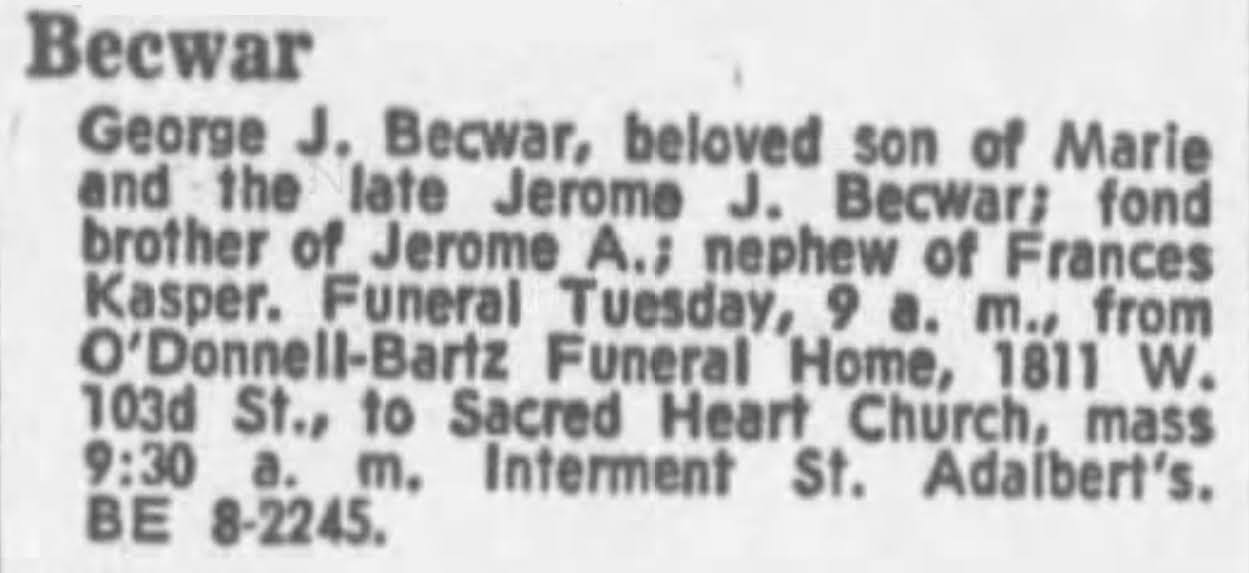
Sadly, George Becwar's life was even shorter than that of Ed Wood. The Illinois-born actor passed away at the age of only 52 on July 9, 1970, having never married nor had children.  George's body was sent back to his home state and buried at a Catholic cemetery in suburban Cook County. A modest obituary appeared in the July 13, 1970 edition of The Chicago Tribune. 

"Sent to bring you home": George Becwar's obituary.

CONCLUSION: George Becwar played a fleeting but not insignificant role in the saga of Edward D. Wood, Jr. It may never occur to most viewers to ask who this man was, where he came from, or where he went after Bride of the Monster. As it turns out, however, George had a pretty fascinating and multifaceted life. Was he a pain in the ass? Maybe. But at least he got to take part in one of the most famous scenes in any of Ed Wood's movies, and it's earned him an odd sort of immortality.

Wednesday, March 31, 2021

Ed Wood Wednesdays, week 115: The Wild, Untamed Credits of Ed Wood's 'Jail Bait' (1954)

Jail Bait remains mysterious, all these decades later.

Sixty-seven years after its release, Jail Bait (1954) remains the overlooked middle child of Ed Wood's early filmography. Even with its outrageous plastic-surgery-at-gunpoint plot twist, this low budget noir thriller simply isn't as flashy as Bride of the Monster (1955), Glen or Glenda (1953), or Plan 9 from Outer Space (1959). Jail Bait has no killer octopuses, zombies, or flying saucers to offer its viewers. Criswell, Tor Johnson, and Bela Lugosi are AWOL. The most overtly Wood-ian flourishes are in the wardrobe: Mona McKinnon's furry hat, Dolores Fuller's lacy nightgown, and Theodora Thurman's silk pajamas.

I guess we're not supposed to pay much attention to Jail Bait, kind of like how we're not supposed to focus too much on Zeppo during the Marx Brothers' movies. Perhaps paradoxically, that's why I find it so compelling. I've already written articles about the film's young star, Clancy Malone, and its (sort of) composer, Hoyt Curtin, plus I coauthored a piece about the aforementioned Ms. Thurman. But this week, I just wanted to dive right into the film's credits and see if there were any names that stuck out for whatever reason, preferably names I hadn't given much thought in the past.

Wednesday, October 21, 2020

Ed Wood Wednesdays, week 109: Revealing your Ed Wood preferences

Ed Wood, surrounded by posters for his films.

Whenever I encounter some new or unfamiliar technology, my first reaction generally is to ask, "How can I make this about Ed Wood?" If it's a video-sharing site, for example, does it have Ed Wood-related clips? If it's a social media platform, are people using it to discuss the life and career of Ed Wood? If it's a database of information, is any of that information about (or applicable to) Eddie and his films? You may remember that, about a year ago, I used the Algorithmia website to colorize some scenes from Jail Bait (1954). That's the effect doing this series has had on me. Eddie has become the prism through which I see the world.

Wednesday, September 30, 2020

Ed Wood Wednesdays, week 108: 'Dad Made Dirty Movies: The Erotic World of Stephen C. Apostolof' (2020)

Stephen C. Apostolof, wearing his lucky white shoes, looks over a script.

How did Ed Wood do it? How did he churn out dozens and dozens of books, both fiction and nonfiction, in the span of a few short years? He made it look like child's play. I've just had my first and only book published, and it was one of the most arduous and time-consuming tasks of my entire life. Nearly five years lapsed between the day I agreed to sign on to the project and the day I finally held a physical copy of the book in my hands. Along the way, I thought I was going to lose my mind on more than one occasion. Now, however, Dad Made Dirty Movies: The Erotic World of Stephen C. Apostolof is a reality. It's available in paperback from McFarland Books. I hope you like it as much as I do, and I like this book a lot. For you e-book readers, it's also available in Kindle and Nook editions.

Our gorgeous book cover.
It all started so innocently. Back on January 26, 2016, Bulgarian journalist and filmmaker Jordan Todorov contacted me via Facebook Messenger, telling me he was very impressed with my lengthy, detailed reviews of the movies that Stephen C. Apostolof made in collaboration with Ed Wood in the 1960s and '70s, starting with Orgy of the Dead (1965) and ending with Hot Ice (1978). Naturally, such flattery is a good way to get my attention. He told me he had a "raw and unfinished" manuscript about Apostolof. I wished him good luck with it. Jordan then suggested I become his coauthor, and I responded with four of the most fateful words of my life: "I could do that."

The next five years would test those words severely. Could I do that? What followed were seemingly endless months of writing, rewriting, editing, and reediting. Jordan and I both spent many hours working on a shared Google Doc that was getting slower and slower to load as it bloated to a gargantuan length. Through this process, I felt like I lived Stephen C. Apostolof's life many times over, until I knew the major beats of his story better than I remembered my own life. During this time, Jordan and I exchanged dozens of direct messages and emails, and we spoke at great length by Skype on numerous occasions. These usually turned out to be sprawling, rambling conversations in which we'd start by discussing the book but usually branch out into innumerable other topics.

I should say that both Jordan and I are very opinionated people, and we were both passionate about making Dad Made Dirty Movies as good as it could be. There were times that I thought my coauthor was being unreasonable about some minor issue, and I'm sure he thought the same thing of me. Generally, though, we got along very well during this lengthy journey. If there's a sequel, I'd be proud and happy to work with him again.

There were some dark times along the path, to be certain. In the late summer of 2018, for example, my father was dying, and I was in no mood to talk about Apostolof, the book, or anything else. This led to one of the rare times when I lost my temper during a Skype call with Jordan. Another grim time was when Apostolof's oldest son Steve died in November 2017. The Apostolof children were always our greatest sources of information, and they've been nothing but kind and helpful in making this book a reality. Dad Made Dirty Movies wouldn't exist without them. I'm very sorry neither Steve nor my father lived to see this book.

Assembling a biography of Stephen C. Apostolof was like completing the Twelve Labors of Hercules. Everything from captioning the photographs to assembling the index was its own little challenge. At each stage, I felt like I was living Steve's life one more time. Jordan and I somewhat naively thought that, when we handed the manuscript over to the publisher, the journey was just about over. Nope. That was over a year ago, and it proved to be just the beginning of a new phase in the book's evolution. More work. More messages. More emails. More Skype calls.

But now the moment of truth has arrived. Dad Made Dirty Movies is a 316-page reality. I suppose this is really just the start of another adventure: marketing the book. I really don't know much about doing that, but I suppose I'll have to learn. In the meantime, here is a homemade commercial I produced for the book. If you haven't bought your copy yet, maybe this will change your mind.


And just for good measure, here's a 30-second music video for the book.


Dirty Made Dirty Movies can be ordered at AmazonBarnes and NobleIndieBoundBAM!BookworksMcFarlandWaterstonesIndigoKinokuniya, and other retailers.

Thursday, October 31, 2019

Major book announcement!

Director Stephen C. Apostolof and his children on the set.

For the last couple of years, Jordan Todorov and I have been working on a comprehensive, fully-illustrated biography of Bulgarian-born sexploitation director Stephen C. Apostolof (1928-2005), the man behind Orgy of the Dead, Fugitive Girls, and much more. Along the way, we've had the total cooperation of the Apostolof family and access to Stephen's personal archives. You may know Steve Apostolof from his collaborations with Ed Wood, but there's a lot more to the story than that.

And now, our book, Dad Made Dirty Movies: The Erotic World of Stephen C. Apostolof, is finally available for pre-order from McFarland. It's also available for pre-order from Amazon, and I especially hope you click that Amazon link because you'll see the promotional blurb I wrote for this book however many months ago. I must've been pretty hyped up on caffeine that day.

In all seriousness, this book has been a real labor of love for Jordan and for me, and we're very anxious for Dad Made Dirty Movies to reach bookstores and readers everywhere!

Dirty Made Dirty Movies can be ordered at AmazonBarnes and NobleIndieBoundBAM!BookworksMcFarlandWaterstonesIndigoKinokuniya, and other retailers.

Wednesday, September 11, 2019

Ed Wood Wednesdays, week 89: "That's Show Biz" (1972)

These are the movies that saved Hollywood, according to Ed Wood.

Hot Flicks magazine from 1972.
During his troubled and abbreviated life, Edward D. Wood, Jr. did the best he could to document his own career as a writer and filmmaker. He was proud of the work he did in those fields and kept updating his resumes with his accomplishments. When Eddie died at the age of 54 in December 1978, he'd only recently been evicted from his final apartment and was unable to keep many of his mementos from 30 years in show business.

Fortunately, since then, Ed's loyal fans have undertaken the responsibility of documenting this man's unique and fascinating life. Some of those fans congregate regularly on a Facebook forum moderated by Bob Blackburn, who befriended Ed's widow Kathy and became co-heir to Ed Wood's estate. Joining this forum has given me access to material I never would have known about otherwise.

Recently, for instance, punk musician and longtime Ed Wood fan Howie Pyro shared an interesting article that Eddie wrote in the early 1970s. Let's take a closer look.

The story: "That's Show Biz," originally published in Hot Flicks, vol. 1, no. 1 (1972) from Gallery Press. According to Bob Blackburn, Ed's resume lists this story as being written in 1971.

Synopsis: The motion picture business has come a long way in just 70 years, and the early pioneers of the medium would be shocked by what's happening on the big screen today. The public lost interest in movies after World War II, and theaters started shutting down. Things got worse in the 1950s when television came of age. People could see big stars in their own homes for free, so they no longer felt the desire to go to movie theaters.

In the 1960s, film production costs kept rising, resulting in higher ticket prices at the theater. Kids could no longer afford to go to the movies. Then pressure groups started complaining about the amount of violence in motion pictures. Meanwhile, viewers with their own projectors began to show 8mm movies at home. Theaters would have to do something bold to survive, so they decided to defy the censors and exhibit movies with nudity and sex. It would generate controversy, but it was worth the risk. Eventually, movies contained full-frontal nudity and "hard-core sex acts."

Movie theaters are once again thriving, thanks to these sexy films. Will it last? Who knows? Naturally, children are not allowed to see these explicit new movies, but they'll eventually grow up and, with luck, become the next generation of ticket-buyers.

Wood trademarks: Hollywood history (cf. Hollywood Rat Race); history of sex in films (cf. "What Would We Have Done Without Them?"); mention of classic cowboy stars Tom Mix and Buck Jones (two of Eddie's real-life heroes); random use of italics (cf. "Filth is the Name for a Tramp," "Cease to Exist"); ellipses (Eddie's favorite... punctuation).

Excerpt: "Nudity hit the screen in all its glorious body exposing delights. Slight nudity had been seen from time to time in foreign films and those theatres which showed such things were about the only ones who were surviving during those disasterous [sic] years for Hollywood."

Reflections: Edward D. Wood, Jr. always loved movies and grew up wanting to be part of the film industry. I believe that, if he'd had his druthers, he'd have made old-fashioned Westerns with white-hatted heroes and black-hatted villains. Either that, or Gothic horror films in the Universal tradition. The simple cowboy pictures and spooky Dracula derivatives that Ed preferred were already falling out of favor by the time he arrived in California in the late 1940s, however, so he made films that were more in sync with the public's tastes. For most of the '50s, this meant science-fiction (Plan 9 from Outer Space, Bride of the Monster) and crime drama (Jail Bait, The Violent Years).

By the mid-1960s, however, Eddie's film career had bottomed out, and the only work he could get was in sexploitation and, eventually, outright pornography. That's where he'd stay for the rest of his life. While this would be a crushing blow to any ambitious artist, Ed Wood tried at least to put a positive spin on the situation. In "That's Show Biz," Ed semi-seriously argues that the nudie flick has saved Hollywood. "Perhaps this second breath for the movie business," he writes, "will be enough to cure the cancer which so nearly devoured it during the last twenty years." So there you have it. Porn cures cancer. Kind of makes you look at the industry with more respect.

Ed Wood wrote quite a bit of nonfiction over the years, much of it for publisher Bernie Bloom. Bernie would hire Ed to write short stories for his mags and stroke books, but he also used nonfiction articles like "That's Show Biz" to pad out his publications. A lot of these articles are what I'd call capsule histories or pocket histories of topics related to sex, movies, crime, the occult, etc. The college articles I reviewed a few weeks ago are good examples. Eddie rarely includes specific dates or facts in these articles, and he uses real names only sparingly. My supposition, then, is that he did these with zero research and instead relied on his own memories.

Did anyone even read these articles back in the 1970s? People just bought these magazines for the pictures, right? Well, Hot Flicks, vol, 1, no. 1 carries a cover price of $4. That's nearly $25 in today's money. This was not a cheap product. So the porn connoisseur might want to get his money's worth out of this issue by reading every bit of text it contained.

Wednesday, January 23, 2019

Ed Wood Wednesdays, week 78: (some of) The Many Resumes of Edward D. Wood, Jr.

Ed Wood made sure to keep his CV up to date.

Edward D. Wood, Jr. was nothing if not an ardent self-promoter. Acting, writing, producing, directing, even making music—he claimed to be able to do it all. And he kept track of his ever-growing list of accomplishments, both real and illusory, through his resumĂ©s or CVs. He kept these updated all through his life, even during his impoverished, booze-soaked final years, perhaps always hoping that the next big break was just around the corner.
NOTE BEFORE WE CONTINUE: This is in no way, shape, or form a complete collection of Ed Wood's resumés. I'm sure there are many others floating around out there. You may even have some in your own collection. This is just a handful of the Wood CVs I've encountered in my research over the years. I'm sharing them in the hopes that you, too, will find them interesting.
These documents are fascinating to the Woodologist because they reveal a whole host of mysterious credits, some of which are undoubtedly imaginary or fraudulent. Eddie certainly wasn't above padding his resumĂ© to impress a potential employer. Let's look at one from Eddie's early years in Hollywood. This example seems to date back to the early 1950s; it was typed onto the back of his acting headshot. By then, Ed had appeared in a few plays in Los Angeles, made an abortive attempt to complete Crossroads of Laredo, and directed a handful of TV commercials. Glen or Glenda was apparently still in the future, as it goes unlisted here under any of its many titles.

Early 1950s resume

Under Ed's TV and film directing credits, we can recognize a few commercials: "Surprise," "Treasure and Curves," "The Bestest," "Magic Man," and "Boiled in Oil." Many of the other titles here are likely commercials as well, since Eddie claimed to have directed dozens of them. Some of the most intriguing titles: "Angora Sweater Date," "The Girl Is a Boy," "William Television," "The Shack at the End of the Alley," and "The Will of God."

Interestingly, "Boiled in Oil" seems to refer to Ed's spot for Wesson Oil with Don Nagel, Phyllis Coates, and Conrad Brooks. According to Rudolph Grey's book Nightmare of Ecstasy, this commercial was made in 1954. That would have been after Glen or Glenda. Could this ad actually have been made earlier?

Excerpt from Nightmare of Ecstasy.

Crossroads of Laredo, naturally, is the silent Western Ed tried and failed to make with John Crawford Thomas in 1948. I'm guessing Five Minutes Before Eternity is an alternate title for The Sun Is Setting (1951), simply because both titles vaguely describe the plot. The Sun Is Setting also features Phyllis Coates, again lending credence to the theory that the Wesson commercial was made well before 1954.

Of Eddie's alleged stage credits, only The Blackguard Returns and Casual Company have really been documented. When or where Eddie appeared in The Red Peppers or Peg O' My Heart is anyone's guess. His list of dialects is intriguing. He never really got the opportunity to use any of them in his movies, though he did play a Mexican jailer in the 1974 porn loop Prisoner Love Making (aka The Jailer).

Ed's list of "characters played" is enlightening, including such roles as "Young Sweater Girl," "Neurotic," and "Cowgirl (Stunt Work)." Could that last one be a reference to Ed's work in The Baron of Arizona (1950)?

Interesting, too, that Ed claims to have worked at night clubs in New York, Hollywood, and Washington, D.C. Nightmare of Ecstasy declares on its timeline that Eddie studied drama in Washington in 1946, shortly after leaving the Marines.

Let's move on to another resumé, this one from the middle 1950s.

Mid-1950s resume.

By this time, approximately 1954, Eddie was no longer touting his theatrical work, concentrating instead just on TV and film. And he wasn't lumping his film, TV, and commercial work into one big category anymore. Each gets its own category on the CV. The commercials are further segregated into the ones he made for Story-Ad Films Inc., Consolidated TV Prod., and Play-Ad Films. It's notable that, to date, the only Wood commercials that have surfaced are ones from Story-Ad Films.

The unfinished Crossroads of Laredo has been downgraded to the status of a made-for-TV movie. Perhaps Ed wanted to sell it as a TV pilot. The real TV pilot Crossroad Avenger is now listed in this section as well, along with The Sun Is Setting. Those mysterious Westerns, Double Noose and War Drums, both for Sid Ross Productions, are on there. Douglas North has speculated that these were further TV pilots for Crossroad Avenger star Tom Keene. Maybe The Showdown was a third.

We now also have some feature film credits. Fans will immediately notice that some of these movies are well-known, while others are either lost or were never produced in the first place. Glen or Glenda is now listed, as is The Hidden Face, an alias for Jail Bait (1954). Outlaw Marshal must be an alternate title for the Johnny Carpenter vehicle The Lawless Rider (1954). A second Carpenter picture, White Flash, is here, but it may never have gotten made. Despite its religious title, The Flame of Islam was likely some kind of filmed burlesque show. And what else could Girl Gang Terrorists be except The Violent Years (1956)? This one has been hastily added by hand, while the rest of the titles are typed.

It's worth noting that Bride of the Monster (1955) is AWOL, but Ed's resume does list something called The Atomic Monster. Ed credits himself with the "title only" and says the film is from "Broder Productions." This takes a bit of explaining. See, there's a 1941 Universal film called Man Made Monster starring Lon Chaney, Jr. and Lionel Atwill. In 1953, it was re-released by a company called Realart Pictures under the title The Atomic Monster. Realart was co-founded by a man named Jack Broder. Realart had supposedly swiped the title The Atomic Monster from a script that Ed had written with Alex Gordon. Alex managed to finagle $1,000 out of Realart, and Eddie's film became Bride of the Atom, then Bride of the Monster.

(By the way, I wonder if Ed's application to the Screen Directors Guild was accepted?)

Moving on to Ed's writing resume from 1973, specifically just the section dealing with his motion picture credits.

Ed's writing credits, page 1.

Ed's writing credits, page 2.

Nothing too earth-shattering here, I think you'll agree, apart from a few alternate titles, a couple of unmade films, and a handful of absolute mysteries. In the category of "absolute mysteries," we'll put Escape from Time, The Wicked West, and possibly Bed Time Talk. The Basket Ballers and The Teachers are scripts that Eddie wrote for Stephen C. Apostolof but never went into production. Most of the other films are ones that we have already discussed in this series. Note, however, that Eddie is now crediting The Atomic Monster to "Real-Art."

Poster for The Atomic Monster from Realart Pictures

Finally, I am posting the "bibliographic listing of Edward Wood's feature film credits" that Ed himself supplied to director Fred Olen Ray in 1978. It was printed in Cult Movies magazine, issue #11, page 32m, in 1994. Here is a scan of that entire page.

Cult Movies #11, page 32 (1994)

And here's a closeup of the movie titles.

Ed Wood lists his own movies.

I have already been over this list of film credits in the past, so I'll only point out the real oddities here. We all know The Venus Fly Trap, for instance, but what is The Lure other than The Venus Fly Trap under another name? Las Vegas Cheat is a complete mystery, as is the name "Betty Woods." Ditto The Naked Bowl for Jeff MacRay Productions. There is some speculation that Bed Time Talk is some kind of alias for Revenge of the Virgins (1959), but the only justification for that is the fact that the title is somehow attached to director-producer Pete Perry.

And then there is the fact that, by 1978, Eddie was taking credit for the screenplay of Hot Ice. This is utterly untrue, per the film's director Stephen C. Apostolof. Steve had no qualms about giving Eddie onscreen credit for the films he truly did write, but the diamond heist comedy was simply not among them.

That's the tricky part of dealing with Ed Wood's resumés. Like much of his legend, they're a combination of truth, half-truth, and outright fabrication.