Showing posts sorted by relevance for query monogram. Sort by date Show all posts

Sunday, July 7, 2013

Mill Creek comedy classics #35: "The Nut Farm" (1935)

The Nut Farm's title has both a literal and a figurative meaning... which the script brings up many, many times.

The flick: The Nut Farm (Monogram Pictures, 1935) [buy the set]

Current IMDb rating: 5.8

Director: Melville W. Brown (directed an Amos n' Andy vehicle called Check and Double Check; died three years after this movie of a heart attack at age 50)

Actors of note: 
  • Betty Alden (uncredited bit part in Captains Courageous)
  • Florence Roberts (Babes in Toyland, The Life of Emil Zola)

The gist of it: Bob and Helen Bent (Apfel and Alden) decide to sell Bob's business for $40,000 (the equivalent today of $680K) and move to California, where they stay at the home of Helen's mother (Roberts) and her brother, Willie Barton (Ford), an "assistant director" who hasn't worked in six weeks. Bob and Helen have different plans for the forty g's. Bob wants to buy a 50-acre nut arm, but Helen wants to give the money over to smooth-talking Hollywood hustler Hamilton T. Holland (Page) who swears he can turn Helen into a movie star if she'll just finance her own starring vehicle.

Willie, who knows Holland's a fake, tries to talk Bob and Helen out of it. But they sign their money over to Holland anyway, and Mr. Sliscomb (Charters) -- Willie's landlord and future father-in-law -- puts in an additional ten grand. Willie agrees to direct the production, a terrible desert romance called Scorching Passions, to see that things don't get too far out of hand. However, the resulting picture is a disaster, and it looks like Bob, Helen, and Sliscomb have lost their money. The day is saved when Willie overhears one patron say that Scorching Passions is funnier than most comedies, which gives the young director an idea so crazy it just might work!

Isn't it cool? The highlight of the movie.
My take: The words "Monogram Pictures" do not exactly fill me with confidence at the beginning of a movie. Thus far in this series, Monogram has produced some of the films I've liked the least, and the closest thing they've gotten to an endorsement from me was a generous grade of B- awarded to The Gang's All Here, namely because that movie had a positive Asian-American character and also featured the guy who did the voice of Lampwick in Pinocchio. This one, The Nut Farm, got off to a good start because it was the first of the Monogram films I've seen to feature the company's fanciful animated logo, in which a plane and a zeppelin soar over a très moderne art-deco city while state-of-the-art trains pull the words "Monogram" and "Pictures" onto the railroad tracks.

The film is a letdown from there, though. Like Hollywood and Vine and The Groom Wore Spurs, it's a behind-the-scenes Hollywood satire, but all three movies could have been a lot sharper and, to put it bluntly, nastier. Bradley Page's character is an obvious crook with his honeyed tone of voice and gift for insincere flattery, but he's not a shameless, tasteless, brilliant-in-his-own way conniver like Zero Mostel's Max Bailystock. Likewise, Betty Alden -- who never really did make it in Hollywood after all -- is mildly diverting as a deluded housewife who thinks she's Hollywood's next big thing, but this character could have been played much more broadly and crazily. Wallace Ford is back as the hero, and just like he demonstrated in Money Means Nothing, his comedic arsenal largely consists of dry wisecracks and a few self-satisfied smirks. Seemingly, every movie in this collection needs at least one curmudgeon who loses his temper on a regular basis, but Oscar Apfel's would-be nut farmer, Bob Bent, is one of the milder examples of the species. Ditto Spencer Charters as the semi-obligatory "dotty old-timer" character.

The movie sets up its conclusion well in advance of the actual ending of the picture. Yeah, we get it. Scorching Passions is "so bad it's good" and could be marketed as a comedy. But first we have to endure several interminable and unfunny contract-signing sequences which spoil the movie's momentum. The credits say this thing was based on a stage play. I hope the live version was a little... uh, livelier than this. Incidentally, Melville W. Brown's IMDb biography claims he was a member of Charlie Chaplin's stock company in the late 1910s, but I could find no confirmation of this. I did, however, find this ancient issue of Variety which apparently deemed it noteworthy that Brown was "finishing the first Al St. John comedy at the Astra studio in Glendale." I can find no record of any such film ever being completed or released.

Is it funny: Sort of, from time to time. I liked Lorin Raker and Arnold Gray as Hamilton Holland's sleazeball cronies, two unemployable creeps passing themselves off as a "writer" and an "actor" respectively. And Bradley Page has a few nice moments as Holland himself, a gentlemen thief with an excuse for every occasion. Watch the deft way he handles it when Helen shows up at his office the very moment the furniture is being repossessed. But certain surefire comic set pieces, like a sequence in which Raker reads his script to the potential backers while Charters makes constant corrections and criticisms, just don't have the oomph they should have. And, really, we should have gotten to see more of Scorching Passions. I mentioned Max Bialystock earlier, and in his case, we in the audience do get to watch a good-sized chunk of his anti-masterpiece, Springtime for Hitler: A Gay Romp with Adolf and Eva at Berchtesgarden, so we know what the audience is laughing at.

My grade: C+

P.S. - No stereotypes here. Move along, folks.

Wednesday, August 26, 2026

Ed Wood Wednesdays, week 288: 'Invisible Ghost' (1941) and 'Deanimated' (2002)

Artist Martin Arnold did some interesting things to The Invisible Ghost (1941).

It was a long way down for Bela Lugosi. We know that his Hollywood career peaked with his indelible, much-imitated portrayal of the title role in Tod Browning's Dracula (1931) for Universal. Over time, however, the Hungarian actor's fortunes were plagued by numerous factors: typecasting, shifting audience tastes, plus Lugosi's thick accent and ruinous drug addiction. By the 1950s, when he started working with Edward D. Wood, Jr., his once-sparkling career was utterly in the doldrums. Any work was welcome. Hence Glen or Glenda (1953), Bride of the Monster (1955), and the posthumously released Plan 9 from Outer Space (1957).

But Bela's career was vast and varied. By the time he made Dracula, he'd already accumulated numerous movie credits, foreign and domestic. From 1917 to 1921, he appeared in silent films made in Hungary and Germany. From 1923 onward, he appeared in American-made films, first silent then sound. And all this was in addition to maintaining an extremely active stage career. 

In the turbulent decades between Dracula and Glen or Glenda, Lugosi made dozens of films of wildly varying quality, ranging from major studio productions to low-budget B-movies and serials. In 1941, Lugosi began a productive if not exactly glamorous association with a Poverty Row studio called Monogram Pictures. Nine films in total eventuated from this. For a detailed and thoughtful analysis of this era, I'd highly recommend Gary D. Rhodes and Robert Guffey's Bela Lugosi and the Monogram Nine (2019). 

Friday, December 27, 2013

Mill Creek comedy classics #73: "Million Dollar Kid" (1944)

Adjusting for inflation, this would be The $13.2 Million Kid today.

The flick: Million Dollar Kid (Monogram Pictures, 1944) [buy the set]

Current IMDb rating: 7.1

Director: Wallace Fox (Smart Alecks)

Character man Robert Grieg
Series regulars:
  • Leo Gorcey, Huntz Hall, Gabriel Dell, Bobby Stone (all in Smart Alecks)
  • Jimmy Strand (cameoed in Clancy Street Boys and stayed with the series from 1943-1944; non-ESK films include Faces in the Fog and Are These Our Parents?)
  • Buddy Gorman (this is the first of his ESK films I've reviewed; he was with the series from 1943-1951; he also appeared in White Heat and Meet Me In St. Louis)
  • David Durand (did three ESK films at the end of his career; had previously appeared in Angels with Dirty Faces and Bob Hope's The Ghostbreakers, plus a series of "Terry Kelly" short films at Columbia)
  • Bernard Gorcey (Leo's dad; appeared in quite a few ESK/Bowery Boys movies, including Clancy Street Boys; other films include The Picture of Dorian Gray and Chaplin's The Great Dictator)

Other actors of note:
  • Herbert Heyes (Miracle on 34th Street, The Ten Commandments)
  • Robert Grieg (Hollywood and Vine; the Marx Brothers' Horse Feathers and Animal Crackers; Preston Sturges' The Palm Beach Story, Unfaithfully Yours, Sullivan's Travels, and The Lady Eve)
  • Mary Gordon (James Whale's The Bride of Frankenstein and The Invisible Man)
  • Patsy Moran (a Monogram stock player; worked on TV and in films with Lucille Ball, Laurel & Hardy, W.C. Fields, Bob Hope, and more)
  • Stan Brown (Only Angels Have Wings, You Can't Take It With You)
  • Al Stone (nothing else; this was his first and last movie)
  • Louise Curry (Citizen Kane, The Reluctant Dragon)

Funny lady Iris Adrian
The gist of it: Muggs (Gorcey) is upset about a string of muggings that have been giving the East Side a bad rep and nearly as upset that dimwitted Glimpy (Hall) has invited his even-more-dimwitted cousin Herbie (Stone) to join the East Side Kids. One night, the Kids save wealthy Mr. Courtland (Heyes) from being mugged by some tough gangsters. Courtland is grateful and gives the Kids his card. Later, Glimpy and Herbie find Courtland's wallet and the money inside it, leading Police Captain Matthews (Beery) to believe that the East Side Kids themselves are the muggers.

At the police station, Courtland exonerates the Kids and invites them to his home to use his elaborate gymnasium. The Kids get along surprisingly well with Courtland, but they soon notice that not all is well with the rich man's children. His older son is away, flying for Uncle Sam in WWII. His lovely daughter Louise (Curry) is engaged to charming conman Andre (Brown) who claims to be a French military officer but is actually an American phony whose "uniform" came from a costume shop. After tailing him, Muggs and Glimpy discover that Andre is two-timing Louise with a floozy nightclub singer named Mazie Dunbar (Adrian).

This little conundrum is pretty easily (and cleverly) solved when Muggs brings the outraged Mazie to Andre and Louise's engagement party, but there's a more serious issue with Courtland's younger son, Roy (Duncan). You see, Roy is part of the gang of muggers that's been terrorizing the neighborhood -- not because he needs money, but just because he's bored and looking for kicks. When the Kids learn that Courtland's older son has been tragically shot down in combat overseas, they do everything they can to bring the real muggers to justice without incriminating Roy so that nice Mr. Courtland won't lose both of his sons. Things get complicated, though, when the crooks kidnap one of the Kids, Skinny (Benedict).

Perry juxtaposes silly and serious.
My take: Since the unexpected success of Diary of a Mad Black Woman (2005), critics have complained about writer-director-star Tyler Perry combining deadly serious issues with broad, silly comedy in a clumsy and artless fashion, i.e. juxtaposing domestic violence with the sketch-comedy buffoonery of "Madea." But Million Dollar Kid proves that this is nothing new. Yet again, an East Side Kids movie takes an entirely unwanted detour into heavy melodrama, then still tries to keep the Three Stooges-type wackiness going. I get emotional whiplash from these movies.

As Danny Peary points out in his book Cult Movie Stars, the Dead End/East Side movies are liberal sermons at heart. The point is that uneducated, lower-class youths are not inherently bad; they just need kindly benefactors, including policemen and wealthy philanthropists, to set them on the right path. His level of moral turpitude varies from film to film, but Leo Gorcey is usually a goody-two-shoes in these movies, despite his tough talk. Huntz Hall is weak-willed and therefore more fallible. He always ends up doing the right thing, but it's because Gorcey slaps him around if he doesn't.

The writers and directors at Monogram had apparently stopped trying to give any of the other Kids individual personalities by 1944. Other than Muggs and Glimpy, the other gang members are interchangeable. Obviously, Monogram was trying to switch things up a little by bringing in the new character Herbie, who manages to be even dumber than Glimpy. But just as obviously, that little experiment didn't work and the character (and the actor) disappeared forever. Frankly, though, all this is moot.

When Mr. Courtland gets that most-dreaded telegram from the War Department, Million Dollar Kid stops being a goofball comedy, and no amount of pratfalls or malapropisms can bring it back. Oh, and I couldn't help but notice that this movie yet again took the East Side Kids out of their natural environment. In this case, Muggs and the boys spend virtually all their time at the ritzy home of the Courtlands. I felt really badly for the butler (Grieg) who gets fired for being slightly snooty to the rude, destructive Kids. The movie forgets about this character, and I shudder to think what must have happened to him after losing his job. Damn those East Side Kids!

Leo and Bernard Gorcey
Is it funny: Nah, not really. If there's humor here, it's in the subplot about the fake Frenchie and his bottle-blonde bimbo girlfriend. I would have made this the main focus of the movie and completely left out the "prodigal son" story, which only serves to drag the movie down.

For me, the funniest moment of the movie is when Stan Brown tries to keep his pathetic charade going after the jig is clearly up. There was some real potential with these characters, but they don't get enough screen time. "New guy" Herbie, on the other hand, gets way too much screen time. While all of the East Side Kids are overaged to one degree or another, Al Stone looks like a middle-aged man. Muggs cracks wise about this very topic, but that only makes the situation worse by calling attention to it.

For these reasons and more, Million Dollar Kid just didn't do it for me. Leo Gorcey does have a funny little scene with his dad, Bernard, who looks like a shrunken, older version of his son. However, Bernard plays a delivery man who arrives at the Courtland house to bring the fateful telegram. Therefore, it's monstrously inappropriate to have these two engage in vaudeville-type banter at this point in the movie. What could the makers of this film have been thinking?

My grade: C

P.S. - Scruno had dropped out of the East Side Kids by this point -- Ernest Morrison fought for real in WWII, then got out of acting altogether -- but Million Dollar Kid still manages to sneak in a little bit of old-timey racism when Muggs makes a crack about "Ubangis" and Glimpy responds by grabbing his lips and stretching them out. This is a reference to a cultural misnomer about Ubangi tribeswomen wearing lip plates. Hey, folks, don't blame me. I didn't write these movies.

Saturday, August 3, 2013

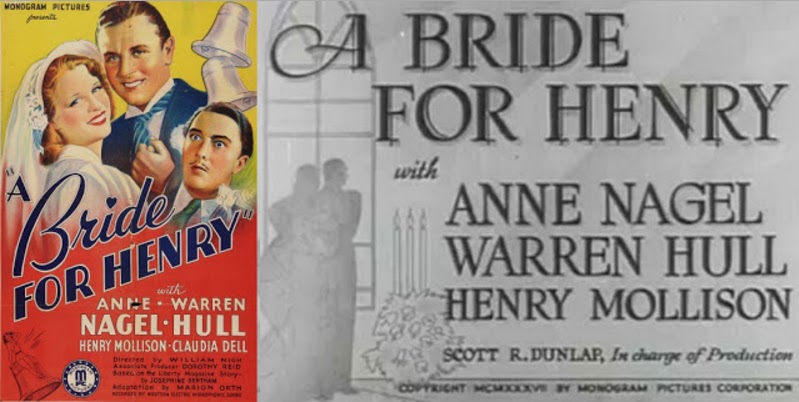
Mill Creek comedy classics #45: "A Bride for Henry" (1937)

Try to guess, based solely on the poster, which guy winds up with the girl in A Bride for Henry.

The flick: A Bride for Henry (Monogram Pictures, 1937) [buy the set]

Current IMDb rating: 5.9

Director: William Nigh (The Ape; several Mr. Wong films with Boris Karloff)

Actors of note:
  • Anne Nagel (starred in many serials for Universal in the 1940s; appeared in a couple of W.C. Fields movies, Never Give a Sucker an Even Break and My Little Chickadee; died at age 53 of alcoholism)
  • Warren Hull (a second-stringer at Warner Brothers and a star at "poverty row" studios; appeared in Michael Curtiz's The Walking Dead with Karloff)
  • Henry Mollison (The Man in the White Suit), Claudia Dell (Cecil B. DeMille's 1934 version of Cleopatra)
  • Betty Ross Clarke (Murder in the Rue Morgue)

The prize: Anne Nagel
The gist of it: Petulant, bratty socialite Sheila Curtis (Nagel) is understandably upset because her fiance, an effete Britisher named Eric Reynolds (Mollison), has failed to show up for their wedding after partying a little too hard the night before. Sheila quickly hatches a plan that will allow her to save face and teach Eric a lesson in the process: she'll simply marry another available man and then get a quickie divorce in Reno. The substitute groom she chooses is her lawyer, suave ladies' man Henry Tuttle (Hull), who has been secretly pining for Sheila for years. Sheila and Henry go on their honeymoon, and the groom learns to his disappointment that the marriage is just part of a harebrained scheme. He wants to make a go of the union, but Sheila is still insistent on marrying Eric.

Once the newlyweds get to their hotel, Eric himself finally arrives and begins to spend a lot of quality time with Sheila. Henry decides that "two can play at that game" and starts canoodling with glamorous blonde Helen Van Orden (Dell) and impressing all the young lovelies at the hotel with his diving skills. It soon becomes clear that Henry and Sheila are in love and are just using Eric and Helen to make each other jealous. Eric won't give up so easily, though, and he and Henry compete for Sheila's affections, finally resorting to fisticuffs in the film's climax.

Henry Mollison, a loser in love.
My take: Monogram Pictures was a so-called "poverty row" studio that cranked out dozens upon dozens of low budget films from 1931 until 1953, when it was absorbed by Allied Artists. This is the sixth Monogram film I've reviewed for this project and the only one to (barely) rise above "C" level. (Get it?) In the days before television, moviegoers expected more than just one movie for their 20 or 30 cents; they expected a whole evening's entertainment. The main feature would be preceded by a cartoon, a newsreel, and possibly a second feature. That's why movies like A Bride for Henry exist. They're the movie equivalent of mozzarella sticks or boneless chicken wings: something to nibble on while you wait for the main course.

I'm guessing that dozens of films in the same general vein as A Bride for Henry must be lurking out there. It's yet another light, bubbly, inconsequential romantic comedy with a silly, contrived gimmick, in this case the fact that the heroine has married the hero simply to get back at her fiance. It's easy to tell in these films which man and woman are going to end up together at the end just by looking at the credits. The top-billed man is destined to win the top-billed woman. In this film, Henry Mollison is third-billed behind Anne Nagel and Warren Hull. Therefore, he's doomed. Worse yet, he's a sophisticated, genteel Brit rather than a strutting, macho all-American type like Hull.

The trouble here is that Henry Mollison's character, Eric, is pretty much the only person in this movie I actually liked, even though he's supposed to be the heel. I ended up genuinely sympathizing with him when his efforts to win Sheila back are plagued by disasters. In one of the movie's funnier scenes, for instance, he and Sheila are forced to temporarily borrow a pair of bicycles without permission; later, they are confronted by the bicycles' rightful owners, two children -- one of whom bites Eric's hand while the other one kicks him in the behind. Ever the gentleman, Eric's reaction is understated: "Charming children."

Anne Nagel is not a bad comic actress and possesses incredibly beautiful eyes, but her character in this film is a nightmare with her temper tantrums and whiplash-inducing changes of mood. It doesn't help that all three main characters seem to be wealthy and famous to some degree because it makes their story seem all the more trivial. The script never comes out and says what's so special about these people, but fedora-wearing reporters with gigantic cameras follow them everywhere, and their love triangle is front page news. I guess that makes them 1930s equivalents of today's tabloid celebrities, but who really gives a damn about the problems of such people?

Is it funny: Not nearly as funny as it should have been. The cast is more than adequate, and the premise is workable (if not incredibly creative), but there seems to be very little zip or energy to this production. Everyone just kind of goes through the motions. The closest I came to really enjoying A Bride for Henry was during the scenes in which stuffy, oh-so-proper Eric suffers indignity after indignity. At one point, his bicycle topples over and he is wedged underneath it.  Sheila, trying to help, tugs on his foot as if she's attempting to pull Eric's entire body through the middle of the bike frame. "Darling," he says with perfect British reserve, "you're not accomplishing a thing." I would have restructured the entire movie around Eric and put him through a gauntlet of humiliating ordeals as he tries to win Sheila back. That might have made for a very funny movie indeed.

My grade: B-


P.S. - Not a stereotype for miles, folks!

Friday, November 8, 2013

Mill Creek comedy classics, #63: "Zis Boom Bah" (1941)

"Cute, clever, and collegiate!": Zis Boom Bah was the Animal House of its day, I guess.

The flick: Zis Boom Bah (Monogram Pictures, 1941) [buy the set]

Current IMDb rating: 4.8

Director: William Nigh (A Bride for Henry)

Peter Loves Mary.
Actors of note:
  • Peter Lind Hayes (son of Grace Hayes; movies include The 5,000 Fingers of Dr. T)
  • Mary Healy (married to Peter Lind Hayes for 58 years; was also in The 5,000 Fingers of Dr. T; she and her husband had a sitcom together called Peter Loves Mary in 1960-1961)
  • Huntz Hall (one of the Bowery Boys/East Side Kids for 20 years; movies include Angels with Dirty Faces; is next to Bob Dylan on the Beatles' Sgt. Pepper album cover)
  • Benny Rubin (57-year career in film and TV includes everything from Citizen Kane to Kolchak: The Night Stalker; was a regular on TV's The Jack Benny Program; did some screenwriting and songwriting, too)
  • "Skeets" Gallagher (another former vaudevillian; lengthy film career included a role as the White Rabbit in the 1933 version of Alice in Wonderland)
  • Frank Elliott (A Funny Thing Happened on the Way to the Forum, Life with Father)

Benny Rubin
The gist of it: Successful singer Grace (Grace Hayes) is playing sold-out shows in New York, but she longs to be near her now-grown son, Peter (Peter Lind Hayes), whom she had given up many years earlier. Grace allowed Peter to be raised by his upper-class paternal grandfather, Mr. Kendrick (Elliott), in the hopes that the lad would grow up to be sophisticated and cultured, but instead he's become a spoiled, attention-seeking jerk. Worse yet, Kendrick is now almost broke, and Grace has to pick up the tab for Peter's education. As long as she's paying the bills, she wants to keep a close eye on her investment.

Grace and her assistant, Mary (Mary Healy), thus travel to Midwick College, the school her son now attends. Peter doesn't know Grace is his mother and is smart-alecky and rude to her when they meet, though he quickly takes a shine to Mary and blatantly hits on her. In order to set Peter straight, Grace cuts off his allowance. Suddenly without funds, Peter has to sell his car and get a job. Luckily for him, Grace buys the local malt shop where all the kids hang out, turns it into a nightclub, and hires Peter and all his friends (including Hall) to sing and dance there. It's a smash success, and even the malt shop's bewildered former owner, Nick (Rubin), gets in on the fun.

Meanwhile, in a subplot running through the whole movie, Grace romances the college's embattled president, Professor Warren (Gallagher), a sweet but befuddled old coot who is in danger of losing his job because the school's football team is so bad. Luckily, for reasons I didn't quite understand, the team miraculously improves and wins the conference.

Grace Hayes casts a pall over Zis Boom Bah.
My take: Sometimes, readers, you encounter a movie so perversely miscalculated that you have to wonder what its makers could possibly have been thinking. Such a film is Zis Boom Bah.

Never mind that Monogram Pictures obviously cut corners at every stage of production, resulting in a chintzy and unconvincing final product. Never mind that the jokes in the script were already old by 1941... and had never been funny to begin with. Never mind that the songs range from bland at best to utterly moronic at worst. Never mind that the college students in this movie all appear to be in their 40s. (According to the IMDb, at least one of them was.) Never mind that the romantic leads, real-life newlyweds Peter Lind Hayes and Mary Healy, generate no sparks whatsoever onscreen.

You can set all of these problems -- vexing though they are -- aside.

What I really want to know is this: if Monogram wanted to produce a light, fun musical-comedy set on a college campus, why would they choose to build it around an embittered, obviously depressed, middle-aged chanteuse like Grace Hayes? She was 46 at the time of this film but looks at least ten years older and acts at least twenty years older.

It's one thing for Hayes' character to show concern for the well-being of her son, but the actress brings an inappropriate heaviness to her scenes, moping and sulking as if she's in a tragedy rather than a comedy. This is Zis Boom Bah, Grace, not Death of a Salesman. Lighten up! She's in almost every scene, clad in funereal black outfits no less, and her performance is totally at odds with the rest of the production! Here you have Benny Rubin doing vaudeville-style "dialect" humor and Huntz Hall playing another wisecracking doofus, and Grace looks like she's about to slit her wrists at any moment.

This movie never had a chance of being any damned good, but it didn't have to be such a downer.

Is it funny: Well, that's a toughie. You see, this movie is kind of a miracle insofar as every single joke in it, right down to the smallest bit of comedic business, fails completely and embarrassingly. Peter Lind Hayes, for instance, gets a few minutes to do his impersonations of famous movie stars (Charles Laughton, Charles Boyer, etc.), and it plays like a dreadful amateur act that would have lasted about 20 seconds on The Gong Show unless the panelists were drunk enough to be in a very charitable mood.

But Hayes is not alone. Everybody gets a chance to fail at being funny in Zis Boom Bah. Benny Rubin's character, Nick, speaks broken English in a thick foreign accent and struggles to fill Grace's order for a gin sling. He laments: "Gin sling... it sound like a Chinaman." See? Not funny. Later on, Nick gets into a seemingly endless bit about seltzer water with another customer. End result: not funny. Huntz Hall sings a song about Army life, which apparently involves getting up very early and doing what you're told to do. Grand total: not funny. Grace mistakes Professor Warren for a gardener because the first time she sees him, he's working in a garden. Survey says: not funny. That's a lot of unfunny for one movie.

And yet, I laughed quite a bit during Zis Boom Bah. The movie is so pitiful, so misguided, so pathetic that I could not help myself. I was laughing at the film instead of with it, but a laugh's a laugh, right? The funniest thing in the movie is probably the gigantic, feathery hat that Grace Hayes wears during the opening sequence in New York. It must be seen to be appreciated.

That whole section of the film, played entirely straight, is a laugh riot. Grace's name appears on a Broadway marquee by use of a terrible, cheap-looking optical effect. Her performance itself consists of shots of the actress standing in front of a curtain intercut with stock footage of an audience in formal wear. She sings a few bars of a draggy, boring song, then sloughs off stage. The audience, of course, is thrilled by this. Maybe they're applauding her hat.

By the way, here is how to make a gin sling.

My grade: D+

P.S. - The character of Nick is obviously intended as an ethnic stereotype of some kind or another, but I could not pin down the nationality. Greek, I guess?

Monday, December 23, 2013

Mill Creek comedy classics #72: "Mr. Wise Guy" (1942)

Fun fact: Mr. Wise Guy is #398,346 of the 800,000 movies made by The East Side Kids.

The flick: Mr. Wise Guy (Monogram Pictures, 1942) [buy the set]

Current IMDb rating: 6.8

Director: William Nigh (Zis Boom Bah, A Bride for Henry; sadly, not Bill Nye the Science Guy)

"Big Boy" Williams
Series regulars: 
  • David Gorcey, Gabriel Dell, Bobby Stone, Ernest Morrison (all in Smart Alecks)

Other actors of note: 
  • Guinn "Big Boy" Williams (perennial sidekick in Westerns; Errol Flynn's best friend; nicknamed "the Babe Ruth of polo"; appeared in The Alamo, The Comancheros, A Star is Born, etc.)
  • Warren Hymer (Capra's Meet John Doe and Mr. Deeds Goes to Town)
  • Ann Doran (Rebel Without a Cause, Mr. Smith Goes to Washington, His Girl Friday; dozens of TV credits ranging from Bewitched to The A-Team )
  • Jack Mulhall (first actor to ever play a dual role in a talking picture; also appeared in Around the World in 80 Days, The Man with the Golden Arm, much more)
  • Dick Ryan (ex-vaudevillian; appeared in Hitchcock's Strangers on a Train; guested on The Andy Griffith Show, Ozzie & Harriet, Rawhide, and more)

Bad girl Ann Doran
The gist of it: Dock worker Bill Collins (Fowley) has been drafted into the Army, but he's worried that his younger brother, Danny (Jordan), might get into trouble and wind up in reform school without supervision. But Danny and the rest of the East Side Kids are then framed for a truck hijacking and wind up in the very same hellish reformatory where Bill had once served as a guard. Visiting the old place, Bill is happy to see that some improvements have been made under the new warden (Mulhall), and he begins a romance with one of the institution's kinder employees, Ann (Barclay).

But an abusive guard named Miller (Ryan) still works there and takes an immediate dislike to the boys, especially the nervy, confrontational Muggs (Gorcey), whom he calls "Mr. Wise Guy." Then Bill himself is framed for a murder actually committed by the same group of crooks responsible for the earlier hijacking: ringleader and escaped con Luke Manning (Williams), gun moll Dorothy (Doran), and fumbling sidekick Knobby (Gilbert). As Bill waits in the death house, Muggs and the gang cross paths with tough fellow inmate Chalky (Stone) and the sadistic Miller, who is eventually fired for his violent treatment of the kids. On the day of Bill's execution, Bobby miraculously spots a bit of evidence in a newsreel which exonerates both his brother and the East Side Kids, too. So the boys break out of the institution and confront Knobby and Dorothy, who had  been secretly conspiring against Manning and were planning to sneak off with his lottery winnings.

My take: The justice system in the East Side Kids universe is an absolute disgrace. From the earliest moments of Mr. Wise Guy, the Kids are being hassled by the cops and accused of crimes they didn't commit. Whenever characters in these movies avoid arrest, it's by pure luck. And when they are arrested, their so-called trials by jury are mere formalities. The verdict is always guilty, though I can't imagine what evidence beyond that of the circumstantial variety is available. We never get to see the inside of a courtroom in an ESK movie, just the screaming headlines in the newspapers. Monogram is too cheap and lazy to even spin the papers (which might take an extra 20 seconds); they just zoom in on the articles.

Pretty early on in Mr. Wise Guy, you can see an obvious cost-cutting measure when the same prop newspaper is used to cover two different plot developments. That would be fine, if the second crucial headline didn't give away an upcoming plot point. Because of that phony paper, I knew the Kids were going to be sent up the river for hijacking a truck wayyyyy before that actually happens in the movie.

That second headline hasn't happened in the movie yet.

By the way, I must point out that this is the third "truck hijacking" movie I've reviewed in this series, and they've all been from Monogram Pictures. The others, in case you were interested, are Money Means Nothing (1934) and The Gang's All Here (1941). Must've been a specialty of the house. None of these flicks have been especially interesting or involving, and Money Means Nothing in particular was a chore to sit through.

Mr. Wise Guy is about average for an ESK flick. I can only assume it was made very quickly and very cheaply, rushed into theaters and then quickly forgotten. It moves along at a good clip and never gets too bogged down in any particular plot points to become boring. Yet again, the Kids spend only the first few minutes of the film on their home turf before the script transplants them to another surrounding.

Is it funny: I can't remember laughing too much during Mr. Wise Guy. I'm kind of back-and-forth on the humor of the East Side Kids, though. I guess if you're in the mood for them, Leo Gorcey's wisecracks and Huntz Hall's stupidity might really strike you as being hilarious. If you're not, watching them is like being cornered by clowns at a birthday party who caper and frolic for you whether you want them to or not. The weird thing about this movie is that the plot is actually kind of heavy and depressing, what with poor Danny worried sick that his brother's going to the electric chair. This material sits uneasily with the Bazooka Joe-esque shenanigans and puns of the East Side Kids. In culinary terms, this film is a peanut butter and tuna fish sandwich.

My grade: C

P.S. - Ernest "Scruno" Morrison is back and brings with him the usual assortment of racial/racist schtick. It starts early, too, with Muggs referring to Scruno as "our blackout warden" in the opening scene (a really weird, extended monologue in which Muggs flirts with a store mannequin). And there are chicken and watermelon jokes, too, plus a scene in which Morrison runs wide-eyed with fear at the very sight of a gun. Still not as bad as Boys of the City, though.

Tuesday, December 31, 2013

Mill Creek comedy classics #74: "Bowery Blitzkrieg" (1941)

Don't these posters make Bowery Blitzkrieg look exciting?

"The noisier the better is the rule when ballyhooing any East Side Kid picture. For Bowery Blitzkrieg get a bunch of rascals dressed as carelessly as the East Siders themselves and send them parading through town with instructions to create as much noise as possible. Have them carry placards with slogans similar to the scorehead teasers suggested in another column of this exploitation section. Supply the youngsters with any noisemakers available -- tin pans, horns, drums . . . and if it's at all possible get them some firecrackers which will take the town by storm when set off out of season."
-excerpt from a vintage Bowery Blitzkrieg pressbook

Charlotte Henry

The flick: Bowery Blitzkrieg (Banner Productions/Monogram Pictures, 1941) [buy the set]

Current IMDb rating: 6.9

Director: Wallace Fox (Million Dollar Kid)

Series regulars: Leo Gorcey, Bobby Jordan, Huntz Hall, Ernest Morrison, Bobby Stone, David Gorcey (all in Mr. Wise Guy), Donald Haines (Pride of the Bowery)

Other actors of note: Keye Luke (The Gang's All Here), Warren Hull (A Bride for Henry), Charlotte Henry (Murders in the Rue Morgue, Laurel & Hardy's Babes in Toyland), Martha Wentworth (Clancy Street Boys), Jack Mulhall (Mr. Wise Guy), Eddie Foster (Buster Keaton's The General, Hitchcock's Saboteur), Dennis Moore (East Side Kids), Pat Costello (Lou Costello's brother; worked as an actor, stuntman, and producer on many Abbott & Costello movies as well as their TV show), Dick Ryan (Mr. Wise Guy), Minerva Urecal (Boys of the City), Tony Carson (John Ford's They Were Expendable)


The gist of it: Danny (Jordan) has split with the East Side Kids due to personal differences with his ex-best-friend Muggs (Gorcey). Danny's now palling around with local hoodlum Monk (Stone), who dupes naive Danny into helping him commit robberies and sets up Muggs to be arrested and thrown into reform school. Fortunately, local beat cop Tom Brady (Hull), who is also dating Danny's sister Mary (Henry), sees potential in Muggs as a boxer and takes him into his own apartment. The former juvenile delinquent proves him right and is a success in the ring. But Mary mistakenly thinks of Muggs as a bad influence on Danny, which throws a monkey wrench into her relationship with Tom. Things get worse when gangster Slats Morrison (Foster) tries to bribe Muggs to take a dive in a Golden Gloves title bout. Muggs turns it down, but Slats plants the money on him anyway to make him look like he's cooperating.

Everyone is suspicious of Muggs, even true believer Tom, who tells Muggs that he'd better put up a good fight to prove he's on the level. But there's a twist, you see! During a post-robbery shootout, Monk is fatally wounded and Danny badly injured. Danny's only hope is a blood transfusion, which he gets from Muggs just hours before the fight. Danny recovers, but Muggs is in no condition to box. And yet, for obvious reasons, he cannot afford to lose this match.

In training... again: Huntz Hall with Pat Costello.
My take: To the best of my knowledge, Bowery Blitzkrieg is the second-to-last East Side Kids movie in this collection. The last one, Spooks Run Wild, doesn't show up until almost the very end of this set (#98 of 100) and it features Bela Lugosi, so I'm actually kind of looking forward to it. I can't say I'm exactly sorry to see the East Siders go. Their movies are formulaic as hell, indifferently made, and generally not that funny. Plus their annoyance factor is pretty darned high, with the Kids talking in those exaggerated Noo Yawk accents and loading nearly every sentence with "dem," "dese," and "dose," plus all that obscure 1940s street slang that I'm not sure anyone ever really used.

But I must have developed some kind of Stockholm syndrome with this series, because I actually started to care what happened in Bowery Blitzkrieg by the time it reached its dramatic apex with poor, depleted Muggs fighting for his life and his reputation in the boxing ring. Blitzkrieg isn't especially good in any noticeable way, though, and it contains many of the elements I've seen in previous ESK comedies. Muggs is trying to make it as a boxer again, so there are plenty of scenes set in a gymnasium. But the East Siders spend their time in gyms in every movie no matter what the plot is about. Hell, even the vaguely pedophilic philanthropist in Million Dollar Kid had a suspiciously-elaborate workout room in his house!

Come to think of it, none of these young men ever display more than a fleeting interest in the opposite sex, and they spend almost all their time cloistered together (often with their shirts off) in basements and back rooms. I think I've spotted them hanging out by the docks a lot, too, and they're forever being hauled off to jail or reform school. Maybe this series is the softest gay porn ever. But how, then, to explain the Kids' atrocious clothing and sloppy hairdos? (Leo Gorcey's hair, in particular, is an absolute disgrace throughout Bowery Blitzkrieg.) Well, maybe they're going for a punky "anti-fashion" thing. Modern day bohemians could learn a few things from these palookas.

A complex guy: Muggs with "Ma" Brady
Anyway, like I was saying, this movie has a lot of stuff I've already seen in other ESK flicks. These boys are always landing in the hospital, for instance, waiting for last-second miracles as their very lives hang in the balance. How often was Monogram planning to play that particular card, I wonder? And why don't these kids ever wise up and steer clear of the unctuous sharpies who are always trying to steer them down the wrong path? I swear, these morons fall for every smooth-talking con artist with a pencil mustache, a cool nickname and a pinstriped suit.

Maybe they're so easily led astray because the good-guy cops in these flicks are total weenies. Warren Hull's Tom Brady might just be the weeniest of them all. He lives with his doting mother (Wentworth) in a very old-lady-ish apartment and has a passionless, sexless relationship with Charlotte Henry's pure, virginal character, who is (not coincidentally) named Mary. The other major cop character, a police lieutenant who spends all his time behind a desk, is played by the cadaverous Dick Ryan, who was much more believable as the sadistic guard in Mr.Wise Guy but is supposed to be one of the heroes here.

Speaking of casting choices, this was apparently the first East Side Kids movie to feature Huntz Hall. (He gets an "introducing" before his name in the credits.) He wasn't exactly a newcomer. He'd been a part of the franchise since at least 1937's Dead End, in which he appeared alongside Leo Gorcey and Bobby Jordan. But this was technically the first of Monogram's East Side Kids films to feature Hall. (If you'll think back, he was absent from Boys of the City and Flying Wild.) He does the same "slow-witted sidekick" routine I've already witnessed several times before, so his supposed debut did not make much of an impact on me.

If there's a reason to watch Bowery Blitzkrieg, it's Gorcey. When I first started watching these movies, I found him extremely irritating, and I'm still not ready to call myself a "fan," exactly. But he brings a real intensity to his role and gives this movie a much-needed shot of adrenaline, even though Muggs McGinnis would never be able to correctly pronounce either "intensity" or "adrenaline." Gorcey's the most complex of the Kids: essentially decent and principled but also deeply insecure and vulnerable. He puts up a tough front, defending himself with sarcastic wisecracks and his fists if necessary. But there's a sad little man behind the bluster and bravado, and that comes through in Gorcey's performance in Bowery Blitzkrieg.

Is it funny: It's not totally unfunny. I'll go that far, but no further. I've run hot and cold on Leo Gorcey's confrontational, aggressive brand of humor. Sometimes I find it winning, other times just irksome. This time around, though I would have advised him to rein it in a little, Muggs is easily the movie's funniest character, especially when he refuses to take life seriously or show the tiniest bit of respect to those in power. One good though underused foil for Muggs is Minerva Urecal's dour reform school matron, whom he playfully nicknames "Picklepuss." The best comedic moment in the movie is the one in which Muggs (newly arrived at the reformatory) pretends to flirt with this humorless woman, to her utter horror: "Oh, Picklepuss, you an' me wuz made fer each udda! We c'd do t'ings! We c'd go places!" It's made all the funnier by the fact that uniformed cop Tom Brady is standing about a foot away from them, watching in total non-comprehension.

Like some other early ESK movies, Bowery Blitzkrieg takes its story pretty seriously but pauses occasionally for moments of levity, as in a self-contained vaudeville-type skit in which Pat Costello and Huntz Hall (both playing dum-dums) discuss how to tend to a boxer's injuries properly during a fight. It's very obvious from this scene that Pat was aping the mannerisms of his younger brother, Lou, but without much success.

My grade: C+

Clancy's shirt
P.S. - Scruno is in this one, so there's the expected racial humor at his expense. Same old, same old. He's a shoeshine boy and as lazy, larcenous, and cowardly as ever, liable to bolt from a room at the mere sight of a cop. There's nothing particularly vicious about the portrayal of his character, but he's still a poor role model.

More interesting is the treatment of Clancy, an Asian-American man who runs the pool hall where the East Side Kids hang out. Just like in The Gang's All Here, Keye Luke gives a dignified, positive, non-stereotyped portrayal. His ethnicity, for most of the film, is not an issue. But there's one weird scene in which Clancy shows up with a t-shirt with Muggs' name on the back and Chinese characters on the front. Muggs thinks the writing must be "propaganda," but Clancy claims he doesn't know what the characters mean. ("I got it off a Chinese calendar.") Muggs demands that he read it anyway, and... well, not speaking the language myself, I can't be sure if what Keye Luke says is real or not. But it's an off-putting, gratuitous moment either way.

Sunday, November 10, 2013

Mill Creek comedy classics #64: "East Side Kids" (1940)

Some would-be wisenheimers get played for Grade A chumps and pass phony fins in East Side Kids (1940), see?

The flick: East Side Kids (Monogram release of a Four-Bell Pictures production, 1940) [buy the set]

Current IMDb rating: 5.7

Director: Robert F. Hill (directed several of Buster Crabbe's Flash Gordon serials, plus Tarzan the Fearless, also starring Crabbe; as an actor, Hill appeared in The More the Merrier, Cover Girl and Son of Dracula)

Series regulars: 
  • Harris Berger (replaced Huntz Hall in the Broadway show Dead End and appeared in various Little Tough Guys, Dead End Kids, and East Side Kids movies from 1938-1940, including Angels with Dirty Faces)
  • Eddie Brian (Angels with Dirty Faces, Boys Town)

Other actors of note: 
  • Leon Ames (55-year career in film and TV includes Peggy Sue Got Married, They Were Expendable, The Absent Minded Professor, Tora! Tora! Tora! and much more; served as SAG president in 1957-1958)
  • Dennis Moore (not the character from the Monty Python sketch; cowboy actor who appeared in Gunfight at the O.K. Corral, Friendly Persuasion, etc.)
  • Joyce Bryant (Johnny Eager; also a singer with numerous appearances on talk and variety shows from the '50s to the '70s)
  • Sam Edwards (voice of adult Thumper in Bambi; appeared in Bullitt, Escape to Witch Mountain, The Absent Minded Professor, and more)
  • Ted Adams (Westward the Women, King of the Rocket Men)

Harris Berger wearing one of those stupid  newsboy hats.
The gist of it: Kind-hearted detective Pat O'Day (Ames) wants to set young Danny Doyle (Berger) and his friends, a gang of young hooligans (including Chester, Burke, and Brian), on the straight and narrow. But Danny's future is in jeopardy because his older brother, Knuckles Dolan (O'Brien) is in the death house awaiting electrocution for a murder he didn't commit -- a fact which could turn Danny permanently against the law. At present, Danny is living with his sister, Molly (Bryant), who is also Pat's girlfriend. The boy believes that Knuckles is "in South America" because Pat and Molly have hidden the truth from him. Pat sets up a gymnasium for the kids and deputizes them as junior police officers, but Danny learns the truth about his brother and is devastated.

Into this tense situation comes the smooth-talking Milton "Mileaway" Harris (Moore), a career crook who claims to be reformed but who is actually the head of a counterfeiting scheme. "Mileaway" is in cahoots with a mean German pawnbroker named Schmidt (Adams), who houses the operation in the basement of his shop. Schmidt and Harris conspire to have Danny and his pals unwittingly distribute phony $5 bills all over town as a distraction so no one will notice if some phony $20 bills go into circulation. They also cleverly arrange to frame Pat as the counterfeiter. Pat goes on the lam and recruits Danny and his friends to bring "Mileaway" (who actually committed the murder of which Knuckles has been accused) and his cronies to justice.

My take: This is the third early 1940s East Side Kids movie from Monogram Pictures that I've reviewed in this series, but it's markedly different from Flying Wild and Boys in the City. Those films were out-and-out comedies, complete with wordplay, slapstick, and impossible plot twists. In comparison, East Side Kids is pretty sober stuff. One of the Kids even dies after falling off a building in a fight with one of the crooks and is memorialized with a pitiful wooden plaque at the depressing warehouse-turned-gymnasium that the boys use as a hangout. (Was that a spoiler? Oops.) The wackier Kids, like Huntz Hall and Leo Gorcey, are off-duty.

At center stage is the over-emoting Harris Berger as at-risk Danny Doyle, a part which would go to Bobby Jordan in Boys in the City. The real question is, which do I prefer: serious East Side Kids or silly East Side Kids? I guess I reluctantly choose serious ESK, but they win by default. East Side Kids was the least painful of the films in the series I've seen so far. But it's not terrifically compelling either. The Kids are mainly just pawns in this game of cops and robbers, if you'll forgive the mixed metaphor. The adults are dullards, and the direction is mostly uninspired until the action-packed climax, which is actually kind of exciting. There's not really too much to distinguish the various gang members, other than their nicknames like "Dutch" and "Pee Wee."

I did find it noteworthy that one of the boys, a surprisingly-tough yet well-mannered nerd named Algernon, is nicknamed "Mouse" when he is initiated into the gang. This was almost twenty years before Daniel Keyes' famous story of another mouse named Algernon. Is this just a weird coincidence or am I missing something?

Five bucks? I'm RICH, beeyatch!
Is it funny: No, but this is a crime drama, not a comedy. Truthfully, it does not belong in this "Comedy Classics" boxed set. There are a few fleeting moments of levity here and there -- roughhousing and goat-getting among the boys -- but this is mostly a serious movie.

There is, however, one moment I found indisputably hilarious. It comes during a montage in which various New Yorkers discover that the advertising fliers on their doorsteps and in their mailboxes contain $5 bills. According to the trusty Inflation Calculator, five bucks in 1940 is the equivalent of $83.62 in today's money. Obviously, this is too much for one elderly woman, who goes into what can only be called a state of religious ecstasy at the mysterious gift. Granted, there was a Depression on, but I don't think a five spot was going to keep the wolves at bay for long, Grandma. Try to maintain just a little dignity, mmkay?

My grade: (overall) C+; (as a comedy) N/A

P.S. - The one negative stereotype in this movie is the German pawnbroker, Schmidt, but his homeland had just invaded Poland the year before.

Wednesday, August 14, 2013

Mill Creek comedy classics #50: "Flying Wild" (1941)

The East Side Kids use their wits... and big pieces of wood... to clobber some saboteurs in Flying Wild.

The flick: Flying Wild (Monogram Pictures, 1941) [buy the set]

Current IMDb rating: 6.2

Herbert Rawlinson, future star of Ed Wood's Jail Bait.
Director: William West (made two other films for Monogram around this time, and that was it)

Returning series regulars: 
  • Leo Gorcey
  • Bobby Jordan
  • Ernest "Sunshine Sammy" Morrison
  • Dave O'Brien
  • Donald Haines

Additional series regulars: 
  • David Gorcey (Leo's kid brother; series regular from 1938-1958)
  • Bobby Stone (series regular from 1942-1944)

Other actors of note: 
  • George Pembroke (Meet John Doe, Call Northside 777)
  • Joan Barclay (Grand Hotel, 42nd Street)

Leo Gorcey as Muggs
The gist of it: Thanks to their buddy Algy (Francis), the East Side Kids all have jobs at an aircraft plant, except lazy Muggs (Leo Gorcey), who just gives his pals a lift to work every morning and spends the rest of the day snooping around the airfield. He tries to make time with pretty nurse Helen Munson (Barclay), but she only has eyes for test pilot Tom (O'Brien). 

Because of some mysterious recent accidents and thefts, plant owner Mr. Reynolds (Rawlinson) is very concerned about saboteurs, so he sends one of the more trustworthy Kids, Danny (Jordan), to deliver some decoy plans and lure the saboteurs out of hiding. Muggs accompanies Danny on this dangerous mission, and they're both tied up by thugs and dumped in an alley until being discovered by the other Kids. The plant's real saboteur is seemingly-respectable Dr. Nagel (Pembroke), who's been using his so-called "flying ambulance" (a medical transport plane) to deliver secret plans across the border. 

The situation gets more urgent when the sabotage at the plant causes a heavy airplane wing to fall on poor Peewee (David Gorcey), who then has to be airlifted to a hospital. Muggs has been suspicious of Doc Nagel from the get-go and figures out his evil plan, and together he and the other Kids team up to sabotage the saboteurs with a scheme which again involves using Danny as a decoy.

A cheapjack DVD release of the film.
My take: Well, well, well! Here we are at #50 -- halfway home! I bought this set just before Halloween last year but didn't start actually reviewing the movies until the beginning of June this year. In a way it's both appropriate and unfortunate that the fiftieth film in Mill Creek's 100 Comedy Classics is another East Side Kids adventure, since their previous outing, Boys of the City, is one of my least favorite films in this entire DVD collection. Of course, that's before I knew what true cinematic pain was. 

I'm glad to report that Flying Wild was not as unpleasant to watch as Boys of the City. It's not good, but it's not as egregiously bad as that one, even though the setting and plot are much less interesting this time around. While I'm never going to be an East Side Kids fan, I found myself less annoyed by their exaggerated New York accents, malapropisms (mostly from Leo Gorcey, who loves to substitute soundalike words in his speech), and quasi-Stooges slapstick.

William West's filmmaking career was extremely brief and unimpressive, but Flying Wild is a respectable enough effort, given the cast, budget, and script. His direction, while flat and uninspired, doesn't get in the way of the jokes at least. But this movie is not much of a calling card for West either. It's a cheapo quickie production whose too-frequent aerial sequences consist of a lot of staticky stock footage along with some highly dubious model work. Meanwhile, actors on cheap sets which supposedly depict the interior of the plane, do their best to sell the illusion by lurching back and forth like crew members on Star Trek when the Enterprise was being attacked.

It's theoretically interesting to note that Flying Wild was released about nine months before the bombing of Pearl Harbor and America's subsequent entry into WWII. Having not been around in 1941, I can't rightly convey to you the mood of the country at that time. I suppose we felt that war might be just around the corner, hence all the talk in the script about patriotism and "the fifth column." But perhaps it was a mistake to have the East Side Kids be such obedient lackeys for the military-industrial complex. That undermines their status as cinematic rebels. Only Leo Gorcey's Muggs cannot be tamed, and I eventually came to appreciate him for that. But the maudlin subplot about Peewee, who sustains internal injuries while saving Muggs and Danny, is far too sappy for a comedy this dumb. If you want to be sentimental, you have to earn the right to do so. Flying Wild doesn't come close.

Is it funny: Well, that depends. Do you think it's funny when someone substitutes a similar-sounding word for the one he really means? If so, you might die laughing during the viewing of this film. Me, I chuckled politely once or twice out of respect to these departed actors who were giving it their all. But miraculously, several of the film's physical comedy bits do work fairly well and coaxed audible laughter from your humble reviewer. For example, the front fender of Mugg's jalopy falls off whenever he touches it, so he pulls his hand away from it and sits on the car's running board... causing the fender to fall off anyway. Okay, it's not Moliere, but what do you expect in an East Side Kids movie?

My grade: C

P.S. - In terms of racial stereotyping, Flying Wild is nearly as bad as Boys of the City, which makes it a contender for the most racist film in this entire series. In the first few minutes, I thought Ernest Morrison's character, Scruno, had been elevated  in status somewhat and now was just another interchangeable East Side Kid like all the others. Uh, nope. The racial humor takes a while to build up, but one it gets started, it really gets out of control. When all the other Kids chase after a villain in one direction, for instance, Scruno tells us that he's running in the other. Muggs gets a black eye during a fight, and Scruno gets a "white eye," i.e. a big white circle painted around his eye. In another scene, Scruno adds 2 and 2 and gets 5. In another scene, Scruno sees Danny with black oil or dirt smeared on his face and says, ""Boy, you look just like my Uncle Rochester when he had the mumps." And so on and so on.