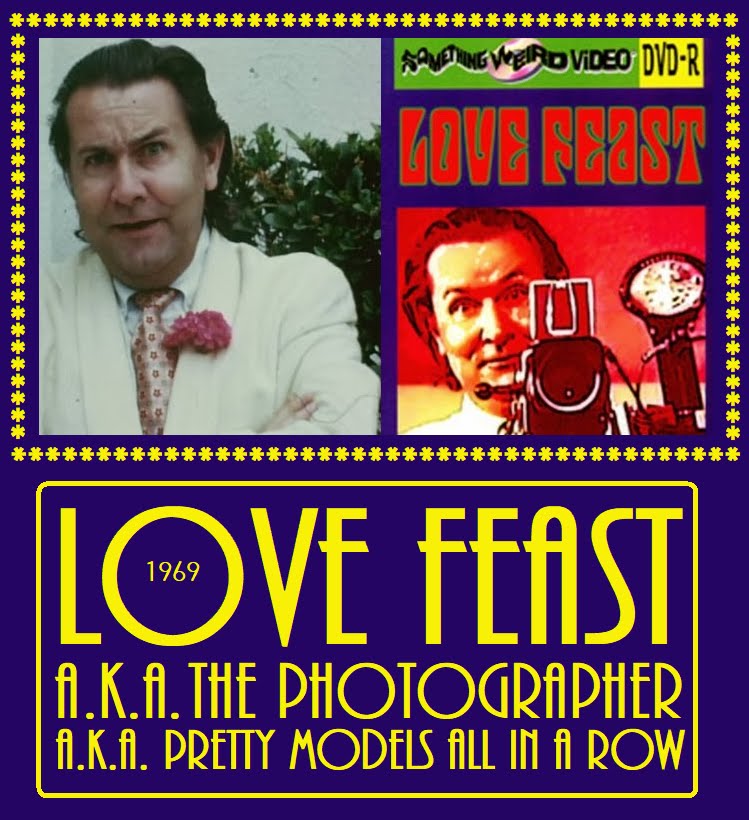
his Errol Flynn-style good looks now drowning in the boozy bloat that has engulfed his body and face, his greasy and unkempt brown hair dangling carelessly down to his shoulders, his sagging jowls and double chin stained gray by his five o'clock shadow. His speech is slurred, his gait unsteady, his physique doughy. In short, he's a mess. The years have not been kind to the Poughkeepsie boy who heeded the advice of Horace Greeley and went west.
But there is still a touch of impish mischief in his sparkling blue-green eyes, and with some assistance from those expressive eyebrows of his, Eddie can still do a vaguely recognizable version of the "come hither" gaze that had charmed numerous young women in the 1940s and 1950s. The pixie, the satyr, the life of the party—they're all still in there, somewhere. It just takes a little more effort to rouse them from their slumbers. Donning women's apparel helps him do that, so he routinely stuffs his now-ruined body into a silver cocktail dress—"the grossest thing in the world," recalled friend and fellow filmmaker Joe Robertson—and dons high heels and a crooked blonde wig to become his idealized feminine alter ego, "Shirley." An unenthusiastic Robinson classified this character as "a 45-year-old bar hooker."
had not directed a theatrical feature for nearly a decade. He would get the a chance to helm a motion picture the very next year, but unlike his previous movies, this one would be in the field of hardcore pornography. Meanwhile, Eddie was paying the bills as a pulp novelist and occasional screenwriter for hire. So many, many paperbacks in those years:
cranking out one vile volume after another for the insatiable "dirty old man" demographic. Maybe Ed was becoming a dirty old man himself.
old by 1969. The strength and vitality of youth were ebbing away, a sad truth he would occasionally lament in his writing. But all was not lost! Eddie still had his circle of friends, many of whom were in show business and had known him for years. Though they hadn't made a movie together since Eisenhower was in office, Eddie and Paul Marco still talked of making
, with Marco as the flamboyant LA-based gangster who was then doing time for tax evasion at Alcatraz. Like so many of Ed's far-out ideas, this one never got much past the "bullshitting" stage. Another planned biopic, based on the life of Civil War photographer Matthew Brady and rather disingenuously titled
, was stillborn as well.
The topic of photography, though, would prove crucial to another Ed Wood screenplay that went into production in 1969. Fascinatingly, it was this eccentric project that would give Eddie the most prominent acting role of his career outside of his turn as the tortured titular transvestite of
(Rhino Video, 2000). The disc also contains Ted Newsom's 1994 documentary
. Something Weird Video has the film under its original release title,
for ten dollars. Additionally, SWV markets two compilations that contain
., both $10 DVD-Rs. These are
My friends, let us now discuss two giants of the exploitation film business: Joseph F. Robertson and Hal Guthu. Joe—"Daddy Joe" or "Papa Joe" to his many friends—had been a Marine in WWII, just like Eddie. It was to Joe that Ed had made his famous confession about wearing pink panties and a pink bra under his uniform during the bloody, casualty-heavy invasion of Tanawa. Robertson deemed it a risky move: "In the Marine Corps, you don't do that stuff."
Like Ed, Joe got into the picture business after the war, though his first efforts in that arena did not surface until the early 1960s. Seeking, as Ed Wood had, to capture the cultural zeitgeist on celluloid and deliver it up to a waiting drive-in audience at fifty cents a pop, Joe Robertson produced a series of quickie B-movies that would one day be used for target practice on
Joe also must have had a fondness for sweet lady liquor, because he ran a joint called the Surf Girl where Eddie, or rather "Shirley," was a hard-drinking regular who referred to "herself" in the third person and who typically needed a ride home at the end of the night. Naturally, these two filmmaking ex-jarheads were bound to collaborate on a project sooner or later, and that opportunity came in the form of a screenplay Ed had typed at his usual lightning pace called
. As Robertson hazily recalled, decades later:
, was not only Joe Robertson's directorial debut but also his first venture into the world of cinematic sexploitation, where he would dwell quite productively until the mid-1990s, when he passed away shortly after the completion of
(1994), which he produced and directed under the name Adele Robbins. (Thank you, Tony Biner, for that bit of information.) Despite what the opportunistically altered credits in the retitled Rhino Video version may say, there is no truth to the claim that Ed Wood either directed or produced
. Those responsibilities were handled by Mr. Robertson.
veteran Casey Larrain.
(1971), starring Russ Meyer regular Uschi Digard, marked Robertson's transition to hardcore, which is where he stayed for the rest of his movie-making career. In a Facebook forum, adult movie actor and historian
The viewing experience: Watching
Love Feast is an experience that one does not
savor so much as
endure. To the diligent Ed Wood acolyte, this movie presents a distinct challenge, a gauntlet if you will. For its entire running time (just over an hour),
Love Feast taunts us with implicit questions:
How far are you willing to go in your pursuit of this man? How much do you really want to see? Are you sure you wouldn't rather turn back?
Obviously, a movie with Ed Wood in the lead role and logging more screen time in the process than he ever had or ever would is too significant to ignore. And yet one sees Eddie on the screen in
Love Feast, nude but for a pair of saggy briefs, looking for all the world like an overgrown baby, and wonders if this moment is too personal, raw, and vulnerable to even watch.
You wanted Edward Davis Wood, Jr.? Well, here he is. Take a good, long look.
 |
| One of Love Feast's literal "painted ladies." |
But let's get down to cases and discuss some specifics. The film begins with a memorable, though not necessarily in a good way, title sequence designed by Granville Murphy, who also served as a second AD on
The Affairs of Aphrodite (1970), written and directed by the ubiquitous Alain Patrick. As the movie's groovy, mid-tempo theme song plays (
"Come with me!/Ooh! Ahh!/To the love feast!"), some anonymous nude women undulate in front of ugly faux-psychedelic wall art and splay themselves across equally garish furniture. Echoing Don Davis's
For Love and Money (1967), these lasses have been elaborately "decorated" with blotchy body paint.
A few of these young women even have the film's credits printed on their thighs, backs, and buttocks, making them look like Goldie Hawn, whose elfin body was being used as a kind of living Post-It Note on TV's
Laugh-In at the very time this movie was in theaters. The evocation of
Laugh-In is furthered by the theme song's many repetitions of the show's famed "Sock it to me!" catchphrase. Wood-ologists may note that one young lady seems to be using a brass statue of a snake as an instrument of erotic pleasure. The serpent-as-phallus motif was also present in Ed Wood's
Bride of the Monster (1955) and the Wood-scripted
Orgy of the Dead (1965).
The Rhino DVD excises some shots that give proper credit to Joseph F. Robertson and adds in their place a totally fraudulent superimposed caption reading: "Written, produced, and directed by Edward D. Wood, Jr." Something Weird's version of the film, though somewhat muddier in picture quality, presents a more intact version of the credits. Either way, though, the title sequence is an eyesore. The women appear to have a sickly, unappetizing pallor, due to a combination of harsh lighting and the puke-green paint slathered on their bodies. I may be prejudiced here, though, as I have never found body painting sexy and am glad it has not come back into vogue.
Once the titles mercifully conclude, the film proper begins. The plot of
Love Feast is stock simple, at least until its last third when it makes one of those unsignaled left turns for which Ed Wood has become famous. A pudgy, disheveled Wood, clad in a snappy-looking white suit with a pink carnation on the lapel, portrays a photographer—possibly amateur, possibly professional, either way a freelancer—named Mr. Murphy. Murphy must be doing all right for himself, since he lives in an attractive home that is almost entirely white both inside and outside with a black, wrought-iron gate, a circular driveway, and an ornately-decorated, jade-colored door. The only outwardly visible clue to the seediness and degradation contained within this house of ill fame is a lurid, burgundy red doormat.
Throughout the film, director Robinson uses a deep shade of red as a prominent accent color. The mirrored
boudoir where most of the film takes place has lampshades, drapes, and bedding in this same unmistakable hue. The home's decor also includes various bronze statuettes here and there—mostly cupids, but also one gorilla seen in a cutaway when Mr. Murphy makes a sexual reference to
King Kong (1933). And, yes, two of Ed's previously-produced screenplays,
Bride and the Beast (1958) and
One Million AC/DC (1969), featured sexual and/or romantic relationships between gorillas and human women. It's officially another motif in his career.
Ed Wood's front-and-center status is established immediately with a monologue delivered by Mr. Murphy directly to the camera. The old lech tells us about his special "technique" for luring young women to his home: he goes through the telephone directory, picks out modeling agencies, and asks them to send over some young women to pose for him. Once these nubile nymphets are in his home, Murphy wastes little time divesting them of their duds, after which he steers him into his bedroom.
On the day depicted in this film, which seems to take place roughly in real time, Murphy tells one such lady that he has "an awful lot of appointments" but that he may be able to squeeze her in. And he's not kidding! The first prospective model, Linda (Casey Larrain in her screen debut), appears at the Murphy manse only moments later, and others are soon to follow. Of the girls, Linda is one of the very few to get any kind of personality or rudimentary character development. When Murphy tells her to disrobe, for instance, she initially takes offense and refuses. His extremely weak alibi that he wants her to model for a line of see-through clothing, though, is enough to change her mind. All in all, to paraphrase the late film critic Roger Ebert, Linda "puts up what only her mother would consider a struggle," and she is soon romping on that decadent crimson bed with our self-proclaimed shutterbug protagonist.
But their fun is interrupted by a knock at the door. Surprise! It's another pretty young thing, suspiciously eager to doff her duds and climb into bed with Murphy and Linda. This pattern will be repeated every few minutes; a new model shows up at the door, is greeted by Ed Wood, disrobes or is stripped naked by Wood, and climbs onto the bed with the others. Somewhere in the middle of the film, a cab driver with a Day Glo green shirt and a flower in his hat band mistakenly shows up at the house, and an exhausted Mr. Murphy pays him $20 to take his place in bed.
Later, as further employees of the fictional ABC Modeling Agency join this pile of wiggling, wriggling, giggling, writhing human flesh, two "young stud"-type plumbers—one bearing a wrench, the other a plunger (two of the least-arousing phallic symbols in my memory—show up out of nowhere and naturally make themselves right at home. The bedroom, as you might guess, becomes very crowded, and
Love Feast slowly transforms into an eroticized, feature-length variation on
the famed "stateroom scene" from the Marx Brothers movie
A Night at the Opera (1935).
Director Robertson keeps cutting back to shots of the bed and its unclad inhabitants throughout the film, and Hal Guthu zooms his camera in and out to give us a good look at what's supposed to be happening there. But mostly what we see are people's backs, arms, legs, scalps, and buttocks. It becomes difficult not to notice all the little physical imperfections—the tan lines, scars (Ed Wood has a beaut running down his left side), bruises, and cellulite. One gentleman has a mysterious tattoo reading "The White Rabbit." Another keeps his knee-length black socks on the whole time. Everyone appears to have a fish-belly white complexion, and the bright red decor only makes that problem worse.
As I see it, the maker of any adult film has one goal that supersedes all others:
to make the flesh irresistible
so that the viewer will want desperately to grab it, fondle it, caress it, etc. Pornographic movies should be
tactile as well as auditory and visual, and it is here that
Love Feast falls short as erotica. There is nothing in this film you will want to touch. The sexual dogpile becomes monotonous over the course of the movie, and some shots may actually be repeated. I am quite sure I heard some unseen figure, perhaps Papa Joe himself, address Casey Larrain by her real first name in two separate scenes. "Casey, move your hand a little bit," says the man on both occasions.
 |
| Ed's beloved Imperial Whiskey |
Mr. Murphy has had enough. Possessing almost no sexual stamina whatsoever, Ed Wood's forlorn character soon retires to the tranquil, almost Zen-like sanctuary of his back yard to enjoy some of his beloved Imperial Whiskey. (Guess he found a new supplier for his favorite drink. See last week's column for details.) The long neck of the whiskey bottle, coupled with the fact that Ed pours its contents into a wine glass, confused me for a moment. But the Imperial logo on the label is unmistakable.
From this location, Wood/Murphy again addresses the audience directly, telling us he his glad that he is no longer young. But there is no rest for the wicked, and the incessant doorbell keeps summoning poor Mr. Murphy, whose once-immaculate attire disintegrates into chaos over the course of the film.
I should mention some oddness with the film's audio. There are many scenes with Ed walking down a hallway to and from the front door, and nearly as many scenes with Ed greeting each individual model. Joe Robertson filmed the hallway and front door scenes without sound and had Ed do some very noticeable "wild track" dialogue that was clearly recorded elsewhere at a different time. A clear giveaway: Ed's lips don't move. Because of this extensive use of looping, I almost didn't notice when, late in the film, we start to hear Mr. Murphy's increasingly-paranoid inner monologue" a storytelling technique very much in the style of Dudley Manlove's narration from Ed Wood's
Final Curtain (1957). Wood/Murphy has such thoughts as "This can't be real!" and "I'm not gonna make it!" as the afternoon wears on, and he wears down.
 |
| Ed Wood's ritual humiliation in Love Feast. |
I mentioned earlier that the film makes a sharp left turn in its final stages. Oh, does it ever. A group of young women drive up to the door in a convertible, and as usual the depleted-yet-jovial Murphy comes to greet them. But these are not the submissive sex kittens we've been seeing for most of the last hour. No, sir. These are take-charge gals who immediately make Ed Wood their sex slave. First, they put a dog collar complete with leash around his puffy, swollen neck. Then, in the scene that dedicated Wood-ologists have been waiting the whole movie for, they have him remove his masculine attire and put on a frilly pink nightgown and canary-yellow panties. At long, long last, "Shirley" (minus the wig) has made her first screen appearance in the Age of Aquarius.
The women themselves strip down to total nudity, apart from the lone African-American of the group (Mia Coco) who retains her lacy black panties. Whether this has some racial or allegorical significance, I cannot say. While the eponymous "love feast" continues unabated in the bedroom, the living room becomes the setting for a sequence that feels like a cheapskate, gender-reversed version of Stanley Kubrick's
Eyes Wide Shut (1999). The women gather around the debased, degraded Mr. Murphy and speak in somber tones about rituals and tests that our hero will have to endure to prove his worthiness, the first of which is to lick the black patent leather boot of one of the girls.
When the women ask their new plaything if he has any experience along these lines, Wood/Murphy responds in the affirmative: "I was in the service." This, of course, is a reference to Ed's stint in Uncle Sam's beloved Marine Corps, though he has taken the figurative term "boot-licking" (a synonym for "apple-polishing" or "brown-nosing") and made it shockingly literal. Eddie obviously took on a submissive, obedient role in the military, but this line gives that whole experience an unwholesome connotation. Murphy's licking of the boot, shown in unforgiving close-up, constitutes the movie's climax.
This boorish, aging, chauvinist has been humiliated and dominated by a group of strong, vital young women, perhaps emboldened by the burgeoning feminist movement. The user has become the used, and moral order has been restored. Or was this Mr. Murphy's plan all along...?
The end of the film finds Wood/Murphy again alone in his backyard and pondering his mortality and fragility. He looks through the window at the still-ongoing orgy and tells us, "The girls back there don't know it, but I'm loving them to death." In retrospect, this is a poignant instance of self-realization for Edward Davis Wood, Jr., who would be dead within a decade. But this painfully honest moment is short-lived. Undaunted and unashamed, Mr. Murphy naughtily tells us that he's going to pull the same phone book stunt next week.
Bringing
Love Feast full circle, Robertson ends the film with a brief reprise of the theme song and a few more seconds with those body-painted women, one of whom has the words
"THE END" inscribed on—where else?—her ass. Thus concludes this distinctly undignified chapter in the Ed Wood saga.
Love Feast is a film all of Eddie's fans should see, but they'd be well advised to have a bottle of Imperial at arm's reach.
This week's installment of "Ed Wood Wednesdays," however, is not yet complete! We have the small matter of a new book to discuss.
ED WOOD'S SLEAZE PAPERBACKS (2013)
 |
| Two pages from Ed Wood's Sleaze Paperbacks: a still from Love Feast and the cover of Black Lace Drag. |
Alternate titles: None.
Availability: Ed Wood's Sleaze Paperbacks (Boo-Hooray, 2013) is now available from
Amazon or directly from
Artbook. A quick Google search turns up
other buying options. For reasons I'll soon explain, I'd advise those interested to obtain the book used or at the lowest-possible price.
 |
| The catalog's cover. |
The backstory: Boo-Hooray (265 Canal St. 6th Floor, New York, NY 10013) is a pop-culture-savvy NYC art gallery that once hosted an exhibition entitled
Ed Wood's Sleaze Paperbacks, the bulk of which was devoted to showcasing the front covers of the various potboilers Ed wrote in the 1960s and 1970s. Curated by Michael Daley and Johan Kugelberg from the collection of science-fiction editor and "pulp scholar" Robert Legault, the show ran from November 2, 2011 to December 4, 2011, after which the books were sold to Cornell University and supposedly integrated into the school's "human sexuality archive." Good to know that Andy Bernard can read
TV Lust or
Bye Bye Broadie whenever he wishes.
Now, nearly two years after the exhibition closed, Boo-Hooray has published this 100-page exhibition catalog, also titled
Ed Wood's Sleaze Paperbacks, supposedly in a limited edition of 750 copies. Artbook describes this newly-published volume as a "fully illustrated, comprehensive bibliography" of Ed Wood's literary career and describes Eddie's "sleaze fiction" as being "as strange, idiosyncratic, and out of step with his times and mores as his infamous movies." The book also contains two brief "poetic homage[s]" to Ed Wood by musician Ricky Luanda of the experimental NYC punk band Chain Gang, an outfit noted for a single called "Son of Sam" (1977) and a 1986 LP called
Mondo Manhattan. These free-form, shambling text pieces reference Ed Wood and
Plan 9 from Outer Space but have very little connection to Eddie's literary career.
For any Chain Gang fans out there, Boo-Hooray is also offering a deluxe $50 version of the book with a slipcover and a vinyl record by Ricky Luanda, paying musical tribute to Ed Wood.
Further suggested reading:
The reading experience: Think of
Ed Wood's Sleaze Paperbacks as less of a
reading experience and more of a
window-shopping experience in book form. This is a slim, insubstantial paperback that is heavy on pictures and very, very light indeed on text. It is likely intended as a chic, fashionable coffee table book. That's to be expected, of course, since this is basically a souvenir from an art exhibit. But since the focus of that exhibit is Ed's literary life, one might have expected a bit more explanatory text and certainly more excerpts from the novels themselves, perhaps even a complete short story or two.
As it is, the best available book about Ed's writing career remains David C. Hayes' flawed-yet-useful
Muddled Mind: The Complete Works of Edward D. Wood, Jr., which is frequently cited and quoted here, as is Rudolph Grey's
Nightmare of Ecstasy: The Life and Art of Edward D. Wood, Jr. The curators of the exhibit have also done a smattering of research into the adult publishing business, just enough to give us a bare outline of how the industry rose and fell (short version: video killed the paperback star) and how Ed Wood fit into the larger mosaic of that strange, shadowy world (short version: he drank a lot and kept getting fired).
Unless you are completely unfamiliar with this aspect of Ed Wood's life, you will probably not learn a great deal from
Ed Wood's Sleaze Paperbacks. The most disconcerting moment comes when the authors chastise Ed for the "racism" of his two Rocky Jones/
Watts novels. Otherwise, the text is written in a dry, encyclopedic manner.
 |
| A typical Ed Wood cover. |
But then, dear readers, there are the pictures!
This book contains many high-quality, full-color photographs of the covers of Ed Wood's books—a hundred pages worth, including the many titles he wrote under assumed names. The curators give us a few back covers, too, and (very rarely) some glimpses inside the books. (Books have insides? Who knew?) If nothing else,
Ed Wood's Sleaze Paperbacks affords the reader an opportunity to study the lurid artwork, bold and distinctive typography, and outrageous advertising claims that made these covers so enticing to sexually-frustrated men of a previous era. Browse them at your leisure. After all, you paid anywhere from $25 to $50 for this book, didn't you?
Thanks to the the back cover of
The Perverts (Viceroy Books, 1968; attributed to "Jason Nichols"), I now have a new addition to my sexual vocabulary:
troilism. My spell checker doesn't like it, but it's an elegant term for a three-way. The pulp cover art, much of it unattributed, is this book's main draw. Weirdly, although coverage of Ed's
Orgy of the Dead (Greenleaf Classics, 1966) takes up six whole pages, more than any other single work in the exhibit, the cover art by Robert Bonfils is reproduced at a rather small size. Meanwhile, an extremely plain, un-illustrated cover for
Let Me Die in Drag (Classic Publications, 1969; credited to "Woodrow Edwards") is shown life size. All in all,
Ed Wood's Sleaze Paperbacks is an extreme example of two people, curators Michael Daley and Johan Kugelberg, trying to disprove the old adage about judging books by their covers.
I have some interest in these yellowing paperbacks as historical artifacts from a bygone age. But my true fascination lies in the chapters that lurk behind the covers, and that's a topic Daley and Kugelberg give only fleeting attention. For these reasons, I will mildly endorse
Ed Wood's Sleaze Paperbacks but recommend that fans try to find it at a discount.
 Next week: One of the cornerstones of Rudolph Grey's best-selling book, Nightmare of Ecstasy: The Life and Art of Edward D. Wood, Jr. (1992), was the author's rediscovery of a Wood-directed feature film that had long been thought lost. Grey described the film in great detail in his annotated filmography of Ed Wood and asked several of his interview subjects about the production as well. After reading such a buildup, one might have expected the movie to achieve a general release on DVD. But here's the thing: it didn't. After 1992, the "found" film seems to have been lost again. Those wishing to see this production have but one option: a collection of silent outtakes that have been cobbled together into a quasi-feature. And that, my dear readers, is just the option I have selected. Be here in a week for my examination of Take it Out in Trade: The Outtakes (1970).