Wednesday, January 15, 2014

Ed Wood Wednesdays, week 27: "The Beach Bunnies" (1976)

Oddball alternate poster for The Beach Bunnies (1976) with sunbursts over the actors' eyes. 

"To make love to someone you may not even like, and to make the audience believe you're really into it, takes as much acting ability as it takes to play Shakespeare!"
-Rick Cassidy, pornographic film actor 
        
"The girls on the beach are all within reach if you know what to do."
-The Beach Boys 
(l to r) Yucca Flats and Pla-Boy Liquor as they look today.
America celebrated the 200th anniversary of its independence from England in 1976, but Edward D. Wood, Jr. had little to celebrate that year, as he was more dependent than ever. Dependent on booze. Dependent on porn. Dependent on favors from friends. And, as we'll soon see, dependent on his own past and his own showbiz memories for sustenance.

Money is the bane of every independent filmmaker and every addict; Eddie, being both, was doubly cursed. Bankruptcy was his apparent destiny. He could never escape it. "He had no conception of money," declared Steve Apostolof. Ed and his wife Kathy didn't even have a bank account. The little money Eddie could earn from his screenplays and stories went toward booze and rent. By the 1970s, the Woods were living in a violent, dangerous, and run-down apartment complex at 6383 Yucca Street in Los Angeles, near the intersection of Yucca and Cahuenga. Ed and his friends all jokingly referred to the place as "Yucca Flats," evoking both a nuclear testing site in the desolate Nevada desert and Coleman Francis' mutation-horror film, The Beast of Yucca Flats (1961), which starred Eddie's late friend Tor Johnson as an irradiated Russian scientist-turned-monster.

At first, the place on Yucca reminded Kathy of the stories of Damon Runyon (the inspiration for the popular musical Guys and Dolls), with its mixture of "racetrack people [and] a couple of hookers." But then, according to actor Paul Marco, a 7-Eleven opened across the street, and Yucca Flats "became quite a hustler place." As of this writing, by the way, there is still a 7-Eleven at that location (1810 N. Cahuenga). "Almost every day/night, there is a stabbing, robbery or assault at this intersection," a Yelp reviewer declared in June 2013. Eddie was ashamed of Yucca Flats and was generally reluctant to have friends over to the place. But they visited him anyway, and their reviews were not kind:
  • "That was a dive ... There would be dog shit right in the halls. " - David Ward, actor and close personal friend of Ed Wood
  • "The place was just horrible" - Nona Carver, actress (Take it out in Trade)
  • "[W]hen you walked in, you just had this ... creeping feeling all over that you might not even survive this walk down the hallway." - Charles Anderson, editor at Pendulum Publishing
  • "I used to go over to that real raunchy place ... Jesus, the doors would be bolted because the cops had raided the next door neighbors." - Aldo Ray, actor
  • "I went over there one afternoon. It was too depressing for me." - John Agar, actor
Yucca Flats' one geographical advantage was its proximity to Pla-Boy Liquor (6435 Yucca Street), a still-existent, still-sketchy establishment just down the street which would cash Eddie's checks and allow him to purchase his alcohol for the weekend. Venturing down to Pla-Boy on foot,  though, was a risky venture and Ed found himself getting mugged by African-American street gangs on a regular basis. He ultimately chose to have Pla-Boy deliver his bottles directly to him. That was a plus as far as he was concerned, but it was a definite minus for everyone else in Ed's life. Alcohol made him violent and abusive. Sadly, it seems he took out his frustrations on the person who was closest to him, i.e. his wife. Kathy, for her part, was vague and euphemistic on this point: "Eddie wasn't nice when he got drunk."

For those who remember the cute, quirky couple portrayed by Johnny Depp and Patricia Arquette in Tim Burton's Ed Wood (1994), it can be especially painful and unpleasant to consider what Eddie and Kathy were really like in their horrendous last years as a married couple, with Kathy yelling ugly racial slurs at the neighbors ("I don't want no nigger trash walking by my window!") and Ed beating his wife (whom he called by her maiden name, "O'Hara") until she was nearly dead because she "wouldn't shut up." But if we want to examine Ed Wood's life and career in its totality, we must come to terms with these grisly, unflattering realities.

Punk princess Shannon Dolder
Touchingly, Eddie retained his enthusiasm and optimism even during these dark times. He never stopped being an idea man, even when he had no way of bringing his ideas to life. He and Kathy befriended a neighboring family, the Dolders, and Ed had some never-to-be-fulfilled plans of turning their daughter, Shannon, into a star with a vehicle called Venus De Milo, a mystery about the famous statue's missing arms to be filmed in Greece. "Ed decided he was going to make me a big movie star," Shannon recalled. "He thought I had the talent to do something." But the funding fell through and Eddie's health collapsed, so the movie was never made. Though Venus De Milo was not to be, the young lady did have some adventures in showbiz.

As it happens, Shannon Dolder aka Shannon Dolder-Wilhelm or Shannon Wilhelm (1956-1996) was quite a fascinating figure in her own right. She was a fixture on the Los Angeles punk rock scene of the late 1970s and early 1980s, performing with a group called The Castration Squad. She was called "the porcelain doll punk Vivian Leigh," by one observer. Shannon's punk compatriots, in fact, were Ed Wood fans! ("A lot of my friends wouldn't miss Ed Wood's films.")

One obituary stated that Shannon was in a band called The Go-Go's. At first, I doubted if this could have been the famous all-female rock group with Belinda Carlyle, but reader Margaret Wynn set the record straight:
"Shannon Dolder was, in fact, very briefly a member of the famous Go-Go's. She lived in the Canterbury Apartments [in Hollywood] along with other band members, and early Go-Go's drummer Elissa Bello was later a member of Shannon's band Castration Squad."
Margaret continues:
"She was beautiful and popular in that very small [Los Angeles punk rock] scene. She had a truly awful band that was one of the first examples of Goth. She had a great sense of style and was a tragic mess. That’s about all there is to tell. (I was also involved in the punk scene at that time, and knew who she was, but not part of that clique.) I had no idea she was a neighbor and friend of the Woods. I guess my interest in Ed’s movies started right around when he died. Wish I’d had the chance to meet him."
Shannon was married but had no children when she died at the very young age of 40 in LA in the mid-1990s. The mementos of her musical legacy are a few grainy performance videos and some rather artsy photographic portraits of the young lady in her prime. Luckily, she was still around in the early 1990s to talk with Rudolph Grey for his book, Nightmare of Ecstasy: The Life and Art of Edward D. Wood, Jr. It was her last significant contribution to popular culture.
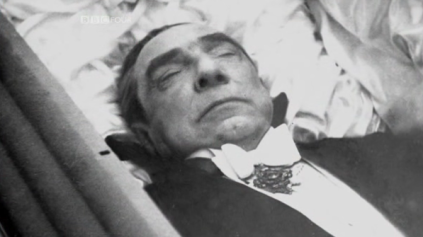
Bela Lugosi at his funeral in 1956.
Ed Wood never forgot  his sci-fi moviemaking past and even remained in touch, albeit sporadically and unpredictably, with some of the old gang from Plan 9 from Outer Space (1959), decades after that film had wrapped. Dudley Manlove, aka Eros the snooty pacifist alien, kindly gave his friend and erstwhile employer a few used typewriters after Eddie had pawned his own beloved IBM Executive model to buy booze. ("It was a very sad day when we lost that typewriter," Kathy recalled.) Mona McKinnon, who'd once portrayed the justifiably-worried housewife Paula Trent, stayed in phone contact with Ed during that last, sad decade of his life. "By 1975," she recalled, "you couldn't reach Ed after six p.m. because he and Kathy would go to sleep by then."

Good old loyal Paul Marco -- synonymous with the role of Kelton the Cop -- stuck around to bear first-hand witness to his pal's alarming decline, as he'd been on hand to witness everything else that had happened to Ed in Hollywood.

And Bela Lugosi? Well, Bela had been dead for twenty years, but he was still a big part of Eddie's life and thoughts. One of the great unrealized multimedia projects of Ed Wood's later career was Lugosi: Post Mortem, an unpublished book and unproduced screenplay about the horror legend's life. The film's cast was to have included Karl Johnson, portraying his father, Tor. According to Rudolph Grey, this highly intriguing project was commissioned by an independent music label called Blue Dolphin Records circa 1975. I can find very little on Blue Dolphin, other than that the obscure company was based in Hollywood and that its roster included an R&B group called Faye Hill and the Hill Sisters. Kathy Wood remembered the book as being quite funny and speculated that working on it may have been keeping Eddie alive during the lean years. Sadly, the "almost finished" handwritten manuscript was lost when the Woods were hastily evicted from Yucca Flats in 1978.

Potential extras in Ed Wood's The Day the Mummies Danced
Eddie's professional life had slowed to a crawl by then. Of course, he was still writing the occasional softcore screenplays for his buddy and benefactor, Stephen C. Apostolof, but Steve wasn't much further ahead economically than Eddie. The Bulgarian-born filmmaker was finding it increasingly difficult to secure funding for new productions. Luckily for him, Steve was his own distributor, via his SCA company, and could at least try to arrange theatrical bookings at home and abroad for his existing movies. There were plenty of those for exhibitors to choose from. In addition to the films Apostolof made on his own in the 1960s, Steve and Ed did three films together in 1972, another in '73, and yet another in '76.  There would be a two-year drought after that, however, and Ed couldn't rely on his writing career as a backup in the meantime.

His steadiest employer in the 1970s, Bernie Bloom's Pendulum Publishing (aka Gallery, aka Edusex) finally let him go in 1975. "Eddie loved Bernie," said Kathy. "He tested Bernie too many times. Eddie was such a kid in a way. When Bernie fired him, it broke his heart." It was a major blow, arguably a fatal one, because Bernie's versatile company distributed magazines as well as books, both fiction and nonfiction, and even some movies. Ed Wood's last big project for the company was a series of twelve super-8 films called the Sex Education Correspondence School (or SECS), which he co-wrote and co-directed with Charles Anderson. These pseudo-educational porn loops represent the last directorial efforts of Edward D. Wood, Jr.

After that, the only publishing company that would release Eddie's novels was Eros Goldstripe, which put out Death of a Transvestite Hooker (1974), Forced Entry (1974), and finally TV Lust (1977).  That was the last confirmed book by Ed Wood to be published during his own lifetime. A 1978 book, Swedish House, is rumored but unsubstantiated.

During all of this, Ed longed to rekindle his career in legitimate movies. Friend John Anderson remembered Ed concocting "a horror script that would have been fine for 1934 but not 1974." When the script was politely dismissed by Wood's old employer, Universal Pictures, a paranoid and delusional Eddie blamed Anderson for "sabotaging" him. Perhaps this script was The Day the Mummies Danced (circa 1976), which Rudolph Grey describes as "Wood's return to the horror genre." This peculiar film "was to have been filmed on location at the famous Guanajuato caves in Mexico, which featured naturally mummified bodies as a tourist attraction." The mummies of Guanajuato were victims of an 1833 cholera outbreak, some of whom were buried alive by accident with horrified expressions on their faces.

Wood's potential cast for the abandoned film included Aldo Ray, John Agar, and would-be backer Dudley Manlove. Needless to say, not a frame of the film was ever shot. But one of Ed Wood's scripts from this same era was made into an actual movie. As Cruel Lady Fate would have it, while Ed Wood was living in squalor and misery, he was tasked with writing a lighthearted, fun-in-the-sun sex comedy about a quartet of young ladies seeking love and laughs on a beach vacation. The incongruous results are described below.

THE BEACH BUNNIES (1976)

Various home video and theatrical releases of The Beach Bunnies.

Alternate titles: Sun Bunnies [video title]; Red Hot and Sexy [alternate UK title as part of a double bill with Ajita Wilson's Blue Passion]; the film's Greek title translates roughly as Sinners on the Shores of Pleasure.

Availability: The easiest way to see The Beach Bunnies today is as part of the six-DVD set Big Box of Wood (S'more Entertainment, 2011). Like the other films in this set, it comes with an explanatory introduction by Ed Wood historian Ted Newsom. A VHS copy of the film, under the alternate title Sun Bunnies, was recently spotted on Ebay for a mere forty bucks. (You can get Big Box of Wood for $27.)

Gidget: The original beach bunny.
The backstory: Counter-intuitive as this might seem, the preeminent beach bunny in American popular culture was created by an author from a landlocked European country. Yes, Austrian-born writer Frederick Kohner wrote the highly successful novel Gidget: The Little Girl with Big Ideas in 1957, taking inspiration from his daughter, Kathy, who grew up in Malibu and immersed herself in the town's thriving surf scene. Kohner's book spawned a series of literary sequels (1959-1968), three major motion pictures (1959-1963), and of course an iconic TV sitcom (1965-1966), which lasted but a single season before becoming a syndication perennial. Other beach-themed Hollywood youth films of the era included Where the Boys Are (MGM, 1960) and Beach Party (AIP, 1963). Bottom-feeding studio Crown International Pictures got into the beach game with Never Steal Anything Wet in 1967, and by the late 1970s, they were pretty much the standard bearers of what had become a particularly disreputable subgenre, with an increased emphasis on T&A and drug-and-booze-fueled shenanigans.

Schlock merchant Stephen C. Apostolof waited until 1976 before dipping his toe into the ocean, so to speak. His misbegotten stab at a beach flick, The Beach Bunnies, was different from the kind of thing Crown-International was doing, though. Crown's beach movies tended to focus on high school and college age characters, while Steve's movie (like all his other 1970s movies) was firmly ensconced in the darker, more sordid world of adults. His characters weren't spring breakers. They were grown-ups with jobs and responsibilities hoping to drown their problems in sex and alcohol for a few precious days.

While characters in Crown-International beach flicks chugged beers at rowdy house parties, the characters in Apostolof's The Beach Bunnies sipped cocktails at dimly-lit piano bars and complained about their dull day jobs. I'll chalk this up to co-writers Stephen C. Apostolof and Edward D. Wood, Jr. writing what they knew. Speaking of which, in an early scene of the film, two of the bunnies talk about their depressing workplaces:
Sheila: Well, this sure beats the four walls of my computer room. 
Bonnie: This is fantastic! All I can see from my office are the tops of buildings... when I'm not staring at a typewriter.
These lines are significant since they so neatly describe Ed Wood's own, rather dismal working conditions at Pendulum Publishing for the first half of the 1970s, a nine-to-five desk job he'd only recently lost when he was writing this screenplay.

As you might guess from the title, The Beach Bunnies was a slight rewrite of Ed and Steve's previous collaboration, The Snow Bunnies (1972). Each film is about a woman who goes on vacation to some resort and takes three of her friends along with her, ostensibly so they can meet guys. The two films are structured along very similar lines: 
  • Prologue which establishes why the frustrated heroine needs to get away.
  • Opening titles with big yellow letters on the screen and upbeat Muzak on the soundtrack
  • Travelogue-type driving sequence with the four ladies making their way toward the vacation spot of choice.
  • Once in their hotel room, the girls undress, redress, then split up for separate storylines. (They do check in with one another sporadically.) Generally, each of the four main ladies gets her own individual boyfriend for the duration of the movie.
  • The female characters hook up with these horny guys in tacky hotel rooms and other workaday locations.
  • A horrifying, anti-erotic sequence in which one of the main characters is raped and/or beaten.
  • More hookups.
  • Still more hookups.
  • Yes, a few more hookups.
  • Our original four characters regroup as their vacation comes to an end.
  • Another extremely long driving sequence as the girls leave the hotel and get back on the highway.
Just like The Snow Bunnies, The Beach Bunnies is a combination of location footage and studio footage. The studio stuff -- mainly hotel rooms, as indicated above -- is virtually indistinguishable from Drop Out Wife, The Cocktail Hostesses, The Snow Bunnies, and The Class Reunion. The sets are constructed from the same materials and feature the same props as those other films. There is one curtain I've come to dread in particular -- a gigantic rectangle of splotchy white-and-green fabric resembling a slice of moldy Wonder Bread. It absolutely dominates any scene in which it appears, as it dwarfs the actors. 

I noticed this time that there were some visible boom mikes during the bedroom scenes, but perhaps this is not Steve Apostolof's fault. The SCA movies in Big Box of Wood, including this one, are all presented in a 1.33:1 aspect ratio and were clearly transferred from videotapes. It is likely, then, that what we are seeing is the full camera negative which has not been properly matted. This would explain also why there is so much "dead space" in Apostolof's compositions. Naturally, the grey-paneled walls from Steve's previous movies make many, many unwanted appearances in The Beach Bunnies. Maybe those depressing tiles were there for sound recording purposes.

The Cameo Room: a forgotten Hollywood nightclub.
The location footage was a little trickier to pin down. During the post-opening-credits driving sequence, there is exactly one legible highway sign, and it identifies the spot as Leo Carrillo State Park Beach. Best known for playing the role of sidekick Pancho in a number of Cisco Kid films and a popular syndicated TV series (1950-1956), Leopold Carrillo was also an active conservationist who served on the California Beach and Parks commission for 18 years. The state park named in his honor is located west of Malibu on the Pacific Coast Highway and has been a filming site for many prominent motion pictures, including Grease (1978), The Karate Kid (1984), and appropriately, Gidget (1959) with Sandra Dee. It is also a popular spot for fishing, swimming, surfing, and beachcombing, so it's possible that Steve Apostolof combined business with pleasure once again and took his family on vacation to Leo Carrillo, just as he did with Mammoth Mountain in The Snow Bunnies.

Other exteriors seen in The Beach Bunnies include a hotel with a distinctive elevator on the outside of the building, a large ranch-style "beach house" on a hill overlooking the Pacific Ocean, and a swinging cocktail lounge called the Cameo Room. This last site was especially intriguing to me, as its exterior featured some very cool-looking neon signs. I could find very little about the place, though, apart from a reminiscence from a retired Navy lieutenant who remembered his mother owning "a little restaurant called the Cameo Room in East Hollywood in partnership with ... a chef and a bartender." And then there was an obituary for a woman named Gladys Mae Davis (1911-2003) who "was an owner of [the] Cameo Room, a nightclub in Hollywood." Ms. Davis' memorial appeared in the Glendale News Press, while the Navy lieutenant's story appeared on the website of Glendale Community College, so I'd have to imagine that there's a connection between the two. Either way, the place is long, long gone.

Top row: Johnny Fain, Brenda Fogarty.
Bottom: Marland Proctor, Mariwin Roberts
As with Steve's previous film, Fugitive Girls (1974), The Beach Bunnies has a cast consisting of both SCA regulars and some fresh faces (and bodies). Apostolof loyalist Harvey Shane was back again, of course, not only as an actor but as Steve Apostolof's Assistant Director on the film, this time sporting bushier hair and a bristly mustache, making him look rather like comedian Avery Schreiber. Con Covert of The Class Reunion and Fugitive Girls was back again, too, as were Cory Brandon and Rick Cassidy (both of Drop Out Wife). Steve Apostolof gave himself a cameo as a piano player in a bar scene and got to show off his skill at the tickling the ivories.

The four main actresses, however, were newcomers to SCA. Playing the central role of gossip magazine editor Elaine Street was actress Brenda Fogarty, then about a year into a five-year stretch of strictly softcore films. Fogarty was not your typical skin flick bimbo, however. Somewhat resembling a Last Picture Show-era Cloris Leachman, Fogarty had genuine acting chops and a warm, naturalistic screen presence. After her half-decade in movies, she remained active in the theater, penning a one-woman show called The Lesbian Monologues and appearing in YouTube videos under the direction of acting teacher Charles Tentindo.

Texas-born beauty Mariwin Roberts made her film debut here. She went on to be Penthouse magazine's Pet of the Month in April 1978 and did a few more R-rated sex comedies before dropping out of show business to become an artist. As of this writing, she's alive, well, and living in Oxnard, CA.

Linda Gildersleeve and Wendy Cavanaugh also debuted here, thus embarking on similarly-undistinguished careers in low budget skin flicks of the late 1970s. Gildersleeve seems to have earned a little extra pocket money as a pinup model, too. Steve Apostolof must have been impressed with these ladies, because he brought Roberts, Gildersleeve, and Cavanaugh back for his next and final film, Hot Ice (1978).

Among the film's notable male talent was Robert Bullock, then just embarking upon a two-decade career in porn which would include Genital Hospital (1987), My Bare Lady (1989), and FrankenHurter: Queen of the Porno Zombies (1993). Marland Proctor, who goes uncredited here despite playing a pivotal role as movie star Rock Sanders, had previously appeared in Steve Apostolof's Lady Godiva Rides (1969) and would eventually claw his way up to legitimate roles on such TV shows as The Rockford Files, Quincy, Fantasy Island, Hunter, and more.

By far, however, the most famous cast member, male or female, in The Beach Bunnies was Johnny Fain (hilariously billed here as "John Aquaboy"), a renowned California surfer who parlayed his success on the waves into a nearly twenty-year film career as an actor and stuntman, including an appearance in (you guessed it) Gidget. He also played doomed ranch hand Shorty Shea in the 1976 TV movie, Helter Skelter. Fain seems to have dropped out of public life since the 1970s, but he has occasionally resurfaced to comment on the physical toll of being a surfer and to eulogize one of his colleagues. Fain does a little surfing here, but it is brief and quite lame. You'd never guess he was once considered "one of the four aces of Malibu."

Depending on your definitions of "last" and "movie," The Beach Bunnies could be considered Ed Wood's last movie. Specifically, it's the last feature-length production based on one of his screenplays to be filmed and released during Eddie's lifetime. Rudolph Grey's filmography in Nightmare of Ecstasy ends with this movie, for what that's worth. But by the same token, I could point out that The Sinister Urge, Necromania, Hot Ice, and other films have been called his last, too. In fact, there are more "last-ever Ed Wood movies" than there are "fifth Beatles" and "farewell tours by the Who." Considering that his screenplays and novels have inspired posthumous films, there never will be a true end to his filmography in all likelihood.

"I've got to know if Rock Sanders has a cock!"
The viewing experience: Alternately enervating and intriguing, in the typical Wood/Apostolof tradition. After the welcome change of pace provided by Fugitive Girls, The Beach Bunnies was a return to the same old, same old. Once again, as pointed out by Ted Newsom, the script was merely an excuse for a lot of nudity and simulated sex. Ironically, modern day viewers will likely find these sex scenes tedious and take more interest in the plot and dialogue. Were it not for the contributions of Ed Wood to the script, after all, it is probable that The Beach Bunnies would be forgotten in the 21st century. As with pretty much all of the Wood/Apostolof films, you're going to want to fast-forward through the supposed "good parts" of the movie, i.e. the romantic interludes, and focus your attention on the narrative shoe leather holding them together. That's where the fun is.

Take, for instance, the movie's infamous opening scene, which sets up the wafer-thin plot and gives us some of Ed Wood's trademark themes and motifs. After a typical Apostolif-ian establishing shot of a phallic skyscraper, we cut to the interior of what's supposed to be the wood-paneled office of Blue magazine editor Elaine Street (Fogarty). Elaine's sitting behind her desk in a white wicker chair that definitely looks like patio furniture. She's wearing a rust-colored polyester pantsuit which will set the tone for the outfits we'll see throughout the movie. Behind her is that hideous green and white curtain which Apostolof has previously used in scuzzy motel rooms in his other movies.

As the scene begins, she's angrily lecturing a guilty-looking reporter (played by a non-speaking, unbilled actor) who has a porno mustache and wears a "Canadian tuxedo" with a black bowtie. As she yells at him, he looks like a child being scolded by his mother. The film begins with an extended monologue, which Brenda Fogarty handles with aplomb:
Elaine: Great Scott! You want something done around this place, you have to do it yourself! (pointing at the reporter) You've put me in a hell of a bind! 
(She stands up.) 
You've had two weeks to file a story on Rock Sanders, and what kind of stuff do you hand in? 
(She picks up a piece of paper and starts to read.)  
"Rock Sanders, just back from Denmark, is thought..."  Thought?! Facts! That's what Blue magazine demands!  "...thought to have had a sex transplant performed on him."  (scoffs) Ha!  "Is he really going to marry his agent, Bruce Collins?"  
(She waves the paper in the reporter's face.) 
What kind of reporting is that? You ever heard of lawsuits? 
(She walks around the desk and sits down on it, now just inches from the reporter.) 
When I was a reporter, I'd do everything and anything to get my stories in! And you hand me garbage like that? 
(She goes back to her chair, nearly knocking over a globe on her desk in the process.) 
Two weeks you've had to file a story, and all I know is that Rock Sanders is ready to star in SCA's new film, Tidal Wave 2000. And big deal, he's staying at the Silver Cove Lodge. (sighs) Look, right now Rock Sanders is pretty hot stuff. Next month he could be a nobody. Blue magazine has got to know the facts! I've got to know if Rock Sanders has a cock! 
(An intercom on her desk buzzes; she speaks into it.) 
I said to hold! 
(She turns her attention back to the reporter) 
Get out of my sight. Go cover that dog show. I'll handle Rock Sanders myself. 
(The reporter gets up and shuffles toward the door, defeated. A distinguished middle-aged man with graying temples and a brown suit walks in. Elaine greets him.) 
Morning, J.B.
JB: (sitting down) What about this Rock Sanders story?
Elaine: I'm working on it, J.B. 
JB: Working on it?! What the hell is that supposed to mean? 
Elaine: Well, see... 
JB: Hey, I've got a deadline to meet! And you tell me you're just "working on it?" 
Elaine: No... no... uh... I've just taken over where what's his name left off. 
JB: (slams his hand down on her desk) I need a lead story and Rock Sanders is it! 
Elaine: Watch your blood pressure, J.B. You'll have it! And I know exactly how to do it! 
JB: So you have a plan. Well, what is it?
Elaine: Yes. (She walks around the desk again so that she's mere inches from her boss.) Well... so he's staying at the Silver Cove Lodge. Now that much we know. I'll just go out there and interview him. 
JB: (interrupting) You'll be kicked out on your butt like all the others that's tried to interview him! His fag agent will just not let anyone near him! 
Elaine: You underestimate me, J.B. You see, I have three beautiful girlfriends that I'll take with me as decoys. And then, when I turn on my own sex charms, I'll get that story, J.B. You know I will. 
(Wocka chicka music fades in on the soundtrack.
JB: (smiles and nods, then rises from his chair and moves even closer to her) You know, that just might work? I've always thought you were the sexiest editor in town. BUT... get that Rock Sanders story. 
Elaine: I'll bring it in personally. Have I ever let you down? 
(They kiss, leading to an extended makeout session. Then she undoes his fly and kneels down, out of frame. We see his pleasured reaction to the implied fellatio as the image goes blurry.)
 Oh, yeah. This is gonna work.
This scene, probably the film's dramatic and comedic peak (and it occurs in the first five minutes), tells you pretty much all you need to know about what happens in The Beach Bunnies. After the theme song, Elaine and her pals go to the Silver Cove Lodge, where Elaine tries repeatedly to get close enough to Rock Sanders to determine whether or not his penis is still attached. Basically, she spends the whole movie acting like Wile E. Coyote: she comes up with some harebrained scheme to spy on and/or grab Rock Sanders; she tries it; it fails miserably; repeat. That is, until the end when she finally bangs him and gets a definitive answer to her question.

Honestly, that's not much of a spoiler because Marland Proctor plays his part in such an obviously-masculine way that neither his gender nor his sexual orientation is ever even remotely in question. Elaine's strange statement about using her friends as "decoys" is just so much fertilizer, since the other three women -- Lorrie (Roberts), Sheila (Gildersleeve), and Bonnie (Cavanaugh) have no impact on the main plot whatsoever. After the introduction, each young lady gets her own individual, largely self-contained subplot. This mostly means that they get paired up with guys and screw their brains out for most of the movie. (There is one major, jarring exception, which we will discuss shortly.) And of course, we can't miss Steve Apostolof's plug for his own distribution company, SCA.

Con Covert as "fag" Bruce Collins.
Wood-ologists can also study the opening scene from The Beach Bunnies for insight into the mind of its ever-confounding author. Elaine's insistence on "facts" is classic Ed Wood, for instance, even though the man himself was a notorious fibber who often retreated into the safety of delusion and denial. For some reason -- critic Rob Craig suggests it might be the influence of Jack Webb's Dragnet  -- the importance of facts is a major recurring theme in many of Ed Wood's screenplays, going all the way back to Glen or Glenda? (1953), which promises in its prologue to give us "the facts -- all the facts -- as they are today." In Bride of the Monster (1955), Police Capt. Robbins (Harvey B. Dunn) tells Loretta King's nosy reporter that "facts are our business. Facts and only facts, and don't you forget it!" In Jail Bait (1954), pious Dr. Gregor (Herbert Rawlinson) states that "the proof is in the fact!" Similarly, Criswell promises in Plan 9 from Outer Space (1959) to give us "the shocking facts about grave robbers from outer space" and then, in Orgy of the Dead (1965), tells us that he has "related the unreal and showed it to be more than a fact." In Venus Flytrap (1970), grouchy Dr. Bragan (James Craig) declares, "I want the facts. The facts, do you hear?" You get the idea.

Meanwhile, the possibility that Rock Sanders may have had a sex change is an obvious callback to Glenda. Gender reversal and gender fluidity are pillars of Ed Wood's career, both on the page and the screen. Note that Rock's manager, Bruce Collins, is derisively referred to as a "faggot," both here and throughout the movie. Con Covert plays Bruce as yet another of Ed Wood's lisping, limp-wristed sissy stereotypes. (See also: The Class Reunion, Take it out in Trade, the novel Killer in Drag.) Elaine also refers to an unhelpful desk clerk as a "fag." Ed Wood's exact feelings toward homosexuality are difficult to suss out. Ted Newsom has speculated that Eddie was likely at least bisexual.

Homosexuality and bisexuality are themes he returns to again and again (and again and again!) in his writing, even more so in his paperbacks than in his movies. Curiously, one thing I've never found in Ed Wood's writing is any sense that he appreciates male beauty. Oh, sure, he has handsome, rugged male protagonists (see Sheriff Buck Rhodes in Devil Girls), but he doesn't fawn over them the way he does with women. The only time Ed, either as a novelist or a screenwriter, lingers over the appearance of a male character, is when that character is in drag. And, trust me, this is a guy whose fetishes and obsessions find their way into everything he writes, whether they belong there or not! Ed's sexual interest was definitely focused on feminine characteristics, as demonstrated by women and (perhaps) by transvestite men. The male form held little fascination for Edward D. Wood, Jr.

Elaine is "rescued," much to Rock Sanders' amusement.
But the male form -- specifically that of Rock Sanders -- holds a great deal of fascination for Elaine Street. As I mentioned earlier, she spends the majority of the running time trying and failing to get near Rock's crotch in a series of increasingly-wacky gambits that feel like something out of a porno version of I Love Lucy. At first, she simply pretends to be Rock's "cousin" and calls the front desk for his room number. The clerk isn't buying it. ("What a faggot!") She finally gets the number by screwing a bellboy (Bullock, in an amusing debut). One critic was unkind enough to point out that Ms. Fogarty seems to have rather a nasty rash on several parts of her body in this sex scene; nevertheless, it yields the desired results. She gets the room number: 714.

But when she calls Rock's room, she gets cigarette-holder-clutching Bruce Collins, who shoots her down immediately, saying in a sing-song voice, "It is my happy, happy duty to inform you that we do not give interviews." Click. That's when the Lucy Ricardo/Wile E. Coyote gene kicks in. Elaine pays a maid $50 for her uniform and enters Rock's room. She tries to peep on him when he's in the bathroom, only to be caught (again) by Bruce. The next day, Elaine spots Rock Sanders on the beach and tries to get his interest by pretending to be attacked by a shark. Why a shark? Well, this was the year after Steven Spielberg's Jaws (1975) broke box office records. This plan too, is a flop. Rock just sits on the beach, staring in amusement, while a Japanese tourist dives into the ocean to "save" Elaine.

Stereotypes are in full effect here. Of course, the tourist has a giant camera around his neck. His companion, a non-Asian actress, is clad in a kimono and carries a silk parasol around with her, as if she's dressing up like a geisha for a costume party. As the well-meaning Japanese fellow carries a protesting, kicking-and-screaming Elaine out of the water, Rock gets the "punchline" for this silly scene: "God, I've gotta learn how to swim sometime!" (I swear, this is followed by a "wah wah wah wahhhhhhh" stinger on the soundtrack.) But our intrepid reporter is far from finished! Her next plan involves standing outside Rock Sanders' room with a fire extinguisher and yelling, "There's a fire! Everybody out of the building!" Unfortunately, in all the confusion, Elaine grabs the crotch belonging to -- can you guess by now? -- Bruce Collins, who is suitably offended. ("You bitch!") Dejected, Elaine sits on the floor in the hallway, spraying foam from the fire extinguisher as Hanna Barbera-type music plays on the soundtrack.

Top: Steve Apostolof at the piano.
Bottom: Chris & Bonnie & Lorrie & Dave.
Meanwhile, while all this is going on, the three non-Elaines cruise for guys at the nearby beaches and bars. Sweet, shy "computer analyst" Sheila Barnes begins a rather chaste courtship with golden-haired surfer boy and trust fund layabout Dennis Coleman (Johnny Fain). That night, she and the Big Kahuna have a boring dinner at a boring-looking restaurant and talk about how boring they are. (He: "Life with the jet set just isn't my bag." She: "I know what you mean! Now, my friends, they thrive on the fast life.") The great thing about this scene is that the actors seem to run out of dialogue before it ends, but the camera just stays on them, smiles frozen on their faces, for a few seconds of what Uma Thurman would call "uncomfortable silence."

Over at the Cameo Room, featuring Mr Stephen C. Apostolof at the piano, Lorrie and Bonnie, get hit on by a couple of cheeseball lounge lizards, Dave (Cassidy) and Chris (Shane), who wear garish polyester outfits and dub themselves "two of the most fantastic studs in town." Dave gets Lorrie and Chris gets Bonnie. That's pretty much how it stays for the rest of the movie, except for one scene in which Dave and Chris double team Lorrie in a hotel room with all the enthusiasm of motorists exchanging insurance information. Another great Ed Wood motif, alcohol, is the cornerstone of these relationships. "That's pretty potent stuff," Dave says of Lorrie's drink "Well, I like 'em... potent," quips Lorrie. Dave, it should be noted, is a pilot -- one of the more frequent occupations in the Wood-iverse. (See also: Plan 9, Drop Out Wife.) This allows for several leering puns about Lorrie's "landing strip." Yeesh.

The boys waste no time in following through on their sexual innuendos. Mere moments after meeting, Chris and Bonnie are canoodling on the former's catamaran. At least Dave and Lorrie have the decency to drag themselves back to a hotel room. Here, we get to see Rick Cassidy's "Shakespearean" feigned lovemaking at its finest.

Sheila cheerfully discusses her rape.
Very unfortunately for the movie, Sheila's subplot goes off on a nasty tangent at this juncture in the narrative. Our redheaded computer analyst confides to Elaine that "there wasn't a bed scene" between her and Dennis. Elaine tells her friend to "stop being such a prude," lest she wind up "an old maid." This, I'm afraid, is foreshadowing. Sheila agrees with Elaine, who is the Marcia Jordan-esque mother figure to the group, and goes out for a walk on the beach. One of Apostolof's jarring dusk-to-dark jumps later, Sheila is strolling along the beautiful shore of Leo Carrillo when she's stopped and harassed by a trio of fairly clean-cut-looking surfers -- Coolie, Tenpipe, and Hickory -- who look like stand-ins for the Beach Boys circa 1963. Later, Sheila will refer to these fellows (totally inaccurately) as "hippies," which shows you just how out of touch Ed Wood and Steve Apostolof were with the counterculture, a movement which had been dead for several years by the time this movie came out.

Anyway, as is becoming a sickening trend in Steve and Ed's movies, Sheila (the nicest character in the story, by the way) is gang raped by the three young men, who strip her naked, then take turns forcing themselves on her. In an absolutely unforgivable twist, Sheila ends up enjoying the "sex" she's having, making this movie even less sensitive than The Cocktail Hostesses. The next morning, Bonnie rouses the sleeping Sheila from her slumbers. Both Bonnie and Elaine, however, soon recognize that something is wrong with their friend, leading to the following discussion, which I present here so that you can read it over and think about what message or messages are being conveyed:
Bonnie: What's the matter, Sheila? Did you have a fight with Dennis last night? (Sheila does not respond. She looks catatonic.) Did you have a fight with Dennis? 
Sheila: I didn't see Dennis! 
Elaine: What's the matter, honey? 
Sheila: I was raped! 
Bonnie: Raped? 
Elaine: When? 
Bonnie: Last night. I was walking along the beach, and all of a sudden I was surrounded by three hippies! 
Bonnie: Oh my god! 
Elaine: Go on. 
Sheila: Well, the next thing I knew, they'd ripped my clothes off, and they were all over me! It was horrible! (Elaine winces.) At first. 
(Elaine and Bonnie are understandably puzzled by this last utterance.) 
Bonnie: Didn't you scream? 
Sheila: Yes. (beat) At first.
Elaine: What do you mean, like, what do you mean, "at first?" 
Sheila: Well, everything became really weird, like, suddenly I was enjoying everything they were doing to me. I really did! 
Bonnie: Enjoyed it? How could you? 
Elaine: Bonnie, shut up! 
Sheila: But I did! Is there something wrong with me? 
Elaine: (shaking her head) No. Sex is fine, but... 
Bonnie: Not like that! 
Elaine: Well, I didn't mean like that! There's a right way and a wrong way! God, what a hell of a way to get it! I'd report those bastards if I were you. 
Bonnie: So would I! 
Sheila: I will. (to Elaine) But you're right. You know, it was the actual screwing I liked! 
Bonnie: Sheila! 
Elaine: You know, now maybe you're beginning to think straight. 
Sheila: You bet I am! 
Bonnie: But... 
Sheila: But what? You like it, don't you? 
Bonnie: Well, yeah, but... 
Elaine: We all like it. Just remember one thing: all men are out for the same thing! 
Sheila: I know! But I'll tell you one damn thing for sure! I'm gonna screw every one of them, before they screw me! And it's gonna start tonight! 
Elaine: Right on!
At that point, Sheila gets a call from Dennis, asking for a date which she accepts. Elaine warns her not to wear herself out before "the big beach party tomorrow night," and the three women end the scene giggling like schoolgirls at a slumber party. Okay, time to regroup. What has happened here?  Sheila says that the rape was "horrible," but that she enjoyed "the screwing." Up until the rape scene, Sheila was the only one of the four women not having sex with semi-strangers. Are we to assume that being sexually assaulted by the three surfers was a form of sexual liberation for this potential "old maid?" If so, and this was meant as Sheila's initiation into adult sexuality, why were the rapists (a sorry trio of braying jackasses) portrayed as overgrown boys rather than men? And yet, judging by Elaine's reference to thinking "straight" (i.e. like a heterosexual woman), I think this is exactly the message the movie is trying to convey. 

Perhaps here we can also see some evidence that Ed Wood and Steve Apostolof were operating at cross purposes in their co-creation of this screenplay, as Eddie manages to include some of his typical quasi-feminist dialogue about how men are "bastards" who want to use women for sex. It's all very confusing, and again (!) I have to wonder why Ed and Steve even had a rape scene in the middle of a featherweight sex comedy. What on earth could they have been thinking? If they'd just done this kind of thing once, I'd chalk it up to a lapse in judgment. But they pulled this kind of thing habitually in their movies!

A Farrah hairdo.
After the out-of-nowhere three-way between Chris, Dave, and Lorrie, the movie shows us another one of Sheila and Dennis's dinner dates. Again, alcohol comes to the forefront. "Mmmm," enthuses Sheila, "cognac just warms me all over!" I have to point out that actress Linda Gildersleeve sports a Farrah Fawcett hairdo in this scene. This was the year that gave us both Farrah's iconic poster and TV's Charlie's Angels. It's odd for me to think of an Ed Wood movie which evokes Jaws, Farrah Fawcett, or any other pop culture icons of the mid-to-late 1970s. For some reason, Ed remains permanently entrenched in the 1950s and 1960s in my mind. Regrettably, this scene also confirms that the rape was indeed intended as a sexual awakening/initiation for Sheila. "Somehow," Dennis notes with appreciation, "you've really changed!" All he knows is that she's more affectionate now, sloppily French kissing him, and shimmying out of her dress in record time. Many have questioned the finale of the film Grease (1978), in which previously-virginal Olivia Newton-John dresses like a "slut" in order to appease macho John Travolta. Well, my dear readers, Grease ain't nothin' compared to The Beach Bunnies when it comes to sending questionable, perhaps very dangerous messages to young women. Johnny Fain was a long way from Gidget here, that's for sure.

When Dennis and Sheila finally hit the (pink satin) sheets, a veteran viewer of SCA films will easily notice that the decor of his supposedly posh beach house looks exactly like the cheapskae hotel rooms where our heroines are staying, right down to those dreaded and dreadful gray square panels on the wall.

The unnamed, mysterious Pink Bikini Girl
At last, we reach the film's conclusion -- a climactic beach party attended by almost all the characters. Steve Apostolof makes a fairly clever transition into this scene, zooming in on a candle during Dennis and Sheila's romantic tryst and cutting from that to a bonfire. Get it? One flame to another. For the most part, this sequence is light on dialogue and extremely heavy on bongo music. There are at least two bongoists on hand at the beachfront bacchanal: one who seems really into it, and one who's just kind of going through the motions. For reasons known only to the actor, Johnny Fain wears a Day-Glo orange and yellow wizard's robe to this affair. It's a major distraction, so I'm not certain why Steve Apostolof allowed it. Perhaps it was colder on the beach that night than it looks onscreen.

Elsewhere, Chris wears his ugliest polyester shirt yet, accompanied by mustard yellow shorts. (Oy, the '70s! I'm tellin' ya!) Actor Harvey Shane proves in this scene that he was no dancer, but he's obviously having a lot of fun anyway, looking like a drunken relative at a wedding reception. After a few minutes of watching a bunch of uncoordinated actors flailing around on the sand, a lone dancer -- a busty, dark-skinned, raven-haired beauty in a pink bikini -- emerges as the center of attention. The credits do not mention her whatsoever, but her extended, wordless dance sequence takes up a good chunk of screen time as she writhes, shakes, and gyrates for our amusement. In a way, it's a return to the dance routines from Orgy of the Dead, except that Pink Bikini Girl does not remove her swimsuit. One bystander does yell, "Take it off!" but she does not heed this advice. Weirdly, this is (for me) the most erotically-charged scene in the entire movie.

But then, of course, Steve and Ed have to return to the darned plot. A late-arriving guest at the party is none other than Mr. Rock Sanders, who stumbles over Elaine, causing her to drop her drink. Rock offers to buy her another one (from whom? this is a beach party!), and they begin chatting. "Thank God for small favors," Elaine quietly utters. Elaine and Rock's relationship escalates quickly, from sharing a drinking glass (She: "It's kind of like kissing by proxy!" He: "Why by proxy?") to screwing on the beach. All this is possible because Rock has finally slipped away from the watchful eye of Bruce Collins. ("That guy follows me around like a warden!" laments Bruce.) At last, our intrepid gal reporter gets indisputable evidence that Rock Sanders' genitals are still very much attached to his body. ("Oh, god, it's big!" she exclaims.)

Perhaps to maintain a sense of democracy among the cast, Steve Apostolof occasionally cuts away from the Rock/Elaine tryst to show the furious coupling of Chris and Bonnie and the just-as-eager fornication of Lorrie and Dave. I guess Steve thought we'd seen enough of Sheila and Dennis by this point. And he was right.

Wise advice from a 1976 bumper sticker.
The next day, Elaine and the gang pile into their Cadillac Eldorado and head for home. Apostolof gives us a brief glimpse of the car's bumper sticker, which reads: "If You're Horny, Honk." Of course, as a Simpsons fan, I was immediately reminded of Honk If You're Horny, the fictional movie Homer attempts to see in the classic 1995 episode, "King-Size Homer." This movie obviously proves that the joke was already 20 years old by then, though the bumper sticker in The Beach Bunnies is phrased a little less gracefully. As with its companion movie, The Snow Bunnies, The Beach Bunnies ends with an almost unconscionably long driving scene as our title characters pull out of the hotel parking lot, drive down a fairly busy stretch of road, and finally merge onto the highway. At least here, there's some attempt at humor, because lots of other cars honk their horns when the girls drive by. I guess there were a lot of horny Californians on the road that day. But this gag quickly wears thin, simply because the noise of car horns is extremely irritating after just a few seconds.

And thus concludes The Beach Bunnies, another fairly generic Steven C. Apostolof sex romp which is notable today only for the contributions of Edward D. Wood, Jr. Rob Craig, in his otherwise-exhaustive Ed Wood, Mad Genius, doesn't even bother covering either of the Bunnies movies And yet, from these seemingly insignificant films, we can examine Ed's views toward women, feminism, rape, homosexuality, youth culture, sex, alcohol, and more. So while The Beach Bunnies is not necessarily a "good" movie in any conventional sense, it is far from a worthless one. If you're looking for insight into the mind of Ed Wood, it's worth an hour and a half of your time.
Next week: When is an Ed Wood movie not really much of an Ed Wood movie? When he's just an assistant director and doesn't write, direct, or act in it. Considering that the film in question was such a career-ending disaster for its director, maybe it's better that Eddie wasn't more deeply involved. You see, even while toiling in sexploitation, Steve Apostolof always wanted to break into the mainstream, so he got the not-so-bright idea to invest every last cent of his own money into a diamond heist movie. He really thought that this was his ticket to the big time. To say the least, it wasn't. But the film does hold a unique place in movie history! Unless some hitherto-unknown film arises from the archives, this is the very last movie Ed Wood worked on before his death in December 1978. Maybe now I've got your attention, huh? Either way, make sure you're back here in seven days when I review Hot Ice (1978)


Dirty Made Dirty Movies can be ordered at AmazonBarnes and NobleIndieBoundBAM!BookworksMcFarlandWaterstonesIndigoKinokuniya, and other retailers.

Wednesday, January 8, 2014

Ed Wood Wednesdays, week 26: "Fugitive Girls" (1974)

Ed Wood and Steve Apostolof tried their hand at a "women in prison" (or WIP) movie in 1974.

"Let us punish the guilty. Let us reward the innocent."
-Criswell, Plan 9 from Outer Space (1959)

Courtroom sketch of Dave Friedman and Steve Apostolof
at the Memphis obscenity trial of their friend, Don Davis.
For all his financial and career woes in the 1970s, Edward D. Wood, Jr. had relatively few known run-ins with the law. In fact, I can find no record of Ed ever having been arrested, subpoenaed, or put on trial. For a violent alcoholic who worked in the pornography business and made occasional public appearances in drag, this is actually something of an accomplishment. A point of pride, if you will. It's more than most of his contemporaries can say for themselves.

In The Sinister Urge (1960), Ed Wood depicted raids on pornography studios and arrests of those in charge. It was a fitting prophecy, not for Wood himself but for his cronies. The hammer of the law came down hard on many of Eddie's professional associates as obscenity in the arts became a bigger issue in the late 1960s and early '70s. By this time, filmmakers and publishers were getting bolder, so the voting public turned to the government to crack down. Both Lyndon Johnson and Richard Nixon dutifully formed commissions to look into the subject and assess the potential threat to the nation's values. Nixon, especially, was vehement in his efforts to stamp out smut.

The fall guys, sadly, were often small-time independent filmmakers like Don Davis. Poor Don, who was an assistant to both Ed Wood and Steve Apostolof before becoming a director in his own right in 1967, was infamously busted for interstate transportation of indecent materials in Memphis, Tennessee in 1972. Steve was actually called as a witness in those proceedings, as was adult entertainment kingpin Dave Friedman. Though Don ultimately beat the charges, neither his life nor his career ever recovered.

Ed DePriest, director of the Ed Wood-scripted One Million AC/DC, was also busted, as I learned when I had the opportunity to interview him via Skype a few weeks ago. Alain Patrick, one of the stars of AC/DC, made a whole movie (1972's Blue Money) about his fear of being hassled by the Man. He got out of showbiz altogether after the early 1980s and apparently went into restoring boats.

Steve Apostolof himself avoided the big house, but he had a few close calls according to frequent Apostolof actor Harvey Shane in the documentary Dad Made Dirty Movies:
Some of those [other directors'] sets were raided. If they were shot at a private home, and they got tipped off, maybe a neighbor saw a girl nude from the waist up or totally nude, getting changed. Some of the policemen mistakenly raid these houses, arrest everybody, and then find out they weren't doing pornography. But there was a lot of problems! Steve somehow dodged the bullet. None of his films' [sets] ever got raided. But a lot of others were, and they were mistaken for pornographic shoots. That was really the problem.
Steve takes the stand.
Note the specificity of Shane's language. One factor on Apostolof's side was that his films were technically not pornographic because the actors and actresses in them do not actually have sex on camera, though oftentimes you'd need to use the freeze-frame and zoom-in features on your remote control to make sure of that. Let's say there are a few near-misses, huh? A few crucial centimeters difference.

Such technical distinctions were all-important. Hal Guthu, Eddie's cinematographer on Necromania and LA's one-time premier talent agent for nude models, would not even film hardcore scenes in his studio. The so-called "inserts" for that movie (explicit shots of oral and vaginal intercourse as well as ejaculation) were shot separately elsewhere and edited into the completed print. Pointedly, no cast or crew members for Necromania were listed in the credits, and Eddie offered both explicit (hardcore) and non-explicit (softcore) cuts of the film to potential distributors.

Steve Apostolof was strictly softcore, but that doesn't mean he didn't have to keep looking over his shoulder to see if John Law was coming. Chris Apostolof, Steve's son, remembers one of his dad's softcore movies being busted in Louisiana. The film itself was seized, and the projectionist was arrested. The trial, oddly enough, was held in Texas. "They flew him there, and they flew him back," Steve's wife Shelly recalls. "And he was so proud of that, that they flew him there and flew him back!" Ultimately, Steve's films were deemed non-pornographic.

Meanwhile, over at Pendulum Publishing, where Ed Wood wrote "dirty" paperbacks, stories, and articles in a misleadingly bland-looking office for much of the 1970s, police raids were a small (but not totally unheard of) threat. As Ed's Pendulum coworker, Leo Eaton, recalls:
I’d been told police raids were a regular occurrence but I remember only one during my time at Pendulum. Coming in the main entrance from Pico Boulevard, there was a small vestibule with a window/hatch through which one could talk to the receptionist. A door with an electric lock closing off the rest of the building could only be opened when the receptionist tripped the switch. On the police raid I experienced, they refused to wait until the receptionist opened the door, instead climbing in through the hatch and scaring everyone in the front office. We all kept our heads down in the back and tried to ignore the shouting and banging.
Did any of this change Ed Wood or Steve Apostolof's attitudes about crime and punishment? What about Steve's experiences in his early adulthood, when he spent a year and a half as a political prisoner after participating in a failed coup against the Communists in his native Bulgaria? Did this soften his opinion toward lawbreakers? Nope. Ed Wood and Steve Apostolof were dyed-in-the-wool, law-and-order conservatives with nothing but contempt for the anarchic counterculture of America's youth, and their work (both together and separately) reflects their right-wing values. Even as he was dodging obscenity charges for making sleazy movies, Steve was being asked to contribute to Richard Nixon's reelection campaign in 1972 and was very active in the local Bulgarian church!

Eddie, as I've seen over and over again in this project, was a big-time supporter of the law enforcement community. One of his best friends, Tor Johnson's son Karl, was a police officer. And apart from the occasional (rare) bad egg on the force, the police are the heroes of many of Ed's screenplays. When you come down to it, nearly all of the films for which Ed Wood is known can be classified as police procedurals to one degree or another (as long as we include occasional insurance investigators and FBI agents in our definition). Crossroad Avenger, Glen or Glenda?, The Violent Years, Bride of the Monster, Jail Bait, Night of the Ghouls, Plan 9 from Outer Space, The Sinister Urge, and For Love and Money all fall into this subgenre, which was given its modern form on radio and TV by super-conservative Jack Webb.

As in Webb's signature series, Dragnet, there is a binary code of morality in the Ed Wood universe. No crime ever goes unpunished in his films or novels. Lawbreakers are either arrested or (preferably) killed by the end of each story. The innocent may or may not be spared, and those who do survive are left with trauma, guilt, and grief. Apart from the tragic Patrick/Patricia of Glen or Glenda? (who commits suicide after his fourth arrest on transvestism charges), the malefactor or scofflaw will find no sympathy from Edward D. Wood, Jr.

I bring all this up because this week's movie is an attempt by Steve Apostolof and Ed Wood to crash one of the hallowed subgenres of exploitation cinema: the "women in prison" (or WiP) film. It is perhaps enlightening for the aspiring Wood-ologist to use this film as a litmus test of its author's attitudes toward women, crime, and the corrections system. One possible clue is that Eddie actually portrays an officer of the law in it!

FUGITIVE GIRLS (1974)

Belgian poster
Alternate titles: Boy, does this movie have alternate titles! It was re-released as 5 Loose Women or Five Loose Women in America. (For some arcane reason, the IMDb still insists on calling it Five Loose Women.) The bilingual Belgian poster has both a Dutch title (Prison of Hot Females), and a French title (Penitentiary of Hot Pussies). In Mexico, it was Fugitive Women or Five Violent Women. The Finns knew it as Girl Gang Escape. To the French, this was Girls on the Run. In Brazil, it was simply The Fugitives. The Greek title (basically) translates as Unscrupulous Satanists of the Asphalt.

In America, the film enjoyed a number of VHS releases under an assortment of titles in the 1980s and 1990s. Top Video, Diamond Video, Nite-Flite Video, and (finally) Something Weird Video all put it out as Fugitive Girls. Luna Video, meanwhile, called it Hot on the Trail. In the early 1980s, a company called MCM Entertainment tried to pass off several otherwise-unrelated flicks, including Fugitive Girls, as a pseudo-franchise under the umbrella title of Women's Penitentiary. In this series, the film became Women's Penetentiary VIII. The series also included films by Jack Hill, Ted V. Mikel, and Jesus Franco.
In an echo of the Regal Video/Venus Flytrap debacle of the 1980s, MCM's version of Fugitive Girls removes the movie's original opening and closing credits and substitutes its own, totally fraudulent cast and crew list. According to MCM, this movie was directed by Bob Green and stars Susanne Carvalno, Laura Gemser (of the Black Emanuelle films), Sandra Currie, Anna Karen, John Stone, and William Redgrave. None of this is true. In addition to all these title changes, Fugitive Girls has undergone a lot of different edits over the years, too, and estimated running times for the movie range from 70 minutes to 90 minutes. The currently-available 85-minute cut of Fugitive Girls is supposedly the "most explicit" edition of the film on the market but is still missing 5 minutes. Angry customer reviews on Amazon suggest that the VHS version had some extra scenes, presumably more sex and nudity.

An assortment of VHS editions of the film (from left): Greek release; MCM version; Luna Video version.

Availability: The good news is that Fugitive Girls is easy to find today on DVD, at least in its truncated, 85-minute form. You can purchase the film as a standalone feature (S'more Entertainment, 2009) on a DVD which also contains a trailer, TV spots, and a production photo gallery. The film is also part of the three-disc set The Lascivious World of A.C. Stevens & Ed D. Wood, Jr. (S'more, 2008) as well as the old reliable six-disc collection, Big Box of Wood  (S'more, 2011). The Big Box edition has an introduction by Ed Wood historian Ted Newsom, a commentary track by Newsom and low-budget filmmaker David DeCoteau, and an uncut half-hour interview with Stephen C. Apostolof.

A vintage 1950s pulp magazine.
The backstory: For over 40 years, the desire of heterosexual men to see women locked up, chained, and subjugated (usually by other women) has created its own special niche in the exploitation industry: the "women in prison" (WiP) story. Always laden with sex and violence, this particular kind of entertainment arguably first appeared in the dime paperbacks and men's magazines of the 1950s, including Women in Prison, Human Detective, Detective World, Women in Crime and more. Oh, certainly, there had been depictions of incarcerated women in popular culture before this, including such 1930s films as Hold Your Man and Ladies They Talk About (both 1933), but these were relatively genteel. Hollywood kept churning out stories of imprisoned women throughout the 1940s and 1950s, sometimes setting the action in reform schools (1950's So Young, So Bad) or WWII internment camps (1944's Two Thousand Women).

Even so, the movies had yet to latch onto what made the pulp stories so popular with men: an emphasis on lurid sexuality at the expense of realism. One problem, of course, was the severity of the censorship laws. But those standards began to relax during the 1960s, paving the way for the women in prison film as we know it. It is possible, though not substantiated, that the first director to truly take advantage of the new freedoms in a women's prison setting was Spanish schlockmeister Jesus Franco, whose 99 Women (1969) featured recognizable stars such as Herbert Lom and Mercedes McCambridge as well as the nudity, violence, and elements of sado-masochism which would becomes hallmarks of the subgenre. The undisputed master in this category, though, was an American: legendary exploitation director Jack Hill, who set the pace with such '70s drive-in classics as The Big Doll House (1971), The Big Bird Cage (1972), and Switchblade Sisters (1975).

In other corners of the filmmaking world, the standard WiP movie mutated into a few highly specialized sub-subgenres, including Nazisploitation flicks set in German concentration camps and "jungle prison" films, usually set in South America or Southeast Asia. Steve Apostolof's buddy, Dave Friedman, was heavily into the Nazi stuff, producing such well-known examples of the form as Love Camp 7 (1969) and Ilsa, She-Wolf of the SS (1975).

Ed Wood had ample experience in this field.
As surely as smoke follows a flame, so do copycats and wannabes follow any notable success in the motion picture industry, especially when there is the promise of a quick profit on a relatively small initial investment. Stephen C. Apostolof had been making sex-drenched feature films for nearly a decade by the time he got the idea to tackle a women in prison film in 1974. The project may have appealed to him because it would allow him to escape somewhat from the "people having sex with semi-strangers in tacky motel rooms" rut he had been in for years. Apostolof always wanted legitimacy and respect in his chosen profession, and a women in prison movie would afford him the opportunity to stage more action scenes and even some car chases.

On the exploitation ladder, a women in prison movie would be at least a rung or two higher than, say, The Cocktail Hostesses or The Class Reunion. This film might play in some venues where Steve's previous flicks were not welcome. And what better collaborator for such a project than Ed Wood? Eddie had written five previous scripts for Steve and had plenty of experience with female-centric crime fiction to boot. After all, he'd written about all-girl gangs in his screenplay for the surprisingly successful The Violent Years (1956) as well as his novels Devil Girls (1967) and Hell Chicks (1968). This should be a piece of cake, especially once they learned and internalized the conventions of the subgenre. True to form, their resulting script, Fugitive Girls, contained many of the standard WiP trappings:
  • An innocent newcomer who serves as our viewpoint character.
  • A tough lesbian inmate who runs the place and has eyes for the newbie.
  • Catfights and lesbian sex scenes among the prisoners.
  • An escape attempt which results in the deaths of several characters.

Top row: Dee & Paula. Center: Kat. Bottom row: Sheila & Toni.
Specifically, the plot of Fugitive Girls centers around innocent brunette Dee (Margie Lanier), who foolishly drives her sleazy boyfriend (Joe Pepe) to a Los Angeles liquor store, not knowing that this guy intends to rob the place. In fact, Dee's boyfriend shoots the owner, pushes Dee out of the car and drives off. As various witnesses run toward the store, Dee lies prone in the parking lot. After the credits, we see that Dee has been arrested, tried, and convicted for her part in the fatal robbery and is being taken to a minimum security institution identified only as "Correctional Facilities for Women." It seems to be some kind of work camp or honor farm and (for good reason, as we'll soon see) looks more like a summer camp than anything else.

In her new home, Dee meets her four co-stars: bull-dyke ringleader Kat (Tallie Cochrane), foul-tempered Sheila (Donna Young), racist Southern belle Toni (Rene Bond), and honky-hating soul sister Paula (Jabie Abercrombie). Toni knows where some money is stashed from a previous job of hers, and Kat and the others have been planning to escape the camp, retrieve the money, and split it four ways. Sheila tells the scared, lonely Dee that Kat "runs this place," and that night Kat proves her dominance by forcing Dee to participate in lesbian sex acts against her will. The actual prison break happens very early in the movie, so the rest of the running time is devoted to what happens to the five girls while they're "on the run."

For starters, they encounter a group of hippies (including Gary Schneider, Maria Arnold, Douglas Frey, Janet Newell, and Eve Orlon), who are initially friendly but then antagonistic. They also encounter a biker gang (including Con Covert and Armando Federico), who are unfriendly right from the start. Other folks they meet along the way include: a hapless motorist (Harvey Shane) who unwisely stops to offer them a ride; a loony caretaker named Pop (Ed Wood) who tries to turn them in; and a terrified housewife (Nicole Riddell), whose husband was crippled in Vietnam. Eventually, internal tensions destroy the group. Kat is killed, while Sheila and a newly-exonerated Dee are taken into custody. That leaves arch rivals Toni and Paula, who actually do recover the money but are chased by the cops toward a gravel quarry, where the film's predictably violent conclusion plays out.

B-movie goddess Tallie Cochrane later in life.
Casting-wise, Steve Apostolof went with a mixture of old and new faces in Fugitive Girls. Two of Steve's most dependable stock players, Rene Bond and Harvey Shane, were given prominent roles once again, and returnees Douglas Frey and Con Covert were back as, respectively, a hippie and a biker. Donna Young had played a prostitute in Ed Wood's Take it Out in Trade (1970), while Maria Arnold had played Tanya in Ed's Necromania (1971). Of the major players in Fugitive Girls, only Jabie Abercrombe seems to have disappeared without a trace. The rest of the actors, male and female, have exactly the kind of resumes you'd expect: about five to ten very productive years in exploitation and sexploitation films of the 1970s, then nothing else.

Many of these actors had worked together before and would work together again, suggesting that the sex film industry was remarkably insular, cloistered and close-knit. The same titles turn up again and again in their filmographies: The Dicktator, The Dirty Mind of Young Sally, Country Doc, Hot Connections, Beach Blanket Bango, etc. An astonishing number of Fugitive Girls cast members wound up in the aforementioned Ilsa, She Wolf of the SS the very next year. There, you'll find Donna Young, Nicole Riddell, Janet Newell, Eve Orlon, and Gary Schneider.

Of the actors I'd never seen before in an Apostolof film, the most intriguing was definitely Tallie Cochrane (1944-2011), a 5'3" Memphis-born spitfire who played a central role as the girl gang's tough-as-nails lesbian leader, Kat. Fugitive Girls was just one assignment in an exciting and varied career which spanned nearly twenty years. Sadly, it doesn't look like she ever worked with Steve Apostolof or Ed Wood again. Several years before her death from cancer, Tallie gave this informative and entertaining interview with Chateau Vulgaria. Here's what she had to say about this film:
They took us to a shut-down boy scout camp where we filmed that whole thing. A girl named Margie Lanier, who was new, was in that with me. She was a genuine klutz and had all of us laughing all day and all night. Steve Apostolof would try and direct us moving around the woods by telling us to "move like spaghetti." He was such a joke. We had a good time.
Ed Wood's three roles in Fugitive Girls: (from l to r) Robbery Witness #2, Sheriff, Pop.

Jackass of all trades: Ed Wood's three credits.
The other major casting news from Fugitive Girls, of course, is that Ed Wood himself plays at least three separate roles in the film, perhaps out of sheer convenience. Eddie was more involved with the making of Fugitive Girls than he had been with any of Steve Apostolof's films since Orgy of the Dead. Under his oft-used pseudonym Dick Trent, Ed was even Steve's assistant director on this one. Steve called Ed a "jackass of all trades" and gave him a variety of chores on the production. Wood-ologists will instantly recognize Eddie's voice in the pre-credits sequence as a witness to the Liquor Market robbery. (His lines sound semi-improvised: "There's no doubt she was with him! We'll call the police, but the guy in there is bleeding to death! Somebody call an ambulance!")

The real fun, though, starts at about the 40-minute mark when Eddie appears as Pop, the scatterbrained old geezer who works at an isolated, lonely airstrip with only a dog for company. Wearing denim overalls, and a red short-sleeved shirt with a strange-looking red hat to match, Wood appears disheveled and befuddled. His hair is long and stringy, he sports a wicked five-o'clock shadow, and his nose is as red and shiny as that of W.C. Fields or even Rudolph. He's bloated and out of shape, but not quite as bad as he looked in Love Feast (1969). The part is very much like the "desert rat" Harvey B. Dunn played in Crossroad Avenger (1953) as well as Al Ricketts' talkative and eccentric grease monkey from Venus Flytrap (1970). Dunn would have been ideal for the role of Pop. Unfortunately, the actor died at the age of 73 in 1968.

Wood himself is obviously having a lot of fun with the part, and the character emerges as one of the most memorable elements of the film. Happily, Eddie reemerges at about the 69-minute mark as a sheriff who takes Sheila and Dee into custody and informs Dee that her boyfriend confessed everything when he was caught, thus putting her in the clear. Here, Eddie is clean-shaven, has his unruly hair tucked up into his cowboy hat, and sports a rather snazzy pencil mustache. He's hardly the Errol Flynn lookalike who once starred in Glen or Glenda?, but he looks better here than he had in years. So involved was Eddie in this particular production that he even narrated the film's terrific, hyperbolic trailer.

The Liquor Market as it appears today. Inset: the Liquor Market in 1974.
Apart from the prologue, most of Fugitive Girls was filmed outside of Los Angeles... but not that much outside. The one behind-the scenes still I have from the production identifies the filming location as Frazier Park, an unincorporated village about 73 miles north of LA. In the Fugitive Girls commentary track, Ted Newsom surveys the terrain and says it looks like either Canyon Country or Palmdale. As Tallie Cochrane pointed out, the main filming site is very clearly an abandoned scout camp. The rather incongruous appearance of a colorfully-painted totem pole gives that away. How many correctional facilities do you know with one of those, huh? Obviously, for this movie, Steven Apostolof had access to both an airstrip and a working gravel quarry. It seems likely that he and Ed Wood wrote the script around these available filming sites.

In sharp contrast to Steve and Ed's sexploitiation films from 1972 and 1973, which relied heavily on ugly studio sets, Fugitive Girls takes place almost entirely in the open air. While this gives the film a bit more visual variety, it also presents a series of challenges. Plenty of the scenes in the script supposedly take place at night, but these sequences were clearly filmed during the daytime and then only mildly dimmed to create the illusion of darkness. As he already showed in Orgy of the Dead, Steve Apostolof was not terribly gifted at "day-for-night" filming, and as a result, Fugitive Girls is filled with visual mismatches. The close-up nighttime driving shots were done through a technique jokingly known as "the poor man's process," A stationary car would be placed in front of a black backdrop and then gently rocked back and forth by stagehands to simulate movement, while spotlights or even flashlights would represent the oncoming traffic. Unfortunately, Steve would intercut such shots with real driving footage, creating the odd sensation that his characters were constantly fluctuating between twilight and pitch blackness.

There are, however, some genuine shots of Los Angeles at night during the opening sequence. We get some more of Steve's customary footage of the Sunset Strip, including a glimpse of the long-gone Sunset Apartments (8440 Sunset Blvd, Los Angeles, CA 90069), current site of a hotel called Mondrian and a hip nightspot called Skybar. The pivotal liquor store robbery was filmed at the still-existent Liquor Market at the corner of Magnolia and Cahuenga. Ted Newsom swears the place hasn't changed much in forty years. If you're doing a tour of "Ed Wood's Los Angeles," don't skip it!

Innocent, naive Dee in bed with her lover.
The viewing experience: Surprisingly satisfying, involving, and even a bit suspenseful. The Class Reunion, The Cocktail Hostesses, The Snow Bunnies, and Drop Out Wife were starting to blur together in my mind. Take away each film's particular gimmick (e.g. the skiing in The Snow Bunnies), and they're basically indistinguishable. After those four movies, I wanted a change of pace, and Fugitive Girls certainly provided that.. but not immediately. The movie begins with a sequence that's straight out of one of those other films. The first shot is of a neon sign whose only visible letters spell out "__dge Motel." (Presumably that first word was "lodge.") Then it's yet another first-blurry-then-clear shot of some truly nauseating motel drapes, accompanied by generic Muzak on the soundtrack. The camera pans down to show some discarded clothes as well as a carpet which looks like it was made from Oscar the Grouch. Pan over to the hideous orange-and-gold bedspread and at last we find our lovers, in flagrante delicto. Their post-coital conversation is worth noting, however, as it is here that Ed Wood establishes the innocence and utter naivete of the heroine, Dee. Moreover, this bit of dialogue contains at least two of Ed Wood's all-time most frequent obsessions: alcohol and "soft" things.
(Dee's boyfriend takes a drink of scotch from a glass and sets it down on an end table.) 
BF: (cuddling up to Dee) You ain't got any more booze, huh? 
Dee: (shakes her head) No. It's only a couple of blocks to the liquor store. You want me to get some? 
BF: (laughs) We'll both go, Dee. I got my own special liquor store across town. Besides, we don't have to lay out any cash. I can sign for it. 
Dee: I've got some money! 
BF: (laughs) How much now? Five? Ten? 
Dee: (shakes her head) Twenty. 
BF: (laughs) We'll do it my way. (He kisses her.) You know, it's been more than a month. How come you suddenly decided to put out for me? 
Dee: I love you. 
BF: (kisses her) Let's get out of here. Get the booze, some fresh air, then get back here. You got soft skin. I like it. 
Dee: Everything about me is soft. Haven't you noticed? 
BF: (kisses her) Let's go.
I'd like to point out here that Dee only has sex with men she truly loves. In an Apostolof film, that practically makes her a nun! Furthermore, she telegraphs her vulnerability with the line, "Everything about me is soft." This scene, of course, leads directly to the fateful robbery in which her boyfriend, the man she says she loves, utterly betrays her for a bottle of scotch and the contents of a cash register. Once again in an Ed Wood screenplay, men are constantly letting down the women who care about them. That's a crucial theme in Fugitive Girls.

As the plot progresses, we will learn more about these women and their negative relationships with men. Except for Toni, each of these female convicts went to prison because of some jerky guy. Sheila was a drug-smuggling stewardess whose male partner let her take the fall. Paula castrated (!) her pimp. Kat murdered hers... and her pimp was her husband! "His mistake, though," she says, "was that he turned me on to chicks... and I dug it!" Kat never lost her resentment for the male of the species. In a possible bit of foreshadowing on Ed Wood's part, she declares, "If I ever get laid out [i.e. killed], it's gonna be by a chick!"

Women not quite behind bars in Fugitive Girls.
After the main title sequence, which looks exactly like the opening credits from all SCA films from the era (big yellow letters superimposed over swirling colors), the movie finally gets to the women-in-prison stuff. True connoisseurs of WiP movies should be forewarned, however, that this particular entry does not really deliver the goods that they are probably expecting. Sadistic and corrupt guards, for instance, are a hallmark of this subgenre, yet I don't think we ever get a single guard in this entire movie. There are several references to "Old Hazel," a sentry who agrees to help the girls escape from prison in return for a cut of the money, but Hazel is never once even glimpsed on camera.

Similarly, everyone knows that a proper WiP movie has to contain at least one gratuitous shower scene. A few minutes into this movie, several of the girls (including Rene Bond!) are indeed summoned to the showers, but we don't go with them. Instead, we stay in the barracks as Sheila shows Dee how to make her bed. I'm not kidding. That's what actually happens in Fugitive Girls. Stephen Apostolof was obviously lacking two major elements that any director of a women-in-prison film really needs: women and a prison. What he had was exactly five actresses, some denim work shirts and blue jeans, and a defunct boy scout camp. Instead of a "women behind bars" flick, this is more like a "women behind screen doors" flick.

At least some of Ed Wood's dialogue is amusing, though I don't know why he and Steve Apostolof thought it was a great idea to have native Californian Rene Bond play her character, Toni, as a Southerner who talks with a "well, hush mah mouth!" sort of accent. Perhaps it was to intensify her rivalry with black inmate Paula, as in the following scene, which also offers some further commentary on gender politics:
(Toni and Dee are hanging around the barracks, not doing much.) 
Toni: Men, men, men! Oh, what a hellhole this place is without men! 
Dee: You really dig guys, huh? 
Toni: There's somethin' else? Lemme tell ya somethin', honey. There's only two things worthwhile for a gal. That's men and money! When I get outta here, I'm gonna have both. I gotta lotta money, you know! 
Dee: No, I didn't know. 
Toni: You can bet on it! Say, why do think I'm doin' time in this sweathole for, anyway? (Kat and Paula enter, silently, in the background.) I got plenty of dough stashed from a job me and Tracy pulled. Only Tracy's dead. But now I'm the only one who knows where it is. 
Paula: Honey child, ain't no money in the world gonna make white trash no more than white trash! 
Toni: Shut your big mouth, you black bitch!
This sets up a Paula/Toni rivalry which will escalate for the rest of the movie and causes a fed-up Kat to bark, "I'm getting sick and tired of this rainbow trip, so you two just cool it!" If you're interested in turning Fugitive Girls into a drinking game, take a slug of the liquor of your choice every single time Paula says the words "white trash." You'll be good and soused by the end of the movie. By then, you'll have also experienced this tender little exchange, which only someone like Ed Wood could have written:
Paula: You'd screw a cockroach if it turned you on! 
Toni: Cockroaches are black, and I don't go black!
As I noted previously, in keeping with the conventions of WiP films, Fugitive Girls does have a scene in which a butch lesbian (Kat) forces a straight woman (Dee) to have sex with her. This part of the film is more depressing than erotic, though. Dee is lying in her cot one night, sobbing loudly, when an underwear-clad Kat gets out of her own bed and climbs into Dee's and proceeds to spoon with her and caress her.
Kat: Sounds like you could really use a friend now. 
Dee: (sobbing) I need a friend! 
Kat: I could be a pretty good friend. (She starts kissing Dee.) 
Dee: Oh, no! No! No! That's not my trip! 
Kat: You realize that you're in prison, and that is the trip! 
Dee: No! No, please! Leave me alone! (She continues to protest.) 
Kat: Cool it! All I have to do is force you! And I've got all the help I could use. (She gestures around the room to the other girls.) Now how do you want it? It's today or tomorrow or the next day. 
Dee: (sobbing hysterically) Oh, no! 
Kat: Oh, yes!
Bat (left) and Presser show off their chain skills.
Under those grim circumstances, it's probably for the best that the big escape scene happens 15 minutes into the movie. Fortunately, this leads to one of the strangest and funniest interludes in the film, namely the escaped girls' extended encounter with a group of hippies who are living in a makeshift commune/campsite in the desert. As Ted Newsom rightly points out, Steve and Ed were middle-aged men when they made Fugitive Girls (Steve was 46; Ed was 50), and neither one had any clue about American youth culture.

That explains why the hippie characters in this film are at least half a decade out of date -- not that they would have been realistic for any year. We first see them at night, when they are playing a crude approximation of folk music and dancing around a campfire. Some moronic, faux-Indian designs are painted on sheets behind them. At least two of the girls are topless (more unmotivated Apostolof-ian female nudity), and most of these characters go by dumb nicknames like Bat, Presser, Calico, and Tears. "They call her Tears because she cries an awful lot," explains Bat, who wears a horrendous mesh shirt which must leave some really weird tan lines. The hippies very generously invite the convicts to share the fire and the booze. ("Hey, prison lady," says Presser to Kat, "want some red?" She proceeds to shotgun it.)

There's some discussion of the sex situation in the hippie camp, during which Kat makes sure to point out that Dee is "taken." (Dee is nonplussed by this.) But it's too late and the girls are too tired for any hanky panky.

The next morning, relations between the fugitives and the hippies go downhill... and rapidly, too. None of the prison escapees like the "organic tea," which they just think is bad coffee. And they refer to the group's vegetarian food as "seaweed" which must have been raised in "dung." Presser steps forward to defend the tribe's cuisine in a pompous and pretentious manner: "When we eliminated ourselves from the establishment, we eliminated all of their ways. And that includes their food styles." After some more talk about organic food (the fugitives still aren't sold on the concept), the hippies say that the girls need not fear the authorities. "We know how to use these," says Presser, wielding a chain. For some reason, this sets Kat off, and she calls the hippies "a bunch of filthy freaks."

This does not go over well, as you might expect, and eventually the conversation turns to the hippies' lack of hygiene. "Don't any of you ever take baths?" inquires Dee, innocently. Bat's typically preachy response: "Water's for growin' things. It's for drinking. We shouldn't pollute it with such things as our body waste!" Then his tone grows darker, as Presser hands him the chain: "However, gentle people as we are, name calling like that can only lead to broken bones and open skulls, lady!" Kat announces that she's more than ready for a showdown, should it come to that. When she asks why these supposedly "gentle" people need to show so much muscle, Presser semi-coherently explains that all non-conformists need to be able to defend themselves.

Weirdly, among this ramping up of tension between the two groups, Bat suggests that the fugitives trade clothes with the hippie chicks so as to avoid detection. (More unmotivated Apostolof-ian nudity follows.) When Presser and Bat ogle the girls as they undress and make lewd remarks about them, Kat finally snaps. She karate chops Bat and then menaces Presser with his own chain, which she has managed to grab away from him. Presser's response to this is an Ed Wood line for the ages: "Oh, good Christ! A lesbian!" Defeated, the hippies let the fugitives leave with the clothes. But it's not much of a victory for our gals. These borrowed duds are infested with lice and are terribly itchy and uncomfortable!

Live and learn, ladies.

The girls menace unfortunate motorist Harvey Shane.
Next in the film is a semi-comical vignette involving Ed Wood's cranky old caretaker, Pop. As the scene begins, Pop receives a telephone call from the sheriff warning him about the five escaped prisoners. To this news, Pop responds (in a silly hillbilly-type voice), "Lemme tell ya somethin', Sheriff. If I see five pretty broads comin' my way at my age, you can bet I'm gonna call on you for help!" After this, a gang of grungy male bikers (whom we've never seen before) harass poor Pop at the airfield because "he services those croppers [crop dusters] but he won't service our choppers," the movie returns to its titular anti-heroines, who have decided to hijack a car since they are now only about 100 miles from where Toni says the money is stashed.

Using scantily-clad Sheila as bait, they manage to flag down a passing horny motorist. And guess who it is? Yep, it's Steve Apostolof's favorite leading man, Harvey Shane, who has no idea that he's stepped right into their trap. The girls steal Harvey's car, of course, plus his wallet and watch, then tie him up and leave him in the desert, but not before they drag him into the brushes and force him to have sex with several of them. This is, of course, a scenario imported directly from The Violent Years. ("You sure took that white boy like a sex-starved pussycat!" Paula gleefully says to Toni after the deed is done.) In later scenes, we'll see Harvey -- whose ankles and wrists have been bound together -- hopping around the desert in his boxer shorts until he's rescued by the cops. He was an awfully good sport to take this uncomfortable and degrading role for his old pal, Steve Apostolof.

Anyway, the gals take off in their stolen car (a clunky-looking brown 1968 Cadillac Coupe de Ville which likely belonged to the director) but realize to their dismay that the darned thing is out of gas. Their search for a working gas pump takes them to Pop's airfield, which in turn leads to the epic, long-anticipated meeting of Ed Wood and the fugitive girls. Eddie plays this scene with real community theater panache, turning Pop into what Bart Simpson might call a "grizzled 1890s prospector." When an impatient Kat instructs Pop to pump the gas a little faster, he responds, "Hey, young lady, this here ain't no big city gas pump!"

Unfortunately, Pop's fate is sealed when he excuses himself from their company, supposedly to use the restroom but really to phone the sheriff who had previously tipped him off about the escaped girls. This wouldn't be so bad, except that he makes this call just a few feet away from the girls in plain sight and uses perhaps the loudest rotary phone in movie history. Kat rips the phone out of the wall and brains him with it. ("I was gonna pay you cash, too!" she says, ruefully.) The last time we see Pop, he is bloody and unconscious on the ground. His ultimate fate is anyone's guess.

Are these unlucky homeowners already dead?
Newly refueled, the fugitive ladies head back out on the road. At first, they are harassed by the same bikers who were bothering Pop earlier. But after a brief rumble, the ladies are victorious. ("Men'll just never learn," says Kat.) The girls' next move is to find a farmhouse where they might locate clothes and guns. "I thought you said there wasn't going to be any killing!" says goody-two-shoes Dee. "Why don't you mind your own business?" Kat replies. Before long, they locate a promising-looking domicile and break in. This turns out to be one of the most surreal and unnerving sections of the film. They find the clothes they want (including "skimpy undies," a classic Ed Wood touch) but decide to break into the house anyway. Their home invasion reminded me of one of the Manson Family's supposed pastimes: "creepy crawling," which involved sneaking into people's houses and watching them sleep. At first, the homeowners in this movie are asleep. The lady of the house is sprawled out like a lifeless rag doll in her recliner while her husband is slumped over in his wheelchair a few feet away. As Rob Craig aptly points out in his book, Ed Wood, Mad Genius, these two people look like they might already be dead. But then the wife's eyes open wide in total terror, and she immediately wakes up her slumbering hubby, Phil. Phil almost immediately recognizes these five ladies as the escaped prisoners and threaten to call the cops.

But Kat has other ideas. She's commandeered the couple's only gun, and she wants the wife to make coffee for them! The husband reluctantly tells her to comply. ("See how your man backs down when you put him in his place?" Kat gloats.) The hubby explains to Kat that he was paralyzed by shrapnel in Vietnam. Kat, utterly without sympathy: "Tough." While Sheila leaves to supervise the coffee-making, Toni turns on the TV, "trying to find the news to see what they have to say about us." But there's nothing to be found, so Toni steers the conversation in a new direction: what is Kat going to do with Dee? Kat suggests that she'd be happy to take her on if Kat is done with her. ("Hallelujah!" exclaims Paula. "White trash is turnin' lez!" Take another drink.)

A side-by-side comparison of A Clockwork Orange and Fugitive Girls.
At this point, Toni notices that the female homeowner is "kinda cute," and the scene takes a disturbing left turn. While Sheila restrains the woman's arms behind her back, Toni rips her clothes off.  This is highly reminiscent of the "Singing in the Rain" scene from A Clockwork Orange (1971), as is the fact that the male homeowner, Phil, is in a wheelchair with a blanket on his lap. Ted Newsom scoffs at the idea that Ed Wood could have been referencing the Kubrick film, but it's well within the realm of possibility. Clockwork was not some obscure art film, let's remember. It was a major release from Warner Bros. and the seventh-highest-grossing movie of 1972 (between Cabaret and The Last Picture Show). Heck, it even made the cover of Mad magazine! Ed and Steve would certainly have been aware of it and had very likely seen it since they both kept tabs on popular culture.

Eventually, all of the girls except Kat and Dee are taking part in the woman's sexual humiliation, as the impotent husband sits off to the side, bawling and begging them to stop: "Please! I'll do anything! Take my car! Take my money!" Kat loses her patience with the man, knocks over his wheelchair and starts kicking him. Quick-thinking Dee seizes this golden opportunity. She grabs the gun and shoots and kills Kat. (Kat's last words: "Look, you don't want to shoot me!") Dee manages to hold Sheila at gunpoint, but Toni and Paula slip away and hop into the stolen car. Sheriff Ed Wood arrives on the scene, arrests Sheila, and tells Dee that she has been cleared of all charges but that she still has to go to the police station to tell her story.

Scenes from the gravel pit.
Now, it's down to Paula and Toni, who speed towards "the old Carson shack," where the money from Toni's previous job is stashed. Toni informs Paula that she's still only entitled to a fourth of the cash. ("Damned lousy white trash!" replies Paula. Take another drink.) The ladies recover the briefcase full of cash, but the cops are hot on their tail. A car chase ensues, and it's surprisingly well-filmed and paced for a Steve Apostolof movie.  Well, uh, except for one shot in which it's obvious that the two actresses, Jabie Abercrombe and Rene Bond, are sitting in a non-moving car because we can see the scenery all around them. And you'll have to excuse the fact that Toni makes the same speech about how she and Paula have to "bury the hatchet about our personal differences" twice in the span of roughly five minutes.

For reasons I couldn't quite grasp, the two thieves ditch the Cadillac and take off on foot toward a gravel pit. Sheriff Ed Wood follows them, of course, accompanied now by a deputy. "We can't shake the pigs!" laments Paula. "There's only one way of stopping them," reasons Toni, "and that's if they find a body!" With that, she smacks her ex-partner upside the head with the briefcase full of money. And it is here, only five minutes before the end of the movie, that Fugitive Girls gives us the big catfight scene we've been waiting for since the opening credits. Eventually, this epic tussle leads our two ladies onto some kind of chute which slopes upward at a 20-degree angle. Toni manages to toss her rival over the railing, and Paula falls to her instant death.

But the cops are still very much in pursuit of our one remaining fugitive, and we get some almost artsy, backlit shots of Ed Wood and his partner walking around on  the scaffolding between the facility's giant towers. Rene frantically scampers back into the woods, where her briefcase opens and the money goes flying everywhere. (Shades of The Killing or Treasure of the Sierra Madre, perchance?) Sobbing, she tries to collect the scattered bills, but it's no use. Ed Wood's deputy has caught up with her and has a gun trained right at her head. The end. Just like a TV cop show.

All in all, Fugitive Girls stands as the highwater mark in the canon of Steve Apostolof/Ed Wood movies and may be the quote-unquote "best" of their collaborations. My sentimental favorite of the bunch, however, is still that one-of-a-kind outlier, Orgy of the Dead. It's tricky to compare the two films. Fugitive is nowhere near as thematically bizarre or visually arresting as Orgy. Like most of Steve's early 1970s films, the color palate of Fugitive is dominated by muddy earth tones, and there are no supernatural elements to the plot whatsoever. (When Dee eagerly asks one of the hippie girls to read her fortune, the pseudo-gypsy refuses: "Sabrina doesn't read!") As points in its favor, though, Fugitive is much more exciting and well-paced than Orgy, largely because it actually has a pretty "normal" plot with a beginning, a middle, and an end. For non-fanatics, then, this film will probably be much easier to watch than Orgy.

And yet, even within this conventional framework, Ed Wood still manages to work in some of his trademark motifs (alcohol, crime, the switching of traditional gender roles) and gives us several memorable set-pieces (the encounter with the hippies, the home invasion) and a few of his more memorable characters (bossy bull-dyke Kat, out-to-lunch old timer Pop).

If you've seen Orgy of the Dead already and want to explore the Apostolof films a little further, this is a great place to start. Kat is a highly-quotable character, and you're likely to imitate her after the movie. She reminds me a lot of the belligerent gangster Vic Brady (Timothy Farrell) from Ed Wood's Jail Bait, since all of her lines fall into one of three categories: barking orders, making threats, and telling other characters to shut up. Best of all, Kat is a one-woman quote factory. Some of her more memorable one-liners:
  • You repeat one word you heard in here, and I'm gonna cut your tits off!
  • It won't hurt, unless you make it hard for yourself!
  • Any of you go to sleep, and you're gonna get my knee in the tender part of your thigh!
  • (to the wheelchair-bound Phil) What are you gonna do, race me to the telephone?

What a charmer! There's also another great little moment when Kat takes offense to Phil referring to her and her four cronies as "sons of bitches." She immediately clubs him with his own gun and says, "That was for your lousy choice of words!" And I agree with her here. Surely, it would have been more efficient and accurate to call them simply "bitches" rather than "sons of bitches." If nothing else, this movie gives you some good, practical advice on what to do if the police are ever hunting you down with dogs. As Sheila tells us, you just sprinkle some garlic powder on the ground. That dulls their senses... and protects them from worms, too!

Thanks for that bit of life advice, Ed Wood.

Next week: Can I confess something deeply personal to you, my dear readers? If I could have lived some other kind of life, one completely different from my own current existence, I would have opted to be a golden-haired, deeply tanned, muscular California surfer dude in the 1960s. Why? Well, I guess it comes from listening to a lot of Beach Boys and Jan & Dean records and daydreaming about how great it would have been to actually live the kind of life that those groups sang about in their wonderful songs, which treated surfing as some kind of blissed-out pagan religion with no downside. You know that one ballad, "Surfer Girl?" That gets me every damned time, right from the opening lines: "Little surfer/Little one/Make my heart come all undone." Anyway, California beach culture is a major component of 20th century America, so it's only natural that Ed Wood and Steve Apostolof would eventually heed the siren song and make their only little tribute to it. Catch you hodads back here in seven when I review The Beach Bunnies (1976).
Dirty Made Dirty Movies can be ordered at AmazonBarnes and NobleIndieBoundBAM!BookworksMcFarlandWaterstonesIndigoKinokuniya, and other retailers.