Tuesday, August 25, 2020

Podcast Tuesday: "Hell Is Other Potsies"

Don Most, Ron Howard, and Anson Williams on Happy Days. Note the painting behind them.

Dempsey and Firpo (1924) by George Bellows.
One of the fringe benefits of doing a weekly podcast about the sitcom Happy Days is that, while researching the cultural and historical references made on the program, I learn about numerous peripheral subjects that I might never have encountered otherwise. In the very first season, for instance, the character Howard Cunningham (Tom Bosley) watches a TV wrestling match and mentions someone named Hatpin Mary, saying that she's the only genuine part of the broadcast. I'd never heard that name before, so naturally I was intrigued. As it happens, Hatpin Mary was the nickname of a feisty older woman who attended wrestling matches in the 1940s and 1950s and stuck the bad guys with her hatpin when she was displeased! There's even a book called The Revenge of Hatpin Mary: Women, Professional Wrestling and Fan Culture in the 1950s. Did you know that? Me neither!

Skip forward to Season 5's "The Apartment," i.e. the episode we're reviewing this week. The plot has nerdy protagonist Richie (Ron Howard) moving into a dumpy apartment with his idiot pals Ralph (Donny Most) and Potsie (Anson Williams). The place is pretty desolate when they move in, but the boys decorate it somewhat. One of their additions is a distinctive painting of a boxing match with one fighter hitting his opponent so hard that he falls out of the ring and into the audience. Since our three roommates spend the entire episode fighting, that artwork is very fitting for their living room wall. That dramatic painting looked vaguely familiar to me, so I checked into its history.

I learned that this was Dempsey and Firpo (1924) by acclaimed American painter George Bellows. The Happy Days kids must only have a print, since the real one is in the Whitney in New York. The work depicts an absolutely bonkers 1923 bout between then-champ Jack Dempsey, known as The Manassa Mauler for his brutal, graceless style, and a relatively unknown Argentinian challenger named Luis Angel Firpo. That's Dempsey getting knocked out of the ring. Astonishingly, the champ went on to win that fight! This Dempsy-Firpo fight sounds like one of the most thrilling events in sports history, and I might've never heard of it had it not been for Happy Days.

Come to think of it, maybe that painting is possessed. Ralph, Richie, and Potsie had never argued with this intensity before. Could it be that the painting itself is guiding their behavior and bringing out their combative side? You can ponder this issue and more as you listen to our review of "The Apartment."

Tuesday, August 18, 2020

Podcast Tuesday: "Rip 'Em Out!"

Fonzie (Henry Winkler) spends Halloween in the hospital.

Even though I used to get frequent, painful sore throats, I never had my tonsils taken out. No doctor even suggested it as a possibility. I guess by the time my problem started, circa the late 1990s or early 2000s, tonsillectomies were already out of style. It turns out that they weren't all that efficacious, plus the mortality rate was higher than you'd expect. Not to mention the fact that tonsils are useful in keeping germs out of the body, making doctors think twice about chopping them out. Today, the procedure is mainly performed on kids with sleep apnea.

Back in the day, though, tonsillectomies were not only common, they were beloved by sitcom writers. It was a good way to send characters to the hospital for a relatively benign reason. Case in point: Happy Days has already done two tonsillectomy episodes! During the first season, Howard (Tom Bosley) went under the knife in "Hardware Jungle." And in the episode I'm reviewing this week, Season 5's "Fonsillectomy," it's Fonzie's (Henry Winkler) turn, even though the super-cool mechanic already had his tonsils taken out when he was a kid. I guess they grew back!

To this day, I cannot speak for long periods of time without it being painful. I record These Days Are Ours with my co-host on Saturdays. It takes about 30-45 minutes, and that's all the talking I do for the day. It's basically all the talking I do for the week. On one occasion, an entire recording session had to be scrapped for technical reasons, forcing us to redo an episode. My voice was shredded well into the next day. So now you know that I suffer for my art!

Speaking of which, here's today's episode:

Wednesday, August 12, 2020

Ed Wood Wednesdays, week 107: Some thoughts on 'Ed and Bela' (1986)

A nearly forgotten short film about Ed Wood from the 1980s.

Scott Allen Nollen, director of Ed and Bela.
The Ed Wood cult is said to have begun officially in 1980 with the publication of The Golden Turkey Awards. And, indeed, this humorous book by Harry and Michael Medved brought Wood and his work to mainstream fame, ultimately leading to numerous screenings of Eddie's early films and even a Tim Burton-directed biopic in 1994. But the truth is a little more complicated than that. B-movie fanatics had long known about Eddie and his bizarre career through magazines like Famous Monsters of Filmland and various drive-in, grindhouse, and late-night TV screenings of Ed's movies. Those hip fans brought Eddie to the attention of the Medveds, not the other way around.

Before the dawn of the internet, the best source of information about Edward D. Wood, Jr. was undoubtedly Rudolph Grey's oral history, Nightmare of Ecstasy, published in 1992. This was the first attempt to cover Ed's life fully in one place, from his early years in Poughkeepsie to the well-known films of the 1950s to his ultimate descent into alcoholism and pornography in the 1970s. Drawing on dozens of interviews with those who knew Ed personally, Nightmare was a sincere effort to tell Eddie's complete story.

But there was a strange, shadowy era between 1980 and 1992 when interest about Eddie was widespread, yet reliable information about his life was scarce. The film I am reviewing this week is very much a product of that era. It is a 21-minute short from 1986 entitled Ed and Bela, written and directed by the team of Bart Aikens and Scott Allen Nollen. As the title suggests, the film focuses on the relationship between Wood and aging Hungarian actor Bela Lugosi. Though crudely made and extremely low-budget, Ed and Bela is in many ways a precursor to Burton's Ed Wood and a fascinating artifact of its time.

First, a synopsis is in order. The film begins with a clip of the real Bela Lugosi in Invisible Ghost (1941). Lugosi's character, Charles Kessler, stares intently at a portrait of his AWOL wife (Betty Compson) and hopes that she will someday return to him. As we will see, this is foreshadowing, since the Lugosi character in this short is experiencing similar issues. The opening credits for Ed and Bela then appear over a still of Lugosi in Dracula (1931), accompanied by that much-recycled Universal horror music. This short film, we learn, is "dedicated to the memory of Dr. Edward Lowry, who would have enjoyed it immensely." Lowry was a film professor from Texas who befriended co-writer/director Nollen in the 1980s.

After the credits, we see a portion of a real 1950 interview with Lugosi. The legendary actor appears in very good spirits and seems at peace with being typecast as "Dracula and the bogeyman." Cut to Bart Aikens as a down-and-out Lugosi, circa 1954. The once-great star is passed out on the floor with a liquor bottle in his hand. This scene, like many in Ed and Bela, is filmed in a small, cramped office. Aikens would have been in his early 20s when this movie was made, and he looks it. Other than slicking the young actor's hair back and having him wear a tie, very little effort has been made to transform Aikens into the decrepit septuagenarian Lugosi of the 1950s. To enjoy Ed and Bela, you have to ignore the lack of verisimilitude. Aikens does attempt a Lugosi impression when he speaks later in the film, though to me he sounded more like Udo Kier or SCTV's Count Floyd.

A blurry dissolve later, we are seeing what is supposedly Bela's worst nightmare: his rival Boris Karloff (George Yatchsin) hijacking the role of Count Dracula and saying the famous "I never drink wine" line as Tod Browning films him. Back in "reality," Bela writhes in agony on the floor of the office as young Ed Wood (Jim Singletary) walks in and finds him. This character's appearance in Ed and Bela is extraordinary, as actor Jim Singletary looks uncannily like Johnny Depp in Ed Wood. In the scene, Eddie manages to pick Bela off the floor and get him into a chair, though the delusional Bela initially mistakes Ed Wood for Boris Karloff. "You took Dracula away from me, the greatest part I ever could have played!" he yells. "Then you took Lilian and Bela. Jr. away from me!" In this film, Bela is very much obsessed with his fourth wife, Lillian, who left him in 1953.

Two Ed Woods: Jim Singletary and Johnny Depp.
Bela eventually recognizes his current employer and benefactor, but Eddie sadly informs him, "You're hooked on booze and dope, my friend. Welcome to the club." On the bright side, though, Ed has some good news: "I've finished the screenplay! Yes, Bride of the Monster!" Bela is disappointed Eddie isn't making The Bela Lugosi Story. Eddie's alibi: "I don't know how it ends." But the director convinces his star that Bride of the Monster will be Lugosi's "comeback vehicle." Bela responds by guzzling from the bottle he still clutches.

Up next is a sequence showing the filming of Bride of the Monster. Remember, this is eight full years before Tim Burton's Ed Wood dramatized the same events! In Ed and Bela, Bela is depicted on the set of Bride with Tony McCoy (Robert Girardi) and Tor Johnson (Yatchsin again). The latter sports a full head of curly hair. His excuse: "Tor not bald in movies anymore!" The way Tor speaks, referring to himself in the third person, I have to wonder if the filmmakers were influenced by Drew Friedman's comics. Anyway, Bela starts boozing it up after saying only a couple of lines, causing Ed to scold him. Bela also seems dissatisfied with costar Tor Johnson: "Why can't he speak properly?"

Bela further complains about the filming of Bride being moved from the spacious Ted Allan Studios (located at the corner of Argyle and Yucca) to the more cramped Centaur Studios (at 7657 Melrose Avenue). So apparently that relatively obscure detail of the production was known to the public before Nightmare of Ecstasy. "It was never like this at Universal or Monogram," Bela laments before storming off. Tony McCoy is not amused. "I'm the associate producer on this picture," Tony reminds Ed, "and Dad put up all the money!" Eddie assures Tony he'll lure Bela back to the set.

Next up is a scene between Bela and his ex-wife Lillian (the ironically named Ann Boris), whom he calls "Lily." As it turns out, Lillian is no fan of Ed Wood. "Bela," she tells her former spouse, "that man is strange." She assures her ex-husband that Bela, Jr. is fine, but she has an ultimatum: "Commit yourself or I'll get rid of all those racy letters from Clara Bow." The steamy affair between Lugosi and Bow is a major motif of Ed and Bela, but it's something I really hadn't known about before watching this short. In the next scene, a very solitary Bela guzzles yet more booze while talking to a picture of Bow. He runs through his whole career, from Broadway to Poverty Row. Eventually, he just starts reciting a list of names: "Tod Browning! Helen Chandler! Davey Manners!" And, naturally, there are a few curses aimed at Boris Karloff along the way.

Eddie walks in, despondent, having failed to find a single poster for Glen or Glenda. Bela expresses his wish to retire temporarily from films due to the "shooting pains" in his legs and head. Eddie won't have it; he's got projects lined up for Bela through 1960. This scene really depicts Ed as a ghoul taking advantage of the feeble Bela. Resigning himself to the fact that Bela is going to rehab, Eddie asks, "Could I take the camera along to the hospital?" He says he wants to film it for The Bela Lugosi Story, but Bela angrily nixes this idea. Fade out.

Fade in. Ed is now reading a story in Variety about Bela's recovery. We then see that he's reciting the article aloud to a reinvigorated Bela, who claims to feel "ten times the man I was in 1931." Ed laments that Bela doesn't have "ten times the money you had in '31. We could make a decent picture!" Bela wants to make Dracula 3-D, but Eddie has other plans. Bela is to play "Mr. Ghoul" in the new movie Graverobbers from Outer Space. This provokes an amusing argument between Ed and Bela.
Bela: (frenzied) "You assured me you would direct me in Dracula 3-D!" 
Ed: (not looking up from his paper) "Yes, but, uh, Tor said we could shoot Graverobbers at his house, so it won't cost us anything."
Ed insists that the profits from Graverobbers will be funneled into Dracula 3-D and predicts: "I'm sure Graverobbers will be my magnum opus!" Ed and Bela then drink to Bela's newfound sobriety!

What follows is another sequence startlingly similar to Tim Burton's Ed Wood. Eddie shoots the silent footage of Bela that will eventually be used in Plan 9 from Outer Space. Bela walks toward the camera in his Dracula cape with his arms outstretched. The only difference is that he has his ever-present bottle of alcohol in one hand.

But this leads to some kind of fantasy sequence in which Ed and Bela actually work on Dracula 3-D. Eddie even wears 3-D glasses as he directs. Bela struggles through a few lines of dialogue ("I am Dracula! I bid you welcome!") but then segues into a rambling monologue from Glen or Glenda. You know, the stuff about "the big green dragon" and "big fat snails." Bela then dons his own pair of 3-D glasses and starts railing against (the absent) Boris Karloff. The actor has gone seriously off-script, but Eddie isn't fazed: "This'll be great for The Bela Lugosi Story!" Bela works himself into a frenzy, then collapses dead on the floor. At first, Eddie thinks the actor is just pretending. Eventually, he realizes the great man is deceased. "We haven't even finished Plan 9!" Eddie whines.

The mourners at Bela Lugosi's indoor funeral.
The next sequence is utterly bizarre and inexplicable. Eddie laboriously drags Bela's corpse out of the studio and into the hallway. In the next scene, the lifeless Bela has been propped up in a chair, where he is discovered by his horrified wife Hope (Ann Boris again). Since Lillian and Hope look identical, most first-time viewers will probably assume them to be the same person, but the end credits clarify that this is a dual role. What any of this material is doing in the film is unknown. It could be a comment on Bela making a posthumous appearance in Plan 9 from Outer Space, i.e. Eddie is using Bela's body even after the actor is dead.

The next scene is supposed to be Bela's funeral, though it's shot in the same dinky office space where most of the rest of the movie takes place. The mourners include Ed, Tony, Lillian/Hope (could be either one), and Tor/Boris (ditto). Co-director Scott Allen Nollen, mustachioed and wearing a fedora, paces in the background. Someone off-camera somberly intones: "Bela Lugosi, dead! Cause -- not dope, not drink, not heartbreak, but filmmaking!" Ed delivers a rambling eulogy, quoting a little of Glen or Glenda's prologue himself, then vowing: "I'll avenge you, Bela! I swear it! Film is my medium, and you are my cause!"

After that scene, Ed is shown watching Bride of the Monster on TV in haunted silence. Again, this is very similar to the scene in Ed Wood in which a grieving Eddie obsessively watches the silent Lugosi footage again and again.  After a blackout, Eddie is shown shuffling into the office, a stack of letters in his hand. He slumps down in a chair and laboriously opens one envelope. It's an eviction notice. Unfortunately, the movie is too blurry for this document to be legible, but it looks very much like the real eviction notices Eddie was getting by the late '70s. The date at the top of the letter says 1977, so the film has apparently jumped forward in time.

In the film's dialogue-free finale, Eddie walks unsteadily down the same sidewalk where he'd previously been filming Bela. As usual in this movie, there's a bottle of booze in his hand. He staggers toward what looks like a small chapel. In fact, it's Danforth Chapel at the University of Iowa -- appropriate, since this short was made in conjunction with the University of Iowa Bijou Film Board. I don't know if it's supposed to be Eddie's home in this movie or what. Inside, Eddie is watching a football game. (It appears to be Super Bowl XX from January 1986. Walter Payton is clearly visible.) Eddie collapses on the floor, also dead. The end. Roll credits.

What are we to make of Ed and Bela? This is obviously a labor of love on behalf of directors Scott Allen Nollen and Bart Aikens. The two kept collaborating on multiple projects for years afterward, including both independent films and music albums. In addition, Nollen became a noted historian and nonfiction author, publishing a series of film and TV-related books, most recently Henry Brandon: King of the Bogeymen in 2020. Unsurprisingly, Nollen has penned two books about Boris Karloff (in 1991 and 1999, respectively), plus volumes about Laurel & Hardy, Louis Armstrong, Paul Robeson, and much more. This is a man whose interests are varied and whose talent runs deep.

Ed and Bela is basically a student film, and it almost feels like something that was done in lieu of writing a term paper. I can imagine Aikens and Nollen digging into the life of Bela Lugosi, finding out about Ed Wood in the process, and then deciding to turn their findings into a short film rather than an essay. As I said earlier, information about Eddie was a lot more scarce in 1986, so the filmmakers had to find what few scraps of information they could and then extrapolate the rest. Interestingly, Ed Wood screenwriters Scott Alexander and Larry Karaszewski attempted to make a Wood documentary of their own, The Man in the Angora Sweater, during their time at UCLA in the 1980s but were turned down by the school's film department. Who would have guessed that the University of Iowa was more open-minded when it came to these things?

The resulting short film by Aikens and Nollen is not exactly a technical marvel. More than anything, it resembles a grainy home movie. It's akin to watching an earnest but amateurish school play filmed on a camcorder. All through it, you hear the persistent, buzzing drone of the equipment. The editing, lighting, and camerawork are perfunctory at best. The acting comes in two distinct flavors: over and under. (See Aikens for the former, Singletary for the latter.) There was no money spent on niceties like sets, costumes, makeup, and props. The film's attempts at comedy, like having Bela blatantly swig from a bottle in literally every scene, are more head-scratching than funny. The narrative isn't crystal clear at all times, especially when the action leaps forward several decades near the end.

And yet, there's something undeniably appealing, even inspiring about this movie. The directors were telling the story of Ed Wood and Bela Lugosi years before Rudolph Grey or Tim Burton got around to it. Some of Ed and Bela is plainly hogwash, like Eddie's Weekend at Bernie's-style shenanigans with Bela's corpse. But there is an admirable amount of historical information crammed into these 21 minutes. I'm impressed that the filmmakers knew so much back then in those primitive, pre-Google days. Hell, I'm impressed that this film exists at all! The fact that they finished it and got it seen is perhaps their greatest accomplishment.

Tuesday, August 11, 2020

Podcast Tuesday: "The Chachination Process Has Begun"

Erin Moran and Scott Baio in "My Cousin the Cheat."

The competition: Jimmie Walker
Happy Days had been a modest ratings success during its first season on ABC in early 1974, but the show's Nielsen numbers dwindled badly during its second season. The gang from Milwaukee just couldn't compete with CBS' Good Times and its hugely popular character, J.J. Evans (played by Jimmie Walker). While J.J. was captivating the nation's youth with his "Dyn-o-mite!" catchphrase, Happy Days was in serious danger of getting canceled by mid-1975.

In order to keep the show alive for a third season, producer Garry Marshall made a number of changes demanded by the network. First, the popular character of Fonzie (Henry Winkler) would move in with the Cunninghams, the show's central family. Secondly, the show would switch from a single-camera format to a three-camera format and would be filmed in front of a raucous live studio audience. And third, the previously unseen character of Arnold, proprietor of the local hamburger stand, would now regularly appear on camera. Oddly enough, this third demand proved the most challenging, with the producers auditioning one potential Arnold after another before eventually hiring comedian Pat Morita.

Happy Days' third season premiere, "Fonzie Moves In," also introduced the show's new catchphrase, "Sit on it!" In retrospect, it is obvious that the producers wanted to make "Sit on it!" the next "Dyn-o-mite!" The phrase is featured prominently in the revamped opening credits, and the characters repeat it often in conversation. Amazingly, the ploy worked. "Sit on it!" did become a popular phrase in America, and Happy Days bounded back into the Top 20, even getting a spin-off, Laverne & Shirley in early 1976. By the next season, Happy Days and Laverne & Shirley were the #1 and #2 shows respectively on all of television.

But for the fifth season, with many of the main characters aging out of high school, Happy Days was eager to inject some more youth into the program. Enter Scott Baio (previously of Bugsy Malone fame) as Fonzie's obnoxious cousin Chachi. This brash newcomer was given his own catchphrase, and for my money, it's one of the feeblest such phrases in TV history: "Wa wa wa!" As with "Sit on it!" from Season 3, "Wa wa wa!" was introduced via a saturation-bombing technique. Not only does Chachi say it several times per show, the other characters wind up saying it, too.

This week on These Days Are Ours: A Happy Days Podcast, my cohost and I review Season 5's "My Cousin the Cheat," the first episode to focus exclusively on Chachi. Much more so than the shark-jumping stunt a few weeks ago, this marks a real turning point for the series. Happy Days had officially become Chachinated. Is there any recovering from this? Tune in and find out!

Tuesday, August 4, 2020

Podcast Tuesday: "We Were Merely Freshmen"

Lynda Goodfriend joins the cast of Happy Days in Season 5. She'd previously played another character.

When Ron Howard agreed to do Happy Days as a weekly series in 1974, one of his stipulations was that his character, average Wisconsin teenager Richie Cunningham, would grow up and eventually graduate from high school. Ron had previously played young Opie Taylor for eight highly rated seasons on The Andy Griffith Show (1960-1968), not to mention kid characters in films like The Music Man (1962) and Village of the Giants (1965). He did not want to be thought of as a child star for the rest of his life. Significantly, his character in American Graffiti (1973) is a recent high school graduate on the eve of starting college.

And so, during Happy Days' fourth season, Richie Cunningham finally graduated from Jefferson High, alongside his pals Fonzie (Henry Winkler), Ralph (Don Most), and Potsie (Anson Williams). Richie was allowed to make another step toward maturity in season five's "Hard Cover" when he met Lori Beth Allen (Lynda Goodfriend). This sensible but fun-loving brunette soon became his steady girlfriend and eventually his wife and the mother of his kids. Keep in mind, though, this is still Happy Days, i.e. a wacky prime time ABC sitcom. "Hard Cover" therefore ends up in cross-dressing shenanigans, with Fonzie and Richie in nightgowns, trying to escape Lori Beth's dorm. So Richie didn't exactly mature overnight.

Nevertheless, this episode marks a major change in course for Happy Days. For the first few seasons, Richie relentlessly pursues girls who are all wrong for him. Either they aren't interested in him at all (see: "In the Name of Love") or they're using him for ulterior motives (see: "Cruising"). This fits with the original conception of the character as a sympathetic Charlie Brown-esque loser who can never seem to catch a break. In "Hard Cover," things finally start going Richie's way.

We talk about "Hard Cover" in this week's episode of These Days Are Ours: A Happy Days Podcast, which you can find right here:

Tuesday, July 28, 2020

Podcast Tuesday: "Shump the Jark"

(from left to right) Laurette Spang, Henry Winkler, and Ron Howard in "Hollywood: Part 3."

Don't blame the shark! Yes, Arthur Fonzarelli (Henry Winkler) water skis over a tiger shark in the 1977 episode "Hollywood: Part 3" from the fifth season of Happy Days. And, yes, a radio host named Jon Hein made a lot of money in the late '90s and early 2000s from the catchphrase "jumping the shark," meaning the moment that a TV show starts to go downhill in quality. If people know nothing else about Happy Days, they know about this one very silly moment. But I say the shark has been scapegoated. Or scapesharked, whatever.

For some arcane reason, Fonzie's shark-jumping stunt has become emblematic of Happy Days' overall decline, even though it's really not much more extreme than Fonzie's garbage-can-jumping stunt from the third season or his wild demolition derby against the villainous Malachi Brothers from the fourth season. Not to mention that the "Hollywood" story arc was highly rated when it first aired in the fall of 1977 or that the series wasn't even halfway through its run!

But, somehow, all the blame gets put on the shark. Did you know that Jon Hein himself didn't even identify this episode as the pivotal moment in Happy Days history? Nope, it was his college roommate at the University of Michigan who had a beef with this one. And from this one guy's complaint, we get a catchphrase that refuses to die. Go figure. What people forget is that the "Hollywood" three-parter also introduced the character of Chachi Arcola (Scott Baio). That has way more of an impact on Happy Days' future than the shark.

Anyway, my cohost and I discuss these issues and many more in our review of "Hollywood: Part 3." I do hope you'll join us.

Wednesday, July 22, 2020

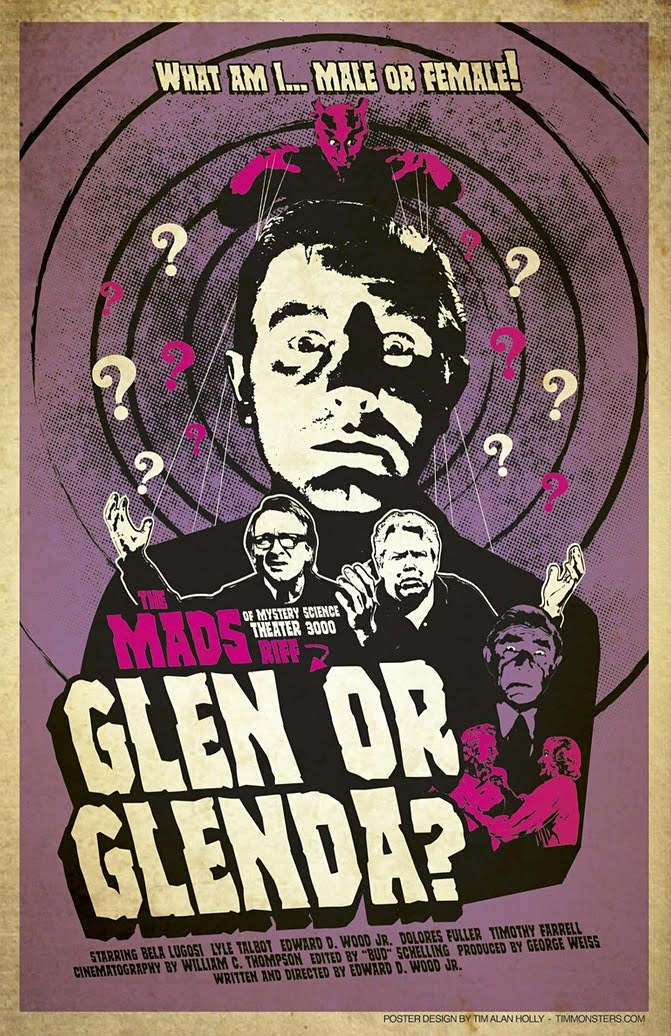
Ed Wood Wednesdays, week 106: "The Mads: Glen or Glenda" (2020)

Frank Conniff and Trace Beaulieu riff on Glen or Glenda.

A poster created for the event.
The global pandemic has changed many people's plans in 2020. That includes the entertainers who regularly perform live in front of audiences. Clubs and theaters have largely been shut down this year, and it's uncertain when they'll reopen. In the meantime, many performers have opted for online-only shows. A streaming session is not exactly like an in-person live concert, naturally, but it's better than nothing. And it does allow performers to interact with fans after a fashion. Compromise is the name of the game here.

Last night, Mystery Science Theater 3000 veterans Frank Conniff and Trace Beaulieu performed an online "riffing" of Edward D. Wood, Jr.'s Glen or Glenda (1953) for over 2,000 fans. For the last few years, Conniff and Beaulieu have been touring as the Mads, a nod to their MST3K mad scientist characters, TV's Frank and Dr. Clayton Forrester. They've even had a podcast, Movie Sign with the Mads. Conniff and Beaulieu were very familiar with Glenda, having provided live commentary on Wood's semi-autobiographical feature dozens of times previously. But this was their first time riffing it online via Zoom, with Beaulieu in Minnesota and Conniff in New York. Comedian Chris Gersbeck acted as the show's producer and coordinator. Since the riffing streamed live over YouTube, viewers were able to comment via a chat feature.

Considering this was the Mads' Zoom debut, the show went very smoothly. Apart from a few fan complaints about the volume of the movie, which Gersbeck quickly corrected, there were no major technical glitches. Conniff and Beaulieu were in fine form as well. They obviously knew the movie forwards and backwards, inside and out, man to woman, woman to man, etc. In the grand tradition of MST3K, they commented on all the many glorious glitches, gaffes, and oddities of Wood's eccentric movie. When Eddie walks toward the camera wearing a pointy bra under his blouse, Beaulieu implores, "Ed, turn the high beams off!" And when portly, balding Henry Bederski wipes down his sweat-soaked fedora in front of a very minimalist street corner set, Conniff quips, "I didn't know the dark, existential void had a bus stop!"

The great thing about a live riffing like this is that the comedians point out things in Glenda that even I hadn't noticed after dozens of viewings. One of my favorite such moments arrives near the end of the movie when we see stock footage of children playing in a schoolyard. We are supposedly seeing one of the film's characters, Alan ("Tommy" Haines), when he was a boy. Beaulieu points out that there's one kid in the footage who just kind of wanders around aimlessly, then stands at the very edge of the frame with just his elbows and ankles visible. Elsewhere, the Mads noted that certain props, including a bookcase and even a Y-shaped tree, turned up in multiple scenes. Conniff also called attention to the fact that Conrad Brooks is credited as "Banker," even though the film has no bankers in it! How did I never catch that?

After the movie was over, Conniff and Beaulieu stuck around for another half hour to answer questions from viewers, and it was at this point when it became apparent that the Mads were major admirers of Glen or Glenda. Both cited it as their favorite "cheesy movie," and Conniff compared it favorably to Tommy Wiseau's equally infamous The Room (2003), saying that Wood's movie preached a message of tolerance toward the LGBTQ community (long before it even had that name) while Wiseau's movie was hateful and misogynistic. Conniff further offered that Wood's true gift as a filmmaker was his sincerity, while Beaulieu pointed out that Glenda was stylistically similar to the films of David Lynch. When the Mads said that the evening was a tribute to Ed Wood, it was obvious that they meant it.

Trace Beaulieu and Frank Conniff: Together but apart.

A DVD of the shorter, censored version.
A TALE OF TWO VERSIONS: As many longtime Ed Wood fans know, there are two versions of Glen or Glenda in circulation currently. One is the version I originally saw on the Rhino Video VHS edition of the film in the 1990s. I now call it the uncensored print. It also appears on the two-disc set called The Ed Wood Collection: A Salute to Incompetence. The second, slightly shorter version of the film is more common. I call it the censored print. It's on the DVD releases from Image Video and Legend Films and has been included in such sets as The Ed Wood Box and The Worst of Ed Wood. Both the censored and uncensored Glendas have been uploaded to the internet.

For last night's streaming show, Frank Conniff and Trace Beaulieu used the longer, uncensored print of Glen or Glenda. But, judging by a pre-show chat Beaulieu had with producer Chris Gersbeck, he and Conniff were more accustomed to the shorter, censored print. Beaulieu estimated that the uncensored print had about five extra minutes of material compared to what he was used to. He pointed out the infamous "cigarette lighting" scene and some extra shots during the dream sequence. Since the Mads have riffed Glen or Glenda on nearly 50 other occasions, Beaulieu had to adjust his timing to the longer edition of the film.

As for the specific differences between these versions, I refer you to my Glen or Glenda transcript. In that article, the material in red type only appears in the uncensored print. After last night's streaming show, I decided to make a side-by-side comparison of the two editions to see exactly how they differed. Even after all these years, there were some revelations in this experiment.

One immediate difference is seen in the main title cards. These have been altered in all existing prints of the film, with the bottom of the frame crudely blocked by a grey cloud and the words "GLEN or GLENDA" added ex post facto by some third party. Since Wood's movie was known by so many titles (I Changed My Sex, I Led 2 Lives, etc.), I'll assume that distributor Wade Williams removed another, lesser known name and substituted the familiar Glen or Glenda handle instead.

The copyright information at the bottom of the screen is another obvious addition to the print, but the wording is a little different between the censored and uncensored versions. In the former, it merely says: "Copyright MCMLIII Screen Classics Productions." But in the latter, the words "25th Anniversary Special" have also been added. Beaulieu and Conniff referred to the longer version of the movie as the "25th anniversary edition."

(left) Title card for the censored version; (right) title card for the uncensored version.

Confusingly, the film's end card carries the "25th Anniversary" banner in both versions, censored and uncensored. However, the uncensored version has an added line: "Copyright Renewed 1981 Paramount Pictures Corporation." This leads me to believe that the "25th Anniversary Special" banner is native to the original print and was placed there at the behest of Glenda producer George Weiss.

(left) The end card of the censored version; (right) end card of the uncensored version.

Watching the two prints side by side was quite educational. I already knew about the major cuts that had been made to the censored version, including the aforementioned "cigarette lighting" scene and the gender-bending twist ending of the foundry sequence. But this time, I noticed that a couple of references to homosexuality had also been cut -- one from Dr. Alton (Timothy Farrell) and one from Inspector Warren (Lyle Talbot). The censored print still has multiple references to homosexuality, just fewer of them. And in the censored print, Barbara (Dolores Fuller) is no longer allowed to describe the specific content of that newspaper article about the sex change operation. The Glen or Glenda transcript has been updated to show these lines in red print.

Just as Beaulieu mentioned, Glenda's lengthy dream sequence was also altered. There's a brief pantomime routine shot in front of a black screen that has been entirely excised in the shorter version of the film. Why, I don't know. In the deleted footage, Glen (Ed Wood) is seen walking uphill at an angle. Then there's a matching shot of Barbara walking uphill at the same angle. Glen continues walking uphill, then turns around to face his blonde-haired lover. Barbara walks further uphill with her arms extended, a visual motif Wood repeats in Plan 9 from Outer Space (1959) and Orgy of the Dead (1965). Finally united, Glen and Barbara hug and kiss. But then Glen magically disappears (just as Ed Wood did in his "Magic Man" commercial), leaving Barbara upset and confused. She rubs her temples in agony.

Again, there was no obvious reason to cut this material, since it contains no problematic dialogue and certainly no sex or violence. Perhaps it was removed for pacing reasons. Later in the dream sequence, there's a more salacious shot of Glen ripping off Barbara's blouse in a rage. This, too, has been cut from the censored version. It still blows my mind that author Rob Craig based his analysis of Glen or Glenda on the shorter, censored print in his book Ed Wood, Mad Genius: A Critical Study of the Films (2009). And it was very frustrating that Legend Films chose to use the shorter edition of Glenda for its restoration/colorization. Hopefully, the longer, more complete version of the movie will reach more Wood fans in the future, and the censored print will fade into obscurity.

Tuesday, July 21, 2020

Podcast Tuesday: "America's Next Top James Dean"

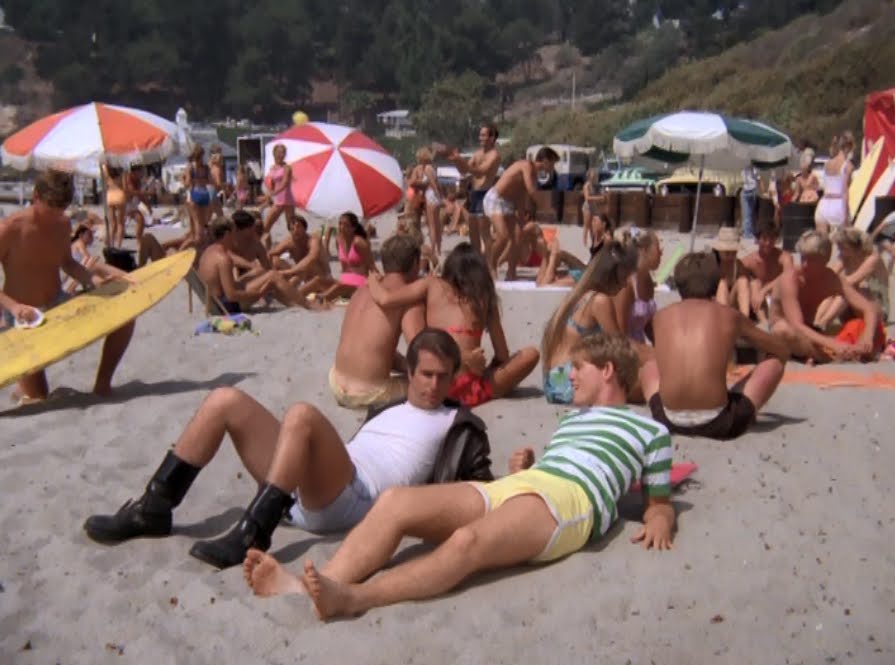
Henry Winkler and Ron Howard relax on the beaches of Malibu.

James Daughton on Happy Days.
Okay, let's just get this out of the way. In today's installment of These Days Are Ours, we are covering the episodes "Hollywood (Part One)" and "Hollywood (Part Two)" from the beginning of Happy Days' fifth season in September 1977. The story has Fonzie (Henry Winkler) going to Hollywood for a screen test at Paramount. Along the way, he develops a rivalry with an arrogant young man named Harold (James Daughton of Animal House) who eventually challenges him to jump over a shark on water skis.

The term "jump the shark" has since become synonymous with creative decline, largely thanks to a radio personality named Jon Hein. Remembering a conversation he had with his college roommate in the '80s, Hein created a popular Jump the Shark website devoted to TV shows that had overstayed their welcome, using Happy Days as the poster child. Because the internet loves a catchphrase, especially a snarky one, "jump the shark" entered the lexicon. Thanks to Jon Hein, Henry Winkler now has to answer at least one question about shark-jumping in seemingly every interview.

But do these episodes actually deserve the scorn that Hein has heaped upon them? Well, it's complicated.

The "Hollywood" story arc certainly did not signal the decline of Happy Days' popularity. The episodes were highly rated, and the sitcom itself remained on the air until September 1984. As for whether the show was "never as good again," that's debatable. The show had already done multi-part stories like "Fearless Fonzarelli," in which Fonzie jumps over garbage cans on his motorcycle, and "Fonzie Loves Pinky," in which Fonzie competes in a demolition derby against the cartoonish villains the Malachi Brothers. Was "Hollywood" really that much of a departure?

We talk about these issues and many more in today's brand new podcast. Enjoy!