|
| Frank Conniff and Trace Beaulieu riff on Glen or Glenda. |
 |
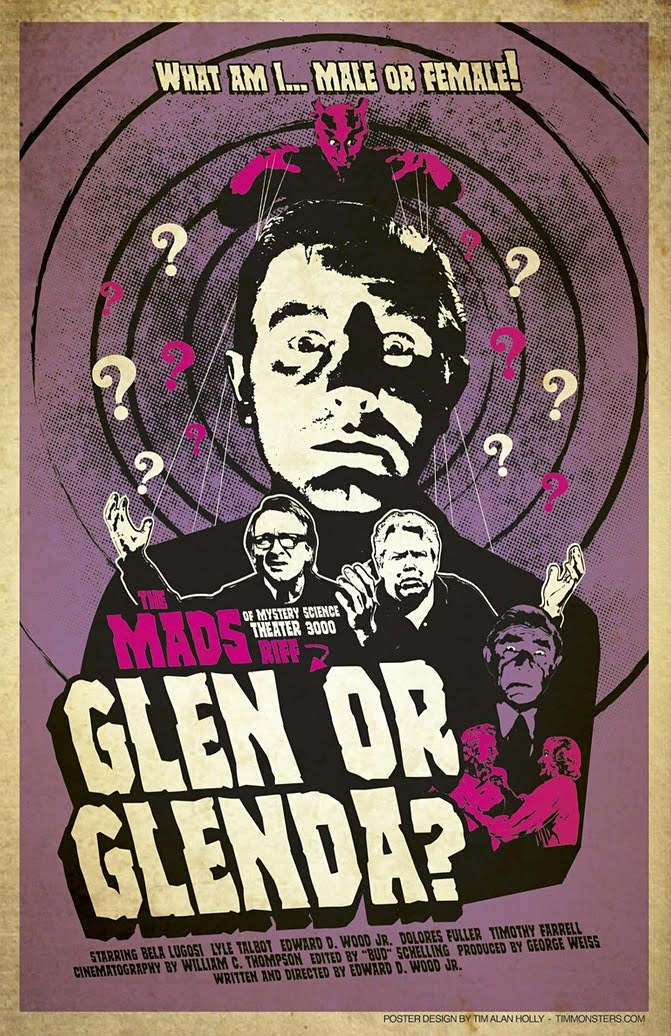
| A poster created for the event. |
The global pandemic has changed many people's plans in 2020. That includes the entertainers who regularly perform live in front of audiences. Clubs and theaters have largely been shut down this year, and it's uncertain when they'll reopen. In the meantime, many performers have opted for online-only shows. A streaming session is not exactly like an in-person live concert, naturally, but it's better than nothing. And it does allow performers to interact with fans after a fashion. Compromise is the name of the game here.
Last night,
Mystery Science Theater 3000 veterans Frank Conniff and Trace Beaulieu performed an online "riffing" of Edward D. Wood, Jr.'s
Glen or Glenda (1953) for over 2,000 fans. For the last few years, Conniff and Beaulieu have been touring as the Mads, a nod to their
MST3K mad scientist characters, TV's Frank and Dr. Clayton Forrester. They've even had
a podcast,
Movie Sign with the Mads. Conniff and Beaulieu were very familiar with
Glenda, having provided live commentary on Wood's semi-autobiographical feature dozens of times previously. But this was their first time riffing it online via Zoom, with Beaulieu in Minnesota and Conniff in New York. Comedian Chris Gersbeck acted as the show's producer and coordinator. Since the riffing streamed live over YouTube, viewers were able to comment via a chat feature.
Considering this was the Mads' Zoom debut, the show went very smoothly. Apart from a few fan complaints about the volume of the movie, which Gersbeck quickly corrected, there were no major technical glitches. Conniff and Beaulieu were in fine form as well. They obviously knew the movie forwards and backwards, inside and out, man to woman, woman to man, etc. In the grand tradition of
MST3K, they commented on all the many glorious glitches, gaffes, and oddities of Wood's eccentric movie. When Eddie walks toward the camera wearing a pointy bra under his blouse, Beaulieu implores, "Ed, turn the high beams off!" And when portly, balding Henry Bederski wipes down his sweat-soaked fedora in front of a very minimalist street corner set, Conniff quips, "I didn't know the dark, existential void had a bus stop!"
The great thing about a live riffing like this is that the comedians point out things in
Glenda that even I hadn't noticed after dozens of viewings. One of my favorite such moments arrives near the end of the movie when we see stock footage of children playing in a schoolyard. We are supposedly seeing one of the film's characters, Alan ("Tommy" Haines), when he was a boy. Beaulieu points out that there's one kid in the footage who just kind of wanders around aimlessly, then stands at the very edge of the frame with just his elbows and ankles visible. Elsewhere, the Mads noted that certain props, including a bookcase and even a Y-shaped tree, turned up in multiple scenes. Conniff also called attention to the fact that Conrad Brooks is credited as "Banker," even though the film has no bankers in it! How did I never catch that?
After the movie was over, Conniff and Beaulieu stuck around for another half hour to answer questions from viewers, and it was at this point when it became apparent that the Mads were major admirers of
Glen or Glenda. Both cited it as their favorite "cheesy movie," and Conniff compared it favorably to Tommy Wiseau's equally infamous
The Room (2003), saying that Wood's movie preached a message of tolerance toward the LGBTQ community (long before it even had that name) while Wiseau's movie was hateful and misogynistic. Conniff further offered that Wood's true gift as a filmmaker was his sincerity, while Beaulieu pointed out that
Glenda was stylistically similar to the films of David Lynch. When the Mads said that the evening was a tribute to Ed Wood, it was obvious that they meant it.
 |
| Trace Beaulieu and Frank Conniff: Together but apart. |
 |
| A DVD of the shorter, censored version. |
A TALE OF TWO VERSIONS: As many longtime Ed Wood fans know, there are two versions of
Glen or Glenda in circulation currently. One is the version I originally saw on the Rhino Video VHS edition of the film in the 1990s. I now call it the uncensored print. It also appears on the two-disc set called
The Ed Wood Collection: A Salute to Incompetence. The second, slightly shorter version of the film is more common. I call it the censored print. It's on the DVD releases from Image Video and Legend Films and has been included in such sets as
The Ed Wood Box and
The Worst of Ed Wood. Both the censored and uncensored
Glendas have been uploaded to the internet.
For last night's streaming show, Frank Conniff and Trace Beaulieu used the longer, uncensored print of
Glen or Glenda. But, judging by a pre-show chat Beaulieu had with producer Chris Gersbeck, he and Conniff were more accustomed to the shorter, censored print. Beaulieu estimated that the uncensored print had about five extra minutes of material compared to what he was used to. He pointed out the infamous "cigarette lighting" scene and some extra shots during the dream sequence. Since the Mads have riffed
Glen or Glenda on nearly 50 other occasions, Beaulieu had to adjust his timing to the longer edition of the film.
As for the specific differences between these versions, I refer you to
my Glen or Glenda transcript. In that article, the material in red type only appears in the uncensored print. After last night's streaming show, I decided to make a side-by-side comparison of the two editions to see exactly how they differed. Even after all these years, there were some revelations in this experiment.
One immediate difference is seen in the main title cards. These have been altered in
all existing prints of the film, with the bottom of the frame crudely blocked by a grey cloud and the words "GLEN or GLENDA" added
ex post facto by some third party. Since Wood's movie was known by so many titles (
I Changed My Sex, I Led 2 Lives, etc.), I'll assume that distributor Wade Williams removed another, lesser known name and substituted the familiar
Glen or Glenda handle instead.
The copyright information at the bottom of the screen is another obvious addition to the print, but the wording is a little different between the censored and uncensored versions. In the former, it merely says: "Copyright MCMLIII Screen Classics Productions." But in the latter, the words "25th Anniversary Special" have also been added. Beaulieu and Conniff referred to the longer version of the movie as the "25th anniversary edition."
 |
| (left) Title card for the censored version; (right) title card for the uncensored version. |
Confusingly, the film's end card carries the "25th Anniversary" banner in both versions, censored and uncensored. However, the uncensored version has an added line: "Copyright Renewed 1981 Paramount Pictures Corporation." This leads me to believe that the "25th Anniversary Special" banner
is native to the original print and was placed there at the behest of
Glenda producer George Weiss.
 |
| (left) The end card of the censored version; (right) end card of the uncensored version. |
Watching the two prints side by side was quite educational. I already knew about the major cuts that had been made to the censored version, including the aforementioned "cigarette lighting" scene and the gender-bending twist ending of the foundry sequence. But this time, I noticed that a couple of references to homosexuality had also been cut -- one from Dr. Alton (Timothy Farrell) and one from Inspector Warren (Lyle Talbot). The censored print still has multiple references to homosexuality, just fewer of them. And in the censored print, Barbara (Dolores Fuller) is no longer allowed to describe the specific content of that newspaper article about the sex change operation. The
Glen or Glenda transcript has been updated to show these lines in red print.
Just as Beaulieu mentioned,
Glenda's lengthy dream sequence was also altered. There's a brief pantomime routine shot in front of a black screen that has been entirely excised in the shorter version of the film. Why, I don't know. In the deleted footage, Glen (Ed Wood) is seen walking uphill at an angle. Then there's a matching shot of Barbara walking uphill at the same angle. Glen continues walking uphill, then turns around to face his blonde-haired lover. Barbara walks further uphill with her arms extended, a visual motif Wood repeats in
Plan 9 from Outer Space (1959) and
Orgy of the Dead (1965). Finally united, Glen and Barbara hug and kiss. But then Glen magically disappears (just as Ed Wood did in his "Magic Man" commercial), leaving Barbara upset and confused. She rubs her temples in agony.
Again, there was no obvious reason to cut this material, since it contains no problematic dialogue and certainly no sex or violence. Perhaps it was removed for pacing reasons. Later in the dream sequence, there's a more salacious shot of Glen ripping off Barbara's blouse in a rage. This, too, has been cut from the censored version. It still blows my mind that author Rob Craig based his analysis of
Glen or Glenda on the shorter, censored print in his book
Ed Wood, Mad Genius: A Critical Study of the Films (2009). And it was very frustrating that Legend Films chose to use the shorter edition of
Glenda for its restoration/colorization. Hopefully, the longer, more complete version of the movie will reach more Wood fans in the future, and the censored print will fade into obscurity.