Wednesday, November 29, 2023

Ed Wood Wednesdays: A roundup of Ed Wood news! (Fall 2023)

A new version of one of Ed's films is coming to BluRay soon!

For a director who's been dead for 45 years this December, Ed Wood has maintained a surprisingly high profile in the 2020s. He never totally goes away, at least not for long. It seems like there's always some Wood-related project in the works, related to his films, his writings, or his life. Ed Wood tribute movies and documentaries are always in production or pre-production somewhere, though many of these may never be finished or released. I know this because the makers of these films (and potential films) contact me occasionally to tell me of their grandiose plans. I wish them all a lot of luck.

Eddie's own movies are occasionally rereleased or repackaged as well. Currently, a company called Gold Ninja Video is taking pre-orders for a new two-disc Blu-ray edition of Eddie's Night of the Ghouls (1959). This remastered version will carry the film's original title, Revenge of the Dead, and comes with a slew of special features. Most impressively, this package includes several of Ed's other movies, including Trick Shooting with Kenne Duncan (1960), Jail Bait (1954), and Final Curtain (1957), plus the Super 8 version of Plan 9 from Outer Space (1957). Ghouls, Plan 9, and Jail Bait will all have optional commentary tracks as well. My esteemed colleague Greg Dziawer has written the liner notes. Can't wait to have this one in hand!

But not all the news I have this week is so positive.

Probably the biggest Ed Wood-related story of the past few months was that the makers of the new, crowdfunded episodes of Mystery Science Theater 3000 wished to use Plan 9 from Outer Space for the show's proposed 14th season. Unfortunately, their Thanksgiving weekend fundraising drive only managed to raise $2.7 million toward the show's $4 million goal, and this was an "all or nothing" campaign. On November 26, MST3K creator Joel Hodgson sent this melancholy message to all who had donated:
Greetings, backers.

Well, we’ve come to the end of the month, and the end of the Turkey Day Marathon and this campaign.
 
While we’re incredibly grateful for all of the support, enthusiasm, and encouragement, it’s clear we’ve fallen short of our goal this time.

First, to be clear, please understand that that means that no one will be charged anything, and we will not be collecting anything that you pledged to this campaign , since the agreement was that we’d only collect funds if we reached our minimum goal. No charges will be put on anyone’s credit cards.

Second, and more important, please know that we’re incredibly grateful for all of your input, feedback, concerns and questions, and are thinking about all the suggestions you have made over the past month.

One silver lining is that the continued support for this campaign, and the show, may have opened up some new conversations about potential partnerships and fundraising that could be key in getting the show another season.

We’ll spend some time now exploring those, and working to integrate all of the feedback and suggestions we’ve heard from you, and will follow up again next year, Lord willing and the creek don’t rise, when we’ve had a chance to regroup and have more to share downstream.

For now, whether you pledged or not, please accept our thanks and gratitude for your ongoing dedication and investment in MST3K.

We’re proud that the show continues to mean so much, to so many, and will keep working to figure out a path forward so that we can hopefully continue to #MakeMoreMST3K.

Until then, have a wonderful holiday season, and thanks again for all of your support.

Cheers and Thanks,

Joel and Team MST3K
For the time being, Ed Wood's most famous film will not be receiving the full MST3K treatment. So Plan 9 from Outer Space will not be joining Bride of the Monster (1955), The Violent Years (1956), and The Sinister Urge (1960) quite yet. But don't despair! There's a RiffTrax version of Plan 9 from 2009 featuring commentary from MST3K veterans Mike Nelson, Bill Corbett, and Kevin Murphy. 


And who knows? Maybe the MST3K team will find a way to make Season 14 happen after all. Lord knows, Ed Wood went through his own struggles to raise money for films. Maybe Joel and the gang can take inspiration (or at least consolation) from him.

Tuesday, November 28, 2023

Podcast Tuesday: "And I Am Outta Here!"

Stanley Brock and Henry Winkler on Happy Days.

In its waning months, with death looming overhead, Happy Days seemed determined to put its characters to the ultimate test. Would their comfortable, longstanding relationships survive major changes to the status quo? In "Welcome Home," for example, Richie (Ron Howard) decides to follow his dreams and move to California. He's also done being the nice, obedient doormat that his friends and family have come to know over the years. How will this affect his relationship with his parents, Howard (Tom Bosley) and Marion (Marion Ross), and his friend, Fonzie (Henry Winkler)? Will they accept this new, more assertive Richie? 

Meanwhile, what about Joanie (Erin Moran) and Chachi (Scott Baio)? They've known each other since Season 5 and been a couple since Season 7's "Fools Rush In." What happens if they break up? What are they to each other then? Friends? Enemies? Nothing? That's what we found out in Season 11's "The Ballad of Joanie and Chachi" and the episodes that immediately followed.

This week on These Days Are Ours: A Happy Days Podcast, we're reviewing "Fonzie Moves Out," an episode whose very title gives away its basic plot but not its emotional complexities. Fonzie has been living over the Cunninghams' garage since Season 3 and has slowly but surely become a surrogate son to Howard and Marion. But what if he moved out of the garage and got a place of his own? What happens then? Find out by clicking the play button below.

Wednesday, November 22, 2023

Ed Wood Wednesdays, week 171: Ed Wood and the Legend of Big Nose Kate

Ed Wood must have been fascinated by the store of Mary Katherine "Big Nose Kate" Horony.

Ed Wood sometimes drew inspiration from real-life historical figures for his work. We all know, for example, that his debut feature Glen or Glenda (1953) was partly based on the highly-publicized story of transgender woman Christine Jorgensen (1926-1989). Generally, though, Eddie's movies are profoundly fictional. Sorry, folks, but the events of Plan 9 from Outer Space (1957) and Bride of the Monster (1955) exist only in the world of imagination. And don't expect to visit the spooky yet sexy mansion of Madame Heles from Necromania (1971) either.

It's through his writing, his innumerable books and articles, that Ed Wood gets to indulge in his interest in history. Think of his fairly straightforward 1973 story "Pearl Hart and the Last Stage," which recounts the career of America's first and last female stagecoach robber. In his book Bloodiest Sex Crimes of History (1967), Eddie writes about the monstrous exploits of Albert Fish, Elizabeth Bathory, and other real-life evildoers. Other such personages are namechecked throughout the nonfiction articles collected in When the Topic is Sex (2021).

But there is at least one prominent historical figure in Ed Wood's writing I have so far overlooked, and it's because I had no idea until recently that she was based on an actual person. What can I say? When it comes to history, I'm kind of a dummy. (And I say that as the son of a history teacher!) This one completely slipped past me. Let's correct that today.

Tuesday, November 21, 2023

Podcast Tuesday: "Nostalgia Kills!"

Alexa Hamilton and Henry Winkler on Happy Days.

Happy Days got pretty decent ratings when it debuted in January 1974. Its status as a nostalgia-driven show set in the 1950s made it something of a novelty and helped it stand out from its competitors in the crowded prime time TV landscape. As Fonzie (Henry Winkler) himself said in an early promo: "Hey, I'm Fonzie. I'm on that new show about the '50s called Happy Days. It'll take you back to some really cool times! Now how does that grab you?" And it must have grabbed people pretty well, since the freshman sitcom made the Top 20 against CBS' Maude and NBC's Adam-12.

Unfortunately, the novelty appeal of Happy Days wore off during the second season, and the show's ratings started to suffer. At ABC's insistence, the struggling sitcom was heavily retooled, with Fonzie becoming a more central character and the entire show being filmed in front of a rowdy studio audience. Miraculously, this revamped version of Happy Days caught on and managed to last another decade, becoming the cornerstone of the network's Tuesday night lineup. 

Over the course of that long (and highly-rated) run, the makers of Happy Days gradually played down the nostalgia gimmick until it was barely part of the show at all. Oh, you'd hear golden oldies on the soundtrack occasionally, and the characters would make some references to TV shows and movies from the past, but Happy Days was otherwise a normal sitcom that could have been set in any era.

In its final season in 1984, Happy Days did the unthinkable: an anti-nostalgia episode! In "The Spirit is Willing," Fonzie falls for a mysterious woman named Nancy (Alexa Hamilton) who shares his love of the past -- the cars, the clothes, the music, all of it. She tries to lure him into a world where it's 1955 forever and nothing ever changes. Fonzie is tempted but ultimately realizes that Nancy is not what she seems and may have a deeply sinister agenda. In short, "The Spirit is Willing," written by Larry Strawther, is a bold repudiation of everything that Happy Days spent 11 seasons building up.

But does that make it a good episode? Find out by listening to These Days Are Ours: A Happy Days Podcast.

Wednesday, November 15, 2023

Ed Wood Wednesdays, week 170: 'The Art of Tatooage' and What I Look for When I'm Looking for Ed Wood

I don't think Ed Wood wrote this 1962 article and here's why.

Ed Wood wrote a lot, you guys. No, you don't understand. I mean, he wrote a lot. Way more than you'd think a raging alcoholic with only a tenuous grasp on reality would be able to manage. In addition to his scripts, both produced and unproduced, Eddie penned novels and short stories, plus nonfiction books and magazine articles, all in massive quantities. For some projects, he used his real name, while at other times he wrote pseudonymously or even anonymously.  Besides releasing many of Ed's books and articles, adult publisher Bernie Bloom used Ed as a sort of literary "man-of-all-work" at Pendulum in the 1970s. Who knows how many pieces of unsigned filler text, including editorials and photo captions, Ed wrote while in Bernie's employ?

A canonical Wood work.
This hyperabundance of work is both a blessing and a curse to the Woodologist. It's wonderful to have so much writing to study and enjoy. But Ed Wood's bibliography is an absolute mess, often frustrating to navigate. It can be very difficult to tell what he wrote and what he didn't. To help us out, we can divide his literary output into a few extremely broad categories. First, there is what I'll call "canonical Wood." These are the works that bear Ed's own name and are generally not in dispute. (I say "generally" because some Wood scholars are extremely skeptical and question his authorship of anything.)

Beyond these uncontroversial works, we have what I call the "stealth canon." These are works that are widely known to be Ed Wood's but don't bear the man's own name. They're listed on his carefully self-curated resumes, and Eddie even signed some copies of them. Eddie's best known aliases are probably Dick Trent and Ann Gora, and these turn up frequently in the "stealth canon," but he wrote under many pen names. His aliases may number in the dozens.

After that, though, you have a whole universe of speculative Wood works—not in the canon (or even the stealth canon) but bearing enough of Wood's trademarks to arouse curiosity. Maybe it's about one of his "pet" subjects, like angora or cross-dressing. Maybe it uses some of his favorite words or expressions. Maybe it's from Pendulum or one of Eddie's other known publishers and comes from the era when we know Ed was active. Or maybe someone just has a hunch about a particular book or article. Does it past the duck test? That's where the debates begin.

I can't say I've read everything Ed Wood wrote. (I don't know if anyone has, other than Eddie himself.) But I've read many works, both long-form and short-form, that he is known or widely believed to have written. And there are certain things I'm looking for when I'm given a text and asked whether I think Ed Wood penned it. This can be especially tricky, since Ed had a number of different modes or styles as an author. He could be surreal and dreamy when he wanted, especially in his short fiction, or he could be dry and encyclopedic if necessary. You never know which Eddie you're going to get. I'm not joking when I say it may depend on how drunk or sober he was when he wrote it.

Recently, podcaster and pop culture scholar Rob Huffman shared with me and some other Wood fans a few pages from an article called "The Art of Tattooage," credited to an author named J. Lee Anderson. It appeared in a men's magazine called Chére in 1962. This now-forgotten magazine was the product of an adult publisher called France, which released both magazines and paperback novels in the 1960s. Ed Wood is thought—or at least rumored—to have written for France in the early 1960s, possibly using "J. Lee Anderson" as a pen name. Rob has explored these possibilities in depth with my colleague Greg Dziawer in the past.

Naturally, I took a good, long look at "The Art of Tattooage" to see if I could detect any traces of Ed Wood within it. Dating from 1962, this would be one of the earlier examples of Wood's writing, if it were his, but the fully-canon novel Killer in Drag (1963) shows that Eddie's signature style was already formed during this time period. So his authorial voice would be detectable if "Tattooage" were indeed his work.

Alas, this article did not give me any particularly strong Woodian vibes. For one thing, in describing the seedy tattoo parlors of early '60s Los Angeles, J. Lee Anderson uses a lot of words that I just can't imagine Ed Wood using very often: dowdy, truculent, vagaries, bemoan, echelon, conjecture, etc. On the other hand, the author never uses any of the words Eddie loved to employ in his own writing: thrill, soft, lovely, conventional, accept, etc. It would also have been nice to see some of Eddie's telltale ellipses.

In a broader sense, Eddie had a way of taking any topic and steering it toward his lifelong obsessions: death, alcohol, and women's clothing. He'd shoehorn these subjects (and anything else that came into his head) into his writing whether they fit the subject matter or not. "The Art of Tattooage" does none of that. Albeit a bit pretentious in his vocabulary, the author of this article sticks to the topic of tattoos and does not veer off on any quasi-philosophical rants. at least not in the passage I read. Eddie rarely had that kind of discipline.

If there's anything Woodian in "The Art of Tattooage," it's the way J. Lee Anderson uses old-timey slang and eye dialect. The article gives us a colorful quote from a tattoo artist who declines to be photographed: "The boss don't want no pitchers. The heat's on. We don't want publicity around here. And no pitchers." Ed Wood often wrote about the underworld of crime, and his characters in this milieu usually talk like gangsters in a Bugs Bunny cartoon, so that dialogue could have come from one of Eddie's works. Otherwise, this article lacks the tone and cadence I expect from Ed.

But don't take my word for it. Follow that link up there and read it for yourself. See if it passes your version of the duck test.

Tuesday, November 14, 2023

Podcast Tuesday: "By the Power of Fonzie, I HAVE THE POWER!"

Scott Baio and Erin Moran on Happy Days.

There's something going on with Chachi (Scott Baio) in the eleventh season of Happy Days. Quite simply, this young man is in serious trouble, lacking direction, purpose, and any semblance of structure in his life. A year earlier, he'd been living in Chicago and pursuing his dream of being a professional musician with his girlfriend Joanie (Erin Moran). But Joanie decided to give up music, move back home to Milwaukee, and pursue a teaching career.

This is where things start to spiral downhill for Chachi. His music gigs seem to dry up, and Joanie dumps him just a few weeks after returning to Milwaukee. He's unemployed and doesn't go to school, so he has a lot of free time on his hands. His days revolve around Arnold's, the local hamburger joint owned by his cousin Fonzie (Henry Winkler). Chachi plays on the Arnold's softball team and makes some half-assed attempt at helping Fonzie run the place, but he is not compensated for this. It's not clear where Chachi is living during this time, and he seemingly has problems getting food. This forces him to beg for meals at Joanie's house.

Chachi's woes are in the background for most of Season 11, but they come to the forefront in "Social Studies," an episode in which Fonzie attempts to help Chachi move on from Joanie. (It doesn't go well.) You can find out what we thought of this episode by listening to the latest installment of These Days Are Ours: A Happy Days Podcast

Wednesday, November 8, 2023

Ed Wood Wednesdays, week 169: The further adventures of Nona Carver

Nona Carver in Rudolph Grey's Nightmare of Ecstasy.

One of the most arresting images in Rudolph Grey's Nightmare of Ecstasy: The Life and Art of Edward D. Wood, Jr. (1992) is a snapshot of burlesque performer and actress Nona Carver, who played "old whore" Sleazy Maisie Rumpledinck in Ed's obscure adult film Take it Out in Trade (1970). The picture, credited to Grey himself, shows a late-middle-aged Carver in her home, proudly gesturing to a room absolutely packed with random junk: hats, pillows, framed artwork, artificial flowers, old clothes, blankets, and more. Most of this is simply piled on the floor in large heaps, giving the impression that Carver (clad in a tank top and short shorts) is a delusional hoarder.

Nona Carver is one of the many intriguing side characters in Nightmare, and the book gives us a few more scraps of information about her. Makeup man Harry Thomas tells us, for example, that Nona performed at the Gayety Theatre on Main Street in Los Angeles. He also offers this memorable description of her: "Big bazooms but very thin little legs. Chewing gum all the time." 

Ed's wife Kathy states that Nona was the girlfriend of actor Kenne Duncan, the cantankerous B-Western baddie who became Ed Wood's close friend and a member of Eddie's repertory company. Nona herself says that she "met Ed Wood quite a few times at Kenne's house." It's worth noting that Nona starred in the softcore feature Revenge of the Virgins (1959), which Kenne narrated. The screenplay for that film has frequently been attributed to Ed Wood. My colleague Greg Dziawer disputes this and says that the film's credited screenwriter, Pete La Roche, was a very real person and separate from Ed Wood.

The longest quote attributed to Nona Carver in Nightmare of Ecstasy is this anecdote about her visits to Ed and Kathy Wood's downtrodden apartment on Yucca and Cahuenga in Los Angeles.

Nona Carver talks of "strangers on the mooch to drink" at Ed Wood's apartment.

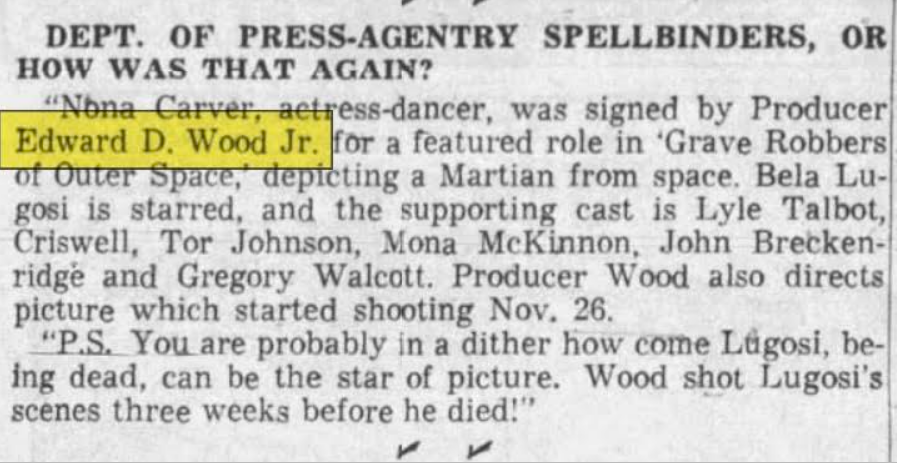
I recently learned a little more about Nona Carver when the unstoppable Rob Huffman sent me some vintage news clippings about her. This article from the November 29, 1956 edition of The Los Angeles Mirror suggests that Nona almost played an even more prominent role in the Ed Wood saga. Entertainment columnist Dick Williams says that Nona would play "a Martian from space" in Plan 9 from Outer Space, then still known as Grave Robbers from Outer Space (or Grave Robbers of Outer Space). Nona's role ultimately went to Joanna Lee, who came to resent her association with the film.

Nona Carver could have played Tanna in Plan 9.

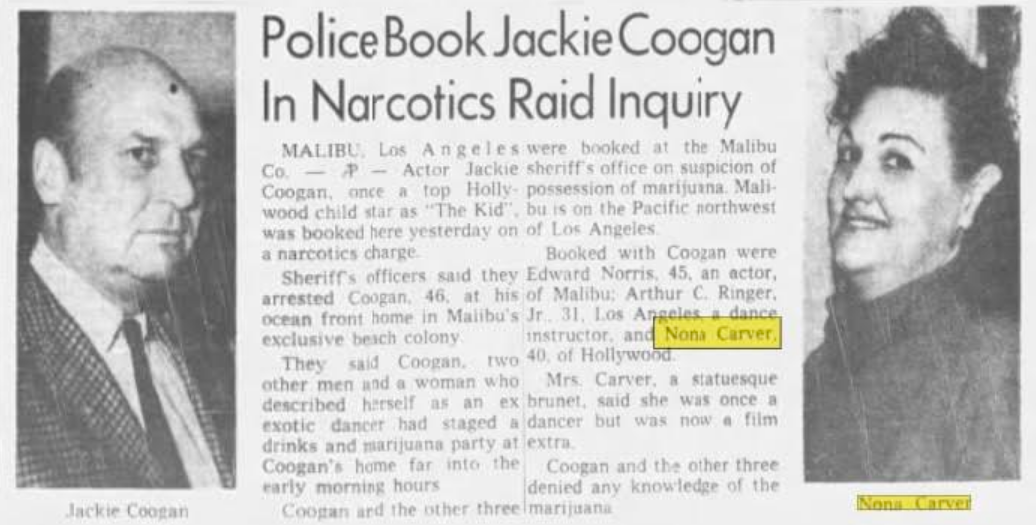
The next Nona story that Rob sent me is even stranger, if you can believe it. It comes to us from The Modesto Bee, January 8, 1961 and tells us about the time Nona Carver was busted after attending a "marijuana party" at the beachfront Malibu home of former child star Jackie Coogan. This was well after Coogan's days of acting alongside Charlie Chaplin in The Kid (1921) but a few years before he played the role for which he is most famous today: Uncle Fester on The Addams Family (1964-66).

Nona and Fester? Who'd have guessed?

The article yields some interesting information about Nona Carver, including the fact that she was 40 years old at the time of this incident and retired from exotic dancing. She gives her profession as "film extra." Other than Virgins and Trade, however, the only film role I can find for her is in 1962's Terrified, a suspense thriller that looks like a a cheapjack imitation of Psycho (1960).

The next article that Rob sent me comes from Ed Wood's hometown paper, The Poughkeepsie Journal, May 2, 1967. It concerns Eddie, his brother Bill, and their father.

Ed's brother Bill (pictured at left) visited his ailing father in 1967.

It seems that both Ed Wood and his younger brother Bill returned briefly to New York State in 1967 to visit their ailing father, Edward D. Wood, Sr., who was in an Albany hospital. Sadly, the Wood family patriarch died just four days after this article was printed. He was 72 years old. I can't help but imagine what Ed's last visit with his father was like. I keep picturing that extremely subdued scene from Alice's Restaurant (1969) in which Arlo Guthrie (playing himself) visits a dying, still-smoking Woody Guthrie (Joseph Boley) in the hospital. Arlo is respectful but taciturn, as he really has nothing to say to his father at this moment. In the hallway outside Woody's room, Arlo talks to his mother Marjorie (Sylvia Davis).
ARLO: He's gotten a lot worse since I saw him.

MARJORIE: Well, let's say no better.

(Arlo glances around awkwardly, unsure of what to do in this situation, then leans in and kisses his mother. He turns around and walks away without another word, passing a nurse pushing an old man in a wheelchair as he leaves.)
Or who knows? Maybe it was nothing like that. Maybe Ed Wood, Jr. and Sr. had a deeply satisfying, far-ranging conversation and got to resolve whatever issues they had between them, allowing the elder Wood to slip into death with a clear conscience.

I have one last item for you today. Rob Huffman hipped me to this remarkable 2001 blog post by renowned science-fiction editor Earl Kemp (1929-2020). In the 1960s, Kemp worked at a publishing company called Greenleaf Classics, which released a few of Ed's books, including the novelization of Orgy of the Dead (1966). Because of this, Earl got to meet and interact with both Ed Wood and Criswell. He says the two were constant companions and could even finish each other's sentences. 

I don't want to spoil any of the article, so I'd advise you to go read it for yourself. Suffice it to say, it's a wonderfully descriptive and evocative passage, detailing what it was like to spend time with these two extraordinary human beings. As a bonus, Kemp also includes the entire Greenleaf style manual, which is surprisingly nitpicky and even stodgy at times. Having read much of Ed Wood's prose, I doubt our man followed guides like these very closely. Or at all.

Tuesday, November 7, 2023

Podcast Tuesday: "Hands Off My Daughter, Lyle Waggoner!"

Marion Ross, Tom Bosley, Lyle Waggoner, and Erin Moran on Happy Days.

Over its eleven seasons and 255 episodes, Happy Days had plenty of guest performers. I'd put them in two distinct categories: (1) character actors who were hired to play specific roles and (2) celebrities with whom the audience would already be familiar. Into that first category, I'd place actors like Warren Berlinger, Ken Lerner, and Arthur Batanides, all of whom played multiple characters on the series. In that second category, we have a host of well-known names, including Danny Thomas, Dr. Joyce Brothers, Bob & Ray, Lorne Greene, Frankie Avalon, and Phil Silvers. These folks either played themselves (e.g. Avalon) or slight variations on themselves (e.g. Silvers).

But then, we have the unique case of Lyle Waggoner. Lyle appeared twice on Happy Days, once in Season 8 and then again in Season 11. By the time of these episodes, Lyle's name and face were well-known to the public due to his film and TV work, especially on the series Wonder Woman and The Carol Burnett Show. People definitely knew who this guy was. Nevertheless, in rather short succession, Happy Days had Lyle playing two different characters: a game show host and a millionaire playboy. I can't remember the show doing this with any other celebrity guest.

This week on These Days Are Ours: A Happy Days Podcast, we review Lyle's second appearance on the show, a Joanie-centric episode called "Like Mother, Like Daughter." Was it worth it bringing back Lyle Waggoner a second time? Join us as we find out!