Showing posts with label Night of the Ghouls. Show all posts

Wednesday, February 18, 2026

Ed Wood Wednesdays, week 264: How accurate is 'Ed Wood' (1994) [PART 1]

Jeffrey Jones in Ed Wood. Inset: Criswell in Night of the Ghouls.

Ed Wood Wednesdays is, by far, the longest-running series in the history of this blog. It may be the most significant project of my entire life. I started it nearly 13 years ago, and it's nowhere near completion. But within that one big project, there have been a lot of smaller sub-projects, like my reviews of every story in Blood Splatters Quickly (2014) and my 2022 Ed-Vent Calendar. These have been some of the most enjoyable articles for me to write, so I'm always on the lookout for the next possible series-within-a-series. And now I think I've found it.

What I plan to do for the next however many weeks is go through Tim Burton's glossy biopic Ed Wood (1994) scene by scene and discuss how accurate—or inaccurate—it is, compared to the real life and career of Edward Davis Wood, Jr. (1924-1978). Before you get upset, please know that I am doing this purely as a tribute to the movie. I am not trying to criticize director Tim Burton or writers Scott Alexander and Larry Karaszewski for taking liberties with the facts. I'm completely fine with them taking liberties with the facts, and I love Ed Wood just the way it is. But this series will (hopefully) allow me to talk about numerous aspects of Eddie's real life and work in an entertaining way.

Oh, and I fully expect to be corrected and nitpicked along the way by you, the readers. If you feel I've made a misstatement, let me know and I'll update the article. Anyway, let's get started.

Wednesday, May 15, 2024

Ed Wood Wednesdays, week 188: Ed Wood's recurring characters (including Kelton and Lobo)

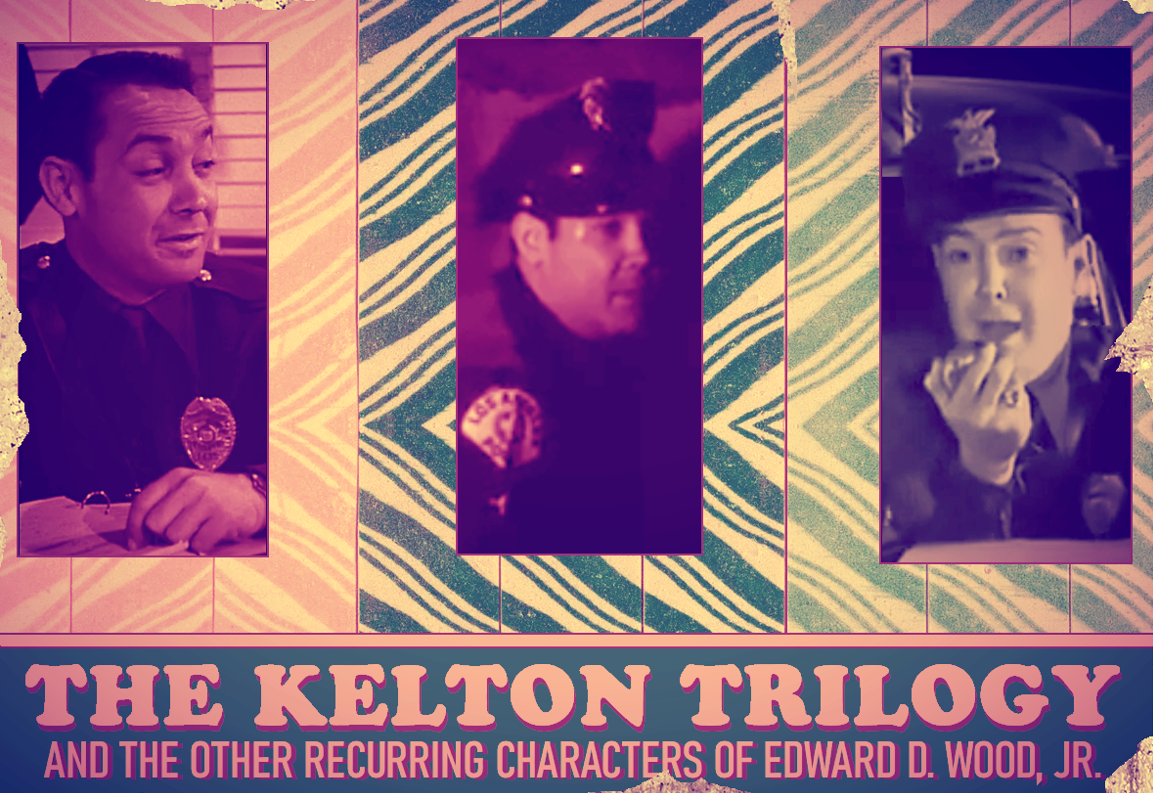
For some reason, Ed Wood kept bringing Officer Kelton back.

Three of Ed Wood's 1950s filmsBride of the Monster (1955), Plan 9 from Outer Space (1957), and Night of the Ghouls (1959)—are collectively known as "The Kelton Trilogy" because they all feature actor Paul Marco as bumbling, cowardly Officer Kelton, a uniformed cop who repeatedly comes into contact with the otherworldly and supernatural. In Ghouls, narrator Criswell gives us a succinct description of the character:
Patrolman Paul Kelton, 29 years of age, four years with the department, eager for the glory of the uniform but wide-eyed with fear at the thought of actually being on special duty. Unfortunately, though eager, not what the department usually looks for in their officers.
Ouch. The other characters in these movies tend to treat Kelton with utter contempt. In Night of the Ghouls, the character even describes himself as "the whipping boy of the whole police force." He's basically the Jar Jar Binks of the Ed Wood universe. So why did Ed keep bringing back Officer Kelton, reusing him the way Shakespeare reused Falstaff? A few reasons, I think. First, Paul Marco was one of his closest buddies and wasn't exactly drowning in work outside of Eddie's films. I'm certain the zany Kelton character was written especially with Paul Marco in mind. ("Hey, Paul, I've got a great part for you in my next picture!")

Beyond that, Ed Wood was heavily inspired by the Universal horror movies of the 1930s and '40s, and those films tend to include broad comic relief provided by wacky supporting characters—chambermaids, English bobbies, villagers, etc. It seems like a Universal movie isn't complete until some Cockney-accented stooge gets spooked by the monster du jour and trips over his own feet trying to run away. Paul Marco's scaredy-cat Officer Kelton is very much in that tradition. As unnecessary as the character may seem to modern viewers, he has his roots in classic horror.

Wednesday, November 29, 2023

Ed Wood Wednesdays: A roundup of Ed Wood news! (Fall 2023)

A new version of one of Ed's films is coming to BluRay soon!

For a director who's been dead for 45 years this December, Ed Wood has maintained a surprisingly high profile in the 2020s. He never totally goes away, at least not for long. It seems like there's always some Wood-related project in the works, related to his films, his writings, or his life. Ed Wood tribute movies and documentaries are always in production or pre-production somewhere, though many of these may never be finished or released. I know this because the makers of these films (and potential films) contact me occasionally to tell me of their grandiose plans. I wish them all a lot of luck.

Eddie's own movies are occasionally rereleased or repackaged as well. Currently, a company called Gold Ninja Video is taking pre-orders for a new two-disc Blu-ray edition of Eddie's Night of the Ghouls (1959). This remastered version will carry the film's original title, Revenge of the Dead, and comes with a slew of special features. Most impressively, this package includes several of Ed's other movies, including Trick Shooting with Kenne Duncan (1960), Jail Bait (1954), and Final Curtain (1957), plus the Super 8 version of Plan 9 from Outer Space (1957). Ghouls, Plan 9, and Jail Bait will all have optional commentary tracks as well. My esteemed colleague Greg Dziawer has written the liner notes. Can't wait to have this one in hand!

But not all the news I have this week is so positive.

Probably the biggest Ed Wood-related story of the past few months was that the makers of the new, crowdfunded episodes of Mystery Science Theater 3000 wished to use Plan 9 from Outer Space for the show's proposed 14th season. Unfortunately, their Thanksgiving weekend fundraising drive only managed to raise $2.7 million toward the show's $4 million goal, and this was an "all or nothing" campaign. On November 26, MST3K creator Joel Hodgson sent this melancholy message to all who had donated:
Greetings, backers.

Well, we’ve come to the end of the month, and the end of the Turkey Day Marathon and this campaign.
 
While we’re incredibly grateful for all of the support, enthusiasm, and encouragement, it’s clear we’ve fallen short of our goal this time.

First, to be clear, please understand that that means that no one will be charged anything, and we will not be collecting anything that you pledged to this campaign , since the agreement was that we’d only collect funds if we reached our minimum goal. No charges will be put on anyone’s credit cards.

Second, and more important, please know that we’re incredibly grateful for all of your input, feedback, concerns and questions, and are thinking about all the suggestions you have made over the past month.

One silver lining is that the continued support for this campaign, and the show, may have opened up some new conversations about potential partnerships and fundraising that could be key in getting the show another season.

We’ll spend some time now exploring those, and working to integrate all of the feedback and suggestions we’ve heard from you, and will follow up again next year, Lord willing and the creek don’t rise, when we’ve had a chance to regroup and have more to share downstream.

For now, whether you pledged or not, please accept our thanks and gratitude for your ongoing dedication and investment in MST3K.

We’re proud that the show continues to mean so much, to so many, and will keep working to figure out a path forward so that we can hopefully continue to #MakeMoreMST3K.

Until then, have a wonderful holiday season, and thanks again for all of your support.

Cheers and Thanks,

Joel and Team MST3K
For the time being, Ed Wood's most famous film will not be receiving the full MST3K treatment. So Plan 9 from Outer Space will not be joining Bride of the Monster (1955), The Violent Years (1956), and The Sinister Urge (1960) quite yet. But don't despair! There's a RiffTrax version of Plan 9 from 2009 featuring commentary from MST3K veterans Mike Nelson, Bill Corbett, and Kevin Murphy. 


And who knows? Maybe the MST3K team will find a way to make Season 14 happen after all. Lord knows, Ed Wood went through his own struggles to raise money for films. Maybe Joel and the gang can take inspiration (or at least consolation) from him.

Wednesday, September 6, 2023

Ed Wood Wednesdays: Jean Stevens in White and Black (Guest Author: James Pontolillo)

Ed Wood gave us two sides of actress Jean Stevens.

In his magnum opus Plan 9 from Outer Space (1957), writer-director-producer Edward D. Wood, Jr. summoned an iconic femme fatale – TV horror hostess Vampira as the striking Vampire Girl – to haunt men for decades to come. Plan 9’s cult status and the fervor directed toward Vampira have caused Ed’s other femme fatales to be largely overlooked. 

Two of his lesser-regarded films – Final Curtain (1957) and Night of the Ghouls (1959) – feature a [White] Vampire and a Black Ghost, respectively. Each role was played by the same little-known actress who managed to exude a mysterious, foreboding air of eroticism not unlike that of Vampira herself. A large measure of credit must be given to the cinematographer, William C. Thompson, whose knack for capturing feminine beauty in crisp, moody black-and-white mirrored the timeless Universal horror classics of the 1930s and 1940s. The young actress in question, Jean Stevens, was no newcomer as far as Ed was concerned. He had known her since his earliest days in Hollywood.

Wednesday, March 29, 2023

Ed Wood Wednesdays: The Ed Wood Summit Podcast #30 by Greg Dziawer

You never know when Warren Beatty is going to swoop in.

When Ed Wood passed away on December 10, 1978, he couldn't have known that his largely-unseen 1959 film Revenge of the Dead, a loose sequel to Bride of the Monster (1955), would shortly thereafter see the light of day under the title Night of the Ghouls. A group of early Ed adopters were already then on the case, including James Brummel, who as a mere teen was in pursuit of the film. I had the pleasure of talking with James about this and related matters on the latest installment of The Ed Wood Summit Podcast.


The story of the film's journey back into the public eye doesn't end there. It was recently announced that a new print was discovered (shout-out to Will Sloan!) and will be released by Gold Ninja Video.

Wednesday, March 15, 2023

Ed Wood Wednesdays, week 145: The Mads: Night of the Ghouls (2023)

Some really cool artwork by Carmen Cerra depicting Dr. Acula's gruesome death.

Well, that was fun. 

Back in 2020, at the height of the pandemic, I watched a livestream of MST3K veterans Trace Beaulieu and Frank Conniff—collectively known as The Mads—riffing Ed Wood's Glen or Glenda (1953). Frank was in his apartment, Trace was in his, and they commented on the film via Zoom. Frank and Trace have kept doing these livestreams for the last few years, and I've checked in occasionally. I'd watch more of them, but they're pay-per-view. I somehow missed or ignored their livestream of Bride of the Monster (1955) last September.

This week, however, they made me an offer I simply couldn't refuse. On Tuesday, March 14, they riffed Ed's sadly overlooked Night of the Ghouls (1959), the final entry in the so-called Kelton Trilogy. To my knowledge, Ghouls has never received this treatment before. The film was never used on MST3K itself, and it's been ignored by such MST3K derivatives as Rifftrax and Cinematic Titanic. I've long felt that Ghouls would be perfect fodder for riffing, at least as good as Plan 9 or Bride. (Trace himself admitted that Plan 9 in particular has been riffed to death.)

The marvelous Marcelle Hemphill.
Last night's livestream proved that my suspicions were correct. Trace and Frank, both avowed fans of the film and of Ed Wood, were in fine form as they picked apart the many, many absurdities of Night of the Ghouls: its disjoined editing, its heavy reliance on voiceover narration, its stagy acting, its many narrative digressions, and its overabundance of scenes in which police cars race across the screen. The riffs were what you'd expect from two MST3K graduates, albeit with a bit more profanity. 

Frank is the more politically-oriented of the two Mads, so he made topical references to Marjorie Taylor Greene, Ron DeSantis, and defunding the police, but these were kept to a minimum. I appreciated the numerous deep cut references to the Marx Brothers and Frank Zappa. Every time the name "Lucille" was mentioned in the movie, for example, Trace sang a bit of "Lucille Has Messed My Mind Up" from Zappa's Joe's Garage album. Meanwhile, Frank showed off his extensive knowledge of Woodology with shoutouts to Nightmare of Ecstasy (1992) and Take It Out in Trade (1970). 

One great thing about events like this is that they give me the opportunity to see new things in movies I've watched dozens of times already. I had somehow missed, for instance, that there is an obvious movie light in front of the sheriff's office at the beginning of the film. (Ed must've wanted to make sure the sign outside was visible at night.) For whatever reason, I found myself focusing on some of the magnificent 1950s automobiles in Night of the Ghouls, especially the gigantic 1958 Pontiac Bonneville driven by Duke Moore's character, Lt. Bradford.

I've already written a great deal about the movie's leading actors: Tor Johnson, Valda Hansen, Kenne Duncan, etc. And their performances in Ghouls are as mesmerizing as ever. During this viewing, however, my attention was diverted by some of the unsung supporting players. I was particularly taken with Marcelle Hemphill (1888-1981) as Mrs. Wingate Yates Foster, the gullible old lady being bilked out of her money by Duncan's scheming Dr. Acula. Marcelle seemed like the prototypical "wealthy dowager" type, yet this is somehow her only known screen credit. She may be a topic of further research.

Look, your enjoyment of a livestream like this really depends on your tolerance for MST3K and its lampooning of old B-movies. Personally, seeing Bride of the Monster on MST3K in the '90s deepened my appreciation of that movie and made my Ed Wood fandom even stronger. Since then, I've enjoyed seeing Ed's other films given similar treatment, including Rifftrax's version of Revenge of Dr. X (1970). But I can understand if you find all this stuff disrespectful or just distracting. If you like both MST3K and Ed Wood, I'm just making you aware of it. If you don't, forget I said anything.

You can find hours of material by Frank Conniff and Trace Beaulieu right here. As of this writing, their version of Night of the Ghouls has not yet been made available for download at their site, but I imagine it soon will be. In the meantime, you can snag their versions of Glenda and Bride.

Wednesday, December 8, 2021

Ed Wood Wednesdays, week 125: The floating trumpet in 'Night of the Ghouls' (1959)

Let's talk about that trumpet.

I will never forget my first screening of Night of the Ghouls (1959). I saw it on Friday, October 30, 1992 as part of an Ed Wood quadruple feature, alongside Glen or Glenda (1953), Bride of the Monster (1955) and Plan 9 from Outer Space (1957). This was my first time seeing any of Eddie's movies, and it was the night that made me a fan for life.

Accessibly weird and endlessly quotable, Glenda and Plan 9 were the hits of the evening, as you might expect. The organizers of the marathon wisely scheduled Night of the Ghouls (aka Revenge of the Dead) to run last. The supernatural thriller, a film both sluggish in its pace and confounding in its construction, just about cleared the room. I stuck it out and have since come to love Ghouls, though I admit that my first viewing was an endurance test.

In particular, the séance scenes in Night of the Ghouls caused multiple walkouts. If you'll recall, the film's plot revolves around a fraudulent psychic called Dr. Acula (Kenne Duncan), who bilks customers out of their money by pretending to communicate with their dead relatives. The con artist demonstrates his "skills" through a variety of cheap theatrical tricks, the kind a Scooby Doo villain might use to scare meddling kids away from an amusement park. One particularly obscure detail: a trumpet dangling from wires so that it looks like it's floating in midair.

Wednesday, May 26, 2021

Ed Wood Wednesdays, week 118: 'Hellborn' (1956/1993)

Hellborn is like a jigsaw puzzle with missing pieces.

One of the strangest passages in Ed Wood's Night of the Ghouls (1959) occurs just four and a half minutes into the film. Ostensibly a follow-up to Bride of the Monster (1955), Ghouls is another of Wood's supernatural horror thrillers. The plot revolves around a phony medium, Dr. Acula (Kenne Duncan), who inadvertently manages to summon the dead while performing fraudulent seances in a spooky mansion. For some reason, though, narrator Criswell takes a few minutes to talk to us about juvenile delinquency:
Your daily newspapers, radio, and television dares to relate the latest in juvenile delinquency. At times, it seems juvenile delinquency is a major problem of our law enforcement officers. But is this the major horror of our time? Is this violence and terror a small few perpetrate the most horrible, terrifying of all crimes our civil servants must investigate? 
The National Safety Council keeps accurate records on highway fatalities. They can even predict how many deaths will come on a drunken holiday weekend. But what records are kept? What information is there? How many of you know the horror, the terror I will now reveal to you?
As we hear this voice-over monologue, accompanied by hot jazz drumming and a wailing siren, Wood shows us flashes of seemingly unrelated footage: a police car whizzing from somewhere to somewhere else; young people dancing and eating at a pizzeria called Jake's Pizza Joint; two men (Ed Wood and Conrad Brooks) fighting in a pit as a crowd watches; a gang of three men beating the tar out of a fourth man as a girl stands off to the side; a car going off the road and tumbling down a cliff before crashing into a tree, etc. Apart from the shots of the police car—this is another of Ed's many police procedurals—none of this footage belongs in Night of the Ghouls. So what's it doing there? 

Wednesday, March 28, 2018

Ed Wood Wednesdays: The Wood Collaborator Odyssey, Part Nine by Greg Dziawer

Valda Hansen, future star of Night of the Ghouls, as she appeared in high school.

Young and innocent: Valda (lower left)
as a junior class officer circa 1950.
A few months back, we took a glimpse at Valda Joanne Hansen, the blonde ingenue who unforgettably played the White Ghost in Ed Wood's Night of the Ghouls (1959). Though she was a delicately beautiful young woman with an otherworldly presence, relatively little has been written about her. And what has been written is contradictory. Depending on what you read, she either met Ed backstage at a play in which she was performing or was his 16-year-old neighbor. This week, we're going back in time to visit Valda and her family before she met Ed, whenever that may have been.

In Rudolph Grey's Nightmare of Ecstasy, Valda Hansen claimed to have been "16 and innocent" when she worked on Night of the Ghouls. She repeated that story in the 1992 documentary Flying Saucers Over Hollywood. Yet the historical records show that Valda was born on November 3, 1932 in Artesia, California, suggesting she was probably in her mid-20s when she first encountered Ed Wood in the 1950s.

Valda's parents, Valdemar and Francine Hansen (née Gero), appear to have had only one child. Since these two were married on May 5, 1932, it means that Francine was already about three months pregnant with Valda when she became Valdemar's wife. By 1940, the family was living on a farm in Downey, about 13 miles southeast of downtown Los Angeles. In the census that year, Valdemar listed his occupation as a "milker." A decade later, we find the Hansen family in the same geography: the suburbs southeast of L.A., in Bellflower, roughly halfway between Norwalk and Compton. By then, Valda was attending the segregated Excelsior Union High School in Norwalk.

Valda's yearbook.
These were years of Cold War tension and an escalating arms race. The Excelsior Union High School yearbooks, the El Aviador from Valda's junior and senior years—1950 and 1951, respectively—play off the atom bomb in a surprisingly lighthearted manner, with cartoon drawings of mushroom clouds and pictures of Lockheed Martin planes. That aerospace defense company was doubtless a principal employer in the suburban Bellflower/Norwalk area.

By the 11th grade, in addition to being a member of the Friendship Committee and the California Scholarship Federation (a West Coast version of the National Honor Society), Valda was a class officer and played the title in the junior play, Kurtz Gordon's three-act comedy Henrietta the Eighth. By her senior year, those school activities appear to have ceased, though Valda's star-making yearbook photo anticipated her post-high school modeling career.

After graduation, Valda went on to work for the modeling agency of actress Rita La Roy, who was a staple of the local L.A. television market in the '50s and '60s and thus a contemporary of Criswell. A memorable photo of Valda appeared in the November 23, 1952 edition of the Long Beach Independent Press-Telegram. This same paper was the original publisher of Criswell's columns and rapidly syndicated them, including both his predictions and his Dear Abby-like advice, six days a week.

The photo of Valda, taken in front of Simms Park Auditorium in Bellflower, is perhaps also anticipatory. The coincidence is striking. It features the young woman—now a blonde—in a "rabbit skin" bikini. She's promoting a "two-day Rabbit Raisers School," including a "rabbit pie banquet." The bikini in the photo is clearly furry. Rabbit fur is best and most affectionately known, especially to Ed Wood obsessives, as angora.


BONUS: There's a passel of Valda Hansen images, including a shot of the young actress in her high school play, right here at the Ed Wood Wednesdays Tumblr. Enjoy.

Wednesday, January 10, 2018

Ed Wood Wednesdays: The Wood Collaborator Odyssey, Part Seven

She was only in one Ed Wood feature, but Valda Hansen casts a long shadow. Art by Drew Friedman.

Among the circle of fascinating personalities appearing prominently in Ed Wood's first half-dozen films—the work for which he is best and "worst" remembered—Valda Hansen (1932-1993) stands out as a fixture of the group despite making only one relatively brief appearance. As The White Ghost in Night of the Ghouls, moll to the scheming Dr. Acula (Kenne Duncan), she projects a delicate beauty and ethereal presence. That film also featured another key player in the Wood repertory company, Criswell, in one of his most memorable roles. In my research, I've discovered a fascinating old newspaper clipping that involves both Criswell and Ms. Hansen, and I'd like to share it with you this week.

The Long Beach Independent and Independent Press Telegram were Criswell's first homes as a regular newspaper columnist in 1949, as he laid the foundation for his persona. These papers covered him often, and it's not hard to imagine that his pull was largely responsible for a full page feature in the Telegram from December 7, 1958, featuring Valda and coverage of the "recently-released" (?) Night of the Ghouls ("...which carried her up to stardom"?). While there are no mentions of writer-director Ed Wood, there are priceless details about Valda that have gone unrecorded elsewhere. And then there's that photo of Cris as "Dead Man." (!) Enjoy.


We'll return to Valda Hansen, and to Night of the Ghouls, among a host of topics all related to Ed Wood, this coming year here at Ed Wood Wednesdays!
NOTE: The original layout for this vintage article can be seen here at the Ed Wood Wednesdays Tumblr.

Saturday, June 27, 2015

Some Ed Wood fan art: Duke Moore in 'Night of the Ghouls'

Some rare Duke Moore fan art.

Originally, I had planned to do more original fan artwork to accompany my Ed Wood Wednesdays pieces, but it never panned out that way. I do, however, have this one attempt at a moody, black-and-white portrait of Duke Moore as he appeared in Final Curtain and Night of the Ghouls. It's the same footage in both movies, so you can decide whether this is Curtain Moore or Ghouls Moore. There's just something about Moore I like, and I tried to capture that here. Enjoy.

Wednesday, February 4, 2015

Ed Wood Wednesdays, week 55: 'Glen or the Bride of the Night of the Plan 9 from Outer Space' (2014)

Ed Wood's 1950s films are woven together into an Oedipal nightmare in Glen or the Bride.

"I can't help but think of Ed Wood as some strange patron saint for anyone who's ever moved to Los Angeles to work in film."
-Filmmaker Jesse Berger

Glenda and Jail Bait.
I never meant it to turn out this way. Honestly, when I started doing Ed Wood Wednesdays back in June 2013, my plan was for the series to run just ten weeks, covering two films each week. I had a whole schedule planned out.

Back then, I thought it might be interesting to format each article as a double feature and compare and contrast two films in the Wood canon at a time. Week 7, for instance, would have paired Joe Robertson's boozy softcore sex comedy The Love Feast with Norman Thomson's Japanese-set monster flick Venus Flytrap. What links these two films is merely their chronological proximity (1969 and 1970, respectively) and the fact that they were both written, yet not directed, by Edward D. Wood, Jr. Otherwise, I cannot see any obvious or hidden connection between them. What would I have come up with that week? Maybe I would have compared the protagonists of these two movies: both middle-aged, white men who cloister themselves away in large houses so that they might pursue their own strange desires without public interference.

It's all academic now, because I have long since abandoned that initial strategy. The "twofer" gimmick lasted all of four weeks and has not reemerged. What changed? Well, I soon realized that researching and reviewing two different movies each week was simply not practical. Both films wound up being shortchanged, and I felt doubly exhausted. Besides, I made a decision early on to take an all-inclusive or "catholic" approach to Ed Wood's career, covering both the canonical and apocryphal films, as well as Eddie's writing, and even making time for posthumous tribute films.

The upshot of all this is that I fairly sped through the work for which Ed Wood is best known, namely the black-and-white independent feature films he made between 1953 and 1959, starting with Glen or Glenda? and ending with Night of the Ghouls. These were the years of Bela Lugosi and Criswell, flying saucers and plywood cemeteries, Lobo and Kelton -- everything, in short, that made it into Tim Burton's Ed Wood biopic in 1994. These are also the things that initially made me a fan of Eddie's back in the late 1980s and early 1990s, when I was a budding film fanatic. And I had gone through all of that stuff by the eleventh week of the project!

It wasn't by choice. I just ran out of material pretty quickly. Also, I stepped up the research aspect of the project, so the articles I wrote became longer and more complex as I went on. As a result, I've written a great deal more about the 1970s than the 1950s. For example, my exhaustive examination of The Snow Bunnies (1972), a film I mostly disliked, positively dwarfs the modest write-up I gave to Glen or Glenda (1953), the Wood film I love most dearly. In retrospect, I've spent the lion's share of Ed Wood Wednesdays documenting Eddie's sad, Nixon-era decline rather than his Eisenhower-era peak.

Don't get me wrong. It's been rewarding. But it can also be pretty depressing, since Eddie's work from the 1970s inevitably reflects his straitened circumstances during that decade. Sometimes, it feels like all I write about are alcoholism, poverty, and spousal abuse. Therefore, to remind myself why I started writing about Ed Wood in the first place, I will take any available opportunity to bask in the glow of Eddie's more genteel 1950s movies. As it happens, there is a remarkable new short film that has allowed me to do just that.

All of this is my way of introducing...

GLEN OR THE BRIDE OF THE NIGHT OF THE PLAN 9 FROM OUTER SPACE (2014)
 
A disapproving Bela Lugosi looms over Dolores Fuller and Ed Wood in this scene from Glen or the Bride.

Alternate title: Glen or the Bride... [abbreviated promotional title]

Availability: This film is available as a digital download for a mere $5 here. Or for $20 you can get a limited-edition DVD with shipping and handling included. The disc includes menus, deleted scenes, and a trailer.

Jesse Berger
The backstory: Edward D. Wood, Jr. and Jesse Berger have at least one important thing in common, a crucial factor that separates them from most of society. Faithful devotees of that strangely alluring religion called showbiz, they both made the Hajj-like pilgrimage westward to Los Angeles in order to be part of the motion picture industry. The City of Angels, an ever-glowing, neon beacon in the darkness, beckoned them across thousands of miles, guaranteeing nothing but implicitly promising everything. To such hopeful travelers as Ed and Jesse, perhaps the Chinese Theatre is a sacred temple and the Hollywood Walk of Fame a sort of horizontal Wailing Wall.

Eddie made his way from Poughkeepsie, NY out to "the great salt lick" (as it was sardonically called in the Coen Brothers' Barton Fink) back in 1947, and he was at least attempting to make his own movies as early as '48. It didn't work out so hot for Ed, but at least he tried. And tried. And kept trying. And kept trying some more, long after even the most devoted acolyte would have lost faith. In that sense, he served -- and still serves -- as a source of inspiration to latter-day pilgrims like Jesse Berger.

An Indianapolis native and alumnus of the College of Charleston in South Carolina, Jesse moved to Los Angeles after his school days were over and, in his words, was "lucky to stumble into freelancing as a film location manager," including a gig on Georgina Garcia Riedel's Ana Maria in Novela Land (due to be released in February 2015), the last-ever film to feature the late and already much-missed Elizabeth Pena. But location management isn't Berger's only talent. A multi-hyphenate, he writes screenplays, edits, and works on music as well. "The LA thing," he calls it, and he's been at it for the last ten years.

Glen or the Bride of the Night of the Plan 9 from Outer Space is a personal project for Berger, since his empathy for the plight of Ed Wood runs deep. "Living in Los Angeles and doing the whole creative lifestyle thing," he explains, "it's hard not to think of Ed Wood and the implications of how his life turned out."

By his own account, Jesse was watching Bride of the Monster (1955) one night when he realized that the same actress, Dolores Fuller, appears both in that film and in Ed Wood's earlier effort, Glen or Glenda? (1953). "The thought hit me," he explains, "that it might be possible to edit multiple Ed Wood films into one."

He embarked upon this course in March 2013, drawing heavily from Bride and Glen, as well as two Ed Wood films from 1959: Plan 9 from Outer Space and Night of the Ghouls. Berger began scrutinizing these four films, picking out "anything I found interesting." Eventually, he had a creative epiphany. "As soon as I stumbled across the idea of Bela Lugosi being Glen's father, I hit the ground running and started churning out a draft.

The result, finally released in October 2014, was an almost David Lynch-ian 25-minute short film about a disturbed and very confused young man, Glen (Ed Wood), who commits a series of murders in order to appease his always-angry, never-satisfied father (Bela Lugosi), a character described on the DVD packaging as "an evil scientist from outer space." Indeed, the father works out of a basement laboratory and regularly consorts with aliens (Dudley Manlove and Joanna Lee), who park their flying saucer in his yard. Glen consults a kindly, understanding doctor (Timothy Farrell) and also confesses his sins to his girlfriend (Dolores Fuller), but still the murders continue.

As in any true Ed Wood movie from the 1950s, there are policemen investigating the case, both uniformed (Paul Marco, Conrad Brooks) and plainclothes (Lyle Talbot, Johnny Carpenter, Duke Moore, Tor Johnson). "Will Glen stop appeasing his father's sick lust for blood," asks the DVD cover, "or will the killing continue?"

Flying saucers from Plan 9 pay a visit on Bride of the Monster.

Berger created this story, which he calls "semi-coherent," entirely out of audio and video elements from Ed Wood's own movies from the 1950s, along with a little fugitive audio from 1969's Love Feast. New meanings are created by juxtaposing scenes from these different films. An entire conversation between Glen and his father, for instance, is cobbled together from footage taken from Glen or Glenda? and Bride of the Monster.

Meanwhile, in one of Glen or the Bride's most amusing moments, a montage of Tor Johnson highlights (culled from Bride and Plan 9) is magically "narrated" by Timothy Farrell's wise Dr. Alton from Glen or Glenda. As Johnson's mute servant Lobo is cruelly whipped by his master, Bela Lugosi, Farrell calmly intones, "Modern man is a hardworking human. Throughout the day, his mind and his muscles are busy at building the modern world and its business administration." It's as if Lobo were just another working stiff with an especially unpleasant boss.

Generally, even though he is drastically rearranging this raw material, Berger leaves the various video and audio clips themselves essentially intact. Occasionally, though, there are shots in which elements from one film are actually superimposed over footage from another. The most obvious examples are the scenes in which the wobbly flying saucers from Plan 9 miraculously land next to "the old Willows place" from Bride of the Monster. The images of Ed Wood and Bela Lugosi are also layered over various scenes throughout the film, suggesting these characters' otherworldly omnipresence in this fictional universe.

For those who may be curious, 1954's Jail Bait was considered for inclusion in this project, too, but failed to make the final cut. Coincidentally, the plot of Glen or the Bride more closely resembles Jail Bait than it does any of Ed Wood's other 1950s films. Both of these movies revolve around troubled young men who are wracked with guilt over crimes they have committed and who live in the shadows of powerful fathers. In retrospect, including some scenes of Timothy Farrell as ill-tempered gangster Vic Brady in Jail Bait might have provided some interesting contrast with his sober, serious Dr. Alton character from Glen or Glenda.

As for Berger's aspirations for this material, the editor/co-director of Glen or the Bride is philosophical: "The two things I've always wanted to know were what would Ed Wood think of this project. And what a random person would think about it if they had no knowledge of Ed Wood or the fact that it was a re-edit of his films."

The first question must forever remain unanswered. The second inquiry may soon receive a response, as Berger has put his film on YouTube. Obviously, the target audience for something like this will consist of those who already care about Edward D. Wood, Jr. The film's odd length -- Berger insisted upon keeping the film under half an hour -- may eventually spell out its destiny. I can imagine Glen or the Bride having a healthy life as either an aperitif or a palate-cleanser at Ed Wood festivals, marathons, and tributes. With the exception of Vampira, who is sadly AWOL, nearly every major performer associated with Ed Wood's "classic period" is here. (Though he does not appear on camera, Criswell is frequently heard as a narrator.) Intentional or not, what Berger has created with Glen or the Bride is a video scrapbook for an entire chapter of American independent film.

Girl Talk's Feed the Animals LP.
The viewing experience: Delirious in a wonderful, wonderful way. While watching Glen or the Bride of the Night of the Plan 9 from Outer Space, I came to the realization that editing is perhaps the definitive art form of this still-young century of ours. I don't necessarily mean the literal editing of film or video, though that's often a big part of what I'm talking about. Rather, I mean taking preexisting images, sounds, phrases, and ideas and artfully rearranging and repurposing them into something else, something simultaneously new and not-new. Isn't that what's really happening right now in music, movies, literature, and television, not to mention the vast, disembodied expanse we call the Internet?

From where I sit, the 21st Century has not been a time of wholly new audio-visual sensations. Instead, it has been a time when clever scavengers have sorted through the accumulated detritus of popular culture and found meaning and order in what seems, on first glance, to be meaningless and chaotic. Modern-day artists are rather like birds, building elaborate and intricate nests from whatever twigs happen to be in their vicinity. You can witness this type of pop cultural nest-building in every Tarantino movie, every Girl Talk album, and every media-bending YouTube parody or BuzzFeed article. Pivotal, game-changing TV shows like SCTV and The Simpsons have largely been about conflating, commingling, and condensing many decades of mass media input, mostly from movies, commercials, and TV shows.

Without an abundance truly new things to look at, the editors of our age have given us new ways to look at the old things that were already there in front of us. Maybe that's where art and culture have been heading for thousands of years. We've been accumulating plays and books and songs and stories and paintings and films for centuries. Now, at last, we have plenty of "raw material" with which to work. It's up to us to assemble this material in ways that speak to the issues and anxieties of our own time. I cannot help but flash back to a quote from Ed Wood's script for Glen or Glenda: "Strangely enough, nature has given us all these things. We just had to learn how to put nature's elements together for our use, that's all." Even Ed Wood predicted the ascendancy of editing.

Top: Ed Wood in Glenda.
Bottom: Jack Nance in Erasherhead.
I mentioned earlier the movies of David Lynch. What I meant by that comparison is that, like Lynch's films ranging from Eraserhead to Lost HighwayGlen or the Bride vaguely sketches out a narrative but generally operates on free-associative dream logic... or the muddled ill-logic of someone who desperately wishes to sleep but cannot. (Berger revealed to me that "fatigue" and "insomnia" played major roles in the creation of his movie.) Also like Lynch, Jesse Berger tends to favor dark, shadowy, moody images and so plucks these from Ed Wood's movies with glee.

If nothing else, Glen or the Bride illustrates just how dark Eddie's movies were during the 1950s. (So many of the scenes take place at night!) One of the central images in Glen or the Bride, in fact, is a foreboding chiaroscuro close-up of Ed Wood from a Glen or Glenda nightmare sequence. This moment bears a rather stunning likeness to the definitive head-and-shoulders shot of Jack Nance in Eraserhead. They're framed the same way. At these respective moments, both Wood and Nance seem to be isolated in their own gloomy little universes.

Jesse Berger also seizes upon the sinister Devil character (played by Captain De Zita) from Glen or Glenda? and includes him, without much explanation or context, in Glen or the Bride. This is analogous to the way Lynch will occasionally include mysterious, demonic characters in his films, like the one portrayed by Robert Blake in Lost Highway. One of the better descriptions of Lynch's work I have encountered was that his movies are like jigsaw puzzles and that Lynch gives his audience either too many pieces or not enough of them. Any viewer, then, trying to definitively "solve" a movie like Inland Empire or Mullholland Dr. is apt to become frustrated.

On the other hand, viewers more interested in the journey than the destination may find Lynch's films all the richer since the writer-director refuses to provide neat solutions, tidy endings, or easy answers. So it is with Glen or the Bride. What Jesse Berger has accomplished here is to create an integrated, inter-connected universe out of four different films, finding the strands that bind them to one another. He is playing "connect-the-dots" with cult cinema!

It should be noted that Ed Wood has given Jesse Berger some help. Paul Marco's bumbling Officer Kelton, a cowardly comic relief character, recurs in three of the original Wood films from the '50s and thus serves as a sort of mascot figure, both to Wood and to Berger. Were he alive to see Glen or the Bride, Paul Marco might well be flattered by the amount of screen time he commands in this new film. But other connections made in Glen or the Bride -- both inter-film (between  different movies) and intra-film (within the same movie) -- are relevatory in their ingenuity! I'll cite examples of both types of connections.

The small window through which Dr. Eric Vornoff (Lugosi) views his pet octopus in Bride of the Monster is, in Berger's film, the porthole through which Glen's father sees into the flying saucer from Plan 9 and communicates with the snooty aliens Eros and Tanna who dwell within it. In the prologue, on the other hand, Berger takes two completely unrelated scenes from Glen or Glenda -- one with Glen's disapproving sister, Sheila, and another with suicidal cross-dresser Patrick/Patricia -- and combines them somehow into a single, unified sequence in which Glen murders a young woman.

This is more than just a parlor trick or high-wire act on Berger's part. By taking these four movies and essentially throwing them into a blender, he has created an arty mood piece revealing the dark, brooding, heart of Edward D. Wood, Jr. Behind those plywood tombstones and model-kit UFOs, there was a restless poet trying desperately to express himself with whatever means he had at his disposal.

Speaking of which, viewers of Glen or the Bride of the Night of the Plan 9 from Outer Space will likely notice that the entire film has a grainy, slightly distorted look, as if it were made from a second-or-third generation public domain print. This, Jesse Berger insists, is intentional. "At one point," he says, "I tried swapping the low res footage I [was] using with higher resolution footage. But the look and feel just wasn't the same. The fact that I was using multiple movies was more obvious, and it just wasn't working. I think there's something about the low-fi bootleg look that rings more true to the nature of the project." While it took my eyes a few moments to adjust, I eventually came to quite enjoy, even relish, the graininess of Glen or the Bride.

While Berger envisions his film as "something someone would find on a random VHS tape at Goodwill," I was taken back to the days when television sets had both VHF and UHF dials. I can remember clicking through all those UHF channels in the hopes of finding something cool and being thrilled when some old, weird cartoon or ancient rerun would suddenly flicker into view for a few seconds before being engulfed by static. Watching those channels was like hovering between sleep and wakefulness. Glen or the Bride offers that same kind of fleeting, intangible pleasure.


Many thanks to Jesse Berger for his immeasurable help in assembling this article.

Wednesday, September 18, 2013

Ed Wood Wednesdays, Week 11: "Night of the Ghouls" (1959)

Tor Johnson reprises the role of Lobo in 1959's Night of the Ghouls.

"I've been lucky. None of my films have been left on the laboratory shelf."
-Edward D. Wood, Jr.

Ed's nearly "lost" classic.
In late 1978, just a few weeks shy of Christmas, a penniless Edward D. Wood, Jr. was evicted from his seedy apartment at the intersection of Yucca Street and Cahuenga Boulevard in Los Angeles, leaving the writer-director and his wife Kathy homeless. In desperation, he called a friend, actor Peter Coe, who agreed to let the Woods stay with him. It was at Coe's home, 5635 Laurel Canyon Boulevard, that Ed died on December 10. What was on Eddie's mind during these dark final days? Perhaps his legacy. 

According to David C. Hayes' book Muddled Mind, Ed Wood's last-known bit of writing was an essay for the liner notes of a Plan 9 from Outer Space soundtrack LP. In these notes, Eddie speaks euphemistically about his current living situation, as if to assure his fans that he was doing just fine. Here is the crucial passage:
Finally, a note to all of my special friends. I am retired now, and living comfortably in the home of a good friend. I still keep a watchful eye on the Hollywood scene, and I still dream of the day when my sequel to "Plan 9," "The Night of the Ghouls," will be rescued from the Pathe Laboratory for all my fans to see and enjoy. Until that time, I plan to occupy myself by puttering in the garden and watching football on television.
Whether or not this piece of writing is genuine (and it probably isn't), there are a number of interesting points here. Ed's well-intended fib about "watching football" is especially poignant. "Eddie didn't like football," his wife Kathy testifies in the incredibly sad final chapter of Rudolph Grey's Nightmare of Ecstasy: The Life and Art of Edward D. Wood, Jr. On the fateful day of December 10, 1978, Ed retreated into a bedroom specifically to avoid a football game the other occupants of the house were watching. From within that room, he complained to Kathy that he couldn't breathe, but the two had been arguing that day, and she merely "cussed him out." Later, he was found dead there, a look of horror frozen on his face.

But the Plan 9 liner notes, allegedly penned only two weeks before this tragic incident, show that Eddie had not lost his lifelong sense of optimism and was eager for a 'lost" film of his, Night of the Ghouls (1959), also known as Revenge of the Dead, to finally see legitimate release. Of course, one could point out that in Hollywood Rat Race (written circa 1965), Ed Wood boasted that none of his films had ever failed to achieve release or been held up in a film lab. Obviously, Ed's memory was selective in this instance. But what's more important is that, in the waning days of his life, the ever-proud auteur was still thinking about a movie he'd made and loved twenty years earlier. And "loved" is truly the appropriate word. Ed Wood told one of the film's cast members, Valda Hansen, "I love this movie so much, it's almost like a part of me."

Ted Newsom: Not a fan of
Wade H. Williams III
The circuitous path Night of the Ghouls took in reaching the public is perhaps one of the most famous anecdotes in the curious, patchwork legend of Ed Wood, Jr. The short version goes like this: the movie, although completed in 1959, did not actually get released until 1983 -- five years after Ed's death -- because the cash-strapped director simply couldn't pay the lab fees. The truth is somewhat more complex. The film's belated benefactor was one Wade H. Williams III (1942-  ), a Missouri-born film producer and exhibitor who is said to possess the world's largest collection of independent science fiction films. His name is certainly familiar to anyone who routinely watches low-budget sci-fi and horror movies from the 1950s and 1960s because he's plastered it on VHS and DVD re-releases of such films since the 1980s. If you're still reading this article, chances are high that you have at least one "Wade Williams Collection" DVD in your possession.

Some fans and critics, including Rob Craig, the author of Ed Wood, Mad Genius: A Critical Study of the Films (McFarland, 2009), have praised Williams highly for preserving many obscure films, including those of Ed Wood, which might have disappeared forever without his intervention. However, others in the "B"-movie community have grumbled about Williams' attempts to exercise copyright control over films (including Plan 9) which are really in the public domain, efforts which seem all the more petty considering Williams' great personal wealth. One of his detractors, in fact, is filmmaker Ted Newsom, the director of Look Back in Angora (Rhino Video, 1994) and the host and presenter of the Ed Wood DVD collection, Big Box of Wood (S'more Entertainment, 2010).

Not being involved in the making or distribution of motion pictures, I cannot tell you who's "right" and who's "wrong" here. But to paraphrase Plan 9 from Outer Space's quizzical Lt. Harper (Duke Moore): "One thing's for sure. Night of the Ghouls is easily available to the public... and Wade Williams is responsible!"

Is that a good thing? I first saw Night of the Ghouls over twenty years ago when it was added to the roster of the Ed Wood movie marathons which were an annual event back then in my economically-blighted hometown of Flint, Michigan. That evening in October 1992 began with Bride of the Monster, then progressed to Glen or Glenda? and Plan 9 from Outer Space. The organizers of the event had wisely scheduled Ghouls as the last film of the night, because it proved to be a room-clearer, sending fed-up patrons shuffling back to their cars in a stupor.

Although only about 70 minutes in length, the oddly claustrophobic and static film felt much longer than that. In particular, the movie's pivotal "seance" sequences, with slide whistles and trumpet blasts on the soundtrack, seemed to test the audience's patience. I somehow managed to stick it out but was not eager to ever see the film again. Oh, sure, I dutifully bought the DVD when it came out ten years ago, but until this project, I'm not sure I'd ever really watched the film from beginning-to-end since first seeing it at that marathon in the '90s. Did this project change my opinion of Night of the Ghouls?

The answer awaits you below, gentle reader...

NIGHT OF THE GHOULS (1959)

This Nostalgia Merchant VHS tape may be overselling the "badness" of Ghouls just a bit.

Alternate title: Revenge of the Dead

Availability: The Wade Williams Collection version, with a clearly-altered title sequence, is available as a standalone DVD (Image Entertainment, 2002) or as part of The Ed Wood Box (Image, 2004).

Johnny Carpenter in his natural habitat.
The backstory: Roughly a decade after his ill-fated partnership with John Crawford Thomas, which yielded only the primitive, semi-finished Crossroads of Laredo (1948), Ed Wood formed a new business venture, Atomic Productions, with a retired Marine named Major J.C. Foxworthy in 1958. Ed's plans for Atomic were, as usual, ambitious: a slate of eighteen potential films. Only one of these, however, came to fruition: a sequel to 1955's Bride of the Monster originally entitled Revenge of the Dead.

The star of Bride, horror legend Bela Lugosi, had inconveniently died in 1956, but Ed brought back at least two of the film's cast, recreating their memorable earlier roles: Paul Marco as cowardly, bumbling Officer Kelton and Tor Johnson as the hulking, mute Lobo. Harvey B. Dunn returned, too, but as a different character: a rattled near-victim of a mysterious ghostly apparition. His previous role, Police Captain Robbins, was now inexplicably played by Johnny Carpenter, another of the B-list cowboy actors Ed adored. (Wood even allegedly ghostwrote a couple of Carpenter's second-tier westerns.) Revenge also had plum roles for several of Wood's most prominent acolytes: sourpuss Kenne Duncan (portraying the "Dr. Acula" character intended for Lugosi), flamboyant pseudo-psychic Criswell (both narrating and participating in the story this time), chiropractor Tom Mason (once Bela Lugosi's unconvincing Plan 9 stand-in, now upgraded to a speaking role), and the old reliables Duke Moore and Don Nagel (as usual, portraying cops).

The most exciting new addition to the cast was a sexy blonde ingenue named Valda Hansen, whom Ed had known since she was a teenager. MST3K fans will also note the participation of Anthony "Tony" Cardoza, again playing an oily-looking sad sack. As in most (or all) of his other films, Cardoza was a financial backer of Night of the Ghouls as well, having been persuaded by Ed to invest in this production rather than an apartment building. Mason, too, invested in the film, thus earning roles for both himself and his wife, Margaret, who plays the hysterical, overreacting spouse of Harvey B. Dunn's character.

Wood's abandoned JD flick.
In the process of making Revenge of the Dead, Ed "Waste Not, Want Not" Wood cannibalized two of his previous failed projects from the late '50s: the unsold Final Curtain pilot (1957) and the unfinished juvenile delinquency film Hellborn (aka Rock & Roll Hell). While Ed made some attempt at seamlessly incorporating the Final Curtain footage into Revenge, namely by having Duke Moore wear a tuxedo similar to (perhaps the same as) the one he wore in that obscure pilot, the Hellborn footage is a complete non sequitir; narrator Criswell momentarily veers away from the film's main topic, i.e. ghosts and the supernatural, to lecture us about juvenile crime and traffic fatalities.

Interestingly, Ed Wood himself appears in the scenes lifted from Hellborn, fighting with Conrad Brooks in front of a crazed "teenage" audience. The material from Final Curtain, of course, is easy to spot: Duke Moore in a tuxedo wandering around the darkened theater, which here is passed off as a creepy haunted mansion.

Valda Hansen as "The White Ghost."
The new footage for Revenge of the Dead, filmed over a few weeks in April and May of 1958, weaves a convoluted new story around the existing footage. A sleazy, ill-tempered con artist named Karl (Duncan) and his sexy blonde girlfriend Sheila (Hansen) have set up shop in a house built on the site of the creepy mansion where Bela Lugosi's Dr. Eric Vornoff had carried out his fiendish experiments in Bride of the Monster. (The sinister location is called "Willows Lake" here. Diligent Ed Wood fans will remember that Bela's home in Bride was the Old Willows place on Lake Marsh, but whatever.) Dubbing himself "Dr. Acula" and posing as a powerful spirit guide who can communicate with the dead, Karl uses cheap theatrical trickery to fool elderly, gullible customers into signing over great sums of money to him so that he can "raise" their departed spouses from the dead.

Sheila, meanwhile, scares people away from the home by stalking the fog-shrouded property in the eerie guise of the "White Ghost." The relationship between these two is much like that of gangster Vic Brady (Timothy Farrell) and his gun moll Loretta (Theodora Thurman) in Wood's Jail Bait (1954). While Vic's favorite expression was "shut up," Karl's is "so what?" (Yes, this is also the pet expression of the anti-heroine played by Jean Moorhead in the Wood-scripted "roughie" The Violent Years.) Early in the film, Sheila becomes aware that a real spirit, the Black Ghost (Jeannie Stevens, another holdover from Final Curtain) is also roaming the grounds, though cynical Karl doesn't believe her. Karl and Sheila have also apparently inherited or adopted Dr. Vornoff's former assistant Lobo, his face now half-melted as a result of the explosive finale of Bride of the Monster. 

Captain Robbins has apparently heard enough about the ghoulish goings-on at Willows Lake that he sends world-weary Lt. Bradford (Moore) and panicky, inept Kelton (Marco, in his final and most prominent appearance in a Wood film) to investigate. Eventually, Dr. Acula's lucrative but heartless scheme backfires on him. The police interference is certainly unwelcome, but Acula's bigger problem is that his fraudulent seances have inadvertently succeeded in supernatural ways he could not have imagined, with horrifying consequences for himself and his girlfriend. Tragically, in all the confusion, the film's most innocent and likable character, Lobo, is gunned down.

Dr. Acula (Kenne Duncan) presides over an absurd seance.
The making of Revenge of the Dead was typically chaotic. As bad a businessman as ever, Ed was almost always on the verge of bankruptcy, and at one point Tor Johnson refused to work until he was paid. Valda Hansen, meanwhile, was sexually harassed on a continual basis both by the male crew members and by her lecherous co-star, Kenne Duncan, who would make vulgar suggestions to her between takes.Valda and Ed, however, were quite close and seemed to have a deep, spiritual connection based on a shared interest in the paranormal. Based on what I've read, I get the sense that perhaps the attractive actress and her director (who still maintained some of his Errol Flynn-like good looks at that point) had a romantic relationship on the side, but I cannot confirm this.

In any event, there is ample evidence that the movie did premiere under its original title in 1959 and may have played a few times in Los Angeles back then, too. There are photos of the film's premiere showing cast members Criswell, Tor Johnson, Valda Hansen, and Paul Marco mugging for the camera. It's possible that the version which premiered in '59 was not quite finished. There are a couple of letters from August and September 1959 from Ed Wood to Tony Cardoza in which Wood suggests re-editing and re-titling the film, possibly removing some of the Criswell scenes from the beginning and replacing them with footage of Bela Lugosi, which he was planning to acquire from Glen or Glenda? producer George Weiss. (These letters also sadly reveal that Wood was too poor at the time to afford a home telephone.)

Rob Craig's book Ed Wood, Mad Genius suggests that the title Night of the Ghouls was the creation of Wade Williams, but some of the existing scripts and letters excerpted in Rudolph Grey's Nightmare of Ecstasy dispute that theory. More likely is that Ed himself wanted to change the title to Night of the Ghouls but never got around to doing so. Whatever the case, Revenge of the Dead was quickly withdrawn from circulation and went missing until Wade Williams paid the film's outstanding lab bills and released on home video in 1983 as Night of the Ghouls, with the new title crudely pasted over the old one.

As it happened, by virtue of debuting decades after it was shot, Ghouls counts as the last-released film of William C. Thompson, the colorblind cameraman who had been Ed's cinematographer on The Violent Years, Final Curtain, Bride of the Monster, Glen or Glenda?, and Plan 9 from Outer Space. The New Jersey-born photographer died in LA at the age of 74 in 1963.

Alternate cover spotted on Ebay.
The viewing experience: Completely baffling, engrossing, and charming all at once. I don't know what's changed in my brain over the last two decades, but I have eagerly sat through Night of the Ghouls about four times in the last few months as I've researched Ed Wood's life and career for this project. Twenty years ago, I had to summon every bit of my inner strength to sit through it even once. What was wrong with me back then? What's wrong with me now? Certainly, the film is stately in its pacing and relies on pages and pages of expository dialogue rather than action for long stretches at a time. Early in the proceedings, there are some long-ish scenes at the front desk of the police station (with a crudely-fashioned "WANTED" poster of Ed Wood taped to the wall) which are filmed in protracted, unbroken takes from one less-than-ideal angle, while the boom mic seems just slightly too far away to capture what's being said with perfect clarity. And, yes, there are the same stock shots of lightning-filled skies and zooming police cars which we've already seen in about half a dozen Wood films.

But even during these less-appetizing passages, we can enjoy the kind of stilted,  improbable, lovely and occasionally profound Wood-ian dialogue. This kind of stuff doesn't just grow on trees, folks. I refer you to Ed Wood, Mad Genius for Rob Craig's compelling religious interpretation of the film's plot, which again focuses on death and resurrection like most of Ed's best-loved creations.

Duke Moore, playing two roles simultaneously.
All of the really exciting stuff, of course, happens in and around the house on Willows Lake. In many ways, Night of the Ghouls makes a perfect send-off for William C. Thompson, who did as much as anyone to shape the look of the film's from Ed's "classic period" of the 1950s. Thompson makes these scenes, shot in crisp black-and-white, moody, mysterious, foreboding, and yet also quite alluring -- qualities also displayed by the great Universal horror features of the 1930s and 1940s. This is a world I'd love to live in. As he proved with Vampira (Maila Nurmi) in Plan 9 from Outer Space, Thompson had an incredible knack for capturing feminine beauty, and what a muse he has here in lovely Valda Hansen.

The house itself is one of Ed Wood's most wonderfully impossible locations. As with the spaceship in Plan 9, there is no logical or visual correspondence between the interior and the exterior of this house. From what we see of the exterior, the place seems to be a rather small, semi-dilapidated shack. Inside, however, the place is immeasurably vast and seems to have no beginning and no end. Viewers of Night of the Ghouls will, therefore, feel as if they are in a dream state with no grounding in real-world geography or architecture. Wood combines a few modest studio sets and the rather grand theater seen in Final Curtain, with its two distinct levels connected by a spiral staircase.

To provide the film's connective tissue, so to speak, Wood merely has his actors walk in front of a black background, giving the impression that they are existing in a shapeless void outside of time and space. The end result is one of the most fascinating and confounding interior spaces in cinema, rivaled only by the titular locale in Mel Stuart's Willy Wonka and the Chocolate Factory (1971).

Adding further to the disorientation of the viewer is the fact that the footage from Final Curtain is completely at odds with the narrative Wood is trying to impose upon it through narration from Criswell and inner monologues from Duke Moore. In Night of the Ghouls, Moore is supposed to be a hardened, seen-it-all policeman who is snooping around Dr. Acula's house looking for clues. But, of course, the actor he had portrayed in Final Curtain was confused and terrified by his surroundings. So in effect, the audio is conveying one story while the video is conveying another. Pretty heady stuff for a low-budget "haunted house" movie from the Eisenhower era.

For Ed Wood fans and seekers of cinematic curiosities, Night of the Ghouls is a veritable treasure trove, a phantasmagoria of sight and sound. When it is boring, it is transcendentally boring. When it is ridiculous, it is triumphantly ridiculous. I love it to pieces. See it at your earliest convenience.

NEXT WEEK: One curious statistic I've heard in some documentaries about Ed Wood is that he only directed five movies. How could anyone arrive at that low number? Well, it depends on what kinds of movies you choose to count towards your total. As far as some critics and historians are concerned, Ed Wood's directing career effectively ended in 1960 with The Sinister Urge, his last "mainstream" movie before his permanent descent into sexploitation (discounting his brief foray into technical and industrial films). Interestingly, the plot of The Sinister Urge revolves around pornography and, thus, serves as a harbinger of Wood's future. Join me here in a week for a discussion of that strange film, which like The Violent Years and Bride of the Monster ultimately wound up on MST3K.