|
| In 1994, a mere $4.95 (or $6.95 in Canada) would buy you the latest ish of Cult Movies magazine. |
"I was classed as a madman, a charlatan, outlawed in a world of science which previously honored me as a genius. Now here in this forsaken jungle hell I have proven that I am alright. No, Professor Strowski, it is no laughing matter."
-Bela Lugosi in Bride of the Monster (1955)
 |
| Eddie's image was upgraded from this to this in the 1990s. |
Ed Wood's ironic postmortem fame arrived in at least three distinct waves, as I see it. In other words, there have been three
separate and
identifiable eras during which the name of Edward D. Wood, Jr. has possessed some pop cultural clout. For the last few decades, Ed's name always meant
something to people, but exactly
what it meant depended on the tenor of the times.
Wood's first wave of after-death notoriety occurred in the early-to-mid-1980s, spurred by the publication of Harry and Michael Medved's
The Golden Turkey Awards. Only the rudiments of Eddie's life and work were widely known to critics and historians at the time, so the first wave was marked by breezy mockery of the man and his career. Wood was merely a cross-dressing clown who made cheap and incredibly amateurish flying saucer flicks. He was a punchline, nothing more.
For many, this is
still the predominant image of Ed Wood, thirty-plus years later, so we can safely say that the first wave of Ed's postmortem fame was the most influential and durable of the three. During this wave, Eddie's three most famous films --
Glen or Glenda?, Plan 9 from Outer Space, and
Bride of the Monster, all from the 1950s -- were staples at revival houses and campus theaters, where they were loudly and joyously jeered by hip audiences.
The second wave happened in the early-to-mid-1990s and was centered around Tim Burton's
Ed Wood and its literary progenitor, Rudolph Grey's
Nightmare of Ecstasy. It was, in a way, a response to the first wave. Second wavers sought to rehabilitate Eddie's image, while still snickering at his life's work. Much more information about Ed Wood's life was known by then, including his debilitating alcoholism, his war record, his prolific career in pornography, and his tragic and poverty-stricken final years.
Appropriately, Eddie was treated with more sympathy and understanding by second wavers, though he remained a figure of fun to them. Wood was still a clown, but now he was a
tragic clown; he'd been upgraded from Bozo to Pagliacci, so to speak. Besides Burton's film and Grey's book, the second wave was notable for the appearance of several loving yet cheeky and irreverent documentaries (typified by Ted Newsom's
Look Back in Angora) that sought to put Wood's cinematic lunacy into some kind of understandable context while still having some guffaws at his expense.
 |
| Part of the third wave. |
Third-wave Woodology (and, yes, I am hijacking this term from "third-wave feminism") is occurring
right now, in the new millennium, and has no particular catalyst or obvious rallying cry behind it. If anything, it has been made possible by advancements in technology, including search engines and social media. These online breakthroughs have made it much easier for writers and researchers to access and disseminate information as well as stay in contact with other like-minded fans.
What, exactly, made me decide to write a series of articles about this man, a series that has now grown to something like half a million words? Why
him? Why
now? I don't know exactly, but there must have been something in the air, because the Wood cult -- which had been largely dormant since the Clinton years -- began to
rise from its slumbers in the 21st century with crucial new books (
Ed Wood, Mad Genius; Blood Splatters Quickly), DVD reissues (
Big Box of Wood; Ed Wood's Dirty Movies), and special events (the gallery exhibition of his paperbacks; a week-long New York film festival). Private Edward D. Wood, Jr. had been officially called back into service.
Hopefully, the third wave of Wood's fame will be the one that finally "gets it right" by painting the most complete and honest portrait yet of this surprisingly complex man. Learning from the first and second waves (without letting our thinking be dictated by them), we third wavers can now use all the information at hand to accurately and evenhandedly assess Eddie's strengths and weaknesses, and we can identify what is still unique and fascinating about Ed's work, while not losing sight of Ed's shortcomings. Perhaps in this sense, time has been a gift to us. As Ed Wood's life recedes further and further into the past, the man himself can get the fair day in court he has been denied for decades.
But now, readers, it is time to revisit an artifact from the
second wave of Woodology, specifically a fan magazine produced in 1994, right before the premiere of Disney-Touchstone's
Ed Wood,
starring Johnny Depp and Martin Landau. A multi-million-dollar, star-studded, studio-financed biopic is the kind of honor normally reserved for those we call "heroes": chart-topping singers, record-breaking athletes, paradigm-shifting science whizzes. For such a biopic to be made about a so-called B-movie director whose films were neither critically nor financially successful in his own time was astonishingly, absurdly rare. And the fan community certainly took notice. Twenty-one years ago, when the now-mighty internet was still a mere fledgling, fans of the bizarre and the overlooked expressed themselves not on the screen but on the page.
(NOTE: In case you missed it, the first part of my Cult Movies coverage is right here.)
Cult Movies magazine, No. 11 (1994):
A continuing examination
"Valda Hansen: Farewell to the White Ghost" (pgs. 54-55)
 |
| Valda Hansen in Night of the Ghouls. |
Actress Valda Hansen (1932-1993) was the blonde bombshell who vampily portrayed the con artist known as the White Ghost in Ed Wood's
Night of the Ghouls in 1959. After years removed from the public spotlight, Valda briefly resurfaced in the 1990s to reminisce fondly about Eddie in
Nightmare of Ecstasy and the documentary
Flying Saucers Over Hollywood. She died of cancer at the age of 60 in July 1993, a year before this issue was released. Her death, in fact, had already merited mention in
Cult Movies #8. "Farewell to the White Ghost" is a fond goodbye to the departed starlet, written by
Cult Movies publisher Buddy Barnett, based on an interview with Hansen by
Cult Movies editor-in-chief Mike Copner.
Valda Hansen is one of those intriguing peripheral figures in the Wood story, a very sexy actress who might have been a big star had she gotten a few lucky breaks. Drew Friedman was sufficiently interested in Hansen to devote one of his Ed Wood trading cards to her. "Farewell to the White Ghost" helps to flesh her out a little more. Ed first discovered Valda when she was a teenage stage actress. It was he who suggested she peroxide her naturally-tawny hair in order to look older.
Personally, I think it's noteworthy that Eddie's other great loves, Dolores Fuller and Kathy Wood, were also blondes. Hansen's promising '50s career as a studio contract player, unfortunately, was derailed by her scandalous romance with George White, a film editor many years her senior. After White's death, Hansen left showbiz for other pursuits. It was a "torrid affair" with B-movie mainstay Tony Cardoza, himself a supporting player in
Night of the Ghouls, which brought her back to motion pictures in the 1970s with such credits as
Wham! Bam! Thank You, Spaceman! (1975). She speaks with kindness and generosity about both Ed Wood and Bela Lugosi, though she does relate the canard that Lugosi drank formaldehyde. (This is an urban myth that wound up in the
Ed Wood screenplay.)
Of Ed Wood, who clearly had a crush on her, Valda says:
Ed was very metaphysical. I don't care about all this stuff about him being the world's worst director, who cares, but he was a very metaphysical person. He used to call me late into the night, he always called me lover. He'd say, "Lover, only you understand what I'm going through tonight, only you. My soul is in torment. Do you understand, lover?" He was always a little drunk at the time. But, I understood him. He used to talk about death and his feelings about death. He used to reminisce about Bela Lugosi and missed opportunities of [Ed's] career. But, he was very metaphysical and believed strongly in life after death. I believe he's still with us, I've sensed his presence many times.
 |
| An actor: Bela Lugosi. |
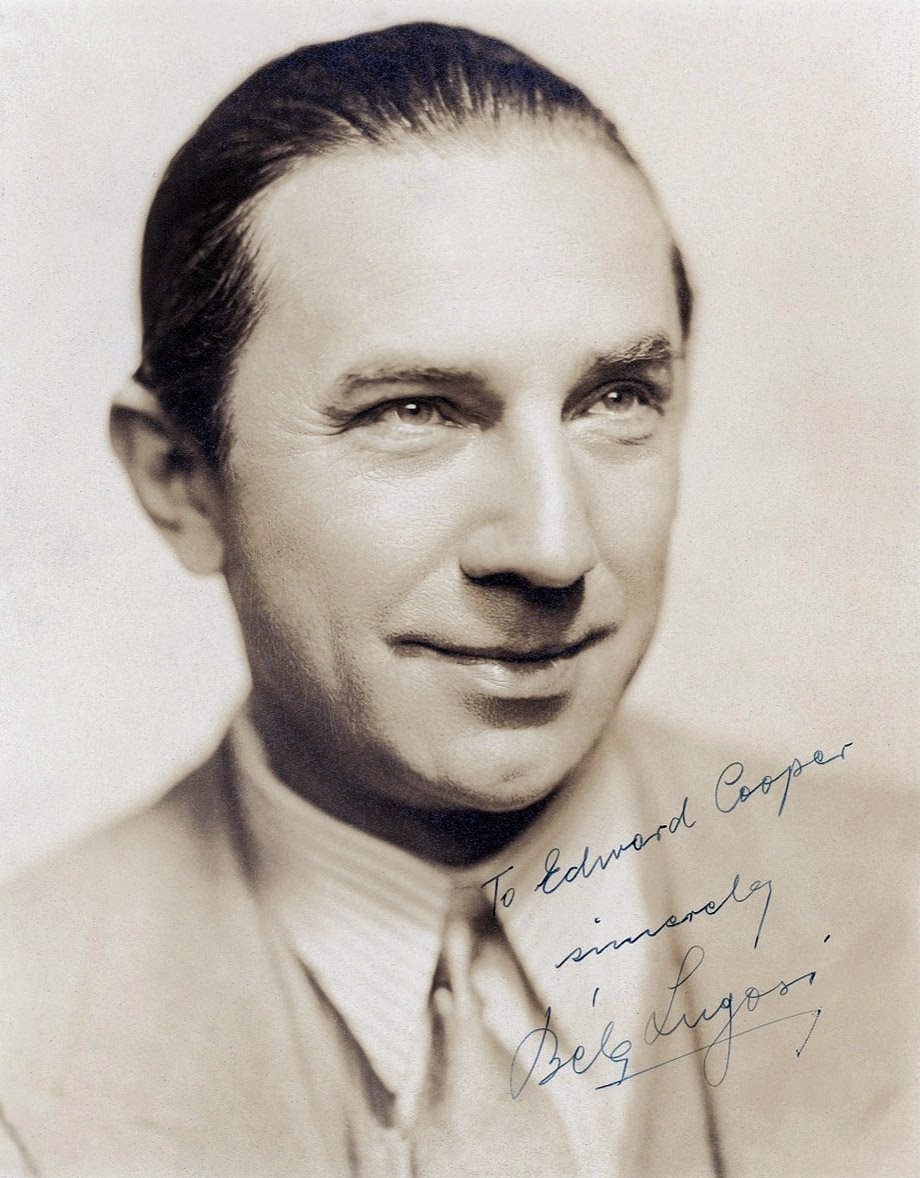
"The Road to Las Vegas: Bela Lugosi in American Theatre" (pgs. 56-65)
Bela Lugosi may have spent much of his career in a coffin, but the man was definitely born in a trunk, to use a hoary old showbiz expression. This eye-opening historical/critical article by author
Frank J. Dello Stritto is easily the lengthiest, most complex, and best-researched piece in all of
Cult Movies #11. It's an incredible work of pop cultural scholarship, one that covers over three decades of Lugosi's life in fairly minute detail and offers great insight into a misunderstood figure.
Dello Stritto painstakingly analyzes Lugosi's theatrical career one show at a time, starting with
The Red Poppy, which lasted a mere ten days in Greenwich Village in December 1922, and ending with
Devil's Paradise, a Los Angeles production that ran for two days in June 1956, only two months before Lugosi's death.
In between these two flops, Bela appeared everywhere from Broadway to summer stock and saw his career ebb and flow like the tide.
Dracula was the actor's most famous role, and he played it many times in many venues of varying respectability, including a 1927-1928 Broadway run that Dello Stritto suggests may not have been a runaway success.
This, however, was merely one facet of the actor's surprisingly diverse, genre-hopping career. By methodically following Lugosi from show to show, the author traces the Hungarian emigre's crazily up-and-down life in the States, including the rise and fall of his 20-year marriage to Lillian Lugosi.
There were triumphs along the way, as in 1943, when a 60-year-old Lugosi successfully took over for professional rival Boris Karloff in
Arsenic and Old Lace and made the role his own. But there were humiliations, too, as in the poverty row "fright night" shows Lugosi consented to do in the early 1950s. Critics were by turns amused, bemused, impressed, and distressed by Bela Lugosi, who never shook his Hungarian accent and who had to resort to some degree of phonetic memorization of his lines, especially in the early days.
I don't know if Dello Stritto realized this Lugosi-centric piece would end up in an issue ostensibly devoted to Edward D. Wood, Jr., but Eddie is a memorable supporting character in "The Road to Las Vegas." In fact, the author goes as far as making this bold statement, which I will quote verbatim:
"Edward D. Wood, Jr. -- sometimes sports promoter, sometime manufacturer of 3-D Christmas cards, director, producer and writer of unforgettably bad films, and now a cult figure in his own right -- is the pivotal figure in Lugosi's last years. Questionable as his cinematic talents may have been, he did succeed in getting Lugosi work when no one else either could or would."
Dello Stritto says that Wood was "the guiding hand" in Lugosi's "moving" and "much-needed" public appearance in San Bernadino, CA on New Year's Eve, 1953, during which the actor made a heartfelt, impromptu speech to his assembled fans. The article divides Lugosi's life into different eras, and Dello Stritto identifies the late 1940s and early 1950s as a time of "Lugosimania," when the actor's presence alone created "spontaneous mass hysteria." This, says the author, was the period when Lugosi met and began working with "a new generation of young filmmakers," including Eddie.
 |
| Comedian Sparky Kaye's grave. |
For Wood fans, the main point of interest in "The Road to Las Vegas" is the section dealing specifically with
The Bela Lugosi Revue, a comedic Vegas stage show allegedly written by Ed Wood and performed over the course of two months in the winter of 1954 at a venue called
The Silver Slipper. Ever the trouper, the aging Hungarian thespian pushed himself to do three shows a day in Vegas for seven consecutive weeks.
Meanwhile, Wood and his then-partner Alex Gordon tried to drum up more work for Bela: perhaps a radio show or comic book and certainly more film roles. Lugosi made it through the grueling run of the
Dracula-spoofing revue like a champ, but the hoped-for job offers did not materialize. Bela's only film work after that was Wood and Gordon's own production,
Bride of the Monster.
Dello Stritto helpfully includes, as a sidebar,
Variety's entire (positive) assessment of
The Bela Lugosi Revue, dated March 1, 1954. From this, we get a much clearer view of what the show must have been like. Though Lugosi was obviously the star attraction, the hour-long show featured a cast of skilled comedians, including Sparky Kaye and Hank Henry, as well as the talents of stripper Terre Sheehan, who "emerges from a large champagne glass of bubbles" at one point in the proceedings.
The Bela Lugosi Revue also included a parody of Jack Webb's
Dragnet, which is interesting to learn because I've often stated that
Dragnet was a huge influence on Ed Wood's movies.
Variety even praises Bela Lugosi's ad libbing skills, disproving a line Martin Landau says in
Ed Wood as Lugosi: "I never said I could ad lib!" According to
Variety, he could.
"Rudolph Grey on Ed Wood" (pgs. 74-77)
 |
| Rudolph Grey and Frank Henenlotter |
One of the true highlights of
Cult Movies #11 is this spirited conversation between Wood biographer Rudolph Grey and cult filmmaker Frank Henenlotter, the man behind such demented horror comedies as
Basket Case and
Frankenhooker. What fuels the discussion is the fact that both men are unabashed Ed Wood fans who are quite familiar with the most obscure titles in Wood's patchwork filmography. As such, they largely forego talking about such obvious titles as
Glenda and
Plan 9 and instead dive headfirst into the deep end of the cinematic swimming pool, to coin a phrase.
Besides the Tim Burton film, the big news in Wood-land at the time of this issue was the recent discovery of a semi-complete print of Ed Wood's
Necromania, a pornographic feature from 1971. Grey said he had offered a $20,000 reward for the movie, but Henenlotter relates the story of how
Necromania really materialized. As it happened, Rudy's book,
Nightmare of Ecstasy, was crucial to the film's identification. Henenlotter:
[The film] turned up quite casually. Some guy wanted to sell [Something Weird Video founder] Mike Vraney a bunch of 16mm sex films. Well, Mike didn't want any hard-core so he asked the guy for a list and was trying to weed out the hard-core from the soft. But since there really isn't any reference work for hard-core titles, Mike called me up saying, "Have you heard of any of these?" And we're just racing through the list going, "nope, nope, nope" and then, boom, he says Necromania. And we both just said, "No. Can't be. No way. Better get it!" So he gets the film, puts it on, sees that the head title is missing and calls me up in a panic. "There are no credits! How do I know if it's Necromania?" I say, "Is Rene Bond in it?" He says, "I don't know who she is." I say, "Is Rick Lutze in it?" He says, "I don't know who he is." So I say, "Get Rudolph's book and turn to page 134. There is a picture of Ed Wood on the set." He does and goes nuts, "We got it! We got it!"
The discovery of
Necromania seems to have bolstered Grey's spirits. He admits to Henenlotter that his fruitless, decade-long search for the Gothic stag film had depressed him. But the mid-1990s were boom times in the Ed Wood biz, as evidenced by Something Weird's VHS releases of Wood's work, the warm reception of
Nightmare of Ecstasy, and the prospect of a Disney-financed Wood biopic. As such, the normally-cagey Grey, whom I've previously described as a cross between Lt. Columbo and Bob Dylan, is unusually effusive, even bubbly.
Since
Nightmare is written as an oral history and is built from quotes by Ed Wood's friends and associates, the book doesn't really offer Grey the opportunity to opine about his chosen subject. Here, then, Grey finally gets the chance to speak his mind about Ed Wood's life and work, particularly his late-career, adult-oriented films from the 1960s and 1970s. Some highlights:
- Rudolph Grey's Ed Wood project began life as a fictional screenplay about a filmmaker who turns to pornography. This was to have been dedicated to Ed Wood.
- At the time of this article, Grey was still trying to track down two other Wood-directed films from the same era (June 1971) as Necromania. These are The Young Marrieds and The Only House in Town. [Note: both have since been located.] According to Grey, Young Marrieds and Only House were both produced by a company called Caballero Films at a cost of $5000 apiece and then sold to Stacey Films for distribution. Caballero, Grey says, was "affiliated with Bernie Bloom, Ed Wood's publisher." This jibes with my theory about those films as well, so I was glad to read this.
- Rudolph Grey reads several long excerpts from Ed Wood's novel The Only House, the book upon which (confusingly enough) Necromania is based. The text is very similar to "Come Inn," a short story I have previously reviewed. The character names (Tania, Madame Heles, Danny, Shirley) are the same in the film, the novel, and the short story.
 |
| Ed-sploitation? |
- Grey and Henenlotter candidly discuss Ed Wood's appearances in the films of Joe Robertson, namely Love Feast and Mrs. Stone's Thing. Eddie appears in drag and intoxicated in these late-1960s productions. In the former, says Grey, Wood is wearing "the kind of underwear my grandmother used to wear." Both Frank and Rudy say that these movies are fascinating finds but ultimately depressing because Ed doesn't look well in them. "It's almost as if he's being exploited," says Grey.
- One Million AC/DC is brought up, then summarily dismissed. Frank Henenlotter calls it "just a lot of stupid jokes abut grapes and an obvious children's toy they're using as a dinosaur."
- Henenlotter also comments on the indelible theme song from For Love and Money: "so ghastly you just can't get it out of your head."
- As the two men survey the films Ed wrote for director Stephen C. Apostolof in the 1970s, Grey remarks that Fugitive Girls has "an Ed Wood script that seems complete and hasn't been tampered with too much." Other SCA films of the era are also critiqued (The Class Reunion, Drop Out Wife, Snow Bunnies, Beach Bunnies, The Cocktail Hostesses), mostly disparagingly. Apostolof, they both feel, exerted too strong a hand in editing Eddie's screenplays, so Ed's voice can barely be heard in the finished films, apart from a few stray lines.
- Grey explains his own qualifications for being able to identify genuine Ed Wood-written dialogue. He finds it especially odd that Eddie listed Hot Ice on his writing resume, since he doesn't detect any trace of Wood in the script. (In my Hot Ice review, I found some potentially Wood-ian elements.)
- Both Frank Henenlotter and Rudolph Grey are much happier with the throwback science-fiction film, The Venus Flytrap (erroneously marketed as The Revenge of Dr. X). Grey enthuses that the film exhibits a "crazy logic" which is "definitely Ed Wood." Henenlotter and Grey are both particularly smitten with the lead performance of James Craig as a cantankerous mad scientist.
- The conversation turns next to John Andrews, a crucial Wood associate who died shortly before the publication of Nightmare of Ecstasy. Grey says that Andrews provided many of the best anecdotes in the book and claims that Nightmare "would have been much less than it was" without John's contributions. Apparently, Forrest J. Ackerman had written an article in Cult Movies disparaging the late Mr. Andrews and accusing him of thievery. Rudolph Grey, in response, calls Ackerman's story "cheap and shoddy."
- The article ends with a thoughtful Rudoph Grey discussing his overall impressions of Edward D. Wood, Jr., the man he has spent decades studying. Ed, he says, was an "unconventional" man with "a vast store of experience," including fighting in the Second World War and traveling with a carnival as a half-man, half-woman. So why didn't Eddie succeed in this world? "Nobody took him seriously," Grey laments. "No one recognized that Ed had something to offer."
"Casual Company - Part 2" (pgs. 78-79)
 |
| Ed's wartime play. |
This particular article was the main reason I decided to buy
Cult Movies #11 in the first place, and it turned out to be my main source of frustration with the issue as well. Just to refresh your memory:
Casual Company was Edward D. Wood, Jr.'s first-ever novel, which he wrote in 1948 at the age of 24, and it was based on his experiences in the Marines during World War II.
Although unpublished during Wood's lifetime,
Casual Company served as the basis for a play that actually was produced at a small theater in Los Angeles in 1948, with Ed both directing and playing the role of "Corporal Anthony." I'm not sure how the manuscript for the ultra-obscure novel survived for half a century, but a copy of it somehow wound up in the possession of the editors of
Cult Movies magazine.
For some crazy reason, I had the impression that the entirety of the novel was included in
Cult Movies #11. This turned out not to be the case. Instead,
Cult Movies chose to serialize the novel, and the magazine's eleventh issue merely contained the second installment of that series: two densely-packed, eye-straining pages of text, presented in what looks like a six-point font and divided into three columns per page.
This layout, coupled with the cheap quality of the paper, makes the experience of reading the article more like that of browsing through a telephone directory in search of an honest-looking plumber.
According to The Hunt for Edward D. Wood, Jr., the first excerpt from
Casual Company appeared in the magazine's tenth issue in June 1993. I do not know if any further installments appeared in the magazine. Perhaps some collectors can enlighten me on this topic.
I was doubly disappointed here: first to realize that the entirety of the novel was
not included in this issue of the magazine and then to find out that I wouldn't even be reading the beginning of the novel but would be joining the story already in progress. (On the letters page, a
Cult Movies reader even says that the idea of serializing the novel in this fashion is impractical. I definitely agree.) But since I had already purchased
Cult Movies #11 and was still very interested in
Casual Company, I read "Part 2" anyway and decided to glean what I could from it.
Tim Burton's
Ed Wood, with a screenplay by Scott Alexander and Larry Karaszewski, memorably depicts the
Casual Company play as being a very earnest and preachy affair set on a grim-looking battlefield. This is understandable, since Eddie claimed to have seen combat in WW2 and even claimed to have survived torture at the hands of the Japanese. But Eddie was also a whiz-bang clerical worker, famed for his typing skills. And when a program for
Casual Company recently resurfaced in the infamous Ed Wood auction of 2015, the play was described as "a farce in three acts" and had lots of jokey, pun-filled character names in its cast list.
True to form, this excerpt from the
Casual Company novel reveals itself as a very mild office comedy with no combat action whatsoever and barely any conflict at all. It could easily be a episode of
Gomer Pyle, USMC or
Major Dad, but it's like one of those shows on Quaaludes.
 |
| Think Gomer Pyle, USMC on heavy sedatives. |
The story -- at least the section of it I read -- is not set in the European or Pacific Theaters at all. Instead,
Casual Company takes place stateside, on a Marine base eighty miles outside of Los Angeles. The activity centers around the office of Casual Company, an outfit that exists to process the medical records of hospitalized Marines. A fleeting reference to Marines becoming "wheel chair cases" is the only hint that there are young men being injured and killed abroad.
Instead, the focus of
Casual Company is on three happy-go-lucky reservists, Elbo, Jim, and Jerry, who have been pressed into service as file clerks. Their lackadaisical attitude towards their work is what gives the Casual Company its name, and the three men are constantly at odds with their commanding officers: dimwitted Captain Roberts, a would-be rabbit hunter who can't seem to hit anything, and the cantankerous First Sergeant Daniel "Hashmark" O'Hare, who is also known as Top. (It took me several readings to figure out that "Hashmark" and Top are the same guy, by the way. Ed Wood does
not make this clear.) Top resents having to deal with these reservists, and the feeling is definitely mutual.
The most major event that occurs in the otherwise snoozy "Part 2" is that Jim receives a personal phone call during work hours from Nadine, a girl he is dating, and Top chews him out for it, only to then receive a nagging phone call from
his own wife, who wants Top to pick up some groceries. It's a standard sitcom comeuppance.
The office atmosphere of
Casual Company reminded me somewhat of the police stations in Wood's later films,
Bride of the Monster and
Night of the Ghouls. Wood tells us that one of Jerry's duties is to fetch Captain Roberts' newspaper each day, which is similar to a minor plot point in
Bride. And just like the cops in
Night, the servicemen in
Casual Company are constantly trying to either delegate or shirk various unwanted responsibilities, including the stamping of record books. Ed Wood's eternal muse, booze, makes an early appearance here, too, with Captain Roberts eagerly anticipating an officer's club party "with good scotch and bourbon waiting, for free."
But there are two passages in particular that Wood's fans will want to read. In the first, Top shares some dialogue with a pretty, angora-clad girl at a cigar counter in the Ship's Service.
The pretty girl in the tight fitting pink Angora sweater set came to him with a smile. "Good morning, First Sergeant," she chirped, cheerily.
"Yeah!" exclaimed the First Sergeant.
The girl looked at him closely. "We haven't met before," she informed the man. "But Elbo has told me an awful lot about you. I feel that I know you like a book."
"I can just imagine what he has told you."
"Oh, it was all good. Elbo is so wonderful."
"Elbo, wonderful! This is a new one."
"Elbo got me my job here. I just started this morning. I like it. Like my new sweater set? Angora ... I just bought it yesterday. I wanted a new sweater set for my new job. So out I went shopping. I saw this angora. It was so soft and cuddly and with this beautiful soft pink color, it is all so feminine. Something new for something new. Isn't that cute? Something new for something new ... I like that."
"I'm glad you like it."
"Ohh, I do ... I paid plenty for the sweater set, too."
Top sighed ... "And I'm glad you like your job, and if you want to continue liking it, I suggest you get me five, fifteen cent cigars."
The girl let her smile fade. Maybe all those things that Elbo had said about his First Sergeant were true, but even looking closely she didn't see any horns, nor did she see the hole in the man's head.
Apart from the fetishistic attention to the textural qualities (and exorbitant price) of angora rabbit fur, one may note the frequent use of ellipses and the comparison of the First Sergeant to a horned devil or demon. All are trademarks of Ed Wood's writing. Another intriguing, quintessentially Wood-ian quote comes near the end of "Part 2" when Top rants about the reservists, whom he deems less than manly. Were
Casual Company more famous, certainly the following line would be among Ed Wood's most famous phrases:
"Ohh, to be with a man's outfit again, and far away from you pantie waist reserves."
I'm not sure if the punning on Wood's part is wholly conscious or intentional, but modern readers will certainly detect some coded messages here to Ed's own, tortured transvestism, which famously caused him anguish during his war years. Also present is Ed's eternal obsession with manliness. Wood himself has been described as "effeminate" by some observers, and his characters frequently brood over their own perceived lack of machismo.
It is interesting to note that self-styled man's man Top is symbolically emasculated by his nagging wife shortly after ranting about "pantie waist reserves," thus calling his own masculinity into question. All in all, even though this book can be classified as mere
juvenilia, Ed Wood's
Casual Company does show some early promise and still reads fairly well.
The main problem I encountered as a reader is that, about halfway through, the story jumps from one location (the Casual Company office) to another (the Ship's Service) with no transition at all. One second, we're with Jim, Jerry, and Elbo, the next with Top and the cigar girl. I have to wonder if
Cult Movies ran two separate chapters together with no break. Otherwise, it's the literary equivalent of a jarring and unexplained jump cut.
Cult Movies ad (pg. 88)
This is a one-page ad for back issues of the magazine. What's notable is that Ed Wood's name appears on the covers of issues #7 and #8. The latter promises: "Coffin Joe, Vampira, Ed Wood, Lugosi & More!" Obviously, Eddie was a regular fixture in the pages of
Cult Movies. According to Philip R. Frey's
invaluable Ed Wood site,
Cult Movies #3 (1991) also devoted its cover to Wood with the headline: "Edward D. Wood Jr.: The Story Must Be Told!!!," while the first part of
The Casual Company appeared in issue #10 from June 1993.
Inside back cover
We are treated to two more stills ("exclusive first photos") from
Ed Wood. The first depicts Lisa Marie as Vampira, hands on hips, standing imperially on the fog-shrouded set of her TV show. The second shows Johnny Depp and Martin Landau as Ed and Bela, watching TV at Bela's home. Below is a darned good approximation of the page. I had to do some searching for a still that showed not only Depp and Landau but the large painting of Bela Lugosi behind them.
 |
| Two more publicity stills from Touchstone's Ed Wood with Lisa Marie, Johnny Depp, and Martin Landau. |
And that, my friends, is just about all the Ed Wood content you'll find in the eleventh issue of
Cult Movies magazine. But even all that is
far from everything you'll find in this slim but densely-packed publication. Along with pages and pages and pages of detailed movie and book reviews, there is a lengthy feature story about softcore filmmaker Barry Mahon, plus some
Godzilla-related interviews, and even a look at "1937: Hollywood's Year of Tragedy."
In short, this is a goldmine of information about weird, offbeat, and underground motion pictures. One could say that magazines like
Cult Movies have been rendered obsolete or redundant by the internet, but I would not agree. This is a professionally-produced piece of work, so it has a sense of authority that may be lacking from amateur fan sites. But it's not a slick, corporate-owned entity either, so it can afford to be more esoteric and niche-specific than most major entertainment websites could ever be today.
The sheer amount of research that has gone into just this one issue boggles my mind, and I don't think all of this stuff has turned up yet online, even twenty years later. Throughout my years as a hardcore movie geek, I've been dimly aware of the importance of magazines like
Cult Movies, but I haven't really given them much time or attention until now. Maybe I should have.
 Next: Thanks to a generous grant from the Philip R. Frey Foundation, Ed Wood Wednesdays is at last able to return to its original purpose of reviewing actual motion pictures. Can you believe it? I'll be reviewing movies again here! The magnanimous Mr. Frey sent me a whole passel of obscure Wood flicks, ones I'd tried to find without success, and I think it's high time I started digging into them. So that's just what I'll do. Make it back here in two weeks for my long-gestating examination of The Lawless Rider (1954).