Showing posts with label depression. Show all posts

Tuesday, August 12, 2025

I wish that I knew what I was supposed to know now when I was my current age

"Poor old Granddad, I laughed at all his words."

I keep hearing the Faces' song "Ooh La La" in movies, TV shows, and commercials. Why? What is it about this particular track that's allowed it to stick around for decades? As I see it, the song's main appeal is that it takes a near-universal sentiment—"I wish that I knew what I know now when I was younger"—and sets it to catchy music. This is a thought many of us have had at some point in our lives, and "Ooh La La" allows us to sing it out loud instead of just ponder it. And so, "Ooh La La" has become a song about the hard-won wisdom that only comes with age.

But I don't think the song, written in 1973 by Ronnie Wood and Ronnie Lane (both 26 years old at the time), is as heartwarming as people seem to think it is. The lyrics of the first verse add some necessary context to the song's famous refrain.
Poor old Granddad, I laughed at all his words
I thought he was a bitter man
He spoke of women's ways
"They trap you, then they use you
Before you even know
For love is blind and you're far too kind
Don't ever let it show"
Try making a heartwarming insurance commercial out of that. Sounds like Granddad is working through some serious issues with women. And his smartaleck grandson does not take him seriously whatsoever. So much for hard-won wisdom.

Still in all, we have that indelible chorus: "I wish that I knew what I know now when I was younger." It's a comforting thought. Everything would have turned out better, we tell ourselves, if we'd just been given the necessary information at a young age. Forewarned is forearmed.

As I think about the current, unsatisfactory state of my life, I've occasionally asked myself the question: what do I wish I had known as a child that would have helped me avoid this fate? And, frankly, I've come up short. The problem with the line "I wish that I knew what I know now" is that it assumes you actually know something now! I don't. Nothing good at least. I've only learned how rotten the world can be. I know which choices of mine didn't work, but I don't know of any better ones I could have made or should have made.

And so, despite what the song says, I can't think of any advice I'd give to my younger self that would have helped him or any wisdom that would have prepared him for adulthood. In fact, if it hadn't been for ignorance—the total, blissful stupidity we only tolerate in children—I'd never have gotten any fun out of life at all. The more I learned of this world, the less I liked. So my version of "Ooh La La" would probably go something like: "I wish I knew as little now as I did when I was younger."

Wednesday, August 6, 2025

Life update: A cry for HEEEEEEEEEEEEEEEEEEEEELP!!!!!!!!!!!!!!!!!!!!

Gene Wilder and Zero Mostel in The Producers.

There's a moment, early in Mel Brooks' The Producers (1967), when meek accountant Leo Bloom (Gene Wilder) finds a serious discrepancy while auditing the books of failing Broadway producer Max Bialystock (Zero Mostel). Max raised $60,000 from his backers for his last flop but only spent $58,000 on the show; the other $2,000 he kept for himself. This is fraud, Leo reminds Max, and could send the producer to prison. Max responds with a soliloquy:
Bloom, look at me. (more forcefully) LOOK AT ME, BLOOM! Bloom, I'm drowning. Other men sail through life. Bialystock has struck a reef. Bloom, I'm going under. I'm being sunk by a society that demands success when all I can offer is failure. Bloom, I'm reaching out to you. Don't send me to prison. (getting very close to Leo's ear) HEEEEEEEEELP!!!!!!!!
I've reached a stage in my life when I can relate to both men in this scene. Like Leo, I go to a dull, unrewarding office job every day. It's how I'm able to pay my rent and my bills and have medical insurance. At night and on the weekends, I pursue various creative enterprises. Unfortunately, like Max, I have largely met with failure. Despite producing a great deal of work over the course of several decades, nothing I have done has reached beyond a very small audience. Sometimes, the only audience is myself.

Sunday, October 30, 2016

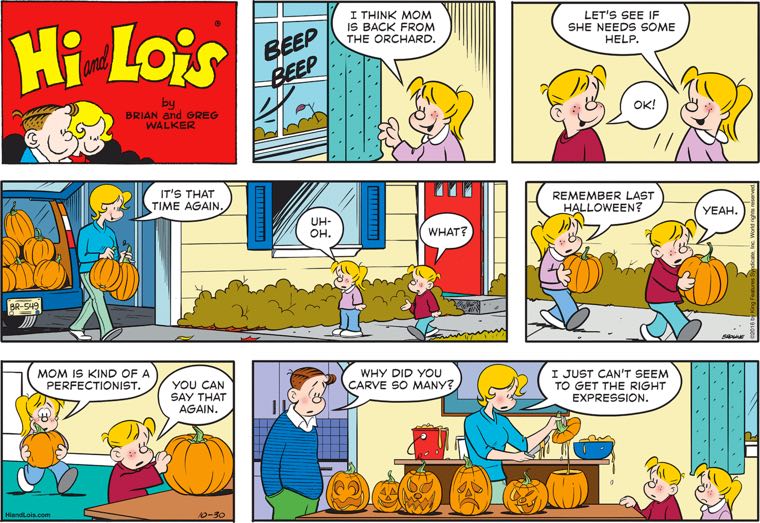
'Hi And Lois' turns into a drama so easily

Filmed in Depress-O-Vision.
  
Autumn is a time of death and decay, but that idea is rarely reflected in newspaper comics, with their gaudy colors and cheap punchlines. Fortunately, the darkness is lurking just below the surface and can easily be brought to the forefront. It takes very little to turn this Hi and Lois Sunday strip into a tense domestic drama similar to Robert Redford's Ordinary People. Just tweak the dialogue a hair, erase the phony smiles from the characters' faces, and desaturate the colors. Boom. Instant Oscar bait. I think the idea here is that Lois Flagston is trying to create the "perfect" jack-o'-lantern because she cannot attain perfection in her own life. And she makes her husband and children suffer because of this. HAPPY HALLOWEEN!

Sunday, August 21, 2016

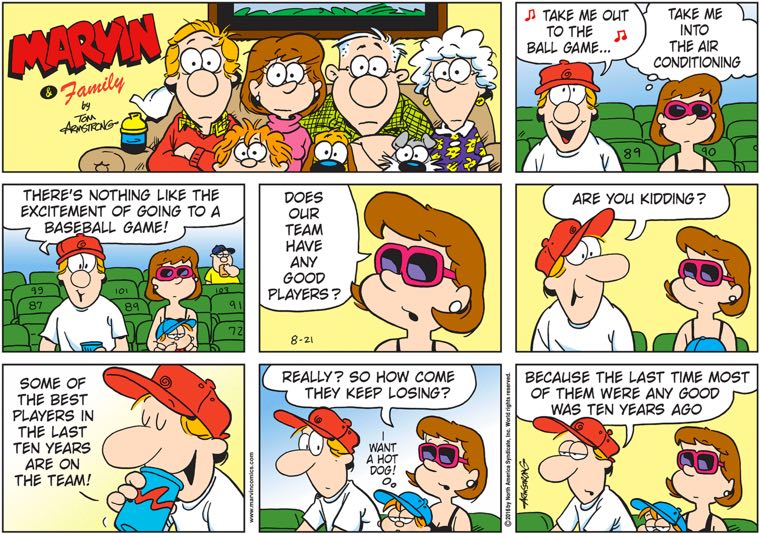
Darkness at the heart of 'Marvin'

My slight rewrite of today's Marvin.

Tom Armstrong's Marvin strikes me as one of the unhappiest domestic comedies in the world of syndicated cartoons. Sure, people point to Funky Winkerbean as a cesspool of ceaseless misery, which it is, and The Lockhorns do not disguise their hatred for one another. But the ostensibly cheerful Marvin, about a baby who never ages and the parents who are stuck caring for him for all eternity, seems profoundly darker than either of those other examples. So I decided to take this Sunday Marvin and give it just a slight rewrite.

Here's another recent Marvin rewrite of mine. This is a little more upbeat, because I've given the parents a way out of their personal purgatory.

Shouldn't there be a horror film called Gore-phanage by now?

Sunday, August 9, 2015

Sometimes, I just need to be openly miserable, okay?

I want you to study this graph very closely. Commit it to memory.

This blog has sucked lately, but I don't apologize for that because it has sucked for a valid, legitimate reason. As anyone who has read Dead 2 Rights or who has known me for any amount of time should be aware by now, I suffer from depression and anxiety. (You should know this because I won't shut up about it.) And we're talking medically-diagnosed, clinical depression and anxiety here. I take antidepressants and attend weekly therapy sessions, and these things help somewhat, but they are not magic by any means. They are not a cure-all. Treatment of mental health issues can be complicated and frustrating. The best, quickest way to illustrate this is to direct you to a recent BuzzFeed article by Anna Borges entitled "13 Graphs Anyone Who's Ever Been Depressed Will Understand." Please read it. It's an excellent summary both of what depression is truly like (read: mostly boring) and of the various misconceptions people have about the condition. Of particular interest is Borges' keen observation that "sometimes, you relapse." That's very true for me.

Since my hospitalization in late 2012, I have made slow, sometimes barely-perceptible progress in my quest to become a happier, healthier person. But I have my share of bad days, too, and sometimes those can turn into bad weeks or even bad months. Lately, I will admit that I have been relapsing somewhat. My high-stress, low-satisfaction job is a constant source of both depression and anxiety, and some recent changes there have had a significant negative effect on me. Part of the fault is my own. As an anxious person, I am liable to take minor, inconsequential issues and magnify them until they are huge, life-threatening crises. And as a depressed person, I am liable to fall into a state of helplessness and lethargy. Combine the two and you've got a real mess on your hands.

One thing which really helps -- and this can be difficult for people to accept or understand -- is to vent my negativity. I do that in therapy, sure, but I also occasionally do that on this blog and in private conversations, too. There are some posts on Dead 2 Rights which are strictly excuses for me to be negative and complain about everything which is going wrong in my life. If those articles don't interest you, by all means skip right over them. There's plenty of other stuff here to read. But if you do choose to read those articles, please try to understand that I just need to be a total downer sometimes. I don't want these articles to worry you or upset you. Believe it or not, these articles help me to feel better. Please just let me be miserable sometimes. It's important to me.

Okay, I'm glad we had this little talk. You may go in peace to love and serve yourself.

Wednesday, April 22, 2015

A pantry full of hate

This is a picture of clutter, in case you don't know what clutter looks like.

The kitchen in my apartment has a pantry, but I don't cook so I use it as a storage closet instead. Being the lazy, indolent sumbitch that I am, I have allowed this pantry to become laughably, even shamefully cluttered. Recently, I was trying to fill out my 1040 EZ for the benefit of good old Uncle Sam and thus went rummaging through the aforementioned closet in search of a large manila envelope upon which the fateful words "TAX SHIT" are scrawled in Sharpie. It took me a while to find, and so I resolved to finally sort through all the useless stuff in there and throw out or recycle anything I didn't actually use or want anymore. Last weekend, I actually went through with this plan, and it felt kind of good for a while. The pantry is still pretty much a mess, but now at least it's a somewhat more manageable mess.

The reason I bring all this up is that my mind is a lot like that pantry. It's cluttered up with a lot of useless junk. You know what takes up an inordinate amount of room? Grudges. Man, I am the king of grudges. I have grudges going back decades. I'm still mad over shit that happened before I was even in kindergarten. There are slights and injustices I can still remember from every phase of my life, and with only a little effort, I can still dredge up the hurt they caused me at the time and make those incidents seem freshly painful again, as if they just happened yesterday. I'm sure lots of good things have happened to me over the years, but my memories of the bad things are so much more vivid in my mind. Four long decades of birthdays and Christmases blend together into one big, blurry blob of indistinct experience. But if you teased me at recess even once in the third grade, you can bet I still hold onto that memory with a vice-like grip.

If you're one of the very few people reading this, it's likely that you're someone I have known for years. And if you're someone I've known for years, it's almost certain that you have caused me some real (or imagined) grief and that I'm still angry about it. I don't like that about myself. I never meant to become so bitter. It just sort of happened, failure by failure, disappointment by disappointment. I don't know what to do with all this bitterness. It's never done me a bit of good, and yet I can't bear to get rid of it.

Monday, February 16, 2015

Good night, Lesley

It was her party. Lesley Gore (1946-2015)

"Can you relate to Lesley Gore's music?"
-dialogue from John Waters' Hairspray (1988)

I feel I should say something about Lesley Gore, who passed away today from lung cancer at the age of only 68. It's not a topic to which I have given a great deal of thought, but I suppose it's fair to say that I've been a fan of Ms. Gore for most of my life, from the time when I first started hearing her songs on the radio until today. Due to laziness on my part, I don't claim to be familiar with much of the music she wrote or recorded after that initial burst of hits in the 1960s, but those hit records from the JFK/LBJ era still resonate with me. 

Everyone remembers "It's My Party" and its soundalike sequel, "Judy's Turn to Cry." But don't forget "Maybe I Know," which was covered decades later by They Might Be Giants, the chilly and dramatic "You Don't Own Me," which turned up in John Waters' Hairspray (1988),  and the ridiculously cheerful "Sunshine, Lollipops, and Rainbows," which was used to hilarious effect on The Simpsons once and which I semi-jokingly, semi-sincerely named as my "recovery anthem" when I was hospitalized for depression in 2012. I actually listened to that song dozens of times back then. Yes, I could relate to Lesley Gore's music. She had a clean, strong, solid voice and sounded like she really meant everything she said. When she told her boyfriend he didn't "own" her, brother, she wasn't kidding! I like emotional directness in music, and Lesley had it to spare.

If you want to remember Lesley Gore today, please watch her (typically stellar) set from the best concert film ever made, 1965's The T.A.M.I. Show. Study it, and see how female pop singers used to be able to comport themselves. Fifty years later, Lesley's still a great role model. Johnny wasn't good enough for you, honey.

Sunday, October 26, 2014

Lunchboxes of my youth: fear comes with its own Thermos

As a child, I spent my lunchtimes staring at the coked-out visage of Ms. Carrie Fisher.

Springview Elementary: a chamber of horrors.
The onset of fall always brings back memories of my own elementary school days. Unfortunately, most of those memories suck, and I would rather repress them than relive them. No offense to my former classmates, who have grown into thoughtful and friendly adults, but you scared the living shit out of me when you were children. Kids can spot weakness in a second, and I was lousy with it. I made the bullies' job too easy by being such a tempting and passive victim. (Fun fact: one of my childhood tormentors eventually did some prison time, a fate I had secretly predicted for him years earlier.) What would I have done differently, knowing what I know now about the world and about human nature? Just about everything.

Back in the early-to-mid-1980s, though, I was as clueless as they come. I mean, I was alert enough to realize I was not getting along well with my classmates, but I had no idea why that was or what I could do to change the situation. Walking to Springview Elementary School in the morning, I felt like a condemned man walking the green mile. I would not have known the words "alienated" or "ostracized" in those days, but both of those adjectives applied themselves manifestly to me. There was no sadder day on the calendar than the last day of summer vacation. I still shudder to think about it. For most kids that age, lunch and recess provide a welcome relief from class. In my case, it was just the opposite. At least in class there were rules and some semblance of order. The playground and, especially, the lunchroom were consequence-free zones where all sorts of torture, mostly psychological but some physical, was either tolerated or ignored.

Despite all this, I still have some residual affection for lunchboxes. I might have been part of one of the last generations in this country who actually got to carry the metal ones to school with them. These were banned years ago because -- and this should come as no shock -- horrible, bratty children were using them as weapons. That's how much kids suck. A second-grader gets a beautiful metal lunchbox in his possession, and his first thought is, "I should just straight-up brain somebody with this thing. It looks like it could cause serious injury." So now, metal lunchboxes exist only as collectibles for sad grown-ups like me. I don't actually buy them, mind you, but on especially lonely nights I do browse through Ebay and see if I can find any of the lunchboxes I carried as a kid. In fact, I think I can trace my entire youth through those long-gone food containers with their matching Thermoses. Let's take a trip down Pointless Nostalgia Lane, shall we?
(Note: I do not currently possess any of these lunchboxes. These are all pictures I yoinked off the Internet. Even if I did still have these, they wouldn't be worth anything because I treated these lunchboxes as carelessly as I treated all my possessions in those days. I was a profoundly stupid child.)

Thursday, October 16, 2014

One Song at a Time: "Love Me, Please Love Me"

French pop star Michel Polnareff sings his Frenchie heart out.

The song: "Love Me, Please Love Me"
Artist: Michel Polnareff
Released: 1966
Elvis Presley had at least two major hit singles in 1956 that were direct, unambiguous requests for love. 

"Love Me Tender," which takes its melody from an old folk tune called "Aura Lee," is a swaggering seduction routine set to music. It's audio foreplay, a sexual aperitif etched into wax. The guy in the song is a Lothario type, sweet-talking some innocent girl right out of her poodle skirt. The lyrics are G-rated ("You have made my life complete, and I love you so") and ostensibly wholesome, but you can tell why this guy made parents nervous back then. What did he mean by "all my dreams fulfill?" What kind of dreams did he have in mind? 

The King had another one that same year just called "Love Me," which I like even better. It's supposed to be about a desperate guy groveling at the feet of a cold-hearted woman. ("Treat me like a fool, treat me mean and cruel, but love me!") But Elvis wasn't really the desperate, groveling type, so the song comes off as kinky and masochistic instead. You get the impression that the guy in the song gets off on the rough treatment he receives from this dame. Topping from the bottom, you might say.

A decade later, over in France, a moody, floppy-haired singer named Michel Polnareff had a #1 hit with his own plea for love, "Love Me, Please Love Me." It's just about the most pathetic I've ever heard someone sound on record, and I love it. Most of the lyrics are in French, but you don't really need a translation to get the gist of it. Not when poor Michel is howling in falsetto like a mournful hound dog.

This song demonstrates a level of vulnerability that Elvis Presley never would have been comfortable with. From what I can glean of his delightfully bizarre and eventful Wikipedia entry, Michel was just as troubled in real life as he sounds on this record. You can hear his genuine sorrow in every throbbing triplet he pounds out on the piano. 

I can just imagine some heartsick Frenchman playing this record over and over again, using his last bit of strength to life the tone arm on his vintage record player. Whenever I want to wallow in misery (which is basically all the time), "Love Me, Please Love Me" is my go-to song.

Thursday, August 28, 2014

Where the hell have I been?

Archie and the gang reenact the myth of Sisyphus.

I have not been updating this blog much for the last couple of weeks (shame on me), but I have a valid-ish excuse. If you read last week's Ed Wood Wednesdays article (and please, please do if you haven't already), you'll know that I came down with what was either the worst cold of my life or some virulent strain of influenza with a wide range of inconvenient symptoms, including the temporary loss of my glorious speaking voice. (The laryngitis came on strong, subsided, came back, and subsided again.) I'm operating at about 90-95% capacity now, but the last two weeks have straight up sucked. Regretfully, I did not face adversity like a champion. Instead, I wallowed in depression and inertia, accomplishing very little. I kept going to work and meeting my obligations there, of course, but everything else kinda went by the wayside. The only thing I've been writing recently are tweets. That doctored Archie comic up there represents my first creative endeavor of any kind in a while. I've been watching the hell out of the 12-day Simpsons marathon on FXX (I don't really give a damn about the "cropping" controversy), but that's pretty much been the extent of my media intake. Other blog/life updates:

  • My dad had to spend some time in an intensive care unit following a procedure to remove excess plaque from his arteries. I'll admit I was scared by this, but he's home now and doing fine. We had a nice long chat yesterday, and seems to be recovering nicely. Even though I'm an atheist, I've done plenty of praying in the last few days.
  • In happier news, I was briefly interviewed by a reporter named Erik Piepenberg from the New York Times for a piece about Ed Wood. I don't know if any of what I said will make it into an article, but it was cool to talk to a professional journalist about something which interests me. I'll keep you posted should anything develop from this. UPDATE: Here is a link to the completed article.I'm only quoted once in it, but it's right near the beginning. And the article does kindly mention Dead 2 Rights and "Ed Wood Wednesdays."
  • Even when I don't post anything new to D2R, I'm always working on upcoming pieces for this blog. I have some stuff planned which I hope you will enjoy.
  • That's it. I have nothing else to say right now. Think of me often as you enjoy the rest of your day.

Friday, July 11, 2014

One Song at a Time: "Mind"

Talking Heads around the time they recorded the Fear of Music LP.

Song: "Mind"
Artist: Talking Heads
Released: 1979

Cheery cover, no?
I lived at home until I was in my mid-20s. I didn't plan it like that. Just sorta worked out that way. And I wasn't a layabout slacker, a la Ben Katz (H. Jon Benjamin) from Dr. Katz, Professional Therapist, either. I went to college, and I worked as a customer service rep and a substitute teacher. But all that time, I was living in my bedroom from high school.

Hell, still to this day, I have the same exact bed that I've had since I was 13. I'm writing this article from it now. Same dresser, too. And on top of that dresser, the same goddamned boombox. But, anyway, let's go back to the early 1990s. Specifically 1992-1993. My senior year of high school. That's the time when you're supposed to be getting your shit together -- applying to colleges, trying to get scholarships, picking out a career, all of that garbage. I knew I was supposed to do that stuff, but I just never got around to any of it. My mom's cancer-related death took a lot of the fight out of me back then, and I turned into the reclusive, bitter weirdo that I still basically am today.

My dad took my mom's death even worse than I did and became a a rather sad and depressive person. I don't know if he's totally recovered, twenty years later. My sister, wisely, moved away and started a family of her own. Me, I stayed with my dad in my hometown. It was just the two of us in a house that was much too large. I'm not gonna lie to you, folks. Those were shitty, shitty years. (Did you see Crumb? Remember Charles Crumb and his mom? It was kinda like that. Not quite as bad, but definitely getting there. It was like the prequel to that.)

My low point was when I took that customer service job, during which I worked in the world's most depressing phone bank in the basement of an auto parts plant. You descended this dimly-lit stairway to get there, like descending into Hell. All day, you had to absorb the negativity of the callers. Between calls sometimes, I would rest my head on my desk and sob. About eight or nine months into doing that, I went through the medicine cabinet at home and took everything in it. Wound up in the intensive care ward for three days. Not fun. Then went back to the parts plant to be a customer service rep again. Even less fun.

Cut to a few months later. Out of the blue, and I mean the fucking Papa Smurf's ass blue, I got a job offer to teach at a middle school near Joliet, IL. Even better, I was at my desk at the parts plant when it happened. I immediately took it, no questions. Quitting that customer service gig was one of the Top 5 happiest moments of my life. (I can't even think of the other four.) My father was not thrilled. He made me feel very guilty about the whole thing, and I don't think he's ever gotten over it. I felt then -- and I feel now -- like an ax murderer for moving out of his house and into my own apartment in another state, even though I'd definitely be dead today if I hadn't.

That was 2001. That middle school was where I was when the Twin Towers fell. It was the day before my 26th birthday. I don't think I taught those kids in Joliet a damned thing. Someday, I'll write about my horrendous experiences as a teacher. (Short version: if you hate and fear people, especially teenagers, don't go into teaching.) But I certainly learned a valuable lesson that first year "on my own."

I thought that the move would somehow magically fix everything and that my personality would just naturally smooth itself out once I was in Illinois. Didn't happen that way. I was the same asshole there that I was in Michigan. All my hang-ups, hatreds, insecurities, and inadequacies were still there in Illinois. That's what I think about whenever I hear "Mind" from the Fear of Music album by Talking Heads. Most of the lyrics are about the things that "won't change you": time, drugs, science, money, religion.

I don't know if David Byrne was directing this song at himself, at the listener, or at somebody he knew. But I'll be good and goddamned if it isn't all true. I can add a few items to his list, too. Xanax won't change you. Therapy won't change you. Welbutrin won't change you. In the chorus, Byrne sings, "I need something to change your mind." Amen, brother. I'm still looking for that something.

Wednesday, October 30, 2013

So it's been a year. How am I?

(from left to right) Me as I appear now; me as I appeared one year ago. 

"So how have you been?"

Every Wednesday afternoon at around 3:59, I pull into the parking lot of the Arlington Professional Center, an uninspiring complex of squat brown office buildings, in my battered, decade-old silver Cavalier and walk to Suite J for my weekly therapy session. I try not to arrive even a minute early, because I want to spend as little time as possible in the waiting room. Suite J of the Arlington Professional Center has the worst waiting room in the history of people waiting in rooms. Auschwitz had nicer waiting rooms than this place. It is a cramped and ugly space which, if anything, would deepen a patient's sense of hopelessness. There's a faded poster of a wolf on one wall and a table piled high with useless, glossy, oversized magazines filled with pictures of expensive furniture. Certainly, the room's oddest touch is a shelf with a hopelessly outdated and never-used boombox, along with a stack of never-played CDs (classical, new age, lite jazz) and even one sad, neglected cassette. Fortunately, my therapist's own office is much more inviting, with its soothing, dim lighting and comfy, tasteful furniture. Each week, at around 4:01, I haul my depleted husk of a body into this room and plop down on an overstuffed black couch. My therapist, a 50-ish Polish woman with spiky blue hair and the wardrobe of a bohemian artist, asks me how I've been that week.

"Oh, I don't know," I'll usually say. "The same, I guess..."

Monday, February 18, 2013

My therapist stood me up. That's not a joke.

A scrambled portrait of your humble blogger. No,wait, I hate that word. Your humble bloggist.

It sounds like the setup for a joke in Woody Allen movie, but it actually happened to me this week. My therapist did not show up for our weekly appointment. Actually, the office she shares with another doctor was totally locked and empty when I got there. I stood out in the cold, knocking on the door for a few minutes, but to no avail. I have no idea what happened. Maybe she's ducking me. Who knows? I could have been the patient who finally drove her out of the therapist biz. But I kid my therapist. She's actually very nice -- a thin, spiky-haired woman of about 50 with a heavy Polish accent and the wardrobe of a bohemian art teacher. At our last session, she had dyed her hair blue to match her outfit. No kidding.

Anyway, since I live alone and have very little social life, my therapy sessions are pretty much my only opportunity each week to interact with another human being in person and speak as myself. Naturally, when speaking to coworkers or relatives, I have to be on my best behavior. It's very nice, then, to have an hour a week to say whatever I want and speak freely.

Well, guess what? Since I didn't get to have a therapy session this week, I'm going to treat this blog as if it were my therapist's office and you, dear reader, are going to be my therapist for the week. I'm going to say whatever comes into my head, and you're going to nod and say things like "Mm-hmm" and "Very interesting. Please go on."

Do you think you can handle that? Good! Let's get started.

We only have an hour here, so you're going to want to keep at least one eye on the clock at all times, the way a real therapist does.

I usually start out each session by saying how my week has gone. Well, citizens, it was sort of a rough one for me even though nothing much of note actually happened. Work has slowed down to a crawl lately, which puts a damper on my bank account. And naturally, now is the time when seemingly everything I own has to be repaired or replaced. So more money is going out than coming in currently. I think/hope/imagine/pray that the situation will be better in a few months, but it does sort of get depressing to look at my recent bank statements. I really ought to have a better-paying, more stable job. Even my immediate supervisor has said so. I've basically taken a temp job and managed to make it last ten years. I should probably aim a little higher.

But here's the thing about that: I hate business. I hate business people. And worst of all, I hate business people talking about business stuff. I can't even be around those people for long. I can barely survive an elevator ride with corporate-minded folks spouting all that business gibberish.

The great thing about my job is that, for the most part, it involves very little interaction with these people... or any people. I can just put on my headphones and listen to podcasts all day while doing my work, which is great. The pay is lousy, though, and it's sort of humiliating to be in such a menial, low-level job for a decade.

Why don't I try for something better? Well, for one, I'm not the least bit ambitious, at least not in that way. I've seen the people who get promoted at my company. Many have come through my department. But they're driven by a kind of hunger I just don't have. They hear about an opening for "regional associate managing project director" or some such thing, and they go after it like a dog devouring a T-bone steak. Meanwhile, I can't schmooze. I can't network. I can't self-promote. I just can't bring myself to do any of that stuff. I shudder just thinking about it.

So if the corporate thing isn't for me, why don't I quit my job and pursue my dreams? After all, it's not like I have a family to support or anything. But here's the sad truth: I don't have a dream. There's never been anything I've wanted to do as a career. Not one, even when I was a kid and too dumb to be disillusioned. I'm just a dabbler. I dabble. I've tried all sorts of creative pursuits, including this blog, and they're sort of fun and fulfilling. But I've never stumbled across anything I would describe as a passion. I have interests but no passions. Wow. That sounds just awful, but it's the truth.

Ultimately, that's what makes it really difficult to keep going. I have no goals. There's nothing I really want. And that's the essence of life, isn't it? Wanting stuff? The same goes for relationships. I've had maybe five dates in my entire life and never anything close to a girlfriend. But it's not like I've put a whole lot of effort into that arena. I have no dating skills, and I know from my few disastrous dates that I'm not boyfriend material. I don't think I'd really want a girlfriend, and the idea of being married or having kids scares the life out of me.

So what do I do then? Work a crummy, low-paying job and live alone for a few more decades until I finally die? Yikes. That doesn't sound too appealing. That's the upshot of all this: I'm kind of out of options. I've seen and done as much as I want to do, and there's still so much time left. How am I going to fill it?

Well, well! Speaking of time, it looks like ours is just about up. This has been a great session, doc. I really got to express some stuff that's been on my mind lately. Thanks for listening. Same time next week? Super.

ADDENDUM: I feel I should add a little tag to this article for anyone who reads it and thinks it is too dark or depressing. What you have to understand is that I use my therapy sessions to vent all the negativity that builds up in me over the course of the typical week. Once I've said all this terrible stuff, I usually feel much better. As odd as this might sound, I would liken it to an exorcism. The therapist is the Max Von Sydow to my Linda Blair. This week, I'm asking you to be my Max Von Sydow. Thanks.

Tuesday, January 1, 2013

New Year's resolutions? Sure. Why not?

If nothing else, this post has at least capitalized on your residual affection for Calvin & Hobbes.

This is the time of year when people traditionally make unrealistic promises to themselves that they cannot and do not intend to keep. We get a new calendar and temporarily feel we can press the "reset" button on our lives. Lose 20 pounds? Sure, champ. Learn a foreign language? Whatever you say, sport. Finally get out from under that crushing credit card debt? Stranger things have happened, pally. 

But let's be honest. The surest predictor of future performance is past performance. In 2013, you will all but certainly continue to be whatever it is you were in 2012. If that's a good thing, then relax and enjoy it. Keep up the good work! If that's a bad thing... well, there's always alcohol and television, right? Me, I'm setting a goal which is just vague enough to be attainable. My New Year's resolution is to suck less.

Where are Lazy and Resentful?
That's right. I will admit here and now to you readers that I (often) suck as a human being. I don't take pride in that. In fact, my goal for the new year is to reduce that suckage by some measurable percentage. How does 3% grab ya? One percent seems too skimpy, but five would be pushing it. Three is doable. 

So what are my suckiest traits? Uh, let's see. I'm judgmental, short-tempered, impatient, resentful, self-absorbed, lazy, cowardly, gluttonous, materialistic... wow, this list is a bummer. It also sounds like a list of rejected dwarfs from Snow White, doesn't it? Anyway, I think I'll stop the list of adjectives right there. You get the idea. You'll notice I didn't mention any physical attributes -- health, appearance, etc. 

Frankly, I can't deal with that stuff right now. We'll table that for the time being and get back to it in 2014. 

For now, let's just concentrate on the personality and behavior. Looking back on 2012, it was kind of a momentous year for me. After trying (unsuccessfully) to deal with the anxiety and depression which have ruled my life for decades, I finally got help for myself, and I'm being very good about it, too. You should be proud of me. I'm taking the meds every day and attending therapy once a week. And though it hasn't magically made my life "perfect," it's helped in measurable ways. I sleep easier now, for instance, and get sick less often. Like anyone else, I still experience fear, uncertainty, disappointment, and sadness, but I'm no longer plagued by the panic and depression which once took full possession of my body and mind. When I'm especially weak, I almost miss those feelings. As unpleasant as they were, they at least lent a little drama to what is otherwise a very monotonous, uneventful life.

There's a minute or so just about every morning when I regain consciousness and remember who I am, what I am, and how I live. Usually, that's not a good moment. My normal pattern of thought is something like: "Oh, jesus. Not this bullshit again. You mean I have to live this guy's life another day? Drive his car? Do his job? Eat what he eats? Be afraid of the things he fears? Oh, lord." I get impatient with myself, remember? It was on the list. 

Most mornings, when I look in the bathroom mirror, I want to be able to aim a remote control, press a button, and just change what's there instantly. ("I'm a 50-year-old Chinese lady now? Okay. Let's see what that's like.") I'm not at all pleased with it being 2013 either because this year will mark the twentieth anniversary of my graduation from high school. I feel like I haven't achieved much of anything in the ensuing two decades. I've squandered that time and have nothing to show for it. 

Does that mean I want a home of my own, a family, and a meaningful career? Hell, no! I wouldn't have the slightest idea what to do with any of that shit. I get tired of most things after about 20 minutes. If I had a wife, kids, a corner office, and a mortgage, I would most likely fake my own death and move to the Himalayas. 

What do I really want, then? If I were being truthful, I'd say that I want other people to fail, particularly my former classmates. (Apologies to my former classmates. I'm just being brutally honest.) I want to them to be broke, divorced, imprisoned, hopelessly addicted to smack, or some combination of those. That's a terrible thing to wish for other people, but that's how my brain operates. 

I just can't understand that phrase "I'm happy for you." How can you be happy for someone? Let them be happy for their own damned selves. Frankly, if I either know you or know of you, there's a good likelihood that I hate you... at least a little. It would be nice if my blanket hatred of humanity were replaced by a more selective, sensible hatred of humanity.

Okay, this article has been a lot more negative than I had originally intended. See? That's exactly the kind of thing I'm trying to fix in 2013. Maybe some uptempo music will help. Maestro, if you please...


Huh. How about that! Chubby Checker was doing the "invisible horsey dance" 50 years before "Gangnam Style." I think it's time we paid the man the respect he deserves. Okay, even if I don't achieve any of that other crap I mentioned in this article, I want to be able to do the pony by January 1, 2014. You can hold me to that.

Sunday, December 2, 2012

I Couldn't Live Like That: The quiet outsider in pop culture

Talking Heads sing of buildings, food, and other topics

Boy, it's amazing the connections you can find in pop culture without even searching for them. You simply experience various works as they come into your life, either by choice or happenstance, and themes emerge and reveal themselves to you. Take a few steps back and -- whaddya know -- the individual tiles form a larger mosaic.

Today, I had such a revelation while listening to some early Talking Heads songs from the late 1970s. The band's lead singer and chief songwriter, David Byrne, has gone through many phases and stages as a lyricist. One hallmark of his early work is a kind of stoic, matter-of-fact plainness. Another is his interest in unromantic, workaday topics and prosaic sentiments which rarely get expressed through music. While other groups were singing about love, politics, injustice, and grand passions, Talking Heads were (quite literally) performing songs about buildings and food. I can still remember the first time I heard "Don't Worry About the Government," a track from their debut album, Talking Heads: 77. It blew my mind as a teenager because it completely expanded my definition of what a song could be or what lyrics could be.

Somehow, I'm not buying it.
Although the lyrics do have a meter, they rarely rhyme. More astonishing, though, is that the sentiments expressed in the song are so unpoetic. The singer's words consist of flat, factual descriptions of the obvious, mixed in with a few generic platitudes delivered with no enthusiasm or genuine human emotion whatsoever.

The listener is immediately confronted with questions. Is Byrne expressing his own thoughts and beliefs here or is he singing through some sort of character? If it's a character, then who exactly is this guy? Something is deeply troubling about this narrator. No real human being buys into "the system" (a vague term meaning, roughly, "a way of life dominated by commerce and government") as completely as this man seems to. Is he mentally impaired? Does he suffer from what we'd identify today as autism or Asperger's? Has he been brainwashed in some way, either by doctors (through lobotomy or drugs) or by television commercials which have short-circuited his brain? We don't know.

Furthermore, though this man refers to "friends" and "loved ones," he seems to be isolated and possibly a bit desperate for human contact. Notice how he gives us directions to his apartment, but there's no evidence that anyone is taking him up on his too-generous offer of hospitality. The song's chipper yet non-specific musical backing further muddies the situation at hand. Is it meant as an ironic counterpoint to the dark issues raised by the song or does the upbeat music somehow validate or endorse the views of the narrator? It's a puzzler, this one.

More Songs About Buildings and Food
The second Talking Heads album, 1978's More Songs About Buildings and Food, gives us an equally startling song, "The Big Country," with a narrator who exists seemingly at the opposite end of the ideological spectrum as the eerily compliant fellow from "Don't Worry About the Government." While that poor fellow wants desperately to fit in with "normal" society, the narrator of "The Big Country" dismisses it out of hand.

Once again, unlike other bands, Talking Heads are devoting themselves to the mundane. Maybe because no one else was really doing so in the punk and art rock scenes at the time. If music is supposed to reflect our culture and society, shouldn't someone be writing about the boring little stuff which actually fills up our days? To that end, "The Big Country" offers a supremely mundane scenario: a man looks out the window of an airplane and remarks on what he sees. That's it. Before we go any further, let's listen to the song:

Musically, the song is very different from "Don't Worry." Instead of being buoyant and poppy, "The Big Country" is languid and laconic, with a country-ish twang to the guitars. But as with the earlier song, the lyrics here are very plainspoken and only barely rhyme. In the first verse, our narrator simply describes what he sees out the window of the plane:
I see the shapes,
I remember from maps.
I see the shoreline.
I see the whitecaps.
A baseball diamond, nice weather down there.
I see the school and the houses where the kids are.
Places to park by the fac'tries and buildings.
Restaurants and bars for later in the evening.
Then we come to the farmlands, and the undeveloped areas.
And I have learned how these things work together.

I see the parkway that passes through them all.
So far, so neutral. (Apart from the vague, almost mechanical "nice weather down there.") It seems that he is describing either a suburban or rural part of the American landscape, since there are "undeveloped areas" near the houses, factories, baseball diamond, etc. The community is tethered to society by means of the parkway. But then, there's a transitional line leading into the chorus:
And I have learned how to look at these things and I say,
This lets us know that our man on the plane has developed a worldview and is about to deliver it to us. We know what he's seeing, and soon we'll know what he thinks about it. That's when David Byrne drops the nuclear bomb on the listener:
I wouldn't live there if you paid me.
I couldn't live like that, no siree!
I couldn't do the things the way those people do.
I couldn't live there if you paid me to.
These bitter lines should jolt the listener. The scenery he'd been describing up to that point was quite ordinary, probably like the places where most of us live, but his reaction to it is utter contempt. It should be noted that Byrne sings these lines the way he sings the rest of the song, i.e. sounding bored and mildly peeved rather than truly angry. It seems probable that this man is traveling alone and only thinking these things rather than saying them aloud. With the second verse, Byrne further damns this place and the people in it with faint praise:
I guess it's healthy, I guess the air is clean.
I guess those people have fun with their neighbors and friends.
Look at that kitchen and all of that food.
Look at them eat it. I guess it tastes real good.
That repeated phrase "I guess" negates any real positivity one might construe from these words. It's what you say when you are reluctantly agreeing to something but are not truly convinced by it. He begrudgingly notes the area's lack of air pollution -- another clue that our narrator is likely a city dweller -- and admits that the residents (whom he pointedly refers to as "those people," separating them from himself) might be having "fun," but he wants no part of it. The two lines about the kitchen and the food demonstrate that some of what the man is "seeing" is merely in his mind. He would not be able to actually see these things from the vantage point of the plane. He goes back to making flat, factual observations about food distribution and how the undeveloped areas, the businesses, and the private homes form one big food chain:
They grow it in the farmlands
And they take it to the stores
They put it in the car trunk
And they bring it back home
And I say...
Then he repeats the brutal chorus. The final verse is perhaps the most cryptically revealing and, therefore, the most interesting. So far, all we know of this strange man is that he is observing a world which is literally (and in his mind, figuratively) beneath him. But now Byrne gives us some insight into the narrator's opinion of his own station in life:
I'm tired of looking out the windows of the airplane
I'm tired of traveling, I want to be somewhere.
It's not even worth talking
About those people down there.
David Byrne, social critic?
He is apparently unsatisfied with his own transient, insubstantial life, perhaps as a businessman who travels frequently as part of his job, and he seemingly yearns for permanence and meaning. But he's just trashed the very place where he might have found these things. Is he having second thoughts about his cynical rejection of society? We'll never know because, in those last two lines of the verse, he simply gives up this line of thought with a slightly annoyed shrug. He's been pondering these people and their lives for a while, but he suddenly decides that this line of thought is worthless and simply surrenders to the thoughtless boredom of his plane ride.

There are no further lyrics to the song, apart from David Byrne repeating the phrase "goo goo ga ga ga." These are the syllables we frequently use, of course, to mimic the babbling of babies. I'm not 100% sure why Byrne sings this at the end. Is our narrator making a comment on the fact that the (in his opinion) worthless people down there keep reproducing and making more of themselves, i.e. more people for the narrator to hate? Is he dismissing the very idea of talking, implying that it all boils down to us making nonsense syllables that we pretend have meaning? Or is he just making a sarcastic comment on the low IQs of those he holds in contempt? We'll never know, but the ending feels right for the song.

Hudson & Landry
The song's intensity has been building slightly by this point, and this is where Byrne sounds his angriest. Like "Don't Worry About the Government," "The Big Country" is a song I'll never get tired of largely because I can't figure it out.

By an amazing coincidence, I just heard a track by a once semi-popular, now very obscure 1970s comedy team which ties in very well to this theme of self-imposed exile from society. Hudson and Landry scored four gold records, a Grammy nomination, and several national television appearances in the same decade which produced those Talking Heads albums.

H&L have all but vanished from our collective memories now, but there's a particular Hudson and Landry bit I want to share with you today because it ties in so well to "The Big Country." Just like that song, it makes repeated use of the phrase "I couldn't live like that." It's called "The Prospectors" and it concerns two would-be gold prospectors who have been out in the desert for decades with only each other -- and a pet snake named Floyd -- for company. The isolation from others has driven them quite crazy by this point, and their lives seem utterly miserable, but still they mock the ways of city slickers.

I'd like to leave this slightly heady article on a fun note, so give it a listen:


I guess I'm writing about all this stuff because I've never been quite comfortable in "normal" society and do tend to isolate myself at times, as much as I attempt to avoid doing so. But sometimes I do look at regular, average people and can't help thinking, "I couldn't live like that."

But I'm trying to "live like that" anyway. Wish me luck.

Wednesday, November 28, 2012

My (involuntary) vow of silence, or "I Am Joe's Larynx"

The tiny demon who apparently lives in my larynx.
  
Did you hear the one about the nun who joins a very strict convent and is only allowed to utter two words every ten years? Well, our nun survives ten difficult years there and then reports to the Mother Superior's office to say her two precious words. "Food bad," she says before quietly returning to her cell. Ten more miserable years pass, and the nun says, "Bed hard." After ten more grueling years, the nun can take no more. She says to the Mother Superior, "I quit." And the Mother Superior replies, "Well, no wonder! You've been here thirty years, and all you've done is bitch, bitch, bitch."

I can relate to the nun in that story because I, too, have to ration my spoken words sometimes. I'm one of those people who get sore throats very frequently, on average of once a month. I've been to various doctors about it, and there's never been much they can do. My sinuses drain into my throat or something, I've been told. Don't worry. The problem is well under control. I can always feel when these flare-ups are coming, and there are steps I can take to treat the symptoms and shorten their duration. It's not fun, exactly, but I'm managing very nicely.

No talking, please. PLEASE!
This condition has been a part of my life for about 20 years now, and one thing I have learned is that the less I talk, the better. Even when I am healthy and feeling great, my voice gives out very easily. You can see how something like this could have affected my past careers as a teacher and as a customer service rep. One of the great features of my current job is that there is very little talking involved. Oh, sure, there's the usual banter and chit chat, and there are certain occasions when actual conversation is more efficient than e-mail. But there are also long stretches of each day when I don't have to say a solitary word.  These sore throats generally last three to five days. I can always tell when the flare-up is "peaking," and on such days, I try not to talk at all and communicate solely through e-mail and handwritten notes. This is not unusual for our department, since one of my coworkers is a deaf-mute and does most of her communicating this way.

The only problem is that, at heart, I am a know-it-all and smart-aleck who has to resist the urge to chime in with an opinion about any given topic. If you've ever discussed something with me online, you know that I am capable of burying you in paragraphs upon paragraphs of rhetoric. Under the right circumstances, I can be like that in person, too. I have to suppress that part of my personality on "sore throat" days. But sometimes, that's not an option. Today, for instance, was my weekly therapy session. It was the only talking I'm going to do today, but it was an hour of almost nonstop wear and tear on my vocal cords. Right now, my voice is absolutely shredded, but it was still worth it since I need my weekly opportunity to vent.

Random childhood memory: For a few months when I was in junior high, my friends and I became obsessed with a very low-budget commercial for one of those cheesy "golden oldies" compilation albums called Fun Rock. The ad seemed to be in nonstop rotation on local TV until we'd memorized it like members of a cult reciting from some sacred scripture. Almost a quarter of a century later, I can still remember the announcer's hysterical opening spiel: "Remember when rock had no message, no meaning, no nothing but PURE FUN?!?!?" One kid down the street, Andy, went so far as to get his parents to actually order the album for him. It took up, as the ad proclaimed, "three giant cassettes," and I was able to strong-arm Andy into making me copies of two of them on the absolute cheapest, worst-quality blank tapes I could find. Somewhere amid the collected debris of my life, I think I still have one of those tapes.

Tuesday, November 27, 2012

A day (vicariously) spent with Tom Lehrer

Tom Lehrer: Mathematician turned singer-songwriter turned mathematician again.

"One man deserves the credit. One man deserves the blame."
-Tom Lehrer

Tom Lehrer would scoff at the idea of being anyone's hero. This is part of the reason why he's one of mine.

A native New Yorker born way back in 1928 (one shudders to do the grim calculations here), Lehrer was a child prodigy who graduated magna cum laude from Harvard at the age of 19. Since that time, he has spent most of his career either teaching or lecturing about mathematics at some of America's finest academic institutions, including MIT and the University of California at Santa Cruz. He formally retired in 2001, but he's still listed at the Rate My Professors website with a student review as recent as 2005.

Latter-day Lehrer
What sets Tom Lehrer apart from other mathematicians, apart from his claim of inventing the Jell-O shot, is that he devoted much of his time in the 1950s and 1960s to writing and performing some of the darkest, funniest songs I've ever heard -- deceptively joyous musical theater-type ditties with droll, sardonic lyrics about such topics as sex ("I Got It From Agnes"), drugs ("The Old Dope Peddler"), violence ("The Masochism Tango"), religion ("The Vatican Rag"), death ("I Hold Your Hand in Mine") and war ("So Long, Mom") with a candor that set him far apart from both the singers and the comedians of that era. Today, comedians can joke openly about pornography, incest, cannibalism, bestiality, and necrophilia on prime time network television, but this wasn't true 60 years ago when Tom's records couldn't even be played on the radio during respectable hours.

As with much of the music that now clutters up my brain, the bizarre and sometimes brutal song stylings of Tom Lehrer first entered my life through The Dr. Demento Show. This was back in the 1990s, before the internet was any damned good, and it was difficult to come by information about Tom's life or career back then. I couldn't even find a picture of the guy! I knew instinctively, though, that he wore glasses. Somehow, that was obvious to me. His myopia was audible

Despite the apparent rudeness of his lyrics, Mr. Lehrer conducted himself with the utmost decorum onstage, using impeccable Ivy League diction, eclectic and impressive vocabulary, and carefully-curated grammar. On his records, he comes across as man far too smart to take life the least bit seriously. Lerher's musical career occurred during the Cold War when it seemed ever-more-likely that mankind would annihilate itself with increasingly-deadly weapons. This looming apocalypse is the topic of several Lehrer songs, and he treats it the way he treats all other subjects: with an air of detached amusement at the absurdity of it all.

Tom Lehrer's 1953 debut
Today, almost two decades after I first heard "Poisoning Pigeons in the Park," (the song that made me a fan) I spent some quality time listening to virtually every Tom Lehrer recording available to the public. That's not a great investment of time, honestly. There are roughly three hours of Lehrer audio in total, nearly all of it consisting of Tom singing solo and accompanying himself on piano. 

His musical output boils down to two brief studio albums (Songs by Tom Lehrer and More of Tom Lehrer), three live albums (Revisited [a.k.a. Tom Lehrer in Concert], An Evening Wasted With Tom Lehrer, and That Was the Week That Was), plus a handful of miscellaneous recordings. He recorded a handful of his most famous songs with a full orchestra, for instance, plus he did a few well-remembered educational songs (like "Silent E") for a PBS children's program called The Electric Company. There are a few good CD compilations out there of Lehrer's work, but buyers should know in advance that the same exact songs from the two studio albums are heard on his first two live LPs as well. And I mean, they're note-for-note the same. If you buy the boxed set with his "complete" recordings, be prepared to sit through the same songs two or even three times.

In all instances, the live versions are superior to their (crude) studio counterparts. For one thing, Tom tends to put a little more oomph into his singing and playing when he's onstage, hamming it up for the benefit of the crowd. He was supposedly uncomfortable with live performances and had trouble remembering the words of his own songs, but you'd never guess that from these recordings.

Better yet, Tom's between-song monologues are little masterpieces of deadpan, spoken-word comedy. He does long, elaborate intros to his tunes, often going off on absurd tangents that have little to nothing to do with the songs. These little digressions are the source of many of Lehrer's best one-liners and bon mots. A particular favorite, from his description of a fictitious doctor: "His educational career began interestingly enough in agricultural school where he majored in animal husbandry... until they caught him at it one day." The audience roars at that joke, and the reaction of the crowd is another reason why Tom's best records are his live ones. There's palpable tension as the audience members decide how far they're willing to let Mr. Lehrer go in his pursuit of tasteful bad taste. You can practically hear them wince, for instance, when Tom gets to this couplet from "Bright College Days":
Oh, soon we'll be out amid the cold world's strife.
Soon we'll be sliding down the razor blade of life.
I'll leave this little discussion of Tom Lehrer's brilliant career with one of the nastiest, truest, and most cynical songs ever written. It first appeared on his 1953 debut album, and when he reprised it on his first live LP, he dedicated the song to those in the audience who were still in love. If you are in love, I now dedicate this song to you:


HEALTH NEWS AND NOTES: I haven't done one of these updates in a while because, frankly, there's been nothing much to report. Taking meds and attending therapy sessions no longer feel like digressions from my life anymore. They're simply part of my life, as regular as a job. Speaking of which, my job remains simultaneously stressful and dull.

Make no mistake: I am fortunate to be employed at all by anyone in any capacity, so I am very grateful to my corporate paymasters. I cannot forget that the insurance I have through my job is what's financing my treatment. Homer Simpson once memorably referred to alcohol as "the cause of and solution to all of life's problems." That's kind of how I feel about my job. It makes me miserable, but I'd be lost without it. 

My anxiety and depression have tapered off quite nicely over the last month, and the severe gastrointestinal problems that were once a huge part of my life have now disappeared utterly. I'm still isolating myself from the world, and I'm always in danger of disappearing into a sinkhole of solipsism or narcissism. I can spend entire weekends pondering the subjective nature of "truth" and "reality" rather than, you know, talking to other human beings or getting fresh air and exercise. Gotta work on that.

Sunday, November 18, 2012

"Is he really going to do a post about laundry day?" (sigh) Yes.

Welcome to my Sunday.

There's a special kind of existential despair which sets in on laundry day, isn't there? Despite such optimistic product names as Fab and Cheer, there is very little merriment in this regularly-occurring ritual. There you are, alone, with your own wardrobe for a few long hours. Your clothes are a big part of how you present yourself to the world, so in a sense, they define you. And now, a big part of your identity is gurgling and struggling in a dense, squat machine while you sit helplessly by and observe the vaguely shameful rite. It isn't even about you. It's a battle between the machine and your clothes. You are there simply to witness the event.

You can't put cheer in a box.
I'm an apartment dweller and there are no laundromats or dry cleaners within a manageable distance, so I rely on the communal laundry room in the basement of my complex. It is an almost unimaginably grim locale -- dimly-lit, musty, and seemingly haunted by the ghosts of those long passed. 

While you wait for the machine to finish doing whatever it needs to do to your clothes, you can explore the various corridors down there, dark passageways which lead to boilers and storage lockers, but this is not recommended. When you're in this basement, you get the definite sense that this is a place where people have suffered. "Terrible things have occurred here," you think to yourself. 

It's a laundry room, of course, so there are the occasional discarded or forgotten items of clothing -- usually leftover socks. Today, I noticed that someone had draped a pair of child's underpants over a rusty pipe. That seems like a detail from an avant garde art installation by a relapsing heroin junkie, but it's actually just a routine part of my day every time the hamper is full and the sock drawer is empty.

The washers and dryers in the basement are the completely opaque, windowless kind, so I don't even have the satisfaction of watching my clothes tumble around in there. I am told that some people find this soothing.

Saturday, November 17, 2012

That is a bummer, man: Depression is very un-Dude

A potential role model: Jeff Bridges as The Dude in The Big Lebowski (1998)

"Oh, man, my thinking about this case had become very uptight." - Jeffrey "The Dude" Lebowski

I like to tell people I'm in a Jeff Bridges movie. It's only technically true. He's in the movie, and I'm in the movie, but our scenes were filmed at different times in different locations. In reality, Mr. Bridges and I are both interviewees in Eddie Chung's The Achievers: The Story of the Lebowski Fans, a 2009 documentary about the fan culture surrounding the Coen Brothers' 1998 comedy, The Big Lebowski, and the phenomenon of Lebowski Fest, an annual, multi-city series of celebrations in the film's honor. Fans of the film call themselves "Achievers," a reference to the Little Lebowski Urban Achievers, a fictional charity which figures into the film's plot. These Achievers gather regularly at various theaters and bowling alleys to socialize, bowl, drink White Russians, and participate in costume and trivia contests. To date, I have attended one such event -- the first-ever Chicago Fest in early 2008. I happened to win the trivia contest on the Fest's second and final night, which led to my being interviewed by the film's director. I've gotten a bit of mileage out of my first and likely only screen appearance. I managed to wrangle an IMDb entry out of it, for instance, and look what happens when you Google the movie's title:

Even Google says I'm in a Jeff Bridges movie.


I had a lot of fun at that Lebowski Fest in 2008 and met some very nice people there, including Liz and Ben, the hosts of The Lebowski Podcast, a show whose sixteenth episode features your humble blogger as a special guest. Achievers tend to be funny, friendly, laid-back people, and virtually everyone I encountered at the Fest made me feel welcome. But I have not attended any subsequent Fests, and a lot of that is due to my depression and anxiety. (If you are new to this blog and don't know what's been happening in my life, this post will get you up to speed.)

The Dude and Walter
The film itself may contain a role model -- or "roll" model, if you will -- for my recovery. Set in 1991, the convoluted plot of The Big Lebowski revolves around Jeffrey "The Dude" Lebowski (played by Jeff Bridges), an aging, pot-smoking ex-1960s radical who now lives a slothful but contented life in Venice, CA. Because he shares his name with that of a wheelchair-bound millionaire, The Dude is improbably drawn into a Raymond Chandler-like mystery story which requires the THC-impaired slacker to act as a sort of detective. Together with his best friend, a volatile Vietnam veteran named Walter (John Goodman), The Dude must investigate the possible kidnapping of the millionaire's young porn star wife, Bunny (Tara Reid). His adventures put him in contact with a variety of eccentric Southern California characters, including the millionaire's avant garde artist daughter, Maude (Julianne Moore), a Hugh Hefner-like pornographer named Jackie Treehorn (Ben Gazzara), and a trio of German nihilists (whose leader is portrayed by Peter Stormare) who once had a techno band but are now trying to extort money from the millionaire. Meanwhile (this is a complicated film), The Dude, Walter, and a third companion, Donny (Steve Buscemi), are participating in a bowling tournament which puts them at direct odds with the film's most infamous character, a preening, profane pederast named Jesus Quintana (Jon Turturro at his creepiest) whose bowling skills are almost supernatural. All of these events are observed by a mysterious cowboy known only as "The Stranger" (Sam Elliott), who narrates the film, addresses the audience directly, and occasionally talks in a casual but reassuring way to The Dude.

Throughout all of this, The Dude maintains an admirable equanimity -- some of it attributable to his intake of marijuana and alcohol but much of it owing to his extremely casual, low-pressure approach to life. His credo, after all, is "The Dude abides" (a beloved slogan among Achievers), meaning that he simply accepts life as it comes to him. It should be noted, however, that The Dude does not always live up to this personal philosophy. Quite often throughout the film, he shows moments of stress and anxiety, and at the film's midpoint, he even has a bout of depression as he begins to take a pessimistic view of his current situation. This attitude briefly alienates him from Walter and Donny, at which point The Stranger sidles up to him at a bar to give him sort of a low-wattage halftime pep talk.

Despite his easygoing nature, The Dude also deals with some anger issues in the film. As the Coen Brothers themselves point out in a featurette on the DVD, The Dude will often lose his cool throughout the story. Usually, these episodes are triggered by Walter, whose blustery exterior masks a deep insecurity and whose unpredictable behavior only exacerbates The Dude's existing problems. The friendship between The Dude and Walter is the heart of The Big Lebowski. These men are opposites, both temperamentally and politically -- one a dove, the other a hawk -- yet they seem to have struck a balance which has lasted for years. Much of this is due to The Dude's eternal elasticity. It is true that he has negative episodes, as we all do, but he always returns to his genial, accepting nature before long. It is no wonder that The Dude has inspired his own religion, Dudeism. In our most stressful and troubling moments, wouldn't we all like to be as peaceful as he seems to be?

Poor Brandt
Frankly, I am not much like The Dude, though I am trying to be. I have much more in common with one of the film's supporting characters, Brandt (Philip Seymour Hoffman), the millionaire's nervous, glad-handing assistant. He is the one character in the film with whose life I can personally identify, perhaps because he is the only person whose job remotely resembles mine. 

The Dude is chronically unemployed, while Walter runs his own security business out of a seedy-looking strip mall, but Brandt is the one who dresses up for work every day and spends his time trying to please his boss. This must be difficult, as the millionaire Lebowski is a cantankerous, disagreeable man prone to shouting and insults. Brandt spends his days pretending to smile as he does his boss' dirty work, and the beleaguered assistant must deal with some serious denial issues as he labors to put the best possible spin on the situation at hand. He chuckles jovially, for instance, as Bunny makes a crude sexual remark about him to The Dude. If this scene weren't so funny, it would be heartbreaking. Think of poor Brandt, having to deal with this humiliation as a routine part of his job.

The road to recovery is a long one, marked by "strikes and gutters, ups and downs," as The Dude succinctly puts it in the film's final scene. Perhaps through therapy and medication, I can learn to be a little less Brandt and a little more Dude.