Showing posts with label movie posters. Show all posts

Wednesday, May 1, 2024

Ed Wood Wednesdays, week 186: Tom Jung and the iconic 'Plan 9' poster

It turns out that this familiar poster was created by a prolific and successful artist.

In Tim Burton's Ed Wood (1994), the title character (Johnny Depp) is so eager to direct an upcoming biopic of Christine Jorgensen that he visits the headquarters of a hole-in-the-wall studio called Screen Classics and talks to the film's producer, George Weiss (Mike Starr). Weiss tells Eddie that the film will have to be fictionalized, since he doesn't have the rights to Christine Jorgensen's life, but he's going forward with the project anyway.

"Is there a script?" Eddie asks.

"Fuck no," Weiss replies. "But there's a poster."

With that, he holds up a one-sheet featuring a half-man, half-woman and the provocative title I Changed My Sex, cheerfully adding that the film "opens in nine weeks in Tulsa."

Is this Ed Wood's most famous poster?
The scene illustrates the importance that posters have had in selling films, both big and small, for decades. Who can forget the iconic posters for Jaws (1975), Halloween (1978), Silence of the Lambs (1991), and Jurassic Park (1993)? Movie posters are a lot like movie trailers: pretty much every theatrically-released film gets them, regardless of genre, and they promise thrills and excitement that the movies themselves can't always deliver. Because they're so collectable, movie posters have been remarkably long-lived for something that's supposed to be ephemeral. Occasionally in my research, I've found film posters that have survived even when the films themselves haven't!

So far, I've not written a lot about the posters that advertised Ed Wood's movies, even though these were a constant in his career from the 1950s to the 1970s and beyond. Let's change that today, shall we? If I were to pick out the single best-known poster used to advertise one of Eddie's movies, I'd probably choose the one-sheet for Plan 9 from Outer Space (1957). If you're a Wood fan, you've seen this one countless times—the grim-faced astronaut with his head encased in a fishbowl, the shadowy gravediggers, the cloaked figure menacing a man in a tunic, the spaceships soaring overhead, and even Vampira herself in a strapless, sleeveless red cocktail dress better suited to Jessica Rabbit. It's a poster that raises many questions, namely: "What the hell kind of movie is this, anyway?"

Ed Wood's most famous film premiered under its original title, Grave Robbers from Outer Space, on March 15, 1957 at the long-since-demolished Carlton Theatre in Los Angeles, but it didn't achieve any kind of meaningful release until 1959, when it was picked up by the Hal Roach-owned Distributors Corporation of America (DCA), retitled Plan 9 from Outer Space, and shipped out to unsuspecting theaters across America. That's also when the film acquired its iconic poster.

Wednesday, April 8, 2015

Ed Wood Extra! The arrival of Lots #3028 and #3043

Here I am with my new Ed Wood poster, bathed in the greenish fluorescent glow of my small kitchen.

This poster caused me so much grief.
Chalk up one more thing Ed Wood and I have in common. Eddie suffered for his art. And I, too, have suffered for Ed Wood's art, though not for the reasons you might be imagining.

While making my way through, let's say, the '70s softcore romps Eddie wrote for Steve Apostolof involved a certain amount of tedium, I cannot say that Wood's work has inspired in me the same kind of theatrical agony it seems to have caused other observers. No, my suffering has been of a different stripe.

Since Ed Wood Wednesdays began back in July 2013, I have essentially been an indentured servant to a man who died nearly 40 years ago. In my quest to catalog the life and career of Edward Davis Wood, Jr., I have frequently forsaken such niceties as fresh air, exercise, and sleep. The sun may shine and the birds may chirp, after all, but this DVD of The Undergraduate isn't going to review itself! Like Mark Borchardt said in American Movie: "I have to adhere to this keyboard."

Conservatively, I'd estimate I've put on 15 to 20 pounds in the time I've been writing Ed Wood Wednesdays. I chalk it up to all those hours I've spent hunched over my laptop computer, keeping my energy up with a steady intake of frozen dinners and prepackaged snacks. Hey, Eddie got a little doughy near the end, too. That's yet another thing we have in common, except his weight gain came from booze while mine came from gummi worms and microwaved pizza.

And sometimes, this project has inconvenienced me in such silly ways that all I can do is laugh. Take today, for instance. You'll remember, a few weeks ago, that there was a massive auction of Ed Wood memorabilia. I chickened out on the big ticket items, including a suitcase and two trunks owned by Eddie himself, but I wanted to get something out of the auction so I bid on a few of the smaller items. I wound up winning two of these: a vintage one-sheet poster for Glen or Glenda? under the alternate title I Led 2 Lives (Lot #3028) and a set of eight Mexican lobby cards for Plan 9 from Outer Space (Lot #3043).

Today, they are in my possession at last, and getting them into my apartment was a Sisyphean ordeal. It should have been easy. FedEx was scheduled to deliver them yesterday, but I knew I'd be at work when they arrived so I arranged to have Patricia, the lovely lady who manages the office of the apartment complex where I live, sign for them in my absence. My apartment, I should say, is literally next door to this office. We share a wall.

But you know what they say about the best-laid plans of mice and men. My landlady happened to be dropping by the office when the FedEx guy arrived, and she prevented Patricia from signing for the package, reasoning that if they performed this simple kindness for me, a loyal rent-payer for 12 years, they'd have to do the same for everyone. My landlady, I can say from experience, is not someone with whom you can bargain... or reason.

One of my nifty new lobby cards.
Meanwhile, of course, my package could not be delivered as instructed. So back to the FedEx pickup center it went. Luckily, this is less than a quarter-mile from my home, since I live in a busy commercial district dominated by strip malls, chain stores, and gas stations. The clerk there was only too happy to turn over my Ed Wood poster and lobby cards to me.

But here is where the story turns into a Buster Keaton comedy. RR Auction sent these items in one large, flat cardboard box, and there was no way of fitting this into my cramped 2002 Chevy Cavalier. I tried every configuration I could imagine. Seats all the way forward. Seats all the way back. Passenger seat tilted as flat as it would go. Windows open. Trunk open. Nothing, and I mean nothing, worked.

Here I was, stranded in the FedEx parking lot just a few minutes away from my apartment. I thought of temporarily ditching the car and just walking the damned thing back home. But, again, this is a busy commercial district, and my story was happening during rush hour traffic. How was I ever going to get across those busy, dangerous streets with this ridiculous cardboard box? If I held it in front of me, I couldn't even see the traffic coming.

In desperation, I dragged the package back into the FedEx place and asked if I could just open it there and take the contents out. The lady behind the desk said this was fine, so I borrowed her scissors and cut into the package. And what tumbled out? More styrofoam packing peanuts than I have ever seen in my life. Dozens and dozens of the goddamned things accumulated at my feet. Mortified, I spent a good (read: bad) 10 to 15 minutes crawling around the floor of the FedEx pickup center in a frantic effort to retrieve every last one of those peanuts. The place looked nicer than my apartment, after all, and I didn't want to muck it up.

Eventually, though, I did manage to extract my purchases and get them into my battered, grungy old car. The Glen or Glenda? poster was swaddled in about eight miles of bubble wrap, so it was still quite a large item even outside of its cardboard cocoon. But at least it was now flexible enough to be (barely) wedged into the nearly-nonexistent back seat of my vehicle. I couldn't see a damned thing out the rear window, but then again, I didn't have far to drive. It wasn't 100% safe, but it was safe enough.

Once I got back home, I had a devil of a time chasing after all the additional styrofoam peanuts that were falling everywhere. I'm kind of a zealot about littering, especially in my own neighborhood, so I didn't want to just leave a trail of those tell-tale peanuts outside the apartment complex where I live. It was a windy day, though, so this was tricky to say the least. I'm sure I lost a few soldiers today.

And now? Well, now the poster and the lobby cards are safely ensconced in my apartment. And you know what else? They're really lovely. I have no idea what I'm going to do with them, but they're lovely nonetheless.

The Glenda poster is larger than I was imagining, the size of a small (admittedly very wide and flat) child, and still a satisfying shade of fire-engine red. Right now, still wrapped in plastic, it's leaning against the wall of my kitchen. I'll probably have it framed soon, but I think the kitchen is a good place for it. Much of Glen or Glenda? takes place in kitchens. Even Lugosi's lab where he creates life is a kind of kitchen. Every morning when I have my bowl of cereal, I can look up at Eddie smooching with Dolores Fuller, forever preserved in their 1953 glory. That's a nice thought.

The lobby cards came in a thick, heavy binder of their own. I might just leave them that way. To be honest, I haven't given much thought to the items themselves. I've barely even looked at 'em. For now, I'm just happy they're home.

POSTSCRIPT: In my Clouseau-esque struggles to get the uncooperative poster and lobby cards into my vehicle on Wednesday, I somehow managed to injure my left leg rather badly. By Thursday, that leg was noticeably bruised and achy, making it difficult to walk. For the last two days, then, I have been limping to and from work. Now that I am at last in repose, attempting to recuperate over the weekend, the medicinal smell of a cheap, over-the-counter topical ointment is stinging my nostrils. So when I say I have suffered for Ed Wood's art, I mean it quite literally.

Thursday, December 5, 2013

Movie posters shouldn't have to suck

Christian Bale, Jennifer Lawrence, and Jeremy Renner were photographed in separate dimensions for this poster.

David O. Russell's American Hustle -- and forgive me for sounding like Dr. Seuss just then -- is a very promising-looking film. Top-notch cast. Interesting subject matter. Positive pre-release buzz. I'll very likely wind up seeing it. Heck, it might even be a contender for Best Picture for all I know.

The poster, however, is an abomination. It's not particularly distinctive. In fact, it's pretty typical of modern movie posters. That's partly what makes it an abomination. The film's five main stars -- all highly-esteemed, award-winning actors, mind you -- are gathered together for what should be a badass group shot but winds up being an unimaginative, uninspiring mish-mosh. Here's one major problem: each one of them has obviously been filmed individually, and their portraits have been lazily composited in a computer after being Photoshopped to within an inch of their lives. And then there's the whole deal about who gets to stand where and what order their names are listed. Here, just take a look at this mess, both on its own and with my markings:

Hey, kids! See if you can match up each actor's name with his or her picture!

You can practically hear the movie industry weasels negotiating each and every little detail. The actors definitely seem to be divided into two distinct tiers. The top tier is headlined by Christian Bale, whose name goes first on the poster over his fellow tier-mates Bradley Cooper and Amy Adams. But Christian Bale's picture is in the center because apparently we can't have the top-billed star in the movie standing off to the side like a loser. In fact, no one's name is matched up with his or her picture, so the poster ends up being like one of those puzzles in an activity book for children in which the object is to match each name to the correct picture. (I have done so for you above, using nice bright colors to make it pretty and add a little visual interest.) The second, lesser tier is occupied by Jennifer Lawrence (who's currently starring in the #1 movie in the country) and Jeremy Renner, the only actor whose face has not been rendered as smooth and featureless as unmolded Silly Putty. In both tiers, boys outrank girls. But J-Law gets the "and" billing, which is supposedly a status symbol on television. I don't know if it's one in the movies or not.

The point here is that there's no reason for movie posters to suck this hard. There are decades and decades of beautiful, creative, and eye-catching artwork created to promote movies. Nowadays, movie fans on the Internet will gladly create such images for free just for the fun of it! Why, then, do crappy posters continue to exist? Do they sell more tickets? I cannot imagine that they do. If you'll look at the list of the top-grossing movies of all time, you'll see that none of them were advertised this way. In fact, the posters for such all-time box office champs as Gone with the Wind and Star Wars have become icons in their own right!

Please, Hollywood, end the tyranny of shitty posters. Thank you.

Sunday, September 23, 2012

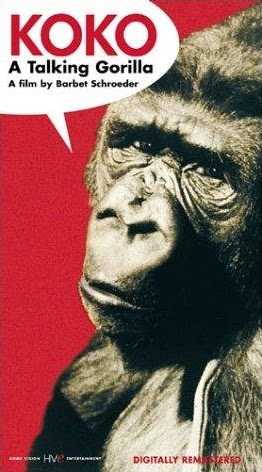
Koko, a Talking Gorilla (1978)

 
Penny Patterson and Koko in 1978


NOTE:
Over at her movie review blog, Deadly Doll's House of Horror Nonsense, my dear friend Emily Intavia is devoting the month of September to the theme of Animals Doing Human Stuff. She asked me if I might want to write something about this topic, and I decided it would finally give me the excuse to write about a 1970s documentary I might not otherwise cover on this blog. Enjoy.
We really want animals to be human, don't we? We talk to them and sometimes pretend that they are talking back to us. We give them names. We dress them up in "people clothes." We ascribe all kinds of emotions to them. In fables, comics, and cartoons, we routinely use animals as full-fledged stand-ins for people, generally rendering them in humanoid form in the process. (Does Mickey Mouse look or behave like any actual mouse you've ever seen?) Comics historian Don Markstein once traced this literary tradition of "funny animals" back to the fables of Aesop. But how much are animals like us really? How "human" can we make them? And should we be doing this at all?

Poster for Koko, a Talking Gorilla
These are among the questions considered in Barbet Schroeder's involving yet not entirely satisfying 1978 documentary entitled Koko, a Talking Gorilla, which focuses on the controversial and possibly groundbreaking work of Dr. Francine "Penny" Patterson, who supposedly taught American Sign Language (ASL) to Koko, a female gorilla born in captivity. More has been written about Penny and Koko over the last 40 years than I could ever hope to relate to you. If you're interested in the saga of this remarkable gorilla and her adoptive "mother," this essay provides a good overview.

The gist of it is this: Koko was born in the San Francisco Zoo in 1971 but was sickly as an infant. She was placed in the care of Penny Patterson, a grad student then in her mid-20s. Instead of returning Koko to the zoo, Patterson decided to use Koko as the center of an unprecedented, decades-long language experiment which continues to this day under the auspices of an organization called the Gorilla Foundation. Patterson now alleges that Koko has a vocabulary of roughly 2,000 words and can respond to spoken English as well, but these claims are not universally accepted in the scientific community. Oh, and in 2005, there was a very strange sexual harassment suit filed against Patterson by disgruntled ex-employees of the Gorilla Foundation who claim they were pressured to expose their breasts to Koko in order to satisfy the gorilla's "nipple fetish." I'm not making this stuff up.

I'm not sure how valid this experiment has been, but I can tell you that I found Penny Patterson to be an absolutely mesmerizing character, much more fascinating in her own way than Koko. Flawlessly pretty with long, blonde, wavy hair and smooth, doll-like features, Patterson absolutely does not look like the kind of woman you'd imagine catching a gorilla's urine in a cup (straight from the source, no less). But there she is, on camera, cheerfully doing just that. Director Schroeder also narrates the documentary and makes a point of the fact that Patterson has no children of her own, never takes vacations, and must be with Koko every morning and evening. He never explains why the doctor has to be there every time the gorilla wakes up or goes to bed, but he seems impressed by her dedication to the project. By the end of the film, Schroeder has given up all illusions of neutrality and is openly endorsing Patterson's work.

One wonders how Werner Herzog might have handled this same assignment. If nothing else, Koko, a Talking Gorilla might make an interesting companion piece to Herzog's much-less-sentimental Grizzly Man. The other film I was thinking about while watching this documentary, of course, was King Kong. In every cinematic iteration of that story, Kong has become enamored of a human woman. And all of these women (Fay Wray, Jessica Lange, Naomi Watts) have been blondes, just like Patterson.

Penny and Koko in the early days
In fairness to Schroeder, it's easy to fall under Patterson's spell. She's sweet-natured and enthusiastic, and how can you not love a woman who blithely cruises past used car lots and fast food restaurants with a giant gorilla in the passenger seat of her car? A great deal of the film is devoted simply to showing Patterson and Koko spending quality time together, and they do seem to have a genuine mother-daughter bond.

This is a 1970s PBS-style documentary, so there are also occasional minutes of screen time devoted to earnest scientists talking in a rather dry fashion directly to the camera about the language capabilities of various primates. These are "groovy," Jimmy Carter-era scientists, though, and they have beards, turtlenecks, and Prince Valiant haircuts, so you know that they're not some uptight squares, man. The only real opposition to Patterson the film presents is a brief interview with a zoo owner who believes Koko should be back in a zoo environment and not raised as a pseudo-human child by a (possibly) crazy lady. Even this gregarious man, though, knows his opinions will not be popular with viewers and sadly acknowledges he will likely come off as a villain in Schroeder's film. And besides, we don't want to see some boring dudes yakking away at the camera. We want to see Penny teaching Koko to wear makeup! Or Penny dressing Koko in a red sweater! Or Penny and Koko just wrestling around on the floor!

Can Koko really use sign language and understand spoken English? Eh, it's debatable. She does seem to be able to make a few unmistakable signs (she's got "toothpaste" down pat), and she seems to be able to identify pictures of various animals in a book after Penny reads their names aloud. But through all of this, it takes a lot of coaching from the pretty young doctor. A lot of times throughout the film -- and in the other, later documentaries about Koko -- we only really know what the gorilla is thinking because Penny tells us. Certainly, some of the project's success exists only in Patterson's mind. How much, I don't exactly know. There's an interesting scene in this film when Koko starts to misbehave and Penny has to chase after her. The doctor seems a little rattled and says the word "cut." Is that some kind of command to the gorilla, or is she telling Schroeder to turn off his camera?

All in all, Koko, a Talking Gorilla (which was actually given a Criterion DVD release a few years back) is definitely worth 85 minutes of your time. It's not as emotionally satisfying as a Herzog documentary might be under the same circumstances, but it nevertheless provides valuable insight... not so much into gorillas but into human beings and our desire to see ourselves reflected in the animal kingdom.

Monday, December 26, 2011

(today's zomby) AND CAN YOU GUESS THESE MOVIES BASED ON THE FOREIGN POSTERS?


Whew!

We got through another Christmas, huh? Good for us! Here's a little game to help ease you back into normal society. I'm going to show you some foreign movie posters with the titles and credits removed, and you're going to try to identify the films. Sound good? These are all very famous and popular American movies, so I'm not playing dirty. Apart from covering up the names, the posters have not been altered. Good luck!

(For you defeatists and up-givers out there, the answers are provided in the comments section.)

1.

2.

3.

4.

5.

Okay, class. Pencils down.