Showing posts sorted by date for query "by greg dziawer". Sort by relevance Show all posts

Wednesday, July 22, 2026

Ed Wood Wednesdays, week 283: 'Edward D. Wood, Jr.: A Man and His Films' (1981) [PART 2]

Ed Wood (center, cowering) in the nightmare sequence from Glen or Glenda.

This time last week, we were talking about Edward D. Wood, Jr.: A Man and His Films, a surprisingly thorough 1981 chapbook about Eddie's strange life and career created by two very dedicated California fans, Randy Simon and Harold Benjamin. These young men conducted their research at a time when there were no books about Ed Wood on the market and Eddie's movies weren't even readily available on home video. The acknowledgements page suggests that Randy and Harold may have contacted some of Eddie's family, friends, and professional associates in assembling their booklet.

We'd only gotten as far as the book's capsule biography of Ed Wood, namely because I'd gotten bogged down in discussing how much of it was true and how much of it wasn't. But now, we get into the heart of A Man and His Films: a discussion of Eddie's filmography. The authors have divided this material into several sections: The Major Films (four movies), The Lesser Known Films (five movies), and The Lost Films (two movies, one unreleased and one unproduced). This gives you an idea of how well-documented Eddie's career was in 1981 and how much was still unknown to the public.

So what are Eddie's "major films"? The authors list just four: Plan 9 from Outer Space (1957), Bride of the Monster (1955), Glen or Glenda (1953), and Jail Bait (1954). (And, yeah, they're in that order for some reason.) Remember, at this time, Night of the Ghouls (1959) aka Revenge of the Dead had not been rediscovered and released on home video. So if you wanted some classic 1950s Ed, you really only had those first four features to go by.

Monday, June 29, 2026

Ed Wood Wednesdays: The Wood Paperback Odyssey, Part Five by Greg Dziawer

The elusive T.K. Peters, sometimes misidentified as Ed Wood.

Encyclopedia of Sex ad
As I prepared to write this week's Ed Wood Wednesdays article, I decided to do a quick search of eBay, to see if the old myth of Dr. T.K. Peters being a pseudonym of Ed Wood still persists. You guessed it (merely one example, sadly). Apart from inflating prices, it continues to muddy the waters of Woodology, this muddying now its own niche within the larger spectrum. Dr. T.K. Peters was real, and we'll refute some counter-claims that his esteemed name was "borrowed" from the real "Kim" in future Ed Wood Wednesdays.

In the past, Pendulum Publishers, Inc. and its myriad offshoot imprints (covered ad nauseam in previous posts) published two series of photo-illustrated sexual paperbacks in the early 1970s, sourced from the comprehensive sexual study by Dr. T.K. Peters that he sold to Pendulum boss Bernie Bloom (itself rooted in his work as a marriage counselor in Atlanta from 1950 through 1965, following his retirement from Oglethorpe University...but that's another story that WILL be told). 

Fully three-fourths of the Peters' titles constituted SECS Press' (an unincorporated Pendulum imprint) Encyclopedia of Sex, the rest being the Sexual Enlightenment Series published under the Calga imprint, unleashed just on the cusp of legal, accessible and affordable hardcore sexual imagery via multi-media. For some alchemical reason, the censorship damn bursting encouraged a propensity toward the weird, the extreme and the just plain fucking nuts. In all, between Ed's own resume and an additional few titles in his collection with title-page inscriptions by him, Ed wrote or co-wrote roughly 25% of the Peters paperbacks. That index, too, is another story. Suffice to say that Ed's cohort on West Pico in the Pendulum mag office played a large role in the Pendulum Peters canon. Ed collaborated with fellow staffers Charles D. Anderson and Leo Eaton. William D. "Bill" Jones produced Peters, and so did Robin "Redbreast" Eagle. They did this under a slew of pseudonyms, one of them, Norman Bates, still falsely claimed a pseudonym of Ed. It's impossible to talk about T.K. Peters without running into these clumsy mis-Ed-tributions. That's a charitable statement and I'll leave it at that.

Wednesday, March 11, 2026

Ed Wood Wednesdays: The Lost Greg Javer/Keith Crocker Commentaries [PART ONE]

Keith and Greg talk Ed. (Header image by Brendon Sibley.)

Not long before he died, Greg Javer (aka Greg Dziawer) contributed some commentary tracks to the deluxe three-disc collection Hard Wood: The Adult Features of Ed Wood (2024) from Severin Films. Looking back, this was one of the last major Wood-related projects of Greg's too-brief life. If you purchase that set, you can hear him give his thoughts on Necromania (1971), The Only House in Town (1971), and The Young Marrieds (1972). If you're missing Greg, and I know many of you are, these tracks allow you to spend some time with him.

But these were not the only recordings Greg made for Hard Wood. He and I, for example, recorded a jovial and hopefully informative commentary for the rowdy, rural comedy Shotgun Wedding (1963), which Eddie scripted for director Boris Petroff. Unfortunately, that track got lost in the shuffle and never made it into the finished set. If you're interested in hearing it, I have made it available in a previous blog entry.

Meanwhile, teaming up with film historian Keith Crocker, Greg recorded commentary tracks for six (!) of the adult loops that Ed Wood made as part of the Swedish Erotica series in the early 1970s. These, too, were unfortunately lost in the shuffle and did not make it into Hard Wood. But fear not! Recently, reader Brendon Sibley forwarded these tracks to me and asked for me to present them on my blog. How could I resist an offer like that? 

In fact, I will devote this week and next to the lost Javer/Crocker commentaries. Three this week, three next week. Does that sound like a plan? For obvious reasons, I cannot present the loops without some visual distortion. YouTube has very little sense of humor about these things.

Wednesday, May 28, 2025

Ed Wood Wednesdays, week 230: The Mortician's Tale (1966-1968)

Something about this particular story must have really captured Ed Wood's imagination.

Early in Tobe Hooper's The Texas Chainsaw Massacre (1974), a psychotic hitchhiker (Ed Neal) explains to a vanload of horrified hippies how the delicacy known as "head cheese" is made:
They take the head [of the cow] and they boil it, except for the tongue, and they scrape all the flesh away from the bone. They use everything. They don't throw nothing away. They use the jowls and the muscles and the eyes and the ligaments and everything! From the nose and the gums and all the flesh, and they boil it down into a big jelly of fats!
Ed Neal as the hitchhiker.
Ed Wood could definitely relate to this. Both his films and his writings have that distinct "head cheese" quality to them. If Eddie could help it, he didn't throw anything away either. He'd shamelessly recycle dialogue, plots, character names, and whatever he had on hand. He was so frugal that he edited footage from three separate, failed projects into his film Night of the Ghouls (1959) even though most of it clearly didn't belong there. And he'd occasionally publish short stories that were thin rewrites of stories he'd published only months before! In summary, he just took all the material he had available to him, the jowls and ligaments, and boiled it down into a big jelly of fats. Waste not, want not.

There is one particular plot that turns up at least three times in Ed Wood's literary canon, and it's a perfect metaphor for how Eddie worked. It tells of a disreputable mortician who bilks grieving families out of their money and blatantly abuses the helpless corpses placed in his care, sometimes for profit, sometimes just for fun. To put it mildly, this guy is a real scumbag: a liar, a thief, a necrophile, and a desecrator of graves. Even though he is eventually found out and must face the consequences of his actions, his story still leaves us with a feeling of disgust. And Ed Wood kept returning to that story! I wouldn't be surprised if it turns up in more places that I just haven't found yet! But why? What, exactly, was the appeal of this story?

Well, let's examine it. As far as I know, we first meet this dastardly scoundrel in Chapter Twelve of Orgy of the Dead (Greenleaf, 1966), Ed Wood's patchwork novelization of his film script from the previous year. As I explained in my review of that book, the mortician is just one of the deceased individuals being judged by the Emperor, a mysterious cloaked figure who rules over the underworld and who holds court in a spooky cemetery on a moonlit night. Most of the other "defendants" in the novel are imported from Wood's short stories, but our mortician friend is a new creation.

The Orgy novel.
In Orgy, the mortician is identified as Lyle Carriage, a "cocky," well-dressed man of 45. He's so arrogant, in fact, that the Emperor has to scold him for being too familiar. Lyle says that he was considered "worse than a killer" and that his story received (in a rare Woodian acknowledgement of Vietnam) "more newspaper space than the war." He started out as a physician but was unable to make much money in that profession. Then, fatefully, he inherited a funeral parlor from his uncle. The only other employee besides himself was an elderly embalmer. Fortunately, Lyle's medical training made the job a natural fit for him.

On his first day at the funeral parlor, Lyle was overwhelmed by the sight of a deceased young woman in her late teens. This may have been the first indication of the mortician's latent perversities. Typical of an Ed Wood character, he obsessed over the woman's appearance and outfit. He became especially fixated on a handkerchief he used to wipe some makeup off the woman's face.

After a few months, Lyle began to hatch a scheme. He bought a nearby cemetery, forced the embalmer into retirement, and hired a couple of local drunks (similar to the characters from "To Kill a Saturday Night") to be his gravediggers. He also started convincing families to hold closed-casket funerals for their loved ones. That way, he was free to exploit the corpses. He sold their hair, their blood, and even their internal organs. Eventually, he started removing the flesh from the bones. That way he had two more saleable commodities: skeletons and meat. He especially enjoyed mutilating the bodies of "young girls" and then wearing their clothes. All the while, coffins full of rocks were being buried five or six deep in his cemetery.

It was quite a profitable operation, but it couldn't last. One day, while Lyle was chopping up another young woman and wearing her clothes, one of the drunken gravediggers staggered into his office. The other gravedigger had just recently died, and his sentimental coworker wanted "one last look at his buddy." Upon making the horrible discovery, the surviving drunk notified the police. After posting bail, Lyle decided to abscond with some money he had hidden away in one of the coffins he had buried. That's when a bony hand reached up from beyond the grave and dragged Lyle down to hell. The Emperor sentences the mortician to a most cruel fate: he shall forevermore be forced to wear a "frilly pink dress" that is "tattered, decaying, [and] crawling with grave mold and worms." The phony funeral director runs screaming into the woods. Interestingly, Lyle has become a "little man" by the end of the chapter. He'd been tall at the beginning of it.

The mortician's gruesome story resembles not only Night of the Ghouls, in which conman Dr. Acula (Kenne Duncan) inadvertently provokes the wrath of the dead, but also the long-unproduced I Woke Up Early the Day I Died (1997), which also revolves around some money hidden in a coffin, plus the short story "In the Stony Lonesome" (1972). Interestingly, when he's digging up the coffin, Lyle uses a lighted match to see what he's doing, just as Officer Kelton (Paul Marco) does while rooting around in Inspector Clay's grave in Plan 9 from Outer Space (1957).

Wednesday, December 11, 2024

Ed Wood Wednesdays, week 206: Greg Javer (1968-2024)

"The bell has rung on his great career."

"Where's Greg?"

That is the question I've gotten most frequently over the last year and a half from readers of this blog. The remarkable Greg Javer, a soft-spoken Pennsylvanian who often wrote under the name Greg Dziawer, contributed a great deal of material to this series from 2015 to 2023. He started out with numerous Ed Wood Wednesdays articles before eventually launching his own series of YouTube videos called The Ed Wood Summit Podcast. His interests were wide-ranging, even within the seemingly limited field of Woodology. He was just as likely to cover Eddie's childhood in Poughkeepsie as he was to discuss Ed's pornographic loops of the 1970s.

He was, in short, a major player in the world of Wood research and a significant presence on this blog for eight years. He was also my friend, someone I just loved talking to and working with on various projects. Then, about midway through last year, he vanished. The articles stopped. The videos stopped. Even the emails (for the most part) stopped. Where had he gone, people wondered? I am not one to pry, so I didn't. I'd occasionally hear rumors that he had other matters—perhaps personal, perhaps professional—to attend to. I trusted that he'd eventually find his way back into this strange, little world and would contact me when he was ready to start anew. It just never happened.

On Sunday, December 1, 2024, we finally received a definitive answer about what had happened to Greg, and the news could not have been worse. Not long after receiving a devastating cancer diagnosis, he died at the far-too-young age of 56, leaving behind a daughter, Elyse Rosario, and his partner of 18 years, Jennifer "Kitten" Rosario. I can't help but think how he only outlived Ed Wood by two years (Eddie died at 54 in 1978) and that both men were claimed in the month of December. I wonder if those same thoughts occurred to Greg in his final days.

I asked Jennifer to say a few words in remembrance of Greg, and here is how she responded:
A passionate admirer of Ed Wood Jr., he combined his love of film with his dedication to research and writing, leaving his mark as a contributing author. He found joy in life’s simple pleasures—reading, spending time with family, and delving into thought-provoking documentaries. One thing I want to note is that he considered all of you real friends. I could log into his Gmail right now and find numerous emails of people checking in on him, along with text messages. I can't make every name, but everyone he has worked with since the start of this Ed Wood Jr. journey would fall under this umbrella, at least 10 years or more.  He would tell me a story or something that was found, and it always started with "my buddy ____" or "my friend ___." And I know he cherished each and every friendship made along the way.

Rob Huffman has started a GoFundMe to cover some of Greg's final expenses. The proceeds will go directly to Jennifer and Elyse. Please consider donating. Every little bit helps, as they say. And, if you can't afford it, please forward the link to others on social media so that they can donate. It's the least we can do, considering all Greg did for us.

Wednesday, December 4, 2024

Ed Wood Wednesdays, week 205: 'Ed Wood, Secret Agent' (2013)

You can almost hear the theme song, can't you?

NOTE: We lost someone very special this week. On Sunday, December 1, 2024, Greg Javer, aka Greg Dziawer, died unexpectedly of cancer. I'd known of his illness but not that he was terminal, so this news came as a great and horrible shock. Greg wrote many articles for this blog, and we also recorded numerous episodes of The Ed Wood Summit Podcast together. I considered Greg a good friend, and he was extremely generous with his research. A proper tribute to him will appear on this blog once I have all the facts assembled. 

This week, I'd simply like to share a story by author Colin Schmidt that appeared in, of all places, an Australian Dr. Who newsletter in 2013. It imagines Ed Wood as a Mission: Impossible-type secret agent, with Criswell, Tor Johnson, and Bela Lugosi as his teammates. This story was sent to my email account by someone who was looking for Greg! I dutifully forwarded it on to Greg, but he never rendered an opinion on it. I'm pretty sure he would have enjoyed it, though, and I'm pretty sure you will, too.  J.B.

Wednesday, November 27, 2024

Ed Wood Wednesdays, week 204: The unveiling of Ed Wood's historical marker

A glimpse at the unveiling of Ed Wood's historical marker.

Since Thanksgiving is approaching and most Americans are preoccupied with travel, relatives, decorating, shopping, and food—or possibly all of theseI thought I'd keep it especially light and informal this week. So no big Ed Wood revelations or in-depth Ed Wood reviews, okay? Let's just have a little Ed Wood fun.

Pretty in pink?
Last Wednesday, I told you about how a New York State historical marker was being placed in front of Ed Wood's childhood home at 35 Delano Street in Poughkeepsie, thanks to the efforts of some high school students in teacher Robert McHugh's AP history class in Dutchess County. Those enterprising youngsters cited this very blog in their application to a nonprofit organization called the William G. Pomeroy Foundation, which seeks to denote places of historical significance in the state of New York. 

And, after two years, it worked! The Foundation agreed to mark Eddie's former home with a permanent, bright blue-and-yellow sign. Anyone who walks or drives by 35 Delano Street will know that this was once the home of the director of Glen or Glenda (1953). None of this could have happened without the research of such esteemed Woodologists as Greg Dziawer and James Pontolillo, both of whom have made invaluable contributions to this blog.

I couldn't be there for the unveiling of the sign, unfortunately, but I did write a speech for the occasion. That speech was delivered for me by director and film programmer Katie Cokinos. You can view a gallery of photos from the event right here. In some of the pictures, you can see that the marker was hidden under a pink cloth before it was revealed. To my eyes, at least from a distance, the sign appears to be wearing its very own pink angora sweater! What could be more appropriate?

A 16-minute video of the unveiling ceremony has also been posted to Instagram for those who would care to watch it. It includes Katie's speech, if that's a selling point. You'll really get a sense of how charming this building on Delano Street truly is. This is some old-school construction, and it has a lot more personality than the soulless architecture we see today. I'd be proud to live in a place like this. 

Before we leave this topic in the rearview mirror, I'd like to share an email I received from Katie the day after the unveiling:
Hi Joe,

What an amazing event! Ed Wood’s birthplace, 35 Delano (as in Franklin Delano Roosevelt), around the corner from the Bardavon Theater, the house is owned by Roberto Rossi whose family has a deli, Rossi and Sons, a block away. Robert McHugh, history teacher at Arlington High School, organized the memorial and event along with his students. And your wonderful, inspiring, informative tribute got a rousing applause. Love that this happened during his 100th year. I felt Edward Davis Wood Jr. smiling.

Thank you for participating albeit through your writing,
I only wish I could have been there in person!

Wednesday, November 20, 2024

Ed Wood Wednesdays, week 203: The saga of Ed Wood's historical marker

This house on Delano Street in Poughkeepsie was once Ed Wood's home.

And the year of Ed Wood continues! The 100th anniversary of Eddie's birth has brought with it many marvelous surprises, including some recognition from the director's home state of New York. On Wednesday, November 20, 2024, an official historical marker is being placed at 35 Delano Street in Poughkeepsie, New York to denote it as Ed Wood's childhood home. Amazingly, this blog played some small role in that achievement.

In June 2024, I received this intriguing email from a man named Robert McHugh:
I am a teacher near Poughkeepsie and for the past couple of years I have had my students apply for funding for historic markers for sites in Dutchess County. This year, one group of students decided to try for a marker about Ed Wood. They used some of the material from your sitethe reference to the wedding announcement of his parents in the Kingston paper was especially helpful—as part of the grant application. 
Good news: they were successful and there is now a historic marker being made that will likely be installed sometime over the next few months. (It takes quite a while to fabricate them; I don't know if we will have it by October 10 for his birthday.) It's going to go in front of one of the homes he lived in, at 35 Delano St. 
I'm not sure if you happen to live anywhere near Poughkeepsie, but we would love to invite you to the unveiling, whenever that would be. 
Thanks for posting all that great information about him online.
I thanked Robert for the email and gave due credit to Greg Dziawer, who has written extensively about Ed Wood's early life in Poughkeepsie for this blog. Greg, in turn, has credited the formidable James Pontolillo for his tireless (and ongoing!) research into Ed's New York years. Unfortunately, since I live in the suburbs of Chicago and work full time, I had to tell Robert that attending the unveiling of the marker was not possible.

In October, Robert gave me an exciting update: "The Ed Wood marker has finally been made. Now we have to figure out how to install it and think about an unveiling ceremony." In assembling the ceremony, Robert reached out to director and film programmer Katie Cokinos, who organized the special screening of Ed Wood (1994) that I attended virtually on Ed's 100th birthday last month. Knowing I would be unable to be there in person, Katie very nicely asked me to write a speech for the occasion. Here is that speech:
Ladies and gentlemen:

We are gathered here on this wonderful occasion to honor the memory of a man who received very little recognition in his own lifetime. Edward Davis Wood, Jr. was born in Poughkeepsie, New York on October 10, 1924 and became enamored of show business and the movies at a young age. He even worked as an usher at the Bardavon Theater on Market Street. I can imagine he spent many hours in that place, staring up at the screen and gazing in amazement at the larger-than-life figures projected there. He especially loved the cowboy stars, like Buck Jones, and of course the great horror icon Bela Lugosi.

For many of us, that's where the journey would end. We're content just to watch the screen and to live vicariously through other people's stories. We still do that today, except the screens have gotten much smaller and we can carry them in our pockets. But that wasn't enough for our Eddie. He didn't just want to watch other people's adventures. He wanted to have adventures of his own. That instinct led him, after a stint in the Marines during World War II, to Hollywood in the late 1940s.
 
Heed the words of Lyle Talbot.
Once on the West Coast, Ed Wood did everything he could to make his mark as a writer, director, and producer of motion pictures. And that's not all! He acted on both stage and screen, made TV commercials and pilots, and penned countless novels, short stories, and magazine articles. There seemed to be no end to his creativity or his ambition. Along the way, he attempted just about every kind of story there is: science-fiction, horror, Westerns, and even crime thrillers. He may never have gotten to work with Buck Jones, but he did work extensively with Bela Lugosi and even befriended the great horror icon. Bela wound up appearing in all three of Ed's most famous films: GLEN OR GLENDA, BRIDE OF THE MONSTER, and the infamous PLAN 9 FROM OUTER SPACE.

During his own, rather short time on this earth, Ed Wood received very little praise or recognition from the entertainment industry. He wasn't getting positive reviews in the press or awards from his colleagues. To the extent that Ed's films were noticed at all, they were mocked and derided for their low budgets, unlikely dialogue, and outrageous storylines. And yet, his quirky, memorable films have struck a nerve with fans for decades, and those fans have kept Eddie's memory alive long after his death in 1978. This year alone , the 100th anniversary of Ed Wood's birth, there have been at least three major new books about him, and his films continue to be shown in theaters across the country and re-released for home viewing as well.

And now, we place this marker at Ed Wood's childhood home. I am certain that Eddie would be flattered and thrilled by this honor. And if there is anything we can learn from his life, it's that we shouldn't be content to sit on the sidelines and watch other people do all the exciting things we wish we could do ourselves. As Lyle Talbot says in GLEN OR GLENDA, "We only have one life to live. We throw that one away, what is there left?"
I don't know if Katie will actually deliver that speech at the ceremony, but it was so nice to be asked. As for the marker, here is what it will look like. Perhaps, if you live near Poughkeepsie, you can stop by 35 Delano Street and see it for yourself someday.

This handsome blue and yellow marker stands as a tribute to Ed Wood.

Wednesday, October 30, 2024

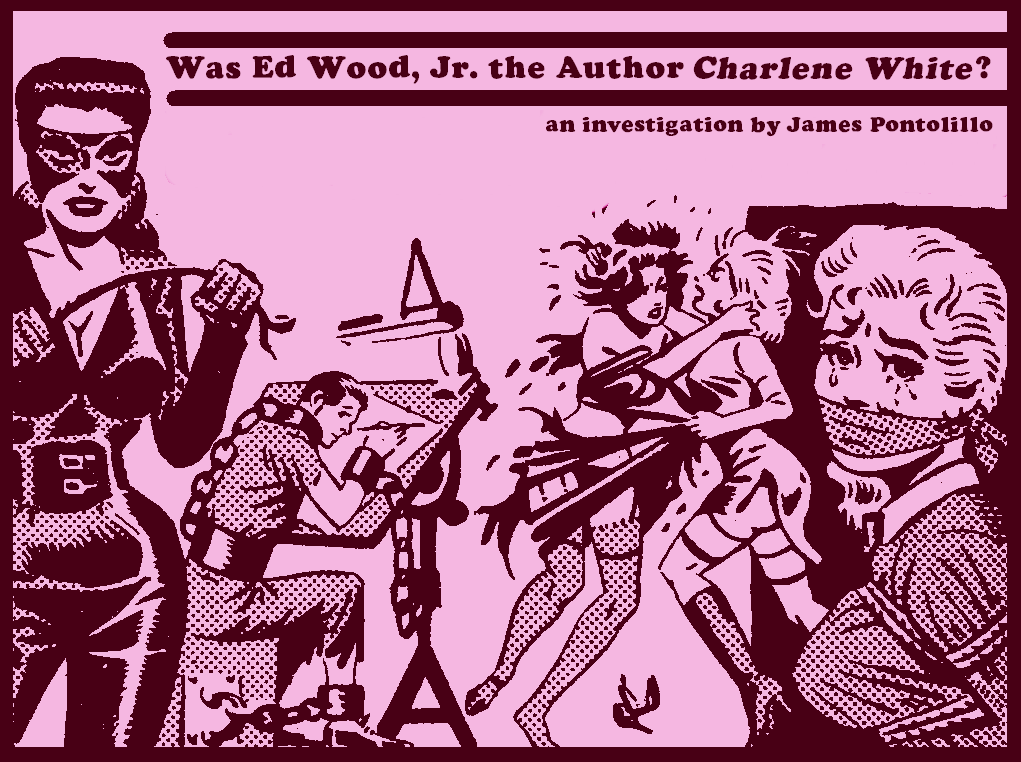
Ed Wood Wednesdays: Was Ed Wood, Jr. the author Charlene White? (Guest Author: James Pontolillo)

Ed Wood had many pen names. Was this one of him?

A copy of the 1966 Charlene White sleaze novel Not So Funny was recently listed on Ebay with an asking price of $950 and authorship attributed to Ed Wood, Jr. But what evidence is there that Charlene White was one of Eddie’s pseudonyms?

Background

In 1966, Satellite Publications (Stanley Malkin and Eddy Mishkin's New York City-based operation that employed multiple other addresses in an attempt to mislead authorities) issued two books by Charlene White: Mask of Evil (hereafter Mask[1] ) and Not So Funny (hereafter Funny; [2]). Both were mass market format paperback originals priced at 95 cents ($9.70 in 2024 dollars) and featured cover art by renowned commercial artist Eric Stanton [3]. The books also included black and white Stanton cartoon work as interior advertisements [4,5]

The print run sizes for these novels are unknown. Sleaze publishers like Satellite treated their paperback books just like the magazines they distributed – limited shelf life with new replacement titles issued monthly. Leftover stock was usually sold at a significant discount to a secondary market reseller. In some cases, the books were returned to the publisher who would strip off the original covers, glue on new ones, and then send them back out to market. As a result, the unwary customer could inadvertently purchase the same book twice.

Mask and Funny are rare collectible books that, due to the Stanton covers alone, currently command prices in the $200-$600 range depending upon their physical condition. Copies sometimes hit the market with considerably higher asking prices ($700-$1000) buoyed by the claim that Ed Wood is the author. Reputable antiquarian booksellers inform customers that this identification is unproven; individual online sellers rarely do so.

My first encounter with the claim that "Charlene White" was one of Eddie's pseudonyms occurred in an online Ed Wood forum/message board sometime around the year 2000. The idea gained significant traction with the 2012 release of Cornell University Library’s finding guide for its Ed Wood Collection. The core of the collection derives from a posthumous donation of works assembled by book collector and science-fiction editor Robert Legault (1958-2008) [6]. It was subsequently expanded with materials donated by writer/editor/publisher/collector Johan Kugelberg [7]. The Cornell collection is the largest publicly available repository of Ed Wood's published works. While Mask is in the collection, Funny is not represented there.

The Books

Mask of Evil cover.
Mask of Evil – This novel follows the sexual awakening and subsequent promiscuous escapades of Brigitte Lamersay, a 20-year-old, perpetually-innocent French nymph as she wends her way through Long Island (NY) high society in search of her adoptive mother’s long-lost American lover. There is a plot amongst all the sexual debauchery, but just barely. Much of the sex is non-consensual, fairly transgressive for the time, and leans heavily into sadism. 

One highlight of the novel is an unusual costume party (men as trees; women as flowers) that quickly degenerates into an anything-goes orgy. This is followed by masked sexual rituals that blogger Joe Blevins described as "Eyes Wide Shut with a brain injury… an enfeebled, lobotomized Eyes Wide Shut. It’s rich people having kinky mask parties." After many adventures, Brigitte finds her man and then a different kind of fun begins. 

The novel initially appears to end with Chapter 14. But after typesetting, the novel would have been 16 pages short of the publisher’s standard book length. So, we are then treated to a new, more complex ending spun out over Chapters 15-17 (meeting the required number of pages) written as if the events of Chapter 14 had never occurred. To complete the reader’s sense of déjà vu and disorientation, the last three paragraphs of Chapters14 and 17 are virtually identical.

Not So Funny cover.
Not So Funny – This novel follows Olga, a well-endowed 18-year-old girl who grows up in a small coal town. She runs away to the big city to escape the clutches of a filthy, physically abusive, and sexually predatory stepfather. While working as a waitress, Olga meets and quickly falls in love with a ruggedly handsome circus animal trainer named Craig. They marry and Olga goes on the road with her new husband. She immediately gains three sworn enemies in the closed community of the circus: her new father-in-law Andrew (who had pledged his son to marry a circus girl), Hilda (the circus girl in question), and Tina (jealous that her brother Karl – for whom she has an incestuous love – is attracted to Olga). 

Much of the novel is devoted to the ins and outs of this swirling melodrama and repeated attempts to undermine Olga in her husband's eyes. The most memorable part of the book revolves around Olga’s friendship with Elmer, a perpetually sad and reclusive clown. One night Elmer takes her in his small clown car to a rundown house in "the village." What transpires there is a phantasmagoric mix of a gay bathhouse encounter and the mirror maze scene from the movie Something Wicked This Way Comes leading to Olga’s sexual humiliation. Ultimately, all of the plots against Olga collapse as death and serious injury are visited upon her rivals by a seemingly just universe. Olga performs an illegal sex act on her husband Craig in the last few sentences of the book, making it clear that they will have a beautiful life together.

Having read both books several times, I have yet to decide whether they were written by the same author. The writing styles are dramatically different with the author of Mask appearing well-educated while the author of Funny seemingly barely escaped grade school. Mask is full of graphic, transgressive sexual acts. Funny is much tamer and, with few exceptions, stays on a "straight and narrow" path, sexually speaking. 

Moreover, Mask is overrun with characters, including many with no role whatsoever in advancing the plot, while Funny has a much tighter focus on eight individuals. The events of Mask take place in real-world locations (Long Island; Pelham, NY; Midtown Manhattan), with the Pelham, NY sequence accurately describing the town's geography. Funny, on the other hand, exists in a featureless void whose locations (the big city, the circus lot, the village) are simplistic generalities that are never described in any substantive way. 

Despite this, the books do share a number of elements: the sexual awakening of a young woman; the grateful sexual abuse victim trope; a similar approach toward introducing nudity and the initiation of sexual acts; orgasms described as planets crashing together (and on one occasion each as a kaleidoscope); repeated instances of sexual sadism; and masked, ceremonial sexual rituals. On this last point, both books feature women dressed as flowers erotically dancing to Tchaikovsky's "Waltz of the Flowers" (from the 1892 ballet The Nutcracker).

Is This You, Ed?

There certainly is a smattering of elements in Mask and Funny that might lead one to think that they were written by Eddie. One of Mask’s main characters has the alliterative name of Randy Ransome/Randon Ransome. Both books contain a sex scene where an orgasm is described as a kaleidoscope of colors, a practice that Eddie used in 17 of his 27 known novels (a rate of 63%; see Sources for the list of known novels). Funny includes a snake element that plays a pivotal role in one of the failed attempts to drive Olga away from the circus. Snakes, in some form, appear in 23 of 27 of Ed’s known novels (85%). 

Finally, there is this inspirational section of text from Mask:
Suddenly, she knew she had to scream. Her lips parted without volition and a harsh, rough sound poured from her. At the same time the young man's breathing became jagged, cutting litany. Infinity became finite and stood still.
Eddie had a penchant for invoking the concept of infinity in his writings.

On the other hand, Eddie never explicitly claimed that "Charlene White" was one of his pseudonyms. Neither Mask nor Funny was included in a list of published works that Eddie generated in the mid-1970s. Nor do they appear similar to the titles of any of his still-missing novels. As the participants on The Ed Wood Summit Podcast #22 concluded, the Wood-like elements in Mask are part of a larger text that was clearly not written by Eddie. His typical obsession with angora, excessive drinking, and a close attention to female clothing are nowhere to be found in either of these novels.

In an attempt to identify diagnostic features in Eddie’s writings, since 2016 I have applied grammar and language analysis tools, as well as statistical measures of word usage and textual complexity, to a group of 27 known Wood novels (see the list in Sources). After several iterations, a group of 45 keywords emerged that are common in Eddie’s novels. His use of this group averages 75% (Side-Show Siren is low at 53%; The Gay Underworld is high at 91%). By comparison, Mask and Funny infrequently use only a handful of the keywords, scoring a paltry 28% and 11% respectively. A twelve-word subset of the 45 keywords is particularly diagnostic because of their very high prevalence in Eddie’s novels.
  • angora, fluff, lovely, pink, sheer, simply, sweater – 100%
  • delight, nylon, panties – 96%
  • furry, negligee – 92%
Mask uses only two keywords of this subset (negligee, pink); Funny does not use any of them.

One final metric that I’ve developed I like to call (tongue-in-cheek) Woodiness. It’s a numerical measure of keyword usage that is prorated to the average use of each individual keyword. Thus, an instance of a more commonly used keyword "scores" more points than a less commonly used keyword. The following plot shows this data [8]. Eddie's known novels have an average Woodiness value of 2754 (Side-Show Siren is low at 1224; TV Lust is high at 5493). In comparison, Mask and Funny score only 176 and 23 respectively. By all measures, these two books in no way resemble Eddie’s known novels.

Mask of Evil and Not So Funny are certainly worth collecting for their iconic Eric Stanton cover art, quirky story lines, and as relics of the battle waged by American publishers to expand the boundaries of our First Amendment protections. But don't collect them thinking they were authored by Ed Wood, Jr. Because all of the evidence is that they were written by someone else.

Sources

  • Brittany A. Daley, et al. (Eds.), 2005, Sin-A-Rama: Sleaze Sex Paperbacks of the Sixties, Los Angeles, CA: Feral House, 287 pp.
  • Charlene White, 1966, Mask of Evil, FN 226, Buffalo, NY: First Niter Books Inc., 157 pp.
  • Charlene White, 1966, Not So Funny, AH 145, Buffalo, NY: After Hours Books Inc., 157 pp.
  • List of 27 known Ed Wood, Jr. novels: Black Lace Drag (1963), Parisian Passions (1966), Side Show Siren (1966), Drag Trade (1967), Security Risk (1967), Watts… the Difference (1967) Watts… After (1967), Devil Girls (1967), Death of a Transvestite (1967), It Takes One to Know One (1967), Suburbia Confidential (1967), The Gay Underworld (1968), Night Time Lez (1968) Sex, Shrouds and Caskets (1968), Young, Gay and Black (1968), Purple Thighs (1968), Hell Chicks (1968), Carnival Piece (1968), The Sexecutives (1968), Toni: Black Tigress (1969), To Make A Homo (1971), The Only House (1972), Mary-Go-Round (1972), Diary of a Transvestite Hooker (1973), Forced Entry (1974), Sex Salvation [Saving Grace] (1975), and TV Lust (1977).
  • A number of Eddie’s well-known works were not included in this list because they were either not novels (e.g., socio-medical studies [The Oralists] and SECS Press collaborations) or they were written under goal-based restrictions that limited the content (e.g., movie tie-ins [Orgy of the Dead], photo novels [Raped in the Grass], and stage adaptations [Casual Company]).

Wednesday, July 24, 2024

Ed Wood Wednesdays, week 197: Comparing multiple prints of 'Glen or Glenda' (1953)

Here we see a side-by-side comparison of two prints of Glen or Glenda.

If movies are made in the editing room, then Ed Wood's debut feature, Glen or Glenda (1953), was made, unmade, and remade several times over. I can't keep track of how many different versions of this film there are, and each one is as unique as a fingerprint. (Notice how fingerprints look pretty much the same from a distance but reveal their differences under scrutiny.) Over the decades, this movie has been released under innumerable titles, including I Led 2 Lives, Transvestite, and He or She. In the Ed Wood canon, perhaps only Orgy of the Dead (1965) has more aliases.  The content of the film has also changed noticeably from one edition to another, with certain lines or even whole scenes being added or omitted. 

Still my favorite edition of Glenda.
This phenomenon is as old as the film itself. Producer George Weiss infamously added saucy burlesque footage to an extended dream sequence late in the film, apparently without consulting Ed Wood. He did this for a number of reasons: to pad the run time, to add some sex appeal, and to reuse footage that he already owned. As a result, I don't think that there is any such thing as a "definitive" or "complete" cut of Glen or Glenda. As much as I'd like to see Criterion release a director's cut of this significant (and still shockingly relevant) motion picture, I don't think such a thing is possible.

The first version of the film that I ever saw was the one released by Rhino Video in 1996 as part of its Ed Wood Collection series of VHS tapes. This was the edition that I meticulously transcribed decades ago, and as far as I know, it's the lengthiest cut of Glen or Glenda that you can buy. Even here, though, are what some may consider impurities. Rhino's edition contains the Weiss-added burlesque footage, for instance, which irks certain Ed Wood fans. And the title card was obviously doctored—and crudely at that—by distributor Wade Williams. (My guess is that Williams' print carried one of the film's lesser-known alternate titles.) Nevertheless, Rhino's Glen or Glenda remains my preferred edition of the film. 

I was rather dismayed that, starting in the 2000s, the most commonly-available Glen or Glenda DVD on the market (included in popular sets like The Worst of Ed Wood and The Ed Wood Box) was from Image Entertainment and mastered from a censored, shortened print of the movie that lacked several key moments! When Legend Entertainment released its colorized version of Glen or Glenda in 2012, they used this censored cut of the movie. Even Rob Craig's exhaustive book Ed Wood, Mad Genius (2009) used the bowdlerized Image Entertainment version of Glen or Glenda for reference.

How do you know if the version of Glenda you're watching is the censored version? There's an easy test. Fast forward to the first conversation between Inspector Warren (Lyle Talbot) and Dr. Alton (Timothy Farrell) until you get to this bit of dialogue:
DR. ALTON: Most of us have our idiosyncrasies.

INSPECTOR: This fellow's was quite pronounced.

DR. ALTON: Yes, but I wonder if it rated the death warrant it received. I don't think so.

INSPECTOR: Well, that's why I'm here today, Doctor. What do we do about it?
If Dr. Alton's "I don't think so" is missing, you have the censored Glen or Glenda. Again, I humbly refer you to my transcript of the entire movie. I've highlighted all the missing and excised material in red.

You may also remember that, back in 2020, there was some hubbub about a restored 35mm print of Glen or Glenda that received some theatrical showings and was briefly available as a digital download from the American Genre Film Archive (AGFA). Any fans hoping for a "definitive" or "complete" edition of Glenda quickly had their hopes dashed when they saw the results. As Greg Dziawer pointed out in his article, this was the shortest edition yet of the film, even shorter than the Image DVD! 

Wednesday, June 12, 2024

Ed Wood Wednesdays, week 192: I bought a stack of Ed Wood books. So how did I do?

Yes, I bought this stack of books. Did I overpay? Underpay? Let's find out together.

Way back in the spring of 2015, there was a massive auction of Ed Wood memorabilia in Cambridge, Massachusetts. I knew I couldn't afford anything pricy, like Eddie's actual suitcase, but I felt like I wanted to get something. I settled for a poster advertising Glen or Glenda (1953) under one of its many alternate titles, I Led 2 Lives, and a collection of Mexican lobby cards for Plan 9 from Outer Space (1957) aka Espectros del espacio. The poster I had framed; it now hangs in my kitchen and greets me every morning. The lobby cards I keep in a binder and rarely look at. 

All in all, this set me back about $400—then and now a huge sum of money for me. When things got particularly lean a few years ago, I even considered selling these items at a loss before deciding that it was more trouble than it was worth. Not to mention depressing. So I kept them as stern reminders of what not to do with my money.

Because of that experience, I vowed I would never make another major and totally unnecessary Ed Wood-related purchase again.  I also knew that, someday, I would more than likely do it again. I bravely (?) held out for nearly a decade. Then, in the spring of 2024, I saw on Facebook that a fan was selling off some of his collection, including a stack of Wood (and Wood-adjacent) books. Since I rely mostly on e-books and PDF files in my research for this series, I own very few paperback and hardcover editions of Ed's work. So I was tempted.

After a couple of weeks of hemming and hawing and exchanging a few direct messages with the seller, we eventually settled on a deal: nine books for $350, including shipping. For you non-mathematicians out there, that's about $38 or $39 a book. Was I cheated? Did I do pretty okay for myself? Let's break it down, book by book, and find out.

Wednesday, February 21, 2024

Ed Wood Wednesdays, week 178: The Perverts (1968) [PART 1 OF 2]

The Perverts is sort of the Swiss army knife of Ed Wood books.

Artificial intelligence has been on my mind a lot recently. I think that's true of many of us, since we're bombarded with AI-generated songs, images, videos, and articles on a daily basis. It's getting difficult to know what's real and what isn't. And then comes the flood of ethical questions. Is AI an incredible boon to humanity or the beginning of the end of civilization as we know it? We don't know yet. I guess we'll have to see how this plays out. If, in 20 years, Earth is a smoldering husk ruled by artificially intelligent automatons, I owe you a Coke.

Eros warned us; we didn't listen.
Science-fiction writers have been warning us for decades about the perils of teaching computers to think, but we didn't listen. We did it anyway. That's human nature for you. We never consider the ramifications of our actions. Remember Ed Wood's Plan 9 from Outer Space (1957)? The alien Eros (Dudley Manlove) tells pilot Jeff Trent (Gregory Walcott) that we humans have been building newer and more powerful weapons before we even fully considered the consequences of doing so. We're jeopardizing the entire universe through our stupidity and violence. Jeff responds by punching Eros in the face. Oh well. It was a nice universe while it lasted.

So far, I've found that artificial intelligence is quite good at mimicking and rearranging what already exists, even if the results are still slightly stilted and predictable. If you want a particular pop song, for instance, sung in the voice of a cartoon character, AI has you covered. Where it falls down is in true innovation and spontaneity. Ask AI to make a profound insight into the human condition or make us laugh in a way we hadn't even considered before, and it won't be able to do it. For now, only people can do those things.

But what if we fed the collected works of Edward D. Wood, Jr. into some chatbot and asked it to churn out a "new" Ed Wood book? It should be eminently possible. Although he switched between styles as an author from one project to the next, Eddie still had a definite cadence to his writing. There were certain beloved words and phrases he used time and again. He also had topics and themes that he returned to repeatedly. And much of his writing is already kind of stilted, as if it were being written by some nonhuman entity who had observed people without truly understanding them. Surely, then, a computer could absorb all of Ed's short stories, novels, articles, and nonfiction books and churn out dozens more for us to read in the 21st century.

The first book to emerge from such an experiment might very well turn out like The Perverts, which Eddie wrote for Viceroy under the name "Jason Nichols" in 1968. (That same year, he wrote Sex Museum and One, Two, Three for Viceroy under the same bland pseudonym, plus Hell Chicks for Private Edition as "N.V. Jason.") Put simply, The Perverts is a distillation of just about every Wood book and article I've read and reviewed so far on this blog. It serves as a Whitman's Sampler of Eddie's obsessions. If you don't have room in your life (or your bookshelf) for Ed Wood's dozens of nonfiction books and articles—most of which are about sex and crime—this one will give you a solid idea of what they're like.

Wednesday, November 8, 2023

Ed Wood Wednesdays, week 169: The further adventures of Nona Carver

Nona Carver in Rudolph Grey's Nightmare of Ecstasy.

One of the most arresting images in Rudolph Grey's Nightmare of Ecstasy: The Life and Art of Edward D. Wood, Jr. (1992) is a snapshot of burlesque performer and actress Nona Carver, who played "old whore" Sleazy Maisie Rumpledinck in Ed's obscure adult film Take it Out in Trade (1970). The picture, credited to Grey himself, shows a late-middle-aged Carver in her home, proudly gesturing to a room absolutely packed with random junk: hats, pillows, framed artwork, artificial flowers, old clothes, blankets, and more. Most of this is simply piled on the floor in large heaps, giving the impression that Carver (clad in a tank top and short shorts) is a delusional hoarder.

Nona Carver is one of the many intriguing side characters in Nightmare, and the book gives us a few more scraps of information about her. Makeup man Harry Thomas tells us, for example, that Nona performed at the Gayety Theatre on Main Street in Los Angeles. He also offers this memorable description of her: "Big bazooms but very thin little legs. Chewing gum all the time." 

Ed's wife Kathy states that Nona was the girlfriend of actor Kenne Duncan, the cantankerous B-Western baddie who became Ed Wood's close friend and a member of Eddie's repertory company. Nona herself says that she "met Ed Wood quite a few times at Kenne's house." It's worth noting that Nona starred in the softcore feature Revenge of the Virgins (1959), which Kenne narrated. The screenplay for that film has frequently been attributed to Ed Wood. My colleague Greg Dziawer disputes this and says that the film's credited screenwriter, Pete La Roche, was a very real person and separate from Ed Wood.

The longest quote attributed to Nona Carver in Nightmare of Ecstasy is this anecdote about her visits to Ed and Kathy Wood's downtrodden apartment on Yucca and Cahuenga in Los Angeles.

Nona Carver talks of "strangers on the mooch to drink" at Ed Wood's apartment.

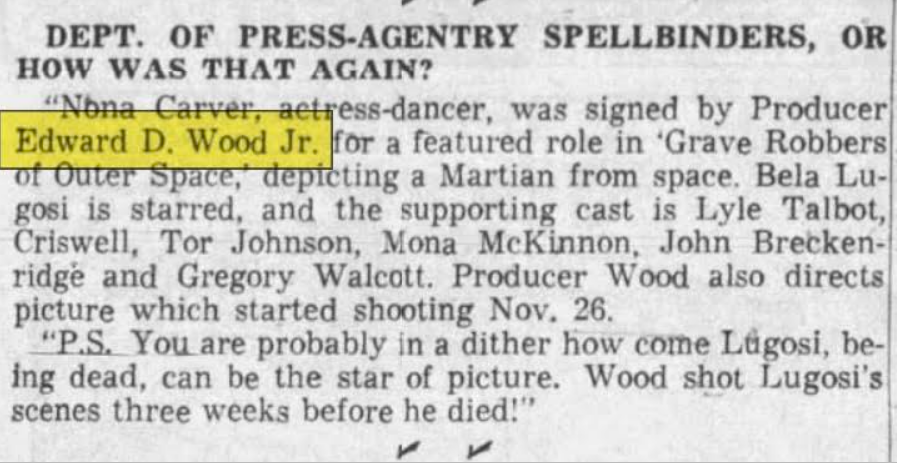
I recently learned a little more about Nona Carver when the unstoppable Rob Huffman sent me some vintage news clippings about her. This article from the November 29, 1956 edition of The Los Angeles Mirror suggests that Nona almost played an even more prominent role in the Ed Wood saga. Entertainment columnist Dick Williams says that Nona would play "a Martian from space" in Plan 9 from Outer Space, then still known as Grave Robbers from Outer Space (or Grave Robbers of Outer Space). Nona's role ultimately went to Joanna Lee, who came to resent her association with the film.

Nona Carver could have played Tanna in Plan 9.

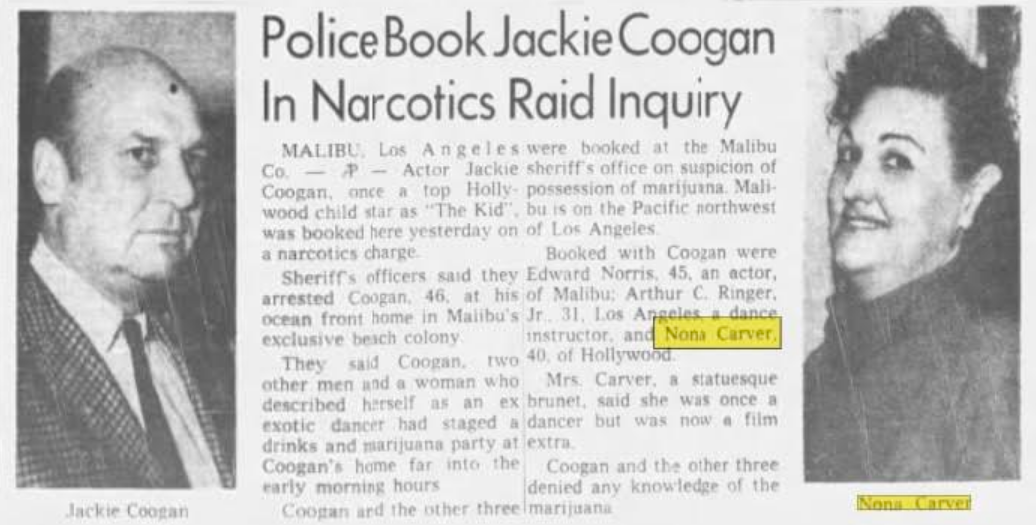
The next Nona story that Rob sent me is even stranger, if you can believe it. It comes to us from The Modesto Bee, January 8, 1961 and tells us about the time Nona Carver was busted after attending a "marijuana party" at the beachfront Malibu home of former child star Jackie Coogan. This was well after Coogan's days of acting alongside Charlie Chaplin in The Kid (1921) but a few years before he played the role for which he is most famous today: Uncle Fester on The Addams Family (1964-66).

Nona and Fester? Who'd have guessed?

The article yields some interesting information about Nona Carver, including the fact that she was 40 years old at the time of this incident and retired from exotic dancing. She gives her profession as "film extra." Other than Virgins and Trade, however, the only film role I can find for her is in 1962's Terrified, a suspense thriller that looks like a a cheapjack imitation of Psycho (1960).

The next article that Rob sent me comes from Ed Wood's hometown paper, The Poughkeepsie Journal, May 2, 1967. It concerns Eddie, his brother Bill, and their father.

Ed's brother Bill (pictured at left) visited his ailing father in 1967.

It seems that both Ed Wood and his younger brother Bill returned briefly to New York State in 1967 to visit their ailing father, Edward D. Wood, Sr., who was in an Albany hospital. Sadly, the Wood family patriarch died just four days after this article was printed. He was 72 years old. I can't help but imagine what Ed's last visit with his father was like. I keep picturing that extremely subdued scene from Alice's Restaurant (1969) in which Arlo Guthrie (playing himself) visits a dying, still-smoking Woody Guthrie (Joseph Boley) in the hospital. Arlo is respectful but taciturn, as he really has nothing to say to his father at this moment. In the hallway outside Woody's room, Arlo talks to his mother Marjorie (Sylvia Davis).
ARLO: He's gotten a lot worse since I saw him.

MARJORIE: Well, let's say no better.

(Arlo glances around awkwardly, unsure of what to do in this situation, then leans in and kisses his mother. He turns around and walks away without another word, passing a nurse pushing an old man in a wheelchair as he leaves.)
Or who knows? Maybe it was nothing like that. Maybe Ed Wood, Jr. and Sr. had a deeply satisfying, far-ranging conversation and got to resolve whatever issues they had between them, allowing the elder Wood to slip into death with a clear conscience.

I have one last item for you today. Rob Huffman hipped me to this remarkable 2001 blog post by renowned science-fiction editor Earl Kemp (1929-2020). In the 1960s, Kemp worked at a publishing company called Greenleaf Classics, which released a few of Ed's books, including the novelization of Orgy of the Dead (1966). Because of this, Earl got to meet and interact with both Ed Wood and Criswell. He says the two were constant companions and could even finish each other's sentences. 

I don't want to spoil any of the article, so I'd advise you to go read it for yourself. Suffice it to say, it's a wonderfully descriptive and evocative passage, detailing what it was like to spend time with these two extraordinary human beings. As a bonus, Kemp also includes the entire Greenleaf style manual, which is surprisingly nitpicky and even stodgy at times. Having read much of Ed Wood's prose, I doubt our man followed guides like these very closely. Or at all.

Wednesday, July 12, 2023

Ed Wood Wednesdays, week 158: Ten years of Ed Wood Wednesdays (2013-2023)

Here's how my blog looked ten years ago.

It was never supposed to be like this. Ed Wood Wednesdays, as I have explained many times over the last decade, was planned as a limited series back in 2013. Emphasis on limited. I'd just gotten the DVD box set, Big Box of Wood (2011), and already had a handful of other Wood films in my collection. I thought it'd be fun to put those films into chronological order and review them one at a time, supplementing my commentary with little historical tidbits from Rudolph Grey's Nightmare of Ecstasy (1992), which was pretty much the only Ed Wood book on the market then. I'd start with Crossroads of Laredo (1948) and end with Hot Ice (1978). That was it.

The project came along at a time when this blog was in need of a new direction. Dead 2 Rights started in October 2009 as a spinoff of a zombie movie podcast called Mail Order Zombie, where I was a regular. But that show ended in April 2013, and I was getting a little burned out on the zombie-related content anyway. Less than a year earlier, I'd had a complete emotional meltdown and been hospitalized for suicidal depression, and this blog briefly became a journal of my recovery as I started taking meds and going to therapy. But I got bored with writing about that stuff, too. 

For a while, I busied myself with reviews of public domain comedies, thinking that those lighthearted, often corny movies from the past might help me shake off my melancholy. They didn't, but I'm still proud of that series. Maybe I shouldn't have abandoned it so abruptly. But the Ed Wood stuff eventually became this blog's main focus and crowded out everything else.

Here I am with my mother at Christmas.
But why Ed Wood rather than, say, a more "respectable" director? Well, like many middle-aged people, I was probably trying to recapture some aspect of my lost youth. I first saw Eddie's films at a Halloween movie marathon in October 1992. I was a high schooler at the time, and this would be one of the last positive experiences of my teenage years. Shortly after that, my mother's cancer returned with a vengeance. Her death sent my life into a tailspin, and the next few years were bleak indeed. For me, Ed Wood somehow became an icon of happier times.

I never put myself forward as any kind of expert on Ed Wood, nor did I intend this series as a deep dive into obscure Wood trivia. In fact, that was the very opposite of my intention for this series. My goal was (and, to some degree, still is) to write for a general audience, and I felt these articles should be comprehensible to the average reader, even one who'd never seen any of Wood's movies. The immediate reaction to Ed Wood Wednesdays was largely positive, with each article getting several thousand hits -- small potatoes by internet standards but very good for a niche blog like this. 

Very soon, though, people started to contact me, either by email or through instant messaging. Some were merely curious and wanted to know if I'd be covering certain speculative Wood films or delving into Wood's written work. Some wanted to make corrections or school me on Ed Wood lore. Some wanted to promote Wood-related projects of their own. And some felt I was an interloper, horning in on territory that rightfully belonged to others. Every fandom has its share of gatekeepers, and Woodology is no exception. I have written of a so-called "Hollywood historian" who considers himself a Wood expert and who has been unfailingly hostile towards me for years. I try not to hate anyone, but this guy makes it tough.

There were some upsides to being the author of Ed Wood Wednesdays. Not many, but some. I was interviewed by The New York Times back in 2014. That was kinda neat. My father had no idea how the internet worked, so telling him about my blog was futile, but even he had heard of the Times. A few professional opportunities came my way because of Ed Wood Wednesdays as well. I know that I was asked to contribute to the Girl Gangs, Biker Boys book (2017) because of this series. The book Dad Made Dirty Movies also came about because journalist Jordan Todorov found my lengthy, detailed reviews of the movies Ed Wood made with director Stephen C. Apostolof in the 1970s.

The salad days of Ed Wood Wednesdays did not last long, though, maybe a year and a half. Then things started to turn sour. For one thing, Google's search algorithm changed and stopped sending people to my blog. It was like a faucet had been turned off. I lost 95% of my audience in a very short amount of time, and it has never recovered. A typical Ed Wood Wednesdays article now gets, at most, a few dozen hits. Only the diehards remained, and they wanted obscure Wood trivia that I was not always able to supply. My life, too, remained chaotic. I abruptly quit my corporate job on a whim in August 2015 and made a quixotic attempt at a career as a freelance writer with virtually no idea how that profession works. What was I thinking? I don't know.

This series probably would have ended in 2015 had it not been for Greg Dziawer, one of my most persistent emailers. He'd inundate me with Wood trivia, some of which I could barely understand. At the time, I was trying to make a go of the freelancing thing and didn't really feel like contributing anything substantial to this blog. (I found that, when I wrote for money, I was less willing to write for fun.) So I made the decision to turn the reins of Ed Wood Wednesdays over to Greg. 

I felt a little guilty about that choice. I called myself a writer, after all, but I wasn't even writing my own blog anymore. For the true Wood diehards, though, this was probably when Ed Wood Wednesdays "got good." Greg was much more willing to supply the graduate-school-level trivia that they wanted, and he made no attempt to court a wider audience with his articles. His stuff was for the true believers only. Greenhorns need not apply. He was combing through old magazines and loops and even contacting people connected to Wood in search of material for the blog. (I was never good at that.) More than once, I suggested he start his own blog, but he thought it was better to publish his findings on my blog. So the series continued.

Eventually, as my freelance writing career evaporated, I drifted back to Ed Wood Wednesdays. Between the main series and such supplementary series as Ed Wood Extras and the 2022 Ed-Vent Calendar, plus my individual reviews of Ed's short stories and magazine pieces, I have now written something like 380 articles about Edward Davis Wood, Jr., totaling god knows how many thousands of words. It's possible that I've written more about Eddie than anyone, certainly enough to fill several books. 

What keeps me going? Well, it helps that the last 10 years has been a time of great discovery in the world of Ed Wood. So many of Ed's movies and written works have come to light in the last decade, and more continue to be found. It's truly the best time to be a Wood fan. Plus, as the founder of this blog, I just get stuff sent to me. I especially need to thank Philip R. Fry, Greg Dziawer, and Bob Blackburn for hooking me up with some Wood goodness. That's the ultimate perk of founding this series.

More than that, though, I find some kind of strange solace in the works of Edward D. Wood, Jr. I can't explain it to myself, let alone explain it to you. It's not that Ed is a hero to me, exactly. He was a drunk who beat his wife; that's no role model. But in his films and his writing and, yes, his own life, he created this fascinating alternate universe that I like to explore, even after all these years. It's my own Oz or Narnia or Wonderland or Middle Earth, populated with beings as extraordinary as any you'd find in those fictional places. I got into this series to cover Ed's movies, but it's his prose that actually gives me the most satisfaction these days. There's just a certain cadence to Ed's writing I find comforting, and reading is for me a more immersive experience than watching.

Make no mistake, Ed Wood Wednesdays is a ton of work for me. It generates no money whatsoever -- quite the opposite, really -- and takes up an inordinate amount of time. That's something I have less and less of, especially now that I work a full-time office job again with a commute and also do a weekly podcast that requires hours of writing, researching, and editing.  But I intend to keep this series going as long as I'm physically and mentally able to do it, long after everyone has stopped reading it. Ultimately, the audience for Ed Wood Wednesdays is and always will be myself. I write these things so that I can read them when they're done.

Occasionally over the last ten years, people have asked me if I'll ever write a book about Ed Wood. I tell them that I have. I've just been publishing it online for free, one chapter at a time. And I hope it'll never be finished.