Showing posts with label books. Show all posts

Monday, June 29, 2026

Ed Wood Wednesdays: The Wood Paperback Odyssey, Part Five by Greg Dziawer

The elusive T.K. Peters, sometimes misidentified as Ed Wood.

Encyclopedia of Sex ad
As I prepared to write this week's Ed Wood Wednesdays article, I decided to do a quick search of eBay, to see if the old myth of Dr. T.K. Peters being a pseudonym of Ed Wood still persists. You guessed it (merely one example, sadly). Apart from inflating prices, it continues to muddy the waters of Woodology, this muddying now its own niche within the larger spectrum. Dr. T.K. Peters was real, and we'll refute some counter-claims that his esteemed name was "borrowed" from the real "Kim" in future Ed Wood Wednesdays.

In the past, Pendulum Publishers, Inc. and its myriad offshoot imprints (covered ad nauseam in previous posts) published two series of photo-illustrated sexual paperbacks in the early 1970s, sourced from the comprehensive sexual study by Dr. T.K. Peters that he sold to Pendulum boss Bernie Bloom (itself rooted in his work as a marriage counselor in Atlanta from 1950 through 1965, following his retirement from Oglethorpe University...but that's another story that WILL be told). 

Fully three-fourths of the Peters' titles constituted SECS Press' (an unincorporated Pendulum imprint) Encyclopedia of Sex, the rest being the Sexual Enlightenment Series published under the Calga imprint, unleashed just on the cusp of legal, accessible and affordable hardcore sexual imagery via multi-media. For some alchemical reason, the censorship damn bursting encouraged a propensity toward the weird, the extreme and the just plain fucking nuts. In all, between Ed's own resume and an additional few titles in his collection with title-page inscriptions by him, Ed wrote or co-wrote roughly 25% of the Peters paperbacks. That index, too, is another story. Suffice to say that Ed's cohort on West Pico in the Pendulum mag office played a large role in the Pendulum Peters canon. Ed collaborated with fellow staffers Charles D. Anderson and Leo Eaton. William D. "Bill" Jones produced Peters, and so did Robin "Redbreast" Eagle. They did this under a slew of pseudonyms, one of them, Norman Bates, still falsely claimed a pseudonym of Ed. It's impossible to talk about T.K. Peters without running into these clumsy mis-Ed-tributions. That's a charitable statement and I'll leave it at that.

Wednesday, December 25, 2024

Ed Wood Wednesdays, week 208: A look back at the year in Ed Wood

There was a lot of Ed Wood in 2024. Too much, perhaps?

In the career-spanning book Frank Zappa: The Negative Dialectics of Poodle Play (1995), author Ben Watson astutely observes that "1984 was a bamboozling year for Zappa consumers: The Perfect Stranger, Francesco, the triple-box Thing-Fish and then, as if that was not enough, a full-scale double rock album of new tunes, Them Or Us." 

Ed Wood consumers could relate, as 2024 was a bamboozling year for them too. This was the 100th anniversary of Eddie's birth in Poughkeepsie, NY, and it seemed to inspire a torrent of releases and rereleases. Fans could barely keep up. And by "fans," I mean me.

Ed Wood's Saving Grace
Let's first talk about the books. God, there were so many! For quite a while, Rudolph Grey's Nightmare of Ecstasy (1992) stood alone as the only full-length book about Edward D. Wood, Jr. Now, Woodology is practically a literary subgenre unto itself. This year gave us a few more entries.
  • Will Sloan announced his upcoming book Ed Wood: Made in Hollywood USA (OR Books), due in June 2025. It promises to be a wide-ranging critical study that includes Ed's movies as well as his novels and other written works.
  • I should also mention Fred Olen Ray's wonderfully goofy horror novel Deep Red (Retromedia Press), based on an unproduced screenplay Fred cowrote with a drunken, dying Eddie in the late 1970s. Fred's book came out in 2023, but I didn't find out about it until 2024. 
Ed Wood fans, you have your reading list for the next six months. Or more. You'd think that would have been enough for me, but this was also the year that I purchased a stack of vintage Ed Wood paperbacks from a seller on Facebook.

Has Flame of Islam been found?
And that's not even half the story! There were some significant home video releases in 2024 as well, all of them on Blu-ray. I guess the era of affordable, accessible DVDs has ended. Oh well. It was nice while it lasted. Here are the titles I added to my collection within the last 12 months.
  • In May 2024, a specialty label called Gold Ninja Video, which bills itself as the "Criterion of Public Domain Bargain Bins," released a two-disc limited edition of Ed Wood's Revenge of the Dead (1959). This is a movie we already know well under the rerelease title Night of the Ghouls but this edition includes the original credits, plus a slew of supplements and commentary tracks. Also included in this set are transfers of Jail Bait (1954), Final Curtain (1957), and (if you go snooping) The Sinister Urge (1960). There are also numerous extras related to actor Paul Marco, who portrays Kelton in the film, as the folks at Gold Ninja are big fans of his. Unfortunately, this seems to have vanished from the market shortly after its release. If you don't already own it, good luck finding it on auction sites.
  • Arguably the biggest Ed Wood home release of the year was Severin's Hard Wood: The Adult Features of Ed Wood. This is a three-disc set containing new—and, in some cases, drastically improved—scans of Necromania (1971), The Only House in Town (1970), The Young Marrieds (1972), and Shotgun Wedding (1963), plus some of Ed's adult loops from the 1970s. Again, there are numerous commentary tracks, some featuring the late, great Greg Javer, plus various featurettes. This is arguably the most ambitious Ed Wood home video release since Big Box of Wood (2011). I only regret that Greg passed away so shortly after its release and that we couldn't go through the contents of this set together. Unlike Revenge of the Dead, this collection is still available.
  • Just this week, I received a disc from BayView Entertainment and The 3D Film Archive containing a new transfer of Arch Oboler's forgotten feature Domo Arigato (1973), which I'd describe as a cross between a romantic drama and a travelogue of Japan. The dramatic parts are middling at best, while the travelogue parts are often spectacular, making excellent use of the 3D "Space Vision" gimmick. My interest in this particular disc is that it also contains a short film alleged to be Ed Wood's long-lost Flame of Islam under the title Cleopatra Follies (1953). It's extremely tame burlesque footage, including rather listless performances by Paula French and Shirley "The Pussycat Girl" Hayes, but the 3D effects are again quite impressive. Eddie's involvement was supposedly limited to writing the (sparse) voiceover narration.
As a result of all these releases, I definitely exceeded my "Ed Wood budget" for 2024. Bob sent me a complimentary copy of Kathy Wood and I, but the other books and discs I got were ones I'd paid for out of my extremely meager salary. Oh well. Who needs such trivialities as food and rent when you can have Necromania on Blu-ray? 

Before 2024 comes to a close, we must remark on the times Eddie made the news this year. As I mentioned earlier, October 10, 2024 would have been Eddie's 100th birthday. This year is also the 30th anniversary of Tim Burton's Ed Wood (1994). So, as you might guess, there were screenings of that film as well as Ed's most famous 1950s films in theaters across the country in October, especially in his home state of New York and his adopted home of California. It's wonderful that Ed's birthday happens to fall during "spooky season," as does the birthday of his most famous star, Bela Lugosi.

While I was not able to attend these screenings in person, I did attend one virtually via Zoom and even got to host a Q&A after a screening of Ed Wood in the Poughkeepsie, NY area. Not long afterward, this same town saw fit to designate Ed Wood's childhood home as an official historical site, complete with its own marker. This recognition came about because of the efforts of some high schoolers in the area who cited this very blog as one of their sources! It does my heart good to know that Greg was aware of all this before his passing.

Look, I'd love to say that 2024 was a banner year in Woodology. In a lot of ways, it was—the 100th birthday, the books, the Blu-rays, the historical marker. That was all great, and it's nice that Ed Wood and his career are still generating such interest well into the 21st century. But the death of my friend and colleague Greg Javer, one of the greatest Woodologists I've ever known, casts a pall over the entire year. A lot of the books, articles, and films I reviewed for this series were only available to me because Greg had sent them. Where we go from here, I don't know. I'm still regrouping. We'll figure this out, week by week. In the meantime, I hope you and yours are enjoying the holiday season.

Wednesday, June 12, 2024

Ed Wood Wednesdays, week 192: I bought a stack of Ed Wood books. So how did I do?

Yes, I bought this stack of books. Did I overpay? Underpay? Let's find out together.

Way back in the spring of 2015, there was a massive auction of Ed Wood memorabilia in Cambridge, Massachusetts. I knew I couldn't afford anything pricy, like Eddie's actual suitcase, but I felt like I wanted to get something. I settled for a poster advertising Glen or Glenda (1953) under one of its many alternate titles, I Led 2 Lives, and a collection of Mexican lobby cards for Plan 9 from Outer Space (1957) aka Espectros del espacio. The poster I had framed; it now hangs in my kitchen and greets me every morning. The lobby cards I keep in a binder and rarely look at. 

All in all, this set me back about $400—then and now a huge sum of money for me. When things got particularly lean a few years ago, I even considered selling these items at a loss before deciding that it was more trouble than it was worth. Not to mention depressing. So I kept them as stern reminders of what not to do with my money.

Because of that experience, I vowed I would never make another major and totally unnecessary Ed Wood-related purchase again.  I also knew that, someday, I would more than likely do it again. I bravely (?) held out for nearly a decade. Then, in the spring of 2024, I saw on Facebook that a fan was selling off some of his collection, including a stack of Wood (and Wood-adjacent) books. Since I rely mostly on e-books and PDF files in my research for this series, I own very few paperback and hardcover editions of Ed's work. So I was tempted.

After a couple of weeks of hemming and hawing and exchanging a few direct messages with the seller, we eventually settled on a deal: nine books for $350, including shipping. For you non-mathematicians out there, that's about $38 or $39 a book. Was I cheated? Did I do pretty okay for myself? Let's break it down, book by book, and find out.

Wednesday, January 17, 2024

Ed Wood Wednesdays, week 175: Young, Black and Gay (1968)

Is this Ed Wood's most incendiary novel?

Nowadays, we would probably demand that the author of a book called Young, Black and Gay be at least two of those adjectives. But I guess authenticity wasn't as important back in 1968, when Edward D. Wood, Jr. penned a novel with that bold title for a company called P.E.C., which published it as part of its French Line imprint with the catalog number FL-38.

I'd say the author of this novel was zero for three. At 44, Ed Wood wasn't terribly young when he wrote Young, Black and Gay. He was decidedly not Black either. As for being gay, while Eddie's sexuality was labyrinthine to say the least, I would never be comfortable calling him strictly homosexual. If you've read A Fuller Life (2008), the autobiography of Eddie's live-in lover and leading lady Dolores Fuller,  you'll know just what I mean. In that book, Dolores is quite candid in describing her intense physical relationship with Ed. 

Was Ed Wood qualified to write this?
So maybe Ed wasn't the most qualified author for Young, Black and Gay (hereafter YB&G), but he must have taken some pride in his work since this is one of the novels he wrote under his own name. It comes from what I'd call the most productive era of Ed Wood's life: 1968 to 1972. (If you want to expand that from 1967 to 1973, I wouldn't argue.) Simply put, Eddie was writing like a madman during these years, churning out books, articles, and film scripts at a pace that is superhuman. And yet, most of this material (including YB&G) is highly indicative of Eddie's signature style. Hurried though he was, Ed Wood usually found time to work his own obsessions, kinks, and quirks into what he wrote.

I suppose we could categorize this novel as one of Ed Wood's "Black" books and file it alongside Black Myth (1971, written under the pseudonym Dick Trent), Toni: Black Tigress (1969), and the two Rocky Alley novels, Watts... The Difference (1966) and Watts... After (1967). And indeed, YB&G has much in common with them, stylistically and thematically, even referencing the Watts riots. But what this novel really reminded me of was Ed's 1967 book Drag Trade, his rambling treatise on transvestism and crime. If you took one of the (manufactured) case studies from that book and expanded it to novel-length, you'd get YB&G.

What we have here is the turbulent, violence-plagued story of Charles Sttanze (yes, that's how his last name is spelled for some reason), a young Black man who grows up in abject Southern poverty in a world that seems little changed from the days of antebellum slavery. He and his family pick cotton and live together in a foul-smelling, barely-furnished shack. Charles learns about the facts of life very early, since his parents unashamedly make love in front of their children. His sisters go naked at home on hot days, so he's well-acquainted with female anatomy.

Charles' life takes a turn when, as a teenager, he meets a field worker named Clyde. Initially rivals, Charles and Clyde are thrown into confinement together after getting into a fistfight and soon embark upon an intense homosexual relationship. Under Clyde's tutelage, Charles develops a female alter ego named Charlene. (Compare this to the case of Charles/Charlotte in Drag Trade.) Eventually, our protagonist identifies as female and uses the name Charlene exclusively. And here, Ed Wood does something subtly revolutionary. After a few chapters, he consistently refers to his main character as Charlene and switches the character's pronouns from he/him to she/her. And this is in 1968!

But let's not go overboard praising Ed Wood for his progressive politics. Charles/Charlene is a largely negative character, and there is little doubt that YB&G is tainted by Wood's own deeply-ingrained racism. Once he escapes from his family, the work-averse Charles embarks upon a life of petty crime and spends much of his time in jail.  He begins a relationship with a white cellmate named Bobert, and when Bobert is killed by another white prisoner, Rance (one of Ed's favorite character names), our hero switches allegiances without too much hesitation. His only real complaint is that Rance is a quickie artist (another major sin in the Wood-iverse).

Once on the outside and living completely as a woman, Charlene reunites with Rance, and together, they form a sort of interracial, transgender Bonnie-and-Clyde-type duo, robbing liquor stores and killing whenever they need to. Ultimately, they arrive in Los Angeles and plan a big-time caper that will finally bring in some real money. But this job will require bringing in a third party, possibly jeopardizing the special chemistry between Charlene and Rance. It doesn't help that the experienced crook that Rance recruits, Moe, is a crude, ill-tempered, mean-spirited brute who immediately antagonizes Charlene.

Saks on Wilshire: Charlene's happy place.
Meanwhile, Charlene starts frequenting a Black gay bar called the Joint Affair and meets a mysterious man named Jeff, who represents a Black Power group known only as "the organization." This is the same name Ed Wood gave to a very similar group in Toni: Black Tigress, and his views on the subject of Black Power are identical in both novels. Charlene seems to have no particular political ideas but is drawn to Jeff because she likes the way he talks. Like all Black organizers in Ed Wood novels, Jeff is selfish and untrustworthy, but our protagonist barely seems to notice his flaws. In the latter stages of the book, Charlene bounces back and forth between Rance and Jeff until YB&G reaches its violent apotheosis.

If Wood depicts his Black characters like Charlene and Jeff negatively, does that mean the novel's white characters are the true heroes? Nope. All through the novel, Charlene is plagued by racist vigilantes, many of them members of the Ku Klux Klan, and Wood depicts these characters as violent, cruel, and hateful. Arguably, the book's most shocking passage comes when the KKK kidnaps and tortures a fairly benign Black character, a genial ex-con turned flophouse owner. They even nail the man's testicles to a tree trunk. Fearing reprisal, Charlene does nothing to help. So it's safe to say that YB&G depicts a world without heroes. The best one can do here is survive.

Like Rocky Alley in the Watts books, Charles does wonder why Blacks are so stigmatized in society. After witnessing the Klan attack, he ponders the issue at some length:
Long ago his aged grandmother had told him white was for purity and good. After that he couldn’t help but wonder if that meant black was vile and bad. The few times, after leaving the plantation that he had seen a cowboy movie on some store window television set, he’d always found the good guys wore white hats and the bad guys wore black hats.
But these thoughts do not occupy Charles' mind for long. After all, there are crimes to commit and money to be made. The character seems to have no moral compass whatsoever.

Earlier, I mentioned Ed Wood's personal obsessions and stylistic quirks. They're all over YB&G, even though this novel is one of his more disciplined long-form works. This book is not laden with Eddie's trademark ellipses, and it lacks the dreamy, free-associative quality of some of Ed's weirdest and most extreme writing. For the most part, he avoids the lengthy flashbacks and philosophical asides that often clutter up (or enhance) his fiction. Who knows? Eddie may have been semi-sober when he spent a day or two typing this book. He tends to stick to the main storyline and keep the plot moving forward.

And yet, all of Eddie's main motifs are present here, including his four principal muses: sex, death, booze, and women's clothing. There is no angora in YB&G, sadly, but there are plenty of sweaters and nightgowns, and seemingly everything Charlene wears is described in excruciating detail. It's treated as a major event when she's finally able to buy an outfit at Saks Fifth Avenue on Wilshire Blvd. And there's plenty of alcohol consumption here, too. In particular, Charlene develops a taste for gin before Jeff angrily informs her, "Gin is a n----r drink!" Not coincidentally, this same exact issue arises in the Watts novels. Ed Wood definitely had some thoughts on the racial implications of drinking gin.

By the way, if you're wondering whether Ed Wood uses the n-word in YB&G, please be aware that this infamous racial slur appears (by my count) 43 times in the text. Four of those are in the very first paragraph, so Ed Wood was clearly looking to shock readers with his use of extremely harsh language. One wonders who the intended audience for this book was. Gay people? Black people? Or straight white men looking for something exotic? Try as I might, I can't imagine anyone finding this book remotely erotic, even though the frequent gay sex scenes are written with Ed's usual passion.

Today, even though it bears the man's own name on the cover, Young, Black and Gay is among the least-known of Ed Wood's novels. As I read it (twice!), I found myself asking if the book could ever find a larger audience if it were reissued today. Frankly, I have grave doubts. The novel's crossdressing angle will make it interesting to fans of Ed's film Glen or Glenda (1953), and Woodologists will find numerous parallels between the two works. But the ugly racism of the book makes it a tough sell to modern readers, especially those outside the cult of diehard Wood fans. It seems destined to remain an obscurity among obscurities.

Wednesday, November 1, 2023

Ed Wood Wednesdays: A review of the two-volume Bunny Breckinridge biography (Guest Author: James Pontolillo)

John "Bunny" Breckinridge was the subject of an exhaustive biography in 2018.
   
Rod Woodard, 2018, Bunny Breckinridge: Exalted as an Early Hero of the Gay Rights Movement, Book One (401 pages) and Book Two (440 pages), self-published, numerous small photos throughout, available for $9.99 each on Amazon in Kindle format only.
John Cabell Breckinridge, Jr. – known as Bunny to friends and acquaintances – was born to wealthy ex-patriate American parents in Paris on August 6, 1903. His familial line, with roots deep in Colonial Virginia and Antebellum Kentucky, established their fortune through tobacco, cotton, and the legal profession. As the great-grandson of both U.S. Vice President and Confederate general John Cabell Breckinridge and Wells Fargo Bank founder Lloyd Tevis, Bunny lived a life of inherited wealth, luxury, and prominence. Just before the outbreak of the First World War, his parents moved the family to England. Bunny spent 1916-1922 at Eton College, Oxford University, and Cambridge University before taking a grand tour of Europe.
 
Portrait of Bunny as a young man.
In 1927, while working as a drag/burlesque entertainer in Paris, Bunny married a minor member of French royalty who accepted the fact that "he liked the boys." They had a daughter but divorced two years later. For the next decade Bunny performed onstage in French revues. Toward the end of 1938, he inherited part ownership of the Palace Hotel in San Francisco. From then on Bunny’s primary residences were in Hollywood and Carmel-By-The Sea, California, while he continued to travel overseas regularly.

As an internationally-known, openly gay socialite with a bigger-than-life public persona from the 1930s to the 1980s, Bunny was frequently written about in Paris, New York, Hollywood, and San Francisco newspapers. If there was an elite party of note, he was sure to be in attendance. Society columnists loved to regale their readers with tales of Bunny’s lavish parties and zany antics. In 1954 he garnered extensive press coverage after claiming that he planned to undergo sexual reassignment surgery in Denmark, after which he would marry the man of his choice. Bunny’s plans came to naught though after the Danish government threatened to bar his entry. 

Two years later, Bunny played a lead role as an alien ruler in Ed Wood’s film Plan 9 from Outer Space. The pair first met through their mutual friend Paul Marco, who played the role of Kelton the Cop in three Wood films. At the time, Marco, Breckinridge, and David De Mering (who played the co-pilot in Plan 9) were living together in Marco’s modest home – despite Bunny being independently wealthy.

In August 1958 Bunny and three other men were arrested on child molestation and conspiracy charges related to their involvement with two brothers, aged 11 and 13. In March 1959 he was convicted on 10 counts of sexual perversion and crimes against children. A month later Bunny was judged not guilty by reason of insanity and sent to the Atascadero State Hospital. He was paroled for good behavior after six months. 

Bunny returned to his sybaritic lifestyle only somewhat constrained by the terms of his parole. On a trip to France in the 1960s he met a divorced American expatriate. Like Bunny’s first wife, she too accepted that Bunny "liked the boys." A whirlwind romance was followed by marriage and a blissful month or two in Paris. The pair then returned to Bunny’s home in Carmel where irreconcilable differences quickly led to a divorce.

The trust fund that fueled Bunny’s grand lifestyle was worth approximately $20 million in the late 1970s, but dark clouds were gathering on the horizon. At least $6 million abruptly vanished due to a bad investment made by his lawyer. Much of the rest was apparently lost to graft and general financial mismanagement, but the courts never resolved the exact circumstances. A series of health problems landed Bunny in a Monterey nursing home where he spent the last three years of his life. By the time he passed away at age 93 on November 5, 1996, Bunny was an impoverished ward of the state. He is only remembered today due to his brief association with Ed Wood.

•─────⋅☾ ☽⋅─────•

The author of this two-volume set, Rod Woodard, first met Bunny while attending the socialite's 70th birthday party in 1973. Even in the autumn of his life, Bunny was well-known throughout Carmel for his galas and attendance was still a feather in one's social cap. Book One opens with a multi-chapter narrative describing their friendship. It then begins a thread that runs through both volumes slowly unfolding how Bunny ultimately ended up in a California nursing home, the curious disappearance of most of his wealth, and Rod's efforts to get him better legal representation as well as a reestablished measure of autonomy. This is followed by several chapters on Bunny's genealogy, heavily footnoted with relevant historical detail. 

The covers of Rod Woodard's two (count 'em!) books about Bunny Breckinridge.

The remainder of Book One covers Bunny’s life from his 1903 birth through 1938. Highlights include his childhood, youth and early homosexual experiences in France; the family's move to England; his college escapades with a focus on student dalliances, homosexual clubs, and affairs with older men/professors; his post-graduation travels throughout Europe; his first marriage and its failure due to his mother's interference; his post-divorce life in 1930s Paris; and his partial inheritance of San Francisco’s Palace Hotel in 1938.

A middle-aged Bunny with his pet cat.
Book Two picks up the narrative in 1939 with Bunny’s relocation to the USA and follows the remainder of his life. Highlights include Hollywood stars and scandals; his travels to Europe and the Mid-East; his adult daughter's attempts to seize control of his trust fund; his party life in the 1950s; his public flirtation with having a sex change operation; his brief association with Ed Wood; the events that led to charges of child sex abuse against him; his trial and subsequent brief committal to a state mental hospital; his second marriage; and the waning decades of his party life. 

Not wanting to end Bunny’s saga on a negative note, the author provides a fictional happy ending – Bunny returns home in control of his life again and metaphorically walks off into a golden sunset – which he corrects with a factual and downbeat epilog.

The books are well-written, but they are not necessarily easy to read. Woodard's use of a discursive "you are there" approach extends even the simplest of events into a protracted narrative. This is amplified by a strongly novelistic style which renders an often-minute level of detail that surely no one could ever actually recall in real life. It all combines into a slow burn portrait of an effete gay man living a wealthy lifestyle disconnected from everyday concerns – The Gay Gatsby if you will. 

Whether Woodard's approach works for you or not will rest solely on your level of interest in Bunny himself and the portrait of a rarified existence few of us will ever be fortunate enough to experience. These are certainly not books for those with merely a passing interest in the man himself. That is not to suggest, however, that there is not ample material here to shock, interest, and titillate the average reader. Caveat lector: Woodard acknowledges the use of pseudonyms and Bunny himself may be an unreliable narrator to a lesser or greater degree.

Bunny lived a capricious, flamboyant life, had an outrageous sense of humor, was renowned for entertaining grandly, and had a penchant for fragrances and costume jewelry. He described his mother Adelaide as a PIC (pretty, insincere, chatterbox). Nevertheless, she was a strong-willed and selfish individual who exhibited an unhealthy level of control over her child’s life until her death in 1958. Bunny was charming, genteel, eccentric, and had a dramatic flair for retelling the events of his life… real or imagined. He often stated that Barbara Bush wrote to him that she could not introduce him to any of her handsome sons because they would surely fall hopelessly in love with him. 

Many will be disturbed by the frank and lovingly-detailed accounts of Bunny’s first sexual encounters as an eight-year-old boy with the uniformly well-endowed teenaged and adult men working on his family's estate. It should be noted that Bunny claimed that he voluntarily initiated all of these trysts. In their personal interactions Woodard noted that Bunny could be positively Victorian one minute (recoiling from a photo in a gay porno magazine) only to produce a photo from his own wallet moments later showing himself nude with two other men in flagrante delicto. On the issue of his legal problems, Bunny claimed that he was completely innocent of any wrongdoing – it was a case of rank extortion by the boy's mother. Although Bunny did seemingly hedge his bets by claiming that the boys were promiscuously gay in any event.

•─────⋅☾ ☽⋅─────•

Bunny in Plan 9 from Outer Space.
The Ed Wood content is limited to Book Two only and is a miniscule part of the narrative. One of Bunny's close friends from this time period ("Jack Soles") had nothing good to say about Eddie.
"Bunny began to involve himself with [a strange mix of people]... One of them was this Ed Wood fellow. He was wearing a Hawaiian shirt and sandals, of all things, when I first met him at one of Bunny’s parties. I was totally dismayed by Bunny’s new class of friends… They were just not educated… and their conversations were filled with filthy language… most of the transvestites dressed like sluts and streetwalkers… After learning of Bunny’s acting abilities and financial status, Ed asked him to be in one of his motion pictures… You cannot imagine how absolutely stupid and degrading it was for a man of his stature and background to be seen in such trash… The following year, Bunny was supposed to act in another of Ed Wood’s movies called The Dead Never Die, but luckily it never came to pass… Bunny lived with Ed Wood for almost a year… Wood had no money, but Bunny chose to live with him anyway in Mr. Wood’s small, run-down shack… Thank goodness Bunny and Ed had a huge disagreement, and that was the end of that."
Bunny had even less to say about Eddie and almost none of it was complimentary.
“Oh, that was a hoot and an honor at the time I was making it, darling. Ed and I were lovers. It was exotic and exciting with big-name stars to headline with me. I was thrilled to get up each morning and be a part of it all. However, when I saw the final thing on the screen, with my name as the lead, I thought it was rubbish and was embarrassed to have been swept up in all that craziness… I was to make another film with that man, but decided against it… As it turns out, darling, we were lovers as long as I was putting money into his production company. When I refused to give him more, he said he could not remain my partner if I did not believe in his dreams the same as he did.”
Sic transit amantes.

This is probably as good a place as any to state that, as much as I like actor Bill Murray's hilarious interpretation of Bunny in Ed Wood (1994), he apparently could not have been farther from the mark. The real Bunny with his penchant for saying "darling" with regularity comes across as a much more refined and debonair individual. Murray’s accent and diction throughout the film project a commonness and coarseness that is simply not evident in Woodard's account. In 1994 Bunny was aware that he was being portrayed in the upcoming Ed Wood biopic, but health problems prevented him from participating in any way. Although he died two years after the film’s release, it is doubtful that he ever saw it.

•─────⋅☾ ☽⋅─────•

Woodard is not wrong when he describes his two-volume opus as the story of Bunny's "coming-of-age and coming out as a homosexual during the waning dominance of Victorian sensibilities." Bunny unconsciously personified a particular kind of fin de siècle ambivalence and social withdrawal commonly seen amongst Western elites of the day. In many ways, he echoed French novelist J-K. Huysmans’ great Decadent protagonist Jean des Esseintes, the eccentric scion of an aristocratic family who retreats from the bourgeois world into an idealized, artistic microcosm of his own creation (A rebours, 1884). Unlike des Esseintes who eventually returns to the everyday world because of the toll artificiality takes on his health, Bunny stayed the course until the end. Or at least until health and financial difficulties cast him into the purgatory of a California nursing home with its nightmarishly recurrent hot dog dinners.

As stated in his books’ subtitle, Woodard makes the case that Bunny should be considered a hero and pathfinder of the gay rights movement through his wildly rebellious, highly sexualized, and ofttimes scandalous lifestyle. There is no doubt that Bunny was openly gay at a time when it was both a daring and potentially dangerous proposition. How inspirational he and others were to the contemporaneous gay community is certainly an unanswered question worth exploring. But the press coverage that Bunny garnered was hardly celebratory of homosexuality in the abstract. 

Setting aside his legal problems, Bunny’s idiosyncrasies, flamboyance, and class affectations meant that he was often treated as the non-threatening punchline to a broader joke that newspapers shared with their readers. More importantly, he was part of a well-protected class of social and economic elites who were generally allowed to live by a different set of rules. Bunny was often insulated from the vagaries of daily life, as well as the consequences of his actions, by the accident of his birth. Bunny Breckinridge: inspirational gay rights icon, the lucky beneficiary of an enviable patrimony, or perhaps both?

In this 1954 photo, Bunny buys a vehicle from Los Angeles car dealer Morrie Roth

Sunday, December 18, 2022

The 2022 Ed-Vent Calendar, Day 18: Cult Movies (1981)

The book that changed my life. Maybe for the worse.

Sometime in my early adolescence, I devised a very handy method for finding the weird and outrageous movies I'd been craving all my life. I'd simply flip through video guides and look for all the one-star and zero-star reviews, making sure to note the titles, directors, and actors. This is how I found out about Herschel Gordon Lewis, Russ Meyer, John Waters, and, yes, Ed Wood. Armed with some promising leads, I'd head down to one of several video stores in the area and start hunting. (Or, failing that, I'd look through the TV listings to see what was playing in the wee small hours.)

The guru: Danny Peary.
This strange technique of mine worked because, back then, movie critics were much more square and stodgy than they are today. In their reviews, they were generally aiming for what I'd call middlebrow respectability. (Think: Merchant-Ivory films. Classy but not too demanding.) They were allergic to the  kind of stuff I was looking for—trashy movies with lots of sex, violence, surrealism, and bad taste. But the authors of video guides reviewed everything, whether they wanted to or not. Learning about what they hated taught me about what I loved.

Then, in high school, I hit the motherlode. At the late, much-missed Young & Welshans bookstore in Flint, MI, I found a copy of Danny Peary's seminal 1981 tome, Cult Movies: The Classics, the Sleepers, the Weird, and the Wonderful. Peary didn't even bother covering "normal" mainstream movies; his book was wall-to-wall weirdness. Just what I'd always wanted! And these weren't mere capsule reviews like I'd find in the video guides. These were lengthy, illustrated essays, complete with cast lists and plot summaries. The author would give a brief history of the film alongside analysis and commentary. I felt like I'd died and gone to heaven. 

While I had first seen Ed Wood's name in print in those video guides, it was Peary's Cult Movies, specifically his four-and-a-half-page essay about Plan 9 from Outer Space, that truly made me want to seek out Eddie's work. Without Danny's book, this series of articles (and possibly this entire blog) would never have happened. Who knows? I might be doing something profitable with my life today.

In those primitive, pre-internet, pre-streaming days, Danny Peary was a hero to an entire generation of information-starved film freaks who wanted to explore the world of offbeat cinema. The curmudgeonly critic was an unlikely tour guide, though, since he often seemed at odds with the material he was covering. My copy of Cult Movies, for instance, has this quote from Playboy emblazoned on the cover:
"Wild bunches of film freaks would brave the badlands of a forbidden planet for a compendium like this!" 
A nice thought, but Danny gave largely negative reviews to The Wild Bunch (1969), Badlands (1973), and even Forbidden Planet (1956). Of the films cited in that Playboy quote, only Freaks (1932) met with Peary's approval. Danny was no fan of H.G. Lewis, Russ Meyer, or John Waters either, and he had little affection for arguably the biggest cult movie of them all, The Rocky Horror Picture Show (1975).

So where does he stand on Ed Wood? I decided to revisit Peary's Plan 9 essay and find out. His cast and crew credits are accurate, as is his plot summary. No quibbles there. As for the essay part, we must remember that Cult Movies came out soon after Harry and Michael Medved's The Golden Turkey Awards (1980), the book that crowned Ed Wood the worst director of all time and Plan 9 the worst film of all time. The popularity of the Golden Turkey book is the main reason Plan 9 is being covered in Cult Movies at all. Naturally, then, Peary largely follows the Medveds' lead and parrots a lot of what they had to say about Plan 9 being so cheap, flimsy, and ludicrous that it's perversely entertaining. 

If there's one line from Peary's essay that has stayed with me through the years, it's this one: "As bad as it is, Plan 9 is, except for about a hundred dull spots, a lot of fun." After screening the movie dozens of times for research purposes, I know what he means. For the most part, Peary points out the same continuity errors and silly dialogue that other critics point out, but there are a few examples that are unique to this essay. I'm sure, for instance, it was Peary who made me notice this underappreciated line from Rev. Lyn Lemon: "The bell has rung upon his great career." And Peary is the only critic in history to note that Jeff Trent (Gregory Walcott) "goes off on a several-day trip with a teeny overnight bag." I also like Cult Movies' description of the infamous cockpit set: "the type of set used by improv groups."

Along the way, Peary repeats some long-debunked canards about Ed Wood and his films, again getting his dubious information third-hand from the Medveds. No, Eddie did not storm an enemy beach in World War II while wearing a bra and panties under his uniform. And, no, the flying saucers in Plan 9 are not paper plates. But that's what people thought 40 years ago. Also, Paul Marco's character is Kelton, not Calvin, as Peary has it. 

Peary also floats the theory that perhaps Ed Wood and Bela Lugosi were working on two different movies at the end of Lugosi's life. He thinks the footage of Lugosi at his wife's funeral and the footage of Lugosi entering the Trents' house and frightening Paula (Mona McKinnon) are from separate projects. Interesting notion, but I don't know that there's evidence to support it.

Peary has some amusing comments about Ed Wood's stock players. Of Criswell, whom he compares to Billy Graham, he opines: "This man belongs in a booby hatch." Of Tor Johnson, he says: "This is the only time I recall he was trusted with dialogue. He is no Leslie Howard." (Peary also recalls Johnson's "exciting" guest role on a 1960 episode of Peter Gunn that I may have to check out. For the record, it's from the show's second season and is called "See No Evil.") His comments about Vampira are quite intriguing: "Her looks remind me a great deal of Carol Borland, Lugosi's costar in Tod Browning's Mark of the Vampire (1935)—except that Borland has screen presence and Vampira just looks like she has anorexia." Unkindness of that remark aside, the connection to Borland is aptly noted. Browning even films Borland approaching the camera with her fingers extended, just the way Wood does with Vampira in Plan 9. And the physical resemblance—the pale skin, the dark lips, the long, straight hair—is uncanny.

Blood sisters: Carol Borland in Mark of the Vampire; Vampira in Plan 9 from Outer Space.

Where the review really gets interesting for me is right at the end, where Danny Peary semi-archly suggests we have misinterpreted Ed Wood's movie all these years. "Could it be," Peary writes, "that putting up a crazy façade is the only way that Wood can get away with making a subversive movie?" After all, the author points out, this is a movie in which the U.S. government wrongly suppresses evidence of UFOs and aliens, prevents Jeff from reporting what he knows, and even covers up the destruction of an entire town. 

And Peary is one of the few critics who points out what I have long felt: that the snooty alien Eros (Dudley Manlove) is actually right, even though he's treated as a villain. "Only the fact that he has a diabolical laugh and a lot of conceit covers up that what he says to [the earthlings] makes sense." In reality, the nuclear arms race really has gotten out of control and could still lead to the end of the world. (We are currently 100 seconds to midnight on the Doomsday Clock.) This passage, more than any other, turned me into an Ed Wood fan before I'd seen a second of any of his movies.

Danny Peary's Cult Movies is an important part of my past and a book that I hope fans will continue to rediscover for years to come. Its availability, apart from libraries, is a little dubious right now. You can read it and its 1983 sequel at The Internet Archive, though Cult Movies 3 (1989) is AWOL there. In the Kindle store, you can (and should) buy four short "samplers" that pull reviews from all three Cult Movies books. But used paperback and even hardback copies of those books are still out there on the secondary market for a reasonable price.

The Cult Movies book series didn't just come along at a pivotal time in my life; it came along at a pivotal time in the history of popular culture. In the 1980s, your home entertainment options were rather limited. You had the three major TV networks and maybe a few independent stations, plus AM/FM radio, and whatever magazines and newspapers happened to be available in your area. Your nearby movie theaters only had so many screens. Your local record stores and video stores only had so much shelf space. If you craved "weirdo" entertainment, you had to take it where you could get it. If you lived in Middle America, far from the big cities, an offbeat movie like Pink Flamingos (1972) or Eraserhead (1977) might seem like a miracle, as if you were receiving a coded message from a distant planet many light years away.

Monday, December 12, 2022

The 2022 Ed-Vent Calendar, Day 12: A Christmas memory from 'It Takes One to Know One' (1967)

The cover of It Takes One to Know One (1967).

Written under his own name and published by Pad Library in 1967, It Takes One to Know One is Ed Wood's most dense and challenging novel, perhaps even his literary magnum opus. A rambling, episodic story, it almost feels like two or three books that have been grafted together, Frankenstein-style. Some day, I may have to write a full review of it (or, even better, convince Greg Dziawer to review it with me on The Ed Wood Summit Podcast).

Waylon Smithers in a teddy bear costume.
Until that day, I'll just say that It Takes One to Know One is the saga of Don/Donna, a sensitive, effeminate young man who is raped and humiliated in a college town and who decides to become a hobo in order to escape his shameful past. While riding the rails, he is mentored by a tough young woman named Pat, who introduces him to the world of drag performers. One remarkable thing about this novel is that it's one of Ed Wood's few works to reference Christmas directly. Today, for the 12th installment of the Ed-Vent Calendar, I'd like to share a seasonally-appropriate passage from the book with you:
How do these things start? Where did it all start for me? I searched my mind so thoroughly there in the confines of that freight car while Pat, almost naked, gazed in her own thoughts, through the open doorway. The farthest back I could remember was a time when I was a very small child. It was a Christmas time. My little cousin, Doris who was about my age came to our house for the holiday visit. My mother and dad gave her a Teddy Bear snow suit. It was made of some kind of very soft fur. 
That Teddy Bear suit seemed to lure me from the first time it made an appearance. So it was a natural thing, the first chance which came about I tried it on. How I loved to wear that snow suit—the little coat—hat and pants. Whenever I had the chance I’d sneak into the darkness of the closet and put it on—wear it longingly and wish it were mine for good and always. It felt so good close to my body. 
Once I put it on wrong side out just so I could feel the fur against my skin. That was the day Grandmother came home early and caught me wearing it. Of course she wanted to know what I thought I was doing, and I told her I was making believe. She never did ask what it was I was making believe, and if she had I doubt if my juvenile mind could have come up with an answer. She just laughed and helped me put the Teddy bear suit on right side out. After all, at the time, I couldn’t have been more than five or six years old. I could get away with so much then. She even tied the little fur and rubber boots for me. 
Grandmother always made such a fuss over me, and although she never mentioned it, at least to me, I’m sure she secretly wished I had been born a girl. 
Okay, so maybe it's not "The Gift of the Magi," but what do you expect from an Ed Wood novel?

Wednesday, July 27, 2022

Ed Wood Wednesdays, week 134: 'Plan 9 from Outer Space: The Original Uncensored and Uncut Screenplay' (1990)

This quaint and curious volume was published in 1990, two years before Nightmare of Ecstasy.

When I reviewed Joe Robertson's hodgepodge sex documentary Love Making U.S.A. (1971) last year, I described it as "an itch begging to be scratched." In other words, I'd known about this rather obscure movie for years, and I ignored it until I just couldn't ignore it any longer. My curiosity as an Ed Wood fan got the better of me. I had to know what this thing was like, so I finally downloaded it (legally) and watched it. Ultimately, I was glad I did. Lovemaking is far from a masterpiece, and its Wood content is minimal (just a few fleeting seconds of borrowed footage), but the film is an intriguing souvenir of its era.

Well, this week, I'm scratching another itch. I'm not exactly sure where or when I first learned of a 1990 book from Malibu Graphics called Plan 9 from Outer Space: The Original Uncensored and Uncut Screenplay, but I've known of it for a while now. I briefly discussed it in 2020 while reviewing another version of the Plan 9 script. Here's what I said at the time:
Supposedly, though, this volume merely contains a transcript of the film, prepared well after the movie's original release. I've never bothered with it, since there's a fairly decent Plan 9 transcript available online. For free, I might add.
Was I content to leave it there? Obviously not. "Supposedly" just isn't good enough for a true Ed Wood acolyte. I had to buy a copy of this thing and see it for myself, just so I could be completely confident what it contained.

The book that finally arrived from an Amazon seller was a surprise to me in many ways. For one thing, it was much smaller and skinnier than I had expected. I thought this would be one of those chunky, clunky 8.5 x 11 paperbacks that was mostly stills or screengrabs from the movie. Wrong. Instead, it's a slim, modest 6.5 x 10 volume—much closer in size and heft to a comic book. In fact, Malibu Graphics was a relatively-short lived (1986-1994) comics publisher best known for Men in Black. Around the time of this Plan 9 screenplay book, Malibu also published a Plan 9 graphic novel by John Wooley.

The screenplay book is about 100 pages long, and nearly all of that is text. Oh, there are a few pictures along the way—the same Plan 9 publicity stills that Ed Wood fans have seen many times before—but this is not by any means a scene-by-scene graphic representation of the movie. Content-wise, this book is what it claims to be on the front cover: Edward D. Wood, Jr.'s circa 1957 screenplay for Plan 9 from Outer Space. It is not a transcript of the finished film. Not even close. In fact, it is extremely similar to that typewritten script I reviewed back in 2020, though with a few significant differences along the way.

When I reviewed the typewritten Plan 9 script two years ago, I wrote these prophetic words in the final paragraph: 
Look, there's no way to detail every single minute change between the screenplay and the released version of the movie without this article being crushingly long and boring.
Well, you know what? Let's be crushingly long and boring today! I'm going to make a point-by-point comparison between the Malibu Graphics screenplay book and the finished film of Plan 9 from Outer Space. Occasionally, when necessary, I will reference the typewritten script as well. For our purposes, the Malibu Graphics screenplay book will simply be called "the book" or "the script." When I specifically want to mention the typed script, I will say so.

Wednesday, April 27, 2022

Ed Wood Wednesdays, week 128: Some thoughts on 'Purple Thighs' (1968) and 'Forced Entry' (1974)

Two of Ed Wood's salacious novels: Purple Thighs and Forced Entry.

In November 2021, I reported to you that I was drowning in a sea of Ed Wood. What I meant by that was, I decided to read a bunch of Ed's novels and nonfiction books back to back over the course of just a few months. Why? Well, Eddie wrote a ton of books in his heyday, and if I'm ever going to understand this strange and complicated man, I have to make it through at least some portion of his vast literary canon. Why not just dive in headfirst and see what happens? 

Now, I don't own any of the rare and pricey paperbacks from the '60s and '70s, but a reader of this blog was kind enough to share with me some of the reprints from the extremely short-lived "Woodpile Press" series from 2009. Mainlining these volumes over the course of a few months was a real education (or Ed-ucation, I suppose), but the books tended to blend together in my mind. So recently, I decided to revisit some of these books and see if they made a stronger impression on me the second time around.

The edition of Wood on Acid that I consulted.
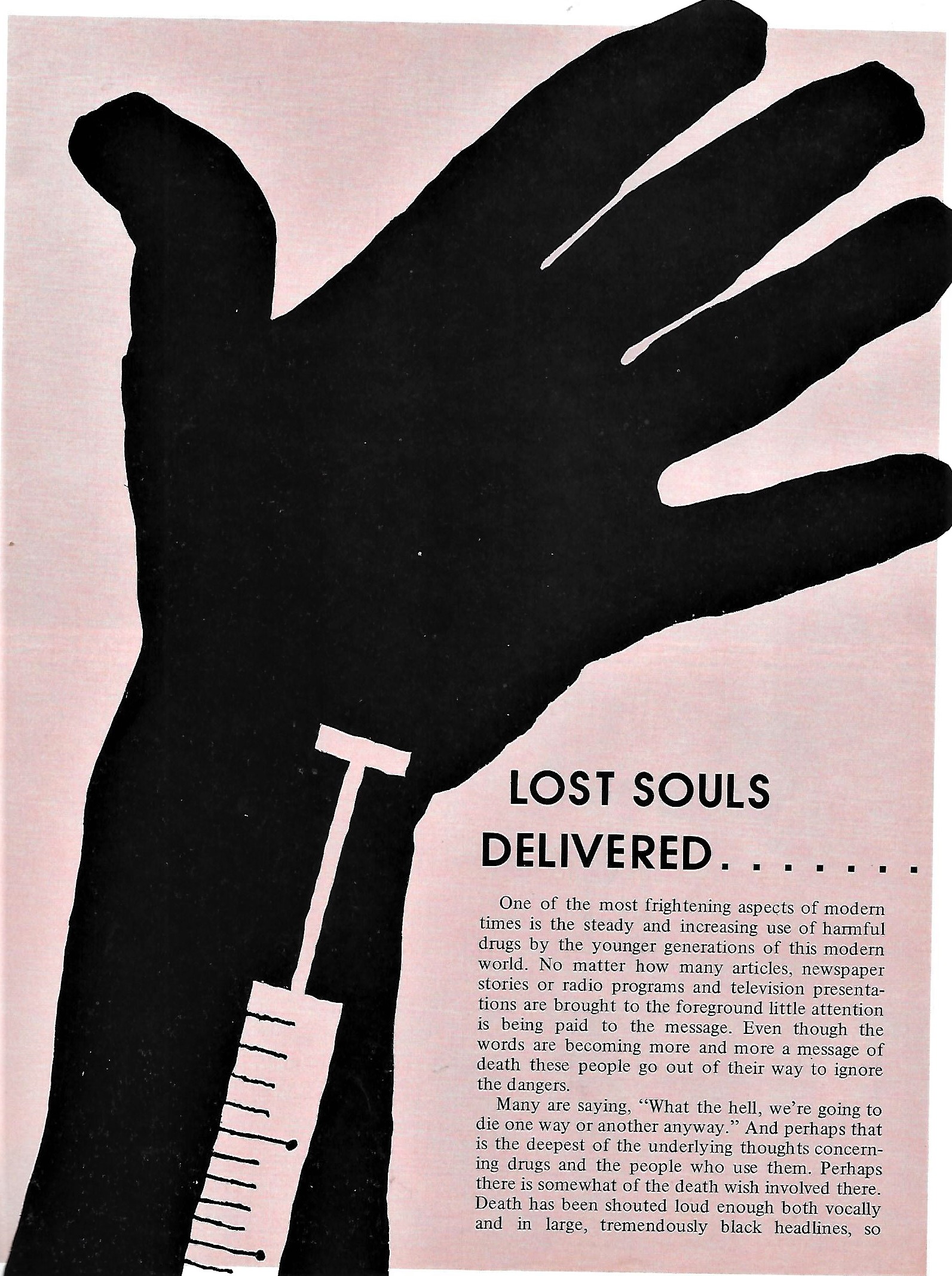
For whatever reason, I settled on a "Woodpile Press" volume entitled Wood on Acid, which contains the text of two full novels: Purple Thighs aka Lost Souls Delivered (1968) and Forced Entry (1974). I vaguely remembered both of these from the first time around, but a lot of the details had faded from my memory. They seemed like perfect candidates for revisiting. What did I think of them this time? Well...

Purple Thighs, Eddie's take on hippies and LSD, is definitely the more interesting and fun of the two novels. I think it helps that Eddie wrote it six years before Forced Entry. He was on the downward spiral by '68, for sure, but things weren't as dire as they were in '74. Ed Wood may not have been at the peak of freshness when he wrote Purple Thighs, but he hadn't completely curdled yet. Speaking of curdling, though, it's remarkable how much America soured between 1967 and 1968. We went from the Summer of Love to the Entire Year of Hate in a very short time. In its own cockeyed way, Ed's novel reflects this sad societal change.

The plot of Purple Thighs revolves around Adam, an honest, hard-working law student who just wants to get an education, darn it. He can't concentrate on his studies, though, because of all these darned dirty hippies loudly protesting against the war. (Seriously, in this book, Ed never passes up an opportunity to remark how filthy and foul-smelling the hippies are.) What's Adam to do? The only logical thing: drop out of school, ditch his nice girlfriend, and go "undercover" among the acid-dropping hippies. It's sort of like Ed Wood's variation on John Howard Griffin's Black Like Me (1961). Call it Hippie Like Me. Oh, by the way, there's a rather gratuitous framing device wherein Adam tells his adventures to a psychiatrist named Dr. Thyme Hammer, who's paying him for his time.

So, anyway, Adam goes to some hippie neighborhood -- I think it's supposed to be Haight-Ashbury, but Ed never really specifies -- and starts to blend in among the locals. Almost immediately, he meets and moves in with a groovy chick named Eve, who introduces him to the wonderful world of LSD-enhanced sex. Right from its bewildering first chapter, Ed's parody of the Book of Genesis, Purple Thighs is full of references to the biblical Adam and Eve. This makes sense because Kathy Wood said that her husband frequently took inspiration from the Good Book. The snake, the garden, the apple, they're all here in this novel, serving some vague allegorical purpose.

Even on acid, Adam is kind of a dullard, the sort of square-jawed, macho hero Eddie seemed to love to put in his stories. Fortunately, Purple Thighs has an outstanding supporting cast of characters, many of whom have truly asinine names straight out of an AIP biker flick. My favorite has to be Rigor Mortis, a local creep who dresses like The Phantom of the Opera and is toted around in a cheap coffin by his henchmen, Crisp, Crap, and Head. (Or was that Snap, Crackle, and Pop?) Rigor likes to be buried alive in a different spot every night, and his thugs begrudgingly comply... until it all inevitably goes wrong. And we mustn't forget Glory Girl, the friendly neighborhood drug pusher who turns out to have an incredible secret. I don't want to spoil the plot too much, but if Purple Thighs had been made into a movie (and it should have been), Ed Wood might've played this part himself.

Anyway, Adam and Eve's neighborhood is being ruined by a bunch of phonies who have moved in just to party, take drugs, have sex, and mooch off others. I couldn't help but think of the song "Who Needs the Peace Corps?" by Frank Zappa and The Mothers of Invention: "Every town must have a place where phony hippies meet. Psychedelic dungeons popping up on every street." I also thought about R. Crumb's comic, "I Remember the Sixties," in which he talks about the decline and fall of "the Haight." Eventually, Adam, Eve, and some of the more responsible hippies move away to some kind of quasi-utopian commune. I guess it's a happy ending. Ed Wood's contempt for the counterculture seeps through nearly every page of this novel, so it's nice that he shows at least a little leniency towards them in the book's final pages.

By the way, the book's original title, Lost Souls Delivered, is Ed Wood's punning variation on "LSD." He used the same title for an article in 1972. As for the new title, Purple Thighs, I think it's a reference to body painting, a practice that was popular among hippies in the late '60s. There's a brief body painting sequence in the novel in which a young woman's body is bedecked with garish colors.

Wednesday, March 30, 2022

Ed Wood Wednesdays, week 127: 'When the Topic is Sex' (2021)

Just some of the nearly 80 articles contained within this book.

NOTE: This article concludes my coverage of Ed Wood's When the Topic is Sex (BearManor Media, 2021).

There has never been a better time to be an Ed Wood fan than right now. For one thing, more of Eddie's movies are available on DVD, Blu-ray, and streaming than ever before. When I was first getting into Ed Wood back in the early 1990s, I had trouble even finding the biggies—Glen or Glenda (1953), Bride of the Monster (1955) and Plan 9 from Outer Space (1957)—on VHS or airing on television. Now I'm fairly drowning in Ed's movies, spanning from his earliest days in Hollywood (1948's Range Revenge)  to the very end of his life (1978's Hot Ice). And, I assure you, more of them are coming.

One of Ed Wood's many magazine articles.
Wood scholarship has also exploded in the new millennium. Thirty years ago, Rudolph Grey's groundbreaking Nightmare of Ecstasy was the only full-length book about Ed Wood's life and career. In the years since, however, we've had Ed Wood, Mad Genius (2009) by Rob Craig, The Cinematic Misadventures of Ed Wood (2015) by Andrew J. Rausch and Charles Pratt, Jr., Scripts from the Crypt: Ed Wood's Bride of the Monster (2019) by Gary D. Rhodes and Tom Weaver, Ed Wood and the Lost Lugosi Scripts (2019) by Rhodes and Weaver, and The Unknown War of Edward D. Wood, Jr. (2017) by James Pontolillo.

Arguably, though, the most essential Ed Wood books to emerge in recent years have been the collections of Wood's own short stories, Blood Splatters Quickly (2014) and Angora Fever (2019), both curated by superfan Bob Blackburn. In the 1960s and '70s, Eddie wrote dozens of short stories for adult publisher Bernie Bloom, who used them as filler in his X-rated magazines like Body & Soul, Swap, Garter Girls, Two Plus Two, Young Beavers and many more. With Eddie's full-length novels and sex manuals largely out of print and out of the price range of most people, these compilations are the best way for fans to experience what Eddie was like as an author. 

But Ed Wood's magazine work was not confined to those wonderfully delirious short stories. Not by the tail feathers of a cockatoo. With his nimble typing fingers and ability to generate reams of text in a small amount of time, Eddie was Bernie Bloom's go-to writer for any number of assignments, including editorials and photo captions. Above all, from roughly the late 1960s to the mid-1970s, Eddie wrote innumerable nonfiction articles on topics ranging from the sexual revolution to witchcraft to politics. On rare occasions, he used his own name for these stories, but he was more likely to write under a pseudonym like "Dick Trent" or "Ann Gora" or go uncredited altogether.

At last, Bob Blackburn has assembled a massive compilation—the biggest yet—of Ed Wood's nonfiction magazine work from this era. When the Topic is Sex contains nearly 80 articles, nearly all of them taken from Bernie Bloom's magazines. Make no mistake, this is a tome: 544 pages of Wood's whiskey-soaked ramblings from the Richard Nixon years. It is not the kind of thing you read in one sitting, unless you are incredibly dedicated to your Wood-ian studies. You may want to bring it with you when you travel. Or, better yet, keep a copy in the privy. I can think of few books more appropriate for that particular room of the house.

Indeed, some readers may see When the Topic is Sex as an imposing, impenetrable block of text. I'd recommend they start with the more manageable Blood Splatters Quickly—a mere 33 stories, including what I'd call Eddie's best and most accessible work as a writer. For the real sickos, the ones who watch Plan 9 with a remote control in hand so they can freeze the frame at any given second, When the Topic is Sex is a godsend. Bob Blackburn assembled this book by buying these magazines himself, one by one, on the secondary market. Trust me, you don't have the time, money, or patience necessary to do this. Bob's done the tough part; all you have to do is buy a copy and read the darned thing.

Realizing that this much Ed Wood could be overwhelming, Bob has mercifully organized this material into 11 themed chapters. There are sections about cross dressing, lesbianism, social issues, etc. Probably due to Bob's long career in radio, each of these chapters is named after a popular song. The lesbian section of the book, for instance, is called "Girls Just Want to Have Fun," while the section about cross-dressing is "Dude Looks Like a Lady." Other sections include "Society's Child," "What the World Needs Now," and "Hot for Teacher."

I referred to the contents of When the Topic is Sex as nonfiction, but that's an ambiguous term when discussing the work of Ed Wood. There are at least three distinct levels of reality in this book. It really depends on how much research Ed did for a particular piece. 
  • In some articles ("More Oddities in the News," "Yes or NoThe Candidates on Busing"), Ed relies almost solely on quotes gleaned from actual newspapers, magazines, tabloids, and books. When Ed Wood was in his research-heavy mode, he occasionally found himself writing articles about other people's articles. "A Tax on Sex?" is a good example of that. 
  • At the complete opposite end of the scale are Ed's many fake "interviews" ("College Interview," "Interview with the Man on the Street About Censorship") in which he pretends to talk to nonexistent people about some controversial or taboo subject. 
  • Somewhere in the middle—in the vast gulf between "totally researched-based" and "totally made up"are articles like "The Changing Woman" in which Eddie quotes some legitimate sources but supplements that information with his own opinions and memories.
For as long as I've been doing this series, I've tried to find common ground with Eddie, i.e. ways he and I are similar. But that's been tough. I don't drink. I don't cross dress. I don't make movies. I wasn't in the Marines. I have (almost) all my own teeth. I don't have an angora fetish. I've never lived in Hollywood or pursued a career in show business. The Great Depression and World War II were before my time. Ed Wood and I have simply not shared many experiences. Our lives only overlapped for three years.

But I do know what it's like to churn out a lot of articles in a short amount of time, many of them simply piggybacking off other people's work. From 2014 to 2017, I wrote for a fairly large pop culture website that covers films, TV, music, video games, etc. Most of my articles could be classified as filler material or clickbait: brief writeups about movie trailers and viral videos. The turnaround time was extremely brief. Once I took an assignment, I had only about an hour to write it, proofread it, select an appropriate header image, and submit it to an editor. Ed Wood's articles for Bernie Bloom could likewise be considered filler, and I'm sure Eddie churned them out quickly, one after another.

Furthermore, just like Ed Wood, a surprising number of my articles were about other people's articles. Basically, I'd summarize a recent noteworthy article that had been published somewhere online, tell people why they should read it, and provide a link to it. My pay for doing this was $15 per story. That was the going rate for all the clickbait articles I did back then, regardless of what they were about. The only way to make a go of it financially was to write 5-7 stories per day, every day. Like Eddie, I prioritized quantity over quality. It was the most fun job I ever had, and I was heartbroken to lose it. I'll never know what it was like to be Edward D. Wood, Jr., but I have some inkling of what his relationship with Bernie Bloom was like.

When the Topic is Sex sheds a light on an aspect of Ed Wood's life that had previously been hidden in darkness. People who only know Plan 9 or Glenda may not even be aware that Ed wrote anything besides screenplays. Others may have heard of his novels or short stories, thanks to Nightmare of Ecstasy or some of the Wood documentaries. But how many fans have plunged into his nonfiction work? Those who do will find that all of Ed's usual quirks and obsessions are on display here but in a form you may not have expected. You wanna know Ed—what fascinated him, what haunted him, what worried him, what motivated him? Get a copy of this book and spend some time with the man.