Showing posts sorted by relevance for query "ed wood extra". Sort by date Show all posts

Wednesday, October 10, 2018

Ed Wood extra: On his 94th birthday, the state of the Ed Wood union is strong

Ed Wood as Alecia in Take It Out in Trade (1970).

Not many of us live to be 94, and Ed Wood didn't even come close. His heart conked out after decades of alcohol abuse when he was 54. So, yes, in a couple of months, we'll be observing the 40th anniversary of his untimely though hardly unexpected passing. He died in poverty and obscurity, mourned by his long-suffering wife Kathy and a handful of longtime friends and professional associates.

Eddie's posthumous career famously took off only two years after he died and has ebbed and flowed in terms of popularity ever since, arguably peaking in the 1990s with the publication of Rudolph Grey's Nightmare of Ecstasy: The Life and Art of Edward D. Wood, Jr. (1992) and the release of Tim Burton's star-studded biopic Ed Wood (1994). Those events sparked a series of new VHS and DVD editions of Ed's most famous movies. Even a handful of his books came back into print. But Nightmare and Ed Wood came out over two decades ago. How is the Ed Wood cult holding up in 2018?

Ladies and gentlemen, I can safely report that the state of the Ed Wood union is strong. While the last couple of years have witnessed the deaths of such Wood associates as Conrad Brooks, Jacques Descent, and David Ward, they have also witnessed lavish Blu-ray reissues of Wood-scripted films like Orgy of the Dead (1965), The Violent Years (1956), and Fugitive Girls (1974). Ed's own Take It Out in Trade (1970) is finally due to be issued on DVD and Blu-ray this November, nearly half a century after its original release.

Ed Wood-related books continue to pour in as well. Four years ago, Wood superfan Bob Blackburn oversaw the publication of Blood Splatters Quickly: The Collected Stories of Edward D. Wood, Jr. And now, he is completing work on two further anthologies of Eddie's many, many short stories from the 1960s and '70s. Other quintessential Wood volumes from recent years include two books by Gary D. Rhodes and Tom Weaver: Ed Wood's Bride of the Monster (2015) and Ed Wood and the Lost Lugosi Screenplays (2016). The definitive critical tome on Ed's movies remains Rob Craig's Ed Wood, Mad Genius (2009), but more are being written, such as The Cinematic Misadventures of Ed Wood (2015) by Andrew J. Rausch and Charles E. Pratt, Jr.  And then there is James Pontolillo's The Unknown War of Edward D. Wood, Jr. (2017), which sets the record straight on Eddie's war record once and for all.

But what has really changed since the 1990s is the rise of the internet, which has made researching Ed's life and work so much easier. Thanks to Google, Amazon, YouTube, Ebay, etc., Eddie's fans have more access to films, stories, and articles related to the notorious writer-director than ever before. And the advent of social media has allowed his fans, including me, to exchange information and insights about Ed Wood in a way that would have been impossible a few decades ago.

When I first became interested in the Wood cult in the late 1980s and early 1990s, it was difficult to find even Eddie's most famous films, like Glen or Glenda (1953) or Plan 9 from Outer Space (1959). No more. Now I have copies of those films and dozens more at my disposal. What has changed? Technology.

Nearly every week, Greg Dziawer knocks me out with some fantastic new discovery he has made in his truly painstaking research into Ed Wood's life and career. While Nightmare of Ecstasy remains a valuable source of information, one in which I am still making new discoveries, Grey's patchwork biography is now profoundly out of date and becomes more so with each passing year, as new information continues to trickle in.

When Ed and Kathy Wood were evicted, penniless, from their Yucca St. apartment in Los Angeles a few weeks before Christmas in 1978, it would seem like Eddie's legacy was in danger of being erased entirely. Four decades later, that legacy has never been more thoroughly documented.

Wednesday, September 18, 2024

Ed Wood's Warm Angora Wishes: "Ed Wood Hollywood Deadwood"

This story deals with Ed Wood's alcoholism and career setbacks. It's more fun than it sounds.
NOTE: This article continues my coverage of Ed Wood's Warm Angora Wishes and Rubber Octopus Dreams (Arcane Shadows Press, 2024).
The story: "Ed Wood Hollywood Deadwood" by David Michael Taylor

Synopsis: Struggling filmmaker Ed Wood drowns his sorrows in vodka at a Hollywood dive bar called Gold Diggers. Eddie is especially upset that his TV pilot, Final Curtain (1957), has failed to sell. His friend, actor/wrestler Tor Johnson, shows up and tries to comfort him. Eddie looks at their reflections in a mirror and imagines Tor as Inspector Clay from Plan 9 from Outer Space (1957) and himself as a little boy dressed in girl's clothes. He leaves the bar, dejected.

One of L.A.'s great cocktail bars.
Ed migrates over to another bar, Boardner's, where he commiserates with Maila "Vampira" Nurmi. She says the future is in television, but Ed laments that he can't get his pilot in front of the right people. The director's epic bar crawl then leads him to the Frolic Room on Hollywood Blvd., where he meets up with psychic Criswell, resplendent in a sparkly Nudie suit. Eddie asks Criswell about the future, and Cris says, "Perhaps on your way home, someone will pass you in the dark, and you may never know it, but they will reveal your future."

Stumbling home to his shabby apartment on Yucca, Ed Wood indeed passes a young man and woman he does not recognize. Could they be the key to his future? He calls out to them. Many decades later, these young people are standing in front of the building at 6383 Yucca Street in Los Angeles. The young man's mother has texted him that Ed Wood once lived here, but neither the young man nor the young woman knows who Ed is.

Excerpt:
She strips the top from the shaker and replaces it with a strainer as I feel myself straining in anticipation. Setting a fresh martini glass on the section of the bar I've clamed as my own for the evening, she tips the shaker, causing the cloudy cocktail to pour through the strainer and into my glass without spilling a drop. A lime wheel appears as if from nowhere and, with a deft hand, she closes its pulp around the lip of the glass.
Another stop on the tour.
Reflections: Some of you Beatle fans may remember the 1995 music video for "Free as a Bird," the "new" song that was created by taking an unfinished John Lennon demo and overdubbing new parts by Paul McCartney, George Harrison, and Ringo Starr onto it. A combination of computer-generated animation and live-action footage, including many vintage clips of The Beatles themselves, the video follows the path of a bird as it flies to crucial locations in Beatle history, including the Cavern Club, Penny Lane, the Strawberry Fields orphanage, and Abbey Road studios. Along the way, we spy brief visual references to Beatle songs, including "Birthday," "Helter Skelter," "Paperback Writer," and more. The more you know about the Fab Four, the more references you'll catch.

David Michael Taylor's "Ed Wood Hollywood Deadwood" is like "Free as a Bird" for Ed Wood fans. Instead of following the path of a bird as it soars majestically through Beatle history, it follows the path of Ed Wood as he stumbles drunkenly from one Los Angeles bar to another. But it, too, is an Easter egg hunt for diehard fans. The story visits a few key Woodian locations, including Gold Diggers, Pla-Boy Liquor, and the notorious Yucca Flats apartment building, and it's peppered with references to Ed's life and career. Much of the dialogue comes directly from the script of Plan 9, for instance, and the bartender has the same name as Ed's mother: Lillian. We also get multiple references to the obscure Final Curtain pilot, a nod to Tim Burton's Ed Wood (1994), and a reiteration of the old story that Ed's mother dressed him as a girl when he was a child.

There's a sighing, elegiac quality to both "Free as a Bird" and "Ed Wood Hollywood Deadwood," though the latter is far less reverential. They're both wistful reminders of a vanished world and the vanished people who inhabited it. The ending of Taylor's story seems to consign Ed Wood to the rubbish bin of history, the victim of youthful indifference, but the truth is that this story could only have been written by someone with a deep, abiding love for Eddie's work. Who else but a fan would bother to write something like this?

P.S. This story is almost fetishistic in its detailed descriptions of alcoholic beverages and cocktail bars. I'm not sure if these things are a major part of the author's life, but they were certainly a major part of Ed Wood's life, so I appreciate the extra effort displayed here. These descriptive passages really bring you into Eddie's dank, boozy world.

Wednesday, March 20, 2019

Ed Wood Wednesdays, week 80: A new edition of 'Married Too Young' (1962)

Artwork from the new DVD release of Married Too Young.
      
The new DVD release.
Married Too Young (1962) has long been one of the more neglected titles in Ed Wood's filmography, especially among his early, pre-porn movies. And, to be fair, it's not difficult to see why. Wood didn't actually direct the film, for example. That duty was performed by Ukrainian journeyman George Moskov. Ed doesn't receive screen credit for coauthoring the script either. Nathaniel  Tanchuck is the film's only official screenwriter, as confirmed by his daughter Heather. Some Wood fans may doubt that their hapless hero had anything to do with this production, even though Married Too Young is duly covered in Rob Craig's Ed Wood, Mad Genius (2009) and Andrew Rausch and Charles Pratt's The Cinematic Misadventures of Ed Wood (2015).

Back in 2014, I gave the film an exhaustive 4,800-word review, calling it "lugubrious" and "sluggish." I guess I wasn't much of a fan at the time. Maybe I was just disgruntled about overpaying for a grainy bootleg from The Video Beat. I already did a rundown of the film's plot and characters in that article, so if you have never seen Married Too Young, I suggest you start there instead of here.

Filmmaker Fred Olen Ray, who attempted to work with Ed Wood very late in the doomed director's life, obviously wants to bring new attention to Married Too Young and elevate this overlooked film to its rightful place in the Wood canon, alongside Plan 9 and Glen or Glenda. His company, Retromedia, has just issued a splashy new DVD release of Married Too Young, paired with The Violent Years on a disc called The Forgotten Ed Wood. In addition to a "23.98 progressive scan" of a widescreen 35mm print of the film, it also contains: trailers for both Married Too Young and The Sinister Urge; a complete copy of The Violent Years; and a pair of extremely brief but informative featurettes, "A Tale of Two Endings" and "Ed Wood and Married Too Young." (I'm guessing Ray himself narrates the former.)

This is a disc long in the making. Fred Olen Ray has been promising a Retromedia edition of Married Too Young since at least 2014, and there were supposedly plans for an official release of this film back in the 1990s, in the wake of Tim Burton's Ed Wood. But now, it's easily available on Amazon for a mere $9.66. If you're an Ed Wood fan with $10 burning a hole in your pocket, you could do worse.

Let's talk about those special features first. "Ed Wood and Married Too Young" lasts 30 seconds and consists of a letter dated August 25, 1994 from Dale Gasteiger of Headliner Entertainment Group to Greg Luce of Sinister Cinema. Gasteiger says that he and Roy Reid bought Ed Wood in "to finish writing [Married Too Young] for us." He contends that Wood's "contribution probably amounted to roughly 25% of the finished script." In their book, Rausch and Pratt quote Fred Olen Ray as saying he has even more documentation of Wood's authorship.

A letter from Dale Gasteiger concerning Ed Wood.

As for "A Tale of Two Endings," it's even more interesting. Previous to this, I had no idea there were alternate endings for Married Too Young. The narrator of the featurette explains:
"In the original 35mm cut negative of the movie, Tommy and his girlfriend go over the cliff in a stock shot. As you can see, the car turns over and shows its underside and then explodes. And it goes directly to the courtroom scene, where I'm sure everyone was amazed to find out that Tommy only hurt his arm and his girlfriend didn't get a scratch. Maybe because of TV or some complaints, later, another sequence was put in with a different stock shot. 
This time, the car does not flip over. It goes straight down, and it fades out before you can see it, and it's followed by a series of newspapers coming off of the presses explaining that somehow or another Tommy and actress Jana Lund somehow miraculously weren't killed in this crash. I'm not exactly sure why they did this, but I suspect it may have been for a television sale where they thought that perhaps there was no way that those kids could've lived through that and that people watching the movie would be upset and then incredibly surprised."
In terms of picture quality, this DVD is a major improvement from the previous edition. To illustrate that, I'll give you a few selected images from the Retromedia disc, and I'll intersperse those with corresponding screen grabs from the previous Video Beat version that I purchased in 2014.

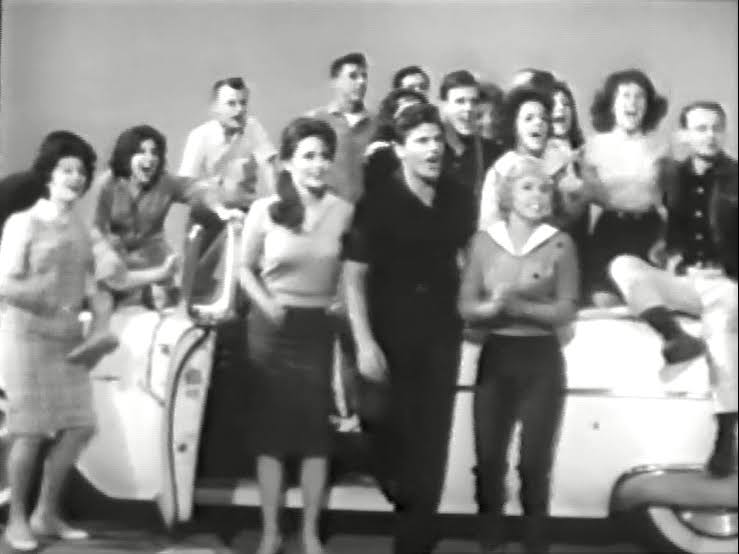
Here's a moment from the opening race, for instance. In the new DVD, you lose a little visual information at the top and bottom of the screen, like the ankles of the actors in the front row, but you gain some ground on the left and right sides. And details are much clearer now, too. Note, for instance, the girl in the plaid dress at the left side of the frame. Can you even tell her outfit is plaid in the second picture? The facial expressions of the spectators are distinct in the Retromedia version but not in the Video Beat version.


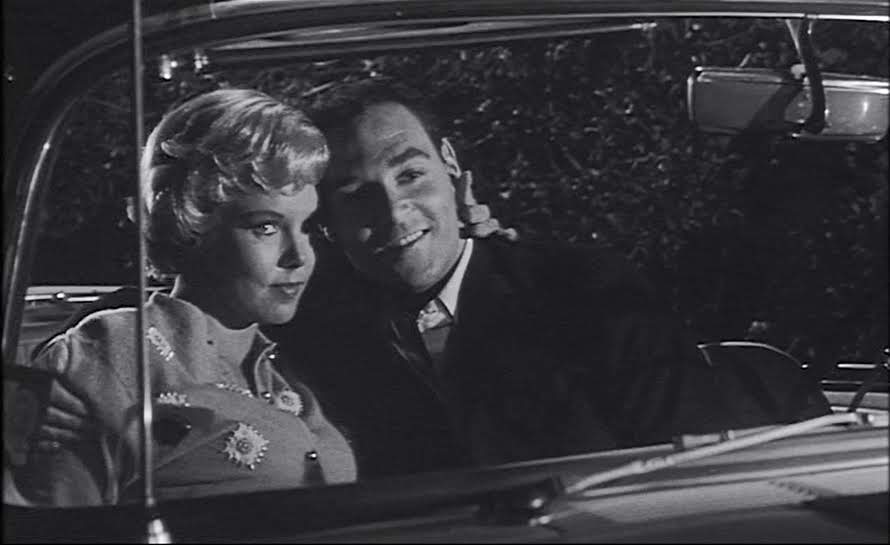
Here are the main characters, Tommy and Helen, on a date. This gives you an idea of what the film's night scenes are like. Notice the fanciful details on Helen's sweater. You can even make out Harold Lloyd, Jr.'s individual front teeth.


For contrast, here's an indoor scene involving Helen and her parents. The Retromedia version offers far greater detail: the clock, the father's jacket, the purse, etc. You can see there is extra visual information on the left and right sides of the screen as well. Check out the banister behind the father for an example. But the grainy Video Beat version has some extra headroom and legroom. Look at the gap between the purse and the bottom of the frame.


Finally, I'd like to show a moment from the dream sequence, since this is the part of the movie that so impressed author Rob Craig and is the most blatantly Wood-ian in tone. With its layering of images, this might be the scene that benefits the most from a crisp transfer.


There is at least one more significant difference between these two versions. In the Video Beat DVD, the opening credits declare that the film was "produced by Headliner Productions." That's it. No human producer is listed, just the company. In the Retromedia DVD, the credits say that Married Too Young was "produced by Nathaniel Tanchuck." Both versions credit Nat Tanchuck with the story and screenplay. So, while my bootleg copy of the film has largely been supplanted by this new disc, the Video Beat edition is not exactly obsolete.

It remains to be seen whether Retrovision's Forgotten Ed Wood disc will revive interest in Married Too Young. I certainly haven't seen much publicity for this release yet. I only found it by accident while searching for other Ed Wood releases on Amazon. The cleaner, sharper transfer certainly makes the movie more enjoyable to watch, and the letter from Headliner Entertainment should satisfy those who have questioned the film's authenticity.

But, still, I can't imagine this turgid, preachy movie ever becoming another cult classic on the order of Glen or Glenda or Plan 9 from Outer Space, and it lacks the inspired lunacy of such Wood-written films as Bride and the Beast and Orgy of the Dead. Those looking for an Ed Wood "youth in crisis" movie will probably gravitate to The Violent Years or The Sinister Urge instead. Ultimately, this is one for the completists out there. If that's you, this DVD is ready when you are.

Wednesday, July 17, 2013

Ed Wood Wednesdays, week 2: 'Glen or Glenda' (1953)/'Jail Bait' (1954)

Two faces have I: Ed Wood's first two features revolve around duality and surgical modification of the body.

Bela Lugosi, Dolores Fuller, and Ed Wood.
By 1953, Ed Wood was pushing 30 and had been in Hollywood six years without achieving a great deal of success in the movie industry. His production partnership with theater buddy John Crawford Thomas had merely produced one crude, blurry, unreleasable Western called Crossroads of Laredo (1948). Another business venture, a creative advertising company called Story-Ad Films, had come and gone with little fanfare apart from a write-up in Ed's hometown paper back in Poughkeepsie.

Meanwhile, Eddie had also been trying to make it in TV. A brief made-for-television drama called The Sun Was Setting had reached local airwaves in late 1951, but it did not lead to a regular series and didn't make much of an impact beyond the Los Angeles city limits. A second attempt at breaking into the TV market, a proposed western series called Crossroad Avenger starring faded screen cowboy Tom Keene, had not generated any interest among the major networks either.

In fact, Ed's steadiest work during these years had come as a stage actor, including a long run in a play called The Blackguard Returns at the Gateway Theater. He also toiled in the story department at Universal, where he worked his way up to the rank of "night production coordinator," typing up call sheets for productions that would be filming on the lot the next morning.

But these were not fruitless years for the decorated ex-Marine. Ed's natural charisma made him popular with the ladies, and his ability to schmooze (today, we'd call it "networking") allowed him to make key professional and personal relationships that would affect the course of his life and career. Far from being a hindrance, Ed's longstanding habit of cross-dressing -- deeply rooted since childhood (supposedly) -- had become the center of his social life, including rumored parties with such major movie stars as Danny Kaye and Tony Curtis.

What's more, during the years between 1952 and 1954, Edward D. Wood, Jr. met many of the actors, producers, and crew members who would contribute significantly to his most famous films, the cinematic works upon which his reputation is largely built. Some of these folks were on the way up. Some were on the way out. Some were just along for the ride. A few, including George Weiss, Bill Thompson, Dolores Fuller, Conrad Brooks, and Bela Lugosi, would eventually become characters in Tim Burton's Ed Wood (1994).

A major turning point in Wood's career was his first theatrically-released feature, a would-be exploitation flick that was supposed to capitalize on some recent sensational headlines. Instead, it wound up being the most personal statement of Eddie's entire film career.

GLEN OR GLENDA (1953)

The Devil attends the wedding of Barbara and Glen in this dream sequence from Glen or Glenda?

Alternate titles: Behind Locked Doors (working title), Transvestite, He or She?, I Changed My Sex, I Led Two Lives, etc.

Availability: A censored, abbreviated print of the film appears in such boxed sets as The Worst of Ed Wood (Image Entertainment, 2000) and The Ed Wood Box (Image Entertainment, 2004) and has also fallen into the public domain.

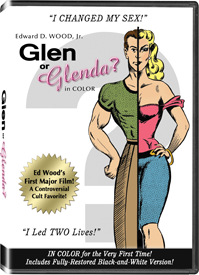
For this project, I consulted two different versions of the film: a longer, uncensored VHS print from the Deluxe Ed Wood Angora Box Set (Rhino Video, 1996) [buy it] and a newly computer-colorized version from 2012 by Legend Films. Legend Films was very gracious in sending me a review copy of this new DVD, and I am happy to let you know you can purchase Glen or Glenda? in color for only $9.95 right here.

Legend's new DVD of the film.
The backstory: Among the professional associations Ed Wood made in the early 1950s, arguably the most important was with veteran cinematographer William C. Thompson, who'd been working in the motion picture business since 1914 and had already filmed Maniac (1934), Dwain Esper's infamous horror epic. Colorblind in his one working eye, Bill Thompson would have an enormous impact on the look of Ed Wood's best-known films. Thompson's camerawork is often stiff and creaky with some shots held far too long, and Henry Bederski -- a frequent repertory player in Ed's early films -- has blasted Thompson for demanding that the actors remain static when it wasn't necessary to do so. But Ed had the highest esteem for Thompson, calling him "one of the most fantastic cameramen I ever met."

As I've rewatched Ed Wood's 1950s films, I can't help but notice how many truly striking shots they contain. There is a dark, brooding, mysterious quality to the images that presages the work of David Lynch, and I think much of that was due to Bill Thompson. Thompson is also the man who introduced Ed Wood to B-movie mogul George Weiss, a meeting that resulted in Ed's debut feature, Glen or Glenda.

As anyone who has seen Tim Burton's film already knows, Weiss had wanted to capitalize on a then-recent scandal, the male-to-female sexual reassignment surgery of Christine Jorgensen, and crank out a quickie biopic from his tiny independent studio, Screen Classics. After Jorgensen refused to grant anyone, let alone a penny-ante producer like Weiss, the rights to her life, the producer simply decided to go forward with a fictionalized version of the events and hired Wood on the recommendation of Thompson, little knowing that the budding auteur would use the film as an opportunity to explore his own personal cross-dressing issues.

The cast of Glen or Glenda is, unsurprisingly, filled with actors from past and future Wood-related productions. Along with the aforementioned Henry Bederski (a pudgy, bald character actor who pops up in multiple scenes), the attentive viewer will find Lyle Talbot, Timothy Farrell, and Conrad Brooks. More importantly, this is the film that introduces two key players in the Ed Wood saga: Bela Lugosi and Dolores Fuller.

The former was the renowned Hungarian-born star of Universal's Dracula (1931), a role that both launched him to superstardom and typecast him as a "bogeyman" for the rest of his life. Lugosi's strong association with the famous vampire, compounded by the actor's heavy accent, erratic temper, and longtime drug addiction, had caused his career to suffer throughout the 1940s. He went from making major studio films to appearing in low-budget "poverty row" productions, and even these had largely dried up by the early 1950s. George Weiss was able to hire Lugosi for a mere $1000, largely to give the otherwise-disreputable movie some "name value."

Aspiring actress and model Dolores Fuller, on the other hand, was a wife and mother of two who divorced her husband to be with Ed Wood, whom she'd met at a casting call. They were soon living together, and their real-life relationship would be the basis for many of the scenes in the film.

And at the very center of it all is an astonishing performance by Wood himself, credited as "Daniel Davis," the first in a series of professional aliases he would use throughout his career. Perhaps because he was playing a character based very closely on himself, Ed Wood gave the performance of his life as the hero, a troubled man who doesn't want to admit to his fiancee that he is a cross-dresser.

A moody moment from the dream sequence.
The viewing experience: I will not mince words here. Glen or Glenda is, unequivocally, my favorite Ed Wood movie. It's the film that made me a lifelong fan. I had never seen anything like it before and have not seen anything like it since. Most of Ed's movies, odd as they are, fall into pretty easily recognizable categories: science-fiction, horror, western, crime thriller, pornography, etc.

Glenda is something different altogether: part horror (Lugosi appears as a Dracula-esque mad scientist in a lab filled with skulls and test tubes), part documentary (Talbot and Farrell play "respectable" members of the community who discuss the issues in a dry, factual way as if they were in an educational film), part soap opera (Wood and Fuller share talky, melodramatic scenes in prosaic locations such as a kitchen and a living room), and part stream-of-consciousness surrealism (symbolic stock footage of a buffalo stampede, a lengthy and bizarre dream sequence).

I found that when I watched this movie at the age of 37, I no longer laughed the way I did when I was 17. Instead, apart from a few scattered guffaws, I became truly involved in the story, thanks largely to Wood's sympathetic performance. And I marveled at the audacious, one-of-a-kind oddness of it all. George Weiss famously padded the movie with several minutes of racy "girly show" footage directed by schlockmeister W. Merle Connell for an entirely different production, inter-cutting it with reaction shots from Wood and Lugosi to justify it being part of the movie. Rather than feeling like a diversion or a distraction from the main feature, the Connell footage (including a husband-and-wife bondage team) only adds to its transportive, dreamy nature.

There are various edits floating around out there, but the most complete I've seen is the VHS version Rhino put out in the 1990s. The version you're more likely to see today, while made from a fairly decent print, lacks a few important moments. The words "god" and "sex" have been clumsily excised a few times, and Timothy Farrell's doctor is no longer allowed to say he "doesn't think" a transvestite deserved to die.

Worse yet, one of the film's most peculiar sequences -- constructed by Wood entirely out of stock footage of highway traffic and a foundry, plus some dubbed-in dialogue by two unseen factory workers, "Jack" and "Joe"  -- loses its semi-shocking punchline, in which one of the workers suddenly starts talking in a woman's voice. The biggest omission is an entire sequence in which an unnamed man (played by Conrad Brooks) rebuffs the advances of a homosexual but then unwittingly lights the cigarette of a cross-dresser. Apart from the Rhino tape, I have not seen this material elsewhere.

The new Legend Films DVD is made from the shortened, censored print available elsewhere, but what it lacks in completeness, it makes up for in visual panache. Quite simply, this is the best-looking, best-sounding version of Glen or Glenda I have ever seen. As is customary of this company's products, the DVD contains the standard B&W edition of the film as well as the colorized print. Apart from a newly-created trailer (not the vintage 1950s trailer that appears on the Rhino and Image versions), the Legend DVD has no extra features to speak of.

The disc's entire reason for existence is to present the colorized version of Glen or Glenda, and that alone makes it well worth purchasing. What the colorization gives us is a whole world of detail that might go unnoticed in the B&W film: the sinister bric-a-brac in Lugosi's lab, the books behind Timothy Farrell's desk, the items on Glen/Glenda's vanity, plus the cars, clothes, and businesses visible in both the stock footage of crowds and the "stolen" outdoor shots of Wood-as-Glenda on the street, staring longingly into a store window. The colorization is very detail oriented. I couldn't help but notice the reflections in the store windows, for instance. (Hey, there's a paint shop across the street from that woman's clothing store! Who knew?)

Given Ed Wood's heavy use of cross-fading and superimposition, this could not have been an easy film to colorize. There are certain moments on the Legend DVD that actually caused me to gasp. By all means, if you want to have a DVD of Glen or Glenda? in your collection, make it this one. By the way, Wood-ian scholars will want to take note of a moment during the dream sequence in which Barbara (Fuller) emerges from the shadows with her arms outstretched. It is a clear precursor to Vampira in 1959's Plan 9 from Outer Space.

While the oddness of Glen or Glenda made it difficult to market, George Weiss managed to sell it to various territories in the United States under a bewildering variety of titles (see the list above), and the film played in China, Argentina, France, and Belgium, among (presumably) others. Ed's next film would be rather more conventional but would still contain a great deal of the director's trademark surrealism and absurdity.

JAIL BAIT (1954)

A lobby card for Ed Wood's feverish film noir, Jail Bait. Note Theodora Thurman in her jammies on the left.

Alternate titles: Jailbait, The Hidden Face

Availability: Like Glen or Glenda?, this public domain film is available in the Image Entertainment boxed sets, The Worst of Ed Wood and The Ed Wood Box. For this project, the DVD version I watched was from Big Box of Wood (S'More Entertainment, 2010) [buy it]. I also screened a VHS edition called Jail Bait: Director's Cut! (Rhino Video, 1995) [buy it].

Cotton Watts, one of the last blackface performers.
The backstory: While Wood's first creative partnership didn't go very well, at least his second one resulted in a couple of actual released films. In 1954, Ed was roommates with British writer-producer Alex Gordon, who was just then starting out in Hollywood before a decade of churning out such drive-in fare as The Lawless Rider (supposedly ghostwritten by Ed Wood), The She-Creature, and Shake, Rattle & Rock!

Wood and Gordon's initial collaboration was a film noir-style crime thriller originally called The Hidden Face. That title, which referred to the script's highly unlikely plastic surgery gimmick, was abandoned in favor of the intentionally misleading Jail Bait. The salacious term is used only once during the film -- in a line of dialogue clearly dubbed in after the fact -- and supposedly refers to an unlicensed gun. Yeah, right.

Several cast members from Glen or Glenda reappear here, and there are living room and kitchen sets that look very much like those from the previous film as well. Lyle Talbot plays another cop. Dolores Fuller is once again the romantic lead. Timothy Farrell, interestingly, has switched sides. A respected and caring physician in the last film, he's a ruthless and grouchy small-time crook named Vic Brady here. Vic's favorite expression seems to be "shut up," which he says several times per scene.

The role of plastic surgeon Dr. Boris Gregor, despite that infamous first name, was intended for Bela Lugosi, but when Lugosi was unavailable, it went to veteran British actor Herbert Rawlinson, who was quite literally dying of lung cancer while he made this film and expired the night after completing his last scenes.

Notables in the cast include bodybuilder Steve Reeves, a former Mr. Universe just a few years away from hitting the big time as the title character in Hercules (1958), and gorgeous singer/model/TV weather girl Theodora Thurman, making her one and only film appearance as a sexy but misguided gun moll who is inexplicably loyal to the sleazy, foul-tempered Vic Brady. Fans should keep an eye out for brunette Mona McKinnon, who would play Paula Trent in Plan 9 from Outer Space.

Ed Wood also "appropriated" two elements from films by director Ron Ormond. The film's much-noticed and very distracting score comes from Ormond's Mesa of Lost Women and was composed by Hoyt Curtin (here misspelled "Kurtain"), who was Hanna-Barbera's house composer for decades, penning theme music and underscore cues for dozens upon dozens of TV cartoons. Meanwhile, a lengthy and very offensive blackface routine was lifted from Ormond's Yes, Sir, Mr. Bones! (This is obvious padding; the only connection to the rest of the movie is that two characters rob the theater where this show is supposedly taking place.) This act was performed by Cotton Watts and his wife Chick. Even by 1954 standards, Watts' act was woefully behind the times, but it unintentionally gives the film extra historical resonance.

In the Rhino cut of the film, which has yet to make it to DVD, the blackface footage is removed and is replaced by a rather blurry burlesque routine film shot at "Les Folles, Los Angeles." Curiously, there seems to be no audio for this rather tame, nudity-free striptease routine, so some of the music from Cotton Watts' blackface act, including audience laughter, is recycled.

A far-fetched but memorable plot point in Jail Bait.
The viewing experience: Feverish. That's the word I'd use to describe Jail Bait. It's appropriate that I'm reviewing this movie during a lengthy heatwave because the film seems to take place in a universe where it's always humid and muggy. Even at night -- and it's perpetually night in this movie -- the weather doesn't cool off. Everybody looks sweaty, tired, and beaten-down. Hoyt Curtin's score, somewhere between Mexican folk music and clattering free jazz, adds to the unease.

This is a world without comfort, without rest, without hope. It has the same stifling, depressing, deflating quality as Ed Wood's previous The Sun Was Setting. The film takes place in the shadowy underworld of crime and violence, but Ed's knowledge of that world seems to have come entirely from dime novels and B-movies, plus maybe some comic books and radio shows.

I kept thinking how kid-like it all was, reminiscent of children playing "cops and robbers" in the back yard. Vic Brady is the kind of tough-talking gangster a 12-year-old might dream up. Similarly, even though he's supposed to be a world-renowned plastic surgeon, Herbert Rawlinson has the medical vocabulary of a middle schooler. ("Do you know I had to completely remodel that man's face? It was strenuous and very, very complicated. Plastic surgery at times seems to me to be very, very complicated.")

The plot, for the first two-thirds or so, is a relatively unremarkable crime-and-consequences tale about a botched robbery. Then? Well, I don't want to spoil too much in case you haven't seen the film yet, but it goes off on a very odd, unbelievable tangent that is probably the film's major source of fascination for modern-day viewers.

In brief: a doctor is forced to perform plastic surgery at gunpoint. As far-fetched as I find this development, I'm almost positive I saw something similar happen on an episode of Nip/Tuck, not to mention John Waters' Desperate Living (1977). At least in those last two examples, the surgery takes place in a hospital. Wood sets his scenario in the living room of an ordinary apartment... and there's not a stray drop of blood anywhere when it's done.

Wood scholars will want to note the script's attempts to psychoanalyze the Don Gregor character, possibly Ed's surrogate in the film. Glen or Glenda made a similar effort to diagnose its title character. Ed might have had some "mommy issues" or "daddy issues"  or both  that he was working through in his scripts. Alcohol, too, is becoming a recurrent theme in his films. The bad guy in Crossroads of Laredo spent all his time at the bar, and the characters in Jail Bait -- good, bad, and indifferent -- are always boozing it up, too.

Next week: Ed tries to capture the zeitgeist with Bride of the Monster (1955) and The Violent Years (1956).

Wednesday, December 17, 2025

Ed Wood Wednesdays, week 255: Is this the most complete cut of 'Glen or Glenda' (1953) yet?

Austin Wolf-Southern has assembled the jigsaw pieces of Ed Wood's debut film.

Like Blanche DuBois, I have always depended on the kindness of strangers. Well, maybe not always. Actually, when I started writing these articles in July 2013, I was pretty much on my own. I had two books, Rudolph Grey's Nightmare of Ecstasy (1992) and Rob Craig's Ed Wood, Mad Genius (2009), to use for reference, as well as the documentaries Look Back in Angora (1994) and Flying Saucers Over Hollywood (1992). Other than that, I was flying solo. What did I bring to this topic? My own thoughts, my own ideas, my own... personality. I wrote Ed Wood Wednesdays by myself for myself. 

But very early on, people started emailing me. Some wanted to ask questions. Some wanted to make corrections. And still others wanted to share Ed Wood-related things with me—trivia, photos, sometimes even entire books, articles, and films. And then there were those who had Woodian projects of their own and wanted to tell me about them. Some were making music. Some were making films or comics. Several were writing or had already written books about Ed. And they sent much of this material to me to see what I thought of it. And, if I were feeling industrious that particular week, I told them. The main reason this column has lasted over 12 years (with no end in sight) is that my readers have supplied me with so much material.

One such person is comedian and Ed Wood superfan Austin Wolf-Southern. He has embarked on a project that should be of interest to all Woodologists: assembling a "complete cut" of Eddie's debut film, Glen or Glenda (1953). I've long said that this movie is the Rosetta Stone for understanding Ed Wood's entire career—not just his other films but his literary work as well. But, to this day, there is no "definitive" or "authoritative" version of it. Over the years, through various theatrical and home video releases, Glenda has had scenes added to it and subtracted from it. And Austin has taken it upon himself to comb through all this material and assemble it, almost as a Frankenstein monster, into one movie.

Friday, August 24, 2018

Ed Wood extra: A smattering of Ed Wood fan art

Four of my portraits of Edward D. Wood, Jr.

A typical early cartoon (1989)
I used to draw an awful lot as a kid. That's not surprising, since I've been obsessed with comics and cartoons since well before I can remember. My only real "instruction," though, was in grade school. At my alma mater, Springview Elementary in Flushing, MI, we'd spend a couple of hours each week in the art room with a glum, mustachioed guy named Mr. Barnes. My strongest memories were of him yelling at me for leaning back in my chair too far. I never studied artwork formally after that.

But on my own, I'd create little homemade comics and cartoons, strictly for my own amusement. I started with established characters like Popeye, Garfield, and Hagar the Horrible. (For some reason, I was always writing gags that involved quick-drying cement.) But by the time I was 11, I was creating my own characters, eventually including Iffy the Troll, Margin Man, and Vernal Q. Equinox, plus a monstrous rock band called The Apple Scruffs, who allegedly killed a fan at every show.

Sometimes, I'd pass my work around in class. Among my earliest "hits" was a series called Moscow Vice, a Russia-set parody of Miami Vice with two burly Bolshevik cops named Crockski and Tubbnik. I also got a strong response with The Melties, a comic strip about a family made of drippy candle wax. Every Melties plot was the same: the family would try to do something (play baseball, have a picnic), but they'd melt in the sun and end up as puddles of goo on the ground.

I kept drawing into my teens and beyond, never keeping a sketchbook but scrawling on whatever random bits of paper came into my hands. Most of my work was in pencil or ballpoint pen on notebook paper, but I'd write on napkins, gum wrappers, the backs of form letters, etc. It was more of a nervous tic than anything else. I drew pictures instead of biting my nails.

By then, most of my drawings were caricatures of famous people—actors, musicians, historical figures—and modeled after photos. I subscribed to Rolling Stone in the '90s and always did drawings of the celebs in there, generally rock stars. But I'd draw my own weird little monsters and grotesque human figures as well. To this day, I have two thick binders of this material.

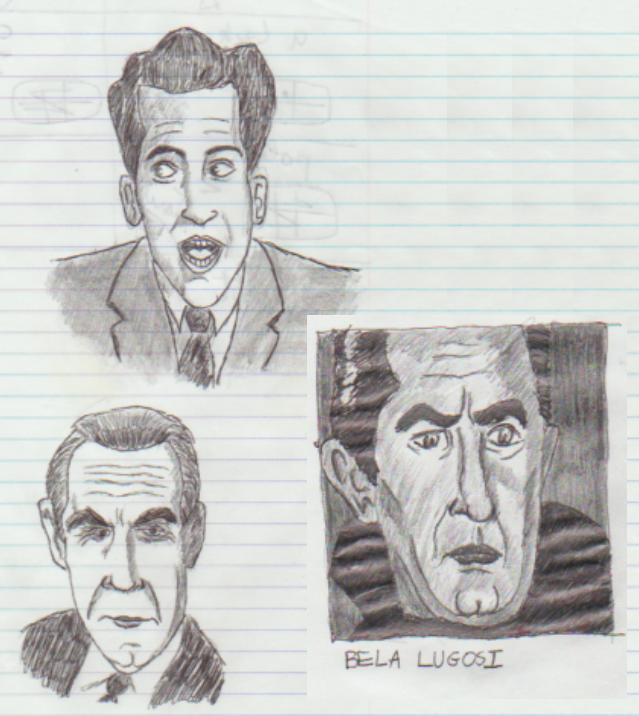
As you might expect, I did some Ed Wood-related drawings over the years, and I'd like to share them with you today. First up are caricatures of Johnny Depp and Martin Landau as their characters from Ed Wood. Also included here is a little picture of the real Bela Lugosi in Dracula (1931). The Lugosi pic was done on a different piece of paper and then cut out.

Johnny Depp and Martin Landau: (inset) Bela Lugosi

Next up are two portraits of Edward D. Wood, Jr. himself, done completely separately but based on the same photograph from Glen or Glenda, as published in Nightmare of Ecstasy. The one on the left is in color, though I used a very messy charcoal pencil for the black background and immediately regretted it.

Two views of Ed Wood from Glen or Glenda.

My most ambitious example of Ed Wood fan art is this wonky triptych based on that much-circulated headshot of Eddie in his theater days. These portraits were done completely separately on different pieces of notebook paper, then taped together. I believe these were done in the 2000s when I was commuting to Chicago from the 'burbs by train. Those Metra trips leave plenty of time for nonsense like this.

An Ed Wood triptych

That about does it for the hand-drawn stuff. These days, I do most of my artwork digitally. It's still just as crude and wobbly as ever, but I don't get ink or graphite on my hands anymore. Plus I can tweak it and try to make it better. Some of this stuff I've already posted on the blog, but I thought I'd put it all in one place. Here's a mischievous Eddie as Mr. Murphy in The Love Feast (1969).

Eddie in The Love Feast.

In a similar vein, here is Eddie in Mrs. Stone's Thing (1970), squinting at the camera through his makeup.

Ed Wood in Mrs. Stone's Thing.

And here is bulldog-faced Duke Moore in Night of the Ghouls (1959). As you can see, this one is a bit more cartoony and distorted. I once thought of creating brand new artwork for every article in the Ed Wood Wednesdays series, but that proved impractical.

Duke Moore in Night of the Ghouls

Here's another actor portrait: craggy, ill-tempered James Craig in Venus Flytrap (aka The Revenge of Dr. X) (1970).

James Craig in Venus Flytrap.

My most recent portraits of Ed Wood include this regal purple one, again based on the same photo from Glen or Glenda. I must be really drawn to that picture, huh?

Ed Wood in Glen or Glenda.

And, last but not least, here's Ed as Alecia in Take it Out in Trade (1970). I hope you've enjoyed this little gallery of Ed Wood fan art. Crude as these are, these sketches and portraits are a testament to my longstanding fascination with Eddie and his movies.

A portrait of Ed Wood from my "blue" period.

Wednesday, May 15, 2024

Ed Wood Wednesdays, week 188: Ed Wood's recurring characters (including Kelton and Lobo)

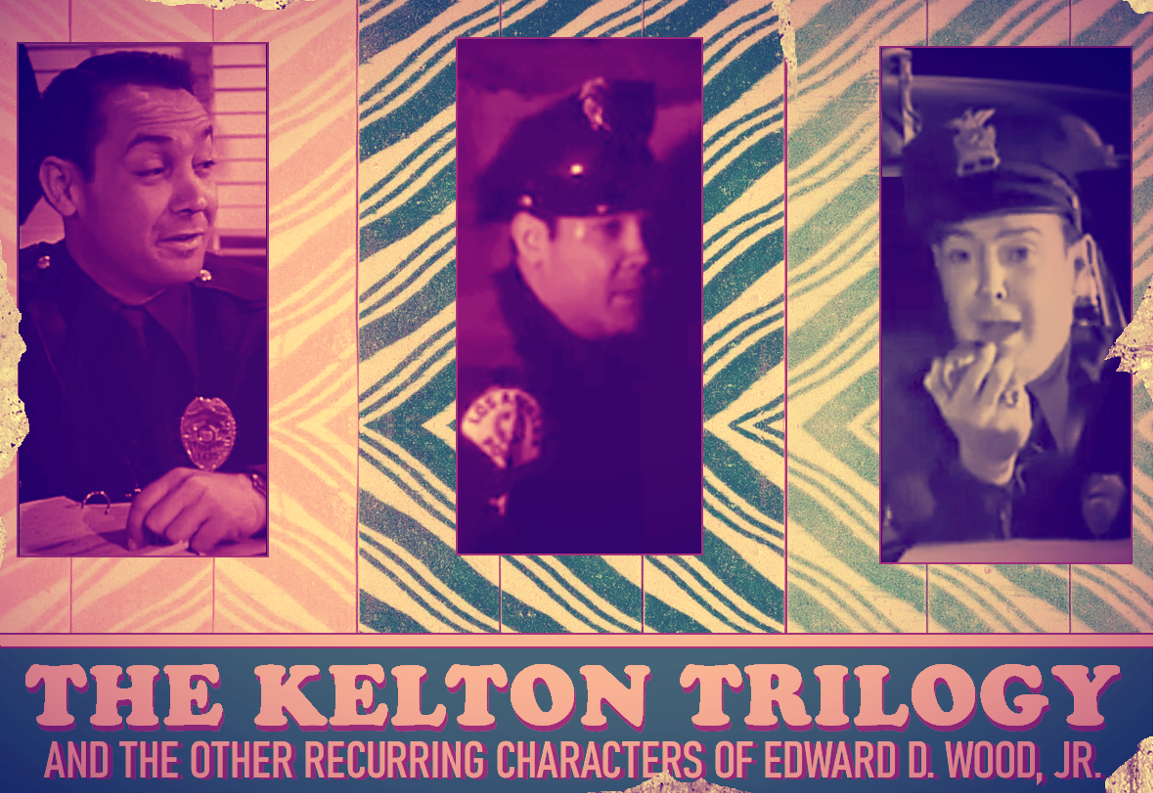
For some reason, Ed Wood kept bringing Officer Kelton back.

Three of Ed Wood's 1950s films—Bride of the Monster (1955), Plan 9 from Outer Space (1957), and Night of the Ghouls (1959)—are collectively known as "The Kelton Trilogy" because they all feature actor Paul Marco as bumbling, cowardly Officer Kelton, a uniformed cop who repeatedly comes into contact with the otherworldly and supernatural. In Ghouls, narrator Criswell gives us a succinct description of the character:
Patrolman Paul Kelton, 29 years of age, four years with the department, eager for the glory of the uniform but wide-eyed with fear at the thought of actually being on special duty. Unfortunately, though eager, not what the department usually looks for in their officers.
Ouch. The other characters in these movies tend to treat Kelton with utter contempt. In Night of the Ghouls, the character even describes himself as "the whipping boy of the whole police force." He's basically the Jar Jar Binks of the Ed Wood universe. So why did Ed keep bringing back Officer Kelton, reusing him the way Shakespeare reused Falstaff? A few reasons, I think. First, Paul Marco was one of his closest buddies and wasn't exactly drowning in work outside of Eddie's films. I'm certain the zany Kelton character was written especially with Paul Marco in mind. ("Hey, Paul, I've got a great part for you in my next picture!")

Beyond that, Ed Wood was heavily inspired by the Universal horror movies of the 1930s and '40s, and those films tend to include broad comic relief provided by wacky supporting characters—chambermaids, English bobbies, villagers, etc. It seems like a Universal movie isn't complete until some Cockney-accented stooge gets spooked by the monster du jour and trips over his own feet trying to run away. Paul Marco's scaredy-cat Officer Kelton is very much in that tradition. As unnecessary as the character may seem to modern viewers, he has his roots in classic horror.

Thursday, January 11, 2018

Ed Wood Extra: To those we lost in 2017

Rance Howard, Martin Landau, Conrad Brooks, David Ward, and Steve Apostolof.

Before we get too far into 2018, I thought it only proper that we should acknowledge a few of those who died in 2017, specifically those whose lives intersected in some way with that of Ed Wood. Sadly, the number of people who knew Eddie or who worked with him directly is getting smaller and smaller each year. And even Tim Burton's Ed Wood is now 24 years old, if you can believe it, and a number of cast and crew members from that biopic have since died. In brief, 2017 took a hell of a toll on the Ed Wood community. It was nice, I suppose, to have some new books and BluRay releases, but they're a poor substitute for these extraordinary people.

Let's deal with the Burton film first. Two of the principal cast members of Ed Wood passed away in 2017. The one who got the lion's share of the headlines, naturally, was Martin Landau, who died at the advanced age of 89 on July 15 of last year. A native New Yorker whose career in film and television spanned an astonishing 64 years, Landau finally won an Oscar in 1995 for his portrayal of a cranky, crumbling Bela Lugosi, turning to Ed Wood for employment and companionship in his final years. Aided by Rick Baker's award-winning makeup, Landau managed to bring new insight and vulnerability to the much-imitated and caricatured Lugosi. Whenever I see Bela in a movie -- whether it's one of Wood's movies or not -- I think of Landau.

Departing our realm, too, was character actor Rance Howard, who played straight-shooting moneyman Donald McCoy in Ed Wood. (He wants Eddie's movie to end with a "sky full of smoke" and gazes up dreamily as he imagines the glorious destruction.) Father of Clint and Ron Howard, Rance was one of the most familiar faces in Hollywood, appearing in nearly 300 movies and television shows starting in the mid-1950s. He had an honest face and a slight Oklahoma drawl that served him well in dozens upon dozens of roles. Rance worked so often and with so many people, in fact, he comes much closer than Kevin Bacon to being the center of the Hollywood universe. Rance Howard died on November 25, 2017. He, too, was 89.

Perhaps the most significant Wood-related death of 2017 was of actor turned filmmaker Conrad "Connie" Brooks, who died just last month at the age of 86. An irreplaceable link to the past, Brooks was truly the last surviving member of Eddie's inner circle, having appeared in Glen or Glenda, Plan 9 from Outer Space, Bride of the Monster, The Sinister Urge, and Jail Bait. Since Eddie's personal and professional lives were so intricately intertwined, Conrad Brooks can safely be called one of Ed's cronies. Who knows how many more movies they would have made together if there were but world enough and time, not to mention cash? A staple of documentaries about Wood, always popping up to talk about his departed pal, Brooks was a B-movie lifer. Even without Eddie, the incorrigible, garrulous Connie appeared in dozens of low-budget flicks (as well as Burton's Ed Wood) and eventually wrote and directed a few of his own.

Attention should also be paid to the passing of stage and screen actor David Ward, who died in August at the age of 84. He'd been a resident of a Los Angeles nursing home for years, and Ed Wood superfan Bob Blackburn stayed in contact with him and visited him frequently until the end of his life. Ward was another of Wood's Hollywood cronies, especially during Eddie's boozy final years in the 1970s, though the two didn't really work on many movies together. Ward was also a personal friend of Bulgarian-born filmmaker Stephen C. Apostolof and made cameos in at least two of Apostolof's movies, The Cocktail Hostesses and Drop Out Wife, both scripted by Eddie. And Ed had other plans for David, including an adaptation of his short story "To Kill a Saturday Night," that never came to pass. The David Ward saga is an incredible one, inspiring the unproduced screenplay Edward Ford, which I thoroughly discussed here.

Speaking of Apostolof, the late filmmaker's oldest son Steve Apostolof died unexpectedly after a brief illness in Simi Valley, CA at the age of 60 on November 19, 2017. Like all of Apostolof's children, Steve made numerous visits to his father's sets and even made an onscreen appearance in 1978's Hot Ice, canonically the last film Ed Wood ever worked on. (Eddie was credited as an assistant director and was slated to make a cameo but was too drunk to do so.) In addition, Steve was one of the interviewees in Jordan Todorov's documentary Dad Made Dirty Movies. He took great amusement in his father's colorful career and helped keep the Wood-Apostolof legend alive by sharing his stories of those bygone days of the 1960s and '70s.

Rest in peace, one and all.

Wednesday, November 8, 2023

Ed Wood Wednesdays, week 169: The further adventures of Nona Carver

Nona Carver in Rudolph Grey's Nightmare of Ecstasy.

One of the most arresting images in Rudolph Grey's Nightmare of Ecstasy: The Life and Art of Edward D. Wood, Jr. (1992) is a snapshot of burlesque performer and actress Nona Carver, who played "old whore" Sleazy Maisie Rumpledinck in Ed's obscure adult film Take it Out in Trade (1970). The picture, credited to Grey himself, shows a late-middle-aged Carver in her home, proudly gesturing to a room absolutely packed with random junk: hats, pillows, framed artwork, artificial flowers, old clothes, blankets, and more. Most of this is simply piled on the floor in large heaps, giving the impression that Carver (clad in a tank top and short shorts) is a delusional hoarder.

Nona Carver is one of the many intriguing side characters in Nightmare, and the book gives us a few more scraps of information about her. Makeup man Harry Thomas tells us, for example, that Nona performed at the Gayety Theatre on Main Street in Los Angeles. He also offers this memorable description of her: "Big bazooms but very thin little legs. Chewing gum all the time." 

Ed's wife Kathy states that Nona was the girlfriend of actor Kenne Duncan, the cantankerous B-Western baddie who became Ed Wood's close friend and a member of Eddie's repertory company. Nona herself says that she "met Ed Wood quite a few times at Kenne's house." It's worth noting that Nona starred in the softcore feature Revenge of the Virgins (1959), which Kenne narrated. The screenplay for that film has frequently been attributed to Ed Wood. My colleague Greg Dziawer disputes this and says that the film's credited screenwriter, Pete La Roche, was a very real person and separate from Ed Wood.

The longest quote attributed to Nona Carver in Nightmare of Ecstasy is this anecdote about her visits to Ed and Kathy Wood's downtrodden apartment on Yucca and Cahuenga in Los Angeles.

Nona Carver talks of "strangers on the mooch to drink" at Ed Wood's apartment.

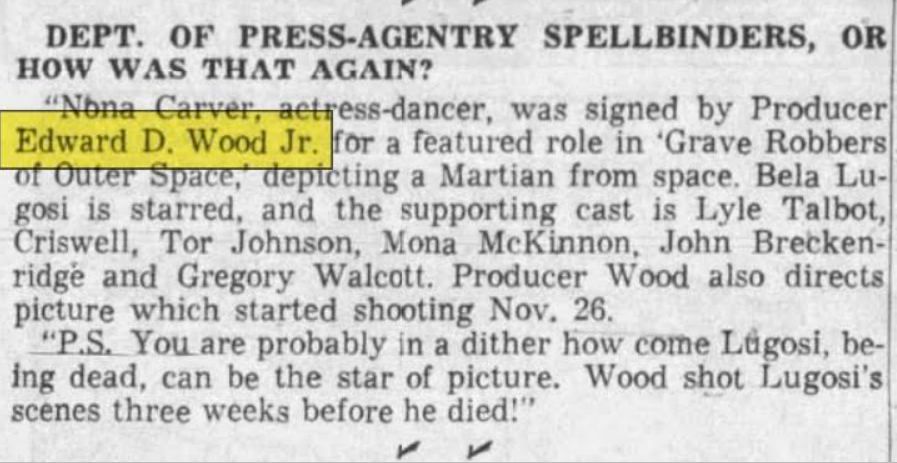
I recently learned a little more about Nona Carver when the unstoppable Rob Huffman sent me some vintage news clippings about her. This article from the November 29, 1956 edition of The Los Angeles Mirror suggests that Nona almost played an even more prominent role in the Ed Wood saga. Entertainment columnist Dick Williams says that Nona would play "a Martian from space" in Plan 9 from Outer Space, then still known as Grave Robbers from Outer Space (or Grave Robbers of Outer Space). Nona's role ultimately went to Joanna Lee, who came to resent her association with the film.

Nona Carver could have played Tanna in Plan 9.

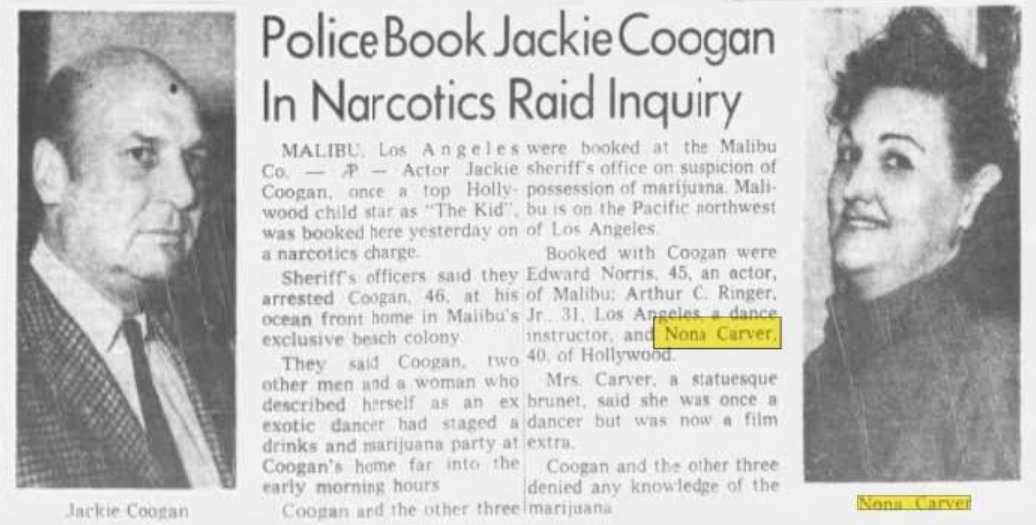
The next Nona story that Rob sent me is even stranger, if you can believe it. It comes to us from The Modesto Bee, January 8, 1961 and tells us about the time Nona Carver was busted after attending a "marijuana party" at the beachfront Malibu home of former child star Jackie Coogan. This was well after Coogan's days of acting alongside Charlie Chaplin in The Kid (1921) but a few years before he played the role for which he is most famous today: Uncle Fester on The Addams Family (1964-66).

Nona and Fester? Who'd have guessed?

The article yields some interesting information about Nona Carver, including the fact that she was 40 years old at the time of this incident and retired from exotic dancing. She gives her profession as "film extra." Other than Virgins and Trade, however, the only film role I can find for her is in 1962's Terrified, a suspense thriller that looks like a a cheapjack imitation of Psycho (1960).
The next article that Rob sent me comes from Ed Wood's hometown paper, The Poughkeepsie Journal, May 2, 1967. It concerns Eddie, his brother Bill, and their father.

Ed's brother Bill (pictured at left) visited his ailing father in 1967.

It seems that both Ed Wood and his younger brother Bill returned briefly to New York State in 1967 to visit their ailing father, Edward D. Wood, Sr., who was in an Albany hospital. Sadly, the Wood family patriarch died just four days after this article was printed. He was 72 years old. I can't help but imagine what Ed's last visit with his father was like. I keep picturing that extremely subdued scene from Alice's Restaurant (1969) in which Arlo Guthrie (playing himself) visits a dying, still-smoking Woody Guthrie (Joseph Boley) in the hospital. Arlo is respectful but taciturn, as he really has nothing to say to his father at this moment. In the hallway outside Woody's room, Arlo talks to his mother Marjorie (Sylvia Davis).
ARLO: He's gotten a lot worse since I saw him.

MARJORIE: Well, let's say no better.

(Arlo glances around awkwardly, unsure of what to do in this situation, then leans in and kisses his mother. He turns around and walks away without another word, passing a nurse pushing an old man in a wheelchair as he leaves.)
Or who knows? Maybe it was nothing like that. Maybe Ed Wood, Jr. and Sr. had a deeply satisfying, far-ranging conversation and got to resolve whatever issues they had between them, allowing the elder Wood to slip into death with a clear conscience.

I have one last item for you today. Rob Huffman hipped me to this remarkable 2001 blog post by renowned science-fiction editor Earl Kemp (1929-2020). In the 1960s, Kemp worked at a publishing company called Greenleaf Classics, which released a few of Ed's books, including the novelization of Orgy of the Dead (1966). Because of this, Earl got to meet and interact with both Ed Wood and Criswell. He says the two were constant companions and could even finish each other's sentences. 

I don't want to spoil any of the article, so I'd advise you to go read it for yourself. Suffice it to say, it's a wonderfully descriptive and evocative passage, detailing what it was like to spend time with these two extraordinary human beings. As a bonus, Kemp also includes the entire Greenleaf style manual, which is surprisingly nitpicky and even stodgy at times. Having read much of Ed Wood's prose, I doubt our man followed guides like these very closely. Or at all.