Wednesday, September 20, 2023

Ed Wood Wednesdays, week 164: NECA Toony Terrors: Vampira (2023)

I'm going to call this a Plan 9 from Outer Space toy. Try and stop me.

If I ever won the lottery, I'd spend at least a million dollars of it on toys. Instead of talking to a financial planner or stockbroker like a mature and responsible adult, I'd be on eBay and Amazon immediately, buying up every action figure, playset, and vehicle I ever wanted, including vintage classics from the '70s and '80s as well as items made more recently for the collector market. I'd devote an entire room -- or two or three -- of my house to that wonderfully useless plastic junk and spend many hours there. Eventually, I'd become a Howard Hughes-type recluse, content to stay indoors with all my fabulous possessions. Finally, finally, I could die happy.

This will never be my life.

The sad reality is that a lack of shelf space and a lack of money prevent me from becoming this kind of collector. Like just about everything else these days, toys are getting pricey. So I have to content myself with a few modest shelves of action figures, many rescued from dollar and discount stores and worth virtually nothing. Every once in a great while, however, I find a new item that's too tempting to resist.

Earlier this year, the NECA toy company, which mainly caters to adults, announced the lineup for Series 8 of its Toony Terrors line of horror figures: Svengoolie, Captain Spaulding (from 2003's House of 1000 Corpses), and Vampira. Anyone who follows me on Twitter knows that I'm an obsessive viewer of Sven's Saturday night spook show on MeTV. I'm also a longtime fan of cult movie star Sid Haig and have greatly enjoyed his ghoulish, gleeful Captain Spaulding character. But obviously, the main draw of Series 8 for me was that Vampira figure.

All three figures in Series 8 of Toony Terrors.
And so, way back in April, I preordered a set of all three figures from a site called Clark Toys. And then I waited. And waited. And waited some more. I was on the verge of giving up hope. Finally, just a few days ago, a box arrived at my doorstep containing Sven, Captain Spaulding, and our beloved horror hostess. I'd never purchased anything from NECA before and didn't really know what the Toony Terrors figures would be like. I thought maybe they'd be bobbleheads or similar to Funko Pops.

As I soon found out, Toony Terrors are six-inch action figures that give us slightly cartoony or caricatured versions of famous horror characters. ("Bring the fun of Saturday morning cartoons to your horror collection," the packaging declares.) Articulation is minimal. The heads are on ball joints, and the arms can be moved as well. Otherwise, the figures are immobile from the waist down. Each figure comes with an accessory. Svengoolie has a rubber chicken sculpted permanently in his left hand. (He's also the only figure with articulation at the wrists.) Captain Spaulding has an alternate, swappable head with a different facial expression. And Vampira has a prop skull that can also double as a swappable head for the Toony Terrors figures. Buyers should know that the sculpt of Vampira's hair prevents her head from being posed too dramatically. You can slightly tilt her face to the right or left, but that's about it.

Since both articulation and accessories are limited in this line, the real draw of Toony Terrors is the quality of its sculpts. All three figures in Series 8 were sculpted by Adrienne Smith, and I am pleased to say that they are uniformly excellent in terms of design, managing to be both cute and creepy at the same time. Fans of Plan 9 from Outer Space (1957) will immediately recognize Vampira. Her Morticia-like black dress, her hair, her facial expression, even her eyebrows -- all just as you remember them from the movie. Best of all, you can pose her with those long, pointy fingernails of hers sticking straight out. I'm positive Ed Wood would have purchased one of these figures himself if he'd been around in 2023. 

I'm not a collector who keeps his toys in their original packaging, but NECA has kept mint-on-card collectors in mind with Toony Terrors. The packaging design is quite attractive, made to look like the marquee and ticket booth of an old time movie theater. The back of each card can also be used as a "bonus backdrop display." Vampira's card shows a velvet curtain, some fog, and some candles. I'm guessing it's meant as a recreation of the set of her 1950s TV show.

There's not much licensed, official merch related to Ed Wood, so this Toony Terrors Vampira figure was quite a treat. Sure, the toy is kind of stiff and static, but so was the real Vampira! Her character in Plan 9 was supposed to be a reanimated corpse, after all. I'm pleased as punch to have a little plastic replica of Maila Nurmi on my shelf. To keep her company, I've paired her with a 1990s Toy Biz figure of Marvel's Kingpin that's a dead ringer for Tor Johnson. They make a great couple.

Tuesday, September 19, 2023

Podcast Tuesday: "Richie Punches Fonzie Right in the Face!"

Henry Winkler and Ron Howard on Happy Days.

Generally, in the week before we cover an episode of Happy Days on our podcast, I screen that episode several times, take copious notes on it, and ponder what I want to say about it when we record on Saturday. In other words, the episode is on my mind frequently during those days. But I'm taking in a lot of other, non-Happy Days media as well during that same time. And sometimes, that other media affects how I think about Happy Days.

I'll give you an example. 

This week on These Days Are Ours, we're covering the classic Season 11 two-parter "Welcome Home." I bet you remember this one. Richie Cunningham (Ron Howard) comes home from a three-year hitch in the Army, only to tell his family that he wants to move to California and become a screenwriter for the movies. His parents, Howard (Tom Bosley) and Marion (Marion Ross), are worried that Richie won't be able to provide for his pregnant wife Lori Beth (Lynda Goodfriend) and his young son Richie, Jr. (Bo Sharon) as an aspiring writer, so they pressure him to take a job as reporter for The Milwaukee Journal. As a result of obeying his parents' wishes, Richie plunges into depression and goes on a drinking binge, even punching his best friend Fonzie (Henry Winkler) in the face. The episode ends happily, however, as Richie decides to move his family to California so he can pursue his showbiz dreams. Lori Beth, Howard, Fonzie, and Marion all support Richie in this risky decision.

Very nice, right? Well, the week before we reviewed "Welcome Home," I finally saw the notorious Danish exploitation film The Sinful Dwarf (1973). This spectacularly unpleasant flick—a sleazy horror/porn hybrid—tells the story of Peter (Tony Eades), an idealistic young writer who is so broke that he and his beautiful young bride Mary (Anne Sparrow) have to move into the grungiest, most ominous boarding house in the world. They simply can't afford to live anywhere nicer. The place is run by a hardboiled ex-cabaret singer named Lila Lash (Clara Keller) and her sadistic dwarf son Olaf (Torben Bille). Needless to say, Peter and Mary soon regret ever setting foot inside this place.

I realize it's ridiculous to compare or somehow equate Happy Days and The Sinful Dwarf. They're miles apart in terms of tone and content. But I just couldn't help having ominous feelings about Richie moving himself and his family to a tough, unforgiving city like Los Angeles when he lacks money and a place to stay. Sure, Lori Beth supports his dream wholeheartedly, but that poor lady from The Sinful Dwarf supported her husband wholeheartedly, too, and look where that got her!

Anyway, I'm rambling. You can find out what I really thought of these episodes by listening to the podcast below.

Wednesday, September 13, 2023

Ed Wood Wednesdays, week 163: Criswell's 'The Dying Planet' (1955)

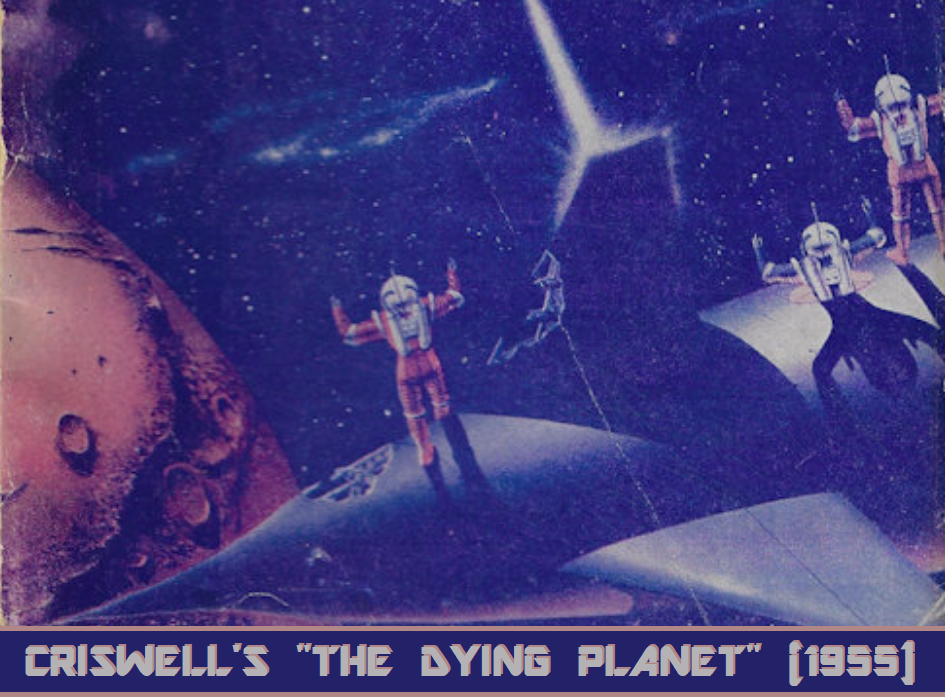
Criswell told an amazing tale in the April 1955 issue of Spaceway.

The summer of 2023 was the hottest on record, and there are alarming news stories about catastrophic weather events seemingly every week. It often feels as if we're on a collision course with oblivion and that there is no turning back. Sure, we collectively survived Y2K a couple of decades ago, but the human race may well be extinct by the time Y3K rolls around.

In short, these would be great times for Criswell (1907-1982), the well-coiffed prognosticator who became not only Ed Wood's good friend but also an important member of the Wood repertory company with his roles in Plan 9 from Outer Space (1957), Night of the Ghouls (1959), and Orgy of the Dead (1965). More and more these days, we seem to be living through one of the many outlandish doomsday predictions that Criswell made over the years through his columns, books, and other media appearances.

Recently, reader Rob Huffman, host of the YouTube series Sin & Sci-Fi in the '60s, sent me one of those apocalyptic Criswell pronouncements: "The Dying Planet," which Cris wrote for a pulp sci-fi magazine called Spaceway in April 1955. A relatively short-lived publication from William L. Crawford's Fantasy Publishing in Los Angeles, Spaceway lasted only from December 1953 to June 1955 with a brief revival in 1969 and 1970. Criswell was a regular contributor to Spaceway and even appeared on its cover a couple of times. (L. Ron Hubbard also contributed to Spaceway, if that tells you anything.)

Some artwork by the great Paul Blaisdell accompanied this Criswell story.

Spaceway April 1955.
"The Dying Planet" captures Cris at his bonkers best. In this article, the great seer tells us of a distant yet inhabited planet called Bellarion—whose society mirrors ours in many ways—that is veering away from its usual orbit and will enter our solar system in the "very near future." Our planet will not necessarily perish because of this catastrophe, but there will be numerous consequences ranging from bizarre to tragic to merely inconvenient. Among them:
  • "Your hair will not remain combed, but will stand up in wild disarray, due to the coming electrical disturbances."
  • "Huge buildings will become loosened from their foundations and will fly off into space."
  • "Pregnant women will explode."
  • "The skies will rain blood because of the millions of crushed bodies floating in space."
  • "In cemeteries, the dead will be lifted from their graves through a strange magnetic force which will influence only dead cells."
That last one I mentioned is especially noteworthy because it presages both Ed's own Plan 9 as well as George Romero's seminal Night of the Living Dead (1968). In Romero's film, the zombie plague is apparently caused by the Venus Space Probe and the radiation it brought back to our planet.

Speaking of classic sci-fi and horror, the Spaceway article is accompanied by artwork from the great Paul Blaisdell (1927-1983), who created iconic monster costumes and other props for such classic B-movies as It Conquered the World (1956), The Beast with a Million Eyes (1955), The She-Creature (1956), and many more. Occasionally, Paul himself would climb into the costumes and portray the monsters himself. It's regrettable that Paul Blaisdell and Ed Wood never had the opportunity to work on a film project together.

Immediately following "The Dying Planet," the April 1955 issue of Spaceway also includes a biographical article about Criswell attributed to one "Charles F. Wireman." I put that name in quotes because "Charles" is pretty blatantly Criswell writing under a pen name. He doesn't even bother to change his telltale writing style from one article to the next. In "The Dying Planet," for instance, Criswell refers to "trend, pattern of habit, and the unalterable laws of cycle," a phrase I also recognized from Criswell's delightful 1970 album. Then, "Charles F. Wireman" uses the exact same phrase on the very next page! So much for covering your tracks.

Regardless of its authorship, the biographical article has some interesting Criswell trivia in it. For instance:
Criswell's favorite character in history is Napoleon, and his favorite age in history is from 1890 to 1900. His favorite American writer is Edgar Allen Poe. Criswell's most cherished newspaper interview was with the late H.G. Wells, who proved to be a great influence.
The article stops short of telling us Criswell's turnons and turnoffs, and for that, I am grateful. I am also grateful to Rob Huffman for sending me this wonderful example of Criswell arcana.

Tuesday, September 12, 2023

Podcast Tuesday: "Deep Shvitz"

Anson Williams, Ted McGinley, and Scott Baio on Happy Days.

For a show whose entire purpose is getting viewers to remember the past, Happy Days has a surprisingly spotty memory for its own past. Continuity was simply not a priority for the writers and producers of this long-running ABC sitcom. Fairly major life events could be repeated (such as Fonzie having his tonsils taken out) or forgotten (such as Marion returning to college) without anyone noticing. Actors could come back as multiple, different characters (as both Ken Lerner and Warren Berlinger did), and no one would be the wiser. And even recurring cast members could vanish from Happy Days with scarcely a comment. This was the ignominious fate of Chuck Cunningham, Eugene and Melvin Belvin, Flip Philips, K.C. Cunningham, and more. 

So it's somewhat touching that, when Ashley Pfister (Linda Purl) and her daughter Heather (Heather O'Rourke) were dropped from the show at the end of Season 10 for budgetary reasons, the writers of Happy Days bothered to give us a reason for their absence. In the Season 11 episode "Where the Guys Are," Fonzie (Henry Winkler) informs us -- or, more specifically, informs guest star Rita Wilson -- that his relationship with Ashley ended when Ashley's newly sober ex-husband resurfaced, wanting to reconcile with her. Sure, this same basic thing happened to Fonzie back in Season 6 (during the "Kid Stuff" episode), but a recycled explanation is still better than none at all.

You might've noticed that picture up there of Anson Williams, Ted McGinley, and Scott Baio wearing towels and wondered what that has to do with Linda Purl leaving Happy Days. Well, it'll all be explained in this episode of our podcast. Why not listen and find out?

Wednesday, September 6, 2023

Ed Wood Wednesdays: Jean Stevens in White and Black (Guest Author: James Pontolillo)

Ed Wood gave us two sides of actress Jean Stevens.

In his magnum opus Plan 9 from Outer Space (1957), writer-director-producer Edward D. Wood, Jr. summoned an iconic femme fatale – TV horror hostess Vampira as the striking Vampire Girl – to haunt men for decades to come. Plan 9’s cult status and the fervor directed toward Vampira have caused Ed’s other femme fatales to be largely overlooked. 

Two of his lesser-regarded films – Final Curtain (1957) and Night of the Ghouls (1959) – feature a [White] Vampire and a Black Ghost, respectively. Each role was played by the same little-known actress who managed to exude a mysterious, foreboding air of eroticism not unlike that of Vampira herself. A large measure of credit must be given to the cinematographer, William C. Thompson, whose knack for capturing feminine beauty in crisp, moody black-and-white mirrored the timeless Universal horror classics of the 1930s and 1940s. The young actress in question, Jean Stevens, was no newcomer as far as Ed was concerned. He had known her since his earliest days in Hollywood.

Tuesday, September 5, 2023

Podcast Tuesday: "The Ballad of Joan-bone and Chach-crotch"

Erin Moran and Scott Baio on Happy Days.

Over the course of reviewing 11 seasons of Happy Days, I've really come to respect Erin Moran (1960-2017) as an actress. Some viewers may not know that she was the third Joanie Cunningham, after Susan Neher (a redhead from the first pilot) and Audrey Pfeiffer (a blonde from the second). The kid sister of protagonist Richie (Ron Howard), Joanie could easily have been a nothing character, doomed to live in the shadow of her more celebrated sibling and only occasionally allowed to crack wise at the dinner table. Joanie didn't even make it into the opening credits until Season 3! I'm convinced it was Erin's spirited portrayal that made Joanie an important part of Happy Days. She carved out a place for herself on this overcrowded series, episode by episode.

I don't feel that the show always treated Joanie well, however. Like I said, they didn't even bother to add her to the opening credits for the first two seasons! During the early years of Happy Days, most of the good stories went to either Richie or Fonzie (Henry Winkler), though Joanie got occasional spotlight episodes like "Smoking Ain't Cool" and "Joanie's Weird Boyfriend." Starting in Season 5, Joanie became romantically involved with Fonzie's slightly sleazy cousin Chachi (Scott Baio), and this drastically altered the course of her character. She was no longer just Richie's sister; she was now Chachi's girlfriend.

But what if she weren't? This week on These Days Are Ours: A Happy Days Podcast, we're talking about the Season 11 episode "The Ballad of Joanie and Chachi," in which our two lovebirds realize  that they're just not compatible for each other because they want different things out of life. It's a more dramatic, downbeat episode than Happy Days usually does. Is this change of pace good for the show or not? Let's find out together.

Wednesday, August 30, 2023

Ed Wood Wednesdays, week 162: Who was Patricia?

Patrick/Patricia is a crucial figure in Glen or Glenda (1953).

For reasons known only to himself, Ed Wood formatted Glen or Glenda (1953)— his surprisingly bold exploration of transgender issues—as a Dragnet-style police procedural. The film's inciting incident occurs when a young crossdresser named Patrick aka Patricia commits suicide in his small apartment after being arrested repeatedly for dressing as a woman. On the soundtrack, we hear Patrick's suicide note, presumably read in the man's own voice:
The records will tell the story. I was put in jail recently. Why? Because I, a man, was caught on the street wearing women's clothing. This was my fourth arrest for the same act. In life, I must continue wearing them. Therefore, it would only be a matter of time until my next arrest. This is the only way. Let my body rest in death forever in the things I cannot wear in life.
The policeman investigating the case is the humorless but sensitive Inspector Warren (Lyle Talbot). So concerned is he about the situation that he visits the office of psychologist Dr. Alton (Timothy Farrell). It is Alton who relates the two stories that comprise the bulk of the film, the first revolving around Glen/Glenda (Ed Wood), the second revolving around Alan/Ann (Tommy Haynes).

While Glenda moves on from Patrick/Patricia after about the first ten minutes, I could not help ruminating about this key supporting character and the actor who portrayed him. Glenda's own credits offer no help in identifying him, so we must turn to Rudolph Grey's Nightmare of Ecstasy (1992), where the filmography section tells us that this role was played by "Mr. Walter." Furthermore, the book's fourth chapter, entitled "Glen or Glenda & Jailbait" contains a Glenda cast photo provided by Conrad Brooks. There, the actor is identified as Walter Hajdwiecyz. Though he is at the center of the action and obviously among friends, he is unsmiling.

Back row: Makeup man Harry Thomas, Tommy Haynes, Ed Wood, unknown extra.
Center row: Conrad Brooks, Walter Hajdwiecyz. Front row: Henry Bederski.

Unfortunately, I cannot find any records of anyone with the surname Hajdwiecyz in the world. But a handle like Walter Hajdwiecyz can only be Polish in origin, and the similar moniker Hajkowicz is a real Polish surname. As for the "Mr." part, it was once common practice for hairdressers to go by "Mr. _____," omitting their last names. The most famous example was Mr. Kenneth (1927-2013). I'm not saying Mr. Walter was definitely a hairdresser, but he sounds like a midcentury hairdresser. In John Waters' Multiple Maniacs (1970), actor/hair stylist David Lochary is referred to as Mr. David.

Then, we must consider the voice we hear on the soundtrack, reading Patrick/Patricia's suicide note. We can take it on faith that this was Walter Hajdwiecyz himself, though it may not be. I've suggested in the past that this bit of voiceover narration was an inspiration for Johnny Depp's performance in Ed Wood (1994). I know Johnny watched Glenda repeatedly while prepping for the title role, and I feel that the Patrick/Patricia scene may have influenced his vocal cadence. Oddly, though, I don't think Ed Wood himself provided this bit of audio.

My dark horse candidate is another mysterious figure in the Woodiverse: Clancy Malone (aka Scott McCloud), the gawky male ingenue of Jail Bait (1954). I know it sounds screwy to you longtime fans, but these two characters have a very particular way of speaking—low and sort of whispery, their confidence wavering at the ends of sentences. Here, I've presented a little side-by-side comparison. Listen for yourself and make up your own mind. Either way, if you can provide me with more information about Mr. Walter, I'd appreciate it. You know how to reach me.

Tuesday, August 29, 2023

Podcast Tuesday: "Today I Am a Fonz"

Henry Winkler on Happy Days.

Happy Days was in real trouble at the start of the 1983-84 television season. Not only was it getting shellacked in the ratings by NBC's The A-Team, it had been rudely ousted from its 8:00 timeslot in favor of a new show called Just Our Luck starring comedian T.K. Carter. When a long-running show is kicked out of its normal place on the network schedule, that's generally a bad sign for its overall health. To make matters worse, the sitcom's budget had been cut and several cast members had been let go. The remaining regulars must have known the show's future was in serious jeopardy. (Time to polish up the old resume?)

The show had been in a similar situation nearly a decade earlier during the 1974-75 season. At that time, it was getting beaten badly by CBS' Good Times and was in line for cancelation. But producer Garry Marshall wouldn't surrender! Instead, he retooled the show and turned it into a massive hit, bigger than it had ever been. No such comeback was in the offing in 1983. Marshall had already started directing feature films by then, and his surviving Happy Days cast members were getting older. Besides, the TV landscape had changed. Happy Days was old hat. Its time had passed.

Even if Marshall and company couldn't save their show, they could still have fun with the time they had left on the air. This week on These Days Are Ours, we review the Season 11 premiere episode, "Because It's There." It's a classic Fonzie adventure in which the beloved mechanic (Henry Winkler) once again has to prove himself by performing a ridiculous motorcycle stunt. You can find out what we thought of this episode by listening to the podcast embedded below.