Two greats square off: Criswell and S.J. Perelman.
"I am not only witty in myself but the cause that wit is in other men."
-Falstaff in Shakespeare's Henry IV, Part 2 (1600)
It's strange to thinkthat the Amazing Criswell (1907-1982) did not arrive fully formed into this world. After all, the man seemed so innately himself, both in print and on camera, that it's difficult to imagine him doing anything else. But he was not always the pompadoured, tuxedoed showman we see in Ed Wood movies, confidently spouting (inaccurate) predictions and waxing philosophical about time and space. Long before the books, the movies, the newspaper columns, and the TV talk shows, he was merely Jeron Criswell King from Princeton, Indiana.
An ad for Criswell's books.
Much like his Plan 9 from Outer Space (1957) castmate Maila "Vampira" Nurmi, Cris cycled through various identities and professions before landing on the gimmick that would make him cultishly famous. In 1935, after a failed teaching career, he relocated to New York and spent a few years trying to establish himself as a radio personality, playwright, and stage actor. During this period in his life, he met and married the equally outlandish Myrtle Louise Stonesifer (1905-1985) aka Louise Howard aka Halo Meadows.
Cris and Halo wrote a series of utterly bizarre how-to guides, most of them about making it in show business. (On some of their books, a third author named Arthur Jones is listed.) Though they had not found much success in the entertainment field yet, they were cheerfully selling books about how to make it as an actor, a songwriter, or a playwright. Definitely a case of "fake it 'til you make it."
These books are not commonly found today on the secondary market, but I have a xeroxed copy of one: How to Crash Tin Pan Alley from 1939. It's ostensibly a how-to book for songwriters. It explains how newcomers can get their compositions published, recorded, and performed. Since Criswell and his cohorts knew absolutely nothing about songcraft, the book assumes you can handle that part of the process yourself without their help. Instead, they focus on the music industry and the many pitfalls that a young, inexperienced songwriter may encounter while navigating it, from skeptical publishers to egotistical singers. The tone of the book is very similar to Ed Wood's own posthumously-published showbiz guide, Hollywood Rat Race (1998). Somehow, Cris and Halo managed to wrangle an introduction from celebrated jazz bandleader Sammy Kaye (1910-1987).
Since neither Criswell nor Halo Meadows ever became a hit songwriter, I wasn't sure what kind of cultural impact How to Crash Tin Pan Alley ever had. My xeroxed edition of the book was made from a copy at the University of Illinois, where it had been checked out numerous times over the years, starting in 1943. The most recent stamp on the inside cover said February 18, 1999. Imagine that! As late as Bill Clinton's second term, someone was still taking highly dubious career advice from Criswell!
Jeffrey Jones in Ed Wood. Inset: Criswell in Night of the Ghouls.
Ed Wood Wednesdays is, by far, the longest-running series in the history of this blog. It may be the most significant project of my entire life. I started it nearly 13 years ago, and it's nowhere near completion. But within that one big project, there have been a lot of smaller sub-projects, like my reviews of every story in Blood Splatters Quickly (2014) and my 2022 Ed-Vent Calendar. These have been some of the most enjoyable articles for me to write, so I'm always on the lookout for the next possible series-within-a-series. And now I think I've found it.
What I plan to do for the next however many weeks is go through Tim Burton's glossy biopic Ed Wood (1994) scene by scene and discuss how accurate—or inaccurate—it is, compared to the real life and career of Edward Davis Wood, Jr. (1924-1978). Before you get upset, please know that I am doing this purely as a tribute to the movie. I am not trying to criticize director Tim Burton or writers Scott Alexander and Larry Karaszewski for taking liberties with the facts. I'm completely fine with them taking liberties with the facts, and I love Ed Wood just the way it is. But this series will (hopefully) allow me to talk about numerous aspects of Eddie's real life and work in an entertaining way.
Oh, and I fully expect to be corrected and nitpicked along the way by you, the readers. If you feel I've made a misstatement, let me know and I'll update the article. Anyway, let's get started.
There are so many connections between these strange, mid-20th-century entertainers, even though one predicted the future (dubiously) and the other played the piano (flamboyantly). Criswell and Liberace—one bisexual, the other gay, both products of the Midwest—were popular during roughly the same time period, from the 1950s to the 1970s. They both went by catchy, one-word monikers. They both favored flashy tuxedos and fancifully-coiffed hair. They were both fixtures of the TV talk show circuit. They were both widely parodied and mocked but didn't seem to care as long as they kept making money.
Above all, Lee and Cris related to their fans in very similar ways. In fact, I think there's significant overlap between the Liberace audience and the Criswell audience. I picture a lot of middle-aged and older ladies with impatient, irritated husbands.
"Honestly, Gladys, I don't get what you see in that fruitcake!"
Liberace is actually name-checked numerous times in Fact, Fictions, and the Forbidden Predictions of the Amazing Criswell (2023), Edwin Lee Canfield's thorough biography of the famed Indiana-born prognosticator. But Canfield oversaw another Criswell book in 2023. Together with Charles Phillip Wireman, he compiled a generous volume called Criswell Predicts an Accurate Glimpse of the Future. I see Accurate Glimpse as a companion or supplementary volume to Forbidden Predictions. When you read about Cris' life, you'll likely want to explore the man's work in further detail. Accurate Glimpse draws material from Criswell's many books, audio recordings, magazine articles, and newspaper columns. The editors pop in from time to time to offer some historical context.
The story: "Ed Wood Hollywood Deadwood" by David Michael Taylor
Synopsis: Struggling filmmaker Ed Wood drowns his sorrows in vodka at a Hollywood dive bar called Gold Diggers. Eddie is especially upset that his TV pilot, Final Curtain (1957), has failed to sell. His friend, actor/wrestler Tor Johnson, shows up and tries to comfort him. Eddie looks at their reflections in a mirror and imagines Tor as Inspector Clay from Plan 9 from Outer Space (1957) and himself as a little boy dressed in girl's clothes. He leaves the bar, dejected.
One of L.A.'s great cocktail bars.
Ed migrates over to another bar, Boardner's, where he commiserates with Maila "Vampira" Nurmi. She says the future is in television, but Ed laments that he can't get his pilot in front of the right people. The director's epic bar crawl then leads him to the Frolic Room on Hollywood Blvd., where he meets up with psychic Criswell, resplendent in a sparkly Nudie suit. Eddie asks Criswell about the future, and Cris says, "Perhaps on your way home, someone will pass you in the dark, and you may never know it, but they will reveal your future."
Stumbling home to his shabby apartment on Yucca, Ed Wood indeed passes a young man and woman he does not recognize. Could they be the key to his future? He calls out to them. Many decades later, these young people are standing in front of the building at 6383 Yucca Street in Los Angeles. The young man's mother has texted him that Ed Wood once lived here, but neither the young man nor the young woman knows who Ed is.
Excerpt:
She strips the top from the shaker and replaces it with a strainer as I feel myself straining in anticipation. Setting a fresh martini glass on the section of the bar I've clamed as my own for the evening, she tips the shaker, causing the cloudy cocktail to pour through the strainer and into my glass without spilling a drop. A lime wheel appears as if from nowhere and, with a deft hand, she closes its pulp around the lip of the glass.
Another stop on the tour.
Reflections: Some of you Beatle fans may remember the 1995 music video for "Free as a Bird," the "new" song that was created by taking an unfinished John Lennon demo and overdubbing new parts by Paul McCartney, George Harrison, and Ringo Starr onto it. A combination of computer-generated animation and live-action footage, including many vintage clips of The Beatles themselves, the video follows the path of a bird as it flies to crucial locations in Beatle history, including the Cavern Club, Penny Lane, the Strawberry Fields orphanage, and Abbey Road studios. Along the way, we spy brief visual references to Beatle songs, including "Birthday," "Helter Skelter," "Paperback Writer," and more. The more you know about the Fab Four, the more references you'll catch.
David Michael Taylor's "Ed Wood Hollywood Deadwood" is like "Free as a Bird" for Ed Wood fans. Instead of following the path of a bird as it soars majestically through Beatle history, it follows the path of Ed Wood as he stumbles drunkenly from one Los Angeles bar to another. But it, too, is an Easter egg hunt for diehard fans. The story visits a few key Woodian locations, including Gold Diggers, Pla-Boy Liquor, and the notorious Yucca Flats apartment building, and it's peppered with references to Ed's life and career. Much of the dialogue comes directly from the script of Plan 9, for instance, and the bartender has the same name as Ed's mother: Lillian. We also get multiple references to the obscure Final Curtain pilot, a nod to Tim Burton's Ed Wood (1994), and a reiteration of the old story that Ed's mother dressed him as a girl when he was a child.
There's a sighing, elegiac quality to both "Free as a Bird" and "Ed Wood Hollywood Deadwood," though the latter is far less reverential. They're both wistful reminders of a vanished world and the vanished people who inhabited it. The ending of Taylor's story seems to consign Ed Wood to the rubbish bin of history, the victim of youthful indifference, but the truth is that this story could only have been written by someone with a deep, abiding love for Eddie's work. Who else but a fan would bother to write something like this?
P.S. This story is almost fetishistic in its detailed descriptions of alcoholic beverages and cocktail bars. I'm not sure if these things are a major part of the author's life, but they were certainly a major part of Ed Wood's life, so I appreciate the extra effort displayed here. These descriptive passages really bring you into Eddie's dank, boozy world.
This week, James further explores the life and career of Criswell.
"Like other skeptics, I once made the mistake of underrating the cold readers."
William Lindsay Gresham, Monster Midway
Note: The search for information about Jeron Charles Criswell King is complicated by the multiple names that he employed up through at least the age of 40. He variously used Charles Criswell, Charles Criswell King and C.C. King as his legal name, while using Charles Cris King, Jeron Criswell, J. K. Criswell, King Criswell, and simply Criswell as stage names (along with the dubious titles of Doctor and Reverend). Similarly, his wife Myrtle Louise Stonesifer used Louise Howard, Halo Meadows, and Halo Vanessa as stage names. I will simply refer to them as Criswell and Louise.
The dawn of the 20th century found Hollywood a quiet place of orchards, farm fields, and scattered homes [1,2]. A decade later, Hollywood Boulevard had been transformed into a wealthy residential street of stately mansions and impressively manicured yards [3, 4,5]. The early 1920s saw the arrival of the film industry with a large number of movie studios, theaters, and shopping centers along Hollywood and Sunset Boulevards [6,7]. The legion of workers needed to support the rapidly expanding industry drove an ever-growing need for dense residential development. By 1930 rural Hollywood and most of the stately mansions were a distant memory – replaced by bungalow courts, duplexes, and multi‐story apartment buildings [8]. Hollywood was not unique in this regard but mirrored development throughout the region. From 1900 to 1940, the population of Los Angeles skyrocketed from 103,000 to 1.5 million as it progressed from being the 36th to the 4th largest city in the nation.
The new arrivals brought with them an unprecedented diversity of beliefs reflective of a trend away from traditional religion that had been spreading across America since the mid-1800s. Among the new faiths to be found in Los Angeles were charismatic and esoteric Christian sects, spiritualism, New Thought ministries, Theosophy with its national headquarters [9], Guy Ballard's I Am Movement, ceremonial magic orders such as the Golden Dawn and Ordo Templi Orientis, as well as a host of lesser occult and metaphysical lights. The film industry, with its seductive subtext that all things are possible, multiplied the effect by attracting individuals dissatisfied with tradition and seeking to create a new life on the West Coast. Newspaper reports revealed 1930s Los Angeles to be "a seething mass of spiritual guides, mystics, fortune tellers, palm readers, and invented sects, with classified ads promising answers for seekers of love, fortune, a salve to their pain, or the access to a higher truth." Many movie stars immersed themselves in metaphysical practices and paid seers handsomely to warn them of astrological changes that might adversely affect their careers.
The reaction by Los Angeles officialdom to this increasingly influential subculture was anything but positive. Newspapers warned readers of charlatanry run amuck with cautionary tales of crooked gypsies and mediums [10]. City leaders suggested that fortune tellers should have to publicly demonstrate their powers or lose their licenses. Police investigated criminal gangs of psychics who extorted, blackmailed, and even sexually assaulted their followers. To the cynic, Los Angeles had become a "haven for psychopaths and confidence-workers of every stripe and degree… Its most elaborate commercial structures are mortuaries… the native Angeleno, who qualifies for such after a six-month residence, is a superior braggart, annoyingly boastful over what turns out to be nonexistent."
This week, James Pontolillo gives us a glimpse at the early years of Plan 9 star Criswell.
"You know, kid… lad like you could be a great mentalist. Study human nature."
William Lindsay Gresham, Nightmare Alley
Note: The search for information about Jeron Charles Criswell King is complicated by the multiple names that he employed up to the age of 40. He variously used Charles Criswell, Charles Criswell King and C.C. King as his legal name, while using Charles Cris King, Jeron Criswell, J. K. Criswell, King Criswell, and simply Criswell as stage names (along with the dubious titles of Doctor and Reverend). I will simply refer to him as Criswell. It is often claimed that his surname is actually Konig. There is no evidence to support this assertion. Criswell's surname traces back unchanged to his earliest known ancestor, Samuel King (1775 Virginia).
The publication of Edwin Lee Canfield's Fact, Fictions, and the Forbidden Predictions of the Amazing Criswell (2023) has finally provided fans with an abundance of material on the quirky psychic and key Ed Wood repertory player. Canfield corrected a long-standing problem where Criswell was concerned – a lack of basic information and leads to pursue. Nearly all online biographies about Criswell are short and riddled with errors. The man himself provided few clues beyond brief disjointed statements scattered across interviews, magazine articles, and the introductions to his prophetic books. These statements are generally unreliable in their details. If Ed Wood, Jr. was a bullshitter about certain aspects of his life, then Criswell by comparison would have to be called The Amazing Bullshitter.
One particular claim that Canfield reproduced caught my attention: that for two summers Criswell served as a manager/actor at Greenkill Park Theater outside of Kingston, NY. If true, this placed him a mere 19 miles from Ed Wood, Jr. Was it possible that young Eddie had seen Criswell perform on stage with neither man being aware of this connection when they met up yet again years later in Hollywood? I immediately began a deep dive in search of confirmation. Uncovering many previously unreported details on Criswell's life, I realized that there was a much larger story to be told. The story of the unlikely transmutation of a rural Indiana high school boy into the Amazing Criswell.
Ed Wood associate Don Nagel (pictured, lower right) figures in this sordid story.
FADE IN:
EXT. CITY - NIGHT. A montage of nighttime scenes showing the hustle and bustle of life in the big city. Cars and trucks rushing about. Lit up storefronts casting their ruddy glow out into the night. And everywhere people. People... all going somewhere... all with their own thoughts... their own ideas... all with their own personalities.
DISSOLVE TO MEDIUM SHOT OF CRISWELL We see CRISWELL, wearing a dark suit and evening coat, standing in profile to the camera as he browses through magazines at a news kiosk. Holding the most recent issue of Weird Tales, he turns and looks straight into the camera.
CRISWELL I am Criswell. For years, I have told the almost unbelievable, related the unreal and showed it to be more than a fact. Now I tell a tale of the entertainment industry, so astounding that some of you may faint. This is a story of those in the twilight time. Once human, now actors, in a void between the employed and the unemployed. Actors to be pitied, actors to be despised. A night with the thespians, the thespians reborn from the innermost depths of Hollywood.
MONOLOGUE CONTINUES AS CAMERA CUTS TO FULL MOON STOCK FOOTAGE, WOLF HOWLS
CRISWELL (Voice Over) It is said on clear nights, beneath the cold light of the moon, howl the dog and the wolf, and creeping things crawl out of the slime. It is then that thespians cavort in all their radiance.
My friends, it is 10 PM on the evening of March 15, 1949 and a full moon is overhead as we stand on West Pico Blvd in Los Angeles. Two young men – marginally employed actors and friends since high school – are moments away from a date with destiny. If I am not pleased with tonight's entertainment, I shall banish their souls to everlasting damnation!
Five points if you know which TV show I'm referencing. (HINT: It ain't Tales from the Crypt.)
Remember trick-or-treatingwhen you were a kid? You'd try to keep track of what candy you were collecting along the way, but you'd never get an accurate inventory until you got home and dumped out that pillow case or plastic pumpkin head and sorted through your treasure. There'd always be some weird candy in there that you'd never heard of, stuff you'd never see any other time of the year. Mexican Hats? Bottle Caps? Mary Janes? Tootsie Rolls in flavors other than chocolate? All this stuff seemed exotic to me back then.
Well, I had a similar feeling this week when faithful reader Rob Huffman, host of Sin & Sci-Fi in the '60s, sent me some vintage Ed Wood-related newspaper clippings. These are the Mary Janes and Mexican Hats of Woodology, the obscure stuff that you wouldn't even think to look for because you never knew it existed in the first place. How Rob keeps finding this material I don't know. Let's sort through it together, huh?
The first item comes to us from The Los Angeles Evening Citizen News, March 12, 1952, and concerns actor Kenne Duncan of Night of the Ghouls (1959) and The Sinister Urge (1960) fame. While touring Japan in 1951, Kenne lost a .22 pistol that was later recovered in an irrigation ditch.
(left) An article about Kenne Duncan; (right) A Japanese poster for Kenne Duncan.
When he sent this to me, Rob joked that Kenne probably shot someone and ditched the murder weapon, but the cops covered it up because he was a celebrity. ("I'm kidding," he clarified.) Ed Wood fans will be familiar with Kenne Duncan's Japanese tours, which were documented in the short film Trick Shooting with Kenne Duncan (1960) and Ed's posthumously-published book Hollywood Rat Race (1998). You can read my thoughts on both of those things right here. I guess the snarling Western actor, memorably nicknamed "Horsecock," had a major following in Japan. That puts him in the same category as Kentucky Fried Chicken, Cheap Trick, and Little Jimmy Osmond.
Rob also sent me some tantalizing excerpts from Criswell's long-running syndicated newspaper column. Here's an item from 1972 about Ed Wood's long-gestating I Woke Up Early the Day I Died project, which was not actually produced until 1997. This was published in The Bridgeport Post on March 26, 1972.
Criswell (right) talks about The Day I Died.
Cris and Ed Wood were close friends as well as professional collaborators, so the celebrated seer would have known all about this unproduced screenplay that Ed had been working on (under various titles) since the 1950s. As of 1972, the script was simply called The Day I Died. The morbid plot description that Cris gives us makes the film sound a lot like Eddie's short story "Into My Grave," which was published in 1971. Notice that this column makes no mention of the main character's murderous crime spree. The other truly noteworthy detail is the mention of "Wes Kale, a dramatic new discovery." I cannot find any documentation of Mr. Kale, who sounds like a SpongeBob character. When the script was finally made, Billy Zane played the lead.
The next item on the agenda comes from Criswell's column of December 21, 1975. It, too, was published in The Bridgeport Post and concerns an aborted Ed Wood project called Erotica 76 that was totally unknown to me. Cris says Eddie was planning to direct it.
Was Ed Wood (right) hoping to direct Erotica 76?
Each new detail of this article is more baffling than the one that preceded it. Erotica 76? Jeopardy? Dennis Owens? What are you talking about, Criswell? You reference all of these things as if we know exactly what they are.
Nightmare of Ecstasy: The Life and Art of Edward D. Wood, Jr. (1992) makes no mention of Erotica 76 or Dennis Owens. I cannot even find a director, producer, screenwriter, or actor of any note called Dennis Owens. (The closest is an East Coast news anchor with that name.) Orgy of the Dead (1965) is a title we're all familiar with, but what is Jeopardy? Could Criswell be referencing the 1953 crime drama, directed by John Sturges? I doubt he's talking about the extremely long-lived game show of that name. That wouldn't make sense in this context.
Furthermore, how will a film that sounds like blatant, low-budget pornography "revive the old days of Hollywood" or "set the new trend of entertainment for the entire family"? I guess all of these questions (and more) will forever remain unanswered. But before we leave this news clipping, let's take a moment to appreciate Criswell's philosophizing about "the waves of time." Eddie makes this kind of dreamy, vague observation a lot in his writing; he and Cris truly thought alike.
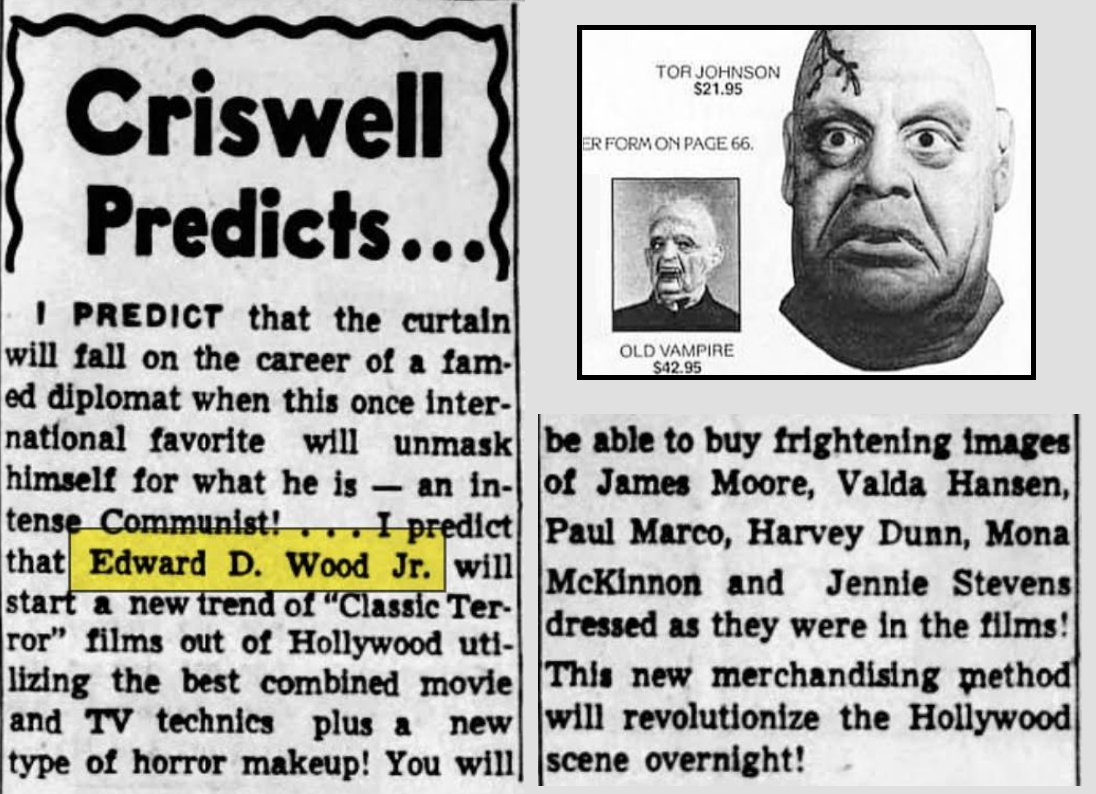
The third and final Criswell article for today comes from the April 23, 1958 edition of The Escondido Times-Advocate and concerns the merchandising of the actors in Ed Wood's repertory company.
A Criswell column from 1958. Inset: An early 1980s ad for Don Post studios.
As mentioned earlier, Criswell and Ed Wood were good friends, and I think the former mentioned the latter in his column occasionally just to get Eddie's name in print. In those pre-internet days, a struggling writer-director in Hollywood needed as much media attention as he could possibly get. I don't know if Criswell's columns opened any doors for Eddie, but they couldn't have hurt. Ink is ink.
Here, the great prognosticator declares that Eddie will not only revive classic Hollywood horror movies but will utilize "the best combined movie and TV technics plus a new type of horror makeup." Perhaps Cris was already describing Night of the Ghouls, in which Tor Johnson's badly-scarred Lobo wears the most elaborate makeup ever seen in a Wood-directed movie. In the 1960s, Tor's familiar face became the basis for a popular Halloween mask from Don Post Studios. That company no longer exists, but several versions of the Tor mask are still on the market today.
What's interesting is that Criswell predicted a whole line of masks based on the cast of Night of the Ghouls, but he doesn't include the three most obvious candidates for this treatment: himself, Tor Johnson, and Kenne Duncan. Instead, he suggests masks based on James "Duke" Moore, Paul Marco, Harvey B. Dunn, Mona McKinnon (who appears in Ghouls via repurposed footage), Valda Hansen, and even the obscure Jean Stevens (identified here as "Jennie"). Again, I think this was Cris' sneaky way of getting his costars' names in print.
Rob Huffman sent me further Ed Wood clippings, but I think we will save those for a future installment of this series. After all, you don't eat all your Halloween candy on one night, do you?
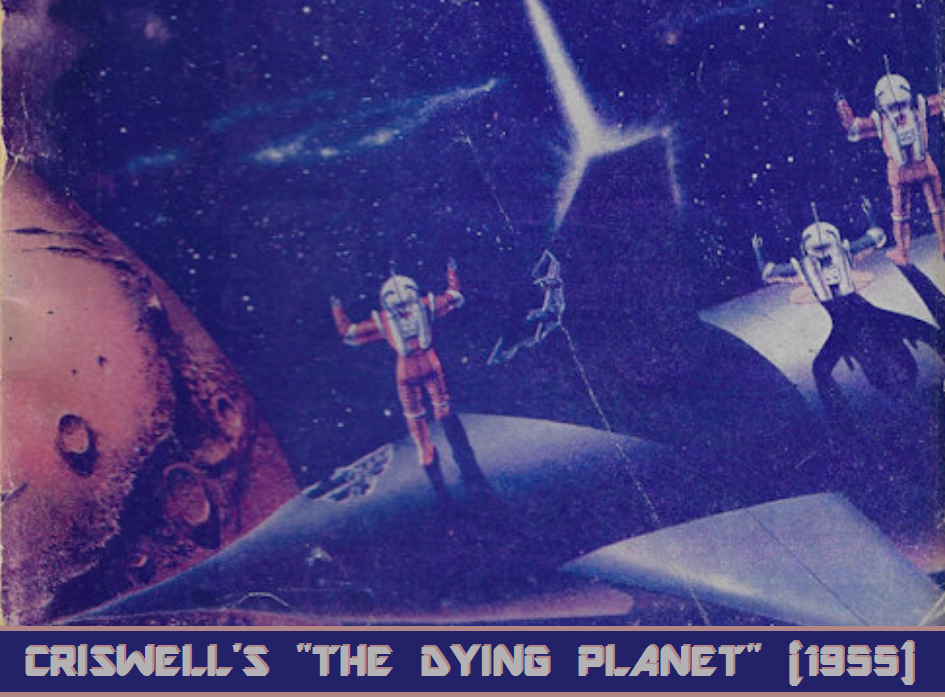
Criswell told an amazing tale in the April 1955 issue of Spaceway.
The summer of 2023 was the hottest on record, and there are alarming news stories about catastrophic weather events seemingly every week. It often feels as if we're on a collision course with oblivion and that there is no turning back. Sure, we collectively survived Y2K a couple of decades ago, but the human race may well be extinct by the time Y3K rolls around.
In short, these would be great times for Criswell (1907-1982), the well-coiffed prognosticator who became not only Ed Wood's good friend but also an important member of the Wood repertory company with his roles in Plan 9 from Outer Space (1957), Night of the Ghouls (1959), and Orgy of the Dead (1965). More and more these days, we seem to be living through one of the many outlandish doomsday predictions that Criswell made over the years through his columns, books, and other media appearances.
Recently, reader Rob Huffman, host of the YouTube series Sin & Sci-Fi in the '60s, sent me one of those apocalyptic Criswell pronouncements: "The Dying Planet," which Cris wrote for a pulp sci-fi magazine called Spaceway in April 1955. A relatively short-lived publication from William L. Crawford's Fantasy Publishing in Los Angeles, Spaceway lasted only from December 1953 to June 1955 with a brief revival in 1969 and 1970. Criswell was a regular contributor to Spaceway and even appeared on its cover a couple of times. (L. Ron Hubbard also contributed to Spaceway, if that tells you anything.)
Some artwork by the great Paul Blaisdell accompanied this Criswell story.
Spaceway April 1955.
"The Dying Planet" captures Cris at his bonkers best. In this article, the great seer tells us of a distant yet inhabited planet called Bellarion—whose society mirrors ours in many ways—that is veering away from its usual orbit and will enter our solar system in the "very near future." Our planet will not necessarily perish because of this catastrophe, but there will be numerous consequences ranging from bizarre to tragic to merely inconvenient. Among them:
"Your hair will not remain combed, but will stand up in wild disarray, due to the coming electrical disturbances."
"Huge buildings will become loosened from their foundations and will fly off into space."
"Pregnant women will explode."
"The skies will rain blood because of the millions of crushed bodies floating in space."
"In cemeteries, the dead will be lifted from their graves through a strange magnetic force which will influence only dead cells."
That last one I mentioned is especially noteworthy because it presages both Ed's own Plan 9 as well as George Romero's seminal Night of the Living Dead (1968). In Romero's film, the zombie plague is apparently caused by the Venus Space Probe and the radiation it brought back to our planet.
Speaking of classic sci-fi and horror, the Spaceway article is accompanied by artwork from the great Paul Blaisdell (1927-1983), who created iconic monster costumes and other props for such classic B-movies as It Conquered the World (1956), The Beast with a Million Eyes (1955), The She-Creature (1956), and many more. Occasionally, Paul himself would climb into the costumes and portray the monsters himself. It's regrettable that Paul Blaisdell and Ed Wood never had the opportunity to work on a film project together.
Immediately following "The Dying Planet," the April 1955 issue of Spaceway also includes a biographical article about Criswell attributed to one "Charles F. Wireman." I put that name in quotes because "Charles" is pretty blatantly Criswell writing under a pen name. He doesn't even bother to change his telltale writing style from one article to the next. In "The Dying Planet," for instance, Criswell refers to "trend, pattern of habit, and the unalterable laws of cycle," a phrase I also recognized from Criswell's delightful 1970 album. Then, "Charles F. Wireman" uses the exact same phrase on the very next page! So much for covering your tracks.
Regardless of its authorship, the biographical article has some interesting Criswell trivia in it. For instance:
Criswell's favorite character in history is Napoleon, and his favorite age in history is from 1890 to 1900. His favorite American writer is Edgar Allen Poe. Criswell's most cherished newspaper interview was with the late H.G. Wells, who proved to be a great influence.
The article stops short of telling us Criswell's turnons and turnoffs, and for that, I am grateful. I am also grateful to Rob Huffman for sending me this wonderful example of Criswell arcana.
(left to right) Kirk Kirkham, Ed Wood, Criswell, and David De Mering.
Prolific as he was, Ed Wood could not possibly bring all of his film projects to fruition. He simply had too many of them and not nearly enough money and time. Eddie left behind a veritable graveyard of unfinished, unmade, or otherwise abandoned movies. I've written in depth about some of them, including Trial by Terror, The Basketballers, and Hellborn.
But today, I'd like to turn your attention to one of those cinematic orphans that even hardcore Ed-heads never seem to mention: 1957's The Dead Never Die. Here's what Rudolph Grey's indispensable Nightmare of Ecstasy (1992) has to say about this intriguing never-to-be project.
Rudolph Grey on The Dead Never Die.
What immediately sets this project apart is that Ed was going to direct someone else's script for what would have been the only time in his career. Eddie collaborated with other screenwriters, including Alex Gordon and Steve Apostolof, but he always had a hand in writing the movies he directed. This time, however, he would have been working from a story by Criswell and Paul Marco. Now that's a combination that should raise eyebrows. Cris and Paul were two of the, let's say, more eccentric members of the Wood coterie. I can only imagine the kind of tale these two men—neither of whom has a screenwriting credit to his name—might concoct.
But Criswell and Paul Marco didn't actually write the script for The Dead Never Die themselves! That chore fell to William "Bill" Harlow and Kirk Kirkham, another odd couple. Harlow (1922-1996) was an Ohio-born actor who worked mainly in television from the 1950s to the 1980s, turning up on such well-known series as The Rebel, Branded, Combat, B.J. and the Bear, and Knight Rider. As for Kirkham (1926-2001), he was a fairly well-known stage magician with only a handful of TV credits, either appearing as himself or playing a magician. I can only speculate that Kirk and Bill traveled in the same social circles as Cris, Paul, and Ed.
Now, let's turn our attention to the film's projected cast. Rudolph Grey dates this project to 1957, so naturally The Dead Never Die would have shared numerous cast members with Plan 9 from Outer Space. Cris and Paul would have been in it, of course, alongside such Plan 9 vets as Vampira, Bunny Breckinridge, and David De Mering. I'm sure Tor Johnson and Mona McKinnon could have been persuaded to take part, too. I'm even more intrigued by the other names in this list: Brad Jayson, Lynne Brighton, Lee Trant, and Judy Parks. Judy is a total mystery—no known credits, and she's never mentioned again in Nightmare of Ecstasy. Same goes for Lee Trant and Lynne Brighton. Who were these wonderful (or terrible) people?
The only one with any kind of paper trail is Brad Jayson. This is a name that I've known for a while, since Criswell dedicated the truly bizarre, nigh-indecipherable 1972 book Criswell's Forbidden Predictions to him:
I wish to express my deep appreciation to BRAD JAYSON for his tireless efforts in researching the heretofore unknown meanings of Nostradamus from the archaic French in which they were written.
For these noble efforts, Brad is mentioned just once in the 2023 book Fact, Fictions, and the Forbidden Predictions of the Amazing Criswell by Edwin Lee Canfield, and there his name is spelled "Brad Jason." Criswell's art director, Claudia Polifronio, describes Brad as a "good-looking actor wanting to break into Hollywood." Did he? Well, someone named Brad Jayson worked as a dialogue coach on the last three seasons of Petticoat Junction in the late 1960s and served as an associate producer on a Jack Benny special in 1965. The timeline matches up, so this could be our guy. Maybe after Petticoat Junction wrapped in 1970, Brad had plenty of time to translate Nostradamus.
As for the content of The Dead Never Die, one can only guess. Rudolph Grey provides no plot details, so all we have is the title. That phrase suggests two of Ed Wood's pet themes: death and resurrection. It's easy to imagine the film revolving around ghosts or zombies, both of which abound in the Wood canon. It's also interesting to consider that, in 2019, Jim Jarmusch wrote and directed a film with the very similar title The Dead Don't Die. (This was Jarmusch's star-studded take on the zombie subgenre.) And then there is the truly dreadful 1990 comedy Dead Men Don't Die.
Perhaps we will never know the truth behind The Dead Never Die. I'm not even sure if the screenplay is extant. But that title unintentionally serves as a fitting epitaph for Ed Wood himself. As he keeps proving to us, decade after decade, the dead really never die. At least not completely.
UPDATE: In the years since writing this article, I have learned a little more about The Dead Never Die. The following article ran on June 1, 1957 in the Los Angeles Examiner. It says a new company called Marwell Productions (the name is a portmanteau of Marco and Criswell) is planning to make six films, including The Dead Never Die. According to the article, Dead will be a horror film starring Criswell, Paul Marco and Vampira.
I wish all six of these films had been made. None were.
Criswell also mentioned the project in his October 3, 1957 syndicated column. Here's a clipping of same from the Laredo Morning Times. According to the article, Paul Marco will play a movie director named Jonathan Stevens in the film.
Cris gives his buddy Paul a shoutout.
Cris also mentioned The Dead Never Die in his September 19, 1957 column and said that Vampira would be playing a "lady ghost" in the film. Here's the column as it appeared in the Laredo Morning Times.
Cris shines a little light on Vampira, too.
Cris' column from June 4, 1957, gives us a little more of a clue as to the film's contents. He says The Dead Never Die will include lookalikes of famous dead movie stars. Yet again, this comes from the Laredo Morning Times.
"We have top men working on it right now." "Who?" "Top... men."
This series has unexpectedly been on hiatus for the last few weeks. Sorry about that. What can I say, folks? Life gets in the way of Ed Wood scholarship sometimes. It's certainly not for lack of material to cover. In fact, there's way, way too much still left to cover. And more of Ed Wood's work is being discovered all the time—articles, stories, novels, scripts, loops, and even feature films. Had we but world enough and time...
Meanwhile, loyal reader and former Ed Wood Summit Podcast guest Rob Huffman has been faithfully flooding my inbox with photos and press clippings about Eddie and his various professional associates. I think his intent was to inspire me or Greg Dziawer to write a new article. Well, in a roundabout way, he was successful, because this week we are delving deep into The Huffman Files.
This quaint and curious volume was published in 1990, two years before Nightmare of Ecstasy.
When I reviewed Joe Robertson's hodgepodge sex documentaryLove Making U.S.A. (1971) last year, I described it as "an itch begging to be scratched." In other words, I'd known about this rather obscure movie for years, and I ignored it until I just couldn't ignore it any longer. My curiosity as an Ed Wood fan got the better of me. I had to know what this thing was like, so I finally downloaded it (legally) and watched it. Ultimately, I was glad I did. Lovemaking is far from a masterpiece, and its Wood content is minimal (just a few fleeting seconds of borrowed footage), but the film is an intriguing souvenir of its era.
Supposedly, though, this volume merely contains a transcript of the film, prepared well after the movie's original release. I've never bothered with it, since there's a fairly decent Plan 9 transcript available online. For free, I might add.
Was I content to leave it there? Obviously not. "Supposedly" just isn't good enough for a true Ed Wood acolyte. I had to buy a copy of this thing and see it for myself, just so I could be completely confident what it contained.
The book that finally arrived from an Amazon seller was a surprise to me in many ways. For one thing, it was much smaller and skinnier than I had expected. I thought this would be one of those chunky, clunky 8.5 x 11 paperbacks that was mostly stills or screengrabs from the movie. Wrong. Instead, it's a slim, modest 6.5 x 10 volume—much closer in size and heft to a comic book. In fact, Malibu Graphics was a relatively-short lived (1986-1994) comics publisher best known for Men in Black. Around the time of this Plan 9 screenplay book, Malibu also published a Plan 9 graphic novel by John Wooley.
The screenplay book is about 100 pages long, and nearly all of that is text. Oh, there are a few pictures along the way—the same Plan 9 publicity stills that Ed Wood fans have seen many times before—but this is not by any means a scene-by-scene graphic representation of the movie. Content-wise, this book is what it claims to be on the front cover: Edward D. Wood, Jr.'s circa 1957 screenplay for Plan 9 from Outer Space. It is not a transcript of the finished film. Not even close. In fact, it is extremely similar to that typewritten script I reviewed back in 2020, though with a few significant differences along the way.
When I reviewed the typewritten Plan 9 script two years ago, I wrote these prophetic words in the final paragraph:
Look, there's no way to detail every single minute change between the screenplay and the released version of the movie without this article being crushingly long and boring.
Well, you know what? Let's be crushingly long and boring today! I'm going to make a point-by-point comparison between the Malibu Graphics screenplay book and the finished film of Plan 9 from Outer Space. Occasionally, when necessary, I will reference the typewritten script as well. For our purposes, the Malibu Graphics screenplay book will simply be called "the book" or "the script." When I specifically want to mention the typed script, I will say so.
Did Criswell accidentally record the greatest album of all time?
In 1970, Criswell released an album that I have probably listened to as much as—or even more than—Abbey Road, Dark Side of the Moon, or Exile on Main St. No, I am not kidding. It's called The Legendary Criswell Predicts! Your Incredible Future, and I consider it one of the greatest albums ever made. I wish he'd recorded ten more just like it, but this was the famously inaccurate prognosticator's only full-length LP. (It wasn't his only trip to a recording studio, though.)
Jeron Criswell King (1907-1982) is largely remembered today for his appearances in three Ed Wood movies: Plan 9 from Outer Space (1957), Night of the Ghouls (1959), and Steve Apostolof's Orgy of the Dead (1965). But, in his heyday, Criswell was a multimedia celebrity whose fame easily eclipsed that of Edward D. Wood, Jr. The great seer published numerous books (some containing his predictions, others intended for those trying to break into showbiz), hosted his own Los Angeles TV show, and wrote a syndicated newspaper column that ran for decades. He was a favorite of two consecutive Tonight Show hosts, Jack Paar and Johnny Carson. And, yes, he recorded this one remarkable spoken-word LP.
The Legendary Criswell Predicts! Your Incredible Future (catalog number H-156) was a product of a tiny Hollywood-based label called Horoscope Records. Given that extremely on-the-nose name, I thought this was a one-time-only vanity label that existed solely to release this LP. Nope! Horoscope appears to have been a legitimate record label for several years in the late 1960s and early '70s, releasing mainly spoken word albums, including Paul Leon Masters' The Voice of Meditation and Bill Novell's Transcendental Meditations For Happiness, Peace Of Mind, Prosperity and Riches. Horoscope also released a sentimental Vietnam War ballad entitled "I Was Called" by Jimmy Chapel, produced by Mars Bonfire (who wrote "Born to be Wild" for Steppenwolf) and Morgan Cavett. The independent label is long gone, naturally, having ceased operations sometime in the mid-1970s. Its headquarters once stood at 1610 N. Argyle, which today is the Hollywood Le Bon Hotel.
The former location of Horoscope Records in Hollywood.
But what is the album itself actually like and why do I love it so dearly? Those of you who have read Criswell's books, Your Next Ten Years (1969) and Criswell Predicts from Now to the Year 2000! (1968), will know exactly what to expect from this LP. For 42 glorious minutes, the Indiana-born futurist—and that's really what Criswell is, a futurist, more so than a psychic or fortune teller—monologues in that beautifully melodious voice of his about what we can expect in the decades to come.
To say the least, it's a mixed bag. At times, Cris points to a whiz bang Jetsons-like future with incredible technological advancements: floor-to-ceiling TVs, robot maids, education pills, anti-gravity pills, and a "one-shot serum" for all known diseases. At other times, his pronouncements are extremely grim, including a 40-day ice age when the entire earth will be covered in snow and ice and the cessation of life as we know it on August 18, 1999. It's unclear from this album whether we should be looking forward to the future or dreading it.
Obviously, this LP is going to appeal most strongly to Ed Wood fans, and they will not be disappointed by what they hear. Criswell begins Side 1 with a speech very similar to the one that he recites at the beginning of Plan 9 from Outer Space:
Ah, greetings, my friend! We are all interested in the future, for that is where you and I are going to spend the rest of our lives, whether we want to or not. And remember, my friend, these future events will affect you! The future is in your hands! So let us remember the past, honor the present, and be amused at the future!
Just for the sake of comparison, here is the opening spiel from Plan 9:
Greetings, my friend. We are all interested in the future, for that is where you and I are going to spend the rest of our lives. And remember, my friend, future events such as these will affect you in the future.
It has long been a pet theory of mine that Ed Wood may have ghostwritten for Criswell on occasion or at the very least served as a consultant or sounding board for the prognosticator. Some of the passages on this album are very Wood-ian in tone and cadence, as when Criswell refers to "the endless, endless ribbon of time" or repeatedly calls doctors "miracle men of medicine." It's possible that Ed Wood and Criswell simply shared a lot of the same interests: cemeteries, funerals, flying saucers, prostitution, etc. All these topics come up on the album. When Criswell predicts that flying saucers will land on the White House lawn on May 6, 1991, it's difficult not to think of it as a deleted scene from Plan 9.
Most interestingly for Ed Wood fans, Criswell makes this apocalyptic pronouncement near the beginning of the album:
I predict that the coming years will be known as the three R's: riot, rape, and revelry. I predict this insatiable desire for destruction will be fed by the increased use of drugs found in a simple headache tablet. Huge areas of cities will become smoldering ruins! Piles upon piles of human bodies will be heaped in our thoroughfares as a warning by these writhing radicals! Some gutters will flow with blood, as rain after a spring shower. Law enforcement will break down, and we will be forced to go into a garrison state and other military rule! The riots, the rapes, and the revelry will merely be replaced by crisis, chaos, and carnage!
According to the bibliography in Rudolph Grey's Nightmare of Ecstasy (1992), Ed Wood wrote an entire book called Riot, Rape & Revelry. This seems too astonishing to be a mere coincidence.
An excerpt from the bibliography in Nightmare of Ecstasy.
Make no mistake, however: this is a Criswell album through and through. Listening to The Legendary Criswell Predicts! Your Incredible Future is like spending 42 minutes with the man himself. It's an incredibly intimate recording. The famed predictor often pauses, stumbles over words, loses his train of thought, and audibly shuffles the pages of his script. These "mistakes" greatly enhance the listening experience, which may be why I've listened to this LP so many times.
Criswell's obsessions and quirks are on full display throughout this album as well. He certainly thought more about the topics of leprosy ("the scar on the festering face of the future") and the Panama Canal than the average person. Just as he does in Plan 9, he works in a quick plug for vitamins on this album. Perhaps the most interesting motif on the album is nudism. He mentions the topic no fewer than five times, being careful to mention that man is made in the image of God and that public nudity will one day be commonplace. From what I understand, Criswell's wife, Halo Meadows, was a devoted nudist. Perhaps she and Cris went nude at home, though I hope they managed to cover themselves up when they had company.
It would be difficult for me to pinpoint my favorite part of this album, since there are so many. I will point out the aforementioned "leprosy" segment, however, as a particular highlight. For one thing, the way Criswell pronounces the name of this dreaded ailment, it sounds like "le pussy" to me. I'm also charmed by Cris' suggestion that squeamish listeners should cover their eyes during this gruesome part of the record. What good that will do, I don't know. Another noteworthy portion of the album occurs when Criswell makes a series of predictions inspired by Lewis Carroll's 1871 poem, "The Walrus and the Carpenter." Remember that part about "shoes and ships and sealing wax"? Well, Criswell has predictions for each of those subjects, plus cabbages, kings, pigs with wings, and more.
Perhaps the sweetest and most vulnerable moment on the album comes at the very end.
And in closing, I would like to say: oh, my friend, when all else is lost, remember the wonderful future still remains. Now when you see me on the street, come up and speak to me. For that is the only way that you and I can ever win our war against our loneliness. I'll be lonely without you. And may all your shattered dreams be mended by morning and may success overtake you overnight. Goodnight, my dearest friend, and may God bless you.
For my money, that's at least as profound as: "And in the end, the love you take is equal to the love you make."
This week, Greg looks at the great prognosticator, Criswell.
Criswell.I need merely to mention his name and it will certainly conjure him in your mind, with his spit-curled hair, tux, and over-the-top theatricality. Although best remembered today for introducing Ed Wood's Plan 9 from Outer Space (1959), he was a household name for a quarter of a century, with a nationally syndicated column of predictions and frequent appearances on TV talk shows with the likes of Jack Paar and Johnny Carson. He even had his own show based upon his column, on KTLA's channel 13 in Los Angeles. Maila Nurmi occupied the dressing room next to him during the run of her stint as horror host Vampira.
Join me as we spend a little time marveling at the strange and wonderful predictions of The Amazing Criswell, including his thoughts on sex, politics, education, medicine, and the end of the world. And remember, depending on where you hear it, he was somewhere between 87% and 90% correct in his predictions.
Here's that Mae West song about Criswell that I mentioned during the podcast.
And here's a latter-day example of Criswell's syndicated column, this one taken from the March 12, 1980 edition of Cicero Life from Cicero, IL. He died in 1982.
Criswell was still predicting in 1980.
All episodes of The Ed Wood Summit Podcast can be found here!