Showing posts with label Buster Keaton. Show all posts

Saturday, October 12, 2013

Mill Creek comedy classics #60: "Speak Easily" (1932)

Buster Keaton is a nerdy professor turned theatrical impresario in Speak Easily.

The flick: Speak Easily (MGM, 1932) [buy the set]

Current IMDb rating: 5.9

Director: Edward Sedgwick (Riding on Air)

Actors of note:
  • Ruth Selwyn (Five and Ten, Polly of the Circus; film career in early 1930s was brief; best known as the wife of writer/director/producer Edgar Selywn)
  • William Pawley (The Grapes of Wrath, Angels with Dirty Faces)
  • Sidney Toler (famously played Charlie Chan from 1938 to 1946 when ill health forced him to retire; died a year later)
  • Sidney Bracey (The Marx Brother's Duck Soup, Tod Browning's Freaks, much more)
  • Edward Brophy (voice of Timothy Q. Mouse in Dumbo; also appeared in Freaks)
  • Fred Kelsey (Yankee Doodle Dandy, Mildred Pierce)

Thelma Todd puts the moves on Buster Keaton.
The gist of it: Naive, unworldly Professor T.Z. Post (Keaton) receives a fraudulent letter from his well-meaning assistant, Jenkins (Bracey), informing him that he has inherited $750,000. Jenkins only means to get the shy academic to explore the world a little, but Professor Post soon goes too far. During a train trip, he takes a shining to a sweet, pretty dancer named Pansy Peets (Selwyn), the "star" of a third-rate theatrical troupe, and agrees to take her crummy show to Broadway and bankroll it with the money he thinks he has.

The rest of the cast, including comedian-pianist Jimmy (Durante), is thrilled about this, but Pansy is honest and doesn't want the Professor to waste his money on a show she knows is a bomb. But Post is undaunted and brings the entire cast to New York to start rehearsing, even though the newly-hired director (Toler) has no faith whatsoever in the show or in Pansy's marginal talents. A blonde vixen named Eleanore Espere (Todd) wins a role in the show and does her damnedest to seduce Professor Post and trick him into marrying her, even getting him drunk for the first time in his life. Eventually, reality catches up with this misbegotten show on its opening night when a lawyer's representative (Apfel) shows up and tells Jimmy that Post doesn't have any money and will be slapped with an injunction for non-payment of his bills if he appears at the theater. And, sure enough, an impatient process server (Kelsey) comes looking for the professor.

Knowing that the only chance to get some of Post's money back is for the show to go on as planned that night, Jimmy does his best to keep the professor away from the theater. But the hapless, totally-oblivious Professor Post wanders back to the theater and even bungles his way onto the stage many times during the evening, unintentionally sabotaging every scene. The audience thinks this is all part of the act, and the show becomes a fluke hit.

This movie did not end the Great Depression.
My take: Pop culture historians say that Buster Keaton's career went into decline in the 1930s when he signed a contract with MGM and lost creative control of his films. This humble 1932 MGM production, then, is part of Buster's downfall. And yet I found a lot to enjoy about Speak Easily. It's a breezy, good-natured backstage farce with some well-executed verbal and physical humor. Yes, verbal. Obviously, a big difference between Speak Easily and the movies Buster made in the 1920s for Joseph M. Schenck is that this one is a talkie.

Fortunately, the erstwhile silent comic has a knack for dialogue, delivering his lines in a charmingly bemused manner with just a hint of a Kansas drawl. His character here, prissy Professor Post, seems like the 1930s equivalent of David Hyde Pierce as Dr. Niles Crane on Fraiser. The script gives Keaton some good lines, especially in his exchanges with sexy Thelma Todd (more on those later). And while not as overtly physical as his short films of the 1920s, Speak Easily has a few impressive stunt sequences for Keaton to perform, like when he's dragged behind a moving train while trying to reach for his trunk or when he sneaks out of Todd's apartment via the fire escape.

But Buster is not the whole show here! Jimmy Durante is second-billed and gets a generous amount of screen time to do his high-energy, Vaudeville-style patter, performing with such enthusiasm and panache that you can't help but be won over. Durante's character is a hacky comedian whose jokes are intentionally awful, so his appeal comes from his desperation as he tries to sell his weak material and his indignation when his punchlines are met with annoyed silence. His frantic nature also makes a good counterpoint to Buster Keaton's practiced nonchalance. As a vintage ad for the film proclaims, "Nature meant them to co-star!" While nothing earth-shattering or game-changing, Speak Easily is a film worth salvaging from Buster's much-maligned tenure at Metro-Goldwyn-Mayer.

Is it funny: Yes! The laughs start right away, with a darkly humorous sequence in which Jenkins tries to warn Professor Post about the dangers of avoiding life and staying hidden away with books as one's only companions. Post's predecessor, Jenkins says, shot himself in the very chair where the introverted professor is now sitting. Buster Keaton then (wisely) gets out of that chair and lays down on a nearby couch... which Jenkins then informs him is where the poor guy died. Sometimes you just can't win, folks. Later, Keaton and Thelma Todd share some snappy banter:
SHE: (seductively draping her leg on his desk) Y'know, I've got legs. 
HE: (nervously) I assumed as much. 
And then there's this:
SHE: Have you ever seriously considered marriage? 
HE: Yes. (A beat.) That's why I'm single.
The film has several other sustained comedic sequences, too, namely one set at a railroad depot where Buster has all manner of trouble with his trunk and his ticket, incurring the wrath of the conductors. Maybe my favorite sight gag in the film comes when our hero, thinking he's finally sorted everything out, blithely sits down in an otherwise-empty car... as the rest of the train pulls away from the station without him.

My grade: B+

P.S. - No African-American stereotypes, but Brophy's nervous, bug-eyed character appears to be an ethnic stereotype of some kind. What exactly he's supposed to be is beyond me, though. Spanish? Italian? Also, Durante makes a joke about the supposed cheapness of Scotsmen. ("In Scotland, Dr. Jekyll & Mr. Hyde is playing as a double feature!" Get it?)

Saturday, September 28, 2013

Mill Creek comedy classics #58: "Steamboat Bill, Jr." (1928)

Buster Keaton is a dandy who tries to impress his father in the surprisingly emotional Steamboat Bill, Jr.

The flick: Steamboat Bill,  Jr. (United Artists release of a Joseph M. Schenk production, 1928) [buy the set]

Current IMDb rating: 7.9

Director*: Charles Reisner (The Hollywood Revue of 1929; The Marx Brothers' The Big Store)

*Buster Keaton was an uncredited co-director.

Actors of note:
  • Tom McGuire (The Marx Brothers' A Night at the Opera, Meet John Doe, Little Caesar, etc.)
  • Ernest Torrence (The Hunchback of Notre Dame, Tol'able David)
  • Tom Lewis (a handful of obscure 1920s films; died before this one was released)
  • Marion Byron (Trouble in Paradise, They Call It Sin)
  • James T. Mack (busy 1930s character actor; appeared in Buster Keaton's College; made an uncredited cameo as a prompter in Citizen Kane)

The film's climactic storm.
The gist of it: Rough-mannered sea captain "Steamboat Bill" Canfield (Torrence) receives a telegram informing him that his son, whom he has not seen in many years and who has been away at school in Boston, is coming to visit him in the seaside community of River Junction, as per his mother's wishes. There, Bill and his loyal "last and first mate" Tom Carter (Lewis) operate a battered but durable old steamboat called the Stonewall Jackson, but they are in danger of being run out of business by pompous tycoon J.J. King (McGuire), who owns many local businesses and has just launched his own, super-deluxe steamboat, the King. Undaunted, Bill and Tom go to the depot to meet Bill's long-lost son, but they have a tough time picking him out of the crowd.

Eventually, they meet up, and Bill is utterly horrified to learn that his offspring, William Canfield, Jr. (Buster Keaton) is a foppish, dandified wimp. Worse yet, William almost immediately strikes up a Romeo-and-Juliet-type romance with J.J. King's pretty daughter, Kitty (Byron). Both fathers disapprove of the union and do everything to keep the young lovers apart. Meanwhile, Bill keeps trying to make a man out of William but has little success. When William won't stop seeing Kitty, Bill buys him a ticket back to Boston and tells him to get out of River Junction. But things take a turn for the unexpected when King has the Stonewall Jackson condemned by the safety commission. Infuriated, Bill physically assaults King and is tossed into jail. William throws away his train ticket and attempts to break his father out of jail, but he succeeds only in getting himself taken to the hospital with a closed head injury. But just then, a tremendous storm comes through River Junction, destroying nearly everything but the Stonewall Jackson, and William gets a chance to prove himself a hero to his girlfriend, her father, and his own father all at once.

Hank and Bobby Hill struggle to find common ground.

My take: I never went into Buster Keaton's films with the intent of psychoanalyzing the man, but Steamboat Bill, Jr. makes it tough to avoid the issue. Quite simply, this whole movie is about Buster trying to win the approval of his gruff, imposing father. There are obvious parallels here to Buster's own life, in which he fled from his violent, alcoholic father, Joe, in terror in the 1910s, leaving the Keaton family's vaudeville act for a solo career. After becoming successful, the comedian did not sever all ties with Joe but instead hired him repeatedly to act in his short films. And here is Buster Keaton's most elaborate meditation yet on father-son tension.

I think Steamboat Bill, Jr. will strongly resonate with any weird, nerdy kid who ever felt like he was disappointing his father by never learning to properly throw a football or change a tire. Certainly, there are echoes of this relationship in Mike Judge's animated series, King of the Hill (1997-2010), which was mainly about a proud, traditionally "manly" father, Hank Hill (voiced by Judge), and his goofy, misfit son, Bobby (voiced by Pamela Adlon), as they struggled to understand each other and build a workable relationship. Hank's main interests in life were beer, propane, BBQ, football, and mowing his lawn. Bobby was more drawn to stand-up comedy, puppeteering, music, and other creative pursuits. But to their credit, these two very different people worked to find common ground on a week-by-week basis.

Being only about 70 minutes long, rather than 13 years long like Judge's show, Steamboat Bill, Jr. has to condense this father-son saga into one bite-sized story with little vignettes that speak volumes about the relationship between the two men before wrapping everything up in a way that will satisfy the audience. The incredibly elaborate storm sequence -- which I did not know in advance was coming -- is an admittedly extreme yet effective solution to that narrative challenge. It's also an incredible feat of movie-making, especially considering when it was made, and a sublime showcase for Keaton's fearless, athletic physical comedy. Incidentally, it is here that Buster performs his absolute most famous stunt. During the storm, the wall of a house falls down on top of Buster, but the young man is not harmed because he was standing right where the window landed. It's a joke countless comedians have imitated, including "Weird Al" Yankovic in the "Amish Paradise" video.

Sadly, although the film is generally lauded by reviewers today, Steamboat Bill, Jr.'s critical reputation is not quite so sterling as it ought to be. Movie historians rather grudgingly declare it one of the last "classics" of Buster's golden age of the 1920s before he signed on with MGM and lost creative control over his films. However, to a man, they point out that Steamboat cannot be considered on the same "level" as Keaton's The General (1926). But why does there need to be a caste system among films anyway? Why do critics feel the need to turn everything into a horse race or a pissing contest? What good -- what single, tangible benefit -- has ever come from that? Name me one, and I'll bow at your feet.

I'd advise these critics and other viewers to concentrate on the movie they're actually watching and not worry so much about how it stacks up against other, "superior" films. It's all subjective and impossible to "measure" or "prove," so there's little point in worrying about it. I'd give the same recommendation to those folks who fiercely debate such topics as who was the greatest rock drummer of all time or which one novel they'd want on a desert island. Fellas, relax! You're wasting precious brain cells!

Upon its release in 1928, Steamboat Bill, Jr. received a rather vicious panning in the New York Times from short-sighted critic Mordaunt Hall, who in the same column raved about a now almost totally forgotten Dolores Del Rio melodrama called Ramona. While the sole remaining copy of Ramona today collects dust in the Czech Film Archive, Steamboat is available as a special edition Blu-ray from Kino Video, so perhaps history has rendered a different verdict than Mr. Hall did. (This same critic also gave Fritz Lang's Metropolis a rather sniffy appraisal. Could he pick 'em or what?) Despite Mordaunt Hall's objections, Steamboat Bill, Jr. received a high-profile and durable tribute the very same year it was released when Walt Disney's first cartoon with synchronized sound was titled Steamboat Willie. That particular 'toon launched the career of Mickey Mouse and has eclipsed even Keaton's film in fame and popularity. For the record, Mordaunt Hall liked the cartoon, proving that even a stopped watch is right twice a day.

Buster and his umbrella.
Is it funny: Yes. That's what really matters in a comedy, isn't it? Take away the flashy effects and the psychological underpinnings, and Steamboat Bill, Jr. is still a well-functioning and productive joke machine. A lot of the humor comes from the contrast between crude, no-nonsense "man's man" Ernest Torrence and fussy, effete "college boy" Buster Keaton. One review claims that Buster was "too old" for the part, but he looks young enough to me. The thick, almost kabuki-like makeup he wears renders his age difficult to discern.

Buster's very appearance at the beginning, complete with a beret and a ukulele, is funny because it's so out of place and inappropriate for River Junction. At one point, Buster prepares to board the Stonewall Jackson dressed in the fancy uniform of a Titanic crew member, and Tom tells his boss that "no jury would convict" him for shooting his son at this moment. There's a great extended sequence in which Buster tries on a great number of hats (including his signature porkpie, which he quickly discards) while his increasingly impatient father looks on. After all that fuss, Buster's new hat blows away the second he leaves the store, and the young man winds up wearing the same beret that had upset his father in the first place.

There are a few other nice extended comic sequences, like Buster's futile attempts to break his father out of jail with tools hidden inside a suspiciously large loaf of bread. Some of my favorite moments in the film, though, are the little ones -- like the running joke in which Steamboat Bill repeatedly injures his feet by stepping barefoot on the nutshells his son has carelessly left on the floor. Buster also gets some nice comedic mileage out of an umbrella that gets turned inside out and ends up collecting rather than deflecting water.

My grade: A

P.S. - Viewers should know that there is a bit of racial humor in the film, though not much. At one point, Bill is searching for his son and makes several wrong guesses -- including one man who turns out to be black, a situation that provokes gales of laughter from Tom Carter. In another scene, Buster falls into the ocean while attempting to see his beloved Kitty King. Soaked to the bone, Buster climbs back aboard the Stonewall Jackson, which for some reason terrifies a Negro guitar player who runs away in utter horror. Actually, in retrospect, maybe it wasn't so cool to name the heroes' steamboat after a Confederate general.

Wednesday, September 25, 2013

Mill Creek comedy classics #57: "Buster Keaton Classics" (1921-1923)

Buster Keaton at the beginning and end of his career. Notice that Buster is missing the tip of his left index finger.

Eddie Cline
NOTE: This is another collection of Buster Keaton's innovative two-reel silent comedies from the early 1920s, made under the banner of Buster Keaton Productions for producer Joseph M. Schenck and distributed theatrically by First National Pictures. The Roaring Twenties were Keaton's peak years as an actor and director, the golden age when he reached his pinnacle of popularity and creativity. An unsung hero in the Buster Keaton saga is Edward F. "Eddie" Cline (1891-1961), a super-prolific director, writer, and occasional actor who was Keaton's most frequent collaborator during this crucial era. 
Although not always credited as such, Cline co-wrote and co-directed most of Buster Keaton's famous two-reelers and pitched in as an actor whenever necessary, too. Born in Kenosha, WI, Cline signed on with Mack Sennett's Keystone Studios in 1914 and began his career as a supporting actor in Charlie Chaplin's Keystone films. It wasn't long before he was writing and directing films in addition to acting in them. Happily, Cline's career did not end with the advent of talking pictures in the late 1920s. In fact, during the 1930s, Cline began his professional relationship with another legendary comedian, W.C. Fields. Cline directed Fields in several highly-regarded features, including My Little Chickadee (1939) and The Bank Dick (1940). Fields did not take "direction" in any conventional sense, so Cline was one of the few filmmakers who could successfully work with him... or around him if need be. Interestingly, Stanley Kubrick named The Bank Dick as one of the ten greatest films up to 1963. 
Although Cline dabbled occasionally in other genres, including melodrama, he worked almost exclusively in comedies through the 1940s, occasionally re-teaming with his old pal, Buster Keaton, who by then was a character actor. The 1950s marked the end of Cline's career. He died about 11 years later, never having been fully recognized for his crucial role in the history of film comedy. One of his last gigs was on Buster's short-lived TV show, Life with Buster Keaton.

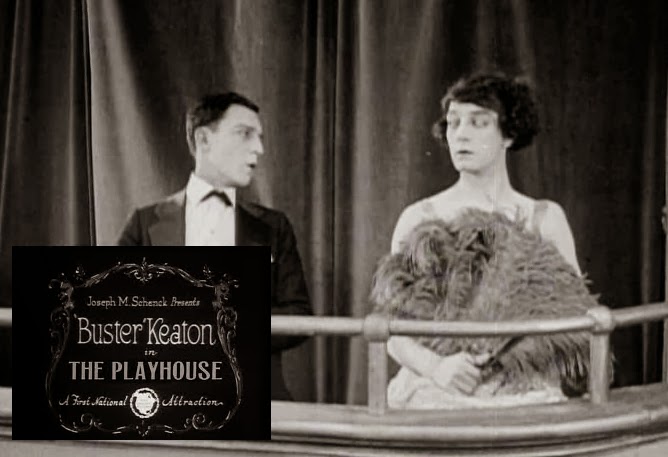
Buster Keaton meets Buster Keaton in Buster Keaton's The Playhouse.

The first flick*: The Playhouse (First National Pictures release of a Joseph M. Schenck Productions film, 1921) [buy the set]

*The IMDb lists this as The Play House.

Current IMDb rating: 7.8

Directors: Buster Keaton (Allez Oop, Grand Slam Opera) and Edward F. Cline (W.C. Fields' You Can't Cheat an Honest Man)

Actors of note: Buster Keaton (Paradise for Buster, The Man Who Bought Paradise), Edward F. Cline (The Boat), Virginia Fox (The Blacksmith), Joe Murphy (Calamity Jane; played Andy Gump in many short films from 1923 to 1928), Joe Roberts (The Paleface)

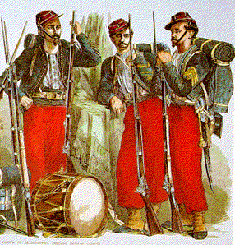
Zouave Guards of the French Army.
The gist of it: Buster goes to an opera house where every performer and every audience member, male and female, young and old, looks exactly like him. One patron opens a program and sees that everyone in the cast and crew is named "Buster Keaton." All this turns out to be the surreal dream of an absent-minded stagehand (also Buster), who is roused from his bed by a belligerent stage manager (Roberts) in what turns out to be a set on the stage of an actual opera house. Buster's girlfriend (Fox) works at the opera house, too, but he's always getting her confused with her twin sister (Fox again) who dresses exactly like her. Buster resolves "never to drink anymore... but just as much."

An animal trainer (Cline) unwisely gives Buster the job of dressing a monkey, but the mischievous orangutan immediately escapes. Buster's solution is to disguise himself as the monkey and go on in the creature's place. Later, Buster is tasked with finding men to play Zouave Guards (French light infantry) in the show. He recruits a bunch of laborers (including Murphy) who were napping on the job next door, and the men do an elaborate but disastrous gymnastics routine. A burly actor (Roberts again) sets his phony beard on fire, and Buster uses an ax to knock it off the man's face. Enraged, the actor chases Buster around the theater. 

Meanwhile, a young woman in the show gets trapped in a glass tank full of water, and Buster comes to the rescue. After unsuccessfully trying to bail her out one teacupful of water at a time, he smashes the tank and floods the entire theater. Sensing dire consequences, Buster grabs his girl and dashes to the Justice of the Peace. But he's grabbed the wrong one, so he goes back to the theater and collects his real girlfriend, carefully marking the nape of her neck with a large "X."

Was this Keaton's comment on showbiz vanity?

My take: An extraordinary technical achievement as well as a pint-sized masterpiece of surrealist comedy, The Playhouse is one of the most amazing things I've seen in this collection. Painstakingly shot with a special shuttered lens that could film only a portion of each scene at a time, this short is a special effects tour de force and a terrific showcase for the versatility of Buster Keaton, who gets to play women, children, musicians, performers of all sorts, and even a monkey. As a writer-director, Keaton was clearly interested in pushing the limits of cinema and seeing how far he could go with the existing technology.

The Playhouse would merely be an interesting but dry technical exercise if there weren't any sharp comedic ideas behind it, but fortunately Buster Keaton's mind was ablaze with such ideas in 1921. The dream sequence, for instance, could be interpreted as a parody of show business egotism and megalomania. (It's also an obvious predecessor for the infamous restaurant scene in Being John Malkovich.) After the dream ends, we think we are back in the "real world," only to find that the supposed bedroom is just another theatrical set! From there, the movie lurches from one bizarre vignette to the next as Buster's slyly subversive character causes chaos throughout the theater. Why Buster Keaton ever decided to make himself up to look like a monkey is beyond me, but he certainly takes to the role with abandon. One wonders about the fate of the escaped orangutan, who is never seen again after making his getaway.

The "Zouave Guards" sequence is another seemingly random, out-of-the-blue choice in the film's diverse script, and it somehow leads to an elaborate slapstick acrobatic routine with a cannon and at least two dwarf actors. (Though maybe it's just one dwarf made to seem like two through camera trickery. In this film, who knows?) The IMDb claims that Keaton's stunts in The Playhouse were "tame" because the actor was recovering from a broken ankle, but he certainly does a lot of running, jumping, climbing, and falling in this film. The water tank sequence, for instance, must have been physically punishing for all the actors involved, including Buster.

Incidentally, the film's little joke about Buster's vow "never to drink anymore" after confusing his fiancee with her identical twin becomes bitterly ironic when you consider that alcoholism would nearly ruin Buster's career and life.

Is it funny: Yes, and frequently, too! It's a shame Buster didn't do more drag humor, because he's awfully good at it. Just the sight of Buster as a society matron in a dress, makeup, and wig is comical because these trappings make him look just like Maggie Smith. He makes a good "bratty kid" and "negligent mother," too. That mother, perched in a balcony, carelessly spills her Coca-Cola on some poor spectators below her. With typical Keaton stoicism, the victim of this rude behavior simply takes out an umbrella to cover himself. Some of my favorite jokes in the film are the simple ones, like when Buster walks up to a punch clock, ponders it for a moment, then very literally punches it. As usual, big bruiser Joe Roberts makes an excellent foil to "twig boy" Buster, and it's fun to see the wily comedian get on the nerves of his physically imposing rival time and again. Buster's main asset as a comedic character is that he's basically unshakable and can quickly adjust to any catastrophe. When the orchestra pit floods, for instance, he merely turns a bass drum into a makeshift canoe and uses a violin as a paddle. Problem solved!

My grade: A


P.S. - Yes, regrettably, there are some racial stereotypes in this film. Namely, Buster appears in full blackface makeup playing a character called "Mr. Bones" as part of a minstrel show, and there's a poster outside the theater showing a caricatured African-American man playing a banjo. No getting around that. But at least the intertitles make no attempt at replicating "Negro" dialect, and the lame joke "Mr. Bones" tells is a standard schoolyard riddle with no racial overtones. Considering that the theater's marquee promises "twenty-five of the world's greatest minstrel stars," the blackface portion of The Playhouse is mercifully brief and not at all central to the film.

"Would you like to fly in my beautiful balloon?": Buster Keaton in The Balloonatic.

The second flick: The Balloonatic (First National/Buster Keaton Productions, 1923) [buy the set]

Current IMDb rating: 6.7

Director: Buster Keaton (The High Sign, The Love Nest) and Edward F. Cline (The Villain Still Pursued Her)

Actors of note: Buster Keaton (Palooka from Paducah, Oh Doctor!), Phyllis Haver (Don Juan, Yankee Doodle in Berlin; broke into showbiz as one of Mack Sennett's Bathing Beauties; retired from acting to marry a millionaire in 1929; she divorced him in 1945 and committed suicide in 1960), Babe London (plump comic actress who worked in films from the 1920s to the 1950s; appeared in The Snake Pit, Road to Rio, and Buster Keaton's The Paleface)

Phyllis Haver and Buster in a flying canoe.

The gist of it: On a fine summer day, Buster visits an amusement park and is bedeviled by phony skeletons, man-made fog, and fabricated demons at a spooky attraction called the House of Trouble. After unsuccessfully attempting to woo a young lady with the old Sir Walter Raleigh cloak-and-mud-puddle routine, our hero then attends a demonstration of a hot air balloon that accidentally takes off with Buster on board. While he's up in the sky "three and a half miles higher than a kite," Buster decides to do some duck hunting and manages to deflate the balloon with his rifle.

After plummeting to earth, he safely lands on top of a tall tree in a wooded area. By the next morning, Buster has set up camp and has somehow constructed a canoe, the Minnie-Tee-Hee, whose three separate sections keep coming apart. Meanwhile, there's an attractive young lady (Haver) who is also fishing and hunting in this same forest, and she keeps crossing paths with the disaster-prone Buster. At first she is irritated with him, but over time she begins to like him. 

After the hapless man narrowly escapes being eaten by a bear, he and the lady begin a "backwoods romance." The young man and woman float down the river in the newly-refurbished Minnie-Tee-Hee, blissfully unaware that they're about to go over a waterfall. But at the crucial moment, the canoe miraculously doesn't fall. We then see that Buster has attached the hot air balloon to the vessel. As Buster and his sweetheart sail through the air in their curious balloon boat, the front and back of the Minnie-Tee-Hee again fall off.

Buster on top of the balloon.
My take: Unlike the other films in this Mill Creek project, the Buster Keaton shorts have often required me to take notes before composing my reviews. The reason for this is that they don't follow any conventional logical patterns, plot-wise, but instead consist of almost-unconnected events strung together in a stream-of-consciousness manner. Just when you think the story is going to be about one thing (Buster is pushed around by creatures in a haunted house), it switches to something else (Buster tries to put the moves on a brunette, only to get a black eye for his troubles), then something else again (Buster climbs on top of a hot air balloon, which then unexpectedly takes off). The hunting and fishing plot seemed to come out of nowhere (a clear blue sky, so to speak), and until the last scene, I thought Buster had forgotten that this was supposed to be a movie about hot air ballooning.

The Fatty Arbuckle and Keystone Cops shorts had only a small handful of comedic ideas apiece; Buster's films seemingly contain dozens, all trying to elbow each other out of the way. The Playhouse obviously had a strong central location to keep things grounded. The Balloonatic, like the hot air balloon itself, is not tethered to anything in particular and simply floats from place to place. The only thing these scenes really have in common is Buster Keaton himself. Maybe that's why Buster insisted on wearing the silly hat and keeping his facial expression the same all the time; it's a way of establishing continuity in a movie that would otherwise be totally disjointed.

Is it funny: A good number of the jokes still work, yeah. I got some yuks out of the physical bits, like Buster pouring water out of his boots by standing on his head, for instance, or Buster diving into the water to save the girl but totally missing the river and flopping on the dirt instead. The House of Trouble (with its irresistible slogan "Get Into Trouble - 10 Cents") is a very promising locale, and I wish we'd seen more of it. One of the film's best gags is that visitors to the House of Trouble are rudely ejected via a slide that dumps them on the front sidewalk. After his experience leaves him befuddled, Buster stays in front of the attraction a little too long, and a hefty customer (London) lands on him. And I enjoyed the scene at a log-flume ride called "Ye Old Mill" in which Buster sits next to an attractive woman. We don't see what happens when their car enters a dark tunnel, but our hero emerges with a broken hat and a severely blackened eye.

My grade: B

P.S. - Apart from the faux Native American name of Buster's canoe, there's nothing racist here, though there is a lot of implied violence towards animals.

Family reunion: Buster gets up close and personal with the in-laws in My Wife's Relations.

The third flick: My Wife's Relations (First National Pictures, 1922) [buy the set]

Current IMDb rating: 6.7

Director: Buster Keaton (The Railrodder, The Rough House)

Actors of note: Buster Keaton (The Gold Ghost, Nothing but Pleasure), Monte Collins (Our Hospitality, The King of Kings), Wheezer Dell (Major League pitcher, 1912-1917), Kate Price (prolific, mostly forgotten silent screen comedienne of the 1910s and 1920s; career petered out in the '30s), Harry Madison (spent a quarter-century on the vaudeville circuit; made only two films, the other being King of the Circus), Joe Roberts (a regular in Buster Keaton's short films until a second stroke killed him in 1923), Tom Wilson (normally a blackface performer; appeared without the burnt cork makeup in Charlie Chaplin's The Kid)

Buster and the clan pose for a portrait.

The gist of it: In "the foreign section of a big city" where "people misunderstand each other perfectly," Buster is a young artist who works as a taffy puller in a candy shop. Unfortunately, he gets a little too into his work, knocks over a helpless mailman, and winds up with someone else's envelope stuck to his shoe in the process. The mailman tosses a bottle at Buster, smashing a window, and our taffy puller takes off running. Unfortunately, he collides with Kat (Price), an enormous and unpleasant woman who sees the broken window, assumes Buster is responsible, and drags him in front of a judge. The judge, however, only speaks Polish and was expecting to perform a marriage ceremony that day, and before you can say "annulment," Buster and Kat are man and wife.

A surprisingly delighted Kat drags the young man home to the small-ish apartment she shares with her father (Collins) and her four enormous, rough-mannered brothers (Dell, Roberts, Madison, and Wilson). Buster gets knocked around a lot at first by the whole family, who say he "won't last a week," but while Buster's asleep, his in-laws rifle through his possessions and find the errant envelope, which leads them to believe that Kat's new hubby has just inherited $100,000. (That's $1.3 million in today's money.) Treating the penniless taffy puller like a king, Kat sends Buster out the next morning to rent a nicer place for the whole family to live. He opts for a townhouse with sky-high rent, and he and his new family begin to live like royalty.

During a party, however, the relations discover that the envelope wasn't intended for Buster, and our young hero has to make a quick getaway before they kill him, bill him, or both! Fortunately, some home-brewed beer (to which Buster has added too much yeast) floods the house with foam, providing Buster the chance to escape from Kat and hop on the first train out of town.

My take: It may have been an omen that Buster Keaton made My Wife's Relations the year after he married actress Natalie Talmadge. Their union came to a bitter end a decade later. Natalie was so thoroughly disillusioned by the experience that she opted never to marry again, but Buster gave matrimony two more chances. (The third time was, in fact, the charm for him.) While The Balloonatic was all over the place, literally and figuratively, My Wife's Relations is a straight-down-the-middle sitcom-type story with a clear narrative through-line. I can imagine the same basic thing happening to, say, one of the Three Stooges. (Most likely Shemp.)

As "marital hell" stories go, Relations can't really compete with the acidic wit of W.C. Field's domestic comedies, but then again, a Fields film wouldn't have the rigorous physical buffoonery on display here. One particularly astonishing sequence occurs when the brothers are chasing Buster around the townhouse. Buster tumbles down one flight of stairs, getting himself rolled up in the carpet, then falls down another flight of stairs, perfectly unrolling the carpet again. After the groundbreaking experimentalism of The Playhouse, Buster Keaton proved with this film that he could do more "normal" stories and still hold the audience's attention with well-conceived and perfectly-executed gags. It's no world beater, but My Wife's Relations is a modest winner.

How about putting some coffee in your sugar, man?

Is it funny: Yes. Keaton isn't trying to dazzle us with cinematic technique or surreal storytelling here the way he did in his other, more daring films. My Wife's Relations is just a clothesline on which he pins a series of goofy jokes. But they're well-done, clever jokes, so it works out just fine, both for him and for us.

As I see it, the comedic highlight is Buster's first meal with his new family. He ends up passing so many items to so many people that he doesn't have time to eat! (A similar thing happened to Danny Kaye in The Inspector General.) Then, the main course -- I think it's supposed to be meatloaf -- is served, and after taking a moment to say grace, Kat and her family go after it like a pack of wild dogs, leaving none for Buster. He craftily comes up with a plan to change that, though, by surreptitiously tearing a page off the wall-mounted calendar and convincing his new family that it's actually Friday instead of Thursday. They must be Catholic, because they immediately stop eating the meatloaf, meaning Buster can have as much of it as he wants. 

In that same scene, Buster gets tired of seeing his brother-in-law add one sugar cube after another to his coffee, so he simply takes the brother's coffee and dumps it in the sugar bowl. Voila! A truly Keaton-esque solution! Another shining moment comes when the entire family is posing for a photographic portrait. Buster has to go to some extreme lengths to make sure he's actually visible in the picture. Watch the movie. You'll see what I mean.

My grade: B

P.S. - I don't think Polish-Americans will be too thrilled with the portrayal of Kat and her piggish family in this film. But their ethnicity is not really the joke here, just that Buster has accidentally stumbled into a terrible marriage with a woman who happens to be Polish Catholic. After the scroll at the beginning, which describes the communication difficulties among non-English-speaking immigrants in large cities, I was expecting much worse than this.

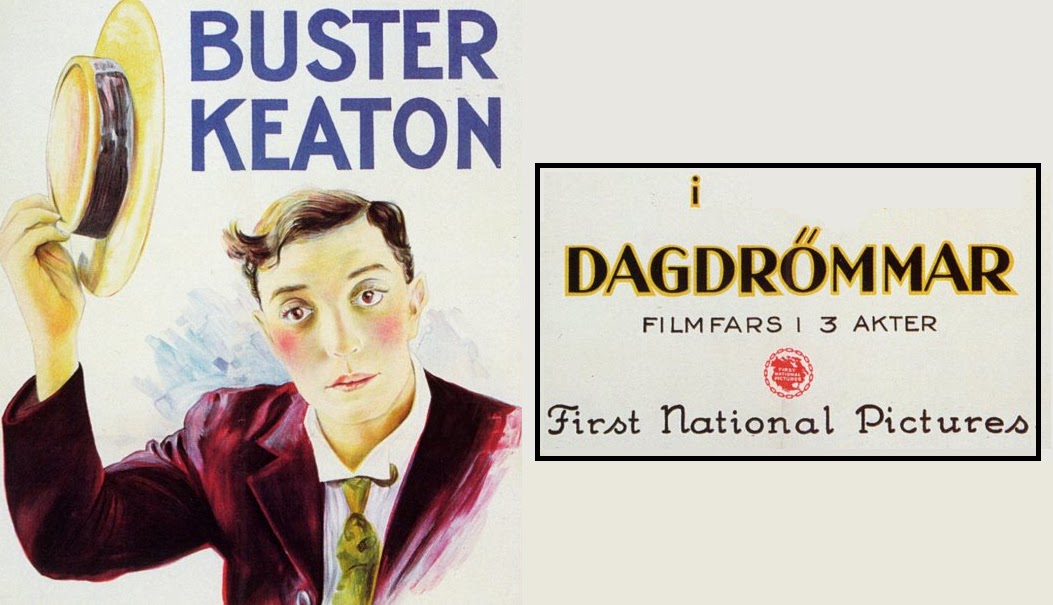
Buster rewires a mansion in The Electric House. At left: a Swedish poster for the film.

The fourth flick: The Electric House (First National Pictures, 1922) [buy the set]

Current IMDb rating: 7.2

Directors: Buster Keaton (Hollywood Handicap, Spite Marriage) and Edward F. Cline (Peck's Bad Boy with the Circus)

Actors of note: Buster Keaton (The Adventures of Huckleberry Finn, How to Stuff a Wild Bikini), Virginia Fox (The Paleface), Joe Murphy (his last film, The Misfit with Clyde Cook, was released posthumously in 1924), Steve Murphy (Chaplin's The Gold Rush, Keaton's Sherlock, Jr.), Joe, Myrna, and Louise Keaton (Buster's real-life father, mother, and sister)

"Electric snooker": A Buster Keaton innovation.
The gist of it: Buster has just graduated from "State University" with a doctorate in botany, but he gets his diploma mixed up with that of an electrical engineer (Murphy). The wealthy dean (Roberts) offers Buster a job wiring his mansion for electricity, and Buster accepts because he has a crush on the rich man's daughter (Fox). The real engineer is none too pleased with this outcome and seethes with resentment at Buster. The dean and his family then go on holiday, expecting Buster to be done with the job when they come back home.

When they return, they find that the young man has indeed added all kinds of crazy electrical gadgets to their house, including: a lever that raises or lowers the water in the pool; a model train that carries dishes from the kitchen to the dining room and back; a conveyer belt that loads and unloads the balls from a snooker table; and an escalator to the second floor. The escalator moves too quickly, though, and sends the dean crashing through an upstairs window into the aforementioned pool. Despite this and other mishaps, the family throws a party to show off their "newfangled" home to some guests. But the real electrical engineer sneaks into the home with the intention of sabotaging Buster. It works, and the machines start attacking the guests.

Buster then attempts to get a little retaliation of his own against the engineer by using the escalator to dump his rival in the pool. Unhappily for Buster, he ends up inadvertently depositing the dean into the pool, too. Buster is fired by his outraged employer and then tries to commit suicide by jumping in the pool with a heavy rock from the garden tied to his waist. The dean (who hates Buster) and his daughter (who now loves him) use the electric lever to alternately raise and lower the water in the pool, either saving or drowning him. But while they argue whether the botanist should live or die, a huge drain pipe carries Buster away to a remote spot in the woods... where he's reunited with the soaking-wet electrical engineer.

Design for Leaving: Daffy modernizes Elmer's home.

My take: Buster Keaton was rather famously injured during the filming of the escalator sequence of The Electric House, so he shelved the film temporarily and worked on The Playhouse instead, limping along on a broken ankle. But he started again from scratch on The Electric House with all-new sets and all-new footage the very next year. Why? I'm guessing it was because he sincerely believed in the underlying concept and knew it would work. And he was right! Our lives and homes are so technology-saturated today that the basic premise now seems a little quaint, giving this short some added historical value. It reminds me of that great Daffy Duck/Elmer Fudd cartoon, Design for Leaving (1954), in which the mercurial mallard plays an overeager salesman who installs various "push-button" devices in a cranky suburbanite's home for a ten-day free home trial. These machines end up trashing the house and brutalizing its owner -- not by malfunctioning, but by functioning too well.

The same basic thing happens here, except that the homeowner has volunteered for this treatment. I wonder if the makers of Design for Leaving saw The Electric House. I'm sure they must have at some point. In any event, while Keaton did not have the freedom afforded to filmmakers through animation, he did come up with plenty of ingenious devices and wild, gadget-centric situations in this satire of technology in the days of the Warren G. Harding administration. The escalator is probably the most impressive of all... even if it did temporarily hobble the great comic. All told, Design for Leaving is one of the strongest Keaton shorts I've seen and, as always, features some dazzling stunts. I'm tellin' ya, man, this Buster Keaton was a world-class athlete! The exteriors of the electrified house, by the way, were filmed at Buster's real-life home, so if you want to see how he was living in those days, here's your chance.

Is it funny: Oh, yes. The single funniest sight in this film is that of Buster trying in vain to run against the direction of the escalator and getting nowhere fast. Perhaps the best use of this device comes when Buster tries to lug a heavy trunk up the stairs, not knowing that a female servant has crawled inside after being bedeviled by the vengeful engineer's tricks. Meanwhile, Buster and Joe Roberts have a great skinny-guy-annoys-fat-guy dynamic going, making it all the more sad that Roberts only had a year or so left to live. But pretty much everybody in The Electric House is injured in some way by Buster's strange machines, as when Buster's famous model train simply bypasses all the other people sitting at the dinner table and deposits all the dishes right in the lap of the dean's wife. In real life, Buster was so taken with the train that he set up a similar one in his own dining room at home. I'm guessing he didn't do the same with the escalator.

My grade: A-

OVERALL GRADE FOR BUSTER KEATON CLASSICS: A-


P.S. - Noting even remotely like a racial or ethnic stereotype here.

Sunday, September 15, 2013

Mill Creek comedy classics #56: "Buster Keaton Festival" (1921-1922)

Writer-director-star Joseph Frank "Buster" Keaton is considered a genius of early film comedy.

Joseph M. Schenck gave
Buster his big break.
NOTE: This program contains four silent films, each about 20 minutes in length, which comedian Buster Keaton made in 1921 and 1922, starring in them as well as co-directing and co-writing. Born Joseph Frank Keaton on October 4, 1895 in Piqua, Kansas, young "Buster" (a nickname which, according to legend, was bestowed upon him by Harry Houdini) entered show business at the age of three as part of his family's slapsick-oriented vaudeville act, with his alcoholic father Joe and his beleaguered mother Myra, who played the saxophone. Never receiving much in the way of formal schooling, Buster nevertheless became a rising comedy star as a member of "The Three Keatons" and broke with his father to start a solo career in the late 1910s. 
After serving in World War I and suffering permanent hearing damage as a result, Buster met Roscoe "Fatty" Arbuckle in 1917 and soon signed a film contract with producer Joseph M. Schenck, a key figure in the early motion picture industry. Schenck assigned the young comic to work with Arbuckle as a supporting actor, gag-man, and all-purpose crew member. Satisfied with the young man's work, Schenck generously allowed Keaton to make his own silent comedies under the personal banner of Buster Keaton Productions. First came a number of successful short films, including the four I am about to review, then a series of features which are among the most-acclaimed in comedy and film history. Critic Roger Ebert pinpoints the years between 1920 and 1929 as Buster's creative peak. During this era, Buster Keaton earned the nickname "the Great Stone Face" for his never-changing stoic appearance. 
In features and shorts, Keaton wowed audiences and critics alike with his daring stunt work and innovative gags. His film-making career declined, however, once he signed on with MGM and lost the creative independence he had enjoyed with Schenck. Like his father (who was killed by a passing automobile in 1946), Buster also became an alcoholic and nearly lost his career because of it. Happily, though, he made a comeback in the 1940s as a busy and in-demand comedic character actor, and he racked up many, many film and television appearances right up until his death in 1966 at the age of 70.

This ad for The Blacksmith parodies Longfellow, but they should have changed "brawny" to "scrawny."
C'mon, guys, that's Parody 101.

The first flick: The Blacksmith (First National Pictures release of a Buster Keaton Productions film, 1922) [buy the set]

Current IMDb rating: 7.0

Directors: Buster Keaton (The General; Sherlock, Jr.) and Malcolm "Mal" St. Clair (The Goat, The Bullfighters; busy director of shorts and features of all genres in the silent years; career faltered a bit in the sound era, but he did direct four Laurel & Hardy features in the 1930s and 1940s; famed as one of Hollywood's tallest directors)

Actors of note: Buster Keaton (Sunset Blvd., Around the World in Eighty Days, The Villain Still Pursued Her), Virginia Fox (1920s comedienne who mostly worked for Mack Sennett; married for 55 years to film tycoon Daryl F. Zanuck), Joe Roberts (Our Hospitality, One Week; appeared in nearly all of his pal Buster Keaton's short films but not much else; died of a stroke the year after this movie was released)

Publicity shot with Keaton, Roberts, and Fox.
The gist of it: Opening with a few lines from Henry Wordsworth Longfellow's poem, "The Village Blacksmith," this film depicts Buster as the predictably incompetent assistant to a burly, ill-tempered blacksmith (Roberts). Buster's duties include shoeing horses and repairing automobiles, but he excels at neither of these. When he goes to assist his disagreeable boss, a giant magnet over the door of the workshop snatches two hammers and a wheel away from the hapless Buster.

When the boss starts pushing him around, a sheriff tries to intervene... only to find that his badge and gun have been grabbed by the giant magnet, too. A group of deputies manage to drag the blacksmith off to jail after Buster knocks him out by falling on him. But our hapless hero's problems do not end there. An attractive female equestrian (Fox) brings her white horse in to be shoed and groomed. Buster chooses to do this while simultaneously working on a car, so he manages to get oily handprints all over the animal. Another horsewoman comes in, complaining about the roughness of the ride, and Buster sells her a ridiculous contraption called a "saddle shock absorber" and sends her bouncing off down the road. Later, a wealthy man brings his fancy car into the shop to be repaired, and Buster wastes little time in destroying it.

While he's doing this, the blacksmith gets out of jail and comes looking for revenge. He and some of the shop's dissatisfied customers (including the wealthy man and the shock absorber lady) form a lynch mob and go after him. Meanwhile, Buster has managed to (accidentally) save the life of Virginia Fox's character, and the two of them hop on board the "honeymoon express," while the lynch mob is drenched by a railroad water tower.

Buster's famous hat
My take: One aspect of Buster's on-screen character I have thus far neglected to mention is his famous hat: an absurdly flat porkpie-style topper. It looks either like a cake which has failed to rise or a flying saucer piloted by tiny aliens who have inadvertently parked their vehicle on top of Buster Keaton's head. In The Blacksmith, Buster wears the hat at all times, and his long, thin face makes the pitiful little chapeau seem all the more inadequate and undersized for the job it's supposed to be doing. You get the impression that this guy has owned the hat since he was a small child and didn't stop wearing it even though he'd outgrown it.

Anyway, the plot of The Blacksmith is par for the course in comedic shorts of this nature: a guy screws up at his job in a variety of ways, causing mayhem along the way and angering both the boss and the customers. I'd say that sitcoms and movies are still doing variations on that basic formula, wouldn't you? This could have been The Butcher, The Baker, or The Candlestick Maker, and the plot wouldn't have been that different.

The challenge here is: what kind of jokes can you do in a blacksmith's shop? Well, there are hot coals, which Buster can use to cook his lunch. And he can also manage to accidentally sit on a red-hot horseshoe, forcing him to cool his ass off in a bucket of water. (I think this the first time that beloved cartoon joke has shown up in one of these Mill Creek comedies.) Buster increases the number of comedic possibilities by having the blacksmith's shop offer both horseshoes and auto repair, allowing him to do horse jokes (Buster treats a horse as if it were a human customer at a shoe store) and car jokes (Buster uses a child's balloon to hold up one end of an automobile's frame until it pops, sending the car crashing down).

In general, the gags work as intended, and the film is fast-paced and amiable, making The Blacksmith a success. I can't say I would have sensed genius here, but there is a definite skill in the way Keaton sets up his jokes. Notice, for instance, the big "reveal" of the oily handprints on the side of the white horse. From one side, the horse looks completely normal. Then, its rider turns her steed around, and we see the extent of the mess Buster has made.

Is it funny: Yeah, I laughed a few times, particularly at the movie's opening joke. The first intertitle card is a quote from the famous Longfellow poem: "Under the spreading chestnut tree, the village smithy stands." Cut to Buster leaning against a very tall palm tree. The camera methodically tilts upward to show the top of the tree, then a wide shot reveals how small Buster looks standing next to it. Big, bald Joe Roberts makes a perfect foil for Buster; they're a classic Laurel & Hardy-type "angry fatso vs. dimwitted beanpole" duo. Buster's utter detachment is the key to his comedic persona. He doesn't react visibly to the events around him; he simply accepts them as they come, good and bad, with that same stoic countenance. In the tableaux of domestic bliss at the end of the film, Buster is now apparently a husband and father, but he looks neither happier nor sadder than he was as the blacksmith's lowly assistant.

My grade: B+

P.S. - No real racist humor here. Buster does get his face covered in motor oil, but there's never any attempt to convey this as "blackface."

Interestingly, "Eddie" Cline does get a co-writer and co-director credit in this ad for The Boat.

The second flick: The Boat (First National/Buster Keaton, 1921) [buy the set]

Current IMDb rating: 7.1

Director*: Buster Keaton (Steamboat Bill, Jr.; The Cameraman)
*He doesn't get an onscreen credit in the print I saw, but the IMDb says that Edward F. Cline of The Villain Still Pursued Her was Keaton's co-writer and co-director on this and other films.
Actors of note: Buster Keaton (It's a Mad Mad Mad Mad World, A Funny Thing Happened on the Way to the Forum), Edward F. Cline (stalwart director of comedies from the 1910s through the 1940s; last credit was Life with Buster Keaton, a 1951 TV series; as an actor, appeared in Cops, The Scarecrow, and other short films of the 1910s and 1920s), Sybil Seely (One Week, The Scarecrow; one of Buster's frequent leading ladies but quit the business after just a few years to marry a writer named Jules Furthman)

Buster's fans call themselves
Damfinos because of this short.
The gist of it: Buster has built a boat, the Damfino (a play on "damn if I know"), in the workshop under his house, but it's too big to fit through the door once it's completed. He widens the door and tows the boat outside with the family car, bringing down the entire house in the process. Undaunted, he salvages a bathtub from the rubble and takes his wife (Seely) and two small sons out on the road, dragging the boat behind them. They arrive at a marina, where Buster gets out of his car while it's still rolling, sending it tumbling off the pier into the water.

After an unsuccessful first launch, Buster finally manages to get the Damfino afloat, and he takes his family on a sea cruise into the mighty Pacific Ocean (destroying a bit of the pier in the process). Once anchored out at sea, the Damfino is hit by a mighty storm and begins to take on water. Buster wires for help, but the SOS receiver (Cline) thinks it's a prank when he hears the vessel's name. The would-be sea captain manages to get his wife and sons into the bathtub lifeboat, while he apparently goes down with the ship. His porkpie hat rises to the surface, and his family members begin to mourn -- until they see that Buster is still under it. He climbs into the bathtub with them, but this makeshift dinghy also begins to sink. That's when Buster and his family realize that the water beneath them is only a few feet deep, and they simply walk to shore.

My takeThe Boat is quite an accomplishment, both as a comedy and as an example of early cinema. Buster attempts -- and, better yet, achieves -- some very ambitious moments here. The destruction of the Keaton homestead, for instance, is perfectly handled. And that's good news, because there's no way he could have gotten a second take of it. Once the boat is out on the water, Keaton manages to use camera tricks, pantomime, revolving sets, and models to create the illusion of nautical discord. It's really quite something. You ought to see it.

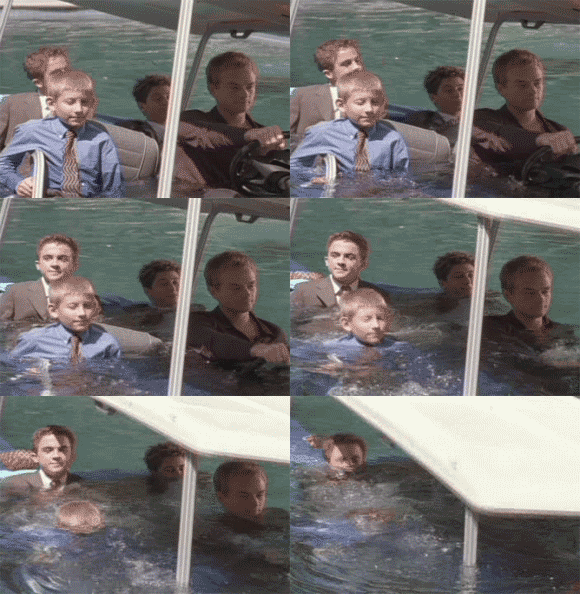
A Keaton-esque moment from Malcolm in the Middle.

With his permanently blank facial expression, Buster serves as his own straight man. Throughout the many calamities in this film, Buster's mood never changes. Twice during The Boat, Keaton calmly stands atop the Damfino as it sinks into the Pacific Ocean. It reminded me of a moment from Malcolm in the Middle in which the show's four rowdy brothers betray almost no emotion as their golf cart is submerged in a water hazard. The outlandish visual jokes were Buster's specialty, of course, but he also used the captions and intertitle cards to his advantage. In The Blacksmith, he was able to ironically contrast his pitiful character with the paragon of manliness described in Longfellow's verse. In this film, he uses the cards to convey a bit of comedic "dialogue" between himself and Eddie Cline.

After a few viewings, I can easily see why Buster Keaton's hardcore fans have decided to honor this particular film by dubbing themselves "the Damfinos." Modern day viewers, however, might be horrified at Buster Keaton's terrible parenting style. He himself was physically abused on stage as part of his family's act when he was a child, and his character's sons are treated just as roughly in this movie.

Is it funny: Yes, happily. I've already mentioned the film's major visual gags, but there are a lot of funny little moments along the way, too. My favorite moment comes when Buster has accidentally dumped his son overboard; the selfish father tests the water's temperature before deciding whether or not to jump in and rescue the child. Then, there's Buster's ill-advised attempt to nail a painting to the wall of the ship's cabin. When water starts pouring in, the confused man seems to think that perhaps the painting itself (a nautical scene) is leaking. Later, when the Damfino starts taking on water in disturbing quantities, Keaton drills a hole in the bottom of the boat to let some of it out. Needless to say, he's unhappy with the results. I also appreciated the fact that the bathtub's faucet somehow still worked and could provide fresh drinking water on demand. Buster catches some in his hat, but then puts the hat back on his head.

My grade: A-


P.S. - Any racial stereotypes? Nope. No room for 'em on the boat, I guess.

Buster Keaton shares the screen with a fake Indian (Joe Roberts) in The Paleface.

The third flick: The Paleface (Assorted First National/Buster Keaton Productions, 1922) [buy the set]

Current IMDb rating: 7.0

Director*: Buster Keaton (Our Hospitality, The Navigator)
*Again, Edward F. Cline was an uncredited co-director.
Actors of note: Buster Keaton (Convict 13, Beach Blanket Bingo), Virginia Fox and Joe Roberts (both from The Blacksmith, as seen above)

Buster's winsome co-star, Virginia Fox
The gist of it: An unscrupulous oil tycoon wants some land which currently belongs to a peaceful Indian tribe, so he sends one of his thugs to knock one of the tribesmen out and steal the deed away from him, leaving a silver dollar in the man's palm as "payment." The tribe's Chief (Roberts) gets notice that he and his people have to vacate the land, so he instructs his warriors to kill the first white man who sets foot on the property. That happens to be an oblivious butterfly collector (Keaton) who has no clue what is going on. The Indians tie Buster to the stake to burn him alive, but he escapes and takes shelter in a nearby cabin, where he he designs a fireproof bodysuit to be worn under his clothes.

Once he's recaptured by the tribe, Buster survives being burned at the stake because of his "asbestos BVDs" and is initiated into the tribe as a member in good standing. A lovely Indian maiden (Fox) takes notice of this odd new tribesman, who is dubbed "Little Chief Paleface." He and his fellow Indians go to the office of the oil man and do a war dance around his desk. But the bad guy sneaks out, steals a horse, and escapes. Buster and the Indians go after him, but the oil man gets the drop on Buster and demands that they switch clothes, so the approaching Indians will aim their arrows at Buster instead. It works for a while, but eventually the tribesmen realize that the man they thought was the oil tycoon is really Buster, aka "Little Chief Paleface." Better yet, the oil man forgot to take the deed to the land out of his suit pocket. Triumphant, Buster kisses the Indian maiden (whom he calls "squab" instead of "squaw") in a moment of passion which goes on for a ridiculously long time.

My take: Much shorter and incalculably funnier than Kevin Costner's Dances with Wolves, The Paleface is an excellent showcase for Buster's talents as both a comedian and as a director. Of course, the holocaust of Native Americans at the hands of Europeans was not so distant in the country's rear-view mirror at the time. In the 2009 documentary Reel Injun, which includes clips of The Paleface, critic Jesse Wente puts it this way:
There were more than a hundred silents made involving Native Americans, very much as this part of American history, of course, was really still ongoing at the time that cinema was really being born.
So the wounds were still fresh when Buster Keaton made this film. While The Paleface does not present an enlightened, complex view of Native Americans, it at least makes them (mostly) the heroes of this story. The villains are greedy jerks who want to take the beautiful land away from the Indians and drill for oil there. Buster is caught in the middle and, admirably, sides with the natives. The Paleface is not really intended as any kind of racial or political statement, though. It's a showcase for Buster Keaton, and it's quite a magnificent one.

Filmed mostly outdoors, The Paleface makes excellent use of its locations, especially in the long shots which show the action at a distance so that the audience gets a good look at the natural surroundings. This helps when Buster is, say, falling off a cliff or trying to cross a canyon on a precarious rope bridge. While modern audiences may cringe a bit at the very "Hollywood" depiction of Native American life, it's difficult to deny the artistry and craftsmanship that Buster Keaton brought to this film.

Is it funny: And how! Sorry, but I couldn't resist that terrible, terrible joke. The Paleface is chockablock with classic Keaton routines. He starts earning laughs from the moment he makes his first appearance, trying in vain to beat up a butterfly. And there's a very amusing sequence when he discovers that the stake to which he has been tied is not embedded in the ground. Without spoiling anything, I'll say that his character takes great advantage of this situation. More than the other comedians of this era whose work I've been seeing lately, Buster really tries to defy the laws of gravity and physics in his films. His "Chief Paleface," who cannily adds a feather to his trademark porkpie hat, soars and tumbles and goes flying through the air like a cartoon character. Probably the film's best sequence is the one in which he builds a bridge while he crosses it. But there are funny little moments, too, as when the butterfly collector stands behind a tiny tree for the sake of modesty when he and the oil tycoon trade clothes.

My grade: A-


P.S. -  Obviously no African-American stereotypes, but Native American stereotypes? You betchum, kemo sabe. There's a little bit of phony "Injun talk" in the title cards, and members of a rival tribe are inelegantly referred to as "savages" who "went broke playing strip poker." All the usual Hollywood cliches are here: war dances, peace pipes, scalping, burning at the stake, an exotic Indian princess who falls for the white hero, etc. Like I said, a documentary this ain't. But for the time, the politics of The Paleface are fairly progressive.

A lovely Dutch advertisement for the film. The foreign title translates as The Daydreamer.

The fourth flick: Daydreams* (First National, 1922) [buy the set]
*The IMDb spells it Day Dreams.
Current IMDb rating: 7.0

Director*: Buster Keaton (In the Good Old Summertime, Excuse My Dust)
*Again, Edward F. Cline is Buster's co-director. He's credited on the print I saw.
Actors of note: Buster Keaton (episodes of TV's The Twilight Zone, The Donna Reed Show, Route 66, and Burke's Law), Renée Adorée (French-born ex-circus performer turned film star; died of tuberculosis at age 35), Joe Keaton (Buster's dad, a drunken ex-vaudevillian; Buster threw a few parts his way once he made it big in silent pictures), Edward F. Cline (see The Boat above), Joe Roberts (see The Blacksmith above), George Rowe (Stan Laurel's Oranges and Lemons)

Buster evades the police in a giant paddle wheel. 

The gist of it: A young man (Buster Keaton) wants to marry his sweetheart (Adorée), but the girl's crotchety father (Joe Keaton) wants to know if this ne'er-do-well can support his daughter. The young man says he'll go to the city and try to accomplish great things. If he fails, he vows to shoot himself. The girl's father agrees to this and says the young man can use his revolver.

Our hero does go to the city and starts sending back letters to his girlfriend, stretching the truth outrageously about his supposed triumphs. First, he tells her he's heading up a sanitarium with 200 patients... when he's really working at a veterinary hospital, and his "patients" are cats and dogs. He gets fired from this job after mistaking a skunk for a cat and bringing it into the doctor's examining room. Then he writes his girl that he's "cleaning up" in the financial district. And he is... as a street sweeper. The problem is, he's having no luck whatsoever removing dirt from the street, dumping some of it in open manholes and onto the heads of unamused sewer workers.

His fortunes further decline when there's a messy ticker tape parade for the Mayor (Roberts) and he unwisely chooses a fire hose to clean the street. Finally, he tells his beloved that he's playing the lead in Hamlet. In truth, he's merely an extra, apparently portraying a Roman soldier in a historical pageant. When he winds up on the wrong side of the curtain at the end of a scene, the angry theater director (Cline) tosses him out on the street with only his skirt-like Roman soldier costume. He tries to steal a suit of clothes from a second hand shop and attracts the attention of policemen, leading to an uproarious chase which ends with Buster jumping in the water and being caught by a fisherman... who throws him back.

Our sad protagonist returns as a failure to his girlfriend and her father and agrees to accept his fate, but he misses when he tries to shoot himself. Buster asks the girl's father how he can set things right, and in response, the father tosses the worthless young man out the window.

My take: Considering the rocky relationship Buster and Joe Keaton must have had, Daydreams is a fascinating artifact indeed, seeing as how Buster spends the entire movie trying and failing to win Joe's approval. This turned out to be my favorite of the four Keaton shorts in this collection, though I liked each of them individually.

What sets Daydreams apart is the sheer variety of settings and the wild inventiveness of the jokes on display in this one film. Because Buster's luckless (and, truth be told, brainless) character attempts three different jobs, we get to see him in three very different environments. First, he struggles with the animals at the veterinary hospital, stupidly putting a cat into a bottomless basket and then even more stupidly grabbing a skunk by its tail and bringing it inside. (Later, we see Buster in a robe burying his clothes in the backyard.) Next, we see Buster as a street sweeper whose job is like a comedic version of the myth of Sisyphus. The more he attempts to "clean" the street, the messier it gets.

His final career, as a bit player in the theater, flashes by all too briefly but leads to one of the greatest comedic foot chases I've ever witnessed. The climactic riverboat scene, with Buster running around inside the vessel's paddle wheel like a hamster in a wheel, is a classic. It's funny because it's unexpected, and it's also quite a feat on Keaton's part. Make no mistake: this man was a great athlete. Just examine the scene in which he manages to jump aboard a moving streetcar. I hope his dad was suitably impressed.

Buster Keaton's Daydreams evokes harakiri. 

Is it funny: Oh, yes. Quite. The movie quickly sets up what is, to me, a very funny pattern: Buster sends letters to his girl in which he lies about his job, and the girl swoons and dreams of the success her paramour is having. If nothing else, this affords us the chance to see Buster Keaton very briefly play Hamlet, complete with tights and a skull. Buster's pledge to kill himself, a Westernized version of harakiri or seppuku, gives the film a dark undertone which, to me, made it even funnier. Since this movie is about impressing one's elders and maintaining honor at all cost (even death), I wonder how well it played over in Japan. In any event, Daydreams (unlike its spectacularly incompetent protagonist) works extremely well from start to finish, with Keaton's intricate jokes landing right where they're supposed to. What can I say? I loved this one.

My grade: A

OVERALL GRADE FOR BUSTER KEATON FESTIVAL: A-


P.S. - Not a stereotype for miles.