Showing posts with label Charles Ruggles. Show all posts

Sunday, June 9, 2013

Mill Creek comedy classics #6: "Her Favorite Patient" (1945)

Which of these titles would have convinced you to cough up 40 cents back in 1945?

The flick: Her Favorite Patient (United Artists, 1945) [buy the set]

Current IMDb rating: 5.6

Director: Andrew L. Stone (The Last Voyage, Stormy Weather)

Actors of note:
  • John Carroll (Only Angels Have Wings, Go West)
  • Ruth Hussey (The Philadelphia Story, The Uninvited)
  • Charles Ruggles (Goodbye LoveLove Me Tonight, Son of Flubber)
  • Ann Rutherford (Gone With the Wind, The Secret Life of Walter Mitty, the Andy Hardy series)

The gist of it: Pretty young Dr. Hedy Fredericks (Hussey) is bound for Chicago and a job in a research lab, but she stops by her hometown to visit her bachelor uncle (Ruggles), also a doctor, and brings three hitchhiking Marines -- all named Smith -- along with her. The uncle's medical caseload is overwhelming, so he desperately needs his niece to stay in town. Meanwhile, swaggering local jet pilot Morgan Hale (Carroll) has taken a shine to our lovely doctor, so he and the uncle cook up a scheme to keep her there. To wit: the pilot suffers a minor head injury but then fakes the symptoms of pantophobia (fear of everything) so that she'll stick around to treat him.

My take: Every boy-meets-girl story needs a gimmick, and this one's is that the boy is shamelessly malingering, i.e. exaggerating symptoms for some secondary gain (in this case, love). Her Favorite Patient is a lighthearted little trifle from the waning days of WW2. It's the second Charles Ruggles movie of the collection, but it's not nearly so freewheeling and fleet-footed as Goodbye Love. No, this one is more sentimental and patriotic, with lots of dialogue about serving one's fellow man and, thus, one's country. There's even a serious subplot about a young lady who's been horribly scarred in an accident and desperately needs our young doctor to perform plastic surgery on her so that she won't be disfigured for life.

I think we're supposed to consider the heroine's hometown to be a charming, pleasant place to live, but it looks like hell on earth to me. The local population has exploded, but the town simply isn't equipped to handle the influx of new residents. Parking and lodging are at a premium. Patrons of a downtown cafe have to wait in a long line for a table... and get lousy food for their troubles. Every place you can possibly go is crowded, and there are only two doctors to care for all these people. But everybody's exchanging snappy 1940s movie banter, so I guess they're all okay with it.

More than anything, Her Favorite Patient is a cinematic message-in-a-bottle sent from a long lost age. The hero, who kind of resembles an undernourished Clark Gable, has pomaded hair and a thin mustache, traits that today would mark him as a sleazy criminal but back then rendered him, in the movie's words, "catnip to women." Colorful '40s slang abounds here. Morgan Hale's previous gal pal, Lola (Rutherford), says he's "as true as a $2 cornet," whatever the hell that means. Our leading lady, meanwhile, favors outfits with blocky padded shoulders that form perfect 90-degree angles at her sides. And you know you're in another era entirely when doctors not only drink in the operating room but offer cigarettes to their patients.

Devotees of film music will want to know that the serviceable score for this movie is by Emil Newman, part of the formidable Newman dynasty of film composers. Emil is the brother of Lionel and Alfred and the uncle of Randy. Modern day viewers may want to know why a dwarf actor in a bellboy uniform shows up in one of the restaurant scenes. It's because of Johnny Roventini, the diminutive spokesman for Philip Morris for 40 years, the guy who's always yelling, "Call for Philip Morris!" Pulp Fiction even has a Roventini lookalike working at Jackrabbit Slim's. The real guy was on I Love Lucy, too.

Harvey Korman in Blazing Saddles: "That's Hedley!"
Is it funny: Eh, it could be funnier. Like I said, pretty much everyone makes with the rapid-fire 1940s banter 24/7, but it all feels a bit forced and uninspired. Preston Sturges this ain't... not quite. And John Carroll and Ruth Hussey, while both acceptable, aren't exactly Tracy and Hepburn, either. I was glad to see good old Charlie Ruggles back, too, but he's a kindly supporting character here and exists mainly to service the plot and facilitate the Carroll/Hussey relationship. He hasn't lost his way with a witticism, though, and he gets in a few cynical zingers about bachelorhood and the newspaper industry.

There are a few inspired comedic setpieces here, including a frantic comedic car chase in which Carroll drives alongside Hussey and shouts the Hippocratic Oath to her while they both dodge obstacles, plus a late-in-the-game scene that has Hussey (who has learned the truth about her patient's condition) putting Carroll through some torturous "treatments," including an ice bath, intentional bee stings, and a session in one of those old-timey steam baths in which you sit in a big metal box with only your head sticking out at the top. Her Favorite Patient could have used a few more moments like these,... or else they could have cut maybe 10 minutes from the running time to solve some pacing issues. For you Mel Brooks fans out there, the film offers an additional layer of unintentional enjoyment due to the lead character being named Hedy. She's addressed by name many times throughout the film, and each time, I involuntarily replied, "That's Hedley!"

My grade: B- (which is generous)

P.S. - No embarrassing African-American stereotypes here.

Wednesday, June 5, 2013

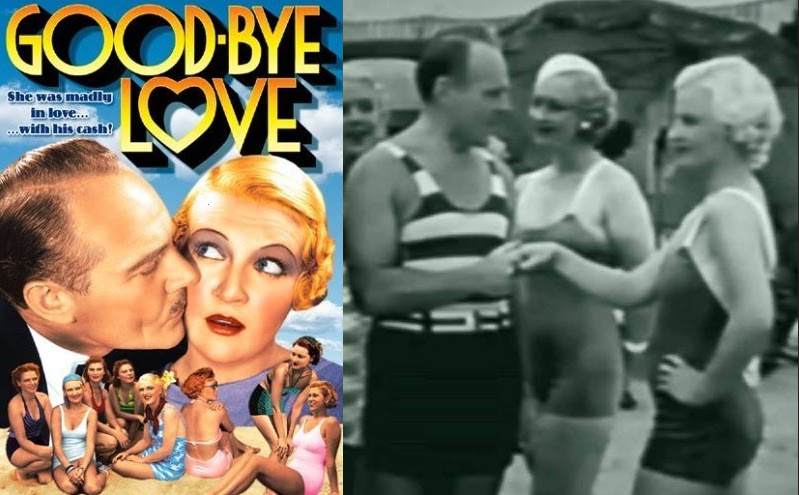
Mill Creek comedy classics #4: "Goodbye Love" (1933)

Charles Ruggles surrounded by bathing beauties in Goodbye Love.

The flick: Goodbye Love (RKO Radio Pictures, 1933)  [buy the set]

Current IMDb rating: 5.1

Director: H. Bruce Humberstone (I Wake Up Screaming, several Charlie Chan films)

Actors of note:
  • Charles Ruggles (Bringing Up Baby, The Parent Trap, TV's Aesop and Son)
  • Verree Teasdale (A Midsummer Night's Dream)
  • Sidney Blackmer (Rosemary's Baby, High Society)
  • Mayo Methot (Mr. Deeds Goes to Town)
  • Ray Walker (It's a Wonderful Life)
  • Edward Van Sloan (Frankenstein, Dracula, The Mummy)
  • Hattie McDaniel (Gone With the Wind, Song of the South)

The gist of it: A bumbling butler (Ruggles) needs some cash to get out of "alimony jail," where his embittered ex-wife has placed him for nonpayment. His wealthy stockbroker boss (Blackmer), a fellow "alimony jail" inmate, advances him $2500 on his salary. The butler, though, gives merely a month's alimony to his ex (an enormous, ill-tempered woman) and spends the rest on a seaside vacation at a rather fancy resort  where he passes himself off as a millionaire and big game hunter, attracting the attention of a ruthless golddigger. This very same golddigger, it turns out, is also engaged to the butler's boss, the stockbroker! Several marriages and divorces occur among the cast members before the whole mess is sorted out.

My take: You don't hear the term "alimony jail" much these days, but apparently the idea of husbands providing financial support for ex-spouses was a new, controversial idea back in '33 because this whole film is built around it. It presents ex-wives as lazy, materialistic succubi, draining the life and money out of their beleaguered ex-husbands. Before you cry "sexism," I should point out that the men in this film are no great shakes themselves, horny devils getting in and out of marriages without much forethought and then trying to weasel out of paying spousal support. In fact, I was surprised how refreshingly cynical this 80-year-old film was about the topic of marriage. I didn't even think Hollywood made divorce comedies back then!

The flick is nothing special from a technical standpoint with merely adequate direction, but it looks acceptable for what it is, considering its age and budget. Goodbye Love would work just as well as a stage play. The acting, writing, and plot carry it off nicely, though. Movie buffs will almost certainly recognize two very familiar performers in the supporting cast. First is a pre-Gone With the Wind Hattie McDaneils, playing yet another Mammy-type maid. Classic horror fans, though, will likely be more interested in Edward Van Sloan, a character actor who had appeared in Universal's Frankenstein and Dracula. Here, he's a genial justice of the peace who presides over a couple of chaotic wedding ceremonies and has to look bemused at the wacky goings-on.

Aesop and Son: A prestigious credit for Charles Ruggles.
Is it funny: Yes! For the first time in this project, I've seen a film that actually deserves to be called a "comedy classic." Almost all of that is due to Charles "Charlie" Ruggles, the voice of the toga-wearing, story-telling dad in the Aesop and Son segments of The Bullwinkle Show. (From where I sit, being on Bullwinkle is better than winning an Oscar. And,  yes, this film has an actual Oscar winner in the cast, Hattie McDaniels.) Flustered and spineless, yet capable of droll asides, Ruggles is a subtle but very funny comedic presence. There's no real modern equivalent for him. Not long ago, I saw Ruggles playing another butler character in Universal's The Invisible Woman, and he was probably the best thing in that film, too.

The script for Goodbye Love is very sharp with lots of witty one-liners that I will not spoil by repeating them here. Just watch the flick and discover them yourself. The script, while often formulaic, goes off on some admirably weird tangents, too. When the stockbroker's greedy first wife confronts the even-greedier golddigger, for instance, I thought they'd just squabble a little. Instead, they get rip-roaring drunk together (this was only a few months after the end of Prohibition) and plot against their mutual target. Then, there's the scene in which the stockbroker gets thrown in jail. It plays out almost like the middle section of Goodfellas, when Henry Hill and his fellow mobsters go to prison and their biggest concern is how thin their onions should be sliced at dinnertime. Goodbye Love's version of jail is basically a men's supper club, where divorced deadbeats gather around a long table as they feast and sing silly songs about their ex-wives.

Goodbye Love is in no way a perfect picture. The energy sags when Ruggles is off-screen for too long. Meanwhile, the stockbroker is a very dull and lifeless character, and there's an all-too-obvious subplot about his personal secretary, a trustworthy brunette who pines for her employer as he marries one shrewish blonde after another. But all in all, this is by far the best flick I've seen in this project.

My grade: A-

P.S. - It is now clear that I will have to keep a running tally of the negative Negro stereotype characters in these films. Colonel Effingham's Raid had one. Freckles Comes Home had two more. And Goodbye Love has three!