Showing posts with label Frank Leahy. Show all posts

Wednesday, July 5, 2023

Ed Wood Wednesdays, week 157: I Watched Football Early the Day I Died (2023)

An unproduced Ed Wood script from the 1970s has now seen the light of day.

Francis William "Frank" Leahy. Now, where did I first run across that hallowed name from sports history? Probably in issue #11 of  Cult Movies magazine, which reported that Ed Wood wrote an unproduced film about him circa 1975 called The Frank Leahy Legend. After a tiny bit of digging, I soon learned that Ed's script was based on a book by Bernard J. Williams and that the unmade screenplay still existed and was languishing in an archive in Los Angeles somewhere. Not being a football fan myself, I probably never would have heard of Leahy, who died in 1973, otherwise. He just wasn't on my radar.

A new book from Bear Manor.
I could have pursued this case further, but I simply never got around to it. What can I say? Ed Wood wrote a lot of things in his 54 years, and a script about a 1940s Notre Dame football coach somehow didn't seem as exciting as a novel about a cross-dressing hitman or a movie about wife-swapping suburbanites. Life is short, as both Ed Wood and Frank Leahy knew all too well. So I let The Frank Leahy Legend stay on the shelf. 

But a couple of dedicated Woodologists, W. Paul Apel and Greg Javer, decided to hunt down the Leahy script, and now their findings have been published in a new book from Bear Manor Media called I Watched Football Early the Day I Died. In addition to the complete screenplay, rescued from the Loyola Marymount University archives, this volume contains a foreword by Bob Blackburn, friend to Ed's widow Kathy, and introductory notes by Greg and Paul. Best of all, Paul provides explanatory notes throughout the entire screenplay; it's like a commentary track for a movie that was never made.

While reading the screenplay, I kept thinking of a quote from the notorious John Andrews in Nightmare of Ecstasy: "Eddie wrote a horror script that would have been fine for 1934 but not 1974." Yeah, even during his booziest, porn-iest, most debauched years, Eddie could get mired in the past sometimes. What's most amazing about The Frank Leahy Legend is that Ed Wood (or anyone) considered it to be marketable to jaded movie audiences who'd already seen The Godfather (1972) and The Exorcist (1973). Even nostalgic movies from the 1970s like Paper Moon (1973) and The Summer of '42 (1971) looked at the past through a modern lens.

Meanwhile, apart from a smattering of profanity, The Frank Leahy Legend is the type of creaky, old-fashioned, highly sanitized biopic you might have seen in the 1930s or '40s, the kind that basically acts as a feature-length commercial for its subject. If you watch enough TCM during the off-peak hours, you'll see these flattering films about politicians, songwriters, war heroes, entertainers, inventors, and athletes. Try sitting through something like Swanee River (1939) or The Babe Ruth Story (1948), and you'll know what I mean. This type of cornball biopic was already old hat when Steve Allen starred in The Benny Goodman Story in 1956, and Eddie was trying to get away with an even cornier script two decades later! Actual line spoken (without irony) by an actual character in this movie: "You know Frank Leahy, you're truly an amazingly, great man..."

Leahy: Neither hero nor villain.
But was Leahy amazing? Or great? Or amazingly great? Eh, I don't know. He certainly won a lot of football games in his day, but he did it by bending the rules just a bit. He got married. He had kids. He yelled at his players occasionally. He sold rubber or something on the side. He really liked Notre Dame. Does that count as a personality?

Leahy's life doesn't really fit any of the standard biopic templates, and in this unproduced screenplay, the reader can sense Ed Wood struggling to turn this material into something resembling a movie. I wouldn't call Leahy a hero or a role model, necessarily, and his life is not exactly inspiring. Then again, he's not a villain or a cautionary tale either. We can't learn anything from his story, because Frank doesn't learn anything from his own story. Even that scoundrel Charles Foster Kane has an epiphany in the last few seconds of his life.

Furthermore, Leahy doesn't seem to have had a quirky, outsized personality, the kind that would make him a good movie character. His coach and mentor Knute Rockne did, though, and Ed's screenplay makes Knute a colorful supporting character. Our protagonist, however, remains opaque. Either Frank Leahy is unknowable or there is just nothing to know about him beyond the surface details.

Either way, W. Paul Apel makes a splendid companion on this journey through the screenplay, jumping in whenever he has something to add or explain. (His commentary definitely helped me understand a few murky plot points along the way.) Unlike me, Paul's actually read the book upon which this script is based, so he can better explain how Ed Wood adapted this material. My guess is that Eddie was merely a hired gun on this movie and banged out this script strictly for the paycheck, but he manages to work some of his obsessions into The Frank Leahy Legend anyway. There are numerous funeral scenes, for instance, and even a prominent reference to Eddie's beloved angora.

For the most part, it seems like Eddie went out of his way to avoid showing any football in this supposedly football-centric movie. We know Wood was no sports fan, so when he wrote The Frank Leahy Legend, he tended to skip over all those pesky games and practices. Instead, we get a lot of scenes of Leahy talking to people in various offices. Glen or Glenda (1953) and Plan 9 from Outer Space (1957) are similarly chatty in nature, as is Wood's later film The Young Marrieds (1972). While the lack of action in this script could have been a budgetary concern, the stiflingly static nature of The Frank Leahy Legend makes it feel like something from Ed Wood's 1950s heyday.

Overall, The Frank Leahy Legend is an intriguing "what if?" from Ed Wood's strange career. It's a relatively wholesome piece of work from a time when Eddie's own life was anything but. Perhaps that's why he wanted to work on this project. It was a chance to do something with no connection whatsoever to pornography or even horror. This biopic may have been stodgy and old-fashioned, but it was respectable. This was one he could write home to Mother about.

You can purchase your own copy of I Watched Football Early the Day I Died directly from Bear Manor or from online retailers like Barnes & Noble or Amazon.

Wednesday, May 5, 2021

Ed Wood Wednesdays: The Wood/Dziawer Odyssey, Part 15 by Greg Dziawer and W. Paul Apel

Frank Leahy (lower right) arrives at Notre Dame University.

If you've been paying any attention to this series lately, you've surely noted my recent obsession with former Notre Dame head football coach Frank Leahy, the hero of Ed Wood's unproduced biographical screenplay The Frank Leahy Legend (1975). Once a mere footnote in my research on Ed—a strange topic for a script I wrongly assumed to be missing— Frank has become a persistent subject that I can't shake.

Faithful reader W. Paul Apel, who joined me on a recent Ed Wood Summit Podcast to dissect the screenplay, mentioned that he was planning to visit Leahy's grave. "Send me pics," I excitedly said. And so he did. He also penned an anecdote about his visit that I'm happy to share with you. Perhaps this will provide some ritualistic finality, and I'll be able to let go of Frank Leahy. We'll see.

Special thanks to W. Paul Apel for sharing the story of his visit and his pictures of Frank's grave and surrounding environs. I wonder if all of that peace and quiet makes Frank yearn for the sound of rolling thunder across the bleachers at the stadium at South Bend.

Wednesday, April 28, 2021

Ed Wood Wednesdays: The Ed Wood Summit Podcast #8 by Greg Dziawer

Greg delves further into The Frank Leahy Legend.

I'm not sure why I've recently become fascinated with The Frank Leahy Legend (1975). One of Ed Wood's final unproduced screenplays, to be sure, it has until now remained largely unseen and unread. Having recently obtained a copy, I'm blown away by how clearly Ed's voice screams through otherwise perfunctory and canned dramatics of this sports biopic. The very survival of the screenplay is astounding. Last week, W. Paul Apel and I performed an autopsy on this remarkable script.

This week, I turn my attention to the book on which the screenplay is based: Bernard J. Williams' unauthorized 1974 biography of Notre Dame coach Frank Leahy. I recently purchased a deluxe, slipcovered edition of The Frank Leahy Legend and was amazed by what I found. The book corresponds so closely to the script as to be a true source document. In this episode of The Ed Wood Summit Podcast, I delve into that source. Here are (mostly) some thoughts on the source of the screenplay.


Wednesday, April 21, 2021

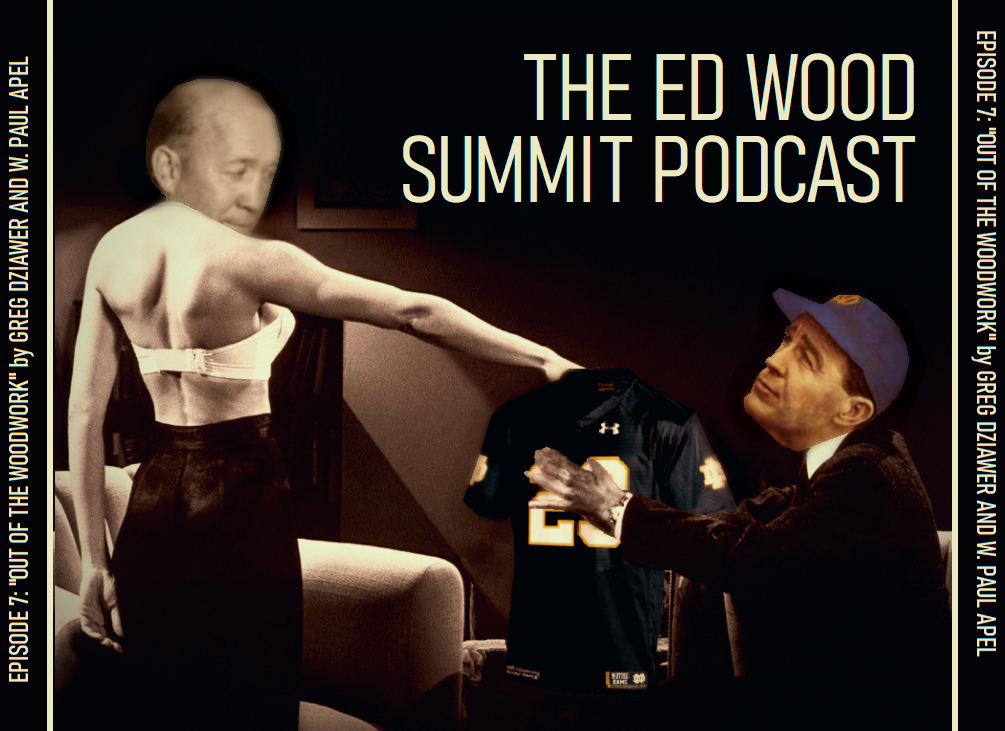
Ed Wood Wednesdays: The Ed Wood Summit Podcast #7 by Greg Dziawer and W. Paul Apel

Knute Rockne (left) hands the sacred Notre Dame football program over to Frank Leahy.

The cover to Ed's script.
This week on The Ed Wood Summit Podcast, it was my privilege to speak to Wood superfan W. Paul Apel, whom I met through a private Facebook group. Our topic of conversation was the newly-unearthed screenplay The Frank Leahy Legend, a sports biopic originally written by Ed in the mid-1970s but never actually produced. As you'll soon see from the video, this unusual document provided a lot of fodder for speculation and discussion. Even in a career as varied as Ed Wood's, this script stands out.

As a prelude to the two-hour-plus podcast, however, Paul himself shares his thoughts:
Perhaps one of the most confounding entries on Ed Wood’s resumé is the mysterious unproduced screenplay The Frank Leahy Legend, written for the equally mysterious Scotty Williams Entertainment, and based on a book by the same name by Bernard J. Williams.

Up until now, no Ed Wood experts have read the screenplay or reviewed it, let alone published their findings, but that’s not where the mystery ends. How did Wood, an underdog who wore his quirks on his (angora) sleeve, end up writing about macho, win-at-all-costs Notre Dame coach and Knute Rockne protégé Frank Leahy?

We may never know. However, Greg Diawer and I finally secured a copy of the lost Wood screenplay and thoroughly dissected, reviewed and discussed it here. Now, Woodologists everywhere will finally get a glimpse into this once obscure line on Wood’s resumé and find out if Wood’s irrepressible personality and unique style make it into Leahy’s life story – or if this is ultimately a work for hire, devoid of Woodian weirdness.

Thanks, Paul. And now, on with the show.


Wednesday, March 17, 2021

Ed Wood Wednesdays: The Wood/Dziawer Odyssey, Part 14 by Greg Dziawer

Notre Dame coach Frank Leahy caught the attention of Ed Wood in the 1970s.

"Show me a gracious loser, and I'll show you a failure."
-Knute Rockne

In post-revolutionary 1837 France, Blessed Father Basil Moreau founded the Congregation of Holy Cross. Within a few years, he sent six Brothers—four of them of Irish descent—to the United States to extend the mission. In 1842, they established the University of Notre Dame du Lac, the first permanent foundation of the Congregation in the United States. Today, you'll recognize this cultural institution simply as Notre Dame.

A little over a hundred years later, in 1946, the Holy Cross Fathers extended their mission to Wilkes-Barre, Pennsylvania, They created King's College, a small liberal arts school I attended from 1986 through 1990. Many of my professors were priests, and they were a funny, smart, and encouraging bunch. I received a wonderful education there, and the curiosity they inspired in me then remains with me to this day. The school's connection to Notre Dame was never brought up, nor was football, as the school did not have a team. (It does now, as King's College has grown over time.)

I recognized just how important the legacy of Notre Dame football was to many people, long before I attended King's. When there were only four channels on the television dial, it was hard to avoid college football games on a Saturday. Everyone drank the same Kool Aid. Notre Dame football was a sacred tradition; the program seemed to possess a magical gravitas.

Notre Dame coach Frank Leahy
Ara Parseghian was coaching the Irish in the early '70s when I was a wee lad. Little did I know back then about the storied lineage of Notre Dame football coaches—especially Knute Rockne (1888-1931), the coach to whom all others would be compared. Rockne's life was tragically cut short by a plane crash in March 1931, supposedly while on his way to participate in a film called The Spirit of Notre Dame. At the time of his death, the coach was at the zenith of his powers, having won back to back national championships in 1929 and 1930. 

One of Rockne's tackles during his final three years as coach was a tenacious Nebraskan named Frank Leahy (1908-1973). After his playing days were over, Leahy served as a line coach at Georgetown, Michigan State, and Fordham before becoming head coach at Boston College. Finally, in 1941, he assumed the role of head coach at his beloved alma mater, later ludicrously claiming that "noder dame" were among the first words he ever spoke as a child. At Notre Dame, Leahy shepherded the team to four additional national championships while toiling in Knute Rockne's long shadow. Interestingly, the story of Frank Leahy intersects with that of Edward D. Wood, Jr., the man whose life and work I began strenuously researching about six years ago.

I'd never even heard the name Frank Leahy prior to seeing an undated screenplay called The Frank Leahy Legend listed in a resume that Ed Wood supplied to budding filmmaker Fred Olen Ray in 1978. While the coach's name was unfamiliar to me, Joe Blevins noted at this very blog that Leahy was a Notre Dame football coach and that a book with that title had been released in 1974, the year after Leahy's passing. For years, I accepted this as just about all we would likely ever know. The project was not even mentioned in Rudolph Grey's Nightmare of Ecstasy (1992). The only additional information came from the resume itself. Ed parenthetically noted "Scotty Williams Ent." alongside the listing, suggesting that the film got far enough along to atttract a producer. Unfortunately, that name and production company drew blanks in my searching.