Showing posts with label Bob Blackburn. Show all posts

Wednesday, March 25, 2026

Ed Wood Wednesdays, week 267 The great 'Hollywood Rat Race' auction of 2026

This eBay auction is a veritable smorgasbord.
NOTE: The following article is about the sale of some rare Ed Wood material. Because this sale is happening on eBay (an auction site) and because the seller is willing to entertain offers (or bids) from interested parties, I am referring to this as sale an "auction." JB.
This is not the article I planned to write this week. I actually wanted to get back to my ongoing series about Tim Burton's Ed Wood (1994). But something unusual has happened in the world of Ed Wood fandom, and I feel it is my responsibility to record it for the sake of posterity before we all forget that this ever happened. I strongly suspect that this is the kind of one-off oddity destined to fall down the memory hole never to be recalled again.

On March 16, 2026, Bob Blackburn (co-inheritor of the Ed Wood estate) posted on Facebook about a very intriguing eBay auction he'd learned about through fellow fan Patrick McCabe. It seems that a legitimate memorabilia dealer called NEOvintage was selling a treasure trove of rare Ed Wood materials from the 1960s, including a manuscript of Hollywood Rat Race typed by Eddie himself and some ultra-rare cassette tapes including unreleased interviews with Ed and others talking about Bela Lugosi. The asking price for these precious goodies? A mere quarter of a million dollars, though the seller is willing to offer a $50,000 discount to the right buyer. If you have a spare vacation home you're not using or perhaps a Scrooge McDuck vault of gold coins, maybe consider it.

Wednesday, October 15, 2025

Ed Wood Wednesdays, week 246: "5 Questions with Bob Blackburn"

Who better to consult on Ed Wood's birthday than Bob Blackburn?

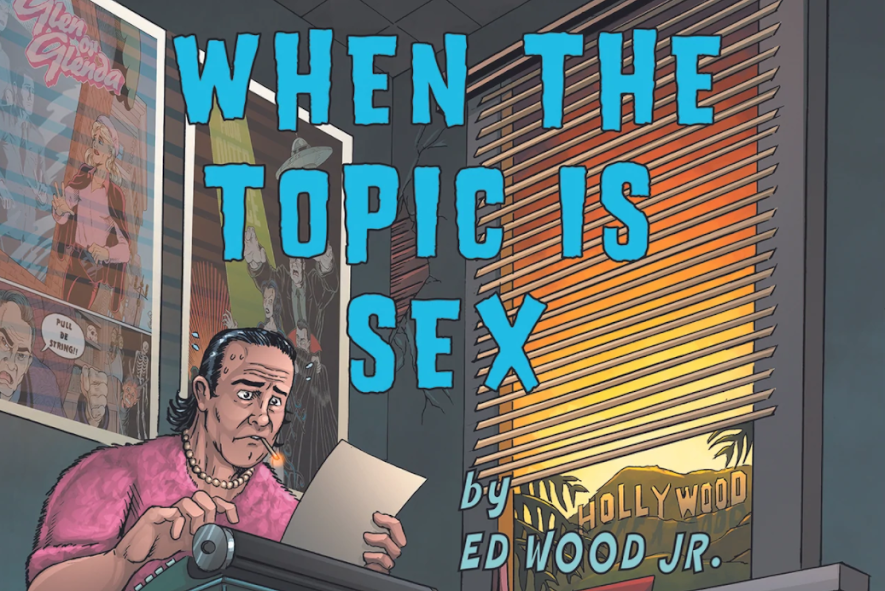
October is Ed Wood's birth month. The director/writer/star of Glen or Glenda (1953) would have turned 101 years old on October 10, 2025. I couldn't just let this milestone pass without adequate fanfare. And so, I bring you the following conversation with the illustrious Bob Blackburn, one of two heirs to the estate of the late Kathy Wood. (That makes him the de facto spokesman for the Ed Wood estate as well.) A second-generation radio industry professional, Bob is also a musician and author. In addition to his 2024 memoir, Kathy Wood & I, he has compiled three indispensable volumes of Ed Wood's magazine work from the 1960s and '70s: Blood Splatters Quickly (2014), Angora Fever (2019), and When the Topic is Sex (2021).

Despite all this, Bob was never a guest on The Ed Wood Summit Podcast during its original run (2021-2023) when it was hosted by the late, much-missed Greg Javer. Bob has certainly given plenty of interviews about Ed Wood over the years, but he somehow never wound up on this particular show. Well, today, we change all that. On this episode, Bob shares some rare items from his collection of Ed Wood memorabilia and answers some general questions about Ed and Kathy. I think it's a fun and informative chat. Enjoy.

Wednesday, July 16, 2025

Ed Wood Wednesdays, week 236: Plan 9: The Cemetery Screening (2025)

What's the weirdest place you've ever seen a movie?

Sometimes, the place where you see a movie can make all the difference. 

A very special screening.
I hope I will never forget seeing Citizen Kane (1941) at the magnificent Fox Theatre in Detroit or The Rocky Horror Picture Show (1975) at the crumbling Capitol Theatre in Flint. Then there's Chicago's historic Music Box, where I saw The Wizard of Oz (1939), Brand on the Brain (2006), and Inland Empire (2006). Magnificent experiences all. During Inland Empire, the theater was so cold I kept my winter coat on all three hours!

But I can also remember seeing Do the Right Thing (1989) at the long-gone Genesee Valley Cinema in Flint. This was a perfectly ordinary multiplex, but I happened to be there on a night when the air conditioning was on the fritz and the theater was sweltering, allowing us in the audience to experience some of what the characters onscreen were going through. My mother took me to see that film, and we had a long discussion afterwards about the characters and the choices they made.

Occasionally, the venue where you see a movie isn't even a theater at all. My first, transformative viewing of Monty Python and the Holy Grail (1975), for instance, took place on a long bus trip to Indiana when I was a teenager. And I vividly remember watching the Suspiria (2018) reboot on an Amtrak train and being absolutely enraptured by it. Somehow, in both of those examples, being in motion made the viewing experience more intense. 

Ed Wood fans in the Los Angeles area have an opportunity later this month to view the director's most famous film in a highly memorable and most appropriate setting. On Saturday, July 26, 2025 at 6:30pm, the San Fernando Valley Historical Society (SFVHS) is hosting a screening of Plan 9 from Outer Space (1957) at the Pioneer Memorial Cemetery in Sylmar, CA. This, in case you didn't know, is the very cemetery where Eddie actually shot some scenes for the film! Director Mark Carducci visited this cemetery for his documentary Flying Saucers Over Hollywood (1992), as did film critic Harry Medved for an episode of his PBS series Locationland (2025). The SFVHS is holding this screening to honor the 100th anniversary of Ed Wood's birth.

Wednesday, June 4, 2025

Ed Wood Wednesdays, week 231: Catching up with some recent reader feedback

What can I say? I love a cheap pun.

I have some very knowledgeable and attentive readers. This is mostly a good thing, but it can be a little worrying sometimes. Niche fandoms tend to attract people who are passionate and detail-oriented when it comes to their chosen subject matter, so I know that some complaints and corrections are (potentially) headed my way whenever I post a new article in this series. For the most part, however, Ed Wood's dedicated fans have been extremely generous in sharing books, articles, scripts, videos, photographs, and more with me. I'm truly grateful for that. Many articles in this series have come about because of the items people have sent me or because of the information they've shared with me.

Generally, the day I post a new Ed Wood Wednesdays article, I'll mention it on my various social media accounts, including the very active Ed Wood Jr. Facebook forum moderated by Bob Blackburn. These Facebook posts often inspire some interesting and informative responses. But social media is, by its very nature, ephemeral, so I wanted to document some of these responses before they evaporate forever from my memory.

Monday, February 10, 2025

Ed Wood Extra! Harry Medved revisits Plan 9 on Locationland (2025)

Tor Johnson emerges from his grave in Plan 9.

We may have celebrated the 100th anniversary of Ed Wood's birth in 2024, but the party is continuing well into 2025, folks. We all know film historian and critic Harry Medved as the co-author of The Golden Turkey Awards (1980), i..e. the book that brought posthumous fame to Ed Wood. Well, these days, Harry is working on a series of videos for PBS entitled Locationland in which he visits the Southern California filming locations of some of Hollywood's golden classics. 

Did you think he'd forget about Eddie? Fat chance!

In today's episode, premiering at 6:00 pm PST, Harry visits the filming locations for Ed Wood's Plan 9 from Outer Space (1957). Harry's guests include comedian and writer Dana Gould, author Katharine Coldiron, and our very own Bob Blackburn, the co-heir of Kathy Wood's estate. You can watch the premiere of Plan 9 episode of Locationland right here. And you can watch a trailer for the episode right here. And if, by chance, you need a little more Medved in your life, Will Sloan recently interviewed Harry about The Golden Turkey Awards. You can find that right here.

Happy viewing/listening!

Wednesday, November 13, 2024

Ed Wood Wednesdays, week 202: Kathy Wood gives her side of the story

Kathy Wood, seen here with her dog McGinty in 1988, was married to Ed for over twenty years. 

Bob Blackburn's recently-published book, Kathy Wood & I: How I Fell Down the Ed Wood Jr. Angora Rabbit Hole (Bear Manor Media, 2024), documents the author's decade-plus friendship with Ed Wood's widow, Kathleen O'Hara Everett Wood (1922-2006). Bob approached the publicity-shy Kathy shortly after attending a marathon of Wood's movies in 1992 and, after a few false starts, slowly but surely gained her trust. Bob remained her pal and confidant until Kathy's death in 2006.

Kathy's late husband started becoming more well-known during these years, largely because of Rudolph Grey's oral history, Nightmare of Ecstasy: The Life and Art of Edward D. Wood Jr. (1992). That book was adapted into a lavish, star-studded biopic called Ed Wood (1994) by director Tim Burton, with Johnny Depp in the title role and Patricia Arquette playing Kathy. The publicity generated by Burton's movie led to some home video rereleases of Ed's vintage films and a smattering of documentaries, TV specials, and articles about the infamous director and his career. A radio industry professional himself and the son of a popular sportscaster, Bob Blackburn was there to serve as Kathy's guide through these unlikely events.

As a bonus, Kathy Wood & I includes a letter that Kathy drafted in 1998 and submitted to a Los Angeles probate court as part of a dispute over Ed Wood's estate. Her purpose in writing it was to demonstrate that she was Ed's partner, not just his wife. I didn't mention any of this in my review of the book last week, but I thought Kathy's letter deserved some extra attention, as it's really the closest thing to an autobiography she ever wrote. It also offers a fascinating glimpse into Ed Wood's private life that we won't get anywhere else.

A Canadian who relocated to Los Angeles in 1954 for professional reasons, Kathy O'Hara Everett first spotted Edward Davis Wood, Jr. in 1955 when they both started attending meetings of the Church of Religious Science at the Wiltern Theatre. Kathy considered Ed quite handsome but noticed he was always alone at these lectures. They finally met a few months later when a down-on-his luck Eddie approached Kathy at a Hollywood night spot called The Cameo Room. They remained a couple for the rest of Ed's life, eloping to Las Vegas in 1956 and staying married for 22 years.

"Life with Eddie wasn't a bed of roses," Kathy writes, "and I paid dearly for loving and standing by him." This sentence serves as a thesis statement for the entire letter.

Kathy Wood helped write this scene.
By the time he met Kathy, Ed was 31 and had already made Glen or Glenda (1953), Jail Bait (1954), and Bride of the Monster (1955), but his most famous film, Plan 9 from Outer Space (1957), was still on the horizon. The creation of that now-classic sci-fi film is a big part of Kathy's letter. She served as Ed's typist and creative consultant on the script, as she details:
It was during this time that Eddie started writing Plan Nine from Outer Space (Grave Robbers From Outer Space). We spent many hours discussing the story and dialogue and the plot. I helped him with my ideas and typed a large part of the script as usual. It was a happy time and a crazy time. [...] Ed and I kept working on the Grave Robbers script, both of us throwing lines back and forth to each other. I remember one Sunday afternoon we were both stumped for some kind of horrific bomb. I grabbed our Bible and was reading it when some certain passage came to mind. Something about the powers of the sun (or the "Solarnite" bomb in the script). We had a lot of fun talking ideas back and forth on the script.
I've heard Kathy tell similar stories in documentaries about her husband, and I feel that the Bible passage she is referencing must be Revelation 16:8-9, which states: "The fourth angel poured out his bowl on the sun, and the sun was allowed to scorch people with fire. They were seared by the intense heat and they cursed the name of God, who had control over these plagues, but they refused to repent and glorify him." Let's face it, if there's a book of the Bible that would have appealed to Eddie, it's Revelation, with its often surreal, grotesque, apocalyptic imagery.

For the most part, Kathy's letter describes her often chaotic domestic life with Ed Wood. Surprisingly, there were many good times along the way—pool parties, vacations, nights on the town. The Woods were social animals, and their circle of friends included many of the kooky characters we know from Ed's movies: Duke Moore, David De Mering, Bunny Breckinridge, Tor and Karl Johnson, Kenne Duncan, Dudley Manlove, and Paul Marco. These folks often did what they could to save Ed from impending doom, but occasionally, they couldn't even save themselves. That's life in Hollywood for you. It seems Ed and Kathy could never hold onto a residence or a vehicle for long, and Kathy's letter is full of  stories of disputes with various landlords, including Plan 9 investor Ed Reynolds.

Money, or the lack of it, became the dominant issue in the Woods' lives. (Isn't that true for most of us?) While Kathy worked as a secretary and stenographer at various companies, including Muzak, Eddie's career as a writer-director was unreliable at best. He'd sell a screenplay or a novel, but the money would soon be gone. She also claims that some of Steve Apostolof's checks to Eddie bounced, which may explain her longstanding resentment toward the director-producer and his "cheap girly movies." Kathy does not dwell on Eddie's raging alcoholism, even though it was the chief cause of his professional decline and early death. As Kathy sees it, the drinking was just part of the problem, along with Eddie's "cranky" moods and his consumption of salty foods.

Every Ed Wood fan knows how this sordid story ends. In December 1978, the Woods were evicted from their Yucca St. apartment by the local sheriff and had to move in with actor Peter Coe. They'd undergone similar trials in the past, even rooming with Duke Moore in his one-bedroom unit for a while, but this final disgrace proved too much for Eddie. He died heartbroken—literally and figuratively—on December 10, 1978, at the age of 54. Kathy's letter comes to an abrupt conclusion here: "Our world had ended." There's no redemption arc, no deus ex machina, just loss and despair. She does not mention Ed's posthumous, ironic fame.

And yet, Kathy's letter is not merely an exercise in misery. She clearly had a lot of fond memories of her late husband, and that comes through in her writing about their marriage. She relates a bittersweet anecdote about the time Eddie tried (unsuccessfully) to nurse an injured bird back to health, for instance. She also remembers the way he kept her and a neighborhood child enraptured for hours with his action-packed and largely fabricated World War II stories. That child, Tim Brockman, grew up to be a helicopter pilot in the Vietnam War.

Above all, through this letter, we get little glimpses of Ed Wood in his prime, back when he was still the life of the party. You can almost see why Kathy stuck by him for so many years, possibly hoping the old spark would somehow return. As it says on Kathy's grave: "She hitched her wagon to a star."
Kathy Wood and I: How I Fell Down the Ed Wood Jr. Angora Rabbit Hole is available in hardcover, paperback, and Kindle editions right here. Or you can purchase it directly from the publisher.

Wednesday, November 6, 2024

Ed Wood Wednesdays, week 201: 'Kathy Wood & I: How I Fell Down the Ed Wood, Jr. Angora Rabbit Hole' (2024)

Bob Blackburn (left) befriended Ed Wood's widow, Kathy, in her later years.

Picture this. 

You're about to go on a long bus trip—Tulsa to Milwaukee, let's say. Right before the bus leaves the station, a gentleman takes the seat next to you. With his graying beard, ponytail, casual wardrobe, and overall laid-back demeanor, he seems like he could be a classic rock DJ or possibly an ex-roadie. Maybe he's a distant relative of Jeff Bridges' The Dude from The Big Lebowski (1998). The gentleman notices you're wearing a Plan 9 from Outer Space (1957) T-shirt and asks, in an unmistakable California accent, if you're an Ed Wood fan. You say sure. And then, with no more prompting than that, he launches into the story of how he met Ed's somewhat reclusive widow, Kathy, in the early '90s and remained her friend until her death in 2006. 

This was a fairly busy and interesting time in Kathy's life, since it saw the release of two major Wood-related films, Tim Burton's Ed Wood (1994) and Aris Ilipoulos' I Woke Up Early the Day I Died (1997), plus the publication of Ed's long-lost manuscript, Hollywood Rat Race (1998). If that weren't enough, a couple of Ed's vintage novels came back into print during these years, and there were various stage shows and documentaries inspired by Ed's life and work. The gentleman sitting next to you on the bus tells you he was there to guide Kathy through all of this. He even put her in touch with legal counsel, specifically an entertainment lawyer named Robert Weinberg.

Bob's new book.
Imagine further that this conversation were transcribed word-for-word and then published as a book. You now have a good idea of what it's like to read Bob Blackburn's Kathy Wood and I: How I Fell Down the Ed Wood Jr. Angora Rabbit Hole (Bear Manor, 2024). If you can't take Bob himself with you on your next bus trip, taking a copy of this book is the next best thing. Truth is, Bob makes for a very entertaining traveling companion. This book is every bit as informal and unpretentious as its author. Kathy Wood and I is not really a biography of Kathy or Ed; it's more of a collection of affectionate memories being recorded for posterity. Bob jumps around in the timeline quite a bit; you get the sense that he's writing these things down in the order they occur to him.

Years ago, when this series of mine was still in its infancy, I learned you don't get far in Woodology before crossing paths with Bob Blackburn. Forget finding him; he'll find you. The man is relentless. I've called him "the keeper of the flame," and that's really what he is in the world of Wood fandom. Not only did he start an extremely active Facebook group devoted to Ed Wood, he's also the man responsible for the three (count 'em) anthologies of Eddie's magazine work from the 1960s and '70s. Bob tracked down those stories and articles one by one, purchased the (often pricey) publications in which they first appeared, and then arranged for them to be republished so that we could enjoy them today.

And now, with this book, Bob has given us the most intimate portrayal of Kathy Wood that we're likely to get. Ed and Kathy met in late 1955 and were married in Las Vegas in 1956. Kathy remained with Ed until the truly bitter end in December 1978. She was his other half for the last two decades of his life, and yet, how much do we really know about her? As portrayed in Ed Wood by actress Patricia Arquette, she's a demure, soft-spoken lady who warms to the quirky yet lovable Eddie (Johnny Depp) quite quickly and isn't scared off by his cross-dressing or his dicey-at-best showbiz career. 

Rudolph Grey's oral history Nightmare of Ecstasy (1992) gives us a few more glimpses of Kathy's tumultuous, sometimes violent life with Eddie in the 1960s and '70s. These are some of the most depressing passages in Grey's book, as Ed's alcoholism worsened and his career and lifestyle deteriorated dramatically during these years. No matter how bad things got, however, his wife remained by his side. Kathy Wood essentially grabbed Ed's hand as he dove headfirst into hell. And, for better or worse, she never let go. How many of us can say we'd have done the same?

Kathy Wood's favorite soup.
By the time she met Bob Blackburn in 1992, Kathy Wood was 70 years old, retired, and living on a fixed income in a modest Hollywood apartment not far from the one she and her husband had shared during their tragic final years together. In the 1980s, she'd had to undergo open heart surgery due to years of smoking, and this had slowed her down somewhat. Like many older people, she was quite set in her ways and not especially keen to make new friends or even talk to strangers. She was especially wary of Ed Wood fans who only approached her because of her famous dead husband, a man she both loved and hated.

But Bob was not discouraged. He was living in the same building as Kathy and gradually gained her trust, one interaction at a time. Eventually, their friendship progressed to the point that Bob would hang out at her apartment regularly and hear stories of the old days or just shoot the breeze. He even took Kathy to movies from time to time. (An appendix in the book dutifully lists all the films Bob and Kathy saw together.) As Kathy's health declined and her social circle shrank, Bob truly became one of her closest companions. In the abstract, Bob and Kathy's relationship bears a passing resemblance to the unlikely friendship that Ed Wood forged with Bela Lugosi toward the end of Bela's life in the 1950s.

The best thing about Kathy Wood and I is that it lets us spend some quality time, so to speak, with its title subject. We readers may never have gotten a chance to meet Kathy or speak with her, but Bob Blackburn certainly did, and now he's telling us what that experience was like—right down to fairly minute details, like Kathy's love of Andersen's split pea soup and her devotion to then-acclaimed actor Kevin Spacey. This book reminds us that Kathy Everett O'Hara's life did not end when Ed died in 1978. She survived for two and a half more decades and experienced such major events as the L.A. riots of 1992 and the Northridge earthquake of 1994. Above all, she was a human being, with all the foibles and complexities you'd expect anyone to have. Bob's book may be our last, best chance to get to know this woman.
Kathy Wood and I: How I Fell Down the Ed Wood Jr. Angora Rabbit Hole is available in hardcover, paperback, and Kindle editions right here. Or you can purchase it directly from the publisher.

Wednesday, February 28, 2024

Ed Wood Wednesdays, week 179: The Perverts (1968) [PART 2 of 2]

An unusual massage from Ed Wood's The Perverts. (Image courtesy of Bob Blackburn.)

Let's play a game.

I'll give you a passage from The Perverts (1968), a sexual guidebook Ed Wood wrote for Viceroy under the assumed name "Jason Nichols," and you try to tell me what this chapter is actually about. Ready? Here goes:
Time and the tide seldom changes. It only revamps itself to progress other thoughts. The river continues to run year after year and one might wonder why it never runs dry. The story is that the river is once more sucked up into the sun and redeposited at the head again.
Okay, maybe that wasn't enough. I'll give you the entire next paragraph:
Sex is much the same way. As has been stated over and over again during these chapters, SEX per se is never satisfied. It is only sucked up into the body of another and redeposited for another fling, and so it shall be to the end of time and since there is no such thing as the end of time so there shall never be an end to SEX and the variations thereof.
Give up? That was from the chapter about incest. So what was all that stuff about tides and rivers and the sun? You got me. But I'm trying to give you an idea of what reading The Perverts is like. 

As a writer with a restless mind, Ed Wood will go off on philosophical tangents that have little or nothing to do with the subject at hand. Remember Glen or Glenda (1953), in which narrator Dr. Alton (Timothy Farrell) is supposed to be telling us about cross-dressers but somehow gets onto the topic of "the modern world and its business administration"? Much of The Perverts is like that. The book's quasi-lofty tone is also highly reminiscent of the ponderous narration of Ed's The Young Marrieds (1972). Very often in that film, the narration will play over footage of waves crashing against the rocks, similar to the tidal imagery used in The Perverts.

Speaking of images, last week I complained that my edition of the book lacked the photos that were in the original printing. Well, Bob Blackburn heard my plea and sent me some of the pics from his copy of The Perverts, which in turn was Ed Wood's own personal copy of the book! Bob says that there are about 20 to 30 "mostly topless" black-and-white photographs altogether in his edition. It does not look like the publisher, Viceroy, commissioned new photos based specifically on Ed Wood's text, but instead used whatever photos they happened to have lying around that sort of matched what was in the book. Below is a collage of images from the chapters on troilism, fetishes, and lesbianism. 

A triptych of images from The Perverts.

I'm grateful to Bob for giving me a sampling of the visual content in The Perverts. Feel free to explore this gallery of images if you're interested in seeing more. But now, let us talk about the literary content in this remarkable book.

Wednesday, August 2, 2023

Ed Wood Wednesdays, week 161: Contos & Delírios (2022)

A snazzy edition of Ed Wood's short stories in Portuguese.

You might think I have a treasure trove of Ed Wood rarities and memorabilia stashed away somewhere, but you'd be wrong. I live in a fairly small apartment, so I don't have room for much stuff, and I wouldn't have the money to pay for it anyway. Mail room clerks aren't exactly rolling in dough. Most of my Wood collection (Woodiana, if you will) exists only virtually—various videos, pictures, and documents saved to my hard drive. It doesn't take up any extra room in my place, which is nice.

On top of that, I do have some physical objects, including DVDs, videotapes, paperback books (nothing old or valuable), and little novelties like the Drew Friedman-designed Ed Wood, Jr. Players trading cards, a matchbook from the Hunters' Inn, and one of those glow-in-the-dark Criswell dashboard figures. My only truly extravagant Wood purchases were the I Led 2 Lives poster and Mexican Plan 9 lobby cards I bought at auction in 2015. I still don't know what I was thinking when I bought those, and I may well have to sell them someday.

Okay, so maybe I do have a collection of Ed Wood detritus. I don't try to collect Eddie memorabilia, but it does sort of accumulate over the years. Recently, I threw another item onto the pile: a beautifully-designed, hardbound collection of Ed's short stories called Contos & Delírios (2022) from a Brazilian publisher called Darkside. That title translates as Tales & Delusions, and the 33 wild and woody stories contained within this volume are translated into Portuguese, a language I cannot read or speak.

A peek inside the book with an illustration.
So if I don't know any Portuguese, why did I buy Contos & Delírios? How could I hope to understand it? Well, the strange tales in it are taken directly from Blood Splatters Quickly: The Collected Stories of Edward D. Wood, Jr. (2014), a book curated by Wood superfan Bob Blackburn. Contos & Delírios even presents this material in the same order, starting with "Scream Your Bloody Head Off" (1972) and ending with "Final Curtain" (1971).  In case you're wondering, the front matter of Contos & Delírios does acknowledge that it is a translation of Blood Splatters Quickly, and there is a paragraph-long biography of Bob at the end of the volume.

The real reason I had to buy Contos & Delírios was because it's a unique and quite lovely presentation of Ed Wood's best short stories, the likes of which I'd never seen before. The collection is nicely bound and has a striking pink, black, and white color design. Even better, each of the 33 stories has a new illustration by transgender Brazilian cartoonist Laerte Coutinho aka Laerte. As a non-Portuguese speaker, it's fun to flip through Contos & Delírios and try to guess which of Ed's stories is being illustrated. "Hellfire" (aka "Fogo do inferno") has Satan lying on his back with a volcano emerging from his crotch. "To Kill a Saturday Night" ("Matando o sábado") has two anthropomorphic penises, complete with arms and legs, casually chatting. "Breasts of the Chicken" ("Os seios de galinha") has a pudgy restaurant customer picking lobster-sized mermaids out of a glass tank.

As for actually reading the stories within this volume, well, I had to rely very heavily on my copy of Blood Splatters Quickly. I thought my decades-ago college Spanish courses might help me, but they didn't. At least not much. I did find it interesting that "The Wave Off" became "Voando em círculos" or "Flying in Circles," while "Calamity Jane Loves Hosenose Kate Loves Cattle Anne" became simply "O amor delas" or "Their Love." I was also amused to see that the aforementioned "Fogo do inferno" carried a footnote explaining that Ed Wood's "lived/devil" pun was "untranslatable in Portuguese." As for the newly-written introduction ("Preliminales dark") by director Paolo Biscaia Filho, I'm afraid it's lost on me, which is a shame. It looks interesting.

I should mention that getting my hands on a copy of Contos & Delírios was trickier than I expected. I bought it from an Ebay seller in Brazil because the price seemed quite reasonable. (I hadn't factored in shipping, which I should have.) The book took many weeks to reach me, and when it finally arrived at my apartment, the mailman wanted a signature that I was not able to provide because I was at work. After trying without success to use the USPS website and hotline—both useless for international packages, apparently—I made the cataclysmic decision to drive to the local post office. At rush hour. On the hottest day of the year. I was still not able to claim the book immediately, but I did set into motion a series of events that ended with the item in my hands. It was a process, let's say.

This was also the year that I tried (legal) edibles for the first time, and I think it says something that getting those shipped to my apartment was much quicker, cheaper, and easier than getting an Ed Wood book. Seriously, though, Contos & Delírios is a neat keepsake for Wood fans, even those who don't speak Portuguese. I wish more of Eddie's stories would receive this deluxe treatment.

Wednesday, July 5, 2023

Ed Wood Wednesdays, week 157: I Watched Football Early the Day I Died (2023)

An unproduced Ed Wood script from the 1970s has now seen the light of day.

Francis William "Frank" Leahy. Now, where did I first run across that hallowed name from sports history? Probably in issue #11 of  Cult Movies magazine, which reported that Ed Wood wrote an unproduced film about him circa 1975 called The Frank Leahy Legend. After a tiny bit of digging, I soon learned that Ed's script was based on a book by Bernard J. Williams and that the unmade screenplay still existed and was languishing in an archive in Los Angeles somewhere. Not being a football fan myself, I probably never would have heard of Leahy, who died in 1973, otherwise. He just wasn't on my radar.

A new book from Bear Manor.
I could have pursued this case further, but I simply never got around to it. What can I say? Ed Wood wrote a lot of things in his 54 years, and a script about a 1940s Notre Dame football coach somehow didn't seem as exciting as a novel about a cross-dressing hitman or a movie about wife-swapping suburbanites. Life is short, as both Ed Wood and Frank Leahy knew all too well. So I let The Frank Leahy Legend stay on the shelf. 

But a couple of dedicated Woodologists, W. Paul Apel and Greg Javer, decided to hunt down the Leahy script, and now their findings have been published in a new book from Bear Manor Media called I Watched Football Early the Day I Died. In addition to the complete screenplay, rescued from the Loyola Marymount University archives, this volume contains a foreword by Bob Blackburn, friend to Ed's widow Kathy, and introductory notes by Greg and Paul. Best of all, Paul provides explanatory notes throughout the entire screenplay; it's like a commentary track for a movie that was never made.

While reading the screenplay, I kept thinking of a quote from the notorious John Andrews in Nightmare of Ecstasy: "Eddie wrote a horror script that would have been fine for 1934 but not 1974." Yeah, even during his booziest, porn-iest, most debauched years, Eddie could get mired in the past sometimes. What's most amazing about The Frank Leahy Legend is that Ed Wood (or anyone) considered it to be marketable to jaded movie audiences who'd already seen The Godfather (1972) and The Exorcist (1973). Even nostalgic movies from the 1970s like Paper Moon (1973) and The Summer of '42 (1971) looked at the past through a modern lens.

Meanwhile, apart from a smattering of profanity, The Frank Leahy Legend is the type of creaky, old-fashioned, highly sanitized biopic you might have seen in the 1930s or '40s, the kind that basically acts as a feature-length commercial for its subject. If you watch enough TCM during the off-peak hours, you'll see these flattering films about politicians, songwriters, war heroes, entertainers, inventors, and athletes. Try sitting through something like Swanee River (1939) or The Babe Ruth Story (1948), and you'll know what I mean. This type of cornball biopic was already old hat when Steve Allen starred in The Benny Goodman Story in 1956, and Eddie was trying to get away with an even cornier script two decades later! Actual line spoken (without irony) by an actual character in this movie: "You know Frank Leahy, you're truly an amazingly, great man..."

Leahy: Neither hero nor villain.
But was Leahy amazing? Or great? Or amazingly great? Eh, I don't know. He certainly won a lot of football games in his day, but he did it by bending the rules just a bit. He got married. He had kids. He yelled at his players occasionally. He sold rubber or something on the side. He really liked Notre Dame. Does that count as a personality?

Leahy's life doesn't really fit any of the standard biopic templates, and in this unproduced screenplay, the reader can sense Ed Wood struggling to turn this material into something resembling a movie. I wouldn't call Leahy a hero or a role model, necessarily, and his life is not exactly inspiring. Then again, he's not a villain or a cautionary tale either. We can't learn anything from his story, because Frank doesn't learn anything from his own story. Even that scoundrel Charles Foster Kane has an epiphany in the last few seconds of his life.

Furthermore, Leahy doesn't seem to have had a quirky, outsized personality, the kind that would make him a good movie character. His coach and mentor Knute Rockne did, though, and Ed's screenplay makes Knute a colorful supporting character. Our protagonist, however, remains opaque. Either Frank Leahy is unknowable or there is just nothing to know about him beyond the surface details.

Either way, W. Paul Apel makes a splendid companion on this journey through the screenplay, jumping in whenever he has something to add or explain. (His commentary definitely helped me understand a few murky plot points along the way.) Unlike me, Paul's actually read the book upon which this script is based, so he can better explain how Ed Wood adapted this material. My guess is that Eddie was merely a hired gun on this movie and banged out this script strictly for the paycheck, but he manages to work some of his obsessions into The Frank Leahy Legend anyway. There are numerous funeral scenes, for instance, and even a prominent reference to Eddie's beloved angora.

For the most part, it seems like Eddie went out of his way to avoid showing any football in this supposedly football-centric movie. We know Wood was no sports fan, so when he wrote The Frank Leahy Legend, he tended to skip over all those pesky games and practices. Instead, we get a lot of scenes of Leahy talking to people in various offices. Glen or Glenda (1953) and Plan 9 from Outer Space (1957) are similarly chatty in nature, as is Wood's later film The Young Marrieds (1972). While the lack of action in this script could have been a budgetary concern, the stiflingly static nature of The Frank Leahy Legend makes it feel like something from Ed Wood's 1950s heyday.

Overall, The Frank Leahy Legend is an intriguing "what if?" from Ed Wood's strange career. It's a relatively wholesome piece of work from a time when Eddie's own life was anything but. Perhaps that's why he wanted to work on this project. It was a chance to do something with no connection whatsoever to pornography or even horror. This biopic may have been stodgy and old-fashioned, but it was respectable. This was one he could write home to Mother about.

You can purchase your own copy of I Watched Football Early the Day I Died directly from Bear Manor or from online retailers like Barnes & Noble or Amazon.

Wednesday, November 30, 2022

Ed Wood Wednesdays, week 137: "The Beacon" (1973)

Are you turned on by the color of Pepto Bismol? (Artwork from Savage.)

You know, it's a small world. Back in the 1950s, my mom's parents ran a little bar in Northern Michigan called The Beacon. I picture it as a place frequented by flannel-clad deer hunters. Almost nothing remains of this long-gone beer joint, apart from some well-worn jukebox 45s that I still have in my collection—everything from Pat Boone to Fats Domino. In fact, I hadn't even thought about The Beacon in a long time until the great Bob Blackburn sent me a vintage Ed Wood story with a curiously familiar title.

The story: "The Beacon." Originally published in Savage (Gallery Press), vol. 2, no.2, June/July 1973. Credited to "Stanley John."

Synopsis: Jeanne, an 18-year-old Kansas farmgirl, is driving home one dark night after losing her virginity to her boyfriend, Jim. She unwisely decides to take a desolate, poorly maintained backroad in order to return home at a "respectable hour." As she drives down this bumpy, winding path, she thinks back to the sexual ecstasy she recently experienced with Jim. Unfortunately, Jeanne's car gets hopelessly lodged in a deep rut, leaving her stranded in the middle of nowhere.

Jeanne ponders whether to just spend the night in her car when she sees a bright yellow light in the distance—a beacon signaling to her. The light emanates from the attic of a remote farmhouse. When the girl knocks on the door, she is very surprised to find that the inhabitants, an attractive couple named Kirk and Elaine, are elegantly dressed and have decorated their home in an ultra-modern style. At first, Jeanne is skeptical and afraid. (Why should they be so dressed up in the middle of the night?) But she soon warms to Kirk and Elaine and partakes of the food and drink they offer.

This, too, proves a mistake. The now-drugged Jeanne finds herself being used like a living sex toy by Kirk and Elaine. The former ties her up while the latter penetrates her with a rubber strap-on. They continue with their "weird sexings" even after Jeanne passes out. As we ultimately learn, Kirk and Elaine do this all the time. They deliberately booby-trap the road, sell the cars to the local scrapyard, and bury the drivers beneath the house after drugging and raping them. This is to be Jeanne's fate as well.

Excerpt: "The nightmare began to move rapidly, in a blur of lights, faces, penises, arms, legs, breasts, thighs, buttocks, pubises. . Jeanne was pulled from the bed and led to the corner of the room. Kirk dangled a long rope in one hand and held his dick in the other."

Table of contents from Savage's June/July 1973 issue.
Reflections: It was typical for the adult magazines published by the Pendulum/Calga/Gallery consortium in the 1970s to have particular themes. Voyeurism, lesbianism, group sex, lingerie—whatever you were into, they had a magazine especially for you. The theme of Savage seems to have been S&M. An editorial on the magazine's contents page from its June/July '73 issue explains this fetish in the driest, most convoluted way possible. It starts out like so:
When one thinks of how strongly integrated our understanding of body abuse is to corporal punishment it is easier to comprehend why it is so very difficult to accept the existence of a pain-pleasure principle.
Clear as mud, huh? Try diagramming that sentence.

Ed Wood very likely penned that editorial, and he is also undoubtedly the author of "The Beacon," a strange and unsettling short story published in that same exact magazine and credited to the nonexistent Stanley John. (Any similarity to the horror host and author John Stanley is coincidental.) This particular issue of Savage also included "The Movement," which Ed wrote under his more common pseudonym, Dick Trent. I now fully understand why editor Bob Blackburn included that article in the S&M section of When the Topic is Sex.

Eddie sometimes ignored a magazine's theme when he wrote his stories and articles. None of his pieces for Garter Girls feature garters, for instance. But he did give the readers of Savage a little bondage action in "The Beacon." I'm not sure if the magazine's audience would be sated by that, however, since the bondage scene is brief and occurs in the midst of a rape/murder. Is the reader supposed to identify with or envy Kirk in this story? That's an upsetting thought.

"The Beacon" is one of Ed Wood's many tales of innocence defiled, and it would have fit in beautifully in Blood Splatters Quickly or Angora Fever. Yes, the narrator does tell us that sophisticated Elaine is wearing an angora sweater (with nothing underneath!), but the connection to Wood goes much deeper than that. Many of Ed's stylistic quirks are here, including an abundance of ellipses and RANDOM CAPITALIZATION. Some of Eddie's favorite words, like "thrill" and "lovely," turn up here, too. Like any good Ed Wood protagonist, Jeanne experiences "chills" twice—once while making love to Jim and once while thinking back on it. This is emblematic of Wood's writing; his characters are forever having hot flashes or cold chills.

What really makes this an Ed Wood story is its overall structure. The setup—a luckless woman stranded on a country road in the night after having car trouble—is pure Eddie. Similar events occur in both Night of the Ghouls (1959) and Orgy of the Dead (1965). The sinister farmhouse in "The Beacon" has many first cousins in the Wood canon as well. Think of the old Willows place in Bride of the Monster (1955) or the titular bordello in "The Whorehouse Horror" (1972), not to mention the crumbling castle in "Dracula Revisited" (1971) and even Madam Heles' pleasure palace in Necromania (1971). (Remember that some of Madam Heles' guests never leave.) It's also typical for Eddie's short stories to take a gruesome turn about two-thirds of the way through, so the ghoulish payoff of "The Beacon" is highly Woodian.

Most importantly, like many of Ed Wood's films and stories, "The Beacon" intertwines and essentially equates sex and death. If you have sex, you die. I could not help but feel that Jeanne was being severely punished for losing her virginity to Jim, a massively-endowed barley deliveryman. Elaine even tells her, "You're not all that innocent." So even a stranger can tell that Jeanne has been deflowered. From that perspective, "The Beacon" becomes a cautionary tale to young women, as if there were any reading Savage in 1973.


Special thanks to Bob Blackburn for sending me this story and making this article possible.

Wednesday, March 30, 2022

Ed Wood Wednesdays, week 127: 'When the Topic is Sex' (2021)

Just some of the nearly 80 articles contained within this book.

NOTE: This article concludes my coverage of Ed Wood's When the Topic is Sex (BearManor Media, 2021).

There has never been a better time to be an Ed Wood fan than right now. For one thing, more of Eddie's movies are available on DVD, Blu-ray, and streaming than ever before. When I was first getting into Ed Wood back in the early 1990s, I had trouble even finding the biggies—Glen or Glenda (1953), Bride of the Monster (1955) and Plan 9 from Outer Space (1957)—on VHS or airing on television. Now I'm fairly drowning in Ed's movies, spanning from his earliest days in Hollywood (1948's Range Revenge)  to the very end of his life (1978's Hot Ice). And, I assure you, more of them are coming.

One of Ed Wood's many magazine articles.
Wood scholarship has also exploded in the new millennium. Thirty years ago, Rudolph Grey's groundbreaking Nightmare of Ecstasy was the only full-length book about Ed Wood's life and career. In the years since, however, we've had Ed Wood, Mad Genius (2009) by Rob Craig, The Cinematic Misadventures of Ed Wood (2015) by Andrew J. Rausch and Charles Pratt, Jr., Scripts from the Crypt: Ed Wood's Bride of the Monster (2019) by Gary D. Rhodes and Tom Weaver, Ed Wood and the Lost Lugosi Scripts (2019) by Rhodes and Weaver, and The Unknown War of Edward D. Wood, Jr. (2017) by James Pontolillo.

Arguably, though, the most essential Ed Wood books to emerge in recent years have been the collections of Wood's own short stories, Blood Splatters Quickly (2014) and Angora Fever (2019), both curated by superfan Bob Blackburn. In the 1960s and '70s, Eddie wrote dozens of short stories for adult publisher Bernie Bloom, who used them as filler in his X-rated magazines like Body & Soul, Swap, Garter Girls, Two Plus Two, Young Beavers and many more. With Eddie's full-length novels and sex manuals largely out of print and out of the price range of most people, these compilations are the best way for fans to experience what Eddie was like as an author. 

But Ed Wood's magazine work was not confined to those wonderfully delirious short stories. Not by the tail feathers of a cockatoo. With his nimble typing fingers and ability to generate reams of text in a small amount of time, Eddie was Bernie Bloom's go-to writer for any number of assignments, including editorials and photo captions. Above all, from roughly the late 1960s to the mid-1970s, Eddie wrote innumerable nonfiction articles on topics ranging from the sexual revolution to witchcraft to politics. On rare occasions, he used his own name for these stories, but he was more likely to write under a pseudonym like "Dick Trent" or "Ann Gora" or go uncredited altogether.

At last, Bob Blackburn has assembled a massive compilation—the biggest yet—of Ed Wood's nonfiction magazine work from this era. When the Topic is Sex contains nearly 80 articles, nearly all of them taken from Bernie Bloom's magazines. Make no mistake, this is a tome: 544 pages of Wood's whiskey-soaked ramblings from the Richard Nixon years. It is not the kind of thing you read in one sitting, unless you are incredibly dedicated to your Wood-ian studies. You may want to bring it with you when you travel. Or, better yet, keep a copy in the privy. I can think of few books more appropriate for that particular room of the house.

Indeed, some readers may see When the Topic is Sex as an imposing, impenetrable block of text. I'd recommend they start with the more manageable Blood Splatters Quickly—a mere 33 stories, including what I'd call Eddie's best and most accessible work as a writer. For the real sickos, the ones who watch Plan 9 with a remote control in hand so they can freeze the frame at any given second, When the Topic is Sex is a godsend. Bob Blackburn assembled this book by buying these magazines himself, one by one, on the secondary market. Trust me, you don't have the time, money, or patience necessary to do this. Bob's done the tough part; all you have to do is buy a copy and read the darned thing.

Realizing that this much Ed Wood could be overwhelming, Bob has mercifully organized this material into 11 themed chapters. There are sections about cross dressing, lesbianism, social issues, etc. Probably due to Bob's long career in radio, each of these chapters is named after a popular song. The lesbian section of the book, for instance, is called "Girls Just Want to Have Fun," while the section about cross-dressing is "Dude Looks Like a Lady." Other sections include "Society's Child," "What the World Needs Now," and "Hot for Teacher."

I referred to the contents of When the Topic is Sex as nonfiction, but that's an ambiguous term when discussing the work of Ed Wood. There are at least three distinct levels of reality in this book. It really depends on how much research Ed did for a particular piece. 
  • In some articles ("More Oddities in the News," "Yes or NoThe Candidates on Busing"), Ed relies almost solely on quotes gleaned from actual newspapers, magazines, tabloids, and books. When Ed Wood was in his research-heavy mode, he occasionally found himself writing articles about other people's articles. "A Tax on Sex?" is a good example of that. 
  • At the complete opposite end of the scale are Ed's many fake "interviews" ("College Interview," "Interview with the Man on the Street About Censorship") in which he pretends to talk to nonexistent people about some controversial or taboo subject. 
  • Somewhere in the middle—in the vast gulf between "totally researched-based" and "totally made up"are articles like "The Changing Woman" in which Eddie quotes some legitimate sources but supplements that information with his own opinions and memories.
For as long as I've been doing this series, I've tried to find common ground with Eddie, i.e. ways he and I are similar. But that's been tough. I don't drink. I don't cross dress. I don't make movies. I wasn't in the Marines. I have (almost) all my own teeth. I don't have an angora fetish. I've never lived in Hollywood or pursued a career in show business. The Great Depression and World War II were before my time. Ed Wood and I have simply not shared many experiences. Our lives only overlapped for three years.

But I do know what it's like to churn out a lot of articles in a short amount of time, many of them simply piggybacking off other people's work. From 2014 to 2017, I wrote for a fairly large pop culture website that covers films, TV, music, video games, etc. Most of my articles could be classified as filler material or clickbait: brief writeups about movie trailers and viral videos. The turnaround time was extremely brief. Once I took an assignment, I had only about an hour to write it, proofread it, select an appropriate header image, and submit it to an editor. Ed Wood's articles for Bernie Bloom could likewise be considered filler, and I'm sure Eddie churned them out quickly, one after another.

Furthermore, just like Ed Wood, a surprising number of my articles were about other people's articles. Basically, I'd summarize a recent noteworthy article that had been published somewhere online, tell people why they should read it, and provide a link to it. My pay for doing this was $15 per story. That was the going rate for all the clickbait articles I did back then, regardless of what they were about. The only way to make a go of it financially was to write 5-7 stories per day, every day. Like Eddie, I prioritized quantity over quality. It was the most fun job I ever had, and I was heartbroken to lose it. I'll never know what it was like to be Edward D. Wood, Jr., but I have some inkling of what his relationship with Bernie Bloom was like.

When the Topic is Sex sheds a light on an aspect of Ed Wood's life that had previously been hidden in darkness. People who only know Plan 9 or Glenda may not even be aware that Ed wrote anything besides screenplays. Others may have heard of his novels or short stories, thanks to Nightmare of Ecstasy or some of the Wood documentaries. But how many fans have plunged into his nonfiction work? Those who do will find that all of Ed's usual quirks and obsessions are on display here but in a form you may not have expected. You wanna know Ed—what fascinated him, what haunted him, what worried him, what motivated him? Get a copy of this book and spend some time with the man.

Friday, December 31, 2021

Ed Wood's When the Topic is Sex (2021): An introduction

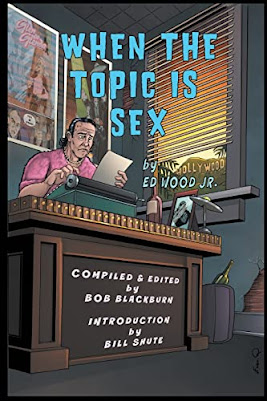
When the Topic is Sex (2021). Cover illustration by Evan Quiring.

Well, it's that time again. A new compilation of Ed Wood's extensive magazine work is upon us, the third of its kind in recent years. This time, it's called When the Topic is Sex, and it is now available from BearManor Media in hardcover or paperback editions. Like the two previous Wood compendiums, Blood Splatters Quickly (2014) and Angora Fever (2019), When the Topic is compiled and edited by Bob Blackburn, the Los Angeles resident who befriended Eddie's widow Kathy Wood in her later years and became co-heir of her estate. 

A new book to devour.
It's nothing short of a small miracle that these volumes exist at all. Bob Blackburn curated these books by purchasing vintage adult magazines containing Eddie's work on the secondary market, sometimes at considerable expense. Ed Wood fanatics owe him a debt of gratitude for that. Simply put, Bob tracked these stories down so that we could enjoy them in the 21st century. Otherwise, a vast swath of Ed Wood's literary output might've been lost to time.

I've repeatedly said that fans who want to familiarize themselves with Ed Wood's writing style—and thus with the man himself—should pick up Blood Splatters Quickly or Angora Fever and read his short stories, most of them written in the early 1970s when Wood was a penniless alcoholic. From these sex-and-violence-strewn tales, you'll get a sense of Eddie's quirks as an author: his stilted syntax, his oddball approach to punctuation, his often surreal and meandering plots, and his love of particular words and phrases. Above all, those short stories demonstrate how Eddie could direct nearly any subject toward his three great muses: death, booze, and women's clothing.

It's true that Eddie churned out dozens of novels in the 1960s and '70s, but these are usually very expensive and difficult to find. Besides, many fans may find these books challenging to read because Ed Wood (he of the notorious "muddled mind") had trouble maintaining a coherent plot over the course of a couple hundred pages. His novels tend to get bogged down with flashbacks and digressions. The great thing about the short story form is that it forces Ed to stay at least somewhat focused on the task at hand. He knows he has to bring his plot to some kind of conclusion after a few pages, so he's more apt to get to the point. Having read many of Ed's novels, I can say with confidence that the short stories contain all of the author's idiosyncrasies, just in a more digestible form.

What sets When the Topic is Sex apart from Blood Splatters Quickly and Angora Fever is that those previous compilations focused on Eddie's short stories, i.e. his brief works of fiction, some of them supernatural. The articles anthologized in this new book, however, are examples of Ed Wood's plentiful but overlooked nonfiction. I use the term "nonfiction" with caveats. As Bob Blackburn points out in his explanatory foreword, some of Ed's supposedly "factual" articles were based on real-world research, while others were entirely concocted from the author's alcohol-soaked imagination. 

Bob further maintains that Eddie's nonfiction articles "more than his short fiction really show more of the real person of Ed Wood in them." I don't know if that's necessarily true—it doesn't gibe with my experience as a reader—but I will say that Wood's nonfiction has a tone of its own, distinct from his novels and short stories. He's slightly more stiff and formal when writing this material, but he's also more optimistic and even-handed. Think back to Glen or Glenda (1953) when kindly Dr. Alton (Timothy Farrell) starts narrating in the style of a high school civics film:
Give this man satin undies, a dress, a sweater and a skirt, or even the lounging outfit he has on, and he's the happiest individual in the world. He can work better, think better. He can play better, and he can be more of a credit to his community and his government because he is happy.
That's the Ed Wood who emerges from the nonfiction. You can also see this side of Ed's personality in the unsigned editorials he wrote for Pendulum Publishing's adult magazines. Greg Dziawer recently wrote about how those "idealistic" articles differ in tone from Eddie's seedy, often downbeat fiction.

Author and publisher Bill Shute further sets the stage with an excellent essay called "Edward D. Wood, Jr.: Professional Writer," which serves as the introduction to When the Topic is Sex. In describing the nonfiction articles, Shute writes: "Wood comes off as thoughtful, measured, and wanting to consider and respect differing viewpoints." Shute also asserts that these allegedly fact-based articles allowed Eddie "to basically riff on a theme in a unified way." 

As you might guess from the compilation's title, many of the articles in this book are about sex (and changing sexual mores), but Eddie sounded off about a number of topics, including the film industry and even school busing. Shute warns us that "some of this material is extremely politically incorrect by today's standards." (Bob Blackburn gives a similar warning in his foreword, though the term he uses is "squirm inducing.") Longtime Wood fans should be able to handle it, though—especially those brave souls who have been willing to explore Eddie's pornographic work, both on screen and in print. Once you've seen Eddie strip down to his jockey shorts in Love Feast (1969), very little should shock you.

Bob Blackburn has pieced When the Topic is Sex together from over 80 individual articles, originally published between 1971 and 1973 in various adult magazines. The two previous Wood compilation books provided many hours of entertainment for me, and I am confident that When the Topic is Sex will do the same. I hope you'll join me as I make my way through this volume and share my thoughts on it. Perhaps along the way, I'll come to agree with Bob Blackburn that these nonfiction articles bring us closer to the "real" Ed Wood.

Wednesday, March 27, 2019

Ed Wood's ANGORA FEVER: "Hitchhike to Hell" (1971)

Don't accept a ride from Harry Vincent, that's for sure.

NOTE: This article begins my coverage of Angora Fever: The Collected Short Stories of Edward D. Wood, Jr. (BearManor Bare, 2019).
Hitchin' a ride.
The story: "Hitchhike to Hell," originally published in One Plus One, vol. 4, no. 1, January/February 1971.

Synopsis: Harry Vincent is a serial killer whose death toll is up to seven. He prefers killing pretty young girls—they scream better—but he'll settle for men, including those he meets in gay bars. He's also obsessed with "wolfmen" and insists the moon is guiding his actions. One night, he kills an old wino he finds in an alley, slicing the poor, bewildered man to pieces with a surgical knife.

Harry decides his next victim must be a young female hitchhiker, since he's convinced those "tramps" are always out to victimize men like him. He sets out on the road, but his car soon breaks down, forcing him to walk back home. Just when it seems like his night is ruined, he himself is offered a ride by a young woman in an angora sweater. But this temptress has plans of her own for Harry.

Wood trademarks: Werewolves (cf. "Howl of the Werewolf," Orgy of the Dead); cocktail bar (The Cocktail Hostesses); maggots (cf. "Scream Your Bloody Head Off," "Hellfire," "I, Warlock," "In the Stony Lonesome," "Into My Grave," "The Whorehouse Horror"); newspapers having "a field day" (cf. Glen or Glenda); angora sweaters (cf. Glenda); winos ("To Kill a Saturday Night").

Excerpt: "He spun around, and after he got out of the headlights he saw her. She was luscious. More than he had hoped for. She was wearing a tight red angora sweater and a matching red miniskirt. She was beautiful and she was blonde. No good girl would stop for a man on the side of the road like that. She had to be one of those kind."

Reflections: Well, here we are again, folks. Five years after the publication of Blood Splatters Quickly: The Collected Stories of Edward D. Wood, Jr. (2014), we finally have a second collection of short stories by Ed Wood. As usual, this volume is the passion project of Bob Blackburn, friend of the late Kathy Wood and co-heir to the Wood estate. Bob spends his time and money scouring Ebay for back issues of the magazines—generally pornographic in nature—where Eddie's stories originally appeared in the 1960s and 1970s. And we lucky fans get to enjoy Bob's findings in these lovingly compiled books.

Angora Fever kicks off with a gruesome horror tale from 1971. Readers of Blood Splatters Quickly will find themselves right at home here, because "Hitchhike to Hell" seems like a first cousin to such Wood splatter-fests as "The Gory Details" and "Breasts of the Chicken." The similarity to "Chicken" is especially striking, as a chauvinist sicko again gets his well-deserved comeuppance. However, here is no denying that Wood seems to take gleeful pleasure in describing the man's crimes in nauseating detail. Maybe Eddie was working through some aggression.

It's worth noting that Ed wrote for both gay and straight publications, as well as specialty magazines catering to particular fetishes. This story has a little something for everyone, as Harry kills both gay and straight victims, all while wearing "rubber panties." But there are limits to his depravity. During the scene with the decrepit wino, Ed points out that Harry Vaughn "didn’t have any homosexual inclinations connected to his slasher thoughts at that moment as he had had with the boy those months before."

I guess even homicidal maniacs have some standards.

P.S. This story also offers a snapshot of America's changing views of hitchhiking. The risky practice was beloved by free-living hippies, as documented in the 1969 million seller "Hitchin' a Ride" by Vanity Fare. Ed Wood famously detested the counter-culture, though, and his feelings about the younger generation are clear in this story as he describes them with undisguised contempt. "The dirty ones," he calls them. "Broads" with "bearded boyfriends."

Next: "Gore in the Alley" (1972)