Showing posts with label fiction. Show all posts

Sunday, November 22, 2015

Social Media Buzz: Another short story by Joe Blevins

"Eat your soul? Who, me?"

     After gently knocking twice, the dapper young man cracked open the door of his immediate supervisor's tastefully-appointed office and tentatively peered in.
     "Mr. Van Landingham?"
     The other man, fiftyish and conservative, did not rise to greet the young man but remained seated behind his desk as he said, "Come in, Korey. Have a seat, please."
     The young man entered the room, closed the door behind him, and respectfully sat down in a chair across the desk from his boss.
     "How do you think you've been doing in your role of Social Media Manager for the General Mills family of cereals?" said the older man.
     "Uh, good, I guess?"
     "Okay. Okay. Interesting. Now, one of your professional duties these last six months has been maintaining the Twitter account of Buzz the Bee, the cartoon mascot of our Honey Nut Cheerios brand. Is that correct?"
     "Uh, yes, it is."
     "All right. Now we're getting somewhere. Well, Korey, I took the liberty of printing out some of your recent tweets from that account. I have them right here. Do you mind if I read them out loud?"
     "Not at all."
     "Okay, here's one: 'Nothing like a bowl of Honey Nut Cheerios to start your morning right.' Now, normally, that would be a damned fine tweet, Korey, but you chose to end it with the hashtag '911WasAnInsideJob.' Can you explain that?"
     "Well, uh, Mr. Van Landingham..."
     "Please. It's Kevin."
     "Well, Kevin, it's not that I personally think 9-11 was an inside job. But, of course, the account is written from Buzz's point of view. It's what he thinks. He's a multi-faceted character."
     "Okay, fair enough. But how about this one? 'Bee happy. Bee healthy. Life begins at conception.'"
     "Well, children do make up a substantial portion of our customer base, Kevin. And if they're not carried to term, they're not going to be eating any of our delicious Honey Nut Cheerios, are they?"
     "Hmmm. I suppose not. But then, there was this tweet that contained only a photo of actress Neve Campbell topless in the 2007 film I Really Hate My Job."
     "What, specifically, is the issue with that one?"
     "The issue, specifically, is that it's a photo of actress Neve Campbell topless in the 2007 film I Really Hate My Job. We try to keep our social media content family-friendly, Korey."
     "Are you saying then, Kevin, that General Mills considers the female body to be inherently shameful, something to be hidden away from view?"
     "Well, no, not exactly. But..."
     "Haven't you heard of the Free the Nipple campaign, Roderick?"
     "Kevin."
     "Whatever. It's a vital, burgeoning movement in this country right now. Shouldn't General Motors..."
     "Mills."
     "...Mills be at the forefront of change for once? There's nothing wrong with breasts, Kevin. Breasts produce milk, and what goes better with cereal than milk?"
     "Yes, but did you have to post that same photo every hour on the hour during the Paris terrorist attacks? People were beginning to wonder if it was some kind of code. Now I have the NSA breathing down my neck."
     "People always fear what they don't understand, Kevin. That's what I'm up against every time I tweet something on behalf of Buzz the Bee. You don't know what kind of an awesome responsibility this is. While you're tucked away in this cozy little office of yours, I'm out there on the front lines! Right now, people are starving for the truth, and I'm there to feed it to them, 140 characters at a time. The new millennium needs its own Che Guevara, and why shouldn't it be a cartoon spokes-bee? The truth will out! Viva the Bee!"
     As the young man pumped his fist in the air and assumed a pose of hard-won victory, the older man reached into a desk drawer, pulled out a small blow gun, raised it to his mouth, and shot a dart directly into his subordinate's neck. The young man slumped over instantly. The older man paused, sighed, then picked up the landline phone on his desk.
     "Gladys? Have maintenance send a crew to my office immediately. We have another Code B to take care of. Say, how many more nephews do you think the CEO has left, anyway?"

Saturday, October 24, 2015

A Game of Checkers: An extremely short story by Joe Blevins

The Wilsons' names are George and Martha.

Mrs. Wilson turned her head halfway toward Dennis, paused, then looked back at the wall. The room grew very quiet then for about thirty seconds, at which point Dennis heard a sound he eventually recognized as Mrs. Wilson sobbing softly. Mr. Wilson must have heard it, too, because he said something that sounded like ‘goddammit,’ and he lifted his heavy frame from the chair and walked out of the room. Mrs. Wilson didn’t even watch him go. Dennis, sensing an opportunity, rearranged the pieces on the checkerboard in his own favor.

Wednesday, September 4, 2013

Ed Wood Wednesdays, week 9: "Muddled Mind: The Complete Works of Edward D. Wood, Jr." (2001)

A whimsical illustration by your humble blogger in tribute to Ed Wood's writing career.

"Is there a perfect reader somewhere, a total reader... so that my reading is in a way pointless? Well, I hope not."
-Julian Barnes, Flaubert's Parrot

Flaubert's Parrot
Geoffrey Braithwaite, MD, the protagonist and narrator of Julian Barnes' extraordinary novel Flaubert's Parrot (Jonathan Cape, Ltd., 1984) goes on the trail of his favorite author, the late French novelist Gustave Flaubert, visiting the famed writer's old haunts, talking with other Flaubert fans and consulting various literary and historical experts to gain perspective on his hero's life and work. 

In particular, the retired doctor hopes to find one bizarre souvenir: a colorful stuffed parrot Flaubert used as inspiration during the writing of a story called "A Simple Heart." Braithwaite ultimately finds two likely candidates for "the real parrot," each one with an owner who vouches for its authenticity, but he never really does find out which one was genuine and ultimately learns to live with that uncertainty.

At one point in his travels, however, he ponders the fact that many before him have studied Flaubert and may, thus, have made his own inquiries redundant. So why does he continue? "My reading might be pointless in the history of literary criticism," he concludes, "but it's not pointless in terms of pleasure."

In the process of writing the Ed Wood Wednesdays series, I've often felt a bit like the good doctor of Barnes' novel. There are at least a dozen documentaries about the eccentric writer-director and several thoroughly-researched books about the man and his career, in particular Rudolph Grey's Nightmare of Ecstasy (1992), an exhaustive oral history ten years in the making, and Rob Craig's Ed Wood, Mad Genius (2009), a methodical, often-revelatory critical analysis of Ed's films. Anyone interested in the life and work of Edward D. Wood, Jr. should own those two volumes.

I have neither the time nor the resources to truly compete with Grey or Craig. In some ways, it would be impossible. Wood had only been dead a few years when Grey began his research. The trail is much colder now. Eddie's ashes were scattered at sea about 35 years ago. Many, perhaps most, of the interview subjects in Nightmare of Ecstasy have died since its publication. And because Ed's career was not well-documented during his own lifetime, it can be extremely tricky to even identify his work, let alone obtain copies of his films and books for review. In short, bringing it back to the Barnes novel, the amateur Woodologist may search and search and yet never find "the real parrot."

But still I continue, perhaps in the hope that by delving into as much of Ed Wood's career as possible (that is to say, possible for me given my work schedule and income), I will emerge with a better understanding of this fascinating, troubled, contradictory man. Vicariously, Eddie and I have spent a lot of time together these past couple of months. Since much of his literary output is currently unavailable to me, however, I have had to rely on the reportings of others to explore the gloomier corners of Ed's career.

Case in point:

MUDDLED MIND: THE COMPLETE WORKS OF EDWARD D. WOOD, JR. (2001)

David C. Hayes' Muddled Mind: Think of it as Cliffs Notes for budget-minded Ed Wood fans.

Alternate Titles: None.

Availability: The book is available directly from the publisher in paperback and hardcover editions.

Author David C. Hayes.
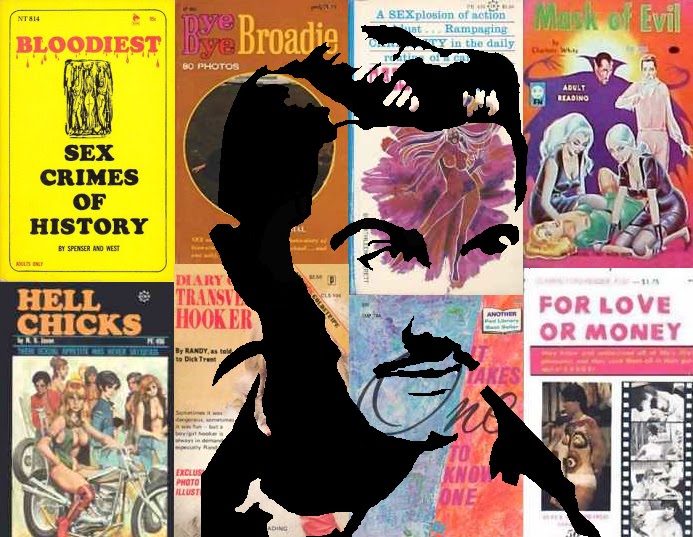
Backstory: As of 2013, only a handful of Ed Wood's books are widely available and affordable to the average consumer. Any reader with a computer can easily procure used copies of Death of a Transvestite (1967), Killer in Drag (1963), Devil Girls (1967), and Hollywood Rat Race (1998) for less than the cost of postage. After that, though, it gets rough. Small-time publisher Ramble House reprinted several of Wood's books in the mid-2000s, but these editions have largely vanished from the primary and secondary markets. With luck, patience, and a great deal of money, fans might be able to purchase a few vintage Ed Wood paperbacks on eBay.

For most of us, though, these works remain frustratingly out of reach. David C. Hayes' Muddled Mind: The Complete Works of Edward D. Wood, Jr. (Ramble House, 2001; revised 2006) does what it can to correct that sad situation. To my knowledge, this is the only guidebook devoted to Ed Wood's writing career rather than his films. 

Author-filmmaker Hayes, who also appeared as both Rev. Steele and Lobo in Ed Wood's Devil Girls (1999), gives a fairly thorough overview of Wood's writing career, summarizing and providing excerpts from many of Ed's novels, nonfiction books, magazine articles, and short stories. He tries to give readers a sense of what these books and stories are like and how they fit into the overall arc of Ed's life and career. Along the way, Hayes also critiques these works in a mildly satirical style, razzing Ed somewhat for his logical flaws, his narrative inconsistencies, and above all, his unconventional grammar and syntax. Likely inspired by Ed Wood's many professional pseudonyms, Hayes occasionally credits certain chapters, including an article on the making of the Devil Girls movie, to a deranged alter ego, "Hayden Davis, Ph.D." These intrusions, mercifully, are brief and rare.

Arranged chronologically, Muddled Mind also includes information on where and how to track down Ed's books (including price estimates) as well as a thorough index of Wood-related films, recordings, and publications.

The reading experience: For those of us who cannot afford to spend hundreds of dollars on obscure paperback novels from the 1960s and 1970s, Muddled Mind: The Complete Works of Edward D. Wood, Jr. is an extremely helpful volume. While I'd someday love to own full-length versions of Hell Chicks (1968), Side-Show Siren (1966), TV Lust (1977), and the many other books synopsized in this career-spanning catalog, at least now I feel that I have a more complete picture of Ed's tremendously productive and eccentric literary life. Hayes' tone is slightly irreverent, but Muddled Mind is clearly intended as a tribute to Ed Wood.

While not as substantial and enlightening as Nightmare of Ecstasy or Ed Wood, Mad Genius, this book is still a handy reference work for the struggling Woodologist. By far, the book's greatest selling point is that it actually includes three verified short stories by Edward D. Wood, Jr. himself. (He wrote hundreds more, many of which have yet to be located or identified.) This was an area of Wood's career that was entirely new to me. I would like now to discuss these three stories individually and give you my impressions of each, as well as some background information about them.

"The Night the Banshee Cried" (1966)

"The Night the Banshee Cried" was originally published as part of Ed Wood's Orgy of the Dead.

Originally published: In Orgy of the Dead (Greenleaf Classics, 1966), a short story collection produced as a tie-in with the 1965 film of the same name, written by Ed Wood and directed by Stephen Apostolof (aka A.C. Stephen).

Comments: Most Ed Wood fans know that the infamous "monster nudie" film Orgy of the Dead (1965) had a tie-in paperback book. I had always been led to believe that the book was a novelization of the film, but this turns out not to be the case. In fact, while it does contain a textual version of the film's story, the Orgy of the Dead paperback book actually functions as a treasury of Ed Wood's strange "spooky" stories, not all of them erotic in nature. An example of such a non-erotic horror story is "The Night the Banshee Cried," which Ed had written several years earlier.

Actress Valda Hansen, a blonde ingenue who memorably starred in Ed Wood's Night of the Ghouls (1959), told biographer Rudolph Grey that Ed wanted to make "The Night the Banshee Cried" into a film and asked her to make a recording of the monologue he had written for it. The Wood filmography at the end of Nightmare of Ecstasy actually includes a listing for a 22-minute short film adaptation of the story that Ed wrote, produced and directed in 1957. This film has since gone missing, but as late as 1963, Ed still planned to use it, along with the unsold Final Curtain pilot and a third, yet-to-be-filmed tale called "Into My Grave" as components of a feature-length anthology film called Portraits in Terror. None of this ever came to be.

The version of "Banshee" which did reach the public -- and which now graces this book -- seems to be the same monologue that Valda Hansen recorded for Ed back in the '50s. It's a paranoid, rambling soliloquy by a tormented soul who has been mysteriously summoned from her grave and has now returned to her former homestead in order to replace the banshee who has long haunted the premises. The incumbent banshee, naturally, is quite displeased by these events and is not shy about expressing her feelings.

With its emphasis on death and resurrection, "Banshee" is quintessential Wood. In Irish mythology, incidentally, a banshee is a female spirit or fairy whose screams are an omen of an impending death. Ed, naturally, takes this myth and makes it thoroughly his own. As far as this story is concerned, being a banshee is a full-time job and retirement is obviously unwelcome. Tonally, this story is highly reminiscent of both Final Curtain and Criswell's speeches from Plan 9 from Outer Space (1957), Orgy of the Dead, and Night of the Ghouls (1959).

"To Kill a Saturday Night" (1971)

Ed Wood's disturbing, tragicomic "To Kill a Saturday Night" deals with sex, booze, and violence.

Originally published: According to Hayes, this story first appeared in the February 1971 issue of Black and White from Pendulum Press. However, Rudolph Grey's book says that this particular edition of Black and White was released in 1972. Not having an original copy of this magazine, I cannot tell you which date is accurate.

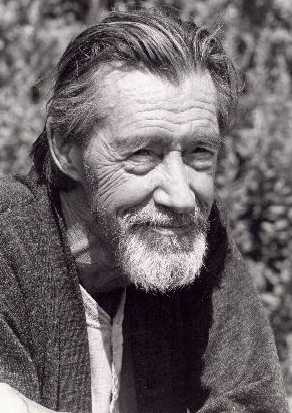
John Carradine: an ideal wino.
Comments: A pitch-black story of two hard-drinking farmhands whose Saturday night plans may include murdering prostitutes, "To Kill a Saturday Night" was also (quite inappropriately) reprinted in Tales for a Sexy Night, Vol. 2 (Gallery Press, 1973). Rudolph Grey says "Saturday Night" was based on one of Ed's many unproduced screenplays. In 1973, Ed tried unsuccessfully to film this story, along with two others, as part of yet another never-to-be anthology film. Supposedly, he wanted John Carradine and David Ward for the lead roles of winos Pete and Art.

Bracingly nasty and yet somehow grimly comic as well, "To Kill a Saturday Night" reminded me a bit of Beckett's Waiting for Godot. There's no real plot to speak of, just a circular, semi-coherent dialogue between two highly intoxicated, small town working stiffs who sit on a curb and discuss what they should do to kill the time on Saturday night. Pete, the more vicious of the two, suggests killing and robbing a couple of "whores" named Lulu and Maizie. The slightly-dim Art is skeptical of the plan at first, but Pete makes a convincing -- or at least forceful -- case. These two desperate, hopeless losers seem to inhabit a hellish nightmare world of cheap, bitter-tasting wine and unsanitary, unsightly, and disease-ridden prostitutes.

Ed Wood presents us with a rancid slice of Americana with this memorably sleazy tale. "To Kill a Saturday Night" shows American society at its worst. Pete, in his own sick and misguided way, is kind of a philosopher. Certainly, his views on personal hygiene are unique. (Sweating profusely, he argues is as good as bathing since sweat is water.) I would have loved to have seen John Carradine play this role. "To Kill a Saturday Night" is quite a discovery and justifies the purchase of Muddled Mind all by itself.

"Pearl Hart and the Last Stage" (1973)

Female stagecoach robber Pearl Hart is among the historical figures chronicled in Outlaws of the Old West.

Originally published: As part of the book Outlaws of the Old West (Mankind, 1973), edited by Charles D. Anderson.

Comments: Charles D. Anderson was one of Ed Wood's friends in the publishing business (mostly pornography), and the two had worked together on many disreputable projects. But Anderson also knew of Ed's love of cowboy movies and gave him the opportunity to write a chapter of the 1973 non-fiction book, Outlaws of the Old West. Specifically, Ed's portion of the book is devoted to Pearl Hart, who was both the last stagecoach robber in American history and the first female in this particular line of work.

Much gentler than the previous two stories, "Pearl Hart and the Last Stage" is still very much in keeping with the rest of Ed's career. For instance, Ed tells us that Hart wore men's clothing during the infamous robbery and was originally misidentified as being a boy. This is very similar to the gender-bending female criminals in Wood's script for The Violent Years (1956).

Moreover, "Last Stage" is really a show business story about the pains and pleasures of fleeting fame. Hart modeled herself after the stagecoach robbers she'd read about in magazines, idolizing them just as Ed had idolized movie stars as a child. After she'd been arrested (she and her male accomplice got lost in a storm and thereby bungled their getaway) and convicted, Pearl reveled in the attention she received from the public and the press.

After her release from jail, Pearl Hart toured the country as a star attraction for about a year, until the crowds began to dwindle and she disappeared into obscurity. The chapter is bookended by the image of an aged Pearl in the year 1924, visiting the courthouse where she'd been a well-known prisoner so long ago. Apparently, she was nostalgic for her days of youth and fame. Perhaps Ed, only five years away from his own demise, could identify with that longing.

Next week: In one short week, I'll be jumping back into Ed Wood's filmography with a look at his most famous creation, Plan 9 from Outer Space (1957). Be there or be... well, somewhere else I suppose.

Sunday, August 11, 2013

"A Twinkie Too Far": A short story by Joe Blevins

So delicious, so deadly. The Twinkie that changed everything.

I

His body somehow knew it before his brain did. His extremities went numb. His jaw went slack. His stomach felt like an elevator whose cables had snapped.

The blue and white box. The cheerful red logo. The cowboy-hatted mascot. It couldn't be true. But it was true! The Twinkie had returned!

Ray had just turned a corner with his cart at the Shopway when a display in the middle of the aisle stopped him cold. Twinkies. Boxes and boxes of Twinkies arranged into a pyramid. Panicked, Ray grabbed the fluorescent vest of the first employee he could locate, a wispy lad of about 15 with a vague expression on his face.

"Is this... I mean... are these permanent?"

A pregnant pause, then finally a response from the kid:

"...What?"

"The Twinkies, man! The Twinkies!" Ray gesticulated wildly in the direction of the pyramid. "Golden sponge cake! Creme filling! TWINKIE THE KID!"

Total incomprehension on the kid's face.

"Useless! Absolutely useless!"

Ray staggered out of the store, a man possessed. He practically had to remind himself  how to walk. One leg in front of the other. Repeat. He felt weirdly disconnected from his surroundings. The volume had been turned down on the outside world, but there was an audible throbbing inside his head. Oblivious to the world around him, he stepped in front of the path of a shiny black RAV4 in the parking lot. The driver, a suburban mother, was able to slam on the brakes in time to avoid hitting the seemingly-intoxicated man, who walked as if he were in a trance.

Once he'd reached a vacant section of the parking lot, Ray stopped and breathed deeply. He held his arms out at his sides. His rational mind was beginning to reassert control over his body. Unselfconsciously, he started to verbalize his thoughts:

"This is happening. This is happening. This is happening. Your name is Ray Dauber. You are 40 years old. You work as a computer programmer. You live at 2307 Creighton Avenue, Apartment B. You have a sister named Dale who lives in Utica. You're in the parking lot of the Shopway on Frontage Road, near the highway."

He slapped himself across the face.

"C'mon, man! Get your head in the game!"

He slapped himself again. Harder.

"Okay... okay... okay...." The word became a mantra.

More deep breaths, then a pronouncement: "Home. That's where you need to be right now. Go home. Go home, Ray. Go home."

A beat.

"Where did I park?"


Saturday, June 2, 2012

Blank Like Me: The Invisible Man Looks Back

"This'll kill ya. We're workin' up a Beatle medley for the act."

Well, naturally, the act has evolved over the years. For business reasons, mainly. I mean, you've gotta change with the times or the crowds go elsewhere. And in a town like Vegas, there's plenty of elsewhere for them to go.

So I've been adding new gimmicks to the act, new twists, new cast members. When I started at the Sahara, it was just me. That was enough for 'em in the beginning. Hell, half the act was Q&A with the audience. Now we've got, what, forty people in the cast -- dancers, backup singers, et cetera. Not to mention the pyrotechnics, the lighting. It's quite a production now. A circus. And all of this costs money. I should know that better than anyone, since it comes outta my bottom line. But my manager, Doug, keeps giving me the old "spend money to make money" routine.

Where is Doug, anyway? He's never around when I need him. I'm the Invisible Man, and he's the Invisible Manager. Heh. Probably off snorting more of my money up that big schnoz of his. Don't print that.

Listen, while you're up, pour me a drink, will ya? Scotch and soda. Thanks. Woah, easy! Easy! I gotta show to do in 20 minutes. There you go. You can take your hand away. I got it. No, really. I got it. Thanks again, kid.

Eating and drinking has been a part of my act since the beginning. It still gets 'em -- watchin' the food float in the air and then magically disappear. It's very simple, but very effective. Through trial and error, we've found that brightly-colored stuff tends to "read" best from the audience's perspective. You'll see me onstage, drinking what looks like blue Kool-Aid or somethin'. Lemme tell ya, that used to be vodka with food coloring. But I was a younger man then, and eventually my doc told me I had to cool it or my liver was going to file for divorce, citing spousal abuse.

So now it's just water. Heh. Killjoy. I guess it was for the best. I used to get pretty hammered onstage back then, but now, what with all the added fireworks, I gotta stay relatively sober. I usually have a quick belt before the show, but it's just one. I could really get hurt up there, y'know? One false move and KABLAMMO!

Anyway, where were we? Oh, yeah, the beginning. It's 1970 now, so that was, let's see here, fifteen years ago. Fifteen years! Jesus Christmas! When I started, there was nothing on the Strip like it. I was the first of the old time movie monsters to come to Vegas, and I emphasize the F-I-R-S-T. Now, ya got Dracula doing three shows a night at the Torquemada. Godzilla's packin' 'em in at the Sunspot. Even the Creature from the Black Lagoon has put together some kinda act at the, uh... at the...

HEY, RANDY! YOU'D KNOW THIS! WHERE'S THE CREACH PERFORMING THESE DAYS? 

That's right! The Cucaracha Club. Poor Creach, playin' a dive like that. No wonder he drinks like the fish he is. Don't print that either. Nice guy once you get to know him, though I'm not sure what his "act" consists of. He's like Esther Williams. Wet, he's a star. Dry, he ain't much. Maybe he brings a tank with him onstage. I dunno. I haven't made time to catch his act. Maybe I should.

But, anyway, getting back to my point. There are a lot of monsters in town these days. Frankie, Wolfie, Drac, they're ALL here 'cause that's where the dinero is! And those bastards you can see! I gotta convince some dumb tourist from Bumblefuck, Iowa that he should spend his dime and his time on me instead of them. Hence the lighting and the effects and the songs. You know, I still do an hour a day of vocal training and an hour a day of dance rehearsal. Still! At my age yet! That's in addition to the million and one other things I gotta do during the course of a day.

Right now -- this'll kill ya -- we're workin' up a Beatle medley for the act. Get this. We open with "Nowhere Man" then segue into "I'm Looking Through You" and finish with "You Won't See Me." Nah, it ain't ready yet. We gotta have costumes -- at least the gals do. I, of course, do the whole show au natural, except maybe for a top hat and tap shoes. And if you think that didn't take some gettin' used to... Brother, you don't know from stage fright until you've appeared in front of a packed house with your invisible dong flapping in the breeze. Sorry, I don't mean to be so vulgar. Don't mind me, kid. That formula's done screwy things to my brain.

Totie Fields almost crushed him.
Anyhow, for a new number like the Beatle thing, we gotta have costumes, choreography, the whole schmear. The whole thing is storyboarded. Plus we gotta secure the rights to the songs. Doug handles that shit, thank the Lord. Or at least he would if he'd keep the spoon outta his nose for five seconds.

No, no. I bust Doug's chops, but he's a good guy. Saved my life once. Totie Fields almost sat on me one night at the Trocadero, but Doug knew where I was and tackled her to the ground. He was like a Secret Service agent. I tell ya, if Doug had been in Dallas with JFK in '63... well, who knows? The whole world might've been different.

Retire? Me? With three ex-wives and six semi-visible kids to support? No, sir, it'll be a long time before this Invisible Man fades from view.

Well, you know what I mean.

Saturday, May 5, 2012

The BastardTron 9000

A cybernetic superguru for the Information Age

Dateline: Nepal
There it sits, perched serenely upon silken pillows in its lofty mountain temple: the BastardTron 9000, the most sophisticated artificial-intelligence droid ever created. A full decade of research and development, encompassing many thousands of man-hours and, it is whispered, perhaps a trillion dollars, has gone into its production. Scores of programmers, engineers, clerics, philosophers, mathematicians, poets, and noted academics of every discipline have contributed to its final form. The governments of 17 different countries, including the United States, Germany, Russia, and China, have lent financial and technical support. Luminaries ranging from Noam Chomsky and Stephen Hawking to Deepak Chopra and Dr. Phil were seen entering the heavily-fortified BastardTron Labs in Rouen, where the magnificent machine was created, its every stage of development shrouded in secrecy, cloaked in gossip and innuendo.

The purpose of the BastardTron 9000, according to its chief engineer and namesake, the French robotics whiz Guillaume du Bastard, was to be a sort of Cybernetic Superguru for the Information Age, replacing the monks, swamis, fakirs, and holy men of the past. Embedded within the circuits, wires, and gears of this mighty automaton would be housed the sum total of Man's knowledge of his world, the universe, and the very mysteries of Life Itself, including the endlessly complex dynamics of interpersonal relations. At last, they reasoned, the Seeker of Truth would finally have a place to go to find real answers to the most perplexing questions of existence.

Unfortunately, the thing turned out to be a complete bastard.

Friday, April 27, 2012

Attack of the Atomic Snot: A Short Story

"We've got the situation 75% under control..."
The Hubert J. Cromsby Institute for the Advancement of Quantum Botany
Las Calaveras, New Mexico 
April 21, 1975 - 8:04 a.m. 

And hello to you, Dr. Ackerman! Good to finally meetcha! 

Can I call you Jerry? Super. And please, do call me Dr. Mandelbrot. Haw, haw! Just pullin' your leg there, Jer. But all kidding aside, "Tom" will do just fine. We're all friends here at HJC. 

Let me show you around the place and introduce you to some of the boys you'll be working with. Right this way. How's Las Calaveras been treating you, by the by? Settling in to your new home all right? Oh? Well, I sure as heck am sorry to hear that, Jer. My wife was the same way when we first moved out here. But she got used to it, and I'm sure your wife will, too. What's her name, if I may ask? What a coincidence. My grandfather's name was Miriam. Haw, haw! 

But really, Jer, this place isn't too bad once you get used to the heat. Satan's Crawlspace, my wife Dolores calls it. There's not a whole heck of a lot to do in town... a few restaurants, coupla stores. Dolores thought she'd go stir crazy. But I tell ya, Jer, at night Las Calaveras has a beauty all her own. It's the sky, Jer, that great big beautiful open sky fulla stars. Makes a person feel, I dunno, free I guess is the word. And here's the best part, Jer: no lawn to mow! Am I right? Haw, haw! 

The kids took to this place right away. Said it reminded 'em of those old Road Runner cartoons, which I guess it does at that. How you fixed in the offspring department there, Jer? Got two m'self. Randy's nine and Courtney's eleven. How 'bout you? No? Some particular reason? Well, I guess you're right, Jer. It's not my place to pry. But if it's a medical thing, Jer, I know a coupla doctors who would be glad to... Okay, Jer, I'll lay off. Guess I'm always tryin' to stick my nose in where it doesn't belong. But, heck, that's why we became scientists, huh? Delores says a scientist is just a busybody wrapped in a lab coat! A regular Nosy Joe, that's me. Haw, haw!