Showing posts with label religion. Show all posts

Wednesday, April 9, 2025

Ed Wood Wednesdays, week 223: 'Drown the Devil: A Spiritual Biography of Ed Wood' (2024)

In Drown the Devil, Angel Scott finds the connection between Ed Wood and religion.
Neighbors, said the reverend, he couldnt stay out of these here hell, hell, hellholes right here in Nacogdoches. I said to him, said: You goin to take the son of God in there with ye? And he said: Oh no. No I aint. And I said: Dont you know that he said I will foller ye always even unto the end of the road? 

Well, he said, I aint askin nobody to go nowheres. And I said: Neighbor, you dont need to ask. He’s a goin to be there with ye ever step of the way whether ye ask it or ye dont. I said: Neighbor, you caint get shed of him. Now. Are you going to drag him, him, into that hellhole yonder?
-Cormac McCarthy, Blood Meridian (1985)
The field of Woodology has now progressed to the point that we are getting books about fairly specific aspects of Ed Wood's life: his military career, his marriage to Kathy Wood, his unproduced screenplays, etc. Of all these, few projects have intrigued me more than Angel Scott's Drown the Devil: A Spiritual Biography of Ed Wood (Bear Manor, 2024). A real-life pastor, Angel has been a vital part of the Ed Wood online fan community for years now, and I knew she was working on a religious-themed book about Wood and his films. Naturally, I was curious to see what she uncovered in her extensive research.

My guess was that this would be another book that used popular culture as a springboard to talk about matters of theology and philosophy. I was thinking specifically of The Tao of Pooh (1982) by Benjamin Hoff, The Gospel According to Peanuts (1965) by Robert L. Short, and the popular anthology The Simpsons and Philosophy (2001). So has Angel Scott written The Tao of Wood or The Gospel According to St. Eddie? Not exactly. While there is some discussion of the religious content in Wood's films, particularly Glen or Glenda (1953) and Plan 9 from Outer Space (1957), this is not primarily an interpretive or analytical book. For readers seeking something like that, I'd recommend Ed Wood, Mad Genius (2009) by Rob Craig.

Instead, this book is exactly what its subtitle proclaims it to be: a spiritual biography. In Drown the Devil, Angel Scott tells the story of Ed Wood's life and career, from his birth in Poughkeepsie, NY in 1924 to his death in Hollywood in 1978. We hit all the expected stops on the tour. Eddie works as a movie usher in his hometown, serves a stint in the Marines during World War II, comes home after the war, heads out to California, makes some infamous horror and sci-fi movies for a few years, and finally descends into pornography before dying penniless at 54. Along the way, he develops a serious, crippling addiction to alcohol and has at least three significant romantic relationships, two of which lead to marriage. 

Drown the Devil examines the role that religion played in these events. To put it another way, where is God in the strange, sad story of Edward D. Wood, Jr.? To be honest, it's not a question I'd spent a great deal of time pondering before now. When I think of directors whose films frequently grapple with spiritual matters, my mind goes to Martin Scorsese, Federico Fellini, Pier Paolo Pasolini, and Ingmar Bergman. While Ed Wood's movies are not entirely godless—indeed, Bela Lugosi's character in Glen or Glenda might be a stand-in for the Almighty—I wouldn't exactly say religion was one of the director's main motifs. Ultimately, each one of us has to deal with God in some way, whether it's to follow Him, scorn Him, or deny His very existence. So it does make sense to examine Ed's life and work from a religious standpoint.

As I mentioned earlier, Angel Scott did an admirable amount of research for this book, and some of her most interesting findings occur in the early chapters that deal with Eddie's youth in Poughkeepsie. I really had no idea of his Methodist upbringing or the fact that he served as chaplain for the Poughkeepsie chapter of the Marine Corps League for a year after his military service ended. So Ed Wood was much more grounded in religion than I had previously assumed. I was also very intrigued by an extended comparison of Glen or Glenda to Rowland V. Lee's I Am Suzanne (1933), a now-obscure romantic melodrama about the relationship between a dancer (Lilian Harvey) and a struggling puppeteer (Gene Raymond).

The heart of Drown the Devil, accounting for about a third of the book's total length, is a very detailed telling of the making and distribution of Ed Wood's most famous film, Grave Robbers from Outer Space aka Plan 9 from Outer Space. As Ed's fans know, Plan 9 was partially financed by the First Baptist Church of Beverly Hills, and the relationship between the director and the church was not always harmonious. The unlikely story (a Baptist church making a cheap horror film?) has already been told in numerous books and articles and was played largely for laughs in the Tim Burton-directed biopic Ed Wood (1994). One particularly memorable scene has Eddie and several members of his oddball entourage being baptized in a swimming pool. In the published version of the Ed Wood screenplay, writers Scott Alexander and Larry Karaszewski talk about how they handled this aspect of the plot:
We had to turn Plan 9 from Outer Space into a climax. After much thought, the solution hit us, simple and elegant. The bad guys would become the Baptist moneymen, who want nothing more than a coherent film. All they are asking for is what any rational person would: continuity and logic. It is irony on top of irony. In the world of Ed, this impudence makes them villains. How dare they compromise him!
So it seems that the biopic was more interested in telling an entertaining, sympathetic story than in being strictly truthful to history. Fair enough. I don't fault the screenwriters for that.

For this book, Angel Scott has combed through the archives, including some decades-old church newsletters, to discover the truth of the Plan 9/First Baptist saga. It turns out that the story is more nuanced and complicated than I had previously suspected. Yes, Eddie got into contact with the Baptist church through his then-landlord, J. Edward Reynolds, who was a member of the congregation. And, yes, Ed joined the congregation himself in order to curry favor with the church's leadership. But Scott's book reveals that Ed Wood was not the opportunistic carpetbagger you might assume him to be. He attended services at First Baptist for two years and even penned a pageant for the organization, though no scripts have survived. Meanwhile, the infamous baptism of Wood's coterie had a surprisingly long-lasting effect on some of them. And J. Edward Reynolds, essentially a comic character in Ed Wood, emerges from Drown the Devil as a tragic figure with some of the same demons that ultimately claimed Eddie himself.

After directing The Sinister Urge (1960), his last ostensibly "normal" film, Ed Wood spent most of the rest of his life working prodigiously in the adult entertainment industry. He penned dozens of pornographic novels and wrote many short stories and articles for nudie magazines. He also worked on both hardcore and softcore films as a writer, director, and occasional actor. Ed's "porno" work constitutes a major part of his canon, perhaps even the majority of it. So what do we do with all this as we try to make sense of Eddie's life? Some books and documentaries about Wood either marginalize or ignore this material, while others revel in it. Scott takes a moderate stance, giving Ed's adult work ample space in the manuscript without wallowing in the truly unpleasant details. She acknowledges the reality of Eddie's career prospects in the 1960s and '70s while leaving him with at least a modicum of dignity.

As I made my way through Drown the Devil, naturally I reflected on my own complicated history with religion. I was raised in a traditional Roman Catholic family and attended weekly masses until I was in my late twenties. My faith was greatly shaken by my mother's death when I was in high school, but I continued to go through the motions of being a Catholic for roughly another decade after she passed away. As of 2012, I was calling myself an atheist, even though I never actually stopped praying. Today, I honestly don't know where I stand. There are days when God seems impossible to deny and others when He seems impossible to believe. I can't say that Ed Wood's movies have shed a great deal of light on the matter for me, but Angel Scott has certainly given me some new questions to ponder as I screen Plan 9 for the umpteenth time.

Drown the Devil may be purchased from Amazon here or directly from the publisher here

Saturday, December 14, 2024

2024 Comics Fun Advent Calendar, Day 14: CHEESE!

Show those pearly... uh, grays.

How's your Advent going? Mine's going okay, I guess. I haven't been religious in years. Maybe I never was. I went to church a lot as a kid, but it wasn't my idea. My mother was Catholic, which meant we were all Catholic. My dad didn't grow up in any particular religion, but he converted to Catholicism to marry my mom. Took classes and everything. I remember spending some of the most boring hours of my life at a church in Flushing called St. Robert Bellarmine. Mostly these were Sunday masses. But there are a few extra holy days scattered throughout the year when you have to go to church on, like, a Tuesday night or something.  

I remember that one of these extra masses happened the very same night the George C. Scott version of A Christmas Carol was airing on TV. I didn't want to miss any of it, so I was extremely anxious for that mass to end. If I recall correctly, we got home just as the movie was starting, so I didn't miss much or any of it, thank God. The ghoulish looking fellow in today's comic reminds me a bit of the ghost of Jacob Marley. This is yet another comic panel I found through Comics Outta Context and repurposed.

P.S. Has a professional photographer ever told you to say "cheese"? Is that something that happens in real life?

Monday, December 9, 2024

2024 Comics Fun Advent Calendar, Day 9: Joy to the world! Your God is dead!

Did you find all six differences?


What's the holiday season without a little harmless blasphemy, huh? Relax. God's got a sense of humor about these things, I'm sure of it.

Today, we pay backhanded tribute to cartoonist Henry Boltinoff (1914-2001), who worked for decades in both comic strips and books. He's what you'd call a journeyman. His magnum opus, however, may be a long-running newspaper feature called Hocus Focus in which he would present two seemingly identical versions of a cartoon and ask us, the readers, to spot six obscure differences between them. I used to pore over such puzzles as a kid, though I never got good at finding the differences.

"Find all six differences" cartoons are still fairly common even today. You'll see them in Slylock Fox on a regular basis, for instance, and they're still used as filler in newspapers, newsletters, and fliers. Recently, at the office complex where I work, there was a cartoon like this projected on a monitor across from the elevators. I suppose it was there to keep people entertained while they waited.

I decided to take one of Henry's rather innocent cartoons from 1959 (plucked from Comics Outta Context) and take it in a darker direction. Or maybe Henry's cartoon wasn't so innocent! Obviously, these college students from 1959 are pretty square looking, but one of them is concerned enough about the state of the world that he worries the new year will not arrive. Can you sympathize with him? I can.

Monday, December 2, 2024

2024 Comics Fun Advent Calendar, Day 2: "The Next Ten Commandments"

I liked the detail of the Tampa Bay Buccaneers.

I grew up Catholic and spent many hours of my life (through no choice of my own) at a church called St. Robert Bellarmine in Flushing, Michigan. It was a very plain, almost barn-like structure when my family started going there in the early 1980s, but the parishioners raised money and made improvements to it over the years. Eventually, it became a pretty impressive place of worship. I mean, it won't put any cathedrals to shame, but for a church in a smallish Midwestern town, it's not bad.

One of the most prominent additions to the main sacristy was a series of stained-glass windows depicting scenes from the Bible. I generally didn't have much interest in what the priest was saying, so I'd stare at those windows, one of which depicted Moses reading the Ten Commandments. I suppose that memory stayed with me and eventually inspired today's comic.

The last time I ever set foot in St. Robert Bellarmine was in August 2018 for my father's funeral. The place looked better than ever.

Tuesday, November 1, 2022

Podcast Tuesday: "Jumping the Nun"

Diane Adair (aka Diane Diefendorf) and Henry Winkler on Happy Days.

Nuns were weirdly popular in the 1960s. Cheerful, fun-loving nuns, that is. (Dour, punishment-inflicting nuns apparently had the decade off.) One of the biggest films of the era was The Sound of Music (1965), the tuneful story of a manic pixie dream nun, Maria (Julie Andrews), who leaves her convent to work for a stern, widowed Austrian baron (Christopher Plummer) as a nanny to his seven rambunctious children. In short order, with some help from a score by Rogers & Hammerstein, Maria wins over the children and then their father, teaching them how to enjoy both life and music.
"The $ound of Money" (MAD, 1967)

And this was just one example of the nunsploitation trend! On TV, there was Sally Field in The Flying Nun (1967-70), a gimmicky sitcom about a petite nun whose habit allows her to become airborne for short periods of time. And on the pop charts, there was "Dominique," a French-language novelty song by Sœur Sourire aka The Singing Nun. With its catchy melody, it became a widely-loved #1 smash hit in 1963, but the authors of The Encyclopedia of Bad Taste (1990) maintain that "Dominique" forever robbed nuns of their dignity and mystique. They write of the song: "It was a pop music phenomenon, and it toppled nuns from their pedestal. Suddenly the world was faced with an epidemic of kooky, perky, goofy nunnish antics."

MAD tackled this very phenomenon when they parodied The Sound of Music as "The $ound of Money" in 1967 with art by Mort Drucker and a script by Stan Hart. That marvelous satire includes spoofs of many of the songs from the film, including "How Do You Solve a Problem Like Maria?" MAD's version was called "How Do You Solve the Problem of Religion?" and it went (in part) like this:
How do you solve the problem of religion?
How do you handle nuns and not offend?
Just simply have them doing things they wouldn't!
Don't follow the norm,
Or stay true to form.
Pretend!

Just show a kooky nun who rides a scooter.
Or show a Sister try to fly a kite.
The movies can make folks feel
That all these events are real,
And being a nun is fun from morn 'til night!
People will eat up films about religion!
Just keep them corny, saccharin and trite!
The ninth season of Happy Days takes place in 1963, the year of "Dominique," so it's only natural that they'd have their own take on the nunsploitation genre. Their version was called "No, Thank You" or "The Nun's Story." The plot has a young nun named Gloria (Diane Adair) teaching history at Jefferson High. Not knowing his new colleague is a bride of Christ, Fonzie (Henry Winkler) pursues her romantically (without success) and even forces a kiss on her. Naturally, when he learns the truth, Fonzie is eaten up with guilt. But Gloria is one of those happy-go-lucky, non-judgmental '60s pop culture nuns, so she's not mad at all. The episode ends with Gloria knocking Fonzie into the water at a carnival dunk tank, a scene that reminded me very much of the MAD song about "the problem of religion."

But how is the episode overall? Find out by listening to the latest installment of These Days Are Ours: A Happy Days Podcast.

Sunday, April 5, 2020

A Clown, for Christ's Sake: The curious career of Rev. Floyd T. Shaffer (UPDATED AGAIN!)

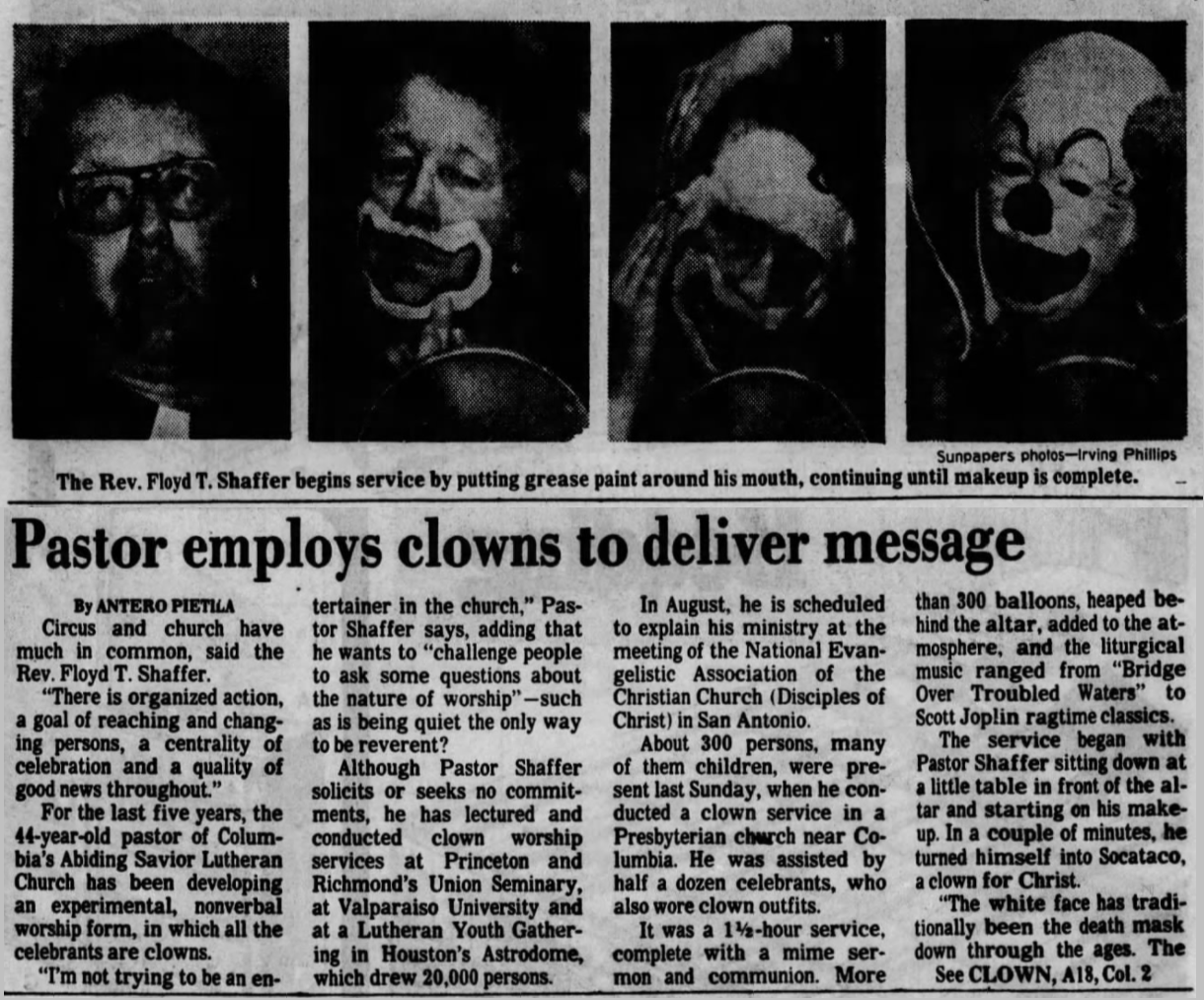
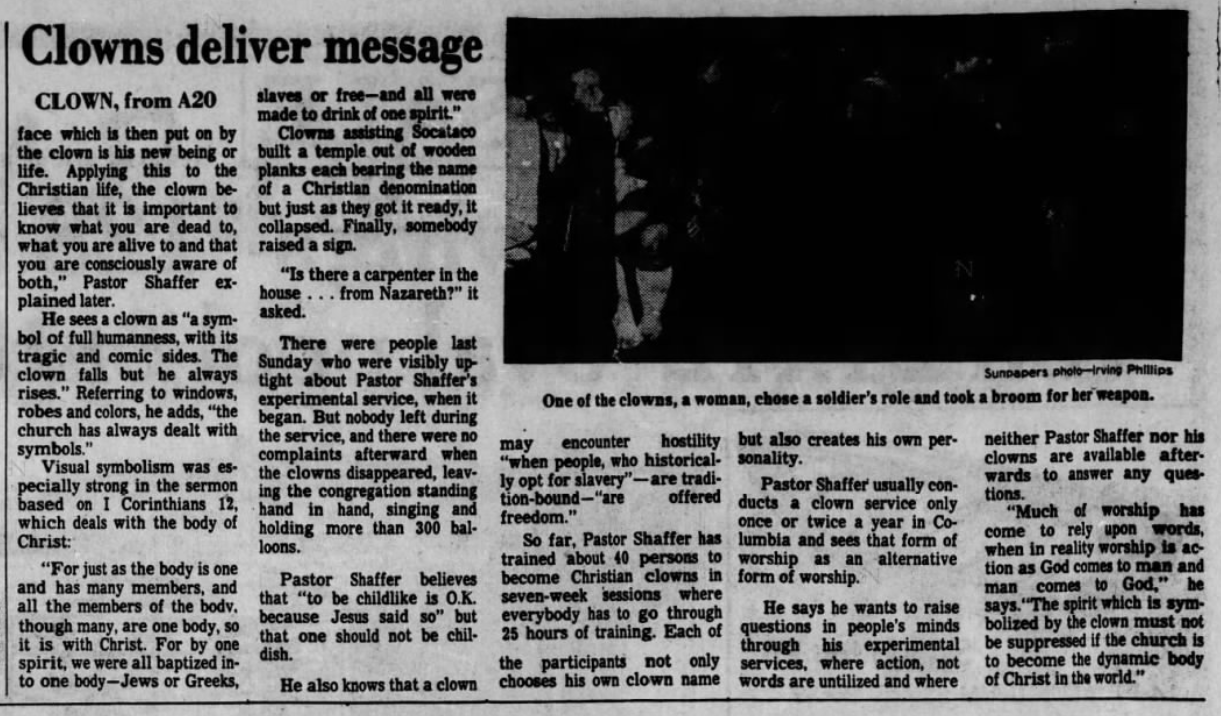
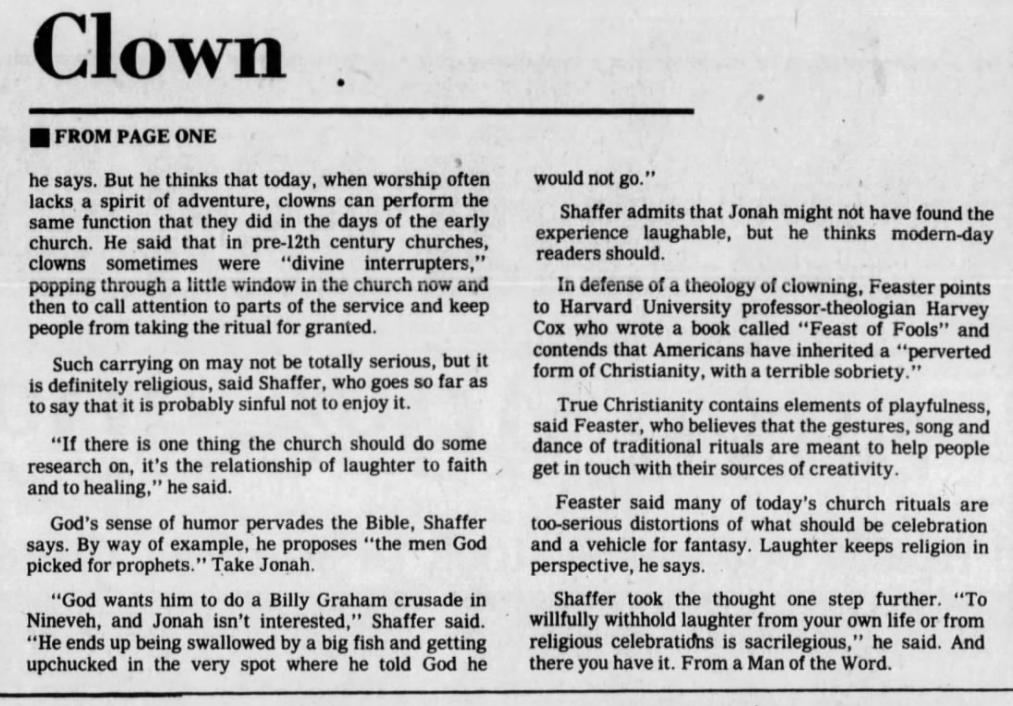
A tabloid article about Floyd Shaffer, the religious clown.

Floyd Shaffer's first book.
The Reverend Floyd T. Shaffer was looking for a new way to reach his congregation in 1969. How could he possibly get through to his practical, sensible flock during that tumultuous age of Vietnam, Woodstock, and Manson? The unlikely answer was by donning a fright wig, floppy shoes, and a round, red, rubber nose.

Though he may not have invented the form, Floyd Shaffer became, for a time, perhaps the most prominent and beloved proponent and practitioner of religious clowning in America. Born in 1930, the kindly and gentle Shaffer was a devout, deeply sincere Lutheran minister whose career trajectory took him from Michigan to Maryland to Ohio. In fact, Shaffer experienced his greatest period of productivity and prominence in the Buckeye State during the Reagan-Bush years. But to appreciate this man's story in full, we must travel back to the Age of Aquarius.

Destined to become a literal Holy Fool, Floyd Shaffer started upon his unusual path in the late 1960s in Columbia, Maryland, where he preached God's word at the still-existent Abiding Savior Lutheran Church. It was at Abiding Savior that Shaffer first introduced costumed clowning into his ministry and encouraged others to follow his example. According to fellow religious clown John Garrett, Floyd was aligning himself with a liturgical tradition stretching back to the Middle Ages, when so-called "holy interrupters" would lighten the mood of formal services with their comedic outbursts. Although a keen student of clowning history, Shaffer was more likely influenced by the counterculture of his own time. Clowning and mime were art forms beloved by hippies, who also had a penchant for face-painting and the donning of colorful, garish clothing. Back in 1969, a preacher dressed as a clown could almost be considered edgy or hip.

In those early years, Shaffer and his ilk were not always welcome among mainstream Christians. The soft-voiced pastor related to his followers the story of his disastrous appearance at a 1970s youth conference held at Houston's famed Astrodome. There, Shaffer and his fellow beneficent buffoons were regarded with extreme skepticism. Thinking the clowns were blasphemous, the other conference attendees derided and, in some cases, attacked Shaffer's troupe. Arlene Trapp, an original acolyte of Shaffer, recalled being "treated like Jesus, kicked at, hit, and mocked."

Still in all, Shaffer's tomfoolery-based evangelism must have yielded positive results in those early days, because he kept at it. In 1974, still based in Columbia, he founded Faith and Fantasy, a nondenominational clown ministry popular enough to have lasted into the 1990s, though its alumni remember it as a loosely-affiliated "non-organization" whose members were never keen on rules. During these years, determined to spread the message of Christ through the techniques of Emmett Kelly and Marcel Marceau, Shaffer and his followers performed their wordless, mime-based act at weekly Lutheran services and also visited numerous hospitals and nursing homes, where they found an appreciative, if captive, audience for their antics.

By 1981, having relocated to Ohio, Floyd Shaffer was well-known enough to attract the attention of the popular press. In August of that year, the black-and-white tabloid Weekly World News ran a profile of Shaffer with the headline "Preacher clowns for God to fill the pews." While essentially flattering to the clown minister, the article also described him as "wacky" and "bizarre."

The Christian Science Monitor followed suit in September with a slightly more dignified article by Stewart McBride headlined "Holy fools rush in." More wide-ranging than the Weekly World News piece, McBride's article looks at different examples of clown ministry from across the United States. In this context, rather than the isolated kook portrayed in the tabloid, Floyd Shaffer is part of a vital, burgeoning movement. The Monitor still recognized Shaffer as a pioneer, however, calling him "one of the first clergymen to perform a Sunday service in whiteface and clown costume" and declaring that "hundreds have followed in his suit of many colors."

The cover of the infamous video.
A few years after these articles introduced the Christian clown phenomenon to a national audience, Floyd Shaffer began writing a series of guidebooks about the topic dearest to his heart. If I Were a Clown and Clown Ministry appeared in 1984. Clown Ministry Skits for All Seasons followed in 1990. Of these, it is Clown Ministry that brought Shaffer a sort of late-blooming, ironic notoriety. The book was accompanied by a 92-minute instructional video that, decades later, was widely excerpted and mocked (shades of the unhappy Astrodome experience!) on video-sharing sites like eBaum's World, Daily Motion, and YouTube.

That was how I first became acquainted with Floyd Shaffer and Clown Ministry. In February 2011, comedians and avid thrift store scavengers Joe Pickett and Nick Prueher used clips from Shaffer's 1984 video in an episode of their web series, The Found Footage Show, which they originally produced for the A.V. Club website. They said they found the VHS tape at a church rummage sale. "This one was intended for budding Christian clowns who wanted to start their own clown ministry," explained Prueher. "I've never understood the connection between Christianity and clowning, and this video certainly didn't help." To which Pickett added: "Really, this video is the best argument against putting your grandparents into a nursing home."

For those whose curiosity has been piqued, the entire Clown Ministry video is now available for viewing on YouTube. In these 92 minutes, Floyd Shaffer walks us through the history and purpose of Christian clowning, demonstrates how to properly apply clown makeup, and even lets us tag along on a typical nursing home visit. It is this last aspect of the video that has attracted the most attention and ridicule over the years, as the elderly patients here seem bewildered and frightened, rather than delighted, by the antics of Shaffer and company.


Floyd Shaffer today
"The clown has no age," Shaffer optimistically told the Weekly World News in 1981. Mankind, however, is not immune from the ravages of time. Now 85 years old and comfortably retired since at least 2006, Floyd Shaffer has returned to his home state of Michigan, where he lives with his wife in Saginaw. The couple have two grown children. Though no longer clowning, Floyd Shaffer is still a loyal follower of the Lutheran faith.

The man's longstanding influence on the world of Christian clowning remains undeniable. In a September 2013 article on the World Clown Association website, Janet "Jellybean" Tucker recalled how seeing Shaffer changed her life; "It was in 1979 or 1980 at a Clown, Mime, Puppet, Dance Ministry Workshop in Oberlin, Ohio, and I saw Floyd Shaffer do a bit on feeding the hungry where his clown ate gobs of popcorn but offered it to a hungry person one kernel at a time. I began reading the Bible through different eyes and began to see the Bible characters as real people."

Obviously, despite the snickering of the internet, Shaffer's message got through to some viewers. As recently as April 2015, Christine Fontaine, a religious-minded mime in Northfield, Massachusetts, contacted Floyd by phone to seek his advice and counsel on how to proceed with her work. The two talked for an hour. As always, Floyd Shaffer remained committed to clowning for Christ.

UPDATE FOR 2020: Amazingly, some more vintage footage of Floyd Shaffer has surfaced! In addition to touring with their collection of offbeat videos, Joe Pickett and Nick Prueher also have a weekly YouTube series called VCR Party Live. In a recent "quarantine" edition of the show, the hosts interviewed film archivist Skip Elsheimer, who specializes in educational and industrial films. One of the clips Elsheimer showed during this visit depicts Floyd, both as himself and in costume, doing some Christian clowning.

After Pickett described the clip as "clown communion," Elsheimer responded: "That one, I can't remember. The title just suddenly left my brain. That one I got recently, and that one I have not shown online anywhere." He went on to say he didn't know where this film was originally shown. "I think this is too scary for Sunday school class." Pickett and Prueher note that the film is dour and that the clowns in it do not seem happy.

Floyd Shaffer appears as himself and as a clown in a newly-discovered film from the 1970s.

Scored with incongruous ragtime piano, the footage seems to date back to the 1970s when Shaffer was working with the Faith and Fantasy troupe in Columbia, Maryland. It may have been made as a record of what their performances were like back then. The movie begins with shots of a congregation in a mid-sized church. Floyd himself, with a full head of curly hair, enters the room in traditional vestments. A slight smile passes over Floyd's face as he stands behind the altar, and through the magic of editing, he transforms into a clown, complete with a red nose and a derby hat. The parishioners are understandably shocked and confused, though some kids giggle.

Floyd opens a gift box and retrieves a card that says FOR THE CONGREGATION. (This may be the title of the film.) The box also contains a pile of severe-looking nails. Shaffer takes one of these nails and hands it to another clown who has joined him at the front of the church. He presses it firmly into the second clown's palm, as if this is communion, and the nail is a wafer. He performs this same service for a third clown, and a title card reading "Communion" appears onscreen.

Floyd pulls a heavy wooden crucifix from a red box, then places bread and wine on the altar. After that, he fills a metal bowl with water from a jar. He takes the bowl over to a small group of clowns and has them place their hands in the water. They dry their hands. Shaffer then solemnly raises the loaf of bread and the wooden crucifix in front of him.  He places the bread on the cross as if the bread itself were Jesus being crucified, but then he breaks off a hunk of it from the bottom. Shaffer then mimes pouring invisible blood from the crucifix into a bottle already filled with wine. He and the other clowns silently, seriously eat the bread and drink the wine as the film fades to black.

The relevant portion of the video begins at about the 28:25 mark. Enjoy.


UPDATE FOR 2021: In my research on Shaffer's career, I found an elaborate article about him in the August 26, 1961 edition of the Fort Lauderdale News. Back then, he was serving as the pastor for Christ the King Lutheran Church. The article includes background details on Floyd's early life and a great picture of the man himself.

An article about Floyd's younger days.

And here's an article from the June 1, 1975 edition of The Baltimore Sun.

Baltimore Sun story about Floyd (part 1).
Baltimore Sun story about Floyd (part 2).

Wherever Floyd went, publicity followed. Here's a huge article from the June 10, 1981 edition of the St. Louis Post-Dispatch.

Floyd in St. Louis (part 1)

Floyd in St. Louis (part 2)

Thursday, October 22, 2015

That moment when you realize Powdered Toast Man is actually Jesus

"Leave everything to me."

"And he took bread, and gave thanks, and brake it, and gave unto them, saying: This is my body which is given for you. Do this in remembrance of me." -Luke 22:19

A PTM comic book.
Writing about Nickelodeon's The Ren & Stimpy Show recently caused me to think about -- and truly consider the oddness of -- the show's colorful cast of supporting characters, including frazzled kids show star Muddy Mudskipper (a seeming first cousin to The Simpsons' jaded Krusty the Clown), textbook suburbanites Mr. and Mrs. Pipe, taciturn steed Mr. Horse, and the dinner-jacketed announcer known only as That Guy.

But perhaps no R&S costar is better remembered or more loved than Powdered Toast Man, a ridiculous superhero voiced by Laugh-In veteran Gary Owens. He is essentially a muscular, deep-voiced man with two giant slices of toast where his head ought to be, and his outfit is the usual form-fitting leotard with the underwear worn on the outside.

During the show's first season, back in 1991, PTM appeared briefly in a mock commercial for the space-age product bearing his name. The concept of Powdered Toast is simple: just shake some powder out of a Comet cleanser-type can onto your plate, and in a few seconds it transforms into warm, crispy toast! In a example of the show's proudly juvenile, absurd gross out humor, the costume-clad crime fighter always made sure to fart on every slice of powdered toast Ren and Stimpy ate. The character made such an impression on R&S viewers that he was given his own episode during the show's second season premiere in 1992. Another PTM cartoon, "Powdered Toast Man vs. Waffle Woman," appeared in 1994.

For such a strange character, Powdered Toast Man's origins are fairly obvious. Superheroes and breakfast cereal ads have both been integral to animated children's TV shows for decades, so it was natural to combine them in this fashion. On the Ren & Stimpy DVDs, furthermore, creator John Kricfalusi has stated that he was inspired by the many Hanna Barbera heroes who, like PTM, routinely shout their own names, a lineage that includes Space Ghost (also originally voiced by Owens), Birdman, and Captain Caveman. Plus, we must factor in that "toast" is just a funny word, especially when you say it repeatedly in a short span of time. PTM's name led to such memorable quotes as Stimpy's "He's toast-terrific!"

I've already written about how Ren & Stimpy was filled with hyper-masculine, strong-jawed, he-man archetypes. PTM would seem to be one of the friendlier examples.

But I started thinking about that 1992 "Powdered Toast Man" episode, and I realized that there may be something else going on with the familiar character. Maybe PTM isn't just a breakfast-based superhero. Maybe he's a stand-in for Jesus Christ, the only begotten son of God. 

Okay, it's a far-out theory, I realize. But hear me out.

Take and eat.
Powdered Toast Man actually opens his own head up and scrapes out some powder onto Ren and Stimpy's plates. This is as close a cartoon representation to the Eucharist as I can imagine on The Ren & Stimpy Show. PTM uses his body to feed a hungry cat and dog! The transformation of powder into toast may, in fact, be miraculous, like the story of the fishes and loaves in Matthew 14.

Fish and bread, it should be noted, are both important motifs on The Ren & Stimpy Show. Their hero, as I've already pointed out, is literally made of bread. In "Son of Stimpy," Stimpy's prodigal son (another biblical reference!), Stinky, even marries a rotting fish carcass before honeymooning in Ren's nose. And fish are common comedic props throughout the series, as in "Haunted House," in which one unlucky trout or halibut becomes part of a grotesque sandwich. That episode, incidentally, features another example of a character literally turning into bread, as an unlucky ghost disguises himself as a slice of bread in an attempt to trick Ren and Stimpy. Eucharistic symbolism abounds!

But getting back to Powdered Toast Man, what other Christ-like characteristics does he have? After studying the "Powdered Toast Man" episode from 1992, I've made the following observations:

  • His skimpy red shorts are monogrammed PTM, but only the cross-like T is emphasized. Throughout the episode, his catchphrase will be "Leave everything to me," which sounds like an updated version of that classic bumper sticker slogan, "Let go and let God." Like Jesus, Powdered Toast Man is voluntarily taking on the burdens of the human race. PTM knows of our fears, our weaknesses, our sins, and our frailties, and he is willing to accept them all if we only ask for his help. Truly, he wants us to leave everything to him.
  • An overly-excited announcer describes PTM as a mysterious, god-like being from another world: "Who is this stranger from another land? Why does he walk among mortal men? What is his mission? Where can we get a pair of undershorts like his? Who is this man of toast and what does he want from us? What is his dark secret?" That second query -- "Why does he walk among mortal men?" -- seems particularly applicable to Christ as well. It's one of the central mysteries of the Christian faith.
  • PTM's chosen alias is "Pastor Toastman, the cool youth deacon." His assistant  is a lovely young lady who dresses much like a Catholic schoolgirl and refers to him as "Father." The fact that the character casually tears off his priestly collar could be viewed as either deliberate sacrilege or the fact that Christ would have no use for the hierarchical structure of organized religion as it is practiced today.
  • In an outlandish parody of Christ's mercy, PTM saves a small kitten from being run over by a delivery truck by crashing a passenger plane directly into the truck. Like Christ, PTM is primarily concerned with the humblest and most helpless of God's creatures. (Never mind that he carelessly tosses the animal into the path of another vehicle moments later.)
  • PTM is, in some ways, better than God or Jesus because he directly answers prayers. He can be contacted through his Toast-omatron Communicator, his inflating and deflating red shorts, and even his tongue, which functions as a telephone. When Ren and Stimpy need toast, PTM comes quickly, as in Revelation 22:12.
FZ as the Pope.
  • Whom does PTM save in the episode's main event? The Pope, as portrayed by Frank Zappa. And from whom does he save the Pope? An angry fish villain, as portrayed by Muddy Mudskipper. There is an absolutely religious-seeming moment in which PTM floats angelically over the semi-conscious, almost-dead Muddy Mudskipper and "resurrects" him, only to tie him to a barrel full of about-to-explode gunpowder. As with the kitten incident, it plays like a parody of a miracle.
  • In the cartoon's final act, PTM becomes heavily involved in American politics, perhaps denoting how much influence the Christian right has over the United States government. After saving the hapless, unnamed president, who gets his penis caught in his zipper in the White House john, PTM assumes the role of Commander-in-Chief, vowing "to relieve the American citizens of their basic human rights."
  • As president, one of PTM's top priorities is settling the "Three Stooges stamp controversy," possibly an oblique reference to the Holy Trinity. In another example of political satire, PTM then burns the Constitution and the Bill of Rights in order to heat the Oval Office, warming himself in front of the fire with his nubile female assistant, a possible cognate for Mary Magdalene.
So as you can see, there are numerous parallels between the Man of Toast and the Lamb of God. Whether this was intentional or not is up to you to decide. And am I, the author of this piece, being sincere with the evidence presented here, or is this an intentionally over-the-top comment on far-fetched fan theories? Well, that, too, is for you to determine. Read it over, examine the evidence carefully, and come to a conclusion that suits you and your spiritual life. Me, I'm off to enjoy some delicious powdered toast.

Tuesday, September 22, 2015

Some thoughts on the Pope's visit to America

Sadly, THIS is my idea of a compelling theology.

The Pope is visiting America right now, and all the TV channels are covering it, which means that when I make my daily phone call to my dad, I have to talk about it for a few minutes. The truth is that I haven't been a practicing Catholic in over a decade, and I haven't been a believer... ever. I went along with it for the first few decades (!) of my life to humor my parents, but I'm done now. Way done. You know what they say: "You can take the boy out of the church... and, all things considered, you probably should. Quickly." No, seriously, this current Pope seems like a nice guy, way nicer than the last couple of Popes, especially that one who looked like the Emperor from Star Wars. But, to me, he's still just a guy in a pointy hat. Hopefully, he can use his (unearned) position of (imaginary) power to do good in the world and inspire others to do good in the world. That's the best you can hope for with something as silly as the Papacy. Non-Catholics often think of the faith as a weird, bizarre cult with all kinds of spooky rituals, but the truth is that growing up Catholic was extremely boring. John Waters has written with as much humor and honesty as anyone about the "Catholic kid" experience. He can remember sitting through mass and fantasizing about the roof of the church caving in. That still makes me laugh, because I had very similar thoughts as a kid. Our church, in fact,had these big ceiling fans hovering over the congregation, and I couldn't help but wonder what would happen if one came plummeting to the floor. That's how boring Catholic church really is.

Sunday, September 20, 2015

Friday, May 1, 2015

You might be the new Jesus and not even know it

Lookin' good, Mr. J! Lookin' good.

I heard this theory once that you should treat everyone you meet as if he or she were the Messiah. I don't believe in the Messiah, but it's an interesting idea anyway, even if it's hopelessly impractical. And, hey, I'm wrong about a lot of shit. I might be wrong on the "Messiah" thing, too. Maybe another one's just around the corner, waiting to fix everything that's wrong with the world. Think of all the people you encounter on a daily basis. Think, furthermore, of all the people you've ever encountered in your whole life. That fat kid in your third grade glass. The barista who served you coffee yesterday. The homeless guy you pretend not to see on your way to work. Any of these folks could be the Messiah. Imagine if one of them turned out to be the Savior of All Mankind, and you were shitty to them, as if they didn't even matter. Then wouldn't you feel like a dope?

Perfect example: In the train station parking lot today, there was this woman -- Caucasian, late middle-age, dark hair, sort of dressed up, if you're trying to picture her --  who walked in front of my car as I was leaving. Not directly in front, I should point out, but close enough that we could see each other's faces. I slowed down, of course, but the woman must have thought I was still going to run her over because she kept waving at me with a distressed look as if I didn't see her. A guy I'm presuming was her husband was with her, and I'm sure she complained about me to him immediately afterward. ("Harry, did you see that? That guy was a maniac! He almost killed me! Good thing I waved!") In truth, I was burned out at the end of another unsatisfying work week and just wanted this lady to get the fuck out of my way so I could get out of that goddamned parking lot and go home. She got to wherever she was going, and I left, cursing her under my breath because she delayed me getting back to my shitty apartment by five seconds. What if this woman were the Messiah? Maybe she is.

But, then again, maybe I'm the Messiah and just don't know it. Wouldn't that be wild? The real Joe Christ. (Much respect to the late filmmaker who went by that name.) I don't have any magic powers, though, and I haven't as yet been inclined toward any world-saving activities. If I'm the new Jesus, I'm a crappy one. Sorry about that.

Friday, February 27, 2015

A brief, biological memory

The powerhouse of the cell.

The nearest thing I ever had to a spiritual experience happened to me when I was in high school. I was 14 years old and a reluctant student in a freshman biology course. This particular teacher and I did not exactly get along famously, and I found the subject matter -- i.e. the very mysteries of life itself -- just as deathly dull as anything I'd ever heard. Maybe those two facts are connected somehow. I know the class involved a lot of sitting still and taking notes. 

Anyway, I would get so bored in class that my soul or spirit would rise up out of my body and float toward the ceiling. I could look down and see myself sitting in class, taking (likely inaccurate, definitely illegible) notes about mitochondria or whatever it was we were supposed to be learning that day. The body stayed in class; the spirit was free to travel. I've never had that experience since then. It was the closest I ever came to believing in the existence of the soul. As for mitochondria, well, I never did figure those out. I know they're "the powerhouse of the cell," but that's as far as my understanding extends.

Saturday, January 24, 2015

This way lies madness: 'The Doggedly Dogs'

A dog, Muffin, is about to enjoy some secular music in "The Doggedly Dogs."

Bible Truths For Children.
What is it about religious shows for kids? Why are they always a direct gateway into a world of complete, bat-shit insanity? You tell me. These programs are generally low budget and semi-amateurish in terms of production values, so you'd expect some degree of wonkiness in the sets, costumes, props, animation, music, acting, and chroma key-style video effects. And you'll definitely find all of that stuff in these shows.

Generally, religious kids shows are labors of love, made by well-meaning people with a shortage of money, experience, and technical know-how. It's understandable that they'd be cheap, cheesy, and tonally awkward. But that's true of a lot of low-budget productions, including secular ones. None of this explains the total delirium that emanates from these particular shows. There's something else going on here.

A big factor is the religious element. All religions seem kind of nutty to me, and the further you commit to any particular faith, the further you stray from reality and science and sanity in general. And by the time you're doing a religious kids show with puppets and talking animals, you're obviously way, way off the deep end. I mean, you don't just start out dressing like a cowboy clown and singing songs about Jesus to four-year-olds. You have to progress to that mindset over time, probably many years. By the time you arrive on the other side, your brain is pretty much the equivalent of butterscotch pudding.

There is a definite element of brainwashing or indoctrination going on here. Kids don't naturally come to religion on their own, after all. It has to be sold to them and reinforced all the time until they believe.

But there's also something dark under the shiny, happy surface, since Western religions tend to center around a capricious creator God who can banish you to Hell for all eternity if you get on his nerves. I guess what makes religious kids shows so entertaining is that contrast between the relentlessly cheerful songs and skits and the more sinister undertones of their true, ultimate purpose.

All of this is my long-winded way of introducing a highlight reel from a video called called Bible Truths for Children. I have very little background on this, other than the fact that it might be a VHS compilation tape of highlights from a mid-1980s Texas-made program called The Filling Station or God's Filling Station.

I honestly don't want to over-explain or oversell what you're about to see. It's better if you go in cold. Just know that I love this video and have watched it at least a dozen times. It encapsulates everything I like about religious kids shows.

Clearly, the main event is "The Doggedly Dogs," which is definitely worth following until the very end, when... well, I don't want to spoil it, but pay attention to the voice of Muffin. The rest of the video is delightful, too: the nerdy ginger kid reading Bad magazine and proclaiming that "Reading is Seeding," the parade of "instruments for righteousness," and the Bob Duke family of Greenwood, Indiana, whose deeply creepy Sears family portrait is emblazoned on the robe of an animated Christ. Enjoy.

Saturday, November 1, 2014

Ed Wood's BLOOD SPLATTERS QUICKLY: 'No Atheists in the Grave' (1971)

As late as 1971, Ed Wood's wartime experiences continued to influence his fiction.

NOTE: This article is part of my ongoing coverage of Blood Splatters Quickly: The Collected Stories of Edward D. Wood, Jr.

"Maybe it's just fatigue, or maybe it's the indignities of war, or maybe ... it's something else."
-Paul Marco (Max Casella) in Ed Wood


"The indignities of war" dramatized in Ed Wood.
The story: "No Atheists in the Grave," originally published in Hot Fun magazine, Vol. 2, No. 2, from Calga, February 2, 1971.

Synopsis: Reverend Dr. Paul Carstairs, an Army chaplain, is 48 and has been working in combat conditions since World War 2. In some unnamed jungle battleground, he is currently ministering to the men of Charlie Company, many of whom are severely injured and under constant threat of enemy fire and cobra attacks. Paul's superiors urge him to retire, and the chaplain has been giving himself the same advice since 1965, but he cannot give up his work. The pressure, though, is clearly getting to him. 

After watching his friend die and refusing to offer any solace to the man in the last moments of his life, Rev. Carstairs has a meltdown in front of the entire company and accuses them of being hypocritical sinners who consort with whores. He punches a corporal who tries to calm him down and then is knocked out by a sergeant. The superior officers insist that this is the end of the line for Carstairs, but then Charlie Company is rocked by incoming mortar fire. Naked to the waist, Rev. Carstairs risks his life to salvage the bodies of four soldiers who died in the attack. He tells the colonel that "there just aren't any atheists in the grave."

Wood trademarks: Warfare; the military; mental breakdown; prostitutes; alcohol; anti-drug message (particularly marijuana); ghoulish reference to bodies in the grave; snakes (both metaphorical and real); the Devil; religion; issues of faith.

Excerpt: "On liberty, every one of you go out and swill the booze. And play with any jezebel-whore who accosts you on the street. You mingle with the dead and dying and laugh in their faces. You kill what is considered the enemy and bring back trophies, yet you get the big hit and you lay here sniveling like some mother's child."

Reflections: Hot on the heels of "Hellfire," here is another story which reminds us of the trauma Ed Wood carried with him from his days as a Marine in World War 2. It cannot be coincidental that the protagonist of "No Atheists in the Grave" is about the same age Ed himself would have been in 1971. Eddie's own patriotism and religious faith were unshakable, even after decades of setbacks, but this story gives him a chance to vent some of his frustration and bitterness before the sentimental, feel-good ending. 

In this respect, "No Atheists" plays like a miniature version of the Old Testament's Book of Job. In Ken's Guide to the Bible (Blast Books, 1995), author Ken Smith finds an upside to Job's pointless, God-induced suffering: "It motivates Job to spend many chapters of his book uttering the most bitter, cynical, and devastating damnations of God to be found in the Bible." Later, Smith observes: "Job, far from remaining faithful, has become the Old Testament's most eloquent rebel." 

On a smaller scale, the same thing happens to Rev. Carstairs. In his delirium, this man of the cloth belittles the power of prayer and calls out the men for their two-faced indiscretions. Naturally, this cannot be allowed to continue for long, and Carstairs is quickly silenced. He's a good "company man" again by the end of the story, and even at his lowest point, he refuses to take solace in the demon marijuana.

Next: "To Kill a Saturday Night" (1971)

Saturday, October 4, 2014

I'm so fan-cy! You already know!

Gotta say, I am looking buff in this photograph. All those years of inertia have really paid off.

Is there any greater thrill in this life than having parcels delivered to your door? I came home from work today to find a large cardboard box parked in front of my apartment. I already knew what it was: my super-fancy new ionizing tower fan. I am unreasonably excited about this.

Let me explain. 

I just celebrated my 10-year anniversary at my job. It's actually more like eleven, but they don't count the time when I was a temp. Before this job, my all-time record for staying at one place of employment was just under a year. (And that was as a customer service rep. Blergh.) 

Anyway, as a token of its esteem, the company I work for now lets you pick a prize out of a catalog when you pass a significant milestone. There were watches, golf clubs, headphones, and even tablets in there, but my eyes went straight to the electric fan. You see, I'm one of those people who leaves a fan running pretty much all the time when I'm home, even during the winter. The droning noise helps me get to sleep. When I visit my relatives, I even travel with a mini fan. 

I've owned a succession of box fans, going all the way back to my adolescent days. The most recent was, until this afternoon, parked somewhat precariously on a desk next to my bed. It'll soon be headed to my storage unit in the basement. There's a new sheriff in town, so to speak. My deluxe new fan has a remote control and a timer and a feature which supposedly "freshens" the air. Plus it looks like one of the lesser droids from Star Wars -- you know, the ones that served as background extras and didn't have fully fleshed-out personalities. 

I must say, I was also rather amused by the promotional text on the packaging, which reads like free verse. (Note: I will try to preserve the punctuation and capitalization of the original text.)

Why Buy a Fan?
Create a Wind Chill
Circulate Air Conditioning
Bring Fresh Air In
Dispel Stale Air & Odor
Use for Only Pennies a Day
Get Comfortable!

Why use a Tower Fan with Fresh Air Ionizer?
Fresher Air -- the built-in ionizer adds
millions of negative ions to the air,
creating a fresh air feeling
like the great outdoors.

Why does the air feel fresher?
An ionizer generates negative ions
and disperses
them to combat and dispel air pollution.
As the negative ion levels grow, 
the air feels naturally fresher.

Most effective when used
4 feet from Surrounding Walls and Furniture.


Now, I'm pretty sure most of that is L. Ron Hubbard/Dianetics-level bullshit, but I don't really care. It's true to the extent that I believe it. This is my new religion, I guess. Yes, I believe in the "millions of negative ions" even though I can't see them or detect them in any tangible or measurable way. But I still won't be following the "four feet from surrounding walls and furniture" advice. I'm not going to have this thing in the middle of the room like it's the monolith from 2001: A Space Odyssey. I'm clumsy as hell, and I know I'd run into it like Dagwood Bumstead every day. So I'm taking my new three-speed God and placing Him in the corner where he damned well belongs.

Friday, March 7, 2014

See, this is why I'm an atheist...


I kept seeing this dumb ad on every website, so I had to fix it. You're welcome. (The one on the left is the original, by the way, in case you weren't clear on that.)

Sunday, November 10, 2013

Saturday, September 28, 2013

Ravi Shankar and George Harrison: Their obscure, late-career masterpiece

Two friends, captured decades apart: Ravi Shankar and George Harrison

I have written of my atheism on this blog several times in the past, but I wouldn't want people to get the impression that I think I have the universe figured out or that I'm not awed by nature. On the contrary, I am sometimes overwhelmed by the beauty and complexity of this world and of what lies beyond it. 

Some of my favorite art has been created in service of religions to which I do not subscribe, and sometimes this very art -- particularly music -- makes me wish that I were a believer, too. That's the experience I had when listening to the little-known album Chants of India (1997). 

I didn't go out looking for this album. I'd never heard of it until I (more or less) accidentally found it through a YouTube search, and even then I didn't know exactly what it was. I just wanted some relaxing music to listen to while I worked, and I prefer longer videos because they're more practical for such purposes. (I didn't want to go looking for new clips every four or five minutes.) I saw a YouTube video of something called Chants of India that ran for 1 hour and 3 minutes, so I clicked on it and went to work. Soon, however, I began to notice how truly beautiful this music was and stopped what I was doing to investigate.

As it happens, Chants of India was recorded by world-renowned sitarist Ravi Shankar (1920-2012), the most famous Indian musician of the last century. A great deal of his popularity outside India was due to the fact that his music was strongly advocated by the Beatles, particularly George Harrison. Shankar and Harrison formed a long-time friendship, and the two organized the famed Concert for Bangladesh in 1971. Over a quarter-century later, George produced and sang on Shankar's Chants of India LP. 

Despite the participation of a Beatle, the album is not currently in print as far as I can tell. At the time of this album's appearance, George had not put out a studio album under his own name in ten years; he died only four years after Chants of India's under-the-radar release. Shankar would live another 15 years, but Chants was his last major professional collaboration with the ex-Beatle. Why it's not instantly available on iTunes in 2013 is beyond me. Still in all, one track in particular stands out: "Prabhujee," a devotional hymn whose lyrics translate as:
Oh Master, show some compassion to me. 
Please come and dwell in my heart.
Because without you, it is painfully lonely.
Fill this empty pot with the nectar of love.
I do not know any Tantra, Mantra or ritualistic worship.
I know and believe only in you.
I have been searching for you all over all the world.
Please come and hold my hand now.
When I first heard the song, I didn't know any of that because the lyrics are all in Hindi. I didn't even know who had recorded it. My thoughts during that first listen were of a traveler who had spanned a great distance, crossing a vast ocean, and had arrived safely at the shore. I felt that this journey was a metaphor for life itself and that the shore was the afterlife or one's ultimate destiny. 

Knowing that George's own life was nearly over when this was recorded gives the song a special significance, as does the line about hand-holding, since it beautifully (if unintentionally) echoes the Beatles' "I Want to Hold Your Hand" and gives that up-tempo Lennon-McCartney rock number an unexpected religious significance. 

I was also struck by the fact that "Prabhujee," while not tied to any particular era in music, was so similar to the music being made by contemporary bands. Specifically, the song combines the slow, sweeping grandeur of Sigur Ros with the keen melodicism of Arcade Fire. In fact, if I were describing this song to someone who'd never heard it (as I am doing now), I would say, "Imagine Sigur Ros covering an Arcade Fire ballad and stretching it waaaaaaaay out."

Here is the song that so impressed me. I hope it impresses you as well.