Saturday, June 15, 2013

Mill Creek comedy classics #10: "Here Comes Trouble" (1948)

The poster promises "gay new Cinecolor," but Mill Creek's print of  Here Comes Trouble is strictly black-and-white.

The flick: Here Comes Trouble (United Artists, 1948) [buy the set]

Current IMDb rating: 5.6

Director: Fred Guiol (Hay Foot, Why Girls Love Sailors, 45 Minutes from Hollywood)

Actors of note:
  • William Tracy (Hay Foot, The Phantom of the Opera, Alfred Hitchcock's Mr. and Mrs. Smith)
  • Joe Sawyer (Hay Foot, Gilda, How the West Was Won)
  • Emory Parnell (The Maltese Falcon, The Andromeda Strain, and so much more)
  • Betty Compson (Mr. and Mrs. Smith, A Slight Case of Murder)
  • Joan Woodbury (The Bride of Frankenstein, The Ten Commandments)

The gist of it: Officious yet gullible Dorian "Dodo" Doubleday (Tracy), returning to civilian life after a stint in the Army, picks up his old life where he left it, i.e. working as a newspaper copy boy at the Tribune and romancing his boss' lovely brunette daughter, Penny. Penny's father, irritable newspaper editor "Windy" Blake (Parnell), despises Doubleday and thus promotes him to the dangerous job of police reporter, hoping that the local gangsters -- angered by the newspaper's anti-mob crusade -- will kill him. On his new beat, Doubleday runs into his old Army buddy, Ames (Sawyer), a big palooka who's recently joined the police force and is so desperate to make good that he's arresting everyone in sight. Despite their total ineptitude at virtually everything, Doubleday and Ames find themselves at the center of a major news story involving organized crime, a shady burlesque theater, a sexy dancer named Bubbles La Rue (Woodbury), blackmail, bribery, and a diary which could bring down the city's crime boss.

A more serious approach.
My take: A kind of goofball, funhouse-mirror version of The Best Years of Our Lives (1946), Here Comes Trouble focuses on the plight of veterans returning home from World War II and trying to reestablish themselves in America. Like the characters in that Oscar-winning film, Doubleday and Ames have to contend with personal and professional strife, but here it's played for lighthearted slapstick rather than pathos. Exploding cigars, sneezing clowns, and accidental judo flips are the order of the day here.

Despite the wholesomeness of Doubleday, the ultimate goody-two-shoes, Here Comes Trouble has a surprising undercurrent of sex and violence. It's strongly implied, for instance, that Mr. Blake cheated on his insufferable wife (Compson) with Bubbles at a convention in Chicago and will do anything to keep this information a secret. And Blake's total nonchalance at sending Doubleday to be murdered by thugs is, to say the least, eye-opening for what is supposed to be a carefree romp.

Far from being patriotic or reassuring, Here Comes Trouble presents America as a place where the police are incompetent, the so-called "crusading" newspaper editor is actually kind of a dirtbag (his reporters seem like pretty slimy guys, too), and a city's real business is conducted in hushed tones behind closed doors.

You have to wonder how Mr. Blake made enough money to afford the seemingly palatial mansion where he and his family live. The Tribune's motto, written in a very stylish art deco font on the wall of the bullpen, goes: "Is it news? Is it interesting? Is it fit to read?" Compare that to the more-direct motto of the small-town paper in Billy Wilder's Ace in the Hole (1951): "Tell the truth."

The cops, meanwhile, are seemingly impotent against an organized crime ring which has permeated the town, even its legitimate businesses, and everyone -- Penny included -- is all too quick to believe that the totally-innocent Doubleday is a murderer.

In short, it's a pretty rotten country we've provided for our returning GIs. On the plus side, Mr. Blake has a very nice private bathroom adjoining his office, complete with a shower. In its glory days, print journalism was quite a racket.

One last thought here: Is the fate of Bubbles La Rue meant to be some kind of moral judgment on her character and, if so, what does that say about gender roles and sexual politics in the 1940s?

Is it funny: For the most part, yes. Certain sequences in Here Comes Trouble, particularly a scene with Doubleday and Bubbles winding up together in Mr. Blake's bathroom while the oblivious Mrs. Blake visits her nervous husband's office, had me laughing out loud. Others, like a scene in which Doubleday's fellow reporters haze him by ruining his new clothes and smearing his face with black ink, just didn't work for me.

The ending of Here Comes Trouble is almost exactly the same as that of All Over Town: A murderer runs around a theater trying to evade capture while the cops and all the other characters stumble all over each other in a madcap pursuit, and the (onscreen) audience just thinks it's being treated to a great show. This final sequence goes on too long and deflates the comedy just a bit in the home stretch, but I have to admit I chuckled when Doubleday managed to lose his trousers and end up in his striped boxer shorts for the last five minutes of the flick. Underwear is always comedy gold.

My grade: B+

P.S. - Yes, there is one stereotypical Negro in a menial role here. This time, it's an elevator operator who reacts with wide-eyed astonishment at Doubleday, who is blissfully unaware that his coworkers have made him look like a bearded hobo.

Thursday, June 13, 2013

Mill Creek comedy classics #9: "Niagara Falls" (1941)

These posters certainly make Niagra Falls look like a class act.

The flick: Niagra Falls (United Artists, 1941) [buy the set]

Current IMDb rating: 6.0

Director: Gordon Douglas (Them!, In Like Flint, Viva Knievel!)

Actors of note: Marjorie Woodworth (It Should Happen to You), Tom Brown (TV's Gunsmoke, Days of Our Lives, General Hospital), Zasu Pitts (All Quiet on the Western Front, It's a Mad Mad Mad Mad World, Greed), Slim Summerville (All Quiet on the Western Front, Jesse James), Rand Brooks (Gone with the Wind, In Like Flint)

The gist of it: A romantic comedy of errors ensues when a squabbling young man and woman (Brown and Woodworth), only recently acquainted after a traffic accident, wind up at the Falls View Hotel in Niagara Falls at the same time purely by coincidence, and everyone simply assumes them to be newlyweds! After all, why else would they be in the honeymoon capital of the world? Particularly intent on forcing this young "couple" to get along is Sam Sawyer, a newlywed himself but no spring chicken. While Sam goes to truly insane lengths to keep these lovebirds together, his poor neglected bride Emmy (Pitts) waits alone in the bridal suite. Meanwhile, the hotel's increasingly flustered manager, Mr. Potter (Brooks), tries to sort all this out.

My take: Romantic comedies were every bit as contrived and unrealistic in 1941 as they are in 2013, but if Niagara Falls is any indication, they were funnier, faster,  and more joyous and inventive than the current breed. Today's romcoms tend to be made for and marketed to women, often in a cynical and pandering manner, but I think both genders are likely to get a kick out of Niagara Falls, a farce which keeps escalating and escalating, much like an episode of Seinfeld or Fawlty Towers. Now, keep in mind, this is a silly, inconsequential "B" movie, obviously made quickly and cheaply. It is utterly unpretentious and aims only to entertain. Those looking for substance are advised to seek elsewhere.

Some may be put off by the characters' outdated morality, including their horror at the very thought of an unmarried couple sharing a hotel room, but Niagara Falls is not preachy or prudish in the least. Yes, some of the hotel guests express outrage at the sins they think are being committed by Brown and Woodworth, but the movie considers these bluenoses to be just as silly and illogical as all the other characters in the script. While seemingly chaste, Niagara Falls is chock full of sexual innuendo. Though never actually mentioned, sex is the #1 subject on the minds of most of the film's characters. Underneath it all, though, there is a genuine sweetness to this film that I found extremely charming.

Hal Roach at one end of his career and the other.
By the way, I have not yet even mentioned his name in this project, but now is as good a time as any to discuss the career of Hal Roach (1892-1992), the movie mogul whose self-named company produced this film, plus Hay Foot and many more of the comedies in this set. A stocky, solidly-built New Yorker born to Irish immigrant parents, Roach started out as an actor in silent pictures but soon realized his place was behind the scenes. He parlayed a small inheritance into what would become one of the great comedy empires of the Twentieth Century, starting his own company and launching the screen careers of many funnymen, including Harold Lloyd, in the process. Hal Roach Studios, as his enterprise was known, was most famous for producing the films of Stan Laurel and Oliver Hardy -- who had been working separately until Roach (or Leo McCarey, depending whom you believe) paired them up -- and the beloved Our Gang series of one-reel kiddie comedies which would later be repackaged for television as The Little Rascals. (Heard of them, rookie? I thought so.)

Though most famous for his short films, Roach also experimented with what he called "streamliners," middle-length films that were meant to play as the bottom half of a double bill with a more prestigious feature. Hay Foot and Niagara Falls are both examples of such "streamliners." After his style of comedy went out of fashion in the late 1940s and his company plunged into debt, Roach switched gears and started cranking out television shows, mostly comedies like The Abbott and Costello Show but occasional action series like Racket Squad. In 1955, he turned the reins of the company over to his (by all accounts) untalented son, Hal, Jr., who ran it into the ground after only six years. A Canadian company would later buy the name "Hal Roach Studios" and continue the business, this time making TV shows like Kids Incorporated and dabbling in the digital colorization of films. Hal himself had nothing to do with this, having given up his stake in the company decades earlier.

Undaunted, the great man spent the rest of his life working as a consultant on projects related to his glory days and plotting his comedy comeback. He lived to be a hundred years old, outlasting two wives, several children, and most of the Our Gang/Little Rascals kids. In 1992, the last year of his life, he was given an honorary Oscar, but the producers of the show failed to provide him with a microphone and his comments went unheard. Thus ended the Hal Roach saga.

Slim and Zasu see the wrong kind of action.
Is it funny: Yes, very much so! Niagara Falls has a clever little script, zippy direction, an ace cast, and lots of eccentric flourishes which make it a fun watch. When the very first shot of a romantic comedy is of a sign which reads "Suicide Point," you know you're in for something unusual. That sign is part of a wraparound story in which the disgraced and befuddled Sam Sawyer works up the nerve to jump off a cliff, while the titular falls make their only appearance in the background. He's interrupted by a passing peanut vendor who wants to hear his tale of woe. The out-of-nowhere appearance of that vendor -- utterly nonplussed that his customer is contemplating suicide, by the way -- reminded me very much of The Simpsons. (Remember the hot dog vendor who followed Homer around?)

The rest of the film is what you'd expect from a bedroom farce: a series of misunderstandings abetted by ill-timed entrances and exits and characters talking at cross-purposes. Brown and Woodworth, while not outstanding, are generally ingratiating as the exasperated non-newlyweds. They start out arguing, of course, but soon enough they have to band together to try to escape from their deranged, gun-toting, would-be matchmaker. Brown sort of reminds me of a discount, off-brand Jack Lemmon. At one particular point, when he expresses his disdain for marriage to Woodworth, his image onscreen is replaced by that of an animated cartoon wolf, anticipating the animated scene from Annie Hall by almost four decades!

The minor characters at the hotel, both the staff and the other guests, are quite funny, too. I particularly liked a scene in which a restaurant patron tries to punch some sense into Brown and... well, I won't ruin the surprise, but the denouement is perfect. Just as well-realized is a delightfully low-key scene in which Sam, having been menaced by the weather and a pesky cat, climbs off a ledge (don't ask how he got there in the first place) and into the room of two strangers.

Much of the movie rests on the shoulders of Slim Summerville and Zasu Pitts, an older couple who have put off marriage (and, apparently, sex) for two decades and suffer an adorable bout of wedding night jitters. Summerville and Pitts, both quite loopy, play their parts to deadpan perfection. They both have expressive, comical faces and a good mastery of posture and body language. (Note particularly how Pitts drapes herself over furniture whenever she gets the chance.) They help make this film a sleeper and a keeper.

My grade: A-

P.S. - There is only one stereotypical Negro character in this film, a porter, but his scene is brief, restrained, and very gentle.

Wednesday, June 12, 2013

Mill Creek comedy classics #8: "All Over Town" (1937)

Oh, happy day! Olsen and Johnson are back for more in All Over Town.

The flick: All Over Town (Republic, 1937) [buy the set]

Current IMDb rating: 5.1

Director: James W. Horne (Way Out West, Big Business, and other Laurel & Hardy features and shorts)

Actors of note:
  • Mary Howard (The Great Ziegfeld)
  • Harry Stockwell (voice of the Prince in Snow White and the Seven Dwarfs, father of Dean Stockwell)
  • Franklin Pangborn (Sullivan's Travels, My Man Godfrey)
  • James Finlayson (To Be Or Not to Be, Foreign Correspondent, many Laurel & Hardy features and shorts, and the guy who popularized the expression "D'oh!" later adopted by Homer Simpson)

The gist of it: Olsen and Johnson, playing fictionalized versions of themselves, are struggling vaudevillians ("the last of their tribe, the true vanishing Americans" according to some title cards at the start of the film) living in a $12-a-week theatrical boarding house in Manhattan and trying to make a star of their trained seal, Sally, who can do the usual seal tricks: balance a ball on her nose, play a tune by honking horns, clap, etc. They bring this dynamite act to the "jinxed" Elridge Theater, a grand old place which has been closed since a murder was committed there two years earlier. During rehearsals for the new show, another murder is committed, setting up a climax in which Olsen and Johnson promise to reveal the identity of the killer live on the radio.

Scooby and Shaggy's signature bit.
My take: All Over Town is not terribly fitting as a title for this frantic backstage farce, but it comes close to describing the film's scattershot, all-over-the-place approach to storytelling.

At first, I thought it was going to be one of those "save the orphanage"-type movies with Olsen and Johnson's trained seal act reviving the troubled Eldridge Theater and rescuing pretty young Miss Eldridge (Howard), the heavily-in-debt daughter of the theater's deceased owner, who in turn pursues a chaste romance with an up-and-coming piano player (Stockwell) with big showbiz ambitions.

Then, when O&J actually get to the theater and are menaced by various flying objects, strange echoes, and a raving lunatic who seems to live there, I thought All Over Town was going to be one of those "scaredy cats in a haunted house" stories, like Scooby-Doo and at least a dozen Three Stooges shorts. They even do the classic Scooby/Shaggy bit where one jumps into the arms of the other.

After that, there are some comic misunderstandings which lead everyone else in the movie to believe that O&J are oil millionaires, so I thought the film was going to be a rehash of Country Gentlemen, with the boys as fly-by-night swindlers. Then, when grouchy old Mr. Bailey (who wants Miss Eldridge to sell the theater) is shot by a mysterious figure, I thought the film was going to turn into a comedy whodunnit.

It ultimately winds up as a wacky, anything-goes live-action cartoon in its last few minutes, with a bumbling cop getting tangled in ropes, a brass band dodging gunfire until only a tuba player is left onstage, and lots of fake "theater snow" falling on everyone and everything as Olsen provides a running commentary for the radio audience. I wasn't bored by All Over Town, but I wasn't really satisfied by it either. The film tries a little of everything, perhaps to distract us from the fact that none of it is really all that good. If nothing else, this movie provides a glimpse of the dying days of Vaudeville, a form of entertainment which (ironically) was displaced by the distribution of motion pictures just like this one.

Franklin Pangborn and James Finlayson
Is it funny: Well, it's funny-ish. I'll give it that. All Over Town is certainly more madcap and adventurous than the previous year's Country Gentlemen. I suppose it all depends on how amusing you consider Olsen and Johnson to be. Personally, I can take or leave them. They're zanier and consequently not as relatable as, say, Abbott and Costello or even Martin and Lewis, yet they lack the pure inspiration of wilder teams like the Marx Brothers or Laurel and Hardy at their best.

This film gives them plenty of opportunities to do their trademark schtick, and at least twice, the movie stops dead so that they can do a bit: one is a phony ventriloquist act with Johnson pretending to be the dummy and another is a musical comedy number with O&J shamelessly stalling before they butcher Rachmaninoff's Prelude in C sharp minor.

At one point, they attempt some Groucho/Chico-style verbal humor, with Olsen trying without success to get Johnson to memorize and repeat a single line of dialogue for the show. None of this really catches fire. Fortunately, for you hardcore comedy nerds out there, the supporting cast includes at least two legends. Franklin Pangborn, famous for portraying "prissy" (today we'd say "gay"), uptight characters, is the show's Costumer.

And the radio show's sponsor, Mr. McDougal of McDougal's Mackerels,  is the impatient, always-agitated James Finlayson, usually a foil to Laurel and Hardy. If you've ever derived pleasure from Homer Simpson yelling "D'oh!" (a contraction of "damn" and "oh") after some setback, you can thank Mr. Finlayson, who made that word his calling card. And, yes, he says it at least twice in All Over Town.

My grade: B-

P.S. - Not even a hint of racial stereotyping here, though PETA folks will probably cringe at the treatment of Sally the seal.

Monday, June 10, 2013

Mill Creek comedy classics #7: "Affairs of Cappy Ricks" (1937)

Walter Brennan in Affairs of Cappy Ricks: Who's up for a threesome? No takers?

The flick: Affairs of Cappy Ricks (Republic, 1937) [buy the set]

Current IMDb rating: 5.9

Director: Ralph Staub (Country Gentlemen)

Actors of note:
  • Walter Brennan (Rio Bravo, Sergeant York, TV's The Real McCoys, three-time Oscar winner)
  • Mary Brian (Brown of Harvard, The Front Page)
  • Lyle Talbot (Plan 9 from Outer Space, Glen or Glenda?)
  • Frank Shields (tennis pro and grandfather of Brooke Shields)

The gist of it: Cantankerous business mogul Cappy Ricks (Brennan) returns to San Francisco after a long sea voyage, only to find his house and his business have changed drastically for the worse in his absence. One of his daughters, Ellen, is unhappily married to Matt, the wimpy, sad-sack son of his late partner, and the son's unbearable, domineering mother, Mrs. Peasley, has moved into and redecorated the Ricks homestead. Worse yet, his other daughter Frankie (Brian) is engaged to the useless Waldo Bottomly, Jr. (Shields), the son of Cappy's business rival, pompous Waldo Bottomly, Sr., whose company manufactures modern "push-button" gadgets Cappy despises.

Aided by his crony -- and Frankie's ex-boyfriend -- Bill Peck (Talbot), Cappy launches an incredible plan to regain control of his life. He gathers Ellen, Matt, Mrs. Peasley, and Frankie on his boat, takes them way out into the ocean ("300 miles off the sea lanes"), and then arranges for them all, Cappy and Bill included, to be marooned on a deserted island so that they'll learn to be self-sufficient and not modernized, sissified "land lubbers."

It should be noted that this was the fifth of six movies about Cappy Ricks (each time he was played by a different actor), a once-popular character whose origins go back to a series of short stories written by Peter B. Kyne. The movie just assumes we know who he is and who the other characters are. For newbies like me, though it gets very confusing very quickly until a news broadcast late in the film sorts a lot of it out. If you want to read a whole book about Cappy's adventures for free, you can do so right here.

Walter Brennan skinny and not-so-skinny.
My take: Was Walter Brennan ever young, or was he born 60 years old? Cappy Ricks was released the year after Come and Get It earned him the first of his three Oscars. He was only 42 when he made this flick, but he appears much, much older. Apparently, he lost most of his teeth in an accident in '32 and played codgers and coots forever after. It worked for him, obviously, as he enjoyed decades of success in television and film. This film was a low-budget quickie, just another paycheck and a few days of filming for Walter.

His character here, both a captain of industry and an actual sea captain, seemed to me to be a bully, a cheat, a liar, and a Luddite. If the movie had thought of him that way, Affairs of Cappy Ricks would be somewhat more successful. But the movie considers him a hero, I think, a Quixote of the Sea, fighting valiantly against modern times and all these newfangled gadgets and ideas of ours. We're supposed to be rooting for him, and I spent the whole movie waiting for someone to sock him in the jaw, which is what he deserves. His plan is not only insane and illegal but cruel and controlling. I am not much of a fan of traveling, because it generally requires one to be confined to a rather limited space for long amounts of time. If I'd been on that boat of his for weeks on end, I'd have probably jumped overboard.

It's also unfair that most of the other characters are so silly and shrill, because it stacks the deck in Cappy's favor. Just because they're wrong doesn't make him right. More problematic is the film's nasty misogynist streak. One persistent theme is that women need macho men to yell at them, boss them around, and overtake them physically. "You have no choice" isn't a line that should be used in a romantic way, but it is here.

Anyway, this thing is strictly routine as far as production values and direction. It's obviously a vehicle for Brennan, who's a little scrawnier than I'm used to seeing him, but there are a couple of mildly interesting people in the cast. I'm probably one of the few people in the world who get excited when Lyle Talbot's name appears in the opening credits of a movie. A bland, somewhat stocky supporting actor, Talbot somehow became part of Ed Wood's repertory company in the 1950s. Stuffy, spoiled Mrs. Peasley should be a fun character, but the actress who plays her, Georgia Caine, is no Margaret Dumont, aka Hollywood's daffy dowager par excellence.

Meanwhile, though, Mystery Science Theater 3000 fans might just be interested to know that one of the smaller roles in the film, a sailor on Waldo Bottomly's ship, is played by the same guy who was the suck-up salesman Jimmy in the short industrial film Hired! (Jam Handy Productions, 1940).

Poopdeck Pappy
Is it funny: Sorry, but I'm going to have to say no. Affairs of Cappy Ricks broke a streak for me in that it was the first film in the collection that didn't make me laugh out loud even once.

Your appreciation for this flick will largely depend on your level of enjoyment of Walter Brennan in the title role. Me, I found him tiresome after a few minutes -- nowhere near as funny as The Simpsons' Captain McAllister. Some of the things that bother Cappy are so mild that I had no idea why he was making such a big deal of them. He comes home to find the place now has a few small knickknacks on the shelves and some modest paintings on the wall, and he rants about all the "trick decorations." The movie backs him up all the way on this, but I didn't see the problem.

The script has a few clever but not quite funny lines, as when Mrs. Peasley complains that she's tired of eating "fish and eggs and eggs and fish," and Ellen, her daughter-in law, reminds her: "You used to like caviar. That's eggs and fish in one!" As a lifelong Popeye fan, I suppose I should mention that Cappy Ricks reminded me a bit of Popeye's irascible father, the somewhat similarly-named Poopdeck Pappy, but E.C. Segar had the good sense to portray Pappy as a scoundrel and not a role model.

My grade: C+ (with regrets)

P.S. No negative Negro stereotypes here, but Mrs. Peasley does make some ill-advised comments about "cannibals."

Sunday, June 9, 2013

Mill Creek comedy classics #6: "Her Favorite Patient" (1945)

Which of these titles would have convinced you to cough up 40 cents back in 1945?

The flick: Her Favorite Patient (United Artists, 1945) [buy the set]

Current IMDb rating: 5.6

Director: Andrew L. Stone (The Last Voyage, Stormy Weather)

Actors of note:
  • John Carroll (Only Angels Have Wings, Go West)
  • Ruth Hussey (The Philadelphia Story, The Uninvited)
  • Charles Ruggles (Goodbye Love, Love Me Tonight, Son of Flubber)
  • Ann Rutherford (Gone With the Wind, The Secret Life of Walter Mitty, the Andy Hardy series)

The gist of it: Pretty young Dr. Hedy Fredericks (Hussey) is bound for Chicago and a job in a research lab, but she stops by her hometown to visit her bachelor uncle (Ruggles), also a doctor, and brings three hitchhiking Marines -- all named Smith -- along with her. The uncle's medical caseload is overwhelming, so he desperately needs his niece to stay in town. Meanwhile, swaggering local jet pilot Morgan Hale (Carroll) has taken a shine to our lovely doctor, so he and the uncle cook up a scheme to keep her there. To wit: the pilot suffers a minor head injury but then fakes the symptoms of pantophobia (fear of everything) so that she'll stick around to treat him.

My take: Every boy-meets-girl story needs a gimmick, and this one's is that the boy is shamelessly malingering, i.e. exaggerating symptoms for some secondary gain (in this case, love). Her Favorite Patient is a lighthearted little trifle from the waning days of WW2. It's the second Charles Ruggles movie of the collection, but it's not nearly so freewheeling and fleet-footed as Goodbye Love. No, this one is more sentimental and patriotic, with lots of dialogue about serving one's fellow man and, thus, one's country. There's even a serious subplot about a young lady who's been horribly scarred in an accident and desperately needs our young doctor to perform plastic surgery on her so that she won't be disfigured for life.

I think we're supposed to consider the heroine's hometown to be a charming, pleasant place to live, but it looks like hell on earth to me. The local population has exploded, but the town simply isn't equipped to handle the influx of new residents. Parking and lodging are at a premium. Patrons of a downtown cafe have to wait in a long line for a table... and get lousy food for their troubles. Every place you can possibly go is crowded, and there are only two doctors to care for all these people. But everybody's exchanging snappy 1940s movie banter, so I guess they're all okay with it.

More than anything, Her Favorite Patient is a cinematic message-in-a-bottle sent from a long lost age. The hero, who kind of resembles an undernourished Clark Gable, has pomaded hair and a thin mustache, traits that today would mark him as a sleazy criminal but back then rendered him, in the movie's words, "catnip to women." Colorful '40s slang abounds here. Morgan Hale's previous gal pal, Lola (Rutherford), says he's "as true as a $2 cornet," whatever the hell that means. Our leading lady, meanwhile, favors outfits with blocky padded shoulders that form perfect 90-degree angles at her sides. And you know you're in another era entirely when doctors not only drink in the operating room but offer cigarettes to their patients.

Devotees of film music will want to know that the serviceable score for this movie is by Emil Newman, part of the formidable Newman dynasty of film composers. Emil is the brother of Lionel and Alfred and the uncle of Randy. Modern day viewers may want to know why a dwarf actor in a bellboy uniform shows up in one of the restaurant scenes. It's because of Johnny Roventini, the diminutive spokesman for Philip Morris for 40 years, the guy who's always yelling, "Call for Philip Morris!" Pulp Fiction even has a Roventini lookalike working at Jackrabbit Slim's. The real guy was on I Love Lucy, too.

Harvey Korman in Blazing Saddles: "That's Hedley!"
Is it funny: Eh, it could be funnier. Like I said, pretty much everyone makes with the rapid-fire 1940s banter 24/7, but it all feels a bit forced and uninspired. Preston Sturges this ain't... not quite. And John Carroll and Ruth Hussey, while both acceptable, aren't exactly Tracy and Hepburn, either. I was glad to see good old Charlie Ruggles back, too, but he's a kindly supporting character here and exists mainly to service the plot and facilitate the Carroll/Hussey relationship. He hasn't lost his way with a witticism, though, and he gets in a few cynical zingers about bachelorhood and the newspaper industry.

There are a few inspired comedic setpieces here, including a frantic comedic car chase in which Carroll drives alongside Hussey and shouts the Hippocratic Oath to her while they both dodge obstacles, plus a late-in-the-game scene that has Hussey (who has learned the truth about her patient's condition) putting Carroll through some torturous "treatments," including an ice bath, intentional bee stings, and a session in one of those old-timey steam baths in which you sit in a big metal box with only your head sticking out at the top. Her Favorite Patient could have used a few more moments like these,... or else they could have cut maybe 10 minutes from the running time to solve some pacing issues. For you Mel Brooks fans out there, the film offers an additional layer of unintentional enjoyment due to the lead character being named Hedy. She's addressed by name many times throughout the film, and each time, I involuntarily replied, "That's Hedley!"

My grade: B- (which is generous)

P.S. - No embarrassing African-American stereotypes here.

Friday, June 7, 2013

Mill Creek comedy classics #5: "Hay Foot" (1942)

William Tracy and Joe Sawyer square off in Hay Foot.

The flick: Hay Foot (United Artists, 1942) [buy the set]

Current IMDb rating: 5.7

Director: Fred Guiol (several Laurel & Hardy shorts including Their Purple Moment, Sailors Beware and Sugar Daddies; later a screenwriter whose credits include Giant and Gunga Din.)

Actors of note:
  • William Tracy (Angels with Dirty Faces, The Shop Around the Corner)
  • Joe Sawyer (The Killing, Grapes of Wrath, and much, much more)
  • James Gleason (Arsenic and Old Lace, Night of the Hunter)
  • Noah Beery Jr. (Red River, Inherit the Wind, TV's The Rockford Files)
  • Elyse Knox (The Mummy's Tomb)
  • Douglas Fowler (Singin' in the Rain, The Thin Man)

The gist of it: Clever young Sgt. "Dodo" Doubleday (Tracy) is long on book smarts but short on street smarts. His encyclopedic knowledge of weaponry and his photographic memory help him win the favor of blustery Col. Barkley and Barkley's pretty daughter, Betty, but the poor dope is too mild-mannered to even fire a real gun. Meanwhile, the more brusque and worldly (read: crude and stupid) Sgt. Ames (Sawyer), who considers himself "the best shot in the Army," wants to prove that Doubleday's a fraud and win the favor of both the colonel and the daughter at the same time.

My take: Hay Foot is sort of an early 1940s military version of Revenge of the Nerds, with a goofy but likable brainiac outwitting some thuggish, dim-witted jock types again and again. This curiously brief feature (clocking in at a mere 43 minutes) feels more like an extended episode of a situation comedy than a feature film.

And, sure enough, UA churned out a whole series of lighthearted service comedies revolving around Sgt. Doubleday and Sgt. Ames from 1941 to 1943 including Tanks a Million, About Face, and Yanks Ahoy. Supporting players like Noah Beery (Jim's dad on The Rockford Files) and James Gleason came and went, but Tracy and Sawyer were in it for the long haul. In 1948, several years after World War II had ended, United Artists brought back Doubleday and Ames one last time as civilians in Here Comes Trouble, which is also included in this Comedy Classics boxed set. A few years later, even-lower-budget Lippert Pictures brought Tracy and Sawyer back for two more military comedies, and the series finally ended in 1952 with Mr. Walkie Talkie, the eighth installment in the "Doubleday" franchise.

It's kind of odd that there's not even a mention of the war in Europe in Hay Foot, the second film in the series, but this is light entertainment, not war propaganda. The strangest thing about this movie is that it seems to end one scene too early. There's a big sharpshooting contest mentioned in the dialogue, but we never get to see it. A shame, too, because it would have been the perfect opportunity for Doubleday to redeem himself as a marksman. As for the film's title, it's never actually said aloud by any of the characters, but it's a Civil War term for a "green recruit," i.e. an inexperienced soldier. Here's an American Heritage article all about it.

Burns & Smithers: One of the great comedy teams.
Is it funny: Yeah, for the most part. I laughed pretty much all the way through Hay Foot at both the verbal and physical humor, and it's always fun to see the little guy make a monkey out of the big guy. Plus the colonel and Doubleday have kind of a "Burns and Smithers" dynamic going on (minus the sexual undertones).

But the film has a bad habit of setting up jokes in a very obvious manner and then repeating them until they lose their appeal.  Case in point: Betty sends a dinner invitation addressed only to "the best shot in the Army." It's intended for Doubleday, but Ames and his crony Sgt. Cobb (Beery) find it, too, and since they both consider themselves to be the Army's greatest sharpshooter, all three men show up at Betty's doorstep. Okay, fine, but Hay Foot shows each of the three men discovering the invitation individually, and the script requires them to explain aloud what's happening even though there's no one else in the room to hear it. (The dialogue is always something to the effect of: "What's this? A dinner invitation for the best shot in the Army? That's me!") By the third time, you want to shout, "Yeah, we get it already! Let's move on!"

But I'm nitpicking. Hay Foot has some good-natured fun at the Army's expense (as usual, the top brass are morons), and the movie even has a cute little dog who thinks he's people. He stands on his hind legs and everything! That's always funny. Plus, if you think it's hilarious to watch guys being thrown out of windows, you need to watch this movie immediately. Hay Foot repeats that particular gag so often that it almost plays like defenestration fetish porn.

My grade: B

P.S. - Any negative racial stereotype characters here? Well, there's one heavyset African-American maid, but she doesn't have any dialogue. I'll say no.

Wednesday, June 5, 2013

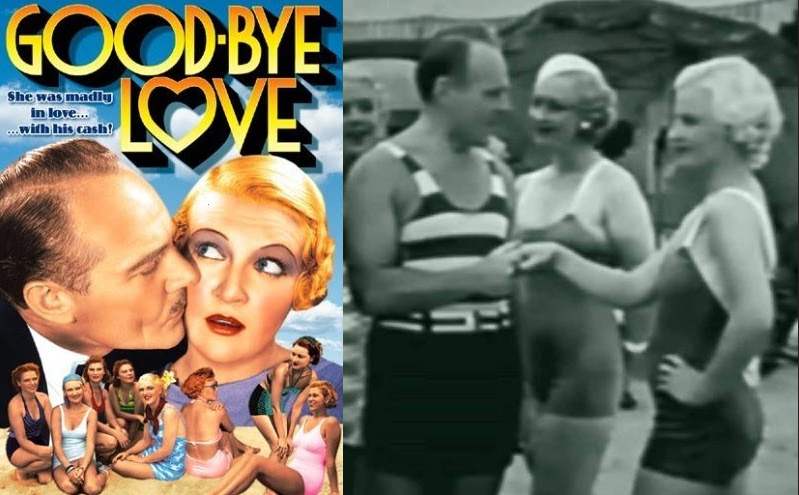
Mill Creek comedy classics #4: "Goodbye Love" (1933)

Charles Ruggles surrounded by bathing beauties in Goodbye Love.

The flick: Goodbye Love (RKO Radio Pictures, 1933)  [buy the set]

Current IMDb rating: 5.1

Director: H. Bruce Humberstone (I Wake Up Screaming, several Charlie Chan films)

Actors of note:
  • Charles Ruggles (Bringing Up Baby, The Parent Trap, TV's Aesop and Son)
  • Verree Teasdale (A Midsummer Night's Dream)
  • Sidney Blackmer (Rosemary's Baby, High Society)
  • Mayo Methot (Mr. Deeds Goes to Town)
  • Ray Walker (It's a Wonderful Life)
  • Edward Van Sloan (Frankenstein, Dracula, The Mummy)
  • Hattie McDaniel (Gone With the Wind, Song of the South)

The gist of it: A bumbling butler (Ruggles) needs some cash to get out of "alimony jail," where his embittered ex-wife has placed him for nonpayment. His wealthy stockbroker boss (Blackmer), a fellow "alimony jail" inmate, advances him $2500 on his salary. The butler, though, gives merely a month's alimony to his ex (an enormous, ill-tempered woman) and spends the rest on a seaside vacation at a rather fancy resort  where he passes himself off as a millionaire and big game hunter, attracting the attention of a ruthless golddigger. This very same golddigger, it turns out, is also engaged to the butler's boss, the stockbroker! Several marriages and divorces occur among the cast members before the whole mess is sorted out.

My take: You don't hear the term "alimony jail" much these days, but apparently the idea of husbands providing financial support for ex-spouses was a new, controversial idea back in '33 because this whole film is built around it. It presents ex-wives as lazy, materialistic succubi, draining the life and money out of their beleaguered ex-husbands. Before you cry "sexism," I should point out that the men in this film are no great shakes themselves, horny devils getting in and out of marriages without much forethought and then trying to weasel out of paying spousal support. In fact, I was surprised how refreshingly cynical this 80-year-old film was about the topic of marriage. I didn't even think Hollywood made divorce comedies back then!

The flick is nothing special from a technical standpoint with merely adequate direction, but it looks acceptable for what it is, considering its age and budget. Goodbye Love would work just as well as a stage play. The acting, writing, and plot carry it off nicely, though. Movie buffs will almost certainly recognize two very familiar performers in the supporting cast. First is a pre-Gone With the Wind Hattie McDaneils, playing yet another Mammy-type maid. Classic horror fans, though, will likely be more interested in Edward Van Sloan, a character actor who had appeared in Universal's Frankenstein and Dracula. Here, he's a genial justice of the peace who presides over a couple of chaotic wedding ceremonies and has to look bemused at the wacky goings-on.

Aesop and Son: A prestigious credit for Charles Ruggles.
Is it funny: Yes! For the first time in this project, I've seen a film that actually deserves to be called a "comedy classic." Almost all of that is due to Charles "Charlie" Ruggles, the voice of the toga-wearing, story-telling dad in the Aesop and Son segments of The Bullwinkle Show. (From where I sit, being on Bullwinkle is better than winning an Oscar. And,  yes, this film has an actual Oscar winner in the cast, Hattie McDaniels.) Flustered and spineless, yet capable of droll asides, Ruggles is a subtle but very funny comedic presence. There's no real modern equivalent for him. Not long ago, I saw Ruggles playing another butler character in Universal's The Invisible Woman, and he was probably the best thing in that film, too.

The script for Goodbye Love is very sharp with lots of witty one-liners that I will not spoil by repeating them here. Just watch the flick and discover them yourself. The script, while often formulaic, goes off on some admirably weird tangents, too. When the stockbroker's greedy first wife confronts the even-greedier golddigger, for instance, I thought they'd just squabble a little. Instead, they get rip-roaring drunk together (this was only a few months after the end of Prohibition) and plot against their mutual target. Then, there's the scene in which the stockbroker gets thrown in jail. It plays out almost like the middle section of Goodfellas, when Henry Hill and his fellow mobsters go to prison and their biggest concern is how thin their onions should be sliced at dinnertime. Goodbye Love's version of jail is basically a men's supper club, where divorced deadbeats gather around a long table as they feast and sing silly songs about their ex-wives.

Goodbye Love is in no way a perfect picture. The energy sags when Ruggles is off-screen for too long. Meanwhile, the stockbroker is a very dull and lifeless character, and there's an all-too-obvious subplot about his personal secretary, a trustworthy brunette who pines for her employer as he marries one shrewish blonde after another. But all in all, this is by far the best flick I've seen in this project.

My grade: A-

P.S. - It is now clear that I will have to keep a running tally of the negative Negro stereotype characters in these films. Colonel Effingham's Raid had one. Freckles Comes Home had two more. And Goodbye Love has three!