Showing posts with label comedy gold. Show all posts

Sunday, April 5, 2020

A Clown, for Christ's Sake: The curious career of Rev. Floyd T. Shaffer (UPDATED AGAIN!)

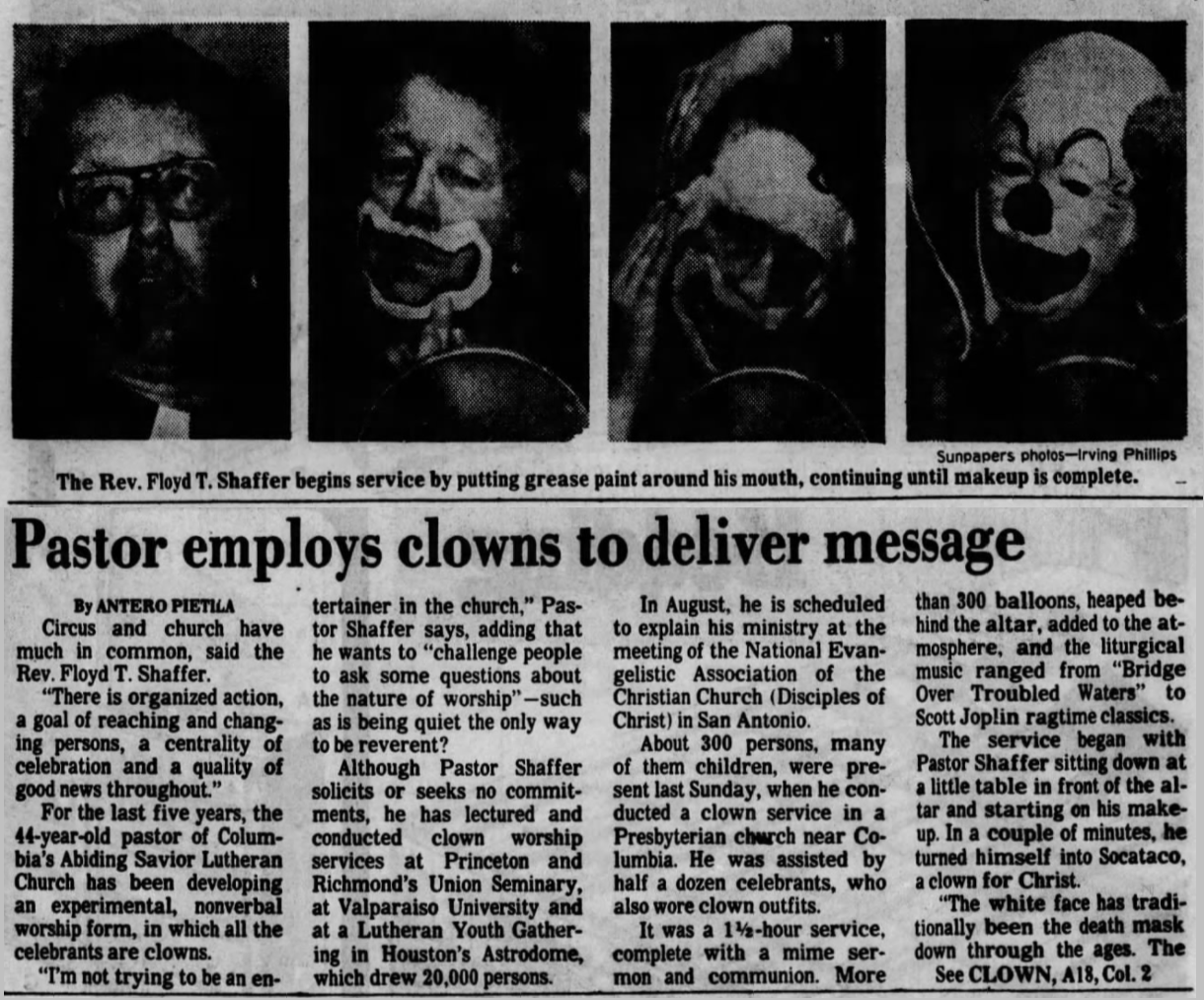
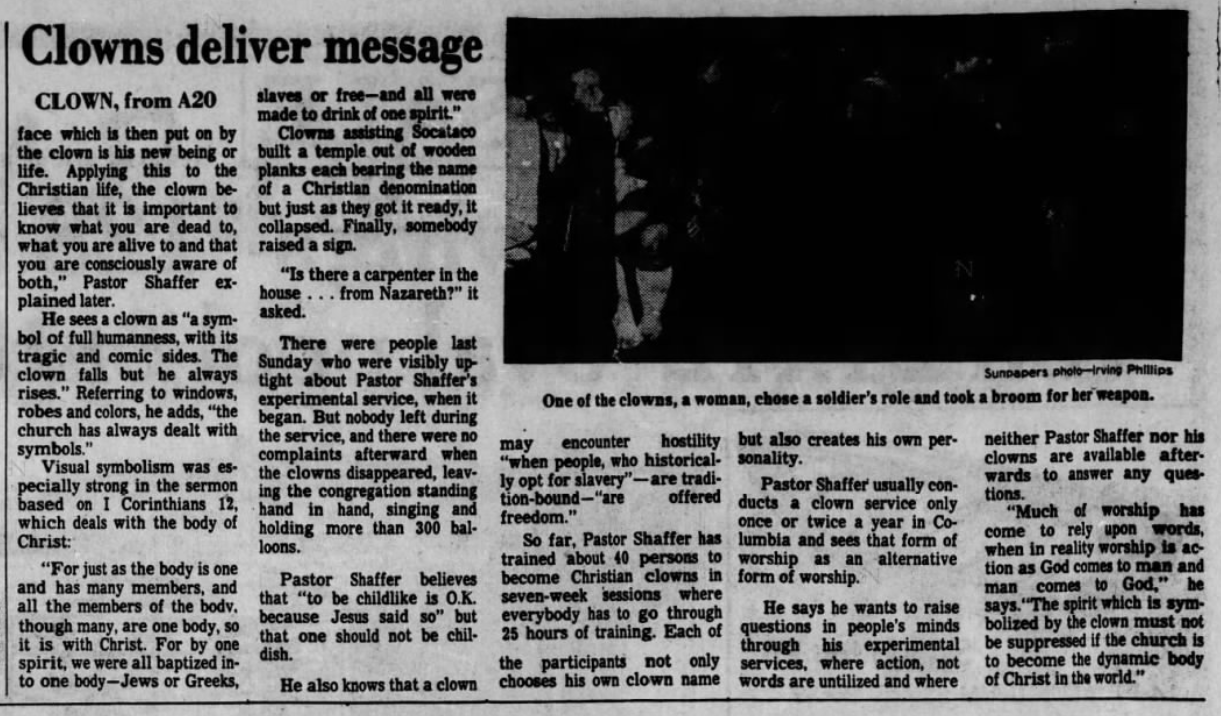
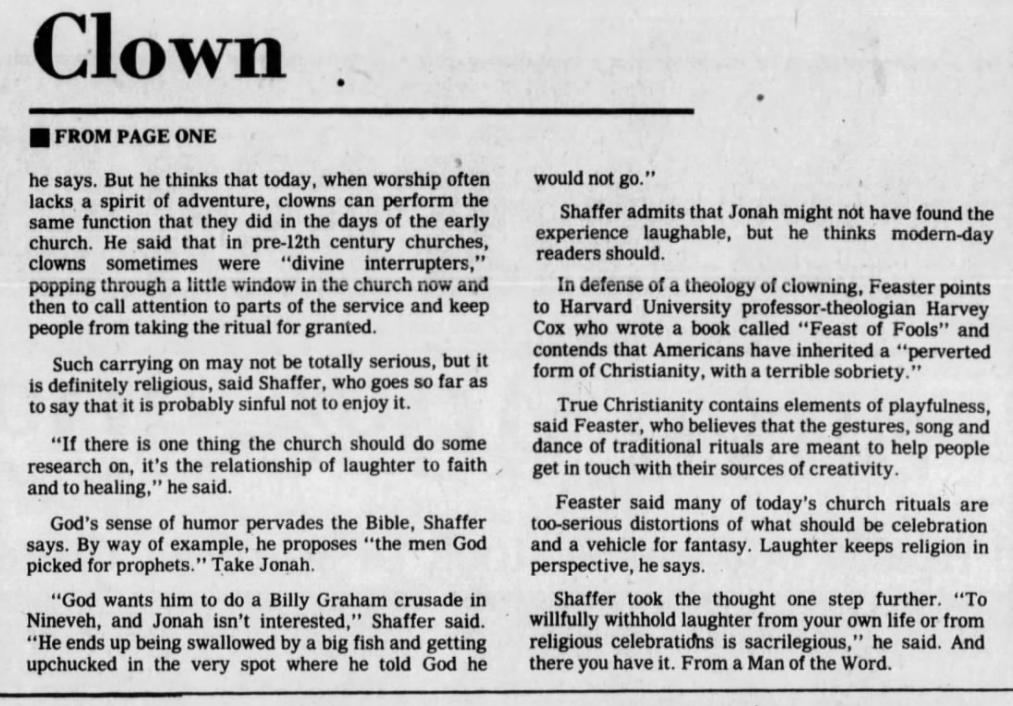
A tabloid article about Floyd Shaffer, the religious clown.

Floyd Shaffer's first book.
The Reverend Floyd T. Shaffer was looking for a new way to reach his congregation in 1969. How could he possibly get through to his practical, sensible flock during that tumultuous age of Vietnam, Woodstock, and Manson? The unlikely answer was by donning a fright wig, floppy shoes, and a round, red, rubber nose.

Though he may not have invented the form, Floyd Shaffer became, for a time, perhaps the most prominent and beloved proponent and practitioner of religious clowning in America. Born in 1930, the kindly and gentle Shaffer was a devout, deeply sincere Lutheran minister whose career trajectory took him from Michigan to Maryland to Ohio. In fact, Shaffer experienced his greatest period of productivity and prominence in the Buckeye State during the Reagan-Bush years. But to appreciate this man's story in full, we must travel back to the Age of Aquarius.

Destined to become a literal Holy Fool, Floyd Shaffer started upon his unusual path in the late 1960s in Columbia, Maryland, where he preached God's word at the still-existent Abiding Savior Lutheran Church. It was at Abiding Savior that Shaffer first introduced costumed clowning into his ministry and encouraged others to follow his example. According to fellow religious clown John Garrett, Floyd was aligning himself with a liturgical tradition stretching back to the Middle Ages, when so-called "holy interrupters" would lighten the mood of formal services with their comedic outbursts. Although a keen student of clowning history, Shaffer was more likely influenced by the counterculture of his own time. Clowning and mime were art forms beloved by hippies, who also had a penchant for face-painting and the donning of colorful, garish clothing. Back in 1969, a preacher dressed as a clown could almost be considered edgy or hip.

In those early years, Shaffer and his ilk were not always welcome among mainstream Christians. The soft-voiced pastor related to his followers the story of his disastrous appearance at a 1970s youth conference held at Houston's famed Astrodome. There, Shaffer and his fellow beneficent buffoons were regarded with extreme skepticism. Thinking the clowns were blasphemous, the other conference attendees derided and, in some cases, attacked Shaffer's troupe. Arlene Trapp, an original acolyte of Shaffer, recalled being "treated like Jesus, kicked at, hit, and mocked."

Still in all, Shaffer's tomfoolery-based evangelism must have yielded positive results in those early days, because he kept at it. In 1974, still based in Columbia, he founded Faith and Fantasy, a nondenominational clown ministry popular enough to have lasted into the 1990s, though its alumni remember it as a loosely-affiliated "non-organization" whose members were never keen on rules. During these years, determined to spread the message of Christ through the techniques of Emmett Kelly and Marcel Marceau, Shaffer and his followers performed their wordless, mime-based act at weekly Lutheran services and also visited numerous hospitals and nursing homes, where they found an appreciative, if captive, audience for their antics.

By 1981, having relocated to Ohio, Floyd Shaffer was well-known enough to attract the attention of the popular press. In August of that year, the black-and-white tabloid Weekly World News ran a profile of Shaffer with the headline "Preacher clowns for God to fill the pews." While essentially flattering to the clown minister, the article also described him as "wacky" and "bizarre."

The Christian Science Monitor followed suit in September with a slightly more dignified article by Stewart McBride headlined "Holy fools rush in." More wide-ranging than the Weekly World News piece, McBride's article looks at different examples of clown ministry from across the United States. In this context, rather than the isolated kook portrayed in the tabloid, Floyd Shaffer is part of a vital, burgeoning movement. The Monitor still recognized Shaffer as a pioneer, however, calling him "one of the first clergymen to perform a Sunday service in whiteface and clown costume" and declaring that "hundreds have followed in his suit of many colors."

The cover of the infamous video.
A few years after these articles introduced the Christian clown phenomenon to a national audience, Floyd Shaffer began writing a series of guidebooks about the topic dearest to his heart. If I Were a Clown and Clown Ministry appeared in 1984. Clown Ministry Skits for All Seasons followed in 1990. Of these, it is Clown Ministry that brought Shaffer a sort of late-blooming, ironic notoriety. The book was accompanied by a 92-minute instructional video that, decades later, was widely excerpted and mocked (shades of the unhappy Astrodome experience!) on video-sharing sites like eBaum's World, Daily Motion, and YouTube.

That was how I first became acquainted with Floyd Shaffer and Clown Ministry. In February 2011, comedians and avid thrift store scavengers Joe Pickett and Nick Prueher used clips from Shaffer's 1984 video in an episode of their web series, The Found Footage Show, which they originally produced for the A.V. Club website. They said they found the VHS tape at a church rummage sale. "This one was intended for budding Christian clowns who wanted to start their own clown ministry," explained Prueher. "I've never understood the connection between Christianity and clowning, and this video certainly didn't help." To which Pickett added: "Really, this video is the best argument against putting your grandparents into a nursing home."

For those whose curiosity has been piqued, the entire Clown Ministry video is now available for viewing on YouTube. In these 92 minutes, Floyd Shaffer walks us through the history and purpose of Christian clowning, demonstrates how to properly apply clown makeup, and even lets us tag along on a typical nursing home visit. It is this last aspect of the video that has attracted the most attention and ridicule over the years, as the elderly patients here seem bewildered and frightened, rather than delighted, by the antics of Shaffer and company.


Floyd Shaffer today
"The clown has no age," Shaffer optimistically told the Weekly World News in 1981. Mankind, however, is not immune from the ravages of time. Now 85 years old and comfortably retired since at least 2006, Floyd Shaffer has returned to his home state of Michigan, where he lives with his wife in Saginaw. The couple have two grown children. Though no longer clowning, Floyd Shaffer is still a loyal follower of the Lutheran faith.

The man's longstanding influence on the world of Christian clowning remains undeniable. In a September 2013 article on the World Clown Association website, Janet "Jellybean" Tucker recalled how seeing Shaffer changed her life; "It was in 1979 or 1980 at a Clown, Mime, Puppet, Dance Ministry Workshop in Oberlin, Ohio, and I saw Floyd Shaffer do a bit on feeding the hungry where his clown ate gobs of popcorn but offered it to a hungry person one kernel at a time. I began reading the Bible through different eyes and began to see the Bible characters as real people."

Obviously, despite the snickering of the internet, Shaffer's message got through to some viewers. As recently as April 2015, Christine Fontaine, a religious-minded mime in Northfield, Massachusetts, contacted Floyd by phone to seek his advice and counsel on how to proceed with her work. The two talked for an hour. As always, Floyd Shaffer remained committed to clowning for Christ.

UPDATE FOR 2020: Amazingly, some more vintage footage of Floyd Shaffer has surfaced! In addition to touring with their collection of offbeat videos, Joe Pickett and Nick Prueher also have a weekly YouTube series called VCR Party Live. In a recent "quarantine" edition of the show, the hosts interviewed film archivist Skip Elsheimer, who specializes in educational and industrial films. One of the clips Elsheimer showed during this visit depicts Floyd, both as himself and in costume, doing some Christian clowning.

After Pickett described the clip as "clown communion," Elsheimer responded: "That one, I can't remember. The title just suddenly left my brain. That one I got recently, and that one I have not shown online anywhere." He went on to say he didn't know where this film was originally shown. "I think this is too scary for Sunday school class." Pickett and Prueher note that the film is dour and that the clowns in it do not seem happy.

Floyd Shaffer appears as himself and as a clown in a newly-discovered film from the 1970s.

Scored with incongruous ragtime piano, the footage seems to date back to the 1970s when Shaffer was working with the Faith and Fantasy troupe in Columbia, Maryland. It may have been made as a record of what their performances were like back then. The movie begins with shots of a congregation in a mid-sized church. Floyd himself, with a full head of curly hair, enters the room in traditional vestments. A slight smile passes over Floyd's face as he stands behind the altar, and through the magic of editing, he transforms into a clown, complete with a red nose and a derby hat. The parishioners are understandably shocked and confused, though some kids giggle.

Floyd opens a gift box and retrieves a card that says FOR THE CONGREGATION. (This may be the title of the film.) The box also contains a pile of severe-looking nails. Shaffer takes one of these nails and hands it to another clown who has joined him at the front of the church. He presses it firmly into the second clown's palm, as if this is communion, and the nail is a wafer. He performs this same service for a third clown, and a title card reading "Communion" appears onscreen.

Floyd pulls a heavy wooden crucifix from a red box, then places bread and wine on the altar. After that, he fills a metal bowl with water from a jar. He takes the bowl over to a small group of clowns and has them place their hands in the water. They dry their hands. Shaffer then solemnly raises the loaf of bread and the wooden crucifix in front of him.  He places the bread on the cross as if the bread itself were Jesus being crucified, but then he breaks off a hunk of it from the bottom. Shaffer then mimes pouring invisible blood from the crucifix into a bottle already filled with wine. He and the other clowns silently, seriously eat the bread and drink the wine as the film fades to black.

The relevant portion of the video begins at about the 28:25 mark. Enjoy.


UPDATE FOR 2021: In my research on Shaffer's career, I found an elaborate article about him in the August 26, 1961 edition of the Fort Lauderdale News. Back then, he was serving as the pastor for Christ the King Lutheran Church. The article includes background details on Floyd's early life and a great picture of the man himself.

An article about Floyd's younger days.

And here's an article from the June 1, 1975 edition of The Baltimore Sun.

Baltimore Sun story about Floyd (part 1).
Baltimore Sun story about Floyd (part 2).

Wherever Floyd went, publicity followed. Here's a huge article from the June 10, 1981 edition of the St. Louis Post-Dispatch.

Floyd in St. Louis (part 1)

Floyd in St. Louis (part 2)

Tuesday, February 19, 2019

Another roundup of comics parodies by Joe Blevins

Remember these?

Well, folks, it's that time again. The long-running comic strip Mary Worth has just wrapped up another glacially paced story, so I figured it was time to do another assortment of comics parodies, takeoffs, and spoofs. I've accumulated quite a few of these over the last few months.

Thursday, November 15, 2018

Here are two stories I couldn't sell! Enjoy!

"Can't be a winner every time, hon." - Edith Massey

What can I say, folks? Every once in a while, even a seasoned professional writer like myself comes up with a loser. A flop. A stink bomb. A turkey. It happens. I'm sure even Jackie Collins had the occasional bad day. Not everything can be Hollywood Wives. And when it happens, you pick yourself up, dust yourself off, and move on. Jackie knew it. I know it.

Some of the stuff I write is purely for my own amusement, but most of it is written to reach an audience, either through this blog or through some online platform that actually pays me. But what is funny or interesting to me is not always funny or interesting to other people. I have learned that lesson many times in the past, and I will learn it many times in the future.

With that said, here are two articles I wrote in hopes of making a sale. Neither one sold, and since they were both time-sensitive, they are no longer relevant or salable. Past their expiration date, both of them. Still in all, I hope that you will either enjoy them or at least learn from my mistakes.

Friday, January 6, 2017

A rant about celebrity impressions

King of the impressionists: Rich Little at the Laugh Factory.

Let me say right off the bat that I have always been fascinated with celebrity impressions and the people who do them. From a very young age, I always looked forward to seeing impressionists when they appeared on variety shows or talk shows. Johnny Carson and David Letterman booked a lot of celebrity mimics over the years, and I was grateful to them for that. Rich Little, Frank Gorshin, Fred Travalena -- these were my boyhood heroes. Sketch shows like SCTV, Saturday Night Live, and In Living Color were always good showcases for celebrity impressions, too, with people like Dana Carvey and Darrell Hammond specializing in aping the rich and famous.

It must be weird and a little lonely being a famous impressionist. No one cares about you. They just care about the characters you do. It's like being a ventriloquist: Your act requires you to all but suppress your own personality. Ever notice how, in most ventriloquism acts, the human always has a very bland personality, and the dummy gets all the jokes? It's the same way with mimics. When they aren't in character, they're the saddest, most boring people ever.

Anyway, celebrity impressions are alive and well in the age of YouTube. Lots and lots of people do them. But it's devolved into a parlor trick. People don't even bother coming up with funny things for celebrities to say and do. They just copy the voice and mannerisms, and that's it. Well, I say, that's not good enough. Here's a YouTube rant on the topic. It's not meant to be an attack on anyone in particular, despite that angry-sounding title.

Friday, October 21, 2016

America could use another 'Mad Mad Mad Mad World'

Barrie Chase and Dick Shawn in Stanley Kramer's It's A Mad, Mad, Mad, Mad World (1963).

Sometimes, when I'm suffering from insomnia, I'll try to put myself to sleep by thinking about fantasy projects that I will never (and can never) possibly complete. Lately, I've been casting an imaginary, 21st century remake of Stanley Kramer's 1963 film, It's A Mad, Mad, Mad, Mad World. That epic, all-star comedy ran on TCM a few weeks ago, and for some reason, it caught my imagination like it never had before. Maybe it's because the title seems so true in 2016, or maybe because I can now relate to the middle-aged crankiness and desperation of the main characters. I've watched the movie all the way through about five or six times now, and I've been combing YouTube and Google for more information about it.

I don't know where this notion of mine came from. Maybe it's from this dodgy-looking IMDb entry for a supposed 2017 sequel. But I don't want to do a follow-up. I want to do a big-budget remake of the original, keeping the plot and characters mostly intact. I'd also keep the musical score by Ernest Gold intact, including the songs with lyrics by Mack David. I'd even set it in 1963, mainly because I prefer the clothes and cars of that time, plus I don't want the characters having access to Uber, smartphones, or GPS. The great thing is that, since most of the movie was set in the California desert, the original locations look pretty much the same today.


Milton Berle as J. Russell Finch
So who would be in my 2016 Mad World cast? The whole crux of this project is that I want to cast Louis CK as J. Russell Finch, the character played by Milton Berle in the original. Finch is a milquetoast, would-be entrepreneur who has suffered a nervous breakdown and is trying to soothe his nerves with a "relaxing" trip to Lake Mead with his wife Emmeline (Dorothy Provine) and his fearsome, always-complaining mother-in-law, Mrs. Marcus (Ethel Merman). That's before he and a bunch of greedy strangers get involved in a madcap treasure hunt for a dying gangster's stolen money. For the role of Algernon, the snooty Englishman that Finch encounters and with whom he forms a shaky partnership, I can only think of Ricky Gervais, with whom CK has worked several times. For Emmeline, who secretly dreams of running away to a convent, how about Amy Poehler?  For Mrs. Marcus... God, I don't know. Ethel Merman really owns that part. Maybe Meryl Streep could do something with it. Or Lily Tomlin or Susan Sarandon. Someone of that caliber. But for the role of Sylvester, Mrs. Marcus' whacked-out beach bum of a son (originally played by Dick Shawn), only one modern day actor will do: Will Ferrell. End of discussion. Non negotiable.

Arguably, the central character of Mad World is Captain Culpepper, a grizzled old lawman who has spent his life being an honest public servant and has nothing to show for it but a face full of wrinkles and a head full of white hair. It's Culpepper who is really orchestrating the whole film, using the treasure seekers to find the same money that he has been seeking without success for years. In the original, this top-billed character is played by an ailing, decrepit Spencer Tracy. For my version, I considered Clint Eastwood but decided instead that Nick Nolte would be perfect. For Culpepper's equally grizzled but less honest colleague Aloysius (originally William Demarest), maybe Billy Bob Thornton.

Some of the casting decisions were no-brainers. In the original, Mickey Rooney and Buddy Hackett play Dingy and Benji, a couple of hipster doofuses on their way to Las Vegas. Keegan Michael Key and Jordan Peele would knock these roles out of the park. Dingy and Benji spend most of the movie aboard a small private plane with a drunken sot of a pilot who passes out cold while making an old-fashioned in mid-flight. In the original, this character is played by Jim Backus, but we don't really have a modern equivalent of that actor. I think Bill Murray could handle the assignment.

Carell and Fey, together again.
In the 1963 film, Sid Caesar and Edie Adams play the Crumps, a dentist and his wife who join the treasure hunt but find themselves locked in a hardware store basement and have to do crazy, dangerous things to escape. This was another easy one for me. Steve Carell and Tina Fey. Hey, I liked Date Night. They could even reprise their roles from that movie if they wanted.

One role that really stumps me is that of Lennie Pike, the burly truck driver played by Jonathan Winters. Lennie is a true force of nature, famously destroying an entire gas station without assistance, and Winters gives one of the film's best performances. We have no modern day equivalent of that comedian. I could go in completely the opposite direction and hire Larry the Cable Guy, but that would turn off the critics and comedy purists alike. So no to that. Instead, I'll give John C. Reilly a shot at the part. But what about Otto Meyer, the conman who takes advantage of Pike? We don't have a modern day Phil Silvers either, but I'll give Steve Martin another try at it. Remember his Sgt. Bilko movie? No? Well, this will be like that, but less of it.

There is but one big piece missing: Who will play Smiler Grogan, the crime boss whose stolen money is at the heart of this story? In the original, this part went to the inimitable Jimmy Durante. For selfish reasons, I'm going to go in a very different direction and cast cult filmmaker John Waters. In addition to being a fine character actor in his own right, Waters could bring a lot of style and flair to this brief but memorable role.

I think that takes care of all the major parts. But the real fun of Mad World is spotting all the famous comedians in supporting and cameo roles. A list of comedians and actors I'd want to use includes (but is not limited to): Stephen Colbert, Jim Gaffigan, Sarah Silverman, the women of Broad City, Chris Rock, Dave Chappelle, Bill Hader, Amy Schumer, Bob Odenkirk and David Cross, Scharpling and Wurster, Christopher Guest (and members of his ensemble, like Eugene Levy and Catherine O'Hara), Neil Hamburger, Dana Snyder, Marc Maron, Kristen Schaal, Eugene Mirman, and H. Jon Benjamin.

Only a handful of cast members from the original movie survive. Carl Reiner, Jerry Lewis, and Barrie Chase are still around, so they should all get cameos. I know that I said I wanted to set the movie in 1963 and avoid modern technology, but for Lewis' scene, I'd bend the rules a little. In the original movie, Lewis plays a man who drives over Captain Culpepper's hat just for fun.


So in my version, Culpepper would again throw his hat out the window, but this time it would land on the sidewalk. Lewis would come by on a mobility scooter and run it over, cackling to himself.  Culpepper would see him and yell, "Hey, you! Yeah, you! Get back here!" At which point, Lewis would throw his scooter into reverse and run over the hat again, still cackling. Culpepper would then give up in disgust and return to work. But a few minutes later, there would be a callback to the joke when a uniformed officer (played by Patton Oswalt) returns the ruined hat to Culpepper. I don't think mobility scooters existed back in 1963, but I couldn't resist referencing the 1963 film this way.

Saturday, July 25, 2015

All roads, even the weird ones, lead inexorably to Spinal Tap

This is NOT Spinal Tap, but it sure looks like it.

Don't ask me why, but I decided to Google "Billy Crystal + blackface" today, and guess what I found? A clip from Billy's 1986 HBO special, Don't Get Me Started, featuring the comedian doing his famous/infamous Sammy Davis, Jr. impression, opposite Rob Reiner. Of course, Crystal and Reiner have worked together on a number of film projects, including The Princess Bride and When Harry Met Sally, but this clip is special in that it features Reiner as his pompous "Marty DiBergi" character -- a composite of Martin Scorsese, Brian De Palma, and Steven Spielberg -- from the classic 1984 mockumentary This Is Spinal Tap. Reiner, who directed and cowrote Tap, has reprised this role in The Return of Spinal Tap and some DVD extras, but Don't Get Me Started came out just two years after the original Spinal Tap movie. In other words, this is prime DiBergi, right down to the nautically-themed ballcap. Enjoy.

Wednesday, June 17, 2015

Let us ponder the riddle that is Orson Bean

Orson Bean admits to having eaten the baloney.

Orson Bean. It's very possible that this name will mean little to you if you're under 40. Cinephiles may remember him as dotty old Dr. Lester, the lecherous, carrot-juice-drinking boss from 1999's Being John Malkovich. ("My spunk is to you manna from heaven.") He was also the voice of Bilbo Baggins in the 1977 animated version of The Hobbit.

Connoisseurs of TV reruns may recall Orson from his appearances on The Twilight Zone, The Love Boat, or The Facts of Life. He did 146 episodes of Dr. Quinn, Medicine Woman back in the '90s, too, if that's what you're into. (Hey, there's no shame in it. My sister loved that show.)

If you watched Game Show Network back when they showed many of the old panel-style game shows from the 1960s and 1970s, Orson Bean should be a familiar face to you. He logged countless appearances on Match Game, To Tell the Truth, What's My Line, and more. In fact, I think of Orson Bean as a sterling example of a now-dying breed: the all-purpose professional celebrity with no particular specialty.

Bean was an actor of stage and screen as well as a comedian and author, but his real claim to fame was as a "personality." Need a familiar face for your talk or game show? Just call Orson! He possessed numerous traits that made him ideal for television: an impish sense of humor, a vast storehouse of jokes and stories, a winning smile, impeccable diction, and a flair for accents and dialects. The man was born to talk into a microphone.

The Orson Bean discography.
Like most stand-up comics of his generation, Orson Bean put his act down on wax a couple of times for posterity. He released At the Hungry I, recorded at the legendarily-hip San Francisco nightclub, in 1959. A decade later, however, Orson released the album that concerns us today: a collection of songs, poems, and "street jokes" entitled I Ate the Baloney. I first heard the title track, an irreverent religious-themed anecdote set to the tune of "Pop Goes the Weasel," on The Dr. Demento Show in the 1990s. Just this year, I found the entire LP had been uploaded to Archive.org.

For reasons I cannot adequately explain to you, I have listened to I Ate the Baloney in its entirety at least 20 times in the last few months, almost becoming able to lip sync the jokes as Bean tells them. I just like the sound of his practiced voice, especially when he slips into an Irish brogue. There's a vaudevillian old-fashionedness to the entire affair I find comforting and satisfying.

Since this LP comes to us from the 1960s, Bean can still openly acknowledge ethnicity in ways that would draw tremendous fire today. Take a conceptual bit called "The American Restaurant," in which Bean affects a broad, almost caroonish Chinese accent. One might be tempted to call the bit racist because of this, but in fact, Bean is poking fun at racism and stereotypes in a clever, insightful, and even subversive fashion. The Chinese characters in Bean's story talk about Americans in the bigoted, reductive way we Americans too often talk about the Chinese. It's a classic role reversal, as when the speaker ponders an infamous urban legend about sex. "Not look now," the man says to his giggling buddies. "American girl sit a-next table. Ooh, that's a nice lookin' girl! Built like a bamboo house! I don't know... American girl... I always wonder. I don't think so either. That's old Army story!"

But the track from I Ate the Baloney which has really captured my attention has nothing to do with religion or ethnicity. Instead, it's a brief bit of comedic doggerel about the plight of an urban commuter. The poem describes a man's experience aboard the IRT, which is what New Yorkers used to call the subway because it was run by a private operator called the Interborough Rapid Transit Company. I don't have much experience with the IRT, not being a New Yorker, but I do commute by train to and from work each day and can thus sympathize with the hero of Bean's poem. Some of the humor and pathos come from Bean's performance, but I think the words are worthy of study, too. In that spirit, the entire text of the poem is included below:

Last week, I'm ridin' in the IRT,
And this poor slob is sittin' right across from me.
So he's sittin' in the subway, kinda slumped in his seat,
Like a tired old dog, so dead, so beat.
His clothes, his face, everything looks sad,
And I'm thinking what a rotten life he must've had.
So I look in his face, and what do I see?
He looks like he's feelin' sorry for me!
But you don't know the IRT!
The windows are filthy. The lights are dim.
It was my own reflection, and I am him!

On the LP, this actually leads into entire bit about whiskey ads on the New York subways.  But I will leave that one for you to discover on your own. Bean is so convincing in delivering this particular hard-luck story that he elicited actual sympathy from the audience. Periodically throughout the recording, you can hear a tender-hearted woman in the audience say, "Awwww." Incidentally, Orson Bean is still alive at the age of 86, thanks to all that carrot juice. He worked as recently as 2014 in a parody of Dr. Quinn, Medicine Woman entitled Dr. Quinn, Morphine Woman. More intriguingly, back in 2008, he recorded a delightful little 10-part series of YouTube videos called "The Art of Joke Telling." Here is possibly my favorite of the ten:


Incidentally, that patch on Orson's shirt commemorates the Flying Goose Brew Pub & Grille in New London, NH. Sounds like a nice place.

Sunday, January 25, 2015

QUIZ: Are you terrible?

Don't be confused any longer! Take this quiz and find out if you're terrible!

It's a question each of us must ponder at some time in our lives: am I truly a decent human being making a worthwhile contribution to this world... or am I a worthless piece of sentient garbage whose very existence is affront to the Lord our God? In other word: am I terrible? Let's face it: unless you clear up this issue soon, you're never going to be able to get your life back on track. And that just hurts the people around you... Steve. So what do you do? It's not like you can just go up to people and ask them, "How much do I disgust and offend you on a scale of 1 to 10?" Well, worry no longer, because the solution has been in front of your stupid, doughy face for months now: Internet personality quizzes. There is nothing these quizzes can't teach you about yourself, including whether or not you're terrible. So what are you waiting for? Answer the following questions (honestly!), tally up the results, and then use those results to see whether you should  remain a full-fledged member of society or whether you should secret yourself away somewhere in the Himalayas in order to spare the world from your sheer awfulness. This should be fun!

1. If you have children, do you ever refer to any of them as "my child?" 
2. How often do you say the word "carbs" out loud per day? Five? Ten? More than ten? 
3. Same thing, only with the word "gluten." 
4. Have you ever corrected someone on the pronunciation of the word "skiing?" 
5. Have you ever gone out of your way to point out that you read the novel on which a movie is based? 
6. Same as #2 and #3, only with "sustainable." 
7. Do you actually need those pre-movie reminders to remember to turn off your cell phone? 
8. How sensitive are you to hearing "spoilers" about the plots of TV shows? 
9. This is a crucial question: Do you use emojis? 
10. Have you ever non-ironically referred to others as "haters?" 
11. Have you ever ironically referred to others as "haters?" 
12. Do you feel that you have "haters?" 
13. Have you ever criticized someone else for being "basic?" 
14. If you answered yes to the previous question, did you do so to compensate for the fact that you yourself are basic? 
15. Have you ever -- even once -- used the word "mainstream" in a pejorative way?

Results time: If you actually take online quizzes seriously and feel that their results have any kind of validity, then I'm sorry to inform you that you are terrible. Please go far away now.

Saturday, January 10, 2015

A new diversion: 'Marvin' minus thought balloons

Marvin minus all those pesky jokes and stories.

Since 1982, Tom Armstrong's Marvin has been sullying newspaper comics pages with the dreary, laughless adventures of an obnoxious child, Marvin Miller, who remains disturbingly unable to develop past infancy. He should be in his early thirties by now, but he still looks and behaves like a preschooler. Doomed to spend eternity in diapers, the boy obsesses gleefully over his own feces and the discomfort it causes in others.

Most of the strip's alleged humor derives, in fact, from the child's copious and foul excretions, though Marvin's selfishness, penchant for destruction, and fearsome temper are important components of the strip as well. Marvin's weary, utterly defeated parents, Jeff and Jenny, bear the brunt of Marvin's wrath; their unenviable fate is to forever tend to the monster they themselves created.

Aesthetically, Marvin is an obvious derivative of Jim Davis' Garfield, with the pudgy, flame-haired child a mere stand-in for the famously overfed orange tabby. Deprived of the ability to speak, both Marvin and Garfield "communicate" through thought bubbles. The other humans in these strips should not be able to hear or understand these thoughts, unless they possess telepathic skills, and yet many of the jokes in Marvin and Garfield rely on just such telepathy.

I wondered what would happen if Tom Armstrong removed these thought bubbles from Marvin. What would the strip look like without them? The answers are seen above. Marvin becomes the story of a mostly-happy, forever-mute child who occasionally changes his facial expression for no apparent reason.

Saturday, October 25, 2014

The (continued) dark side of Mark Trail

Ha! It's funny 'cause somebody probably died!

I don't know why I find the comic strip Mark Trail so endlessly amusing. It's one I used to read as a kid, and even then my appreciation was ironic. Nowadays, I keep up with it through Josh Fruhlinger's Comics Curmudgeon blog. For the uninitiated, Mark Trail is a nature writer, adventurer, and outdoorsman who travels around and gets into life-and-death scrapes while doing research for undoubtedly boring articles. His employer is a publication called Wood & Wildlife. Almost always clad in a tan jumpsuit and sporting immaculately Brylcreemed hair, Mark is simultaneously the squarest, dullest, and manliest character in American newspaper comics today. Here, we see him chatting with his equally-boring editor, Bill Ellis. They're so humorless and straight-laced that it's almost too easy to make fun of them. But I do it anyway. Forgive me.

Wednesday, October 30, 2013

Ed Wood Wednesdays, week 17: "One Million AC/DC" (1969)

Aroused yet? Jack King as an elder in the Ed Wood-scripted caveman sex epic One Million AC/DC.

Kramer: I thought you said she stinks
Jerry: She does stink and she should quit. But I don't want it to be because of me. It should be the traditional route: years of rejections and failures 'til she's spit out the bottom of the porn industry. 
-dialogue from the Seinfeld episode, "The Cartoon" (1998)

"There are eight million stories in the naked city," according to the closing narration of a popular late 1950s TV program. But that grim cop show, like the 1948 movie that inspired it, was about New York.

To me, the epithet "naked city" rightfully belongs to a certain metropolis 2,789.8 miles to the west. There is an abundance of literal nakedness in Los Angeles. But there's a lot of emotional nakedness there, too. New Yorkers have the thick, resilient hides of rhinoceroses. They're not even truly naked when they're naked! But it seems like a lot of Angelinos, many of whom migrate to the city to be closer to "the industry," have no such protective barrier between themselves and the cruel, cruel world. The epidermis of the aspiring starlet, lovely though it may be, has the all resiliency of rice paper.

It's a tough town, LA -- cynical, pitiless, its vulture-like eyes always fixed on the bottom line with the dollar sign. Its appetite is insatiable, and each day it attracts more busloads of weirdos, wingnuts, and wannabes to its rocky, blood-stained lair, its floors strewn with the bones of those who have come before.

What a convenient metaphor!
Ed Wood was one of those unlucky wayfarers who made the pilgrimage to the ironically-named City of Angels. Being of solid East Coast stock and fortified by a stint in the Marines during WWII, Ed managed to last longer than most. LA chiseled away at Ed for thirty years until he was quite literally a pile of dust and nothing more. In 1978, his cremated remains were deposited into the very same Pacific Ocean where his gallantry in action had once earned him the Silver Star and the Purple Heart. (Perhaps a particle or two of Ed managed to return to the shore of the atoll where he'd fought long ago.)

Wood was hardly the first to be defeated by the town... and far from the last. An infamous horror film called The Corpse Grinders (1970), directed by Ed Wood's one-time cohort Ted V. Mikels, gives us the perfect metaphor for the entertainment business: a fearsome machine that grinds up human bodies at one end and spits out cat food at the other. I guess we in the audience are the cats (i.e. consumers) in that analogy.

Ed Wood's film career started with earnest attempts to copy the cowboy movies he had loved as a child. From there, he took a famous detour through horror and science-fiction before finally winding up in what was then called the "smut film racket." I'm sure there are some -- maybe even many -- happy endings in the adult entertainment industry: people who got in, made their money, got out at the right time, and went on to productive, comfortable lives. Or people who managed to carve out nice, long careers in the field of erotica while maintaining their integrity and sanity over the decades. What I've been finding lately, though, are lots of cautionary tales of folks who must have started out as starry-eyed hopefuls but ended up dying young, dying broke, or just disappearing into the ether somewhere.

Luckily, in the Information Age, we have armies of bloggers, vloggers, webmasters, podcasters, and documentary-makers striving to catalog the shadowy netherworld of the X-rated movie business. Perhaps more than anyone else, the good folks at Something Weird Video have preserved as many vintage "dirty" films, shorts, and loops as possible and made them easily and cheaply available to the public. They are doing God's work, and I try to support them with my business whenever possible. SWV is, in fact, the distributor of the film I'm reviewing this week.

One of Ed De Priest's
surfing documentaries.
Even with all those Sherlocks of sleaze on the case, however, there are still some prominent figures in the adult film industry whose lives and careers are (at best) spottily recorded. Take Ed De Priest -- director, producer, jack-of-all-trades -- for example. A laid-back California guy, De Priest was probably best known as the owner of Canyon Films, a company that distributed pornographic movies in the 1970s and 1980s. His career as an independent filmmaker spans 20 years, and yet do you think I can find a single article about him? Fat chance! But there are various nuggets of information about the man stashed here and there on the Internet, just enough to piece together a vague overview of his career.

De Priest got his start making surfing documentaries in the early 1960s, including Ride on the Wild Side (1963), a film so utterly neglected that it does not, as yet, warrant its own IMDb entry. Surfing docs attained some regional popularity in the early-to-mid 1960s but seldom achieved national distribution. Bruce Brown's The Endless Summer (1966) was a prominent exception. Obviously, at some point in the 1960s, Ed decided that there was more of a future in sex flicks than surfing flicks. In a recent interview on the Rialto Report podcast, adult filmmaker Bob Chinn (creator of the "Johnny Wadd" series with John Holmes) stated that Ed De Priest probably used outtakes from his 1960s surfing movies in some of the X-rated pseudo-documentaries he produced in the early 1970s, such as Sexus in Paradise. (Thanks, by the way, to Steven Otero and Ashley West for their assistance in researching this portion of the article.)

In 1967, the very same year that he served as a cinematographer on a surf-doc called Surfari (1967), Ed De Priest also worked as an assistant editor on She Freak, a rather scuzzy, low-rent update of Tod Browning's Freaks. Significantly, She Freak was co-written and co-produced by David F. Friedman, one of the giants of exploitation cinema in general and skin flicks in particular. Perhaps this was the tipping point in Ed De Priest's life and career,

From the late 1960s on, Ed's filmography was dominated by adult movies, both softcore and hardcore. After serving an apprenticeship as a camera operator and second unit photographer for a few years, Ed De Priest began directing and producing feature films of his own in 1968, generally releasing his movies through Canyon Films. While Bob Chinn recalled Ed De Priest owning Canyon, other sources indicate that the company actually belonged to producer-director Paul Hunt (1943-2011). De Priest's gap-filled IMDb filmography ends with Skintight (1981), an "all star" hardcore film featuring Annette Haven, Lisa De Leeuw, Paul Thomas, and Randy West -- all prodigiously-productive pornographic performers. Thomas, in fact, is still active as a director and just released The New Behind the Green Door (2013).

A one-sheet for One Million AC/DC.
Happily, Ed De Priest did not fall off the map after the early 1980s and avoided the sad fate of Don Davis and Ed Wood. Tony Biner, a friend and business associate of Ed De Priest, updated me on the director's whereabouts via Facebook:
Ed De Priest is very much alive. He's a good friend of mine. We've put out quite a few DVDs together in the past 10 years or so [through] Halo Park DVD and Arcanum Video. He lives up in Los Osos and still cranks out DVDs. His company now is called Golden Age Media, and he sells DVDs on Amazon and eBay. 
I met him when I worked with Tommy Sinopoli and Mike Esposito at Visual Images back in the early '90s. He would come down from Los Osos and buy unedited scenes from them and make his own compilations and put them out as new titles, which was way before its time. Nowadays, every video company does that. He did live with [late pornographic actress] Linda Wong for quite a long time up in San Francisco. Ed's a really great guy, and I just talked to him today.
Another Facebook user, Michael Koenig, provided this tantalizing bit of information:
Ed appeared at the Roxie Theater in San Francisco last year for [film producer and rockabilly musician] Johnny Legend's double-bill of Teenage Cruisers and One Million AC/DC, along with Serena, the star of Teenage Cruisers. It was a really fun night.
Ed De Priest (right, holding spear) makes a cameo in One Million AC/DC, alongside star Gary Kent.

So Ed De Priest's life is one of those happy stories from the adult film industry and serves as proof that a career in X-rated cinema does not necessarily have to end in tragedy and despair. Let us now, however, turn our attention, to the first feature-length film directed by Mr. De Priest. As you may have guessed by its inclusion in this series, the film in question was based on a screenplay by our very own Edward Davis Wood, Jr., albeit penned under one of Eddie's more creative pseudonyms. And, citizens, believe me when I tell you that this is an odd one even by the lenient standards of "Ed Wood Wednesdays."


ONE MILLION AC/DC (1969)
ONCE IN A MILLENNIUM, THE MOTION PICTURE SCREEN ERUPTS IN SUCH A STAGGERING SPECTACLE OF ANIMAL PASSION AND BRUTE FORCE THAT THE AUDIENCE IS LEFT DRAINED AND BREATHLESS!
-Tagline for the film

The AC/DC DVD.
Alternate titles: None in America, but the Begian title is Pré-hominiennes,which seems to be some sort of gender-bending variation on the French word for "pre-hominids." Congratulations to the Belgians for coming up with a title that basically preserves Ed Wood's lewd, lascivious pun.

Availability: One Million AC/DC is readily available from Something Weird Video as the bottom half of a double bill with David L. Hewitt's non-pornographic caveman flick The Mighty Gorga (1969) on a DVD called Prehistoric Double Feature: Special Edition (Something Weird, 2002), which also contains a slew of trailers and short films. This disc is also available as part of SWV's four-disc Beauties & Beasts Box Set (Something Weird, 2003). 

Raquel Welch's famous poster.
The backstory: In 1966, England's Hammer Studios, a company best known for its many Gothic horror films, had one of its biggest financial successes ever with a prehistoric fantasy adventure entitled One Million Years B.C., a remake of the 1940 Hal Roach production One Million B.C. starring Lon Chaney, Jr., Carole Landis, and Victor Mature. Directed by Don Chaffey and featuring stop-motion dinosaur effects by Ray Harryhausen, the British remake was a smash success both in the UK and in America, where it was distributed by 20th Century Fox and raked in the present-day equivalent of $130 million on a $5 million budget. (Both of those figures are adjusted for inflation.)

A great deal of the success of One Million Years B.C. can be attributed to the participation of gorgeous Chicago-born actress Raquel Welch, who appeared in the film wearing a very revealing doe-skin bikini. The image of the scantily-clad Welch (who only had three lines of dialogue in the movie) was used quite prominently on the film's iconic poster, which became a major hit in its own right and was even prominently featured in The Shawshank Redemption (1994). A recent episode of the excellent Hammer Films podcast, 1951 Down Place, suggested that it was this film that pushed the venerable English studio towards making more sexually-bold films in order to compete in a rapidly-changing marketplace.

A success like that does not go unnoticed in the film industry, and soon there were a number of cheapskate copycats on the market, though none as lucrative as the '66 Hammer film. Even Hammer itself couldn't replicate its success, and the studio's woeful effort Creatures the World Forgot (1971), again directed by Don Chaffey and again featuring a scantily-clad actress (this time Norwegian model Julie Ege) on its poster, was a forgettable flop.

Look familiar?
From his childhood until the end of his life, Ed Wood was a keen observer of trends in the motion picture industry. It's only natural, then, that he would pen his own twisted, skewed version of One Million Years B.C., emphasizing (simulated) sex and female nudity over caveman violence and dinosaur action, though the script has some of those elements, too.

As so frequently happened in his career, the theme of gender fluidity crept into this project as well. Ed titled his screenplay One Million AC/DC, making a sly, punning reference to a slang term for bisexuals. Appropriately, the finished film contains several lesbian love scenes. Sadly, the script also reflected another key theme of Ed's life: his crippling, out-of-control alcoholism. His chosen pseudonym was "Adkon Telmig," a near-reversal of "vodka gimlet," which some observers speculate was Ed's drink of choice at the time. John Andrews, a drinking buddy of Ed's who had played the werewolf in Orgy of the Dead (1965), told Rudolph Grey that Ed's most-frequently-abused liquor had been Imperial Whiskey (as depicted in the 1994 film Ed Wood), but "he switched to vodka because Ralph's on Highland and Fountain, which was his source of Imperial,  went out of business! Ha ha ha! So he switched to vodka!"

By the way, some sources insist that Ed's pseudonym on this movie was "Adkov Telmig." That would make more sense, but it's not true. The credits clearly list "Adkon Telmig" as the screenwriter. The cavemen in the film would not have access to vodka, let alone fancy, lime-juice-based cocktails, so Ed has them drink wine instead. One of the very first lines of dialogue, in fact, states that the film's cavemen have gathered enough grapes for both the virgin sacrifice and the orgy.

Recycled footage from One Million B.C. (1940)
Director Ed De Priest had never helmed a softcore feature film before, but he was hardly a rookie in the movie business, as detailed above. Though the trailer claims that One Million AC/DC's location footage was shot in California's Death Valley, on the eastern side of the state, knowledgeable moviegoers will immediately recognize the locale as the much-filmed Bronson Canyon in Los Angeles' Griffith Park -- a remote-looking yet easily-accessible site that had also appeared in Phil Tucker's infamous Robot Monster (1953). Interestingly, both Robot Monster and One Million AC/DC borrow clips from the original One Million B.C. (1940), specifically a battle between two lizards made up to look like "dinosaurs."

Additionally, De Priest appropriated some footage from the classic 1940 movie in which a modern-day elephant portrays a "woolly mammoth" via glued-on fur and artificial tusks, plus some other dinosaur sequences from the Hal Roach film. Since De Priest's film is in color ("explosive Eastman color," according to the trailer) and the original 1940 film is in black-and-white, these second-hand, thirty-year-old scenes are shown through a yellow-ish filter, which gives them a trippy, psychedelic look.

For its own, newly-minted dinosaur scenes, One Million AC/DC did not rely on the special effects wizardry of Ray Harryhausen. Instead, the film's main dinosaur (or "monster," as it's called in the script) is portrayed by a quite-stationary green plastic toy held very near the camera in order to create some kind of forced-perspective effect. The trailer informs us that, in addition to the scenes shot in Death Valley, One Million AC/DC was filmed on "four enormous sound stages." I'm sure this is an exaggeration, but much of the movie does play out on cave sets that are, I must admit, fairly impressive.

The look of the film is greatly enhanced by its surprisingly lush camerawork.The IMDb says that the film's two uncredited cinematographers were De Priest himself and a fellow named Eric Torgesson, who has no other credits. Michael Koenig, however, indicated that this movie was lensed by the very prolific Gary Graver (1938-2006), who had a 30+ year career as a director and cinematographer, toiling mostly (but not exclusively) in adult features. Koenig explains:
The print that Johnny Legend showed at the Roxie last year had Gary Graver's name in the credits and was Ed [De Priest]'s personal copy of the film. I guess [Graver] decided to remove his name from the credits later on. Ed also said that because of his friendship with Graver, Orson Welles shot some scenes from his unreleased film The Other Side of the Wind at Ed's house.
Ed De Priest had produced Graver's The Kill in 1968, the year before One Million AC/DC's release. Fascinatingly, in 1993, Graver directed a feature called One Million Heels B.C. (1993) under the pseudonym "Adkov Telmig." That can only be a direct homage to Ed Wood.

A poster for Mrs. Stone's Thing.
None of Ed Wood's familiar repertory players appear here, and Wood does not seem to have participated at all in the actual making of One Million AC/DC. This was strictly a writing gig for him.

Of the cast members, the only one I immediately recognized was Jack King, a rotund, bearded character actor who made his screen debut as the slow-moving, roly-poly "Grandpa Brown" in The Creeping Terror (1964), an almost heroically dull and pointless sci-fi film whose punishing ineptitude has made it infamous even among bad-movie freaks. In that film, he was one of the victims who seemed puzzlingly unable to escape from a lethargic, lumbering, Chinese dragon-type alien. 

Here, King portrays an elder statesman among the cavemen and also serves as sort of a narrator or commentator, a la Bela Lugosi in Glen or Glenda? (1953) or Criswell in Plan 9 from Outer Space (1959). This actor reminds me a great deal of character actor Ken Davitian, who has lent his unmistakable presence to Borat: Cultural Learnings of America for Make Benefit Glorious Nation of Kazakhstan (2006), Meet the Spartans (2008), and a very funny recent episode of It's Always Sunny in Philadelphia. 

For whatever reason, Jack King spent most of his roughly decade-long film career in sexploitation flicks, including a role as "Big Fat Man" in Joseph F. Robertson's Mrs. Stone's Thing (1970), a movie whose cast also included Ed Wood himself as a transvestite. Incidentally, I would love to cover Mrs. Stone's Thing for this series, but the one VHS copy I could find of the film, under its alternate title The Sensuous Wife, is going for $255.99 on Amazon. A little rich for my blood, thanks.

One Million AC/DC is up to code.
Other prominent cavemen and cavewomen in this film are portrayed by Gary Kent (Targets, Freebie and the Bean), a still-productive actor who gives a solid leading performance as the caveman chief, Olaf; Maria Lease, who transitioned from actress to script supervisor, first on early 1970s sexploitation films (Teenage Jail Bait, Schoolgirls in Chains) and then on network TV shows (Hill Street Blues, Boston Legal, The Practice); and the omnipresent Alain Patrick, who worked in various capacities for Bob Chinn (serving as an actor and crew member in several of Chinn's films), Don Davis (acting in The Muthers), and Ed De Priest (writing Skintight) from the late 1960s to the early 1980s. Alain Patrick was already well-known to me for his acting, directing and co-writing vehicle Blue Money (1972), a softcore flick about the hardcore movie industry seemingly based on his own life.

Interestingly, Ed De Priest begins this movie with a notice that his movie "meets the requirements" of the Adult Film Producers Association (AFPA), the organization brought into existence by Stephen Apostolof and Don Davis in 1969.

One Million AC/DC's incredible dinosaur.
The viewing experience: I was, as the British say, gobsmacked by this motion picture. Approaching this film as a total newcomer, I really didn't know much about One Million AC/DC, other than that it was a sexploitation story set amidst a caveman milieu and that it had an exceptionally poor critical reputation. As a writer, Ed Wood was at his most giddy, delusional, and playful when he wrote the script for this film, and director Ed De Priest really built on the wildness of Wood's often deliberately-comic screenplay to deliver a freewheeling, disorienting, and ultimately winning movie so over-the-top in its goofiness that the viewer has no choice but to surrender to the absurdity of it all.

Ed occasionally added comedic elements to his films, through characters like Kelton the Cop in Bride of the Monster or the pitiful mummy and werewolf of Orgy of the Dead. But he had never before ventured as far into outright Vaudevillian territory as he does here. And with the ersatz Tyrannosaurus Rex, Ed De Priest has given us a visual effect as charmingly unconvincing as Plan 9's indelible flying saucers. The dinosaur model used in this film seems no larger than the "Rex" character from Disney-Pixar's Toy Story movies and is even less threatening. Generously, De Priest gives this creature plenty of screen time, including some marvelous close-ups. Rather than hide the cheapness, De Priest revels in it.

AC/DC's main couple Olaf and Marla.
Although Ed Wood did not actually direct One Million AC/DC, his fans will have no difficulty whatsoever finding the telltale signs of his presence here. The frequent, totally unmotivated cutaways to stock footage of bubbling lava, for instance, are highly reminiscent of Ed's trademark thunder-and-lighting shots, which critic Rob Craig suggests are the interjections of an angry God passing judgment on the characters.

As is so often the case in Ed's movies, including Glen or Glenda?, Plan 9, Bride and the Beast, Orgy of the Dead, and Bride of the Monster, the plot of this film is centered around a heterosexual couple: in this case, tribal chief Olaf (Gary Kent), yet another square-jawed, hyper masculine Wood-ian protagonist, and his mate Marla (Maria Lease), who is essentially Olaf's wife. Like the hetero couples in most of Ed's movies, Olaf and Marla spend a good deal of the running time bickering. Mainly, Marla wants Olaf to stay away from a slutty blonde cavegirl named Luga. Olaf, too, demands fidelity from his spouse. Like a prehistoric Helen Roper from Three's Company, Marla directs a lot of vaguely snarky sexual innuendos towards Olaf and complains, "You have no romance in your body."

Their mutual jealousy results in some good old-fashioned gratuitous movie violence. Twice, Olaf kills romantic rivals who try to make time with Marla. And Marla does end up having an extended catfight with Luga, which De Priest wittily intercuts with the aforementioned "dinosaur battle" from One Million B.C. Wood's script also grants Olaf a loyal male companion and advisor, Kenya (Alain Patrick). Together, Olaf and Kenya strategize about how to defeat the monster that has been plaguing the tribe and how to keep their fellow tribe members away from the opening of the cave so that they won't be eaten. In doing so, the two men act very much like the hardworking cops in Ed's other movies -- except they have their meetings in a cave instead of an office.

As mentioned before, the character of the elder played by Jack King is a clear descendant (or should I say an ancestor?) of Bela Lugosi's "scientist" from Glen or Glenda? and of Criswell's narrators from Plan 9, Bride, and Orgy. In Glenda, Bela told the audience that "the story must be told!" and that "the story has begun!" In this film, right before a scene in which a young woman named Mia is eaten by a dinosaur, the elder tells us, "Tragedy is happening!" After she's been eaten, the movie cuts back to the elder, who somberly intones, "Tragedy is done!" Like Bela's character, the elder caveman was nowhere near the action, which suggests perhaps that he is omniscient or that he oversees the fates of the other characters. And just like Criswell does in all of his movies, the elder ends One Million AC/DC by directly lecturing the audience: "Nothing has changed much down through the ages. Man has to kill. Man has to eat. Man has to have his woman."

(l to r) Cave artist Banger; the tribe's strange insignia.
Generally, at least one character in each of Ed Wood's scripts is a surrogate for the author himself. Here, that character can only be Banger, the tribe's resident scribe and cave painter. The movie goes out of its way, time and again, to establish this character as mankind's first-ever pornographer. The first time we see Banger is during the extended "virgin sacrifice" sequence at the beginning of the movie. While a skinny, flat-chested cavergirl (Lesley Connors, star of the 1971 hardcore feature Climax) receives her initiation into the world of sex from a pair of lesbians (who wield a vaguely dildo-like apparatus called "the sacrificial weapon") and a bearded cave dude (who has bonked a fellow tribesman on the head for the privilege of deflowering the maiden), Banger huddles in the corner, eagerly painting crude humanoid figurers onto a scroll. He will serve that same basic purpose throughout the film, never getting much sex himself but capturing the many, many couplings of others with obvious lust in his eyes.

At one point, while Marla and Olaf make love on a cave floor, Banger creepily watches from just about a foot away, peering through a hole in the rock wall. Clearly, if Banger had lived in the mid-20th century, he would have been writing dirty paperbacks and making X-rated movies, just like Ed Wood. Another one of Banger's job duties is to put a stamp on the bare bottoms of the women of the tribe, sort of like a doorman stamping people's hands. The peculiar insignia looks to me a lot like a pocket comb. What that could mean, I do not know. (And, yes, I thought about making a joke about cavemen going "clubbing," but I decided against it.)

The gorilla and his "mate" in One Million AC/DC.
No film can truly be called "an Ed Wood movie" unless it contains an assortment of moments that are arbitrary, ridiculous, incongruous or just plain inexplicable. And here, my friends, is where One Million AC/DC truly shines. Words alone cannot do justice to this movie's resident T. Rex, a completely stationary, expressionless plastic creature (seemingly less than a foot high) who gobbles up a Barbie-type doll meant to represent a young woman.

Then there is the whole business of the gorilla. If you've seen the Wood-scripted Bride and the Beast, you know that Ed has a weakness for interspecies sexual couplings. Here, there is a running gag in which a gorilla (portrayed, naturally, by a guy in a mangy costume) grabs a comely young brunette and drags her into a darkened cave for what we assume are numerous lovemaking sessions. Occasionally, the movie cuts back to this  "couple," with the gorilla always retrieving the girl every time she tries to escape. At one point, she looks at the camera, shrugs, and dutifully walks back into the cave while cartoonish music plays on the soundtrack.

Speaking of which, the presumably-stock score for AC/DC is all over the place: impressive orchestral cues are intermingled with buzzy-sounding synthesizers and thumping jungle drums.

What truly distinguishes this film, however, is its zany, often-juvenile humor. I've written before of Eddie's failed efforts to produce a sci-fi spoof called Invasion of the Gigantic Salami. Well, with this movie, he finally gets to try his hand at writing sketch-comedy-type scenes. Here, for instance, is an exchange between Marla and Olaf:
MARLA: It's like going back in time to my first virginal sacrifice! 
OLAF: Ha ha ha! Your first?
Banger, too, gets a lot of "wacky" scenes thrown his way. He's kind of a cut-up. One of his proudest moments comes when he confronts a tribesman with some of his "feeeelthy cave paintings." (Yes, he speaks with a raspy, Peter Lorre-type accent. He sounds a bit like Ren Hoek from The Ren & Stimpy Show.)
BANGER: Do you have any filthy pictures of your sister? 
TRIBESMAN: No. 
BANGER: You wanna see some? 
(They retreat into a side cave.) 
TRIBESMAN: (laughing) That's her!
In a totally-without-context scene near the end of the movie, Banger just happens to be nearby when a lusty caveman starts flirting with a totally-nude cavewoman.
CAVEMAN: Hi! 
CAVEWOMAN: Hi! 
CAVEMAN: Say, that's a terrific outfit you have on! What is it, wild fox? 
CAVEWOMAN: No, beaver! 
BANGER: (poking his head out of a nearby cave) Beaver?!?
A few seconds later, to really "sell" this joke, Banger lunges at the camera with a long-handled wicker basket, like the kind used to collect donations in church, with a dead beaver inside it. By the way, I like the fact that, throughout this movie, the cave people consistently greet each other with the casual modern expression, "Hi!"

I have not yet really discussed the language in One Million AC/DC. When you write a caveman script, you have to decide how your characters will communicate. Do they just speak in modern-day conversational English? Do they speak in a kind of broken, pidgin English like the Indians in old westerns? Or do they just grunt and groan? Ed tries all of these approaches in his script, bouncing from one technique to another, often within the space of a single scene. As the hero, Olaf is allowed to speak like a modern man. He even uses some 1960s slang, though that causes him some trouble. When he wants to get rid of Marla, he tells her to "blow." She instinctively gets down on her knees. "No, no," he says in frustration. "Not that!"

A lot of the humor in the film's later stages revolves around a crucial plot point: the invention of the very first bow and arrow, a tool with which the cavemen can pierce the monster's brain through his eye. Banger first conceives of the device, which he says will "put a finger through the devil's eye." Olaf approves of the idea, and he and Marla (apropos of absolutely nothing) face the camera and sing to the tune of "For He's a Jolly Good Fellow."

     The spear goes into the monster!
     The spear goes into the monster!
     The spear goes into the monsteeeeeeeerrrrr!
     The monster loses his mind!


Kenya presents Olaf with the first bow and arrow.
Kenya is recruited to build this powerful new weapon. Once the prototype is finished, the artisan remarks, "Never have I made one more to the point!" Olaf, impressed, asks him what he plans to call the device. Kenya proudly holds up the arrow and says, "Bow!" Then he holds up the bow and says, "Arrow!" I don't know why, but I laughed quite loudly at this. I chortled again at the moment when the newly-armed and supremely confident Olaf proudly declares, "I'm off to see the lizard!"

Moments like that, my dear readers, are what I was after when I began this project. Now, I don't want to oversell One Million AC/DC. I do want you to see it, but you should keep your expectations in check. It's a cheapskate sexploitation flick and little more. Most of the running time is devoted to rather generic and dull sexual couplings between people decked out as cavemen and women.

Frankly, many viewers will likely be offended that the film contains so many scenes of men (and gorillas!) simply using women as living sex toys with little (or no) say in the matter. Truth be told, the "virgin sacrifice" that begins the film is rather unpleasant, with the actress screaming loudly and convincingly until she finally gives in and starts enjoying what's happening to her. Many of you will likely want to turn the movie off during the first 5-10 minutes due to scenes like this. But I promise you that if you just have a little patience and try to see past the film's outrageous chauvinism, One Million AC/DC is a fascinating and fun little curio from a bygone era.

Next week: Sometimes in life, my dear readers, you have to do things you'd rather not do. For me, that includes revisiting a film that has utterly defeated me every time I've tried to sit through it. Why should I attempt to slay this particular dragon yet again? Well, because this movie was not only written by Edward D. Wood, Jr. but also stars Edward D. Wood, Jr., in easily the most prominent role of his acting career outside of Glen or Glenda? (1953). Directed by veteran schlockmeister Joseph F. Robertson and known by a number of alternate titles, this film was rediscovered in the 1990s and made widely available to the public, despite its unsavory nature. And in a week's time, my friends, I shall rise to the challenge and conquer my fear of The Love Feast (1969) aka Pretty Models All in a Row. Wish me luck.