I tried to make this picture of Bill Wood look Christmasy. Did I succeed?
The second installment of this series is going to be a lot shorter and less elaborate than the first. That's the way these pop culture advent calendars usually work. Some days, you'll get something substantial. Other days, not so much. If you're working your way through a Lego advent calendar, for instance, you shouldn't expect to find a minifig behind every door. That wouldn't be cost-effective. So instead, you get a few minifigs scattered throughout the month, and in between, you get little accessories. Like maybe one day, you'll get a nice hat for your minifig.
Well, today's article is a Lego hat.
Remember Howard William "Bill" Wood (1926-1986), Ed Wood's little brother? The one who made a career out of the military but didn't live to see age 60? I wrote a whole article about him back in January 2021. At the time, I said I didn't even have a photograph of the man, but when I was looking through my archives for material for this project, I found that wasn't true. In fact, I do have a news clipping from the November 17, 1955 edition of The Poughkeepsie Journal that includes a picture of Bill. When I stumbled upon it, I hastily added it to my original article. But I thought I'd post it here, too, so more people could see it.
Ed Wood's brother, Bill, at age 29 in 1955.
He looks an awful lot like Eddie, doesn't he? Actually, he looks like Ed Wood crossed with Howard McNear, the actor who played Floyd the barber on The Andy Griffith Show. Bill would have been 29 years old at the time this picture was taken, but he somehow looks substantially older. Maybe everyone looked older back then. He was already a husband and father by then, but the army, in its infinite wisdom, had him futzing around with airplanes in Canada.
Mockup poster for an Ed Wood/Steve Apostolof film that never was.
It seems like every year, there are more and more of those specialized advent calendars based on different brands or franchises. You know the ones I mean. There's a Disney one, a Marvel one, a Mario one, etc. But there's never been an official Ed Wood advent calendar! It's an outrage! Isn't the director of Glen or Glenda (1953) as worthy of his own advent calendar as Harry Potter, Lego, or Pokemon? And yet, we Woodologists have been denied!
Well, this year, I'm setting out to change that with a series I call The 2022 Ed-vent Calendar. Each day in December until Christmas, I'll post a bite-sized article about some little aspect of Ed Wood's life or career. Nothing too serious, just a little Wood to get you through the hectic holiday season. Sound good? Then let's continue.
For Day 1, I'm choosing The Basketballers, an unproduced script Eddie wrote for his frequent collaborator, director Stephen C. Apostolof, in 1973. In Nightmare of Ecstasy (1992), Rudolph Grey describes the film thusly: "Unfilmed screenplay by Ed Wood and Stephen Apostolof involves sports, sex and drugs on a small town college campus." I wonder if the tone would have been similar to Apostolof's previous film, College Girls (1968)?
The Basketballers is one of several Wood/Apostolof projects that never went before the cameras, but this one must've gotten fairly far along in preproduction. In the Apostolof archives, now in the possession of the director's youngest son Chris, there exist at least two drafts of the screenplay: one from 1973, another from 1974. For the record, Ed Wood is the sole credited screenwriter on both drafts. Intriguingly, the second one carries the legend: "Property of Valentine Enterprises Inc., Hollywood, Calif." Was Valentine some production company that either Steve or Ed was trying to start?
Two drafts of The Basketballers.
Despite co-authoring an entire book about Stephen C. Apostolof—and have I mentioned that it makes a swell Christmas present?— I have never actually seen or read the screenplay for The Basketballers. Those pictures up there were taken by Bob Blackburn when he visited Chris Apostolof in Las Vegas a couple of years ago. Apparently, Steve's archives include a fair amount of Basketballers ephemera, including the contract Eddie signed with Apostolof Film Productions, Inc. to write the script on October 10, 1973. Coincidentally, that would have been Eddie's 49th birthday.
Ed Wood signed a contract to write The Basketballers on October 10, 1973.
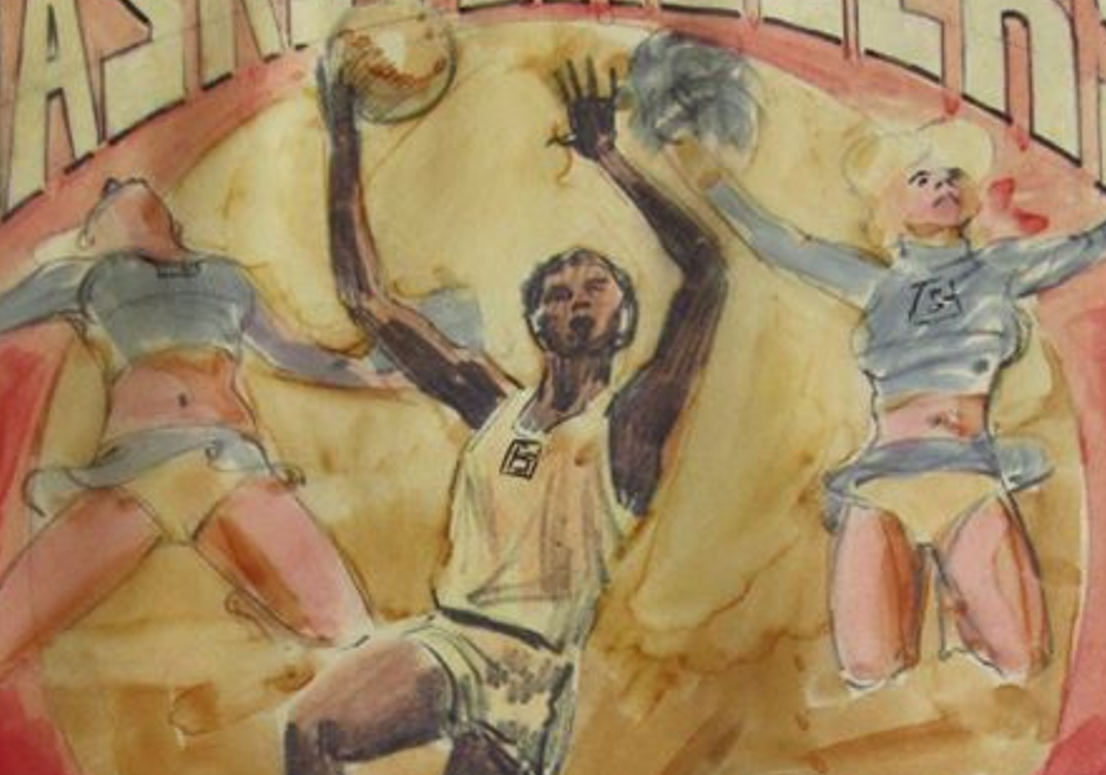
Perhaps most intriguing of all is this mockup of a poster for The Basketballers. To me, it's clear that Steve fully intended to go into production on this script. Like all of the Apostolof films of this era, The Basketballers would have been released under the familiar SCA banner. Note that the poster also proclaims that the film will be in Eastman color. Up until the late 1960s, many low budget sex films (including a few of Apostolof's) were still in B&W. Meanwhile, those scantily-clad cheerleaders are highly suggestive of College Girls and may even have been modeled on Steve's leading lady, Marsha Jordan.
A rough draft for a Basketballers poster.
As further evidence of how serious Steve Apostolof was about The Basketballers, here's a trade paper ad for another Wood/Apostolof joint, Fugitive Girls (1974). This one proudly proclaims that The Basketballers, which now even has its own logo, is being prepared for a "June release." Since Fugitive Girls itself didn't come out until July 1974, Steve must have been looking forward to June 1975. As we now know, that didn't happen. But Steve and Ed weren't done yet! Their next collaboration, The Beach Bunnies, would come out in 1976.
This trade ad for Fugitive Girls mentions The Basketballers.
And that's it. That's Day 1 of The 2022 Ed-vent Calendar. I don't think the subsequent articles will be this long, but I wanted to kick off this series with something special. Hope you enjoyed it.
Are you turned on by the color of Pepto Bismol? (Artwork from Savage.)
You know, it's a small world. Back in the 1950s, my mom's parents ran a little bar in Northern Michigan called The Beacon. I picture it as a place frequented by flannel-clad deer hunters. Almost nothing remains of this long-gone beer joint, apart from some well-worn jukebox 45s that I still have in my collection—everything from Pat Boone to Fats Domino. In fact, I hadn't even thought about The Beacon in a long time until the great Bob Blackburn sent me a vintage Ed Wood story with a curiously familiar title.
The story: "The Beacon." Originally published in Savage (Gallery Press), vol. 2, no.2, June/July 1973. Credited to "Stanley John."
Synopsis: Jeanne, an 18-year-old Kansas farmgirl, is driving home one dark night after losing her virginity to her boyfriend, Jim. She unwisely decides to take a desolate, poorly maintained backroad in order to return home at a "respectable hour." As she drives down this bumpy, winding path, she thinks back to the sexual ecstasy she recently experienced with Jim. Unfortunately, Jeanne's car gets hopelessly lodged in a deep rut, leaving her stranded in the middle of nowhere.
Jeanne ponders whether to just spend the night in her car when she sees a bright yellow light in the distance—a beacon signaling to her. The light emanates from the attic of a remote farmhouse. When the girl knocks on the door, she is very surprised to find that the inhabitants, an attractive couple named Kirk and Elaine, are elegantly dressed and have decorated their home in an ultra-modern style. At first, Jeanne is skeptical and afraid. (Why should they be so dressed up in the middle of the night?) But she soon warms to Kirk and Elaine and partakes of the food and drink they offer.
This, too, proves a mistake. The now-drugged Jeanne finds herself being used like a living sex toy by Kirk and Elaine. The former ties her up while the latter penetrates her with a rubber strap-on. They continue with their "weird sexings" even after Jeanne passes out. As we ultimately learn, Kirk and Elaine do this all the time. They deliberately booby-trap the road, sell the cars to the local scrapyard, and bury the drivers beneath the house after drugging and raping them. This is to be Jeanne's fate as well.
Excerpt: "The nightmare began to move rapidly, in a blur of lights, faces, penises, arms, legs, breasts, thighs, buttocks, pubises. . Jeanne was pulled from the bed and led to the corner of the room. Kirk dangled a long rope in one hand and held his dick in the other."
Table of contents from Savage's June/July 1973 issue.
Reflections: It was typical for the adult magazines published by the Pendulum/Calga/Gallery consortium in the 1970s to have particular themes. Voyeurism, lesbianism, group sex, lingerie—whatever you were into, they had a magazine especially for you. The theme of Savage seems to have been S&M. An editorial on the magazine's contents page from its June/July '73 issue explains this fetish in the driest, most convoluted way possible. It starts out like so:
When one thinks of how strongly integrated our understanding of body abuse is to corporal punishment it is easier to comprehend why it is so very difficult to accept the existence of a pain-pleasure principle.
Clear as mud, huh? Try diagramming that sentence.
Ed Wood very likely penned that editorial, and he is also undoubtedly the author of "The Beacon," a strange and unsettling short story published in that same exact magazine and credited to the nonexistent Stanley John. (Any similarity to the horror host and author John Stanley is coincidental.) This particular issue of Savage also included "The Movement," which Ed wrote under his more common pseudonym, Dick Trent. I now fully understand why editor Bob Blackburn included that article in the S&M section of When the Topic is Sex.
Eddie sometimes ignored a magazine's theme when he wrote his stories and articles. None of his pieces for Garter Girls feature garters, for instance. But he did give the readers of Savage a little bondage action in "The Beacon." I'm not sure if the magazine's audience would be sated by that, however, since the bondage scene is brief and occurs in the midst of a rape/murder. Is the reader supposed to identify with or envy Kirk in this story? That's an upsetting thought.
"The Beacon" is one of Ed Wood's many tales of innocence defiled, and it would have fit in beautifully in Blood Splatters Quickly or Angora Fever. Yes, the narrator does tell us that sophisticated Elaine is wearing an angora sweater (with nothing underneath!), but the connection to Wood goes much deeper than that. Many of Ed's stylistic quirks are here, including an abundance of ellipses and RANDOM CAPITALIZATION. Some of Eddie's favorite words, like "thrill" and "lovely," turn up here, too. Like any good Ed Wood protagonist, Jeanne experiences "chills" twice—once while making love to Jim and once while thinking back on it. This is emblematic of Wood's writing; his characters are forever having hot flashes or cold chills.
What really makes this an Ed Wood story is its overall structure. The setup—a luckless woman stranded on a country road in the night after having car trouble—is pure Eddie. Similar events occur in both Night of the Ghouls (1959) and Orgy of the Dead (1965). The sinister farmhouse in "The Beacon" has many first cousins in the Wood canon as well. Think of the old Willows place in Bride of the Monster (1955) or the titular bordello in "The Whorehouse Horror" (1972), not to mention the crumbling castle in "Dracula Revisited" (1971) and even Madam Heles' pleasure palace in Necromania (1971). (Remember that some of Madam Heles' guests never leave.) It's also typical for Eddie's short stories to take a gruesome turn about two-thirds of the way through, so the ghoulish payoff of "The Beacon" is highly Woodian.
Most importantly, like many of Ed Wood's films and stories, "The Beacon" intertwines and essentially equates sex and death. If you have sex, you die. I could not help but feel that Jeanne was being severely punished for losing her virginity to Jim, a massively-endowed barley deliveryman. Elaine even tells her, "You're not all that innocent." So even a stranger can tell that Jeanne has been deflowered. From that perspective, "The Beacon" becomes a cautionary tale to young women, as if there were any reading Savage in 1973.
Special thanks to Bob Blackburn for sending me this story and making this article possible.
"We have top men working on it right now." "Who?" "Top... men."
This series has unexpectedly been on hiatus for the last few weeks. Sorry about that. What can I say, folks? Life gets in the way of Ed Wood scholarship sometimes. It's certainly not for lack of material to cover. In fact, there's way, way too much still left to cover. And more of Ed Wood's work is being discovered all the time—articles, stories, novels, scripts, loops, and even feature films. Had we but world enough and time...
Meanwhile, loyal reader and former Ed Wood Summit Podcast guest Rob Huffman has been faithfully flooding my inbox with photos and press clippings about Eddie and his various professional associates. I think his intent was to inspire me or Greg Dziawer to write a new article. Well, in a roundabout way, he was successful, because this week we are delving deep into The Huffman Files.
One of the weirdest thingsabout the movie Grease (1978) is its depiction of a supporting character named Eugene Felsnic (Eddie Deezen). He's instantly recognizable as the textbook, all-American nerd. He dresses like Pee-wee Herman, talks like Jerry Lewis, and generally moves about in a klutzy, uncoordinated way. The other students at Rydell High treat Eugene like absolute garbage throughout the entire movie. The first time we see him, he's being harassed on the stairway. Some other students zap Eugene with a joy buzzer and steal his bowtie. They threaten to steal his glasses, too, but he somehow holds onto them. (He has an astigmatism.)
If Grease were a horror movie, Eugene would be the character who snaps and starts bumping off his classmates in cruel, elaborate ways. (The 1986 slasher flick Slaughter High actually does have a similar plot.) But there's no redemption or revenge for Eugene Felsnic. He passively accepts his classmates' abuse with only mild consternation. The only saving grace here is that Eugene seems oblivious to the fact that he's on the bottom rung of the Rydell social ladder. Most of the time we see him, he's grinning like a jack-o-lantern, hopping around, and applauding enthusiastically (too enthusiastically) for just about everything. He seems fine.
Borrowing a page from the Grease playbook, Happy Days has its own nerdy Eugene character. In this case, it's Eugene Belvin, played by Denis Mandel. He has a lot in common with Grease's Eugene Felsnic. They both dress, act, and talk like cartoonish stereotypes, and their classmates treat both of them horribly. Even Fonzie (Henry Winkler), Eugene's teacher, bullies him a little. And, just as in Grease, this is all acceptable because Eugene is such a cluelessly cheerful schmuck.
In Season 9, Happy Days finally gave Eugene his own spotlight episode: "Hello, Tough Guy." The plot has poor Eugene trying to convince Jenny Piccalo (Cathy Silvers) that he's a macho, macho man by beating up Chachi (Scott Baio) in a staged "fight" at Arnold's. When this doesn't work, Eugene is called upon to defend Jenny's honor by fighting a towering thug named Lou (Josh Cadman) at a seedy dive called Vinnie's.
It was inevitable. We reviewed an episode of Happy Days I loved ("Just a Piccalo"), then an episode I hated ("No, Thank You"). The logical next step was an episode I was totally indifferent to. And that's what "Baby, It's Cold Inside" is. It's the most basic, stock sitcom episode you can imagine. The damned thing might as well have been assembled from a kit. This didn't need even need to be a Happy Days episode especially; just about any family sitcom could have done this story.
The plot has Joanie (Erin Moran) taking care of her infant nephew, Richie, Jr., while her parents (Tom Bosley and Marion Ross) are out of town. She wants to prove to her folks that she's a responsible young woman, not just a little kid. Naturally, there are complications. The boiler breaks down during a cold snap, and a wisecracking repairman who calls himself Rudy to the Rescue (Vahan Moosekian) wants $200 to fix it. Also, Richie, Jr. is suffering from his first-ever cold. To make things worse, Joanie's friend Jenny (Cathy Silvers) has invited all their idiot friends over to the house for an impromptu party. How will Joanie handle all these disasters at once? The answer turns out to be not that interesting, quite frankly.
Can we turn a dull episode into an exciting podcast? Find out by listening to the latest installment of These Days Are Ours: A Happy Days Podcast. If nothing else, if you stick around until the end, you'll hear some music by the one and only Weird Paul. Thanks, WP, for letting us use your song!
Two ladies enjoy each other's company in Caine Richmond's "Les Pad."
Dick Trent and Ann Gora are names known to any true Ed Wood superfan, since Eddie wrote books, articles, and scripts under these monikers for years, but have we discovered yet another of his many professional pseudonyms?
The sheer volume of texts written by Edward D. Wood, Jr. in the 1960s and '70s is unquestionably, well, voluminous. At some point in the early 1960s, Ed began writing for the adult entertainment industry—paperbacks and screenplays at first, followed by magazine articles and 8mm porno loops. By the end of the decade, he was writing all of these and then some, often concurrently!
In the midst of this writing frenzy, an obscure adult publishing company called Bernel and Associates—likely a predecessor to the Pendulum/Calga powerhouse that employed Eddie for years—briefly published a small number of adult mags. No one knows for sure how many, but one was Tailgate from 1968, which seemingly ran for just one issue. In that lone edition, there are three texts. One of them, an article called "Sappho" credited to Caine Richmond, appeared herelast year. I suggested, gently, that it might be the work of Edward D.Wood, Jr.
But "Sappho" was not the only text in that issue credited to the mysterious Caine Richmond. The other was an intriguing short story called "Les Pad." This week on The Ed Wood Summit Podcast, Joe Blevins joined me to break it down, and we implicitly asked the question: could it, too, have been written by Ed Wood?
All episodes of The Ed Wood Summit Podcast can be found here.
P.S. Reader Bill Shute has some additional insight into the "Caine Richmond" pseudonym:
Using the name of one of the greats of serials and b-movies, Kane Richmond, spelled creatively, is certainly something Ed Wood would have done.... proudly. This is a man who was excited to get old genre-film pros such as Reed Howes (who he wrote about admiringly in Hollywood Rat Race) and Herbert Rawlinson in his films. Had Kane Richmond still been working in films in the 1950s (he retired from the screen and went into the business world circa 1948-49), there's no question that EW would have tried to get him for a film and would have loved chatting with him about his serials and low-budget action films. It always puts a smile on my face when Ed Wood champions an old-time Hollywood figure, someone who was largely forgotten by the industry.
Diane Adair (aka Diane Diefendorf) and Henry Winkler on Happy Days.
Nuns were weirdly popular in the 1960s. Cheerful, fun-loving nuns, that is. (Dour, punishment-inflicting nuns apparently had the decade off.) One of the biggest films of the era was The Sound of Music (1965), the tuneful story of a manic pixie dream nun, Maria (Julie Andrews), who leaves her convent to work for a stern, widowed Austrian baron (Christopher Plummer) as a nanny to his seven rambunctious children. In short order, with some help from a score by Rogers & Hammerstein, Maria wins over the children and then their father, teaching them how to enjoy both life and music.
"The $ound of Money" (MAD, 1967)
And this was just one example of the nunsploitation trend! On TV, there was Sally Field in The Flying Nun (1967-70), a gimmicky sitcom about a petite nun whose habit allows her to become airborne for short periods of time. And on the pop charts, there was "Dominique," a French-language novelty song by Sœur Sourire aka The Singing Nun. With its catchy melody, it became a widely-loved #1 smash hit in 1963, but the authors of The Encyclopedia of Bad Taste (1990) maintain that "Dominique" forever robbed nuns of their dignity and mystique. They write of the song: "It was a pop music phenomenon, and it toppled nuns from their pedestal. Suddenly the world was faced with an epidemic of kooky, perky, goofy nunnish antics."
MAD tackled this very phenomenon when they parodied The Sound of Music as "The $ound of Money" in 1967 with art by Mort Drucker and a script by Stan Hart. That marvelous satire includes spoofs of many of the songs from the film, including "How Do You Solve a Problem Like Maria?" MAD's version was called "How Do You Solve the Problem of Religion?" and it went (in part) like this:
How do you solve the problem of religion?
How do you handle nuns and not offend?
Just simply have them doing things they wouldn't!
Don't follow the norm,
Or stay true to form.
Pretend!
Just show a kooky nun who rides a scooter.
Or show a Sister try to fly a kite.
The movies can make folks feel
That all these events are real,
And being a nun is fun from morn 'til night!
People will eat up films about religion!
Just keep them corny, saccharin and trite!
The ninth season of Happy Days takes place in 1963, the year of "Dominique," so it's only natural that they'd have their own take on the nunsploitation genre. Their version was called "No, Thank You" or "The Nun's Story." The plot has a young nun named Gloria (Diane Adair) teaching history at Jefferson High. Not knowing his new colleague is a bride of Christ, Fonzie (Henry Winkler) pursues her romantically (without success) and even forces a kiss on her. Naturally, when he learns the truth, Fonzie is eaten up with guilt. But Gloria is one of those happy-go-lucky, non-judgmental '60s pop culture nuns, so she's not mad at all. The episode ends with Gloria knocking Fonzie into the water at a carnival dunk tank, a scene that reminded me very much of the MAD song about "the problem of religion."