Thursday, June 27, 2013

Joe's Record Collection: The Beastie Boys and De La Soul were on the cutting edge of nostalgia, if that's possible

In 1989, the Beastie Boys and De La Soul took hip hop someplace it hadn't been before -- the past.

The records: Love American Style EP (Capitol Records/Beastie Boys Records), 1989 - V-15483); Buddy & Ghetto Thang (Tommy Boy, 1989 - TB  943)

The artist(s): The Beastie Boys; De La Soul

Love American Style EP
History: The Beastie Boys were coming off an incredible high in 1989 when they recorded Paul's Boutique, their sophomore release on Capitol Records. Their first full-length rap LP, Licensed to Ill (1986), had been a mammoth #1 hit in America, selling nine million copies and becoming the first rap album ever to top the Billboard charts.

After half a decade as a punk and experimental band, the Beasties were now among the most popular acts in the country. The key to their success had been following the lead of Run-D.M.C., who had combined rap with heavy-metal-style guitars on singles like "Rock Box" (1984), "King of Rock" (1985), and their genre-bending Aerosmith collaboration "Walk This Way" (1986). The Beasties took this even further with the party-hearty frat anthem "Fight for Your Right," a Top 10 smash closer in spirit to mid-1980s hair metal like Motley Crue than hip hop.

Their album, too, relied heavily on rock and metal samples, particularly Led Zeppelin, in addition to the funk and soul songs that normally provided the foundation on rap records. The first sound listeners heard on Side One of Licensed to Ill, in fact, was John  Bonham's pounding drum intro from the Zeppelin classic "When the Levee Breaks."

Commercial expectations were high for the follow-up album, but the Beastie Boys were not interested in repeating Licensed to Ill. Instead, Paul's Boutique was a heady, densely-layered sound collage, its lyrics jam-packed with arcane cultural references and in-jokes. The Beasties announced their new direction with the Adam Bernstein-directed video for "Hey Ladies," the first single from the album. Gone were the sneakers, jeans, and ballcaps of the "Fight for Your Right" era. In their place were vintage 1970s leisure suits and platform shoes. They'd ditched "rock & roll" image and sound, too. "Hey Ladies" was built around a sample from "Machine Gun," a 1974 funk single by the Commodores.

Initial commercial reaction to Paul's Boutique was underwhelming, and the commercial triumph of Licensed to Ill was never to be repeated, but the quirky 1989 LP had a long shelf life, eventually becoming widely acknowledged as a modern classic. Instead of burning out quickly as a one-joke fad, the Beasties enjoyed two more decades of productivity and success, and their second album was the first step in that new direction.

Their Love American Style EP, characteristically named for a campy early 1970s TV series, is an interesting artifact from the Paul's Boutique era, when the Beasties were paradoxically looking forward by looking back. Nostalgia for the 1970s was still a fairly novel concept at the time. The decade had not yet been strip-mined for parody and imitation quite yet.


Buddy & Ghetto Thang
Meanwhile, that very same year, a Long Island hip hop trio called De La Soul was offering the American public something radically different than anything it had ever seen from a black hip hop act.

Rap had its gangsters (N.W.A., Ice-T), its politicized crusaders (Public Enemy, KRS-One), and its braggarts (LL Cool J, Big Daddy Kane), but it didn't have whimsical, nerdy pacifists like Posdnuos, Trugoy the Dove, and P.A. Mase. That is, until De La Soul's debut LP, 3 Feet High and Rising, came out in 1989. The fact that the album took its name from a Johnny Cash lyric was indicative of just how different it was from everything else in hip hop at the time.

The press was quick to label De La Soul as hippies and their music as "hippie hop," but the group bristled at this snap judgment and said so in their first hit single, "Me, Myself, and I."

Like the Paul's Boutique-era Beastie Boys, De La Soul's sound was rooted in the wacky, tacky 1970s more than the dippy, trippy 1960s anyway. For example, "Me, Myself, and I" was built around a groove from "(Not Just) Knee Deep," a 1979 track by Funkadelic from their Uncle Jam Wants You album. The album's first song, "The Magic Number" was a take-off on "Three is a Magic Number," a 1973 educational tune from the animated Schoolhouse Rock! series. And "Eye Know" borrowed heavily from "Peg," a 1977 Steely Dan number.

In short, the trio raided their parents' record collections in search of soundbites with no regard for the usual "rules" of hip hop.

This wasn't the only way they broke the mold either. While hip hop is famous for its "beefs" -- often-violent rivalries between acts (think Biggie vs. Tupac) -- De La Soul joined like-minded rappers Queen Latifah, the Jungle Brothers, Monie Love, and A Tribe Called Quest in a mutually-supportive collective called the Native Tongues. Several members of the Native Tongues, in fact, guest star in the extended remixes which appear on Buddy & Ghetto Thang, a maxi-single release of two standout tracks from 3 Feet High.

The record stores at my local mall, the Genesee Valley, didn't carry vinyl EPs, so I purchased both the De La Soul and Beastie Boys records during one of my family's occasional visits to Detroit's Greektown district, which at that time had some slightly hipper, more eclectic disc boutiques. At the time, it blew my mind that these groups were issuing alternate, remixed versions of their songs that weren't included on the regular albums. "What will they think of next?" I wondered. This was before pop culture became one big remix, of course.

All Music Guide says:
(Beasties) Three stars. No full review. [link];
(De La Soul) No review, just a generic listing. [link]

Was it a hit:
(Beasties) Tough to say. "Hey Ladies" hit #36 in America and charted in Germany, the Netherlands, and New Zealand as well. But according to this discography, the extended play single was only released as Love American Style in "several territories." The EP did reach #76 in England, so it was a minor hit in at least one country.

 (De La Soul) Nope. The Buddy & Ghetto Thang maxi-single does not appear to have charted anywhere. But "Buddy" did appear as the B-side to "The Magic Number," which hit #18 on the R&B charts, #27 on the club charts, and soared all the way to #7 in England.

Choice excerpt from the liner notes:
(Beasties) Love American Style EP has no notes to speak of, but the credits on the back cover list Adam Yauch's alter ego Nathaniel Hornblower as the photographer and Ricky Powell (memorably name-checked in the Paul's Boutique song "Car Thief") as a photo assistant.

(De La Soul)
Buddy & Ghetto Thang is similarly note-less, but the words "Real Dan Stuckie" (a silly, made-up slang expression frequently used by De La Soul in those days) plus the initials "CG" and a peace sign are etched into the inner groove on Side A. Many records have writing etched into the vinyl; generally, it's just the catalog number but some acts like to use that space for personalized messages. "Weird Al" Yankovic did this habitually in the 1980s, hiding little jokes like "Don't forget to eat your broccoli!" on his vinyl albums for eagle-eyed fans to discover. Try doing that with an MP3!

Robert Blake as TV's Baretta
The listening experience:
(Beasties) Revelatory. The Beasties were always big proponents of vinyl ("I'm still listening to wax/I'm not using the CD," they would later attest on "Sure Shot"), and Love American Style EP shows why. The format is inordinately kind to their intricate, bass-heavy music. Side One contains the album versions of two tracks from Paul's Boutique, "Shake Your Rump" and "Hey Ladies," and even on my rather primitive system, these songs pack a wallop that my iPod can't touch.

Side Two consists of two very worthy instrumental remixes. "33% God," its very title a reference to the 33 1/3 RPM speed at which vinyl records are played, is an extrapolation of "Shake Your Rump," while "Dis Yourself in '89 (Just Do It)" extends the groove of "Hey Ladies." Both tracks on Side Two are opportunities for the Beasties to shoehorn in even more soul, funk, and hip hop samples and get more mileage out of the ones they've already appropriated, like the theme song from Baretta. Why these two fun little tracks were not included on the Paul's Boutique reissue a few years back, I do not know.

(De La Soul) Enjoyable, if a little repetitive. The EP contains three incarnations apiece of "Buddy" and "Ghetto Thang" -- the standard LP versions plus remixes presented with and without their lead vocals.

The extended version of "Buddy," a double-entendre-filled sexual anthem, is a lot of fun. De La Soul use their extra disc space to add a feisty verse by Monie Love (who offers the often-ignored female perspective on sex), a little playful repartee with Queen Latifah (who speaks with a Puerto Rican accent for some arcane reason), and few more eccentric samples, including a chldren's record extolling the virtues of the dictionary and a cool little quote ("In order to make his cavegirl smile, he had to improve his whistle style!") from Disney's 1953 short, Toot, Whistle, Plunk, and Boom.

"Ghetto Thang" does not benefit much from the remix treatment, however. The song is De La Soul's serious look at inner city strife, and the spare, no-nonsense beat used on the LP version suits it perfectly. On this EP, though, the rather somber vocals are overlaid on top of a funky "party" groove, and the disconnection is jarring. The two instrumentals may prove valuable to DJs and freestyle rappers, but they're not too compelling as standalone recordings.

One last note: I'm not sure if Capitol used higher-quality vinyl or what, but these records are of the same vintage and have endured similar treatment, and Love American Style EP still sounds crisp and clear while Buddy & Ghetto Thing is scratchy and dull.

Overall grades: (Beasties) A-; (De La Soul) B

Joe's Record Collection: Ike and Tina Turner had a terrible marriage and a great sound

Doing what they do best: Ike and Tina Turner, tearin' it up onstage.

The record: Live! The Ike & Tina Turner Show (Warner Brothers, 1965 - WS 1579)

The artist(s): Ike and Tina Turner, with Jimmy Thomas, Venetta Fields, and Jessie Smith

Live! The Ike & Tina Turner Show
History: If anyone ever compiles a list of horrible human beings who were nevertheless essential to the history of modern music, surely Ike Turner would rank near the top. Born in Mississippi in 1931, guitarist-songwriter Ike was responsible for what many musicologists consider the first rock record ever made, "Rocket 88" (1951), which was credited to the song's lead vocalist, Jackie Brenston, instead of Turner and his band, the Rhythm Kings.

Ike went on to be a top R&B session guitarist and talent scout, but his career took a major left turn when he met an aspiring young singer named Annie Mae Bullock at a club in 1956. He rechristened her "Tina" and made her a permanent part of his act. In 1962, they married for professional, rather than romantic, reasons. Annie had already been calling herself "Tina Turner" for two years by that point.

As Ike & Tina, they scored a string of hit R&B singles, three of which reached the pop Top 40 as well, in the early 1960s but didn't make a dent on the album charts until they recorded a live disc for Warner Brothers in 1965. They continued recording for a wide variety of labels and toured steadily throughout the Sixties and into the Seventies, until Tina could no longer stand Ike's abuse and escaped from their hotel room in 1976 with less than a dollar in change to her name.

While Tina rebuilt her career and became a solo star in the 1980s, Ike's reputation was irrevocably damaged by Tina's harrowing accusations of abuse, which ultimately overshadowed all of his musical accomplishments, including the induction of Ike & Tina into the Rock & Roll Hall of Fame in 1991. His long-term cocaine addiction finally killed him in 2007, and today his name is all but synonymous with spousal abuse.

Recorded at Fort Worth's Skyliner Ballroom (demolished in 1969) and Dallas' Lovall's Ballroom (fate unknown; its only claim to fame is this album) and edited for release by "Bumps" BlackwellLive! The Ike & Tina Turner Show captures the couple at roughly the midpoint of their 20-year association. They were hardly newcomers, but they still hadn't reached a "crossover" (read: white) audience quite yet. At the time, the act was still controversial because of the raw sexuality of Tina's onstage presence. Their one big mainstream hit, a Top 10 cover of CCR's "Proud Mary," was still five years away.

All Music Guide says: Four stars. "The recording is primitive and raw, with considerable distortion, but that only adds to the excitement." - William Ruhlmann [link]

Was it a hit: It reached #126 on the Billboard charts in February 1965. Ike and Tina released a second live album for Warner Brothers that same year but were recording for other labels by 1966.

Choice excerpt from the liner notes: Disc jockey Curtis (Gene) Pierce of KGFJ, at the time an influential Los Angeles soul music station, gives Ike and Tina a breathless, semi-incoherent rave review. Example: "Namely, listen to 'Let the Good Times Roll' and 'Twist and Shout' on Side Two. That's where Tina sings with especially a lot of soul." [The songs he mentions are both on Side One.] Later, he advises us: "Whenever the Ike and Tina Turner Show is in your town or city, do like me. Make the scene." Trivia note: according to Pierce, Tina was often called "The Human Bombshell."

A young John Waters.
The listening experience: Hot and bothered, low-fidelity bliss. There's scarcely a wasted second in this album's roughly 34-minute playing time. I was introduced to the music of Ike and Tina Turner by director John Waters, who used their songs heavily in his 1960s films Roman Candles and Mondo Trasho. In fact, I first discovered this LP in a used record store while trying to assemble my homemade Mondo Trasho soundtrack. John has always insisted the best records Tina ever made were the ones she did with Ike. He's right. If all you know is "What's Love Got to Do With It" and "We Don't Need Another Hero," you haven't really heard what Tina can do.

You can almost feel the sweat beading up on the musicians' foreheads as they barrel through the 12 tracks represented here. Compared to the sporting arenas where live albums are usually recorded today, the venues on this LP are incredibly intimate. The photos on the front cover show Ike, Tina, and their various backup singers and musicians huddled around microphones on cramped stages under low ceilings. The audience is just a few feet away. Indeed, you can hear their individual shrieks, gasps, and words of encouragement throughout the recording. The music is primal and urgent, and at the center of it all is Tina, half-singing, half-shouting with an intensity that suggests both a religious epiphany and an orgasm.

On a couple of tracks, supporting players in Ike and Tina's revue are allowed to sing lead (most impressively, Jessie Smith), but there's no question about who the star is. Ike may have been a controlling monster offstage, but he's a generous performer in concert, giving Tina a muscular musical backing but never ever overshadowing her. Most of the songs on this LP are covers, all of which the Turners make thoroughly their own, but the album kicks off with "Finger Poppin'," an original that Ike wrote for Tina. This astonishing song is a triumphant declaration of economic independence by a woman who has escaped from a bad relationship. Given the nature of their real-life relationship, this is mind-boggling. Instead of hiding their marital problems, Ike and Tina air them publicly... to a dance beat, no less! Here, take a listen.


Ike and Tina wisely borrow from the Ray Charles playbook in their act. They end this album with a searing cover of Charles' "To Tell the Truth" and perform lurid, sensual R&B re-arrangements of country songs like "You Are My Sunshine" and "I Can't Stop Loving You," both previously done (to great commercial success) by Brother Ray. But Mr. and Mrs. Turner take these songs even further away from the white mainstream than Ray did. You won't hear any soothing strings or Caucasian backing choruses here the way you will on Ray's waxings. While Ray Charles aimed for theaters and nightclubs, Ike and Tina are firmly rooted in the roadhouses and juke joints of black America. To illustrate my point, here's Ray's #1 hit remake of Don Gibson's "I Can't Stop Loving You" from 1962:


And now here's Ike and Tina's version from 1965:


They're both great records, but the Turners' version is much more erotic and not nearly as pop-friendly as Ray's. It was this uncompromising quality of their music that largely kept them off the Top 40, even though they were one of the most potent acts of their time. Tina herself addresses the issue in the spoken monologue that prefaces their one big crossover hit, "Proud Mary" (which is not part of this album):
You know, every now and then I think you might like to hear something from us nice and easy. But there's just one thing. You see, we never ever do nothing nice and easy. We always do it nice... and rough!
With her smash Private Dancer album in the 1980s, Tina finally hit the big time with a sound that was indeed "nice and easy," mid-tempo, adult-contemporary pop-soul that was perfect for MTV and Top 40 radio. She had more than earned her day of triumph, but it's still exhilarating to hear "the Human Bombshell" back when she was nice and rough.

Overall grade: A

Wednesday, June 26, 2013

Mill Creek comedy classics #22: "The Kid" (1921)

Chaplin and Coogan in The Kid.

The flick: The Kid (First National Pictures, 1921) [buy the set]

Current IMDb rating: 8.3 (Top 250: #124)

Director, writer, and producer: Charles Chaplin (Modern Times, The Great Dictator, City Lights, The Gold Rush)

Actors of note:
  • Charlie Chaplin (The Circus, Limelight, Monsieur Verdoux)
  • Edna Purviance (Chaplin's leading lady, appeared in Limelight, Monsieur Verdoux, The Immigrant and more)
  • Jackie Coogan (as a child: Tom Sawyer, Oliver Twist, Peck's Bad Boy; as an adult: The Shakiest Gun in the West, The Space Children, played Uncle Fester on TV's The Addams Family)
  • Carl Miller (A Woman of Paris: A Drama of Fate, The Plainsman)

The gist of it: An unwed mother (Purviance) leaves her newborn son in the back of a limo with a note reading "Please love and care for this orphan child," in the hopes that the car's presumably-wealthy owners will raise the boy in luxury. But the car is stolen by a couple of crooks who abandon the brat in a back alley. A tramp (Chaplin) happens upon the little bundle of joy and -- after making a few attempts to palm the kid off on other people -- decides to raise the tot himself.

Five years go by. The woman is now a famous singer, while the child's biological father (Miller) is a successful artist. The child, meanwhile, has grown into a toddler (Coogan) who lives with the tramp in a grungy but cozy hovel. They've grown quite close, and the child cheerfully assists the tramp with his moneymaking schemes. The boy's mother, who has pined for her child for years, learns of his current whereabouts and places a notice in the newspaper that promises a reward for the boy's safe return. A flophouse owner sees the notice and steals the child in the night, leading the tramp on a frantic search for his missing adopted son.

Chaplin: Pathos and mime.
My take: The Kid is Charles Chaplin's first feature-length production, and it's a universally-acknowledged milestone in comedy and film history. As both a technical achievement and a breakthrough in storytelling, this movie marked a sea change in the film industry. Much more has been written about Chaplin and his films than I could ever hope to convey to you here. So how do I approach this towering monolith of popular culture nearly a century after its release? Well, by considering it in relation to a quote from Chaplin himself: "My only enemy is time." The Kid is certainly revered and respected in 2013, hailed by knowledgeable cinephiles as an all-time masterpiece and analyzed by experts who write thoughtful essays about how this work has forever altered the DNA of screen comedy.

But is it any fun to watch or is it merely a museum piece? The answer, for me, was somewhere in the middle. While watching this movie, I kept flashing back to a classic SCTV skit called "Play It Again, Bob" in which Woody Allen (Rick Moranis) tries to get Bob Hope (Dave Thomas) to do a more serious film that would mix comedy and drama. Hope is dubious. "Pathos worked well for for Red Skelton and Jackie Gleason," he explains, "but I could never get it off the ground, you know? You notice those cats do a lot of mime? Well, I never did that, and I'm glad." Pathos and mime are Chaplin's bread and butter. He doesn't just want to make you laugh; he wants you to cry, too. And he's not shy about admitting it. The Kid begins with this title card: "A picture with a smile -- and perhaps, a tear." That's pretty darned explicit, wouldn't you say? I laughed a bit during The Kid  (as detailed in the next section) but was not moved to tears by it.

Granted, the copy I watched in the Mill Creek set was missing Chaplin's intended (and copyrighted) score. The music in this version is generic instrumental filler and is not timed to match the action or the mood of the film in any way. It occasionally just stops, goes silent, and then picks up again during the middle of a scene. How much this blunts the film's emotional impact, I cannot say.

But no score would change the fact that Chaplin's tramp really isn't that great a father and shouldn't be raising a son on his own in a slum hellhole. The child's very vaguely-drawn mother is more of a plot device than a person, and the father is a completely superfluous character who adds nothing to the narrative. Coogan, the first and biggest of what we'd now call "child stars," is quite good as the scrappy title character. As an actor, Chaplin has an odd, almost alien presence with his stylized white makeup and his (much imitated) peculiar, waddling walk. I think a real-life child might be terrified of such a man. Although the soundtrack has been altered, the picture is clear and fairly crisp, allowing the viewer to appreciate Chaplin's careful compositions, as when the child's mother stops in front of a church window and the stained glass window behind her gives her the appearance of having a halo.

A grown-up Jackie Coogan as Uncle Fester.
Is it funny: The Kid is amiable all the way through and laugh-out-loud funny in a few scattered sequences. The first big laugh is probably when the tramp, all smiles, hands the infant to another fellow then takes off running. I got a kick out of the scam the tramp and the kid are pulling, too. The kid breaks people's windows with a baseball, then the tramp shows up as a windowpane salesman with incredibly fortunate timing. A dream sequence late in the film was so bizarre that it had me laughing, too. The tramp falls asleep in a doorway and dreams that he is reunited with the kid in Heaven, which turns out to be an only slightly-gussied-up version of his own neighborhood where the inhabitants have white robes and wings on their backs. But even Heaven is patrolled by baton-twirling cops, and the angelic tramp still gets into trouble for flirting with the wrong women, just the way he did on earth. ("On earth as it is in heaven," they say.)

The film's comedic centerpiece is a scene in which Coogan gets into a fight with a neighborhood bully, which is treated like a prizefight with the tramp as the kid's corner man. Then the tramp himself gets into a fight with the kid's older brother, a giant, padded-up brute whose punches can smash through brick walls and bend lampposts. Possibly my favorite quick joke in the film -- at least I think it was intended as a joke -- occurs when a wedding party exits a church, and we see that the groom is an elderly man whose young bride looks miserable at the arrangement. The fact that adorable little Jackie Coogan grew up to be TV's creepy, eyebrow-less Uncle Fester adds a layer of surrealism to the production that Chaplin could never have envisioned.

My grade: B+

(I know full well that this grade should be an A+, but if I were seeing this without any previous knowledge of Chaplin's reputation or his career, a B+ is the honest grade I would have given it. I'm not saying that cheapies like Niagara Falls and Goodbye Love are "better" than The Kid, just that I had more fun watching them.)

P.S. - There is only one menial black character in the film, a very young bellhop who grins broadly when he receives a tip for his services. Maybe not one for the Wall of Fame, perhaps, but not terribly offensive either.

Mill Creek comedy classics #21: "The Inspector General" (1949)

No, Danny Kaye does not play a 50-foot-tall drag queen in The Inspector General.

The flick: The Inspector General (Warner Brothers, 1949) [buy the set]

Current IMDb rating: 6.7

Director: Henry Koster (Harvey, The Bishop's Wife, The Robe)

Actors of note: Danny Kaye (White Christmas, The Secret Life of Walter Mitty, The Court Jester), Walter Slezak (Hitchock's Lifeboat; People Will Talk), Barbara Bates (All About Eve, Cheaper by the Dozen [the original]), Elsa Lanchester (Mary Poppins, Murder By Death, the title role in The Bride of Frankenstein), Gene Lockhart (Miracle on 34th Street; father of actress June Lockhart, aka the mom on Lassie and Lost in Space), Alan Hale (Little John in The Adventures of Robin Hood, father of Alan Hale, Jr., aka the Skipper on Gilligan's Island), Walter Catlett (Bringing Up Baby; voice of J. Worthington Foulfellow in Pinocchio), Rhys Williams (Johnny Guitar, How Green was My Valley)

Alan Hale, Sr.
The gist of it: During the time of Napoleon (early 1800s), innocent naif Georgi (Kaye) and ruthless Yakov (Slezak) travel from village to village selling patent medicine. But Georgi spills the beans that their "medicine" is worthless, and he and his partner are chased out of town by an angry mob. Curtly dismissed by Yakov after this disgrace, Georgi straggles into the small village of Brodny, where the corrupt Mayor (Lockhart) runs an incredibly incompetent and buffoonish government (whose ranks include Hale). The Mayor gets word from his brother that Napoleon has dispatched a strict Inspector General who is traveling through the empire and executing any dishonest politicians he finds. Since the entire government of Brodny is dishonest, this sends the Mayor and his cronies into a panic.

Georgi, who had been unfairly arrested as a horse thief and was about to be executed, is mistaken for the Inspector General, and soon all of Brodny is falling at his feet and offering him more bribes than he can handle. Georgi just wants to get the heck out of town before his true identity is discovered. Just as the false Inspector is being given a royal sendoff, though, Yakov arrives in Brodny and exploits his connection to Georgi. Ultimately, Yakov persuades the Mayor and his officials that Georgi knows too much and has to be executed. Then, of course, the real Inspector General shows up to complicate matters further. With all this going on, Georgi barely has time to romance Leza (Bates), the servant girl who has fallen in love with him.

My take: Danny Kaye is sort of a one-man circus, an all-around entertainer. He sings. He dances. He does acrobatic physical comedy. He makes funny faces. And, most famously of all, he recites rapid-fire, tongue-twisting rhymes, generally as part of elaborate and lengthy musical numbers. Seven years before making this film, Kaye was hospitalized for "nervous exhaustion." I don't doubt it. His character in this film, Georgi, is constantly nervous and expends so much energy by running (and hopping) around in virtually every scene that he's bound to be exhausted. I was exhausted just watching him!

Danny Kaye: Nervous and exhausted.

Poor Georgi never gets a chance to relax or enjoy himself for even a second in this film. Food and drink are constantly being snatched away from him, even after he's accidentally promoted from beggar to Inspector General. Your appreciation for The Inspector General will depend largely on how amusing you find Danny Kaye to be. At first, his twitchy, sputtering, clownish presence was too much for me to take in such a large dose. But as the film wore on, I got used to his style of high-energy comedy and started to appreciate Kaye's undeniable talent. It helped that one of my own musical heroes, Tom Lehrer, has repeatedly cited Kaye as a major influence, though Lehrer is much darker and more cynical than his guileless, childlike mentor.

I should point out that The Inspector General is much, much fancier than any of the previous films in this Mill Creek boxed set. Compared to the low-budget flicks from Monogram and PRC, this Warner Brothers production in (now-badly-faded) Technicolor is like Gone with the Wind and Cleopatra rolled into one.

Is it funny: In spots, certainly. I found Danny Kaye more impressive than truly funny, but his musical numbers -- and there are a bunch of them in this film -- still stand as notable achievements. In particular, there is one song in which Georgi ponders how exactly an Inspector General should behave. He dreams up three alternate versions of himself, and then all four Danny Kayes are harmonizing onscreen.

Most of the actual laughs in The Inspector General come from its supporting characters. Elsa Lanchester, for instance, plays the Mayor's flighty, unsatisfied wife who takes a shine to Georgi and and wants to run away with him... as he tries to run away from her. The Mayor and his crooked cohorts are all pretty funny, too, and it's fun to watch them alternately suck up to Kaye (when they think he's a big shot) then treat him like dirt (when they find out he isn't) then suck up to him again (when they're re-convinced of his status). It's a lot like the plot of the classic Fawlty Towers episode, "The Hotel Inspectors" in which inept innkeeper Basil Fawlty (John Cleese) continually misidentifies guests as being hotel inspectors and then treats them terribly once he finds out they're not.

My grade: B+

P.S. - Not a single African-American stereotype here, but Yakov is a pretty negative representative for Gypsy culture.

Tuesday, June 25, 2013

Mill Creek comedy classics #20: "The Gang's All Here" (1941)

Either that gunman is gigantic or Jackie Moran and Marcia Mae Jones are tiny in The Gang's All Here.

The flick: The Gang's All Here (Monogram Pictures, 1941) [buy the set]

Current IMDb rating: 6.3

Director: Jean Yarbrough (Freckles Comes Home)

Actors of note:
  • Frankie Darro (voice of Lampwick in Pinocchio; played Robby the Robot in Forbidden Planet)
  • Keye Luke (the old Chinese man in both Gremlins movies; played "number one son" in the Charlie Chan series, much more)
  • Marcia Mae Jones (The Way We Were, Heidi, Imitation of Life)
  • Jackie Moran (Gone with the Wind; played Huckleberry Finn in The Adventures of Tom Sawyer; Russ Meyer's Wild Gals of the Naked West)
  • Robert Homans (The Grapes of Wrath, The Maltese Falcon)

The gist of it: A large number of "accidents," some fatal, have been plaguing a certain trucking company. Now, Pop Wallace (Homans) is having trouble finding anyone to drive his trucks. Nervy pipsqueak Frankie (Darro) and his lazy, bug-eyed black sidekick Jeff (Moreland) answer Pop's newspaper ad. He's reluctant and highly skeptical, but he gives them the job anyway because he's desperate. Meanwhile, Pop's pushy, demanding daughter Patsy (Jones) is always hounding her grease-monkey boyfriend Chick (Moran) to be more of a take-charge kind of guy... a real go-getter, like Frankie. The so-called accidents are intentional sabotage by a gang of crooks who have forced Pops to be part of their scheme, and it isn't long before Frankie and Jeff find themselves in real trouble.

Keye Luke
My take: If you hear the term "trucker comedy," you're liable to think of mudflaps, CB lingo, and the music of Waylon Jennings and Merle Haggard. But The Gang's All Here is from an earlier era, before the big rigger enjoyed his brief heyday as an anti-establishment, good ol' boy hero in the 1970s. The song "Convoy" wouldn't be written for a few more decades yet. The rigs ain't all that big in this flick, and the drivers aren't transporting anything cool like dynamite or beer, just "perishables" to a Fresno grocery store.

The film actually works a little better as a crime thriller than a comedy. If you'll notice, a lot of the folks from Freckles Comes Home are reunited here, and like that film, The Gang's All Here -- an utterly meaningless title, by the way, unless it's an oblique reference to the film's many gangsters  -- features more murder and mayhem than you'd normally expect from a comedy. The first few minutes, in fact, are nothing but trucks being run off the road and tumbling down cliffs, followed by a montage of headlines about the drivers who have been killed and maimed. It's a weird start to a supposedly funny film, but it does lend a sense of real urgency to the plot. Frankie and Jeff really are in trouble!

I should mention, by the way, that Mantan Moreland's character in this film is scarcely more admirable than his one in Freckles Comes Home, except that Moreland does eventually become sort of valuable to Frankie as a sidekick. But Moreland subserviently refers to his friend as "Mister Frankie," and once again, the movie stops dead so that he and Laurence Criner (whose character is embarrassingly named "Ham Shanks") can do little comedy bits that emphasize Moreland's dishonesty and Criner's stupidity. Not a proud moment for humanity.

But there's hope elsewhere in the film! Keye Luke, the incredibly prolific character actor, plays a Chinese-American character who speaks English fluently and is portrayed in an entirely flattering and positive light. You could even argue that his character is the real hero of this movie. That genuinely surprised me.

Lampwick: Still terrifying.
Is it funny: It's not overly funny, no. It's not a total washout as a comedy, though. Marcia Mae Jones is somewhat fun as the mouthy, never-satisfied Patsy. What Chick sees in her (other than her chipmunk-cute looks) is beyond me, but she's more interesting than the bland love interests in a lot of these movies. The cowardice and laziness of Mantan Moreland's character make him a relic of a bygone era, but the man clearly had a flair for comedy. His timing and delivery are impeccable, even when the material he's given isn't up to snuff.

And then there's the ostensible star of this flick, Frankie Darro, probably best known for traumatizing generations of children as the voice of Lampwick in Disney's Pinocchio. His transformation into a donkey remains terrifying, over 70 years later. His character here, also named Frankie, is a loudmouth whose braggadocio is undercut by his small stature. You know how little dogs are often the most aggressive, challenging much larger dogs to fights they can't possibly win? That's Frankie Darro -- a yappy little Chihuahua who goes around snapping at pit bulls. As someone whose family has always had dogs, I found that rather amusing.

My grade: B-

P.S. - Mantan Moreland and Laurence Criner won't be up for any NAACP Image awards for this film.

Mill Creek comedy classics #19: "False Pretenses" (1935)

The pretenses may be false but those gams are 100% genuine in 1935's False Pretenses.

The flick: False Pretenses (Chesterfield Motion Pictures, 1935) [buy the set]

Current IMDb rating: 5.3

Director: Charles Lamont (seven of the Abbott and Costello Meet... movies; five Ma and Pa Kettle movies)

Actors of note
  • Irene Ware (The Raven, Gold Diggers of 1937)
  • Edward Gargan (My Man Godfrey, Bringing Up Baby)
  • Russell Hopton ('G' Men, Zombies on Broadway)
  • Ernest Wood (San Quentin, International House)

The gist of it: Waitress Mary Beekman (Ware) has always dreamed of better things, but seems unlikely to escape her humble station in life. After her loutish ex-boyfriend Mike (Gargan) causes a scene at the restaurant where she works, Mary is fired and then has the bad luck of losing her last paycheck when it blows out of her purse. Chasing after it, she meets Kenneth Alden (Blackmer), a once-wealthy jet setter who has run out of money and is in debt up to his ascot. Seizing this opportunity, Mary convinces Kenneth to help her pull off a harebrained, high-risk scheme. She's pretty and refined, and he still knows a lot of rich folks, right? So all Ken has to do is introduce Mary to a bunch of his society friends, acting as if she's an old acquaintance who's been shut away in a convent for a few years. One of these rich suckers is bound to marry her, and after the vows are exchanged, Mary will give Ken a share of the profits.

After some training by Miss Milgrim (Beaumont), Mary has two very likely prospects: one she likes a lot (Hopton) and one she doesn't (Wood) but who will do in a pinch. Complications arise when Clarissa (Compson), who has designs on Ken, gets suspicious of this little scheme and tries to sabotage it, enlisting the services of Mike to prove who Mary really is. Meanwhile, a few of Ken's buddies find out he has some kind of surefire investment up his sleeve, and he starts selling "shares" in Miss Mary Beekman.

Zero Mostel and Gene Wilder in The Producers.
My take: A charmingly cynical romantic comedy which plays like a cross between The Producers (1968) and My Fair Lady (1964), False Pretenses is a good example of why I've generally preferred the comedies of the 1930s to those of the 1940s. The ones from the '40s have the specter of World War II looming over them and generally have a strong underpinning of sentimentality and/or patriotism. In the '30s comedies, however, the characters are just allowed to be sneaky, shallow, and greedy without suffering any moral judgment from the filmmakers. Entertainment is the only goal of these pictures.

Living up to the title of their film, the characters of False Pretenses are a cheerfully dishonest bunch. Pretty much everyone is trying to take advantage of someone else at one time or another. And they all own up to to their faults without much prompting. The most important lesson of False Pretenses is that the so-called "upper class" is just as corrupt and silly as the rest of society. Money doesn't bestow any sense of honor or virtue upon you. In recent years, of course, people like Donald Trump and Paris Hilton have been teaching us that on a regular basis, but we as a society once felt that the rich were somehow superior human beings. A clever proverb of unknown origin states that "the upper crust is a bunch of crumbs held together by dough." False Pretenses plays like a feature-length adaptation of that saying.

Is it funny: Yes, I'd say so, though I can't really remember laughing too often. I mostly smiled and chuckled quietly through this one. Ware and Blackmer are nicely congenial in the leading roles. Ware, in particular, is a cutie who has no false modesty about her assets or her talents. And why should she? As The Producers reminds us, "When you've got it, flaunt it!"

Further benefiting this slight, featherweight comedy are some standouts in the supporting cast. I particularly enjoyed Herbert Clifton as Bleven (the name, you will note, is very similar to my own), a gleefully slimy manservant who affects an attitude of great sophistication but will swipe anything not nailed down, given half a chance. And I got a kick out of big, dumb Edward Gargan as an easily-confused lug who prefers speaking with his fists. When he's dissatisfied with the beer he's served, for instance, getting into a physical altercation with the polite, reasonable waiter is Gargan's first resort, his Plan A. Characters like these (and a few other assorted cads, drunks, and phonies) make False Pretenses quite enjoyable, if not exactly essential viewing.

My grade: B+

P.S - False Pretenses is delightfully stereotype-free.

Monday, June 24, 2013

Joe's Record Collection: Lots of artists try to cash in on Beatlemania

Not quite the Beatles: The Rutles are among the artists featured on Rhino's Beatlesongs!

I N T R O D U C T I O N

When I was a teenager, I could spend hours simply listening to music. Every day after school, I'd head up to my room, put on my oversized, padded headphones and turn on my trusty six-disc CD changer (which I still have), then lie on my bed or sit Indian-style on the floor and just commune with the sounds coming through those wires. Other than maybe looking at the album cover or glancing at the liner notes, there was no visual component to this activity whatsoever. As often as not, I'd have my eyes closed. There was no physical component either. I didn't dance to these songs, not even when they were clearly recorded for that specific purpose. The Disco Years, Vol 1 would command the same rapt, serious attention as Sgt.Pepper or Beethoven's Ninth. At most, I might sway a bit in time to the rhythm and involuntarily mouth the words along with the singer.

Music wasn't the accompaniment to some other activity back then. It was the activity. What else could I possibly have needed that the songs themselves weren't already providing?

Today, a couple of decades removed from adolescence, I would say that I listen to as much music as ever. Maybe more. I love my iPod -- and I use that verb unashamedly -- because it allows me to take my entire, unwieldy music collection with me wherever I go, a concept that would have boggled my 16-year-old mind in the days when I had milk crates and filing cabinets full of carefully alphabetized jewel boxes taking up copious floorspace in my cluttered teenage bedroom. Now, thanks to Steve Jobs and his minions, I can listen to Big Joe Turner at the supermarket or Shonen Knife on the jogging path or Sigur Ros at the office. (Trust me, the Icelandic band's grandiose yet soothing music is perfect for cubicle drones.) If I want to dial up Exile on Main Street on a commuter train or Gladys Knight and the Pips' Greatest Hits in a motel room, I can... and frequently do. I can't even remember the last time I bought a physical copy of an album. The first thing I generally do with an LP once I download it from Amazon or iTunes is sync it to my iPod and evaluate the songs as I take a stroll around the neighborhood.

Pioneer PL-990: My savior?
All this is fine, but I kind of miss the days when listening to music was a standalone activity. So that's what I'm trying to regain, one album at a time, with this new recurring feature on the Dead 2 Rights blog. Over the years, without even really trying, I've accumulated quite a few vinyl records in a whole variety of genres, spanning several decades . Some I purchased at second-hand shops and garage sales. Some were given to me by relatives. And some... well, some I just seem to have acquired through a weird form of osmosis.

The great thing about vinyl, at least for the purposes of a project like this, is that it's decidedly not portable. I can't take my turntable to the burger joint across the street or to the park down the block. If I'm going to listen to these records, I'll be very literally tethered via my headphone cord to an appliance, a Pioneer PL-990, which is not going anywhere. That's what this is all about. I don't have any illusions about magically regaining my teenage mindset. Even if that were possible, I wouldn't want it. Too many years have gone by. My brain doesn't work that way anymore. But I do want to take a few moments to slow down, tune out the rest of the world, and really listen to an album from one end to the other. Will it be worth it? I guess I'll find out as I go along. Either way, I hope you'll accompany me.

And now, here's the first entry in the series....

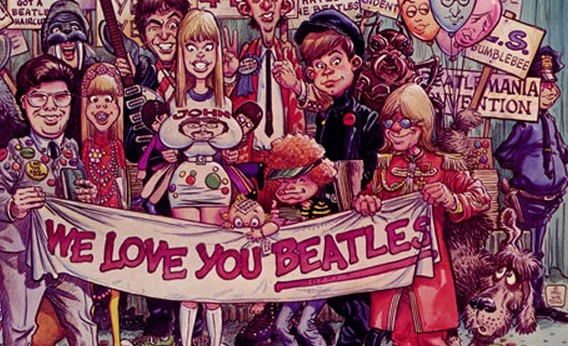
Assassin Mark David Chapman (left) makes an unwelcome appearance on the cover of Beatlesongs!

The record: Beatlesongs! The Best of the Beatles Novelty Records (Rhino Records, 1982 - RNLP 803)

Artist(s): Various, including the Rutles, Casey Kasem, Wild Man Fischer, Allan Sherman, and the comedy team of Peter Cook & Dudley Moore

Rhino Records' Beatlesongs!
History: Rhino Records started out as an actual record store on Westwood Boulevard in Los Angeles, founded in 1973 by the eccentric Richard Foos, but they began distributing their own records just five years later. Their first release was "Go to Rhino Records" (1978) by the notorious "Wild Man" Fischer, a schizophrenic ex-Zappa protege who'd been hanging out at the LA shop. Rhino Records issued a few punk and novelty singles after that, but their real forte turned out to be high-quality reissues of classic rock, soul, pop, and jazz records, and they became one of the top labels for such releases in the 1980s and 1990s.

In particular, Rhino became famous for its often quirky and clever compilation albums with distinctive packaging and well-researched liner notes. One early example was 1982's Beatlesongs! The Best of Beatles Novelty Records, a various artist LP with tracks about (but not by) the Beatles. Most of these are comedy songs released during the first wave of Beatlemania in America, circa 1964, but some are tracks recorded well after the group's demise. Unfortunately, the album was quickly taken off store shelves because of its deliberately tasteless cover illustration by William Stout, who depicted John Lennon's assassin, Mark David Chapman, as one of the attendees of a fictional "Beatlemania Convention."

I bought this in the 1990s at a real Beatles convention from a vendor who swore to me it would become a collector's item. It hasn't. But it still contains some interesting pop culture debris, mostly ephemeral records that were designed to have a very brief shelf-life. Rhino, meanwhile, was absorbed into Warner Music Group in 2009 and has largely been supplanted in the offbeat nostalgia biz by Shout! Factory.

All Music Guide says: 2.5 stars. "Unfortunately, the selections are not as representative as they might have been and occasionally venture into irrelevant territory." - Greg Adams [link]

Was it a hit: No, but "We Love You Beatles" by the Carefrees crawled up to #39 back in February 1964.

Choice excerpt from the liner notes: Musicologist Ken Barnes summarizes the "low comedy role" played by topical novelty records ("idol worship or idle wordplay, sycophancy or sicker fancies") and gives us background details on the artists, e.g. "Wild Man Fischer was so affected by the Beatles (his favorite group at the time) film Yellow Submarine, that he was moved to write 'I'm the Meany' after one of the cartoon characters. Wild Man says his new favorite group is the Go-Go's." The liner notes also contain an explanatory letter from Dudley Moore (by then a major movie star) to one of this album's producers, Harold Bronson. Moore says that "The L.S. Bumble Bee" was made quickly to capitalize on the druggy notoriety of "Lucy in the Sky with Diamonds" but musically was inspired more by the Beach Boys and the Supremes. "The only thing I can remember about the recording session," Moore writes, "was that Peter Cook had practically lost his voice when we were doing it, and found it very hard to put any tone into it."

Beatles label-mate Donna Lynn.
The listening experience: Quick and fulfilling. These twelve tracks are all brief, mostly in the two-or -three-minute range, and the songs tend to be upbeat and catchy, so listening to Beatlesongs! is a breeze. I must've listened to this record a lot in the '90s because I still knew the words to most of the songs by heart. Side One is fairly sedate stuff.

It starts with "The Invasion," a break-in record by Bill Buchanan and Howard Greenfield. Break-in records, for the uninitiated, are spoken-word comedy bits that are structured like news reports and employ cleverly-edited snippets of popular songs in an early, primitive form of sampling. Buchanan helped start this novelty sub-genre with his former partner, Dickie Goodman, back in the '50s with "The Flying Saucer (Parts 1 and 2)." "The Invasion" is a virtual replay of that record, only with the Beatles in place of aliens from outer space. "AMERICA, THIS IS THE END!" cries one panicked observer over the sound of an air raid siren.

Next up is something quite a bit more reverent: "Hold My Hand" by the Rutles, a late-1970s Beatles parody originally created by Eric Idle (of Monty Python) and Neil Innes (of the Bonzo Dog Band) for their British TV series, Rutland Weekend Television and later featured on SNL and their own feature-length NBC special. "Hold My Hand" is not a comedy number, per se, but rather a loving pastiche of the Beatles' early 1960s sound.

The Carefrees are up next with "We Love You Beatles," a song of devotion with a melody swiped from Bye Bye Birdie and sung with almost militaristic fervor.

Forgotten pop princess Donna Lynn, who recorded on the same American label (Capitol Records) as the Beatles, sings the goofy lament "My Boyfriend Got a Beatle Haircut," one of the rare records in which Beatlemania threatens to take a guy away from a girl, instead of the other way around. (On Side Two, the genders are reversed.)

Side One's craziest record -- by far -- is Casey Kasem's "Letter from Elaina," in which, over an instrumental rendition of  "And I Love Her,"  the famed DJ reads, with great sensitivy and gravitas, a missive from a hysterical female groupie who managed to get by security long enough to hug George for several seconds before he could break away, say, "Hi, bird," and drive away in a limo. ("My girlfriends were -- and are -- very envious," she boasts.) What's amazing about this record is how little actually occurs in the story and how much meaning Casey gives it with his tender tone of voice:


Side One ends with "Beatlemania," an instrumental mish-mash of the group's early hits, by Jack Nitzsche, the famed arranger and film composer, who throws in a bit of "Needles and Pins" -- a hit he cowrote with Sonny Bono -- for good measure. Apart from "Hold My Hand," every track on this side comes from the original 1960s heyday of Beatlemania.

Rhino Records mascot Larry "Wild Man" Fischer
On Side Two, things get a bit crazier. Kicking things off is "Beatle Rap," a "Rapper's Delight"-style novelty tune credited to a one-off group called The Qworymen (a play on John and Paul's pre-Beatle band, The Quarrymen) and apparently recorded exclusively for Rhino. Though the rapping is elementary by today's standards and the Beatle impressions are a bit shaky, this record is a blast for knowledgeable Beatlemaniacs, jam-packed with references -- some quite obscure -- to the Beatles and their careers, including the solo years. (The fake "Paul" mentions his then-recent drug bust.) Musically, it's built around the riff from "Day Tripper," but if you listen through headphones, you'll hear nods to "The Inner Light," "Strawberry Fields Forever," and "I Should Have Known Better." My favorite aside, from "John": "Anybody wanna buy some lithos?"

Cook and Moore are up next with their deliberately twee, pseudo-psychedelic pop song about a consciousness-expanding bumblebee. It's hard to believe that this song has been frequently been passed off as a "real" Beatles song and has turned up on Beatle bootlegs for years. It sounds nothing like them.

Next, Rhino Records' unofficial mascot, Wild Man Fischer, delivers the most out-there, avant-garde track on the whole compilation: his unhinged, off-key a cappella rant "I'm the Meany," which contains the line "She told me she was pregnant, so I hit her in the stomach!"

After that, Allan Sherman's "Pop Hates the Beatles," a parody of "Pop Goes the Weasel" complete with orchestral backing, sounds positively genteel. Sherman brings his usual Borscht Belt crankiness to the topic of the Beatles. The song is actually sung from the point of view of an exasperated father whose daughter is a confirmed Beatlemaniac. The live audience on this record, obviously composed of moms and dads of Sherman's generation, laugh appreciatively. Beatlesongs! ends with two quickie cash-in records from 1964 (or thereabouts).

The album's closer, "The Beetle" by hit songwriter Gary Usher, is an opportunistic attempt to create a new dance craze based very loosely on the Fabs.

It's cute enough, I suppose, but I got much more of a kick out of "Letter to the Beatles" by the Four Preps, a clean-cut 1950s pop quartet, i.e. the type of group largely made obsolete by the British Invasion. Perhaps fueled by jealousy, they released a musical lament about a poor guy whose best gal dumps him when she becomes obsessed with the Beatles and -- after receiving numerous unsatisfactory responses to her fan letters -- finally breaks down and agrees to purchase all the merchandise the group wants to sell her. Even if you love the Beatles so much that you're offended by this song, you have to admit that the chorus of "A Letter to the Beatles" is damned catchy. I think this tune is as worthy as any of closing this article, so I'll leave you with it. Enjoy.


Overall grade: B

Sunday, June 23, 2013

Mill Creek comedy classics #18: "Escape to Paradise" (1939)

Twelve-year-old boy soprano Bobby Breen sings and sings and sings in Escape to Paradise.

The flick: Escape to Paradise (RKO Radio Pictures, 1939; reissued by Variety Film Distributors, 1946) [buy the set]

Current IMDb rating: 5.0

Director: Erle C. Kenton (Island of Lost Souls, House of Frankenstein, House of Dracula, Pardon My Sarong)

Actors of note
  • Bobby Breen (Way Down South, Make a Wish; boy singing sensation of the late '30s)
  • Kent Taylor (The Scarlet Empress, The Crawling Hand; partial namesake of Clark Kent, the other being Clark Gable)
  • Marla Shelton (A Star is Born [1937 version], Flying Down to Rio)
  • Rudolph Anders (A Star is Born [1954 version], The Great Dictator, To Be or Not to Be)
  • Pedro de Cordoba (Captain Blood, Hitchcock's Saboteur)

The gist of it: Way down in quaint Rosarita (sometimes "Rosarito"), South America, young go-getter Roberto Ramos (Breen) shuttles tourists around in his motorcycle with a sidecar and occasionally sings at his mother's restaurant. But his real dream is to save up enough money to buy a taxicab. The town's big industry should be the tea (yerba mate) that grows there, but sleazy Mr. Kormac (Anders) is keeping the price down. Into this situation comes playboy Richard Fleming (Taylor), who just wants to get off a cruise ship and ditch annoying would-be girlfriend Penelope (Compton). With Roberto as his guide and sidekick, Fleming tries to woo the lovely Juanita (Shelton) by buying a single shipment of tea from her father, Don Miguel (de Cordoba). This puts him at odds with Kormac, who desires both Juanita and control of the tea business, and gives the people of Rosarita the mistaken impression that Richard Fleming is the town's economic savior.

Yerba mate, the MacGuffin of this film.
My take: Ah, 1939 -- Hollywood's most golden year, lauded by film scholars as the creative peak of the American movie industry! But the studios weren't exclusively turning out masterpieces that year. No, they still cranked out plenty of cheaply and indifferently made "filler" like this movie -- an imperialist comedy that seems to think that South America is a small country and not a huge continent. 

Escape to Paradise is mainly a vehicle for 12-year-old Bobby Breen, a young boy with the voice of a grown woman. It's a little unsettling, and I never quite got used to it. Obviously, a pre-adolescent male singer has a very limited amount of time in which to make as much cash as possible. Three years after this flick, Breen's film career ended with Johnny Doughboy (1942), alongside fellow washed-up child star Carl "Alfalfa" Switzer. The former boy soprano kept performing in nightclubs and recording for decades after that (for a brief while, he was signed to Motown for no apparent reason), eventually settling in Florida and starting his own talent agency.

As for this movie, it's largely a forgettable dud. Kent Taylor is little more than adequate as the romantic lead, and Marla Shelton is far too generic to be of much interest. Rudolph Anders should be able to stir things up as the slimy, monocle-wearing gringo villain, but the script doesn't give him many opportunities to do so. The film sets up the possibility of a duel between Fleming and Kormac, complete with glove-slapping, but nothing ever develops from this. 

Those attempting to watch Escape to Paradise should know that the film is in pretty rough shape, especially its soundtrack (which sounds like one of those Edison wax cylinders). Also, the characters often converse in untranslated, un-subtitled Spanish. That is, when they're not speaking pidgin English, both with Fleming and among themselves. All this means you'll probably have to concentrate a bit to follow the plot, and it's really not worth the effort. 

By the way, yerba mate is very real and is sometimes consumed for health reasons. Whether that's a good thing is up for debate.

Is it funny: Once in a great while. I got a good solid laugh from the film's one big Fleming/Kormac confrontation scene. (There should have been more.) And the movie has one successful, sustained comedic sequence in which Richard Fleming goes to the home of Don Miguel in order to woo the fair Juanita. He and Roberto do the whole "Cyrano de Bergerac" bit, with the kid singing from behind a hedge (the loveliest song in the movie, by the way) while Fleming pitifully tries to lip sync the lyrics he clearly doesn't know while feebly pretending to play a guitar. Juanita catches on almost instantaneously. Our would-be Romeo then tries scaling the wall to her balcony with less-than-ideal results.

My grade: C

P.S. - Being set in "South America," Escape to Paradise has no offensive black stereotypes. You could argue, though, that it has plenty of offensive Latin stereotypes. The people of Rosarita are nice folks but very backwards and behind the times. Striding through the streets in his crisp white suits, Richard Fleming displays an attitude of benign condescension towards the town and its citizens. Regrettably, Roberto's mother is an enormous woman who spends most of her time napping while sitting upright in a chair.