Wednesday, September 25, 2013

Ed Wood Wednesdays, Week 12: "The Sinister Urge" (1960)

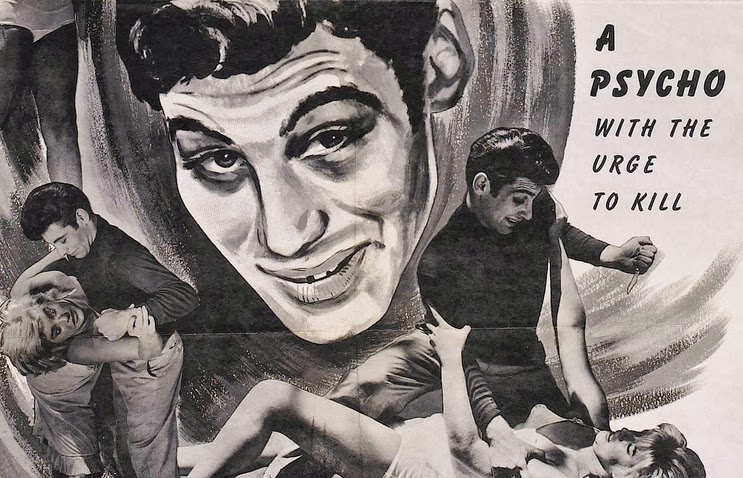
"A psycho with the urge to kill": The Sinister Urge isn't coy about naming one of its main influences.

A slightly paunchy Ed in The Sinister Urge.
The year is 1960. Edward D. Wood, Jr., 36 years of age, has been in Hollywood for twelve years at this point and in that time has done virtually everything there is for a young man to do in showbiz. He's acted in films and onstage. He's been employed by a major studio, Universal, in a position of some responsibility as a night production coordinator. He's worked in local television as a writer and director as well, sometimes even getting paid for it. 

More importantly, Ed has written, directed, and produced his own feature films. He's worked with one certified movie legend, Bela Lugosi, and a whole host of colorful, nationally-known pop culture figures, including Vampira, Tor Johnson, and Criswell, not to mention several of the B-movie cowboy actors (such as Kenne Duncan, Tom Keene, Bud Osborne, and Tom Tyler) he had idolized when he was a young moviegoer in Poughkeepsie, NY. Several of Wood's scripts have been purchased and produced by other filmmakers, too, occasionally to financial success. He's helped stage a Las Vegas revue and even made technical training films for the government.

In short, Ed Wood has been around the block.

None of this has made him wealthy or famous, however. In fact, he's always broke. "I should have a million dollars right now," he sadly tells his friends during his moments of self-pity. But his enthusiasm for show business is unshakable, and he's always focused on the next project with a tragicomic sense of optimism. Unfortunately, his drinking will become an increasing problem in the years to come, and Ed will be forced to rely more and more on favors from friends to find work as he steadily descends the ladder of respectability from low-budget science-fiction, horror, and crime films to softcore "nudie cuties," smutty paperbacks, and finally hardcore pornography. In the pivotal year of 1960, his career is at a crossroads, and he seems to know it.

Wood's last mainstream film.
Those are the circumstances under which Ed Wood directed his so-called "last" feature film, The Sinister Urge (1960), and they're not especially pretty. Actually, a good chunk of the film had already been made back in 1956, when Ed did one day's worth of shooting on a rock-music-themed juvenile delinquent picture to be called Hellborn. Producer George Weiss, who had shepherded Ed's debut film Glen or Glenda (1953), couldn't raise any more money, and the production shut down.

Several years later, actor Conrad Brooks sold the rights to the precious Hellborn footage to independent producer Roy Reid, who agreed to let Eddie make a "new" movie out of it for Headliner Productions, which had previously distributed The Violent Years (1956). As with Night of the Ghouls (1959), Ed wrote and directed an original story that incorporated the existing film footage. The cast was a mixture of Wood's typical repertory players (Harvey B. Dunn, Duke Moore, Connie Brooks, Kenne Duncan, and Carl Anthony) with a few prominent newcomers, mainly LA nightclub performer Jean Fontaine, who supplied her own wardrobe, and a hungry up-and-comer named Michael "Dino" Fantini, who was culled from an acting school. Perhaps out of loyalty, Ed hired his longtime cinematographer, William C. Thompson, to shoot The Sinister Urge, even though the veteran cameraman was losing his eyesight.

As nearly every single biographer of Ed Wood has noted, the plot of the film, in which a once-legitimate filmmaker has gotten involved in the manufacturing of illegal pornography, very much mirrors Ed's own life and career. Perhaps taken together, Glen or Glenda and The Sinister Urge form a more complete self-portrait of Ed Wood.

But how does the film stack up today? Let's succumb to our sinister urges and investigate.

Title screen from the film.

Alternate titles: Racket Queen, Act of Compulsion, Hollywood After Dark, Immoral Intruder, Chains of Evil, Hellborn.

Availability: The film is available with an introduction by filmmaker Ted Newsom as part of the Big Box of Wood collection (S'more Entertainment, 2010). It's available as a standalone DVD as well (Sinister Cinema, 2008).

The backstory: Much like Ed's previous films, Jail Bait and Night of the Ghouls, the plot of The Sinister Urge revolves around a criminal couple. The twist here is that the no-nonsense, tough-talking mastermind in the relationship is the woman -- brassy blonde Gloria Henderson (singer Jean Fontaine, in her first and last screen role), who runs a pornography or "smut" ring for her thuggish bosses in "the Syndicate." (That's what people used to call the mafia.) Her lover and accomplice is the wonderfully-named Johnny Ryde (Plan 9 from Outer Space veteran Carl Anthony), a formerly-respected movie director who now oversees the making of sleazy, no-budget pornographic films and photos. It's a lucrative but highly dangerous operation, with the police (led by Duke Moore and Kenne Duncan) constantly raiding their studios, confiscating their films, and tailing their every move.

The reason for this drastic police intervention is the fact that Gloria and Johnny's pitiful little racket is somehow the hub of the entire city's criminal community. The immoral pornographers even have a greasy, low-rent thug in their employ named Dirk (played with genuine menace by Dino Fantini in his only notable screen role) who kills anyone who may pose a threat to the operation, i.e. models who squeal to the cops. Dirk is basically Gloria and Johnny's vicious "attack dog," but he's getting to enjoy his work too much, not only killing but sexually assaulting his victims as well... and doing so without much subterfuge in broad daylight. Dirk's exploits have brought on even more police scrutiny, and the Syndicate wants him taken care of "permanently."

From there, it's a series of murders, attempted murders, and double crosses that lead to a very moralistic Dragnet-esque finale, with all of the scumbags either dead or headed to jail.

Disappointingly, there do not seem to be many colorful anecdotes surrounding the making of The Sinister Urge. Perhaps sensing this was his last chance at legitimacy or even semi-legitimacy, Ed Wood very much wanted to prove that he could bring a film in on time and on budget with no screw-ups or shenanigans. Producer Roy Reid had every confidence in him, and Wood submitted a carefully-written proposal called "My Plans for Shooting Arrangement and Why" (sample line: "There is an excellent chance of bringing this picture in in four days and one pre-production.") and an itemized budget (Ed's fee for directing: $2600; total budget: $20,152, which today would be about $160,000).

Much of the shooting was done on a ranch owned by cast member Harry Keaton, brother of Buster Keaton, making his last-ever screen appearance in the role of "girly" photographer Jaffe under the semi-pseudonym "Harry Keaten." The micro-budgeted film seems to have played mostly in LA but did make it to New York's then-infamous 42nd Street "grindhouse" circuit, where it ran for 13 weeks. What's notable is that The Sinister Urge is the first of Ed's directorial efforts to contain a brief flash of female nudity, which occurs when a sex-crazed Dirk rips the brassiere from one of his female victims.

Rudolph Grey's Nightmare of Ecstasy includes a photograph of a "bondage" scene, but no such sequence survives in the existing print. It should be noted that a few frames from one scene, in which Kenne Duncan shows some grisly photos to Harvey B. Dunn, have been clearly chopped out by the censors. Nightmare of Ecstasy also mentions that Ed filmed some "additional scenes" for The Sinister Urge in 1961, the year after its original release. Considering how very tame the film is, it's likely that these scenes were a little racier than what was already in the movie.

A threat to American womanhood? This?!?

The viewing experience: Stultifying and drab, but not worthless. The Sinister Urge is an extremely hypocritical film that preaches against pornography with the same fervor that Reefer Madness condemned marijuana but at the same time invites viewers to ogle the (somewhat) scantily-clad women on display in the film and take pleasure from their debasement. Certainly, the two sanctimonious cops on the case must spend a lot of their time poring over "dirty" films and photos. Could that perhaps be why they're so willing to spend virtually all their waking hours on this case? At one point, Kenne Duncan (also in his last screen role) tells us that smut is even more addictive than dope. This is interesting news, since by pure coincidence, I just read about a recent scientific study that suggests that the brain does not actually react to porn the way it does to narcotics and that "porn addiction" may not even exist.

Perhaps because of censorship issues, The Sinister Urge never depicts anything like real pornography anyway. At the moment of the big police raid, here is what is happening: Jaffe is taking some still photos of three women in swimsuits lying on their stomachs next to each other. When the cops kick in the door and start arresting everyone and seizing everything, it seems like a glimpse of a fascist police state, yet I think the movie wants us to feel glad that these lawmen are doing their job to protect the innocence of American womanhood. I've mentioned before that Ed Wood's personality was a strange, self-defeating combination of swinger and square, playboy and prude, and never is that more clear than in The Sinister Urge.

Before embarking upon this project, I had no idea how much influence Jack Webb and Dragnet had over Eddie, but now it's crystal clear. The hard-working plainclothes detectives portrayed by Kenne Duncan (a sexually-voracious sleazeball, by the way, whose boastful nickname was "Horsecock") and Duke Moore (whose character, just as in Night of the Ghouls, is kept from taking a date to the theater in order to focus on police work) are supposed to remind us of Jack Webb's Sgt. Joe Friday, but instead their scenes play out like an alternate universe version of Dragnet in which two dull sidekicks are paired together without a leading man.

In many ways, The Sinister Urge suffers from a shortage of charisma, a problem that  also plagued Crossroad Avenger: The Adventures of the Tucson Kid, another Ed Wood project with Kenne Duncan. In the past, Wood's films had larger-than-life personalities like Bela Lugosi, Tor Johnson, and Criswell to spark the audience's interest. Here, unfortunately, too many of Ed's loyal but dull second stringers have been promoted to leads. I've already mentioned the tedium of Duncan and Moore's talky scenes at the police station. The boredom there is briefly relieved by a welcome appearance from Harvey B. Dunn as a concerned taxpayer, but then Dunn disappears after being shamed by one of Kenne Duncan's Dragnet-esque sermons. (In his shooting plan, Wood says that the "taxpayer" character, Romain, is crucial. That's perhaps why he cast Dunn in the relatively small part.)

On the criminal side of the film, hard-boiled Jean Fontaine (who was married to a rich man and only pursued showbiz as a hobby) and twitchy, greasy Dino Fantini add some much-needed color and eccentricity, but the central character of Johnny Ryde, who by all accounts was Ed's onscreen surrogate*, is too demanding for a pedestrian actor like Carl Anthony, who seems supremely stiff and uncomfortable. Gloria's "syndicate" bosses, too, are a flop. They seem like bland bureaucrats rather than flashy gangsters. Maybe that was part of Ed's plan, effectively deglamorizing the world of crime by showing mob bosses as bean counters and number crunchers.  I must say that Gloria and Johnny's pad, supposedly a den of sin and vice, looks like the standard living room set from every late-1950s/early-1960s TV sitcom. You get the sense that Rob Petrie might come in and trip over the ottoman at any moment.
*Yes, in a much-noticed "in joke," Johnny's office contains lobby cards for Plan 9, Jail Bait, The Violent Years, and Bride of the Monster. Johnny refers to the maker of those films as "a friend."

Actress Jean Fontaine, aka "Gloria."
But what about the standard "Ed Wood" brand of eccentricity? What about his pet themes? Oh, they're here. Have no doubt of that. First and foremost, The Sinister Urge is a clumsy patchwork job that tries to incorporate old footage into a new story by means of dubbed-in dialogue and cutaway reaction shots. The mismatches aren't as crazy as the ones in, say, Bride of the Monster (1955), but they'll do. Similarly, the dialogue is oddly formal and heavy on exposition and outdated slang. While not as quotable as some of Wood's other films, it's noticeably off-kilter at certain points. ("I don't dig the angel bit," says Dirk after Johnny unsuccessfully tries to bump him off.) If there's a character you'll be quoting or imitating afterward, it's probably going to be Gloria, whose climactic "that's not Dirk" speech is already well-known to fans of MST3K.

In the aforementioned scenes from Hellborn, Ed himself appears as a clearly over-aged, somewhat paunchy delinquent, fighting with Conrad "Connie" Brooks outside a pizza joint, thus making his first major acting appearance in one of his own films since Glen or Glenda seven years earlier. That pizza joint is highly reminiscent of the teen hangout repeatedly mentioned in Ed's novel Devil Girls (1967), and one of the female spectators is wearing -- you guessed it -- a fuzzy angora sweater. (I almost typed "a fuzzy pink angora sweater" before remembering that the film was in black-and-white.)

Alcoholism runs all through this film, with Gloria and Johnny boozing it up from one end of the picture to the other. And, yes, there is a scene of transvestism. In order to lure Dirk out of hiding, the police send a male officer dressed in drag to Griffith Park (Dirk's favorite crime scene) to act as "bait" for the mad killer. Does he go for it? Like a moth to a flame, baby. And did I mention that the first victim in the film is a model named Shirley? For those of you just joining us, "Shirley" was Ed Wood's drag name. If you get a kick out of technical mistakes, furthermore, you'll be happy to know that the boom mic is prominent in several scenes, perhaps indicating that either Ed Wood or Bill Thompson was getting sloppy by this point.

Meanwhile, just to show you how interconnected Ed Wood's works truly are, there is a portion of The Sinister Urge that plays like a dramatization of his posthumously-published manuscript, Hollywood Rat Race (Four Walls Eight Windows, 1998). In that book, Ed writes about would-be starlets who come to Hollywood with big dreams after being the lead in a high school play but then wind up being exploited by sleazeballs and phonies. In this movie, the cops discuss such unfortunate young ladies, and then we get to actually see one such victim  in action -- an ingenue named Mary (with all the innocence that name implies) who winds up owing money to Gloria and Johnny and, in order to pay them back, begins a sordid life of indentured servitude as a model for their smutty pictures and films. Such a shame. If only she'd read Ed's book before coming to Hollywood.

Next week: Have I got a treat in store for you? Actually, to be honest, I don't know because the next film is one I've never seen. Could be great. Could be terrible. Could be somewhere in the middle. One of Wood's occasional collaborators in the 1950s and 1960s was a Russian-born director-producer named Boris Petroff. Wood was an unbilled "consultant" (and perhaps more) on Petroff's Anatomy of a Psycho in 1961, and Petroff borrowed the character of Lobo (as played by Tor Johnson) from Bride of the Monster for his infamous 1957 anti-classic The Unearthly. Well, in 1963, Boris Petroff effectively ended his filmmaking career with a backwoods, "hick-sploitation" movie based on a script ghost-written by none other than Eddie Wood. Join me in seven days for an unabashed look at Shotgun Wedding aka Child Brides of the Ozarks. Sounds tasteful enough, doesn't it? Y'all come back now, hear?

Mill Creek comedy classics #57: "Buster Keaton Classics" (1921-1923)

Buster Keaton at the beginning and end of his career. Notice that Buster is missing the tip of his left index finger.

Eddie Cline
NOTE: This is another collection of Buster Keaton's innovative two-reel silent comedies from the early 1920s, made under the banner of Buster Keaton Productions for producer Joseph M. Schenck and distributed theatrically by First National Pictures. The Roaring Twenties were Keaton's peak years as an actor and director, the golden age when he reached his pinnacle of popularity and creativity. An unsung hero in the Buster Keaton saga is Edward F. "Eddie" Cline (1891-1961), a super-prolific director, writer, and occasional actor who was Keaton's most frequent collaborator during this crucial era. 
Although not always credited as such, Cline co-wrote and co-directed most of Buster Keaton's famous two-reelers and pitched in as an actor whenever necessary, too. Born in Kenosha, WI, Cline signed on with Mack Sennett's Keystone Studios in 1914 and began his career as a supporting actor in Charlie Chaplin's Keystone films. It wasn't long before he was writing and directing films in addition to acting in them. Happily, Cline's career did not end with the advent of talking pictures in the late 1920s. In fact, during the 1930s, Cline began his professional relationship with another legendary comedian, W.C. Fields. Cline directed Fields in several highly-regarded features, including My Little Chickadee (1939) and The Bank Dick (1940). Fields did not take "direction" in any conventional sense, so Cline was one of the few filmmakers who could successfully work with him... or around him if need be. Interestingly, Stanley Kubrick named The Bank Dick as one of the ten greatest films up to 1963. 
Although Cline dabbled occasionally in other genres, including melodrama, he worked almost exclusively in comedies through the 1940s, occasionally re-teaming with his old pal, Buster Keaton, who by then was a character actor. The 1950s marked the end of Cline's career. He died about 11 years later, never having been fully recognized for his crucial role in the history of film comedy. One of his last gigs was on Buster's short-lived TV show, Life with Buster Keaton.

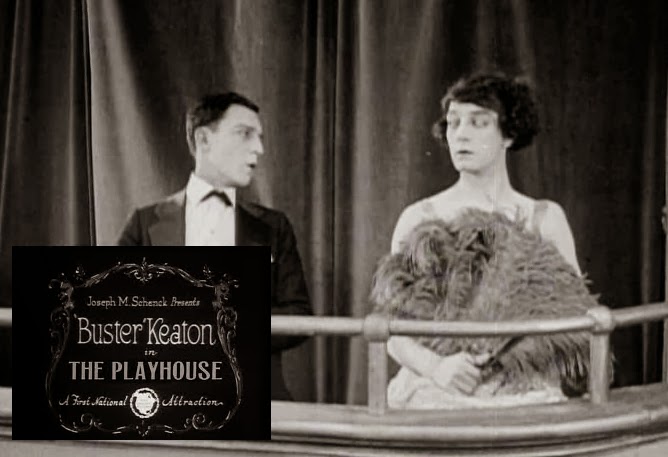
Buster Keaton meets Buster Keaton in Buster Keaton's The Playhouse.

The first flick*: The Playhouse (First National Pictures release of a Joseph M. Schenck Productions film, 1921) [buy the set]

*The IMDb lists this as The Play House.

Current IMDb rating: 7.8

Directors: Buster Keaton (Allez Oop, Grand Slam Opera) and Edward F. Cline (W.C. Fields' You Can't Cheat an Honest Man)

Actors of note: Buster Keaton (Paradise for Buster, The Man Who Bought Paradise), Edward F. Cline (The Boat), Virginia Fox (The Blacksmith), Joe Murphy (Calamity Jane; played Andy Gump in many short films from 1923 to 1928), Joe Roberts (The Paleface)

Zouave Guards of the French Army.
The gist of it: Buster goes to an opera house where every performer and every audience member, male and female, young and old, looks exactly like him. One patron opens a program and sees that everyone in the cast and crew is named "Buster Keaton." All this turns out to be the surreal dream of an absent-minded stagehand (also Buster), who is roused from his bed by a belligerent stage manager (Roberts) in what turns out to be a set on the stage of an actual opera house. Buster's girlfriend (Fox) works at the opera house, too, but he's always getting her confused with her twin sister (Fox again) who dresses exactly like her. Buster resolves "never to drink anymore... but just as much."

An animal trainer (Cline) unwisely gives Buster the job of dressing a monkey, but the mischievous orangutan immediately escapes. Buster's solution is to disguise himself as the monkey and go on in the creature's place. Later, Buster is tasked with finding men to play Zouave Guards (French light infantry) in the show. He recruits a bunch of laborers (including Murphy) who were napping on the job next door, and the men do an elaborate but disastrous gymnastics routine. A burly actor (Roberts again) sets his phony beard on fire, and Buster uses an ax to knock it off the man's face. Enraged, the actor chases Buster around the theater. 

Meanwhile, a young woman in the show gets trapped in a glass tank full of water, and Buster comes to the rescue. After unsuccessfully trying to bail her out one teacupful of water at a time, he smashes the tank and floods the entire theater. Sensing dire consequences, Buster grabs his girl and dashes to the Justice of the Peace. But he's grabbed the wrong one, so he goes back to the theater and collects his real girlfriend, carefully marking the nape of her neck with a large "X."

Was this Keaton's comment on showbiz vanity?

My take: An extraordinary technical achievement as well as a pint-sized masterpiece of surrealist comedy, The Playhouse is one of the most amazing things I've seen in this collection. Painstakingly shot with a special shuttered lens that could film only a portion of each scene at a time, this short is a special effects tour de force and a terrific showcase for the versatility of Buster Keaton, who gets to play women, children, musicians, performers of all sorts, and even a monkey. As a writer-director, Keaton was clearly interested in pushing the limits of cinema and seeing how far he could go with the existing technology.

The Playhouse would merely be an interesting but dry technical exercise if there weren't any sharp comedic ideas behind it, but fortunately Buster Keaton's mind was ablaze with such ideas in 1921. The dream sequence, for instance, could be interpreted as a parody of show business egotism and megalomania. (It's also an obvious predecessor for the infamous restaurant scene in Being John Malkovich.) After the dream ends, we think we are back in the "real world," only to find that the supposed bedroom is just another theatrical set! From there, the movie lurches from one bizarre vignette to the next as Buster's slyly subversive character causes chaos throughout the theater. Why Buster Keaton ever decided to make himself up to look like a monkey is beyond me, but he certainly takes to the role with abandon. One wonders about the fate of the escaped orangutan, who is never seen again after making his getaway.

The "Zouave Guards" sequence is another seemingly random, out-of-the-blue choice in the film's diverse script, and it somehow leads to an elaborate slapstick acrobatic routine with a cannon and at least two dwarf actors. (Though maybe it's just one dwarf made to seem like two through camera trickery. In this film, who knows?) The IMDb claims that Keaton's stunts in The Playhouse were "tame" because the actor was recovering from a broken ankle, but he certainly does a lot of running, jumping, climbing, and falling in this film. The water tank sequence, for instance, must have been physically punishing for all the actors involved, including Buster.

Incidentally, the film's little joke about Buster's vow "never to drink anymore" after confusing his fiancee with her identical twin becomes bitterly ironic when you consider that alcoholism would nearly ruin Buster's career and life.

Is it funny: Yes, and frequently, too! It's a shame Buster didn't do more drag humor, because he's awfully good at it. Just the sight of Buster as a society matron in a dress, makeup, and wig is comical because these trappings make him look just like Maggie Smith. He makes a good "bratty kid" and "negligent mother," too. That mother, perched in a balcony, carelessly spills her Coca-Cola on some poor spectators below her. With typical Keaton stoicism, the victim of this rude behavior simply takes out an umbrella to cover himself. Some of my favorite jokes in the film are the simple ones, like when Buster walks up to a punch clock, ponders it for a moment, then very literally punches it. As usual, big bruiser Joe Roberts makes an excellent foil to "twig boy" Buster, and it's fun to see the wily comedian get on the nerves of his physically imposing rival time and again. Buster's main asset as a comedic character is that he's basically unshakable and can quickly adjust to any catastrophe. When the orchestra pit floods, for instance, he merely turns a bass drum into a makeshift canoe and uses a violin as a paddle. Problem solved!

My grade: A


P.S. - Yes, regrettably, there are some racial stereotypes in this film. Namely, Buster appears in full blackface makeup playing a character called "Mr. Bones" as part of a minstrel show, and there's a poster outside the theater showing a caricatured African-American man playing a banjo. No getting around that. But at least the intertitles make no attempt at replicating "Negro" dialect, and the lame joke "Mr. Bones" tells is a standard schoolyard riddle with no racial overtones. Considering that the theater's marquee promises "twenty-five of the world's greatest minstrel stars," the blackface portion of The Playhouse is mercifully brief and not at all central to the film.

"Would you like to fly in my beautiful balloon?": Buster Keaton in The Balloonatic.

The second flick: The Balloonatic (First National/Buster Keaton Productions, 1923) [buy the set]

Current IMDb rating: 6.7

Director: Buster Keaton (The High Sign, The Love Nest) and Edward F. Cline (The Villain Still Pursued Her)

Actors of note: Buster Keaton (Palooka from Paducah, Oh Doctor!), Phyllis Haver (Don Juan, Yankee Doodle in Berlin; broke into showbiz as one of Mack Sennett's Bathing Beauties; retired from acting to marry a millionaire in 1929; she divorced him in 1945 and committed suicide in 1960), Babe London (plump comic actress who worked in films from the 1920s to the 1950s; appeared in The Snake Pit, Road to Rio, and Buster Keaton's The Paleface)

Phyllis Haver and Buster in a flying canoe.

The gist of it: On a fine summer day, Buster visits an amusement park and is bedeviled by phony skeletons, man-made fog, and fabricated demons at a spooky attraction called the House of Trouble. After unsuccessfully attempting to woo a young lady with the old Sir Walter Raleigh cloak-and-mud-puddle routine, our hero then attends a demonstration of a hot air balloon that accidentally takes off with Buster on board. While he's up in the sky "three and a half miles higher than a kite," Buster decides to do some duck hunting and manages to deflate the balloon with his rifle.

After plummeting to earth, he safely lands on top of a tall tree in a wooded area. By the next morning, Buster has set up camp and has somehow constructed a canoe, the Minnie-Tee-Hee, whose three separate sections keep coming apart. Meanwhile, there's an attractive young lady (Haver) who is also fishing and hunting in this same forest, and she keeps crossing paths with the disaster-prone Buster. At first she is irritated with him, but over time she begins to like him. 

After the hapless man narrowly escapes being eaten by a bear, he and the lady begin a "backwoods romance." The young man and woman float down the river in the newly-refurbished Minnie-Tee-Hee, blissfully unaware that they're about to go over a waterfall. But at the crucial moment, the canoe miraculously doesn't fall. We then see that Buster has attached the hot air balloon to the vessel. As Buster and his sweetheart sail through the air in their curious balloon boat, the front and back of the Minnie-Tee-Hee again fall off.

Buster on top of the balloon.
My take: Unlike the other films in this Mill Creek project, the Buster Keaton shorts have often required me to take notes before composing my reviews. The reason for this is that they don't follow any conventional logical patterns, plot-wise, but instead consist of almost-unconnected events strung together in a stream-of-consciousness manner. Just when you think the story is going to be about one thing (Buster is pushed around by creatures in a haunted house), it switches to something else (Buster tries to put the moves on a brunette, only to get a black eye for his troubles), then something else again (Buster climbs on top of a hot air balloon, which then unexpectedly takes off). The hunting and fishing plot seemed to come out of nowhere (a clear blue sky, so to speak), and until the last scene, I thought Buster had forgotten that this was supposed to be a movie about hot air ballooning.

The Fatty Arbuckle and Keystone Cops shorts had only a small handful of comedic ideas apiece; Buster's films seemingly contain dozens, all trying to elbow each other out of the way. The Playhouse obviously had a strong central location to keep things grounded. The Balloonatic, like the hot air balloon itself, is not tethered to anything in particular and simply floats from place to place. The only thing these scenes really have in common is Buster Keaton himself. Maybe that's why Buster insisted on wearing the silly hat and keeping his facial expression the same all the time; it's a way of establishing continuity in a movie that would otherwise be totally disjointed.

Is it funny: A good number of the jokes still work, yeah. I got some yuks out of the physical bits, like Buster pouring water out of his boots by standing on his head, for instance, or Buster diving into the water to save the girl but totally missing the river and flopping on the dirt instead. The House of Trouble (with its irresistible slogan "Get Into Trouble - 10 Cents") is a very promising locale, and I wish we'd seen more of it. One of the film's best gags is that visitors to the House of Trouble are rudely ejected via a slide that dumps them on the front sidewalk. After his experience leaves him befuddled, Buster stays in front of the attraction a little too long, and a hefty customer (London) lands on him. And I enjoyed the scene at a log-flume ride called "Ye Old Mill" in which Buster sits next to an attractive woman. We don't see what happens when their car enters a dark tunnel, but our hero emerges with a broken hat and a severely blackened eye.

My grade: B

P.S. - Apart from the faux Native American name of Buster's canoe, there's nothing racist here, though there is a lot of implied violence towards animals.

Family reunion: Buster gets up close and personal with the in-laws in My Wife's Relations.

The third flick: My Wife's Relations (First National Pictures, 1922) [buy the set]

Current IMDb rating: 6.7

Director: Buster Keaton (The Railrodder, The Rough House)

Actors of note: Buster Keaton (The Gold Ghost, Nothing but Pleasure), Monte Collins (Our Hospitality, The King of Kings), Wheezer Dell (Major League pitcher, 1912-1917), Kate Price (prolific, mostly forgotten silent screen comedienne of the 1910s and 1920s; career petered out in the '30s), Harry Madison (spent a quarter-century on the vaudeville circuit; made only two films, the other being King of the Circus), Joe Roberts (a regular in Buster Keaton's short films until a second stroke killed him in 1923), Tom Wilson (normally a blackface performer; appeared without the burnt cork makeup in Charlie Chaplin's The Kid)

Buster and the clan pose for a portrait.

The gist of it: In "the foreign section of a big city" where "people misunderstand each other perfectly," Buster is a young artist who works as a taffy puller in a candy shop. Unfortunately, he gets a little too into his work, knocks over a helpless mailman, and winds up with someone else's envelope stuck to his shoe in the process. The mailman tosses a bottle at Buster, smashing a window, and our taffy puller takes off running. Unfortunately, he collides with Kat (Price), an enormous and unpleasant woman who sees the broken window, assumes Buster is responsible, and drags him in front of a judge. The judge, however, only speaks Polish and was expecting to perform a marriage ceremony that day, and before you can say "annulment," Buster and Kat are man and wife.

A surprisingly delighted Kat drags the young man home to the small-ish apartment she shares with her father (Collins) and her four enormous, rough-mannered brothers (Dell, Roberts, Madison, and Wilson). Buster gets knocked around a lot at first by the whole family, who say he "won't last a week," but while Buster's asleep, his in-laws rifle through his possessions and find the errant envelope, which leads them to believe that Kat's new hubby has just inherited $100,000. (That's $1.3 million in today's money.) Treating the penniless taffy puller like a king, Kat sends Buster out the next morning to rent a nicer place for the whole family to live. He opts for a townhouse with sky-high rent, and he and his new family begin to live like royalty.

During a party, however, the relations discover that the envelope wasn't intended for Buster, and our young hero has to make a quick getaway before they kill him, bill him, or both! Fortunately, some home-brewed beer (to which Buster has added too much yeast) floods the house with foam, providing Buster the chance to escape from Kat and hop on the first train out of town.

My take: It may have been an omen that Buster Keaton made My Wife's Relations the year after he married actress Natalie Talmadge. Their union came to a bitter end a decade later. Natalie was so thoroughly disillusioned by the experience that she opted never to marry again, but Buster gave matrimony two more chances. (The third time was, in fact, the charm for him.) While The Balloonatic was all over the place, literally and figuratively, My Wife's Relations is a straight-down-the-middle sitcom-type story with a clear narrative through-line. I can imagine the same basic thing happening to, say, one of the Three Stooges. (Most likely Shemp.)

As "marital hell" stories go, Relations can't really compete with the acidic wit of W.C. Field's domestic comedies, but then again, a Fields film wouldn't have the rigorous physical buffoonery on display here. One particularly astonishing sequence occurs when the brothers are chasing Buster around the townhouse. Buster tumbles down one flight of stairs, getting himself rolled up in the carpet, then falls down another flight of stairs, perfectly unrolling the carpet again. After the groundbreaking experimentalism of The Playhouse, Buster Keaton proved with this film that he could do more "normal" stories and still hold the audience's attention with well-conceived and perfectly-executed gags. It's no world beater, but My Wife's Relations is a modest winner.

How about putting some coffee in your sugar, man?

Is it funny: Yes. Keaton isn't trying to dazzle us with cinematic technique or surreal storytelling here the way he did in his other, more daring films. My Wife's Relations is just a clothesline on which he pins a series of goofy jokes. But they're well-done, clever jokes, so it works out just fine, both for him and for us.

As I see it, the comedic highlight is Buster's first meal with his new family. He ends up passing so many items to so many people that he doesn't have time to eat! (A similar thing happened to Danny Kaye in The Inspector General.) Then, the main course -- I think it's supposed to be meatloaf -- is served, and after taking a moment to say grace, Kat and her family go after it like a pack of wild dogs, leaving none for Buster. He craftily comes up with a plan to change that, though, by surreptitiously tearing a page off the wall-mounted calendar and convincing his new family that it's actually Friday instead of Thursday. They must be Catholic, because they immediately stop eating the meatloaf, meaning Buster can have as much of it as he wants. 

In that same scene, Buster gets tired of seeing his brother-in-law add one sugar cube after another to his coffee, so he simply takes the brother's coffee and dumps it in the sugar bowl. Voila! A truly Keaton-esque solution! Another shining moment comes when the entire family is posing for a photographic portrait. Buster has to go to some extreme lengths to make sure he's actually visible in the picture. Watch the movie. You'll see what I mean.

My grade: B

P.S. - I don't think Polish-Americans will be too thrilled with the portrayal of Kat and her piggish family in this film. But their ethnicity is not really the joke here, just that Buster has accidentally stumbled into a terrible marriage with a woman who happens to be Polish Catholic. After the scroll at the beginning, which describes the communication difficulties among non-English-speaking immigrants in large cities, I was expecting much worse than this.

Buster rewires a mansion in The Electric House. At left: a Swedish poster for the film.

The fourth flick: The Electric House (First National Pictures, 1922) [buy the set]

Current IMDb rating: 7.2

Directors: Buster Keaton (Hollywood Handicap, Spite Marriage) and Edward F. Cline (Peck's Bad Boy with the Circus)

Actors of note: Buster Keaton (The Adventures of Huckleberry Finn, How to Stuff a Wild Bikini), Virginia Fox (The Paleface), Joe Murphy (his last film, The Misfit with Clyde Cook, was released posthumously in 1924), Steve Murphy (Chaplin's The Gold Rush, Keaton's Sherlock, Jr.), Joe, Myrna, and Louise Keaton (Buster's real-life father, mother, and sister)

"Electric snooker": A Buster Keaton innovation.
The gist of it: Buster has just graduated from "State University" with a doctorate in botany, but he gets his diploma mixed up with that of an electrical engineer (Murphy). The wealthy dean (Roberts) offers Buster a job wiring his mansion for electricity, and Buster accepts because he has a crush on the rich man's daughter (Fox). The real engineer is none too pleased with this outcome and seethes with resentment at Buster. The dean and his family then go on holiday, expecting Buster to be done with the job when they come back home.

When they return, they find that the young man has indeed added all kinds of crazy electrical gadgets to their house, including: a lever that raises or lowers the water in the pool; a model train that carries dishes from the kitchen to the dining room and back; a conveyer belt that loads and unloads the balls from a snooker table; and an escalator to the second floor. The escalator moves too quickly, though, and sends the dean crashing through an upstairs window into the aforementioned pool. Despite this and other mishaps, the family throws a party to show off their "newfangled" home to some guests. But the real electrical engineer sneaks into the home with the intention of sabotaging Buster. It works, and the machines start attacking the guests.

Buster then attempts to get a little retaliation of his own against the engineer by using the escalator to dump his rival in the pool. Unhappily for Buster, he ends up inadvertently depositing the dean into the pool, too. Buster is fired by his outraged employer and then tries to commit suicide by jumping in the pool with a heavy rock from the garden tied to his waist. The dean (who hates Buster) and his daughter (who now loves him) use the electric lever to alternately raise and lower the water in the pool, either saving or drowning him. But while they argue whether the botanist should live or die, a huge drain pipe carries Buster away to a remote spot in the woods... where he's reunited with the soaking-wet electrical engineer.

Design for Leaving: Daffy modernizes Elmer's home.

My take: Buster Keaton was rather famously injured during the filming of the escalator sequence of The Electric House, so he shelved the film temporarily and worked on The Playhouse instead, limping along on a broken ankle. But he started again from scratch on The Electric House with all-new sets and all-new footage the very next year. Why? I'm guessing it was because he sincerely believed in the underlying concept and knew it would work. And he was right! Our lives and homes are so technology-saturated today that the basic premise now seems a little quaint, giving this short some added historical value. It reminds me of that great Daffy Duck/Elmer Fudd cartoon, Design for Leaving (1954), in which the mercurial mallard plays an overeager salesman who installs various "push-button" devices in a cranky suburbanite's home for a ten-day free home trial. These machines end up trashing the house and brutalizing its owner -- not by malfunctioning, but by functioning too well.

The same basic thing happens here, except that the homeowner has volunteered for this treatment. I wonder if the makers of Design for Leaving saw The Electric House. I'm sure they must have at some point. In any event, while Keaton did not have the freedom afforded to filmmakers through animation, he did come up with plenty of ingenious devices and wild, gadget-centric situations in this satire of technology in the days of the Warren G. Harding administration. The escalator is probably the most impressive of all... even if it did temporarily hobble the great comic. All told, Design for Leaving is one of the strongest Keaton shorts I've seen and, as always, features some dazzling stunts. I'm tellin' ya, man, this Buster Keaton was a world-class athlete! The exteriors of the electrified house, by the way, were filmed at Buster's real-life home, so if you want to see how he was living in those days, here's your chance.

Is it funny: Oh, yes. The single funniest sight in this film is that of Buster trying in vain to run against the direction of the escalator and getting nowhere fast. Perhaps the best use of this device comes when Buster tries to lug a heavy trunk up the stairs, not knowing that a female servant has crawled inside after being bedeviled by the vengeful engineer's tricks. Meanwhile, Buster and Joe Roberts have a great skinny-guy-annoys-fat-guy dynamic going, making it all the more sad that Roberts only had a year or so left to live. But pretty much everybody in The Electric House is injured in some way by Buster's strange machines, as when Buster's famous model train simply bypasses all the other people sitting at the dinner table and deposits all the dishes right in the lap of the dean's wife. In real life, Buster was so taken with the train that he set up a similar one in his own dining room at home. I'm guessing he didn't do the same with the escalator.

My grade: A-

OVERALL GRADE FOR BUSTER KEATON CLASSICS: A-


P.S. - Noting even remotely like a racial or ethnic stereotype here.

Saturday, September 21, 2013

To achieve or not to achieve? That is, like, the question, man!

"I went out and achieved anyway!" says David Huddleston in The Big Lebowski

"Well, what have you achieved?"
-Bob Barker, talking to a Lebowski fan in an "Achiever" t-shirt
It strikes me as a bit ironic that fans of the Coen Brothers' stoner comedy The Big Lebowski (1998) refer to themselves as "Achievers." At the Lebowski Fest website, home of the annual multi-city festival devoted to the movie and its values, official merchandise includes t-shirts and hoodies with the word "Achiever" on them, and there's a section called Achiever Nation with photos of fans. I was among the interviewees in Mike Chang's documentary The Achievers: The Story of the Lebowski Fans, and I belong to a Facebook group devoted to the film called "Shit Yeah, The Achievers!" 

That's a lot of achieving for a film ostensibly devoted to the art of "takin' 'er easy." The film's hero, shambling hippie Jeffrey "The Dude" Lebowski (Jeff Bridges), is defined by his very lack of achievement. One of the most comforting lessons of this film is that a man cannot be judged solely on the basis of his worldly accomplishments. Those who are lauded and respected for their professional triumphs or grandiose acts of public philanthropy may be morally bankrupt, while an unemployed ex-roadie with a penchant for laziness, bowling, and pot may emerge as a modern-day hero, "the man for his time and place."

To properly decode one of the familiar green "Achiever" t-shirts, as Bob Barker was once famously unable to do on The Price is Right, you first need to know that an important element of the film's plot is a fictional charity called the Little Lebowski Urban Achievers. This organization is devoted to providing the underprivileged youth of Watts with college educations. 

The film's principal villain, a cranky, wheelchair-bound millionaire (David Huddleston) who shares the name "Jeffrey Lebowski" with its hero, is one of the charity's two trustees, the other being his estranged bohemian artist daughter, Maude (Julianne Moore). The elder Lebowski certainly seems to enjoy the attention and adulation that come with this high-profile position. Mr. Lebowski's office, after all, is cluttered with various trophies and certificates of recognition, and he has mounted photographs on the wall to prove that he has met with Republican politicians and conservative movie stars. 

The elder Jeffrey Lebowski is not a man who administers charity in a humble, anonymous manner. He wants these acts to be formally documented. He strikes a paternalistic pose in a portrait of himself with the underprivileged youth he thinks of as his "children," and he has eagerly participated in photo ops with such luminaries as Nancy Reagan and Charlton Heston. Mr. Lebowski's nervous and fastidious assistant, Brandt (Philip Seymour Hoffman), deems it necessary to tell the Dude that his boss met Ronald Reagan but that "unfortunately there wasn't time for a photo opportunity." In Mr. Lebowski's world, the only good deed worth doing is the kind you can thoroughly document and hang on the wall. It's a value Brandt has internalized.

They honored a scumbag.
It is the older, wealthier Lebowski, once honored as "Achiever of the Year" by Variety Clubs International, who introduces the "achievement" motif to the film. Other characters, including Maude, the Dude, and the Dude's belligerent Vietnam veteran sidekick, Walter (John Goodman), utter the word "achiever," but only in reference to the charity and its recipients. Mr. Lebowski, however, works it into his dialogue frequently. 

Commenting on the Korean War injuries that have confined him to a motorized wheelchair, the elder Lebowski tells the younger in their first meeting, "I went out and achieved anyway." After Mr. Lebowski's young wife Bunny (played by Tara Reid and pointedly called a "trophy" by both Maude and the Dude) has supposedly been kidnapped, the blustery old man says that he "can look back on a life of achievement – on challenges met, competitors bested, obstacles overcome." He refers to the kidnappers as “men who are unable to achieve on a level field of play.” 

Later in the film, when the Dude has apparently botched a ransom drop and thus doomed Bunny, Mr. Lebowski testily declares that the younger man has "failed to achieve, even in the modest task which was your charge." Clearly, Mr. Lebowski is a man who neatly divides the world into two categories: achievers and non-achievers.

How strange, then, that the film's biggest proponent of "achievement" is also its most reprehensible scumbag. As we have learned by the end film, Mr. Lebowski is a blustery fraud who pretends to be a busy tycoon and who embarks on a truly vile scheme that more or less amounts to selling his underaged wife for $1 million, embezzling from the very charity he pretends to love, and framing an innocent "sap" for the whole thing.

All of this is done, mind you, out of mere vanity. This man already lives in opulent comfort and receives a "reasonable allowance" from his daughter. What could he possibly need with a million dollars? He just wants some money to call his own, strictly as a matter of male pride. Like the title character in The Wizard of Oz, Mr. Lebowski is ultimately exposed as a humbug, but unlike that ersatz sorcerer, he is not a "very good man" underneath, merely a coward and a thief.

Jackie Treehorn: A faint hint of sulfur in the air?

There are two other characters in the film who mirror Mr. Lebowski in their desire to flaunt their status as social achievers. One is Jackie Treehorn (Ben Gazzara), the mysterious Malibu pornographer seemingly modeled after Hugh Hefner. Treehorn is the one who took Bunny Lebowski (nee Fawn Knudsen) and transformed her from a Minnesota farmgirl into a drug-addicted porn star with a “sizable debt.” Besides “treat[ing] objects like women,” Jackie employs two musclebound thugs and does not hesitate to deploy them like attack dogs when needed. 

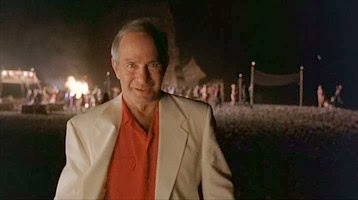
Jackie is a shady character indeed, perhaps the movie's closest stand-in for Satan incarnate. His dramatic entrance, deep into the movie, occurs at night during a beach party where the only illumination is provided by roaring bonfire. As he slowly emerges from the shadows to greet the Dude (and the audience, since this is filmed as a POV shot from the Dude's perspective), the viewer may detect a faint hint of sulfur in the air. At first, the Dude is impressed by Jackie's "completely unspoiled" home, but our hero shows a Groucho Marx-esque disrespect for Mr. Treehorn's profession.

"How's the smut business, Jackie?" the Dude casually inquires.

"I wouldn't know," responds Jackie. "I deal in publishing, entertainment, political advocacy."

"Which one's Logjammin'?" counters the Dude, cannily referring to one of Treehorn's lowest-common-denominator porn films.

Here, as at the Lebowski mansion, it is outward appearance, rather than inner truth, that seems to matter most. Instead of copping to what he really is, Jackie Treehorn rattles off his socially-acceptable achievements. I am reminded of the late author Robert Anton Wilson's satirical sci-fi book Reality Is What You Can Get Away With. In that singular work, published a mere six years before the release of The Big Lebowski, Wilson imagines a future in which lying or "bullshit" is extinct, and the earnest historians of the future are puzzled by the doublespeak of the Twentieth Century. A representative passage: "Realize that the function of Bullshit lies in concealing the facts, especially uncomfortable facts, and you begin to enter the reality-tunnel of this astounding ancient semantics."

A real reactionary: The corrupt police chief of Malibu, CA

Jackie's subterfuge appears to have worked brilliantly, at least judging by the scene in which the Dude, at the behest of the aforementioned smut peddler, is arrested on trumped-up charges by the Malibu police and taken by squad car to the station house. At the Malibu police station, we meet the bellicose and possibly corrupt chief (Leon Russom), who insults and abuses the Dude in what seems to be a comical SoCal parody of Christ's treatment by the Romans. 

The police chief of Malibu is the third prominent "achiever" in the film, and like the other two, he does not inspire our sympathy. Evoking Mr. Lebowski's ostentatious workspace, the Chief's office is decorated with a whole assortment of plaques and parchments, all attesting to his status as a guardian of law and order, endorsed by the upscale porn-funded "beach community" that bankrolls his petty, small-scale fascism. The good chief also reinforces Jackie Treehorn's vaunted place in society when he soberly tells the Dude, "Mr. Treehorn draws a lot of water in this town. You don't draw shit, Lebowski." It seems that Jackie's considerable financial resources have convinced the local law enforcement – and the community at large – to ignore his blatantly unsavory activities, while the harmless Dude is treated as a menace.

If Mr. Lebowski, Jackie Treehorn, and the Police Chief of Malibu are the pillars of your community, then your community is rotting from the inside out. These men have all “achieved” in ways that are recognized by American society. The duplicitous Lebowski and the venal Treehorn live in fancy houses, surrounded by material comfort and lauded by the world for their "success," while the thuggish police chief wears a badge which designates him as an official gatekeeper of modern civilization. 

The Dude, meanwhile, has very little in the way of extrinsically verifiable status. His wardrobe, vehicle, employment history, and living accommodations are all extremely modest. Repeatedly broken into and vandalized over the course of the film, his bungalow is far from "unspoiled." The collars of his t-shirts sag after decades of washings. He doesn't seem to have held a job in years. And that misbegotten 1973 Ford Gran Torino of his – "green with some brown rust coloration" – takes nearly as much abuse as the Dude himself. All of these factors show us that the Dude is not a man who puts much stake in "achieving."

Yet, when the movie is over, which character would we most like to emulate?

Friday, September 20, 2013

Top 10 revelations about J.D. Salinger from that new documentary about him

"Got more stories than JD's got Salinger": The reclusive author is the subject of a new documentary.

The last-surviving cartoon from the
back of one of my Top 10 lists.
One of this weekend's new movie releases is Salinger, a documentary about Jerome David "J.D." Salinger (1919-2010), the late, famously reclusive author of The Catcher in the Rye (1951). I thought this was a good excuse to do something I haven't done in about twenty years: write a Top 10 list in the style of Late Show with David Letterman.

My more-recent Internet pals (hello out there!) won't know this about me, but as an adolescent, I was a fiercely devoted fan of David Letterman's talk show, which at that time was running on NBC as Late Night with David Letterman and was much more anarchic and eccentric than his current, more conventional CBS program. Among my most-cherished items of clothing in the early '90s were an official Late Night ballcap and sweatshirt, and I paid tribute to Letterman's show by writing my own Top 10 lists throughout junior high and high school -- never stealing jokes from the show, but writing my own in the style of the ones I'd seen on TV. I'd write them in pencil -- never pen -- on notebook paper the night before school and pass them around class the next day, often in Band and Algebra. (Sorry, Mr. Ayotte and Mr. Maki.)

Over time, they got more and more elaborate. I used the bottom of the paper and the back of the page for cartoons, comic strips, movie parodies, fake ads, etc. In retrospect, that was my first attempt at writing for entertainment rather than for school. Eventually, I started doing them every school day and even began numbering the "issues." There were several recurring characters: Iffy the Troll (an ill-mannered mascot whose only interest was in merchandising), Margin Man (a superhero whose adventures were drawn at the edge of the notebook page), and Flatt & Gumption (two redneck cops). I circulated those lists in many of my classes, and I got into trouble for them more times than I care to count. Some teachers would even confiscate them, which I always felt was social injustice. But the other kids seemed to like them, so I kept doing them.

The whole Top 10 list phenomenon petered out towards the end of my high school years. By then, I was writing for the school paper and didn't need to pass notes in class anymore to disseminate my views to the masses. I once kept a whole stash of the lists in a cardboard box in the basement of my childhood home, but they were destroyed long ago in a flood.

Recently, a classmate of mine named Geoff Scott was kind enough to send me a Top 10 list he had saved from that era. It is very likely the only-surviving specimen of its kind. Thanks, Geoff! Anyway, I'd like to tap into my adolescent mindset and do a Top 10 list in the style of those bygone days. I hope you enjoy it. I'm going to do my level best to write this from my 14-year-old mindset.

TOP 10 REVELATIONS ABOUT J.D. SALINGER FROM THE NEW DOCUMENTARY
10.  The "J.D." stands for "Juvenile Delinquent." He thought it made him sound tough. 
9.  Killed a few hobos in the 1970s but got away with it because the cops couldn't find him. 
8.  Authored the entire Babysitters Club series and most of Goosebumps. 
7.  Had an intense, decades-long affair with Oscar the Grouch, but they could never legally marry. 
6.  Is writing this list now. 
5.  Put out a series of punk albums under the name "Psychobilly Sex Police" and had a brief hip-hop career as "Jay-Z Salinger." 
4.  Thought he held the world's record for eating the most marshmallows in a minute (37), but it didn't count because they were mini-marshmallows. 
3.  Wrote The Catcher in the Rye hoping it would someday be name-checked in Billy Joel's "We Didn't Start the Fire." In 1989, his dreams came true. 
2.  Iconic character Holden Caulfield was almost named "Holden McGroin."

And the number one revelation about J.D. Salinger from the new documentary Salinger...

1. Isn't dead, just hiding where no one will ever find him -- the Oprah Winfrey Network!

Good night, everybody! Drive safely!

Wednesday, September 18, 2013

Ed Wood Wednesdays, Week 11: "Night of the Ghouls" (1959)

Tor Johnson reprises the role of Lobo in 1959's Night of the Ghouls.

"I've been lucky. None of my films have been left on the laboratory shelf."
-Edward D. Wood, Jr.

Ed's nearly "lost" classic.
In late 1978, just a few weeks shy of Christmas, a penniless Edward D. Wood, Jr. was evicted from his seedy apartment at the intersection of Yucca Street and Cahuenga Boulevard in Los Angeles, leaving the writer-director and his wife Kathy homeless. In desperation, he called a friend, actor Peter Coe, who agreed to let the Woods stay with him. It was at Coe's home, 5635 Laurel Canyon Boulevard, that Ed died on December 10. What was on Eddie's mind during these dark final days? Perhaps his legacy. 

According to David C. Hayes' book Muddled Mind, Ed Wood's last-known bit of writing was an essay for the liner notes of a Plan 9 from Outer Space soundtrack LP. In these notes, Eddie speaks euphemistically about his current living situation, as if to assure his fans that he was doing just fine. Here is the crucial passage:
Finally, a note to all of my special friends. I am retired now, and living comfortably in the home of a good friend. I still keep a watchful eye on the Hollywood scene, and I still dream of the day when my sequel to "Plan 9," "The Night of the Ghouls," will be rescued from the Pathe Laboratory for all my fans to see and enjoy. Until that time, I plan to occupy myself by puttering in the garden and watching football on television.
Whether or not this piece of writing is genuine (and it probably isn't), there are a number of interesting points here. Ed's well-intended fib about "watching football" is especially poignant. "Eddie didn't like football," his wife Kathy testifies in the incredibly sad final chapter of Rudolph Grey's Nightmare of Ecstasy: The Life and Art of Edward D. Wood, Jr. On the fateful day of December 10, 1978, Ed retreated into a bedroom specifically to avoid a football game the other occupants of the house were watching. From within that room, he complained to Kathy that he couldn't breathe, but the two had been arguing that day, and she merely "cussed him out." Later, he was found dead there, a look of horror frozen on his face.

But the Plan 9 liner notes, allegedly penned only two weeks before this tragic incident, show that Eddie had not lost his lifelong sense of optimism and was eager for a 'lost" film of his, Night of the Ghouls (1959), also known as Revenge of the Dead, to finally see legitimate release. Of course, one could point out that in Hollywood Rat Race (written circa 1965), Ed Wood boasted that none of his films had ever failed to achieve release or been held up in a film lab. Obviously, Ed's memory was selective in this instance. But what's more important is that, in the waning days of his life, the ever-proud auteur was still thinking about a movie he'd made and loved twenty years earlier. And "loved" is truly the appropriate word. Ed Wood told one of the film's cast members, Valda Hansen, "I love this movie so much, it's almost like a part of me."

Ted Newsom: Not a fan of
Wade H. Williams III
The circuitous path Night of the Ghouls took in reaching the public is perhaps one of the most famous anecdotes in the curious, patchwork legend of Ed Wood, Jr. The short version goes like this: the movie, although completed in 1959, did not actually get released until 1983 -- five years after Ed's death -- because the cash-strapped director simply couldn't pay the lab fees. The truth is somewhat more complex. The film's belated benefactor was one Wade H. Williams III (1942-  ), a Missouri-born film producer and exhibitor who is said to possess the world's largest collection of independent science fiction films. His name is certainly familiar to anyone who routinely watches low-budget sci-fi and horror movies from the 1950s and 1960s because he's plastered it on VHS and DVD re-releases of such films since the 1980s. If you're still reading this article, chances are high that you have at least one "Wade Williams Collection" DVD in your possession.

Some fans and critics, including Rob Craig, the author of Ed Wood, Mad Genius: A Critical Study of the Films (McFarland, 2009), have praised Williams highly for preserving many obscure films, including those of Ed Wood, which might have disappeared forever without his intervention. However, others in the "B"-movie community have grumbled about Williams' attempts to exercise copyright control over films (including Plan 9) which are really in the public domain, efforts which seem all the more petty considering Williams' great personal wealth. One of his detractors, in fact, is filmmaker Ted Newsom, the director of Look Back in Angora (Rhino Video, 1994) and the host and presenter of the Ed Wood DVD collection, Big Box of Wood (S'more Entertainment, 2010).

Not being involved in the making or distribution of motion pictures, I cannot tell you who's "right" and who's "wrong" here. But to paraphrase Plan 9 from Outer Space's quizzical Lt. Harper (Duke Moore): "One thing's for sure. Night of the Ghouls is easily available to the public... and Wade Williams is responsible!"

Is that a good thing? I first saw Night of the Ghouls over twenty years ago when it was added to the roster of the Ed Wood movie marathons which were an annual event back then in my economically-blighted hometown of Flint, Michigan. That evening in October 1992 began with Bride of the Monster, then progressed to Glen or Glenda? and Plan 9 from Outer Space. The organizers of the event had wisely scheduled Ghouls as the last film of the night, because it proved to be a room-clearer, sending fed-up patrons shuffling back to their cars in a stupor.

Although only about 70 minutes in length, the oddly claustrophobic and static film felt much longer than that. In particular, the movie's pivotal "seance" sequences, with slide whistles and trumpet blasts on the soundtrack, seemed to test the audience's patience. I somehow managed to stick it out but was not eager to ever see the film again. Oh, sure, I dutifully bought the DVD when it came out ten years ago, but until this project, I'm not sure I'd ever really watched the film from beginning-to-end since first seeing it at that marathon in the '90s. Did this project change my opinion of Night of the Ghouls?

The answer awaits you below, gentle reader...

NIGHT OF THE GHOULS (1959)

This Nostalgia Merchant VHS tape may be overselling the "badness" of Ghouls just a bit.

Alternate title: Revenge of the Dead

Availability: The Wade Williams Collection version, with a clearly-altered title sequence, is available as a standalone DVD (Image Entertainment, 2002) or as part of The Ed Wood Box (Image, 2004).

Johnny Carpenter in his natural habitat.
The backstory: Roughly a decade after his ill-fated partnership with John Crawford Thomas, which yielded only the primitive, semi-finished Crossroads of Laredo (1948), Ed Wood formed a new business venture, Atomic Productions, with a retired Marine named Major J.C. Foxworthy in 1958. Ed's plans for Atomic were, as usual, ambitious: a slate of eighteen potential films. Only one of these, however, came to fruition: a sequel to 1955's Bride of the Monster originally entitled Revenge of the Dead.

The star of Bride, horror legend Bela Lugosi, had inconveniently died in 1956, but Ed brought back at least two of the film's cast, recreating their memorable earlier roles: Paul Marco as cowardly, bumbling Officer Kelton and Tor Johnson as the hulking, mute Lobo. Harvey B. Dunn returned, too, but as a different character: a rattled near-victim of a mysterious ghostly apparition. His previous role, Police Captain Robbins, was now inexplicably played by Johnny Carpenter, another of the B-list cowboy actors Ed adored. (Wood even allegedly ghostwrote a couple of Carpenter's second-tier westerns.) Revenge also had plum roles for several of Wood's most prominent acolytes: sourpuss Kenne Duncan (portraying the "Dr. Acula" character intended for Lugosi), flamboyant pseudo-psychic Criswell (both narrating and participating in the story this time), chiropractor Tom Mason (once Bela Lugosi's unconvincing Plan 9 stand-in, now upgraded to a speaking role), and the old reliables Duke Moore and Don Nagel (as usual, portraying cops).

The most exciting new addition to the cast was a sexy blonde ingenue named Valda Hansen, whom Ed had known since she was a teenager. MST3K fans will also note the participation of Anthony "Tony" Cardoza, again playing an oily-looking sad sack. As in most (or all) of his other films, Cardoza was a financial backer of Night of the Ghouls as well, having been persuaded by Ed to invest in this production rather than an apartment building. Mason, too, invested in the film, thus earning roles for both himself and his wife, Margaret, who plays the hysterical, overreacting spouse of Harvey B. Dunn's character.

Wood's abandoned JD flick.
In the process of making Revenge of the Dead, Ed "Waste Not, Want Not" Wood cannibalized two of his previous failed projects from the late '50s: the unsold Final Curtain pilot (1957) and the unfinished juvenile delinquency film Hellborn (aka Rock & Roll Hell). While Ed made some attempt at seamlessly incorporating the Final Curtain footage into Revenge, namely by having Duke Moore wear a tuxedo similar to (perhaps the same as) the one he wore in that obscure pilot, the Hellborn footage is a complete non sequitir; narrator Criswell momentarily veers away from the film's main topic, i.e. ghosts and the supernatural, to lecture us about juvenile crime and traffic fatalities.

Interestingly, Ed Wood himself appears in the scenes lifted from Hellborn, fighting with Conrad Brooks in front of a crazed "teenage" audience. The material from Final Curtain, of course, is easy to spot: Duke Moore in a tuxedo wandering around the darkened theater, which here is passed off as a creepy haunted mansion.

Valda Hansen as "The White Ghost."
The new footage for Revenge of the Dead, filmed over a few weeks in April and May of 1958, weaves a convoluted new story around the existing footage. A sleazy, ill-tempered con artist named Karl (Duncan) and his sexy blonde girlfriend Sheila (Hansen) have set up shop in a house built on the site of the creepy mansion where Bela Lugosi's Dr. Eric Vornoff had carried out his fiendish experiments in Bride of the Monster. (The sinister location is called "Willows Lake" here. Diligent Ed Wood fans will remember that Bela's home in Bride was the Old Willows place on Lake Marsh, but whatever.) Dubbing himself "Dr. Acula" and posing as a powerful spirit guide who can communicate with the dead, Karl uses cheap theatrical trickery to fool elderly, gullible customers into signing over great sums of money to him so that he can "raise" their departed spouses from the dead.

Sheila, meanwhile, scares people away from the home by stalking the fog-shrouded property in the eerie guise of the "White Ghost." The relationship between these two is much like that of gangster Vic Brady (Timothy Farrell) and his gun moll Loretta (Theodora Thurman) in Wood's Jail Bait (1954). While Vic's favorite expression was "shut up," Karl's is "so what?" (Yes, this is also the pet expression of the anti-heroine played by Jean Moorhead in the Wood-scripted "roughie" The Violent Years.) Early in the film, Sheila becomes aware that a real spirit, the Black Ghost (Jeannie Stevens, another holdover from Final Curtain) is also roaming the grounds, though cynical Karl doesn't believe her. Karl and Sheila have also apparently inherited or adopted Dr. Vornoff's former assistant Lobo, his face now half-melted as a result of the explosive finale of Bride of the Monster. 

Captain Robbins has apparently heard enough about the ghoulish goings-on at Willows Lake that he sends world-weary Lt. Bradford (Moore) and panicky, inept Kelton (Marco, in his final and most prominent appearance in a Wood film) to investigate. Eventually, Dr. Acula's lucrative but heartless scheme backfires on him. The police interference is certainly unwelcome, but Acula's bigger problem is that his fraudulent seances have inadvertently succeeded in supernatural ways he could not have imagined, with horrifying consequences for himself and his girlfriend. Tragically, in all the confusion, the film's most innocent and likable character, Lobo, is gunned down.

Dr. Acula (Kenne Duncan) presides over an absurd seance.
The making of Revenge of the Dead was typically chaotic. As bad a businessman as ever, Ed was almost always on the verge of bankruptcy, and at one point Tor Johnson refused to work until he was paid. Valda Hansen, meanwhile, was sexually harassed on a continual basis both by the male crew members and by her lecherous co-star, Kenne Duncan, who would make vulgar suggestions to her between takes.Valda and Ed, however, were quite close and seemed to have a deep, spiritual connection based on a shared interest in the paranormal. Based on what I've read, I get the sense that perhaps the attractive actress and her director (who still maintained some of his Errol Flynn-like good looks at that point) had a romantic relationship on the side, but I cannot confirm this.

In any event, there is ample evidence that the movie did premiere under its original title in 1959 and may have played a few times in Los Angeles back then, too. There are photos of the film's premiere showing cast members Criswell, Tor Johnson, Valda Hansen, and Paul Marco mugging for the camera. It's possible that the version which premiered in '59 was not quite finished. There are a couple of letters from August and September 1959 from Ed Wood to Tony Cardoza in which Wood suggests re-editing and re-titling the film, possibly removing some of the Criswell scenes from the beginning and replacing them with footage of Bela Lugosi, which he was planning to acquire from Glen or Glenda? producer George Weiss. (These letters also sadly reveal that Wood was too poor at the time to afford a home telephone.)

Rob Craig's book Ed Wood, Mad Genius suggests that the title Night of the Ghouls was the creation of Wade Williams, but some of the existing scripts and letters excerpted in Rudolph Grey's Nightmare of Ecstasy dispute that theory. More likely is that Ed himself wanted to change the title to Night of the Ghouls but never got around to doing so. Whatever the case, Revenge of the Dead was quickly withdrawn from circulation and went missing until Wade Williams paid the film's outstanding lab bills and released on home video in 1983 as Night of the Ghouls, with the new title crudely pasted over the old one.

As it happened, by virtue of debuting decades after it was shot, Ghouls counts as the last-released film of William C. Thompson, the colorblind cameraman who had been Ed's cinematographer on The Violent Years, Final Curtain, Bride of the Monster, Glen or Glenda?, and Plan 9 from Outer Space. The New Jersey-born photographer died in LA at the age of 74 in 1963.

Alternate cover spotted on Ebay.
The viewing experience: Completely baffling, engrossing, and charming all at once. I don't know what's changed in my brain over the last two decades, but I have eagerly sat through Night of the Ghouls about four times in the last few months as I've researched Ed Wood's life and career for this project. Twenty years ago, I had to summon every bit of my inner strength to sit through it even once. What was wrong with me back then? What's wrong with me now? Certainly, the film is stately in its pacing and relies on pages and pages of expository dialogue rather than action for long stretches at a time. Early in the proceedings, there are some long-ish scenes at the front desk of the police station (with a crudely-fashioned "WANTED" poster of Ed Wood taped to the wall) which are filmed in protracted, unbroken takes from one less-than-ideal angle, while the boom mic seems just slightly too far away to capture what's being said with perfect clarity. And, yes, there are the same stock shots of lightning-filled skies and zooming police cars which we've already seen in about half a dozen Wood films.

But even during these less-appetizing passages, we can enjoy the kind of stilted,  improbable, lovely and occasionally profound Wood-ian dialogue. This kind of stuff doesn't just grow on trees, folks. I refer you to Ed Wood, Mad Genius for Rob Craig's compelling religious interpretation of the film's plot, which again focuses on death and resurrection like most of Ed's best-loved creations.

Duke Moore, playing two roles simultaneously.
All of the really exciting stuff, of course, happens in and around the house on Willows Lake. In many ways, Night of the Ghouls makes a perfect send-off for William C. Thompson, who did as much as anyone to shape the look of the film's from Ed's "classic period" of the 1950s. Thompson makes these scenes, shot in crisp black-and-white, moody, mysterious, foreboding, and yet also quite alluring -- qualities also displayed by the great Universal horror features of the 1930s and 1940s. This is a world I'd love to live in. As he proved with Vampira (Maila Nurmi) in Plan 9 from Outer Space, Thompson had an incredible knack for capturing feminine beauty, and what a muse he has here in lovely Valda Hansen.

The house itself is one of Ed Wood's most wonderfully impossible locations. As with the spaceship in Plan 9, there is no logical or visual correspondence between the interior and the exterior of this house. From what we see of the exterior, the place seems to be a rather small, semi-dilapidated shack. Inside, however, the place is immeasurably vast and seems to have no beginning and no end. Viewers of Night of the Ghouls will, therefore, feel as if they are in a dream state with no grounding in real-world geography or architecture. Wood combines a few modest studio sets and the rather grand theater seen in Final Curtain, with its two distinct levels connected by a spiral staircase.

To provide the film's connective tissue, so to speak, Wood merely has his actors walk in front of a black background, giving the impression that they are existing in a shapeless void outside of time and space. The end result is one of the most fascinating and confounding interior spaces in cinema, rivaled only by the titular locale in Mel Stuart's Willy Wonka and the Chocolate Factory (1971).

Adding further to the disorientation of the viewer is the fact that the footage from Final Curtain is completely at odds with the narrative Wood is trying to impose upon it through narration from Criswell and inner monologues from Duke Moore. In Night of the Ghouls, Moore is supposed to be a hardened, seen-it-all policeman who is snooping around Dr. Acula's house looking for clues. But, of course, the actor he had portrayed in Final Curtain was confused and terrified by his surroundings. So in effect, the audio is conveying one story while the video is conveying another. Pretty heady stuff for a low-budget "haunted house" movie from the Eisenhower era.

For Ed Wood fans and seekers of cinematic curiosities, Night of the Ghouls is a veritable treasure trove, a phantasmagoria of sight and sound. When it is boring, it is transcendentally boring. When it is ridiculous, it is triumphantly ridiculous. I love it to pieces. See it at your earliest convenience.

NEXT WEEK: One curious statistic I've heard in some documentaries about Ed Wood is that he only directed five movies. How could anyone arrive at that low number? Well, it depends on what kinds of movies you choose to count towards your total. As far as some critics and historians are concerned, Ed Wood's directing career effectively ended in 1960 with The Sinister Urge, his last "mainstream" movie before his permanent descent into sexploitation (discounting his brief foray into technical and industrial films). Interestingly, the plot of The Sinister Urge revolves around pornography and, thus, serves as a harbinger of Wood's future. Join me here in a week for a discussion of that strange film, which like The Violent Years and Bride of the Monster ultimately wound up on MST3K.