Showing posts with label Batman. Show all posts

Monday, December 23, 2024

2024 Comics Fun Advent Calendar, Day 23: Even more Batman ones

"No jellybeans? But isn't this Easter Island?"

Batman. The Dark Knight. The Caped Crusader. The World's Greatest Detective. Whatever you may call him, he's been appearing in comics since 1939 and has crossed over to every possible medium since then. After so many decades of TV shows, movies, video games, and merchandise, is there anything left to say about this character? Probably not. But that hasn't stopped me from trying. I have a bunch of old, unposted Batman comics and cartoons left over on my computer, so I thought we'd just blitz through all of them in one post.

Ready? Then let's proceed. You wanna get nuts? Come on! Let's get nuts!

Thursday, December 12, 2024

2024 Comics Fun Advent Calendar, Day 12: Another Batman one already? Yes!

What can I say? I watch a lot of Batman.

Most of the comics and cartoons I've used in this series have been oldies. I've had them saved to my hard drive for a while and just wanted to post them to this blog for posterity before deleting them from my computer. But today's cartoon is brand new and written especially for this project. A couple of days ago, I saw an ad for a Batman Unmasked action figure and thought, "What if Bruce Wayne walked around looking like that? Would Commissioner Gordon finally figure it out?" Honestly, he might not figure it out even then. Neil Hamilton's version of the character is a pretty dim bulb.

Wednesday, December 4, 2024

2024 Comics Fun Advent Calendar, Day 4: The Adventures of Batman & Robin

What, you think superheroes are oblivious to name-calling?

For the first few years of my life (1975-1981), my family lived in a little ranch-style house in a cozy little neighborhood in Flint, Michigan, right down the street from my rambunctious Uncle John and his family. I've retained quite a few memories from those days, and some of the fondest revolve around Channel 20, a local independent UHF station we used to watch quite a lot. It showed mostly (or all?) reruns back then. Typical offerings included Lost in Space, The Adventures of Superman, The Abbott & Costello Show, and, best of all, Batman.

Thanks to MeTV, I've gotten to revisit Batman in recent years, and the series and its characters have again taken up residence in my imagination. Hence the terribly-drawn comic above. Please forgive me for it.

Saturday, September 1, 2018

Revisiting the 1966 'Batman': What have I learned?

Batman was everywhere in 1966, including the cover of Mad.

A favorite from the cathode ray tube era.
This Saturday night, the nostalgia-based cable channel Me-TV airs its weekly hour-long Batman block for the last time. The network likes to turn over its schedule every now and again, and they've already cycled through the entire 120-episode run of the series. I suppose if I really need my Bat-fix from now on, I could just break down and buy that boxed set of the complete series.

But Me-TV's weekly airings of the 1966-68 Batman were a great way to watch the episodes at a reasonable pace. With a show as stylized and intense as this, two episodes a week are about all I could handle. Any more would be like trying to eat my own body weight in cotton candy. Besides, since the show was airing across the country, it was an opportunity to comment on each episode via Twitter in real time and commune with other Bat-fans. I'll miss that.

I wasn't alive when Batman originally aired, but I definitely saw the reruns on Channel 20, an independent UHF station in the Flint, Michigan area. Channel 20 was one of my main sources of entertainment and enlightenment during my formative years. It's where I saw The Abbott & Costello Show, The Three Stooges, The Adventures of Superman, and Lost In Space. (Coincidentally, Lost in Space will be occupying Batman's old time slot on Me-TV.)

While I had definitely seen episodes of Batman since then—I vaguely remember the show airing on FX or some other, similar basic cable network—I hadn't revisited the series in any kind of systematic way since my early childhood. But now, thanks to Me-TV, I've seen all the episodes a few times over. And here are my thoughts as an adult.

1. Batman is a Zen master. Robin is a hothead.

Peter Deyell and Lyle Waggoner.
Think just anyone could slip into some tights and be the World's Greatest Detective? Think again, citizen.

Batman would have been a very different series if producer William Dozier had gone with the other finalists for the roles of Bruce Wayne and Dick Grayson. Respectively, Lyle Waggoner and Peter Deyell screen tested for these parts. The contrast between this Dynamic Duo and the familiar team of Adam West and Burt Ward is stark. Waggoner's take on the Caped Crusader is stolid, humorless, and utterly lacking in self-awareness. Isn't that how West played him, too? Well, yeah, but West brought a whole level of stylized humor to the part that Waggoner's interpretation totally lacked.

In the 1999 documentary Hollywood Screen Tests, Dozier's assistant Charles B. Fitzsimmons puts it best: "Adam and Burt were, in our opinion, absolutely perfect. Lyle could have performed it. Peter could have performed it. But it would not have been what it became with Adam."

Outside of Batman, Adam West was at home in purely comedic roles, like the delusional title character on the Conan O'Brien-scripted Lookwell or as the daffy, childlike mayor of Quahog on Family Guy. And then there was his classic appearance in the "Mr. Plow" episode of The Simpsons. His version of Bruce Wayne/Batman is one of the great pop culture creations of the 1960s, a man so totally caught up in his dream of protecting Gotham while dressed up as a bat that he doesn't realize it's ridiculous. Adam West seems to exist almost in a dream state on Batman, detached from reality even when he's supposedly relaxing at stately Wayne Manor. The actor all but croons his dialogue, and his dramatic... pauses, flowery phrasing, and over-pronounced diction might even put William Shatner to shame.

Robin, meanwhile, is often thought of as a wide-eyed, squeaky-voiced innocent, constantly in slack-jawed amazement at the events unfolding around him. ("Holy _____!" is his famous catchphrase.) And that was exactly how Peter Deyell played the part. But that's not how Burt Ward plays it. His Robin is a snarling pit bull whom Batman has to keep on a (figurative) leash. And, yes, I realize the animal metaphors are getting scrambled here. The point is, when Robin threatens to fly off the handle, it's Batman who has to keep him in check. Notice how often Burt Ward punches the inside of his palm when his character is upset. His growly voice is even deeper than Batman's!

Adam West's Batman is a true Zen master, almost eerily calm and reserved. Whereas Robin tends to act on instinct, Batman is contemplative and cool, often thinking three steps ahead of the week's villain. One of my favorite aspects of this version of the character is that he's a true believer in rehabilitation. He honestly believes his enemies can mend their ways, and he wants to see them become productive citizens. Unfortunately, he doesn't get much support from the higher-ups, as we'll soon see.

2. Yes, Commissioner Gordon and Chief O'Hara are useless. But so is every official in Gotham, which is why the city needs Batman so badly.

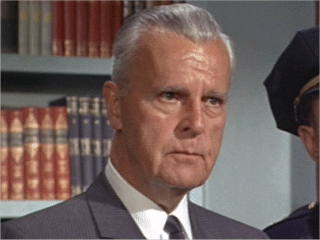
A pair of do-nothings.
It's a well-known trope of the '60s Batman series that Commissioner Gordon and Chief O'Hara are two past-their-prime do-nothings who spend most of their time shooting the breeze in Gordon's office. Meanwhile, the thousands of uniformed Gotham City policemen largely stay offstage. Whenever there's even the merest inkling of trouble, Commissioner Gordon is quick to call Batman on that fancy red phone he keeps under a glass dome like a freshly prepared pheasant.

But Gordon and O'Hara aren't the only screen doors on the submarine that is Gotham. Warden Crichton, who heads the Gotham City Penitentiary, is a weak, namby-pamby bumbler who has no idea how to keep the likes of Joker or Penguin under control. Prison escapes are incredibly common and incredibly brazen. Joker dips out during a baseball game in the rec yard. Shame's accomplices breach the walls of the penitentiary with an honest-to-goodness tank.

It would seem that, in the Batman '66 universe, the entire government consists of spineless bureaucrats who bow to the merest pressure. Take Mayor Linseed, for example. In "Nora Clavicle and the Ladies' Crime Club," he actually fires Commissioner Gordon at the behest of his wife, when the latter threatens to stop cooking and cleaning for him. That's it. That's all it takes. No mind control. No hostages. Just a tiny amount of nagging. If Mayor Linseed had been able to withstand that, an entire episode's worth of trouble could have been avoided.

Oh, and by the way...

3. Gotham is totally New York.

Mayor Linseed and Mayor Lindsay.
Not much to say here. While Marvel's characters tend to live in real-life places like Los Angeles, DC's characters often hail from made-up locales like Metropolis. And Metropolis, we all know, is DC's stand-in for New York City. But what does that make Gotham? Chicago? Christopher Nolan must have thought so, since he filmed The Dark Knight there. (He actually shot the Joker's bank robbery in an abandoned post office right across from the building where I was working at the time.) In Zack Snyder's Batman v Superman: Dawn of Justice, Gotham and Metropolis seem to be right next to each other on the map. Go figure.

But if Batman '66 is to be believed, Gotham is definitely New York City. Which makes sense, since "Gotham" is supposedly a nickname for New York. On this show, Gotham is governed by the weak-willed, glad-handing Mayor Linseed. This character is clearly named after John Lindsay, who was mayor of New York from 1966 to 1973. Lindsay, in fact, is both younger and more handsome than Linseed. Usually, it goes the other way in popular culture. And whatever state Gotham is in, its governor is named Stonefellow, a nod to Nelson Rockefeller, the real governor of New York State from 1959 to 1973.

That's all the evidence I need. Gotham is New York. I guess Metropolis must be Pittsburgh or something.

4. In this version, Batman is largely the protector of Gotham's wealthy elite.

A rich guy protecting other rich guys?
The Batman franchise has gone through many, many incarnations since 1939, some more serious, some less so. But one theme has remained remarkably consistent. If the rich people in Gotham are going to have some kind of fancy-schmancy fundraiser or pretentious art opening or whatever, one of the city's supercriminals is going to show up and cause chaos, partly for material gain and partly for the satisfaction of doing it. That happens again and again on Batman '66.

But maybe that kind of thing happens too often on the show. It seems like this Batman spends all his time at jewelry stores, furriers, high-end galleries, ritzy restaurants, and musty mansions. The villains on this show are forever trying to snag expensive trinkets like diamonds or rare books, and Batman is right there to punch them in the jaw. Sure, he'll come to the aid of the rank-and-file of Gotham, too, but that's usually only when a villain is attempting some city-wide scheme like poisoning the water supply. (What is it with bad guys and water supplies?) For the most part, Batman is like an unpaid, extremely violent security guard for Gotham's wealthy elite.

There's a classic scenario that I associate with the Batman mythos. Picture this. An average citizen of Gotham, perhaps an older, gray-haired lady, is walking along one of the city's lonely back streets at night, just trying to get home. Suddenly, this citizen is accosted by a snarling thief wielding a knife. It looks like the old lady is about to get robbed at the very least. But then, seemingly out of nowhere, a bat-shaped shadow appears from overhead. It's Batman! Our hero wastes no time, first disarming the thief and then knocking him out with a well-placed right hook to the jaw.

Stuff like that almost never happens on the 1966 Batman, and I have to wonder why. This version of the character is a little too uptown for his own good.

5. There's never been a hotter TV couple than Batman and Catwoman (or, more specifically, Adam West and Julie Newmar).

The ideal Mrs. Batman: Catwoman.
Long before such "will they or won't they" couples as Sam and Diane on Cheers or Dave and Maddie on Moonlighting, there was Bruce and Selina on Batman.

To my mind, there has never been a more intriguing romantic pairing than Batman and Catwoman on the 1966 Batman. The chemistry between Adam West and Julie Newmar is undeniable. It helps that no one has ever looked as good in the skin-tight Catwoman costume as Newmar. I could rhapsodize about the way she wears her belt! (In short, very low on her hips.)

Newmar's Catwoman is a flirty, clearly well-educated society girl who seemingly commits elaborate crimes just to get Batman's attention and alleviate her own boredom. She's clearly smart enough to make money in any number of legitimate ways. And it would be easy enough to sink her cat claws into some wealthy nitwit and drain his bank account. But she doesn't want any wealthy nitwit, not even Bruce Wayne. She wants Batman.

He wants her, too, but only if she can mend her ways and become a law-abiding citizen. That's the thing keeping them apart: their very natures. She could no more become a rule-following square than he could become a cat-burgling crook. Neither one can change, and so at the end of a caper, they have to part ways. It's almost tragic. He's a Montague; she's a Capulet.

One of my favorite running gags on the show, by the way, is Catwoman's complete and utter contempt for Robin. It's series canon that Robin is somehow too young to appreciate the opposite sex, so he doesn't understand why Catwoman holds such appeal for Batman. Catwoman, for her part, is bored and irritated by the Boy Wonder, whom she sees as an irksome impediment to her plans. I don't think she'd ever actually kill Batman, but she'd gladly push Robin off the side of a building without a second thought.

6. Alfred is incredibly underpaid and just all around awesome.

Give this man a raise!
Alfred Pennyworth, butler to millionaire playboy Bruce Wayne, is a major part of just about any version of the Batman saga, and the 1966 series is no exception. In fact, this may be the most integral Alfred yet! This dapper, well-spoken majordomo (played beautifully by Universal contract player Alan Napier) raised Bruce Wayne single-handedly after the little rich boy's parents were killed, and now he manages the sprawling Wayne Manor without apparent help. I've never seen any other servants on Batman; maybe they're restricted to certain parts of the house, a la Beauty and the Beast.

Alfred knows all about Bruce's secret life as Batman, and he's perfectly at home in the Batcave (which he apparently accesses by elevator). And he doesn't just know about it; he actively participates in the crime-fighting enterprise. I mean, he's not literally out there punching bad guys every week, but he'll run risky errands for his boss all over town, sometimes getting himself kidnapped for his troubles. If the need arises, he'll even don the Bat-suit himself and impersonate the Caped Crusader, especially when it's necessary for Batman and Bruce Wayne to be in the same place at the same time.

That's a huge part of what makes Alfred so vital to the operation. He's instrumental in maintaining the Batman/Bruce Wayne illusion. Our hero's life is so complicated, so full of duplicity, that Alfred may be the only other person on earth who can keep it all straight. He's never fazed, this guy. "I'm sorry. Master Wayne is indisposed at the moment." "I'm afraid you just missed Batman, Commissioner Gordon." He even manages to tolerate Aunt Harriet and keep her from snooping around in Bruce Wayne's library. Whatever this guy's making, it's not enough.

One more great aspect of Alfred's character on this series is his relationship with Barbara Gordon/Batgirl. So let's discuss her next, shall we?

7. Batgirl was a great addition to the series, and you doubters can just shut your filthy mouths right now.

Batgirl: Oh, she's a worthy addition all right!
Like the third season of the original Star Trek, Season 3 of Batman takes a lot of heat from fans. and not without reason. ABC had obviously cut the budget by then, so there were fewer elaborate death traps for the Dynamic Duo and fewer full-scale Bat-fights. The writers, too, were grasping for ideas, so they wound up recycling plots from Seasons 1 and 2 or relying on increasingly far-fetched gimmicks. Even Adam West and Burt Ward seem a little checked-out during certain Season 3 episodes. Due to some contractual snag, Frank Gorshin's Riddler doesn't appear during this cycle of episodes. (John Astin briefly fills in for him.)

Nevertheless, I'll say the latter-day episodes are enjoyable, in sort of the same way that lesser-quality pizza is still pizza. The basic elements of the show—the Batmobile, the Neil Hefti theme song, the onscreen sound effects, the extremely arch dialogue, William Dozier's hyperbolic narration ("What's this?!")—are all still there. One of my favorite episodes, "Surf's Up! Joker's Under!," is from Season 3, and that one episode continues to inspire its own merchandise!

The best reason to watch Season 3, though, is definitely Batgirl. As played by former ballet dancer Yvonne Craig, she is a well-needed shot of adrenaline for the series. Whether as Batgirl or as mild-mannered librarian Barbara Gordon, daughter to the police commissioner, she's tough, sexy, and a total charmer, not to mention a fashion icon. She also gets her own cool theme song, co-written by Stan Freberg collaborator Billy May! What's not to like? I even enjoy her interactions with her pet bird, Charlie. Some might try to lump Batgirl in with such tacked-on TV characters as Cousin Oliver from The Brady Bunch or Scrappy-Doo from Scooby-Doo. Those people are misguided, to put it mildly.

One of my favorite aspects of the Batgirl character is that Alfred knows her secret identity and acts as her confidant and assistant. I could 100% see a Batgirl spinoff working, but I would have set the whole thing in England. Just come up with some reason for Barbara Gordon and Alfred Pennyworth to move to the UK, then have them be an Avengers-like duo, DC's answer to Emma Peel and John Steed. I'd have watched the hell out of that.

8. Sure, I have ideas for villains I'd like to have seen. Don't you?

My pick for Poison Ivy: Edy Williams.
Let's face it. When it comes to Batman baddies, there are the big four—Joker, Penguin, Riddler, and Catwoman—and then there's everyone else. But even here there are strata. Echelons of respectability, if you will. Foes like Mr. Freeze, Clock King, and Mad Hatter were all imported directly from the pages of DC Comics. Others, like Egghead, King Tut, and Bookworm, were created especially for the TV show but were well-received enough by fans to be accepted into the Bat-canon, eventually making appearances in the comic books and getting their own action figures.

When I was a kid tuning into Batman on Channel 20, I was always hoping for one of the big four. (Little wonder that the 1966 Batman theatrical movie includes all of them.) But I learned to appreciate some of the others, too, especially Otto Preminger's fussy, ill-tempered Mr. Freeze. (Perhaps as a result of growing up in Michigan, I was always interested in coldness-based heroes and villains, including Captain Cold and Killer Frost.) During my Batman re-watch, I've become a fan of Roddy McDowall's persnickety, leather-suited Bookworm and Cliff Robertson's befuddled cowboy Shame.

But I can't help wondering why some classic Batman villains from the comics never made it to the small screen. The seductive Poison Ivy debuted in June 1966, just in time to be immortalized on the series, but it never happened. This would have been a perfect role for perennial man-eater extraordinaire Edy Williams. Edy actually appeared on Batman a few times, but never in this part. A pity.

And what about Two-Face, arguably the most famous of the Bat-foes never to make it on the series? Edward G. Robinson might have knocked this out of the park, and it's not unreasonable to think that he'd do it, because he did guest star as himself on Batman once. (He and Batman discussed art!) But if they couldn't get Edward G. Robinson, the obvious choice would have been George Raft, the tough guy actor famous for habitually flipping a coin. How did this never happen?

Scarecrow, too, might have made a decent Batman character. The producers clearly loved using colored smoke bombs on the show, so Scarecrow's "fear gas" would be a natural. And I think Ray Walston, then probably best known for My Favorite Martian, would have done very well with this part. Ra'as al Ghul debuted just a wee bit late (1971) for this show, but I can definitely see Robert Goulet in this part.

To me, though, the biggest missed opportunity in Batman history was that they never got Jackie Gleason to play a villain. He would have been great at it, wearing tacky plaid suits, smoking cigars, and barking orders at henchmen. Jackie's Honeymooners costar Art Carney was tragically miscast as the pseudo-Shakespearean baddie Archer in a Batman two-parter that doesn't really work at all, But Carney would have made a great dim-witted sidekick to a Gleason villain. I'd have had Gleason play some kind of billiards-themed bad guy, spoofing his image from The Hustler (1961). The Pool Shark or Gotham City Fats or something like that. It would have made for some great visuals. Imagine the Dynamic Duo strapped to a giant billiard ball, about to be knocked into the ocean by a pool cue the size of a battering ram. Fortunately, our heroes are able to escape at the last second while Gleason and Carney have one of their trademark arguments. ("Will you get on with it?!")

As you can see, I've put a lot of thought into the 1966 Batman series. Probably too much. It might be a good thing that Me-TV is changing its schedule.

Tuesday, March 29, 2016

Are 'Zootopia' and 'Batman V Superman' the same movie? Sort of, yeah.

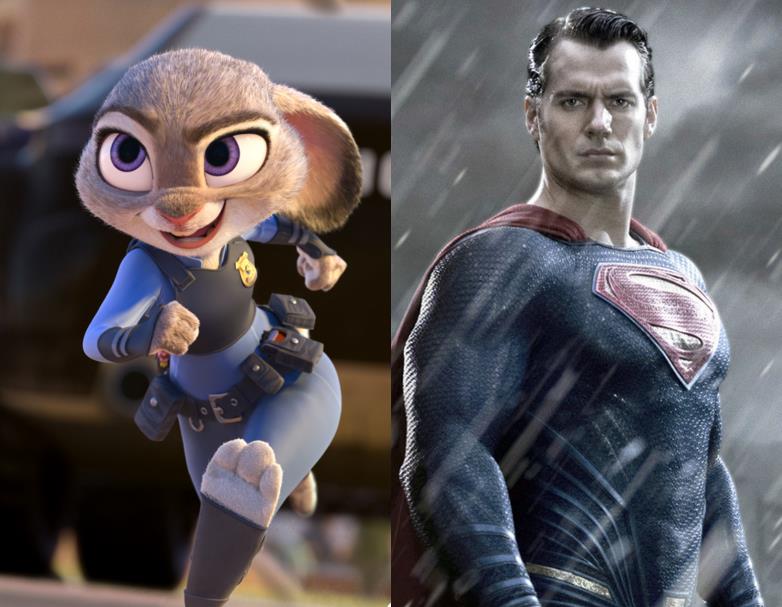
Officer Judy Hopps and Superman: which one is which?

Okay, hear me out on this. Over Easter weekend, while visiting with my family, I got to catch up on two recent movie blockbusters: Disney's Zootopia and Warner Bros' Batman V Superman: Dawn Of Justice. For the record, I basically liked both of them. Zootopia is an extremely cute, attractively animated family film with a good message about tolerance and the dangers of stereotyping. It's a little preachy and on-the-nose for my taste, but it's still enjoyable. Dawn Of Justice is drawn-out and dour with too limited a color palate and too noisy a sound design, but the critics calling it an unmitigated disaster are exaggerating. I wasn't bored by it. It's perfectly fine. I'd never want to sit through it again, but it'll do. Both Zootopia and Dawn are worth your time. But what I noticed is that there are a lot of parallels between these two seemingly dissimilar films. Like what? Well...

(SPOILER ALERT IN EFFECT FROM HERE ON OUT.)

Friday, June 5, 2015

Another heartwarming 'Mark Trail' adventure

Mark seems like he'd be a fun dad, right?

Rather like Batman, nature writer and adventurer Mark Trail has his very own creepy orphan to look after. The motherless waif in Mark's life is named Rusty Wilson, and he's been a part of the venerable Mark Trail comic strip since 1981. Mark officially adopted Rusty over twenty years ago, but the little ingrate still refers to his benefactor by his first name after all these years instead of calling him "Dad." With his off-putting personality and misshapen, rat-like face, Rusty has been a favorite in-joke/whipping boy among Trail-heads for decades. The strip itself often forgets about the little creep for weeks at a time, which is probably for the best. In the episode above, I imagine what the dynamic between Mark and Rusty is like when the cameras have been turned off, so to speak.

Oh, and here's a bonus Family Circus episode featuring that long-running strip's most pitiful character: red-headed middle child Jeffy.

Just eat what you're given, Jeffy.

Tuesday, June 18, 2013

Mill Creek comedy classics #13: "The Animal Kingdom" (1932)

Considering he's married to someone else, Leslie Howard is awfully cozy with Ann Harding in The Animal Kingdom.

The flick: The Animal Kingdom (RKO Radio Pictures, 1932) [buy the set]

Current IMDb rating: 6.5

Director: Edward H. Griffith (The Sky's the Limit, No More Ladies) with an uncredited assist from George Cukor (My Fair Lady, The Philadelphia Story, and further uncredited work on The Wizard of Oz and Gone with the Wind)

Actors of note: Ann Harding (The Man in the Gray Flannel Suit), Leslie Howard (Gone with the Wind, Pygmalion, Of Human Bondage), Myrna Loy (The Best Years of Our Lives, the Thin Man series) , William Gargan (The Bells of St. Mary's, You Only Live Once), Neil Hamilton (Commissioner Gordon on the Batman TV series, Tarzan and His Mate), Ilka Chase (the original Ocean's Eleven, Now, Voyager, frequent answer in the crossword puzzles I do on the train every day)

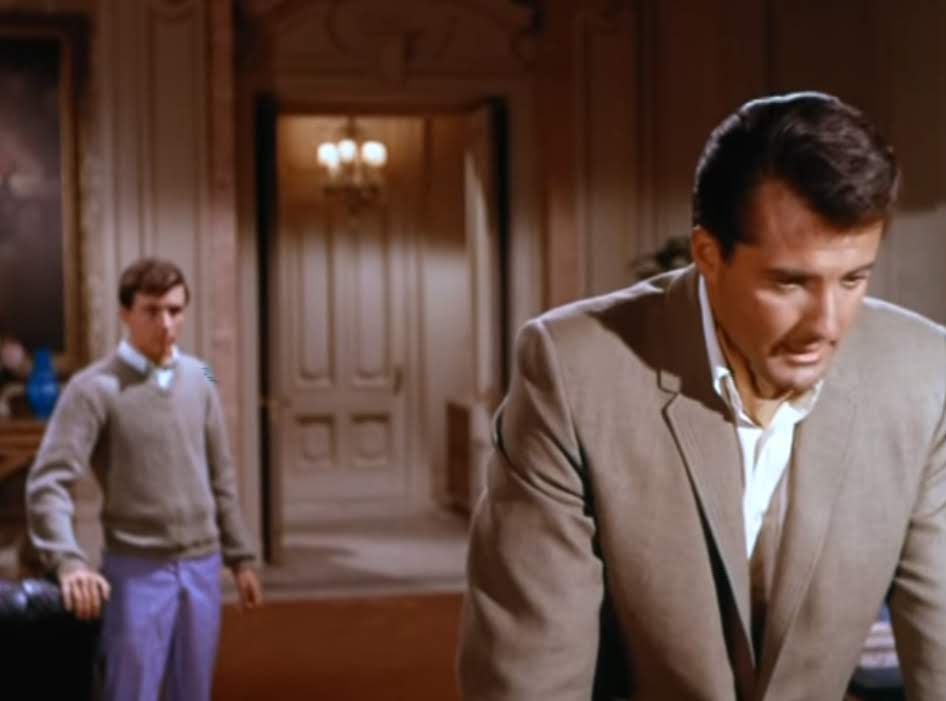
The gist of it: Writer Tom Collier (Howard) leaves behind his soulmate -- and friend with benefits -- artist Daisy (Harding) in order to marry respectable society girl Cecelia (Loy), a match which pleases Tom's wealthy, traditional father but seems to make everyone else pretty miserable. Cecelia's old beau, lawyer Owen (Hamilton), for instance, is none too thrilled by this out-of-the-blue union. Tom tries to convince himself he's happy with Cecelia, but he just can't stay away from Daisy. What's a poor little rich boy to do?

Neil Hamilton, once a male ingenue, on Batman.
My take: I said in my last review that the hero of a romantic comedy will never marry the snooty girl he's engaged to at the beginning of the story. So how to account for the fact that Leslie Howard does marry Myrna Loy in The Animal Kingdom? Simple -- this film is a drama, not a comedy. Oh, there are a few witty lines here and there -- usually from bohemian Daisy ("A foolish virgin me. Oh, foolish anyway.") -- and a bit of comic relief provided by Tom's butler, ex-boxer "Red" Regan (Gargan) who's cheerfully hopeless as a majordomo. But Daisy has an aura of wistful tragedy around her after Tom throws her over for Cecelia, and even Regan's subplot takes some poignant, dramatic turns when it develops that he pines for his former life and doesn't get along with Cecelia at all.

The Animal Kingdom is surprisingly heavy stuff. It's based on a stage play and feels it. There are long, stationary dialogue scenes in living rooms and drawing rooms with the actors parked on couches and only a few brief moments when the characters are out of doors. It's the 1930s, of course, so everyone smokes and drinks up a storm in every scene. The protagonist's name, Tom Collier, even sounds like the name of a cocktail. It's clear from the first few minutes that Tom belongs with Daisy and Cecelia with Owen. I thought there'd be some wacky misunderstandings with playful music on the soundtrack, and everyone would wind up happy at the end. But this movie doesn't quite play out that way. The decidedly-not-playful score is by one of the all-time legends of the biz, Max Steiner, of Gone with the Wind, King Kong, Treasure of the Sierra Madre and so much more.

And the movie is more complex and shaded than I would have guessed. Myrna Loy's character, for instance, is not really such a bad woman, though the script treats her as one, especially towards the end when her materialism takes over her personality. In all honesty, Tom never should have married her in the first place, but the movie goes pretty easy on his character. As I see it, the young writer (who is perfectly willing to sell out and write trashy books for the money, by the way) selfishly strings along two perfectly viable life partners. He definitely needs to hear that Lovin' Spoonful song, "Did You Ever Have to Make Up Your Mind?"  Too bad it wouldn't be released until 20 years after Leslie Howard's death. (Shot down during WWII, sadly.)

She's unlucky in love in this movie, but Myrna Loy earned a nice, permanent place in pop culture history as Nora Charles in the Thin Man movies, where her sophistication and boozing were assets instead of character flaws. And her spurned suitor, Neil Hamilton, used his natural blandness and wooden acting style to great advantage as the hilariously useless Commissioner Gordon on Batman (1966-1967). Top-billed Ann Harding never really broke through, though she worked in film and TV for 30+ years. She definitely has a certain je ne sais quois. I can understand why Leslie Howard couldn't turn her loose.

Is it funny: Nah, not really. I laughed out loud at a couple of Daisy's bon mots, but that was about it. The central story in The Animal Kingdom is pretty sober, so much so that William Gargan's somewhat broadly-played boozing, incompetent butler character seems a little out of place. Again, I don't really consider this film much of a comedy, so this section is largely irrelevant to the film's overall quality.

My grade: (as drama) B+; (as comedy) Incomplete

P.S. - Nothing so distasteful as a racist stereotype in this classy picture. The lazy, inept butler in this story is (mercifully) Caucasian.

Friday, May 31, 2013

A new Superman for a Batman world

Men of Steel: Henry Cavill and Christopher Reeve portray Superman, 35 years apart.


"He's the hero Gotham deserves, but not the one it needs right now."
- Commissioner Gordon describing Batman in The Dark Knight

Pulitzer Prize-winning columnist Mary McGrory is credited with one of the all-time great quotes about sports: "Baseball is what we were, and football is what we have become."

History has more than vindicated Ms. McGrory's statement. The ratings for the 2012-2013 television season have just recently been tabulated, and the leader -- by a wide margin -- was NBC's Sunday night NFL telecast. A mere eight years before my own birth, there was no such thing as the Super Bowl. Now it's a de facto Holy Day of Obligation. Football has long since blitzed past baseball to become America's true national pastime, and I think the reason for that has a lot to do with a gradual shift in the collective American psyche over the last few decades.

In short, we've become more cynical, more technical and less optimistic in recent times. In the years since 9/11 especially, we've become a paranoid, anxious nation, thirsty for blood and hungry for flesh. Football is the sport, more than any other, that fuels our aggregate psychosis. It's a dark game for dark times. Baseball, meanwhile, seems fairly musty in comparison. It's not even a contact sport, for crying out loud!

George Carlin famously explained the differences between these two sports better than I ever could, so I think I'll let him do so now.


So what does any of this have to do with Superman? Well, it's like this, citizens: Superman is the baseball of superheroes. He's corny. He's old-fashioned. He's pastoral -- the very term George Carlin used to describe baseball. Though born on the far-off, doomed planet of Krypton, Superman grew up as Clark Kent amid the pastures of Smallville, the isolated cowtown where his adoptive parents, Ma and Pa Kent, raised him with the good Christian values of the Middle West.

Superman's origin story has often been interpreted as a variation on the Nativity with Clark as an all-American version of the Christ child. Even the Kents' first names -- John and Martha -- are reminiscent of Joseph and Mary. Little wonder, then, that Superman has often been portrayed as the ultimate square, a goody-two-shoes as wholesome as a glass of milk and just about as interesting.

Meanwhile, poor Supes has been eclipsed in the minds (if not hearts) of the public by Batman, a fellow DC hero and frequent teammate. Batman's origin is rooted in urban violence: he saw his own parents gunned down by a mugger and ultimately decided to avenge their deaths by becoming a costumed vigilante. The famed "Caped Crusader" has been portrayed in wildly diverse ways and with greatly varying degrees of seriousness since his debut in the fateful year of 1939, but for the last quarter-century or so, Batman has largely been depicted as a deeply troubled, morally conflicted loner who has chosen to fight crime for reasons that are far from healthy.

This is the character America has embraced, and I think his ascendancy mirrors that of professional football. Batman is a flawed, gloomy pseudo-savior for these sick times of ours. No wonder we love him.

Five summers ago, the most lauded of the studio blockbusters was Christopher Nolan's The Dark Knight. The most ridiculed was Steven Spielberg's Indiana Jones and the Crystal Skull. Is it sacrilege to say that I had more fun at the latter than the former? I emerged from The Dark Knight feeling woozy and a little depressed, like I'd just spent two-plus hours in a tumble dryer, while at least I came out of Crystal Skull feeling like I'd seen the adventure yarn that I'd paid for.

I think the real problem with Spielberg's film is that Indiana Jones was simply the wrong man for the audiences of 2008. It's difficult to imagine him brooding as he stares into a hopeless gray sky. Certainly, Crystal Skull is absurd and cheesy. But what audiences forgot (or ignored) was the fact that absurdity and cheesiness were in the character's DNA from the very beginning of the franchise. After you've found the Ark of the Covenant and the Holy Grail, where else is there to go but aliens from outer space?

Fans howled at the improbability of Professor Jones surviving a nuclear blast by hiding in a refrigerator, but is this really any more ridiculous than the melting Nazis of the first film or the invisible bridge of the third?

While the online community was grumbling about how preposterous Crystal Skull was, they were also rhapsodizing about the supposed realism of The Dark Knight. This argument struck me as baffling for several reasons. First, Nolan's film is in no way realistic. It's not even close. Insane, physically impossible events happen throughout the entire running time. This is not mere conjecture on my part, either. It's scientific fact. If Bruce Wayne really put on that rubber bat suit, he'd barely be able to walk around, let alone win any fights. And if he tried that gliding technique with his cape, he'd soon wind up as an omelette on the sidewalks of Gotham City.

But beyond that is a more troubling question: why would we even want a superhero movie to be realistic? Perhaps our imaginations have been defeated or deflated by years of reality television and grim headlines. Figuratively speaking, we have sequestered ourselves in one dismal, little, windowless room while great halls remain cordoned off and unexplored. Kind of sad, really, but understandable and perhaps inevitable.

This is the world Superman now enters in 2013. A football world. A Batman world. The character's latest cinematic reincarnation, Zack Snyder's Man of Steel, faces critics and audiences on June 14, 2013. The presence of Christopher Nolan as a producer suggests that the film will take a darker, grittier, more reality-bound approach to the character. These suspicions are confirmed by the film's trailer, in which Clark Kent/Superman appears to be dour and humorless, his powers as much a burden as a blessing.

For a while in the 1970s and 1980s, Christopher Reeve managed to find a manageable middle ground with the character. His Superman had a sense of humor, certainly, but was not a cartoonish clown or a novelty act. Furthermore, he had a touch of old-fashioned romance but did not sacrifice his masculinity in the process. Best of all, he made it look like being Superman -- while occasionally a trial -- was a hell of a lot of fun. To my mind, Reeve is the only actor to truly understand the character and play the role properly. Every other actor has either been too stiff and serious (Brandon Routh in Superman Returns) or too much of a lightweight to be a credible action hero (Dean Cain in Lois & Clark).

I plan on seeing Man of Steel, but I worry that the character has lost something essential in the process of being remade for the audiences of 2013.

More than anything in the plot or dialogue, I am concerned about the movie's appearance. Superman comes from comics, an entirely visual medium, and has been transplanted to film, a primarily visual medium. A movie, more than anything else, is a Thing To Look At. So what has Zack Snyder provided us to see here? Obviously, in any Superman movie, the main point of visual interest is Superman himself. I was struck by how different Henry Cavill's 2013 uniform was from the one worn by Christopher Reeve in 1978. Here's a color chart breakdown of the two:

A color chart comparing the Superman uniforms of 1978 and 2013. Notice a difference?

Captain Kirk and his bumpy new uniform
The top row represents the Reeves version: cheerful and bold shades of blue, yellow, and red, similar to the hues seen in a four-color comic book. The bottom row represents the updated Cavill version of the famous suit. The colors are grungier and more nebulous now, reflecting perhaps that we live in a less-certain world. Red and blue have been usurped by reddish and blueish.

If you study the picture at the beginning of this article, in addition to the color change, you'll also notice a change in the texture of the material. Whereas Reeve's leotard was smooth and seamless, Cavill's outfit is ridged and porous.

This emphasis on hyper-accurate detail, perhaps an outgrowth of high-definition television and digital theater projection, is not exclusive to Superman. The trend began, I believe, with Spider-Man about a decade ago. Now, every fantasy hero -- including Captain Kirk -- has to wear such an outfit. Again, I am a little wary of this. Screen heroes should, in some sense, be abstract and mysterious. The new fabric makes these characters more plausible, perhaps, but it also takes away some of the fun because it subtly drags them down to the level of practical reality. I have plenty of practical reality all around me. Why do I need more of it in a superhero movie?

At the end of Oliver Stone's biopic Nixon, the disgraced politician  -- a pessimist saint if ever there was one -- looks up at a portrait of his one-time rival, John F. Kennedy and says, sadly: "When they look at you, they see what they want to be. When they look at me, they see what they are."

Can't we say the same about our movie heroes? Superman is who we want to be (or used to want to be), and Batman is who we are (or fear we are). We used to look to the silver screen to see characters who were impossibly idealized and embodied our fondest hopes and dreams. Now, I suppose, we want to look up there and see at least something of ourselves -- our flawed, fallible selves -- projected on the wall. In a few weeks, we'll see how well Man of Steel accomplishes that.

Monday, October 15, 2012

10 mind-bending novelty records inspired by Batmania!

The hills are alive with the sound of Batman!
The 1966-1968 Batman series is, without fear of exaggeration, one of the great accomplishments of Western Civilization in the Twentieth Century. I need hardly list its many attributes here, but one of the best side effects of the show was that it created a merchandising bonanza whose impact is still being felt on Ebay today. Everybody wanted a slice of the Bat pie, so to speak. Naturally, this included the always-greedy music industry. The show's indelible Neil Hefti-composed theme song became a Top 10 smash hit for the Marketts (a surf rock combo whose "Out of Limits" is prominently used in Pulp Fiction) and was covered by a whole host of artists in a variety of styles. But that was just the beginning! Batman-related novelty singles and albums flooded the market in 1966 and 1967 -- some of them recorded by people in the show's cast, others recorded by opportunists looking to cash in on the fad. Here's a sampling of some of my personal favorites:

1. Dickie Goodman - "Batman and His Grandmother"


Dickie, formerly half of the duo of Buchanan & Goodman, was the king of the so-called "break-in" records. These were audio comedy skits which take the form of fake news reports and use clips of pop songs in place of people's answers. Both with Bill Buchanan and on his own, Goodman used his "break-in" records to comment on seemingly every political and cultural trend in America between the 1950s ("The Flying Saucer") and the 1980s ("Hey, E.T.!"). You didn't think he'd skip the Bat fad, did you? By the way, that weird clip which is used to represent the grandmother (the high-pitched "Ah! Ah! Ah!") is from "Juanita Banana" by Henri Salvador, who in turn cribbed the melody from the "Caro nome" aria from Verdi's Rigoletto.

2. The Scaffold - "Goodbat Nightman"


The Scaffold were a satirical British musical trio of the 1960s who enjoyed several years of chart success in their native country, including the #1 hit "Lily the Pink." Their records are funny and well-made and still hold up pretty nicely today. All this would be pretty impressive, until you consider that one member of the group was Mike McGear, a.k.a. Mike McCartney, brother of Paul. With that perspective, the accomplishments of the Scaffold seem sort of insignificant. For you Monty Python fans, another member of the Scaffold, Roger McGough, makes a cameo in The Rutles. He's the Liverpool poet who only gets to say two words before Eric Idle cuts him off.

3. Burt Ward - "Orange Colored Sky"
4. Burt Ward - "Boy Wonder, I Love You"


It seems almost inconceivable, but somehow Burt Ward -- Robin himself -- teamed up with one of the leading lights of avant garde rock, Frank Zappa, to make these records back in 1966. At the time, Zappa was preparing the debut LP of his band, the Mothers of Invention, for MGM Records when he was hired as an arranger and composer for these sessions. "Orange Colored Sky" is a warped, wildly off-key take on an old standard, while "Boy Wonder" is a hilarious Zappa original.

Here's a whole article (not by me!) about the Ward/Zappa connection. Enjoy!

 5. Adam West - "The Story of Batman"


While this article is mainly about Bat songs from the show's heyday, I had to make an exception for this unreleased 1971 single which Adam "Caped Crusader" West recorded for the Dunhill label. Truly, this song puts the "bat" into "bat shit crazy" with West giving listeners some less-than-practical advice about what to do with their 45s. Batman only lasted two seasons, but West could never quite hang up the cowl for good. He reprised his signature role on Legends of the Superheroes (a two-part live-action special from 1979), and voiced the Dark Knight in several animated series, including The New Adventures of Batman (1977) and Super Friends: The Legendary Super Powers Show (1984-1985). More recently, West has occasionally been called upon to play Batman (in addition to playing "Mayor West," a fictionalized version of himself) on Family Guy. Speaking of which, please watch this montage of Adam's best moments on that show.

6. Link Wray and His Raymen - "Batman Theme"


I promised I'd limit myself to just one remake of the famous theme, so I chose this blast of unruly gutbucket guitar by one of the pioneers of loud, ugly rock & roll, Link Wray. Link more or less paved the way for punk and heavy metal with an instrumental called "Rumble" in 1958, which heralded the arrival of the so-called "power chord" and which ushered in the era of intentional distortion. (Link supposedly helped create his signature sound by punching holes in his amplifier with a pencil.) Link's songs, always a favorite among juvenile delinquents, were heavily used in the early films of John Waters. The music that plays over the opening credits of Pink Flamingos, for instance? That's Link. His combative version of the Batman theme is especially notable because it features some spoken dialogue, with Link himself portraying the Caped Crusader. ("Right again, Robin!")

7. Frank Gorshin - "The Riddler"


Along with Burgess Meredith and Cesar Romero, impressionist Frank Gorshin was one of the B-list celebrities who suddenly found himself attached to the hottest show on television when he guest starred as The Riddler on Batman. Naturally, he wasn't going to let this opportunity pass by without recording at least one cash-in record. He basically just talk-sings some "joke book"-type riddles over a rockin' beat. The song goes very well with the Batusi dance, too.

8. Peggy Lee - "That Man"


This record is an example of how pervasive Batmania truly was in '66. Peggy Lee was a phenomenally popular jazz singer (plus songwriter and actress) for decades, but even she couldn't resist the siren song of the Bat. But our Peggy plays it a bit cooler than most. Notice the song is called "That Man" and not "Batman." Still in all, the song's lyrics are unmistakably inspired by the series. She not only copies the template of Robin's "holy!" catchphrase ("Holy popcorn!"), but she tosses in some of the show's trademark onomatopoeia for good measure.

9. Sun Ra and the Blues Project - "Joker is Wild"


This one takes a bit of explaining. Sun Ra (1914-1993) was unquestionably one of the most eccentric and bizarre musicians of the last century. Born Herman Poole Blount in Birmingham, Alabama, the jazz bandleader/poet/philosopher took on the extra-terrestrial "Sun Ra" persona and claimed to be from Saturn. Nevertheless, he had a nearly six-decade career as a respected and cultishly-adored figure in the music industry. From the 1950s onward, he led a constantly-evolving ensemble generally known as the "Arkestra." And, as you can probably guess by now, several of these folks decided to get in on the Batman trend in 1966. Only they didn't record a mere single in the crimefigher's honor. Oh, no. They did a whole album! Credited to "The Sensational Guitars of Dan & Dale," it was titled Batman and Robin and featured comic book-style graphics on the cover. The selection above is only one of twelve cuts.

10. Jan and Dean - "Robin, The Boy Wonder" (and so much more!)


You know who else decided to devote an entire album to Batman? Yep, those golden gods of surf pop, Jan and Dean, who released Jan and Dean Meet Batman that fateful year of 1966. J&D may be familiar to modern audiences because of their hits like "Dead Man's Curve," "Surf City," and "The Little Old Lady From Pasadena," but if you spend any quality time perusing their discography (highly recommended!), you'll soon learn that these guys had a profoundly goofy sense of humor and did not take themselves one bit seriously. While the Beach Boys were changing the face of pop music with Pet Sounds, Jan and Dean were releasing an entire LP's worth of songs and skits about a costumed superhero. Imagine a band doing anything like that today! Jan and Dean Meet Batman is such a weird pop culture curiosity that I've decided to leave you with a few more selections from it:


Isn't the Internet a marvelous thing?

Saturday, October 6, 2012

A new "Zomby" -- plus lots of wrong Batmen

First, the new Zomby cartoon:


Okay, now here are the wrong Batmen:


And here are some more:


Why did I make all these wrong Batmen? Well, there's this site, see, called Blind as a Batman which challenges people to draw Batman with their eyes closed. The scribbles you see above are my attempts to draw the Caped Crusader in Microsoft Paint with my eyes closed. As you can see, I tried over and over again without success. I took some of my failed Batmen, colored them in, and grouped them into collages.

Yeah, I don't know either.

Tuesday, December 28, 2010

A sh*t ton more ZOMBY!!!

Yes, it's nothing but heartache and trouble for our luckless living impaired pal!

Whether he's looking for love...


Taking in a movie....


Or just doing his weekly grocery shopping...


It seems our boy Zomby will never overcome societal prejudice against his kind. Oh, well. There's always reincarnation. Uh... wait... never mind.