Showing posts with label David Niven. Show all posts

Sunday, January 2, 2022

Ed Wood's When the Topic is Sex: "Behind the Film Scene" (1972)

Phil Cambridge's clever, though hard-to-read logo for "Behind the Film Scene."

NOTE: This article continues my coverage of Ed Wood's When the Topic is Sex (BearManor Media, 2021).

The article: "Behind the Film Scene." Originally published in Blazing Films (Pendulum Publishing), vol. 6, no. 1, January/February 1972. Credited to Edward D. Wood, Jr.

Excerpt: "I doubt very much if today that my old, and very dear friend, Bela Lugosi could carry a picture unless all the ladies he bit in the neck were completely naked and had some kind of a lavish sex scene with the handsome hero beforehand. . . . Or the old gentleman himself became lecherous enough to remove her clothing behind a fence and make her before sucking her blood."

Reflections: This article is very much in the same spirit as "That's Show Biz." Again, Eddie is pontificating and free-associating about the many changes the movie industry has seen over the decades, particularly in regards to the depiction of onscreen sex and the increased demand for realism. What's different this time is that Eddie does mention a few specific film titles, including a few of his own. He talks about Crossroad Avenger (1953), Bride of the Monster (1955), Jail Bait (1954), Revenge of the Dead (1959), and even Take it Out in Trade (1970), which he calls his "first film in the nudie market."
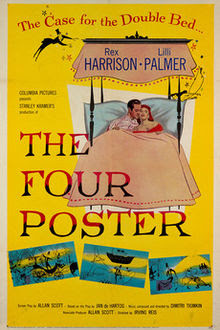
A significant film, according to Ed.
In fact, besides plugging his own movies, the only other title Ed directly references in this article is Irving Reis' The Four Poster (1952)a rather obscure comedy-drama starring Rex Harrison and Lilli Palmer. According to Ed, this movie was significant for its use of a double bed. Previous to this, thanks to the overly-strict Hays Code, directors could only show twin beds onscreen to maintain the fiction that husbands and wives slept separately. Oddly, that aspect of the movie seems to be forgotten today. To the extent that The Four Poster is remembered at all, it is for the animated sequences directed by John Hubley.

People who read a book like When the Topic is Sex probably became fans of Ed Wood through his movies, so they will relish the tidbits of information about those movies that Ed provides here. The director admits that, when he was first making films in the 1950s, he mistakenly thought that stars like Bela Lugosi and Tom Keene would be bigger box office draws than they actually were. He laments the end of the era when a big name on the marquee was enough to sell a movie. Wood further implies that, if Bela were alive in the 1970s, he'd have to make sexually-explicit movies in order to sell tickets. Perhaps it's for the best that this did not come to pass. 

Eddie's memory may have been a little shaky by 1972. In this article, he says that Bela Lugosi starred in Revenge of the Dead (Ed's preferred title for Night of the Ghouls), which is absolutely untrue. The role of Dr. Acula in that film was intended for Bela, but the great Hungarian actor was several years dead by the time the script went into production. Western baddie Kenne Duncan stepped into the role instead and gave one of his most memorable performances as a phony psychic medium who gets his much-deserved comeuppance.

Can we trust Eddie's story about how he was prevented by the censors from showing a gun with a silencer in Jail Bait? How about his recollection of hiring someone just to clean up the horse droppings on Crossroad Avenger? These could well be figments of Eddie's imagination. 

Honestly, it's difficult to summarize "Behind the Film Scene" because Eddie flits from one topic to another without a thought toward coherence. At one point, he discusses the so-called "sweater girls," i.e. the 1940s actresses like Lana Turner and Ann Sheridan who became notorious for their clingy, curve-enhancing cardigans and pullovers. According to Ed, the censors objected to the sweater girls, especially when their movies were shown to members of the military:
The Hays office decided the girls should no longer be dressed in the tight knitted garments because it turned so many of the boys in the service on. And that was one thing which shouldn't happen to them. After all they were in the business of battle. And if the powers that be gave them a little time off to see movies, they most certainly shouldn't see any girls sticking so far out in front. What would happen if they got turned on under such circumstances? Why there might be a whole generation of homosexuals who would come out of the war.
This is dubious reasoning, Eddie. I doubt that the Hays office thought Lana Turner was somehow going to turn a "whole generation" of soldiers into homosexuals. This seems like an out-there idea, even for Ed Wood. 

By the way, this article mentions an infamous blooper from The Red Skelton Hour involving a cow that defecates on the stage during a sketch. "Wonderful cow!" Red enthuses. "Not only does she give milk, but she gives Pet-Ritz pies." For the curious, this classic TV moment is available online. It comes from a 1960 episode entitled "Clem and the Beanstalk." As you might guess from the title, this is a parody of "Jack and the Beanstalk" featuring Red's dimwitted character, Clem Kadiddlehopper. Actor Jack Albertson also appears in the scene as a character named J.B. Throckmorton, which is the kind of name you'd give a businessman back then.


Next: "What Would We Have Done Without Them?" (1972)

Sunday, June 30, 2013

Mill Creek comedy classics #27: "The Lady Says No" (1951)

None of these ladies will say no to David Niven.

The flick: The Lady Says No (Ross-Stillman Productions, 1951; distributed by United Artists, 1952) [buy the set]

Current IMDb rating: 5.3

Director: Frank Ross (husband of star Joan Caulfield; this was his only directing credit, but he produced The Robe, Of Mice and Men, and The Devil and Miss Jones)

Actors of note:
  • David Niven (Oscar winner for Separate Tables; The Guns of Navarone, Murder by Death, three Pink Panther movies, a great deal more)
  • Frances Bavier (The Day the Earth Stood Still; Aunt Bea from TV's The Andy Griffith Show)
  • Henry Jones (Vertigo, Butch Cassidy and the Sundance Kid, way more)
  • James Robertson Justice (The Guns of Navarone, Chitty Chitty Bang Bang)
  • Lenore Lonergran (Westward the Women)
  • Peggy Maley (The Wild One, Anchors Aweigh)

The gist of it: Life magazine photographer and man's man Bill Shelby (Niven) travels to Carmel, CA to photograph Dorinda Hatch (Caulfield), author of the best-selling book, The Lady Says No, which is evidently some kind of proto-feminist broadside. Bill is surprised to find that Dorinda is a sexy young woman and not a dried-up spinster, and he's sure that the comely lass was just parroting ideas she got from her stuffy old Aunt Alice (Bavier), whose scruffy, vagabond husband Matthew (Justice) has just returned home from one of his customary lengthy absences.

Bill and Dorinda go into full-on "battle of the sexes" mode, alternately fighting and flirting, and eventually they get another couple, newlyweds Potsie and Goldie (Jones and Lonergran), involved in their shenanigans. It gets to a point where Potsie and Bill have barricaded themselves in a trailer, and it's up to Dorinda and Goldie and the police and the United States Army to get these feuding couples back together. Along the way, there's a lot of shouting from everyone on the subject of gender roles until Dorinda wises up and tosses her book in the ocean. Gloria Steinem, eat your heart out!

My take: It's tricky to review a "battle of the sexes" comedy from 1951, because men and women were playing by a whole different rule book then. It's tough for me to say what's decent and what's indecent and what's reasonable and what's unreasonable for these people because I don't live in their world. We can't expect the art and culture of the past to conform to our modern-day values.

Joan Caulfield
That being said, the sexual politics of The Lady Says No are fairly repugnant by the standards of any age. At least, I think they are. The characters in this movie are so unrealistic and inconsistent, especially Dorinda, whose personality changes several times per scene, that it's difficult to know what they believe about anything. And if I were casting the role of a testosterone-fueled, macho adventurer -- a traveling photographer who documented his exploits in a book called I Shot Borneo -- I'm not sure that dapper, gentlemanly David Niven would be my first choice.

Most of the plot of this movie revolves around the contents of Dorinda's book and the effect the book has on its readers. Frustratingly, we never get a solid idea of what's in that book, apart from the fact that the author doesn't approve of men whistling at women on the street. Today we refer to that kind of behavior as "catcalling."

And besides, the movie is not really interested in letting its characters truly hash out their issues regarding male-female relationships. The Lady Says No is too busy with pie fights, slapstick barroom brawls, and wacky car chases to really concentrate on the matter at hand.

Still in all, it was difficult not to cringe at a scene in which Dorinda visits Bill's trailer and negotiates with him for the return of an embarrassing photo (don't get excited; it's nothing sexual), and Bill uses this opportunity to get Dorinda to kiss him. In another scene, Bill pays for Dorinda's drink and then says he has a "mortgage" on her. By the end, Bill is blatantly telling Dorinda what to think, and she's grateful for it! I rolled my eyes, but I think if I'd been a woman, I might have been violently ill.

Apart from that, The Lady Says No is a swing and a miss, I'm sorry to report.

David Niven's charming as always (oh, for the days when a pencil mustache signaled sophistication!), and Joan Caulfield brings a lot of energy and wit to her character. Cinematographer James Wong Howe films her in a very flattering way, too, which helps the film somewhat. But I couldn't help feeling that Niven was too just old for her. Actually, they're only separated by 12 years, but he looks older than his age and she younger than hers. Or maybe their personalities just don't fit. In Murder by Death, Niven is paired up with Maggie Smith, who's 24 years younger than he is, and they're somehow a perfect fit.

Is it funny: The blogger says no. Maybe one joke in twenty reaches its intended destination. A few of the film's would-be comic setpieces just flop, such as an interminable sequence at a dive bar called the Wharf Rat, where Dorinda flirts with various men, including Potsie, to make Bill jealous. Or maybe that's not what's happening. Her motives and methods change so often, it's tough to be sure.

I sort of liked an early scene in which Dorinda elaborately humiliates Bill in front of an all-female audience at some kind of social meeting, but the scene went on so long I forgot what she was trying to prove and why he was passively allowing her to cut his necktie (symbolism, I wonder?) and draw on his face with lipstick.

The one scene I really enjoyed was a totally bonkers dream sequence set in a fantasy version of Borneo where Bill has a harem and Dorinda is followed around by a little man in a hideous monkey costume. What this scene has to do with anything is beyond me, but it at least got my attention.

My grade: C

P.S. - As for the matter of racial stereotyping, I'll have to plead nolo contendere. The movie has exactly one African-American character, a woman who is seen frantically jitterbugging at the Wharf Rat to the strains of an all-white jazz combo. She seemed to be wearing a waitress' uniform, but she was standing outside the door of the ladies' room. Who this woman was or what she was supposed to be doing was beyond my ken. The movie holds on her for a moment, though, so she must have some significance.