Showing posts with label fan theories. Show all posts

Tuesday, December 1, 2015

New theory: 'Fargo' season 2 is basically 'The Ladykillers' in slow motion

The Blomquists should not be alive. And yet they are. How?

As anyone who watches it knows, FX's television adaptation of Fargo is no mere regurgitation of the 1996 film by Joel and Ethan Coen. It frequently references that movie, yes, but it also draws upon the Coens' entire 30-year career for source material, in addition to its scads of newly invented, wholly original characters and situations. This season alone has seen major homages to Miller's Crossing, The Man Who Wasn't There, No Country for Old Men, The Big Lebowski, Raising Arizona, and O Brother, Where Art Thou? But it's taken me until today to realize that the Coen film most heavily referenced in the TV show, outside of the original Fargo itself, might just be The Ladykillers, the brothers' little-loved, much-criticized 2004 remake of the classic 1955 Ealing comedy with Alec Guinness and Peter Sellers.

(WARNING: SPOILERS AHOY!)

Now, I've tried to argue in the past that The Ladykillers is a grossly underappreciated, widely misunderstood film that holds up very nicely in a side-by-side, point-by-point comparison with its predecessor. I still feel that way, but I've come to accept the fact that critics and movie nerds have their minds made up about the movie and will not budge. Their loss. Obviously, Noah Hawley, creator of the Fargo TV series, has some affection for The Ladykillers. Early on in the show's second season, a pivotal scene takes place at a restaurant called the Waffle Hut, which is also the name of a crucial location from The Ladykillers and the source of that film's best-known line: "You brought your bitch to the Waffle Hut!" I figured the Waffle Hut locale was going to be Fargo's token nod to The Ladykillers. But I miscalculated. If you'll recall, The Ladykillers centers around a group of thieves, led by Tom Hanks, who decide they have to kill an old lady, Marva Munson (Irma P. Hall), who has found out about their casino heist. In their slapstick efforts to kill the elderly woman, the would-be ladykillers fail every time. One by one, they die, and the woman remains alive and unharmed.

Flash forward eleven years. The second season of Fargo has largely focused on the travails of a North Dakota hairdresser, Peggy Blomquist (Kirsten Dunst), and her likable if rather oafish butcher husband, Ed (Jesse Plemons). The seemingly naive and vulnerable Blomquists find themselves smack dab in the middle of a mafia turf war when Peggy accidentally runs over Rye Gerhardt (Kieran Culkin), a member of a regionally powerful crime family. The Gerhardts have dispatched numerous would-be assassins to erase Ed and Peggy from existence. The result? A lot of dead Gerhardts and no lasting harm visited upon the Blomquists. Ed and Peggy have demonstrated a lot of unexpected toughness and resourcefulness this year, but they've also benefited from tremendous luck and good timing. Just like a certain Marva Munson. Meanwhile, the Gerhardts are a lot like the inept thieves from The Ladykillers, always squabbling among themselves when they should be acting as a team.

But the similarities don't end there. In The Ladykillers, Ms. Munson is a somewhat delusional, deeply religious woman who lives in her own isolated little world. She spends a great deal of time talking to an oil painting of her deceased husband, Othar, and imagines that the painting talks back to her. On Fargo, Peggy is also delusional and believes in a "religion" of sorts based around self-help seminars and women's magazines. Peggy's devotion to her chosen faith rivals that of Marva Munson. While Ms. Munson talks about getting into Heaven as her ultimate goal, Peggy prattles on about becoming "actualized" as her highest ambition.

And, like Marva Munson, Peggy Blomquist is more than capable of carrying on both halves of an imaginary conversation. Last night's episode, for instance, had her seeking advice from a spectral self-help guru, perhaps a psychologist, who had magically materialized in her basement. In reality, she was addressing Dodd Gerhardt (Jeffrey Donovan), a dangerous criminal she had taken hostage and tied up. Peggy's insistence that Dodd mind his manners while in her presence is very Munson-esque. In The Ladykillers, Marva repeatedly slaps poor Gawain McSam (Marlon Wayans) when he uses profanity around her. Peggy, for her part, has no trouble stabbing  Dodd in both shoulders when he fails to say "please" and "thank you" while bound to a chair in a remote cabin. Interestingly, Gawain McSam's timid, utterly botched attempt to shoot Marva Munson in The Ladykillers is mirrored by a sequence in Fargo in which young Charlie Gerhardt (Allan Dobrescu) totally louses up what should be an easy execution of Ed Blomquist. In these moments, both McSam and Charlie are boys sent to do a man's job. Not that the men do any better, mind you.

So there you have it, folks. Fargo's second season is one big extrapolation of The Ladykillers.

Monday, November 16, 2015

My 21-year-old theory about 'Pulp Fiction'

You know any of them old jokes? No, but I know an old theory.

It's all about Travolta, man!
I don't know why this popped into my head today, but I started thinking about a theory of mine concerning the movie Pulp Fiction. This was an idea I started toying with back when the movie was new in 1994, and it never got any further than some primitive, now-obsolete Usenet discussion groups. In those bygone days, I was probably frequenting alt.fan.tarantino or something similar. I think this idea of mine found some traction there, but it probably only amounted to a single stranger saying it was "kind of interesting." That was enough for me back then. Likes and RTs hadn't been invented, so we had to make due with what was available.

Anyway, my theory was that Pulp Fiction, at least the parts concerning the Vincent Vega character, was a movie-length tribute to the career of star John Travolta. It starts with the character's name. Vincent was also the name of Travolta's character on Welcome Back, Kotter. The "Vega" part was simply an acknowledgement that Travolta was a superstar. The actor became famous through television but never did another recurring role on a series after Kotter. That's why Vincent claims never to watch television. He knows he's not on it anymore, so what's the point? And his offhand question to Jules, "What's a pilot?" is a punning acknowledgement of Travolta's own well-known love of aviation. The actor is a certified pilot with five aircraft and a private runway.

Synonymous with disco.
Okay, now we get into more specific nods to iconic Travolta roles. Uma Thurman's Mia Wallace actually calls Vincent "cowboy" at one point, obviously bringing Urban Cowboy to mind. Also, when she's trying to lead Vincent to the intercom in her home, Mia says "disco" when he finds it, referring to the genre of music with which Travolta became synonymous after Saturday Night Fever. Having Vincent and Mia win a dance contest, meanwhile, is another obvious Fever parallel. A less-obvious one is when Vincent's partner, Jules (Samuel L. Jackson), decides to give up being a criminal, which he refers to simply as "the life." This is analogous to a sub-plot from Fever in which Travolta's character, Tony Manero, has a brother who is leaving the priesthood. And where does Jules live? Inglewood, CA, a near-perfect sound-alike for Travolta's own home town of Englewood, NJ.

Pulp Fiction references Grease a few times, too. Not only do Mia and Vincent visit the 1950s nostalgia-themed eatery Jack Rabbit Slim's, which he calls "a wax museum with a pulse," but Vincent also says that he'll be "a fucking grease spot" if Mia overdoses while in his care. And then there is Mr. Vega's antagonistic relationship with boxer Butch Coolidge. To say the least, Butch and Vincent get along poorly throughout the entire movie. This, I suggest, is an in-joke referring to the fact that Bruce Willis provided the voice of the baby in Travolta's Look Who's Talking from 1989.

Anyway, that's my theory, which is mine. There's not much more to it than what I've already described in the paragraphs above. I just wanted to record it here for posterity. Thank you for indulging me.

Thursday, October 22, 2015

That moment when you realize Powdered Toast Man is actually Jesus

"Leave everything to me."

"And he took bread, and gave thanks, and brake it, and gave unto them, saying: This is my body which is given for you. Do this in remembrance of me." -Luke 22:19

A PTM comic book.
Writing about Nickelodeon's The Ren & Stimpy Show recently caused me to think about -- and truly consider the oddness of -- the show's colorful cast of supporting characters, including frazzled kids show star Muddy Mudskipper (a seeming first cousin to The Simpsons' jaded Krusty the Clown), textbook suburbanites Mr. and Mrs. Pipe, taciturn steed Mr. Horse, and the dinner-jacketed announcer known only as That Guy.

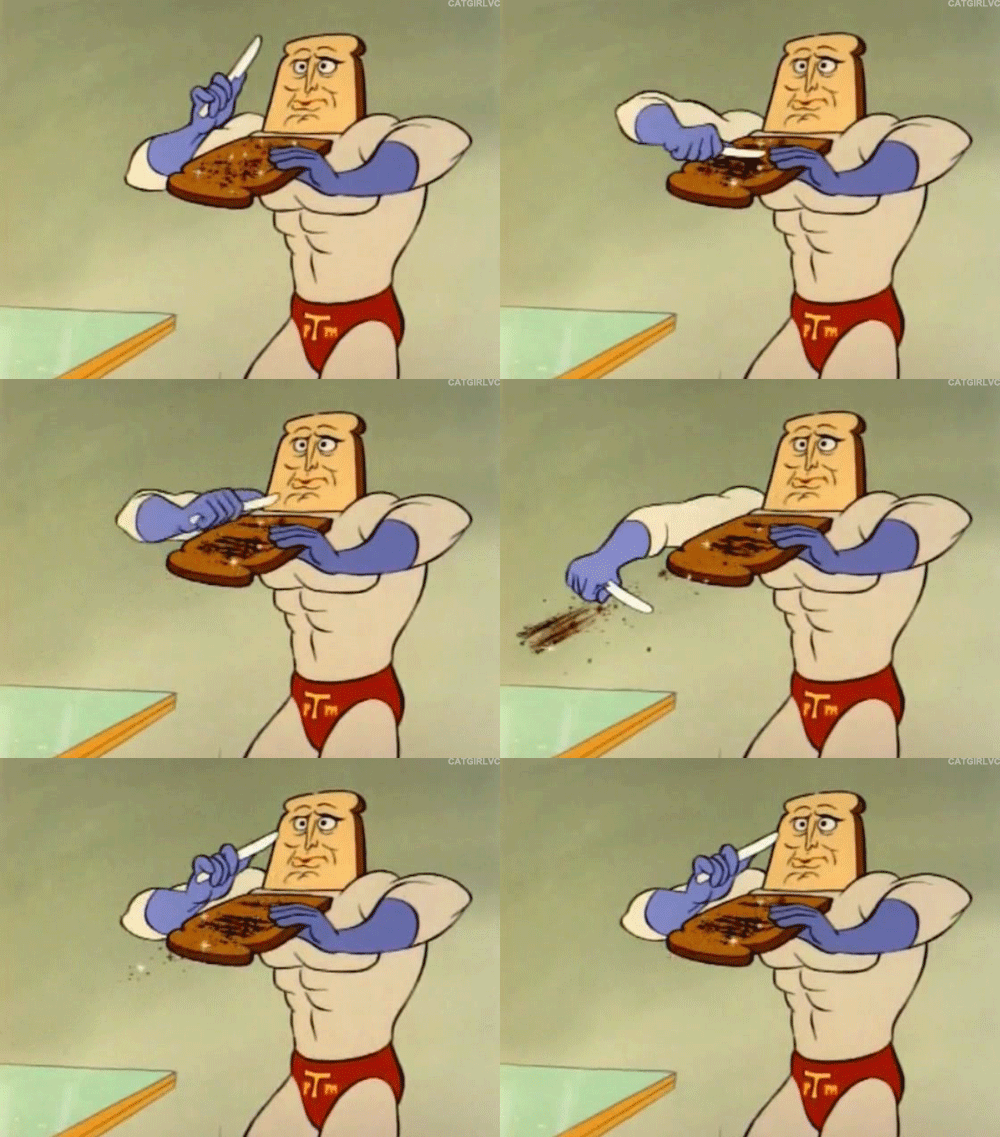
But perhaps no R&S costar is better remembered or more loved than Powdered Toast Man, a ridiculous superhero voiced by Laugh-In veteran Gary Owens. He is essentially a muscular, deep-voiced man with two giant slices of toast where his head ought to be, and his outfit is the usual form-fitting leotard with the underwear worn on the outside.

During the show's first season, back in 1991, PTM appeared briefly in a mock commercial for the space-age product bearing his name. The concept of Powdered Toast is simple: just shake some powder out of a Comet cleanser-type can onto your plate, and in a few seconds it transforms into warm, crispy toast! In a example of the show's proudly juvenile, absurd gross out humor, the costume-clad crime fighter always made sure to fart on every slice of powdered toast Ren and Stimpy ate. The character made such an impression on R&S viewers that he was given his own episode during the show's second season premiere in 1992. Another PTM cartoon, "Powdered Toast Man vs. Waffle Woman," appeared in 1994.

For such a strange character, Powdered Toast Man's origins are fairly obvious. Superheroes and breakfast cereal ads have both been integral to animated children's TV shows for decades, so it was natural to combine them in this fashion. On the Ren & Stimpy DVDs, furthermore, creator John Kricfalusi has stated that he was inspired by the many Hanna Barbera heroes who, like PTM, routinely shout their own names, a lineage that includes Space Ghost (also originally voiced by Owens), Birdman, and Captain Caveman. Plus, we must factor in that "toast" is just a funny word, especially when you say it repeatedly in a short span of time. PTM's name led to such memorable quotes as Stimpy's "He's toast-terrific!"

I've already written about how Ren & Stimpy was filled with hyper-masculine, strong-jawed, he-man archetypes. PTM would seem to be one of the friendlier examples.

But I started thinking about that 1992 "Powdered Toast Man" episode, and I realized that there may be something else going on with the familiar character. Maybe PTM isn't just a breakfast-based superhero. Maybe he's a stand-in for Jesus Christ, the only begotten son of God. 

Okay, it's a far-out theory, I realize. But hear me out.

Take and eat.
Powdered Toast Man actually opens his own head up and scrapes out some powder onto Ren and Stimpy's plates. This is as close a cartoon representation to the Eucharist as I can imagine on The Ren & Stimpy Show. PTM uses his body to feed a hungry cat and dog! The transformation of powder into toast may, in fact, be miraculous, like the story of the fishes and loaves in Matthew 14.

Fish and bread, it should be noted, are both important motifs on The Ren & Stimpy Show. Their hero, as I've already pointed out, is literally made of bread. In "Son of Stimpy," Stimpy's prodigal son (another biblical reference!), Stinky, even marries a rotting fish carcass before honeymooning in Ren's nose. And fish are common comedic props throughout the series, as in "Haunted House," in which one unlucky trout or halibut becomes part of a grotesque sandwich. That episode, incidentally, features another example of a character literally turning into bread, as an unlucky ghost disguises himself as a slice of bread in an attempt to trick Ren and Stimpy. Eucharistic symbolism abounds!

But getting back to Powdered Toast Man, what other Christ-like characteristics does he have? After studying the "Powdered Toast Man" episode from 1992, I've made the following observations:

  • His skimpy red shorts are monogrammed PTM, but only the cross-like T is emphasized. Throughout the episode, his catchphrase will be "Leave everything to me," which sounds like an updated version of that classic bumper sticker slogan, "Let go and let God." Like Jesus, Powdered Toast Man is voluntarily taking on the burdens of the human race. PTM knows of our fears, our weaknesses, our sins, and our frailties, and he is willing to accept them all if we only ask for his help. Truly, he wants us to leave everything to him.
  • An overly-excited announcer describes PTM as a mysterious, god-like being from another world: "Who is this stranger from another land? Why does he walk among mortal men? What is his mission? Where can we get a pair of undershorts like his? Who is this man of toast and what does he want from us? What is his dark secret?" That second query -- "Why does he walk among mortal men?" -- seems particularly applicable to Christ as well. It's one of the central mysteries of the Christian faith.
  • PTM's chosen alias is "Pastor Toastman, the cool youth deacon." His assistant  is a lovely young lady who dresses much like a Catholic schoolgirl and refers to him as "Father." The fact that the character casually tears off his priestly collar could be viewed as either deliberate sacrilege or the fact that Christ would have no use for the hierarchical structure of organized religion as it is practiced today.
  • In an outlandish parody of Christ's mercy, PTM saves a small kitten from being run over by a delivery truck by crashing a passenger plane directly into the truck. Like Christ, PTM is primarily concerned with the humblest and most helpless of God's creatures. (Never mind that he carelessly tosses the animal into the path of another vehicle moments later.)
  • PTM is, in some ways, better than God or Jesus because he directly answers prayers. He can be contacted through his Toast-omatron Communicator, his inflating and deflating red shorts, and even his tongue, which functions as a telephone. When Ren and Stimpy need toast, PTM comes quickly, as in Revelation 22:12.
FZ as the Pope.
  • Whom does PTM save in the episode's main event? The Pope, as portrayed by Frank Zappa. And from whom does he save the Pope? An angry fish villain, as portrayed by Muddy Mudskipper. There is an absolutely religious-seeming moment in which PTM floats angelically over the semi-conscious, almost-dead Muddy Mudskipper and "resurrects" him, only to tie him to a barrel full of about-to-explode gunpowder. As with the kitten incident, it plays like a parody of a miracle.
  • In the cartoon's final act, PTM becomes heavily involved in American politics, perhaps denoting how much influence the Christian right has over the United States government. After saving the hapless, unnamed president, who gets his penis caught in his zipper in the White House john, PTM assumes the role of Commander-in-Chief, vowing "to relieve the American citizens of their basic human rights."
  • As president, one of PTM's top priorities is settling the "Three Stooges stamp controversy," possibly an oblique reference to the Holy Trinity. In another example of political satire, PTM then burns the Constitution and the Bill of Rights in order to heat the Oval Office, warming himself in front of the fire with his nubile female assistant, a possible cognate for Mary Magdalene.
So as you can see, there are numerous parallels between the Man of Toast and the Lamb of God. Whether this was intentional or not is up to you to decide. And am I, the author of this piece, being sincere with the evidence presented here, or is this an intentionally over-the-top comment on far-fetched fan theories? Well, that, too, is for you to determine. Read it over, examine the evidence carefully, and come to a conclusion that suits you and your spiritual life. Me, I'm off to enjoy some delicious powdered toast.