Showing posts with label film. Show all posts

Wednesday, December 3, 2025

Ed Wood Wednesdays, week 253: We are living in Ed Wood's paradise

I don't know if Ed Wood made it to heaven, but he might think we already live there.

Wherever you are right now, I want you to take a moment and look around you. Pry your eyes away from your phone, tablet, or laptop and study your surroundings. Are you impressed with what you see? Well, you should be, because you are living in paradise. At least from Ed Wood's perspective, you are.

Let me explain.

Filmmaker and author Edward Davis Wood, Jr. (1924-1978) spent the last three decades of his life living in Hollywood and trying to find a place for himself in the movie industry. He never really found one, so he was relegated to the margins of show business, working first in low-budget independent pictures and then in pornography. Along the way, he supplemented his income by writing paperback books, short stories, and magazine articles, usually of an adult nature. Prolific as he was in all fields, Ed never made enough money to cover his expenses and so lived in abject poverty for decades. He was also a heavy drinker and chronic smoker. These factors, along with job-related stress and poor diet, led to his early death at the age of 54.

I would suggest that many of the problems Ed Wood faced in the 1950s, '60s, and '70s have been either alleviated or eliminated altogether by the 2020s. Had Eddie been born at a later time, he still might never have found mainstream success—his work is simply too idiosyncratic for that, regardless of budgetary concerns—but he would not have had to live as miserably and die as prematurely as he did. And I say that because of a few larger societal trends.

Tuesday, July 8, 2025

Podcast Tuesday: "Attractive Female"

Richard Gere and Julia Roberts in Pretty Woman.

As my cohost and I have made our way through the films of Garry Marshall, I've been reminded time and again of just how different media consumption was in the 1980s and '90s. For one thing, I saw a lot more movies in the theater back then, at least three or four each month. These days, I'll see maybe two or three movies a year on the big screen.

Another big difference was that, in the days before streaming, we were reliant on VHS tapes if we wanted to screen a film at home. Most we rented, a few we owned. This system wasn't all bad. My sister and I had our own VHS copy of Garry Marshall's smash romcom Pretty Woman (1990) and watched it dozens of times. That film simply became part of our consciousness, and we quoted it frequently.

This week on These Days Are Ours: A Happy Days Podcast, we talk about Pretty Woman. The film was extremely popular in its own time, but how does it hold up in ours? Well, click below to find out.

Tuesday, June 10, 2025

Podcast Tuesday: "The Teaches of Beaches"

Barbara Hershey and Bette Midler in Beaches.

Remember the so-called "monoculture"? If you grew up in the 1980s or earlier, you certainly do. Back then, due to the constraints of technology and commerce, we mostly consumed the same media at the same time as everyone else. Whatever the "big" movies and TV shows were, that's what we watched. Whatever was in the Top 40, that's what we listened to. This may not sound like an ideal system, but it gave us a common frame of reference. When we talked about "the media" in the abstract, we were referring to the same material. Cable and home video started to erode the monoculture just a bit in the '80s, but the '90s was when the entertainment world truly started splintering into a lot of little hyper-specific facets.

Nowadays, thanks to the internet and the rise of personal devices like smartphones and tablets (meant to be used by an individual rather than a group), the entertainment we consume is well-tailored to our various demographic groups and delivered to us by algorithms that know us better than we know ourselves. We stay in our lanes, culturally speaking, and it's considered "weird" (read; undesirable) to do otherwise. In 2025, it's very possible to have a supposed "hit" song that most of the country has never heard or a "hit" TV show that most of the country isn't even aware of. If it's not intended for you, it generally doesn't reach you. I suppose the last vestiges of the monoculture are the big franchise films that dominate the box office: the sequels, remakes, reboots, and adaptations of familiar intellectual properties.

Director Garry Marshall's fifth film, Beaches (1988)—a tearjerking melodrama starring Bette Midler and Barbara Hershey as lifelong friends with clashing personalities—is a definite product of the monoculture. Produced by Walt Disney's Touchstone Pictures division, it's a film designed to appeal to the widest-possible audience. And it did just that! Not only was the film a hit in theaters and on video, it launched a massive hit single ("Wind Beneath My Wings") and led to one of its cast members (Mayim Bialik) getting her own prime time sitcom. I don't think any of this would be remotely possible in 2025. Today, a film like Beaches, if it got made at all, would be shuffled off to a streaming service and quickly forgotten. Indeed, a 2017 remake of the film went straight to cable and was largely ignored.

So Beaches is a reminder of who we once were and of what pop culture used to be. But is that a good thing or a bad thing? We'll try to figure all that out as we review it in the latest installment of These Days Are Ours: A Happy Days Podcast.

Wednesday, June 30, 2021

Ed Wood Wednesdays, week 119: The Life and Career of George J. Becwar (1917-1970)

This week, we examine the life and legacy of George J. Becwar.

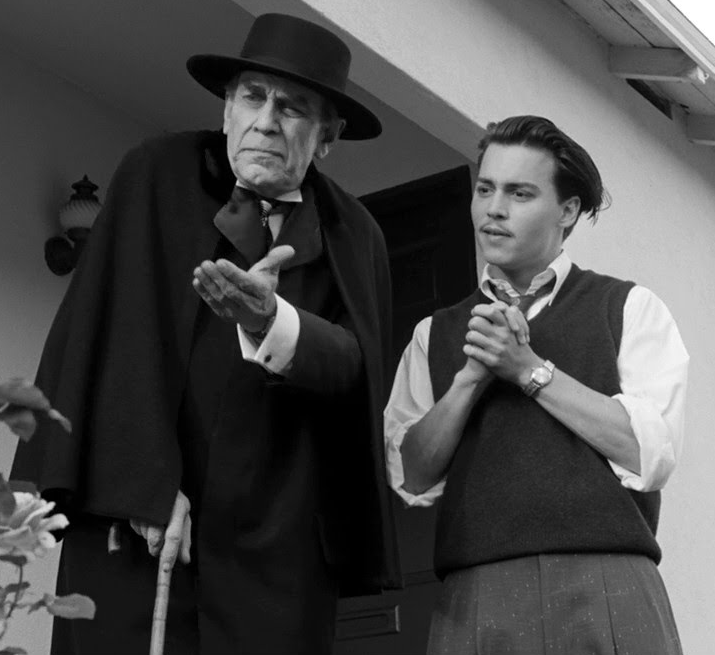
If there's a scene people remember from Ed Wood's Bride of the Monster (1955), it's the one in which Bela Lugosi delivers his heart-wrenching "Home! I have no home!" speech. The emotional monologue looms so large in B-movie mythology that Tim Burton had Martin Landau, portraying an aged Lugosi, recite it twice in the biopic Ed Wood (1994): once while on the set of Bride and once while walking down the street with Ed. The latter performance attracts a crowd of appreciative onlookers, much to Lugosi's satisfaction. The biopic presents this moment as the old actor's last taste of glory before his death.

Lugosi and Becwar in Bride of the Monster.
But Lugosi's character in Bride, tortured mad scientist Dr. Eric Vornoff, would have had no reason to make such a tear-jerking speech if it hadn't been for good old George Becwar. It's Becwar, as duplicitous foreign agent Prof. Strowski, who provokes the emotional outburst by offering to take Vornoff back to the country from which the scientist had previously been exiled. 

"Vornoff," he says in a passable Eastern European accent, "I have searched for you everywhere. Everywhere I hear stories of monsters. Now I am here, sent to bring you home." And from there, Lugosi is off to the races.

Strowski may not be the most glamorous assignment ever given to an actor—the Mystery Science Theater 3000 crew dismissed him as a "worthless ancillary character waiting to be killed off"—but Becwar at least manages to turn him into a pompous villain deserving of our contempt. Thus, it's quite satisfying when Vornoff's henchman Lobo (Tor Johnson) feeds Strowski to a ravenous octopus. Becwar, bless him, remains defiant to the end: "You may kill me, but others will come!"

If actor John Andrews is to be believed, Ed Wood and George Becwar did not exactly have a cozy working relationship during the making of Bride. As he told Rudolph Grey in Nightmare of Ecstasy (1992): "Eddie hated, loathed, despised, wanted murdered, I'm not overdoin' it, man, I'm tellin' you straight—George Becwar." Allegedly, Becwar was dissatisfied with his pay for Bride of the Monster and reported Ed to the Screen Actors Guild. According to John Andrews, Ed Wood held a grudge for the rest of his days against Becwar. Notably, the two never worked together again.

George Jerome Becwar was born on September 16, 1917 in Berwyn, IL a suburb of Chicago. (Yes, the same town mentioned each week on MeTV's Svengoolie.) At Harrison Technical High School, he was a Cadet Major in the ROTC. In 1941, George was drafted by the army and enlisted in the 131st Infantry. His draft card yields some interesting biographical information. He was 23 at the time, living in Chicago and working for the Illinois Writers Project, which was sponsored by the WPA. He lists his mother as his next of kin. For what it's worth, the back of the card describes Becwar as standing 5'10" and weighing 240 pounds with brown hair, brown eyes, and a ruddy complexion. He is said to have worn glasses. The card also notes that he had several scars: one on his left hand, another under his right nostril, and a third at the base of his spine.

George Becwar's draft card.

From the mid-1950s to the early '60s, George had the honor of calling himself a working actor in Hollywood, popping up in at least 14 known television series and seven films. These were not always obscure, low-budget projects either! Remember the CBS Western The Rebel with Nick Adams? ("Johnny Yuma was a rebel! He roamed through the West!") George was on it seven times -- as seven different characters! He's in A Star is Born, too, specifically the 1954 version with Judy Garland and James Mason. Baby boomers may still have fond memories of such black-and-white series as Death Valley Days, Sky King, Highway Patrol, and I Led 3 Lives. All of them hired George Becwar, some on multiple occasions.

After he got to Hollywood, Becwar had his share of misadventures as an actor. The March 31, 1952 issue of The Los Angeles Evening Citizen News shares the "humorous" story of how he was briefly mistaken for a thief.

"Surely, this is not a laughing matter."

In addition to being an actor, Becwar was also civic-minded. The January 3, 1958 issue of The (Los Angeles) Mirror News includes his letter to the editor concerning automobile safety. This letter is not terribly fun, so I suggest you read it aloud in your best Prof. Strowski voice.

George Becwar has a plan.

Los Angeles Times columnist Matt Weinstock wrote about George Becwar a few times. This article from December 15, 1966 gives us yet more background information about the actor, including his past as a journalist and his war injuries. It also fills us in what Becwar did for money between roles, i.e. working as a hotel clerk and doing some writing on the side.

George Becwar was 30% disabled. Who knew?

Another column by Matt Weinstock in the February 9, 1969 issue of The Los Angeles Times yields an intriguing anecdote about Becwar and fills in some details about the actor's past. We learn, for instance, that Bride of the Monster was not the only time George raised a stink about his pay. The article also suggests that the actor had a couple of upcoming movies for producer Martin Zessin. In fact, George's screen acting career basically dried up after 1961. After an absence of eight years, his last-known screen credit is a totally forgotten 1969 film called The Great Sex War, in which he played Gen. Caleb Sutton. This comedy may never have been released, despite the fact that its cast included such well-known actors as James Franciscus, George Raft, and Cantinflas. We were denied a tagline like: "Becwar! Sex War! See it this Christmas!"

As always, George was concerned about his pay.

Other brief mentions of George Becwar in the press (apart from the mere inclusion of his name in cast lists):
  • The Los Angeles Evening Citizen News, March 18, 1953: George is listed as the stage manager of an Equity house at 6040 Wilshire Blvd. where auditions are being held for a two-act musical comedy.
  • The Los Angeles Evening Citizen News, March 25, 1953: A brief item declares that "critics have lauded" the performances of Becwar and his castmates in a play called Outward Bound, which was then in its second week at the Gallery Theater on Santa Monica Blvd.
  • The Los Angeles Evening Citizen News, November 12, 1953: Richard Lipscomb's review of Outward Bound declares that Becwar is among the "promising talent" in the show. 
  • The Los Angeles Evening Citizen News, February 16, 1955: A showbiz column called "In the News" declares that Becwar has signed "with Paul Kohner Agency for radio, movies and television."
  • The Los Angeles Evening Citizen News, January 18, 1956: "In the News" says that Becwar has won a television role as a Czech police chief in The Man Called X.
"An important role" for George Becwar.
  • The Los Angeles Times, January 28, 1956: A one-paragraph article in the entertainment section notes that Becwar "enacts an important role in Bride of the Monster." The film is said to be accompanying Ransom! (1956) at various theaters and drive-ins.
  • The Los Angeles Evening Citizen News, January 18, 1957: "In the News" notes that George has signed with the Swoverland Agency.
  • The (Palm Springs) Desert Sun, July 3, 1957: Columnist Mike Connolly notes that Becwar was hired "at the last minute" to appear in an installment of Playhouse 90 entitled "The Fabulous Irishman." According to Connolly, the hapless actor "stayed up all night working up an Irish brogue," only to find that his character was an Englishman.
  • The Los Angeles Evening Citizen News, August 29, 1959: George is declared the winner of that week's "Name the Stars of Tomorrow" contest. His prize is a Westclock wrist watch. His address is given as 616 N. Gower St.
  • The Los Angeles Evening Citizen News, June 28, 1960: "In the News" reports that George is playing three roles in the play Liliom at a venue called The Theater but he's soon leaving the company "to meet TV commitments." 
  • The Los Angeles Times, July 4, 1960: In his review of Liliom, critic Charles Stinson mentions being impressed by Becwar's performance as "the lecherous and pompous police captain."
  • The Los Angeles Evening Citizen News, April 2, 1963: The "All About People" column notes that Becwar has returned to Hollywood "after seven months of radio work in Las Vegas." He is said to be in rehearsals for a play called Not to Speak Profanely. His address is given as 1764 N. Orange Dr.
  • The Los Angeles Evening Citizen News, February 15, 1967: Another of George's letters to the editor. This time, Becwar opines: "Students at both the University of California and the California State Colleges can easily meet Gov. Ronald Reagan's tuition charges by using the money they used to spend on haircuts." Zing!

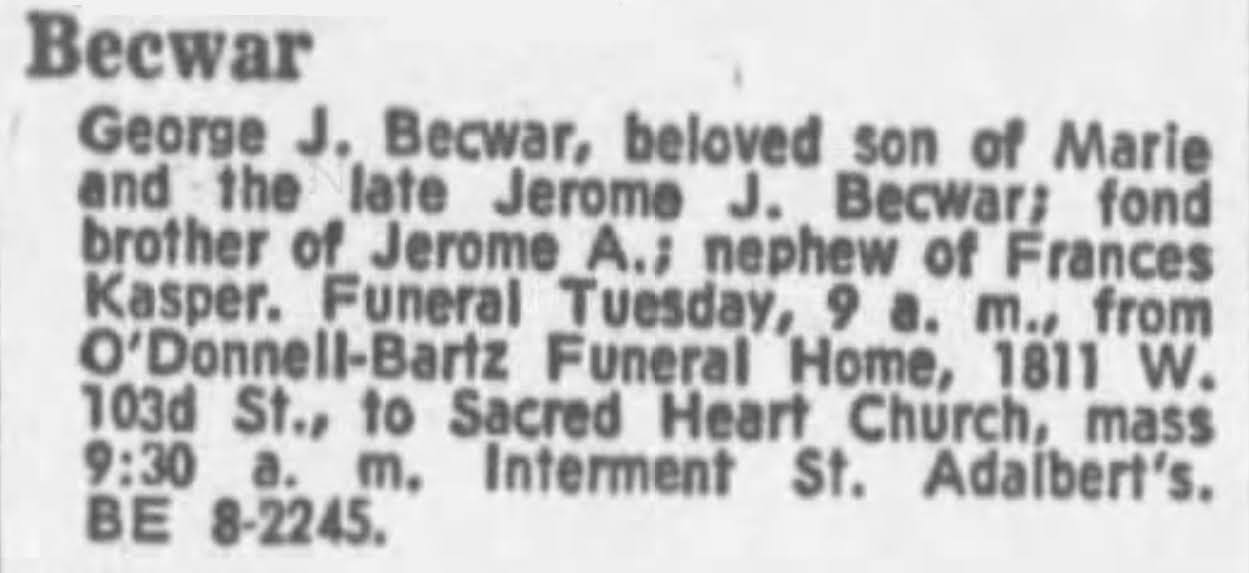
Sadly, George Becwar's life was even shorter than that of Ed Wood. The Illinois-born actor passed away at the age of only 52 on July 9, 1970, having never married nor had children.  George's body was sent back to his home state and buried at a Catholic cemetery in suburban Cook County. A modest obituary appeared in the July 13, 1970 edition of The Chicago Tribune. 

"Sent to bring you home": George Becwar's obituary.

CONCLUSION: George Becwar played a fleeting but not insignificant role in the saga of Edward D. Wood, Jr. It may never occur to most viewers to ask who this man was, where he came from, or where he went after Bride of the Monster. As it turns out, however, George had a pretty fascinating and multifaceted life. Was he a pain in the ass? Maybe. But at least he got to take part in one of the most famous scenes in any of Ed Wood's movies, and it's earned him an odd sort of immortality.

Thursday, October 31, 2019

Major book announcement!

Director Stephen C. Apostolof and his children on the set.

For the last couple of years, Jordan Todorov and I have been working on a comprehensive, fully-illustrated biography of Bulgarian-born sexploitation director Stephen C. Apostolof (1928-2005), the man behind Orgy of the Dead, Fugitive Girls, and much more. Along the way, we've had the total cooperation of the Apostolof family and access to Stephen's personal archives. You may know Steve Apostolof from his collaborations with Ed Wood, but there's a lot more to the story than that.

And now, our book, Dad Made Dirty Movies: The Erotic World of Stephen C. Apostolof, is finally available for pre-order from McFarland. It's also available for pre-order from Amazon, and I especially hope you click that Amazon link because you'll see the promotional blurb I wrote for this book however many months ago. I must've been pretty hyped up on caffeine that day.

In all seriousness, this book has been a real labor of love for Jordan and for me, and we're very anxious for Dad Made Dirty Movies to reach bookstores and readers everywhere!

Dirty Made Dirty Movies can be ordered at AmazonBarnes and NobleIndieBoundBAM!BookworksMcFarlandWaterstonesIndigoKinokuniya, and other retailers.

Wednesday, January 23, 2019

Ed Wood Wednesdays, week 78: (some of) The Many Resumes of Edward D. Wood, Jr.

Ed Wood made sure to keep his CV up to date.

Edward D. Wood, Jr. was nothing if not an ardent self-promoter. Acting, writing, producing, directing, even making music—he claimed to be able to do it all. And he kept track of his ever-growing list of accomplishments, both real and illusory, through his resumés or CVs. He kept these updated all through his life, even during his impoverished, booze-soaked final years, perhaps always hoping that the next big break was just around the corner.
NOTE BEFORE WE CONTINUE: This is in no way, shape, or form a complete collection of Ed Wood's resumés. I'm sure there are many others floating around out there. You may even have some in your own collection. This is just a handful of the Wood CVs I've encountered in my research over the years. I'm sharing them in the hopes that you, too, will find them interesting.
These documents are fascinating to the Woodologist because they reveal a whole host of mysterious credits, some of which are undoubtedly imaginary or fraudulent. Eddie certainly wasn't above padding his resumé to impress a potential employer. Let's look at one from Eddie's early years in Hollywood. This example seems to date back to the early 1950s; it was typed onto the back of his acting headshot. By then, Ed had appeared in a few plays in Los Angeles, made an abortive attempt to complete Crossroads of Laredo, and directed a handful of TV commercials. Glen or Glenda was apparently still in the future, as it goes unlisted here under any of its many titles.

Early 1950s resume

Under Ed's TV and film directing credits, we can recognize a few commercials: "Surprise," "Treasure and Curves," "The Bestest," "Magic Man," and "Boiled in Oil." Many of the other titles here are likely commercials as well, since Eddie claimed to have directed dozens of them. Some of the most intriguing titles: "Angora Sweater Date," "The Girl Is a Boy," "William Television," "The Shack at the End of the Alley," and "The Will of God."

Interestingly, "Boiled in Oil" seems to refer to Ed's spot for Wesson Oil with Don Nagel, Phyllis Coates, and Conrad Brooks. According to Rudolph Grey's book Nightmare of Ecstasy, this commercial was made in 1954. That would have been after Glen or Glenda. Could this ad actually have been made earlier?

Excerpt from Nightmare of Ecstasy.

Crossroads of Laredo, naturally, is the silent Western Ed tried and failed to make with John Crawford Thomas in 1948. I'm guessing Five Minutes Before Eternity is an alternate title for The Sun Is Setting (1951), simply because both titles vaguely describe the plot. The Sun Is Setting also features Phyllis Coates, again lending credence to the theory that the Wesson commercial was made well before 1954.

Of Eddie's alleged stage credits, only The Blackguard Returns and Casual Company have really been documented. When or where Eddie appeared in The Red Peppers or Peg O' My Heart is anyone's guess. His list of dialects is intriguing. He never really got the opportunity to use any of them in his movies, though he did play a Mexican jailer in the 1974 porn loop Prisoner Love Making (aka The Jailer).

Ed's list of "characters played" is enlightening, including such roles as "Young Sweater Girl," "Neurotic," and "Cowgirl (Stunt Work)." Could that last one be a reference to Ed's work in The Baron of Arizona (1950)?

Interesting, too, that Ed claims to have worked at night clubs in New York, Hollywood, and Washington, D.C. Nightmare of Ecstasy declares on its timeline that Eddie studied drama in Washington in 1946, shortly after leaving the Marines.

Let's move on to another resumé, this one from the middle 1950s.

Mid-1950s resume.

By this time, approximately 1954, Eddie was no longer touting his theatrical work, concentrating instead just on TV and film. And he wasn't lumping his film, TV, and commercial work into one big category anymore. Each gets its own category on the CV. The commercials are further segregated into the ones he made for Story-Ad Films Inc., Consolidated TV Prod., and Play-Ad Films. It's notable that, to date, the only Wood commercials that have surfaced are ones from Story-Ad Films.

The unfinished Crossroads of Laredo has been downgraded to the status of a made-for-TV movie. Perhaps Ed wanted to sell it as a TV pilot. The real TV pilot Crossroad Avenger is now listed in this section as well, along with The Sun Is Setting. Those mysterious Westerns, Double Noose and War Drums, both for Sid Ross Productions, are on there. Douglas North has speculated that these were further TV pilots for Crossroad Avenger star Tom Keene. Maybe The Showdown was a third.

We now also have some feature film credits. Fans will immediately notice that some of these movies are well-known, while others are either lost or were never produced in the first place. Glen or Glenda is now listed, as is The Hidden Face, an alias for Jail Bait (1954). Outlaw Marshal must be an alternate title for the Johnny Carpenter vehicle The Lawless Rider (1954). A second Carpenter picture, White Flash, is here, but it may never have gotten made. Despite its religious title, The Flame of Islam was likely some kind of filmed burlesque show. And what else could Girl Gang Terrorists be except The Violent Years (1956)? This one has been hastily added by hand, while the rest of the titles are typed.

It's worth noting that Bride of the Monster (1955) is AWOL, but Ed's resume does list something called The Atomic Monster. Ed credits himself with the "title only" and says the film is from "Broder Productions." This takes a bit of explaining. See, there's a 1941 Universal film called Man Made Monster starring Lon Chaney, Jr. and Lionel Atwill. In 1953, it was re-released by a company called Realart Pictures under the title The Atomic Monster. Realart was co-founded by a man named Jack Broder. Realart had supposedly swiped the title The Atomic Monster from a script that Ed had written with Alex Gordon. Alex managed to finagle $1,000 out of Realart, and Eddie's film became Bride of the Atom, then Bride of the Monster.

(By the way, I wonder if Ed's application to the Screen Directors Guild was accepted?)

Moving on to Ed's writing resume from 1973, specifically just the section dealing with his motion picture credits.

Ed's writing credits, page 1.

Ed's writing credits, page 2.

Nothing too earth-shattering here, I think you'll agree, apart from a few alternate titles, a couple of unmade films, and a handful of absolute mysteries. In the category of "absolute mysteries," we'll put Escape from Time, The Wicked West, and possibly Bed Time Talk. The Basket Ballers and The Teachers are scripts that Eddie wrote for Stephen C. Apostolof but never went into production. Most of the other films are ones that we have already discussed in this series. Note, however, that Eddie is now crediting The Atomic Monster to "Real-Art."

Poster for The Atomic Monster from Realart Pictures

Finally, I am posting the "bibliographic listing of Edward Wood's feature film credits" that Ed himself supplied to director Fred Olen Ray in 1978. It was printed in Cult Movies magazine, issue #11, page 32m, in 1994. Here is a scan of that entire page.

Cult Movies #11, page 32 (1994)

And here's a closeup of the movie titles.

Ed Wood lists his own movies.

I have already been over this list of film credits in the past, so I'll only point out the real oddities here. We all know The Venus Fly Trap, for instance, but what is The Lure other than The Venus Fly Trap under another name? Las Vegas Cheat is a complete mystery, as is the name "Betty Woods." Ditto The Naked Bowl for Jeff MacRay Productions. There is some speculation that Bed Time Talk is some kind of alias for Revenge of the Virgins (1959), but the only justification for that is the fact that the title is somehow attached to director-producer Pete Perry.

And then there is the fact that, by 1978, Eddie was taking credit for the screenplay of Hot Ice. This is utterly untrue, per the film's director Stephen C. Apostolof. Steve had no qualms about giving Eddie onscreen credit for the films he truly did write, but the diamond heist comedy was simply not among them.

That's the tricky part of dealing with Ed Wood's resumés. Like much of his legend, they're a combination of truth, half-truth, and outright fabrication.

Wednesday, November 14, 2018

Ed Wood Wednesdays, week 76: Johnny Duncan in 'Plan 9'

From Batman & Robin to Plan 9, Johnny Duncan had a colorful career in pictures.

The morgue wagon boys.
Strange things are afoot at the old cemetery near Jeff and Paula Trent's house. Two gravediggers have been killed—torn apart, as if by a bobcat—and a handful of police officers have arrived on the scene to take the witnesses' statements and search the grounds for any clue as to who or what committed these murders. The investigation is led by plainclothesmen Inspector Daniel Clay (Tor Johnson) and Lt. John "Johnny" Harper (Duke Moore), aided by two uniformed patrolmen (Paul Marco and Carl Anthony). Lt. Harper tells Inspector Clay that the "morgue wagon oughta be along most any time" to collect the bodies. The sooner the better, since this boneyard stinks to high heaven.

Confident that Lt. Harper has the foul-smelling crime scene well in hand, Inspector Clay departs to explore the rest of the cemetery. An unwise decision, we'll soon learn. Remarkable events transpire in rapid order. A single flying saucer zooms over the area, bringing with it a blinding light and an incredible wind that is neither hot nor cold, just powerful. The Trents (Gregory Walcott and Mona McKinnon) are on their back porch at the time and find themselves thrown to the ground while having a heart-to-heart chat. Lt. Harper and the two patrolmen witness the UFO, too.

By this point, two morgue wagon attendants—decked out in matching jackets, collared shirts, and white pants—have arrived to carry away the bodies. They're carrying one of the gravediggers on a stretcher. When the saucer flies over their heads, however, all five men are knocked to the ground. The morgue wagon guys unceremoniously dump the gravedigger's body into a nearby field. Somewhere else in the cemetery, the man-mountain Inspector Clay remains standing. Fate has something far worse in store for him that night.

A body (Hugh Thomas, Jr.) is thrown into a field.

Batman and Robin (1949)
I've seen Ed Wood's Plan 9 from Outer Space (1959) countless times over the last 26 years, but it was only recently that I paid any attention whatsoever to those two guys from the "morgue wagon." (And, incidentally, that does not seem to be a standard industry term. Ed Wood simply made it up.) Part of what drew my attention to them was revisiting the colorized version of Plan 9 released by Legend Films in 2006. The addition of color to a black-and-white film brings out details that might otherwise go unnoticed, including props, sets, and, yes, background actors.

In the Legend Films edition, for instance, the two morgue attendants are tinted in such a way that they look like a set of twins in matchy-matchy outfits, as if they'd been dressing alike since childhood and carried that habit into their adult years. Once you notice them, it's difficult to ignore them as they theatrically throw themselves to the ground, then regain their composure and confer among themselves.

One of these stretcher bearers has been positively identified as actor-dancer Johnny Duncan (1923-2016), best known today for having portrayed Robin the Boy Wonder in the 1949 Columbia serial Batman and Robin. He was the second actor to play the famed DC character, following Douglas Croft in a 1943 Batman serial. And, yes, that's definitely Duncan in Plan 9. He confirmed as much in a lively, career-spanning 2005 interview. He had little recollection of the film or of Ed Wood, other than the fact that Eddie "made some cheap pictures." For the actor, it was just another job in a screen career that spanned about two decades.

That's the damnedest thing about Johnny Duncan, a Kansas City, MO native who started as a professional dancer in the 1930s when he was a teenager before leapfrogging to a movie contract with Fox. He worked with many famous people over the years, including esteemed directors like John Ford and Stanley Kubrick, and yet he did not seem to take himself especially seriously.

Duncan was the very epitome of a journeyman actor, going from job to job with no real thought as to building a reputation or personal brand. As he tells it, he never actively sought out a film career. It just sort of happened. An agent saw him and signed him, and that was that. From Westerns to musicals to comedies, Johnny was up for anything. He just went wherever he was wanted until he wasn't wanted anymore. After his career dried up in Hollywood, Johnny got out of movies and into the business world; by the 1990s, he was Vice President of Fall Creek Resorts in Branson. He seemed content to live out his days in his native Missouri, though he occasionally missed California and its people.

In his later years, long since retired from showbiz, Johnny Duncan gladly appeared at conventions to meet fans and discuss his role as Robin. Though Duncan's diverse resume includes such titles as The Wild One (1953), The Caine Mutiny (1954), and Spartacus (1960), his name will forever be connected to the deathless Batman franchise. And Johnny seemed perfectly fine with that, having been a fan of the comics before he ever took the role of Dick Grayson. He claimed he even read Batman books on his honeymoon, much to his bride's annoyance.

Filmed over the course of about three grueling months in 1949, Batman and Robin was eventually released in 15 separate chapters, each one averaging about 17 minutes. These would be shown as appetizers before a main feature. The series, directed by Spencer Gordon Bennet, is notable for including the first live-action depictions of such seminal Batman characters as reporter Vicki Vale and Commissioner Gordon. The latter is played by another Plan 9 from Outer Space actor, Lyle Talbot, bringing his usual reassuring stoicism to the part.

Lyle Talbot as Commissioner Gordon in Batman and Robin (1949).

Johnny Duncan in The Flaming Urge.
Johnny Duncan had some funny anecdotes about making Batman and Robin, including how his paunchy costar Robert Lowery had to be squeezed into his costume each day. The costumed crime fighters called each other "Fatman and Bobbin" on the set. Already 26 at the time, Duncan was technically too old to play the adolescent Boy Wonder, but his short frame and tousled hair made him look younger than he was. His high, thin, affectless voice also contrasted with Lowery's deeper, more nuanced vocals.

Though the Columbia serial is considerably more serious than William Dozier's 1966 Batman TV series, the former was clearly an influence on the latter. It is jarring, however, to see that the 1949 version of Wayne Manor is an underwhelming two-story suburban dwelling that looks like it could be the home of Ward and June Cleaver. And the Batmobile is simply a 1949 Mercury convertible straight off the lot. A nice vehicle, sure, but not nearly as customized as other Batmobiles we've known.

Batman and Robin was just one of Johnny Duncan's many showbiz adventures. The Missourian's career as a dancer and actor brought him into contact with such luminaries as Sammy Davis, Jr., Humphrey Bogart, Jimmy Cagney, Lana Turner, Alan Ladd, future president Ronald Reagan, and more. Several of these Hollywood legends, including Bogey and Cagney, became close personal friends of his. He even did a number of films with the East Side Kids, including Million Dollar Kid (1944), which he called "probably the worst picture I ever did." He befriended several of the Kids along the way, including Huntz Hall. That connection was lasting. Shortly before Hall died in 1999, he called Duncan to talk over old times.

"You know it was really a sad thing," Duncan reflected, "because Huntz was really nothing like he was on the screen—stupid like that, you know?"

Johnny Duncan had never worked with Edward D. Wood, Jr. before Plan 9 from Outer Space, and the two would never again cross paths professionally. But Duncan did appear in an arson drama called The Flaming Urge (1953) with Harold Lloyd, Jr. of Married Too Young (1962) fame. Duncan had filmed his part in the movie under the more innocent title The Spark and was dismayed by the suggestive name switcheroo. "I've never seen it yet to this day," he admitted.

When asked in 2005 whether he would write an autobiography, Duncan said, "My life has been interesting to me. It really has." But he worried that younger people would not recognize such names as Joan Crawford or James Cagney. "So I don't know if it would be an interesting book to them or not." Nevertheless, in 2011, Richard Lester published a biographical volume called Johnny Duncan: Hollywood Legend. As always, Duncan was depicted on the front cover in his Robin costume. 

Wednesday, October 17, 2018

Ed Wood Wednesdays, week 72: The unsung supporting players of 'Plan 9'

There are no small parts, not even in Plan 9 from Outer Space.

Recently, in a Facebook forum devoted to Ed Wood and his films, a sharp-eyed fan named Corey Recko made a brilliant observation: the same stock footage of lightning that shows up during the opening credits of Ed Wood's Plan 9 from Outer Space (1959) is also used in Mel Brooks' horror comedy Young Frankenstein (1974). These two films were released a decade and a half apart and are miles away from each other in terms of production value, commercial success, and critical reputation, and yet they contain some of the exact same material. It reminded me of how the same stock footage of military planes shows up in both Dr. Strangelove, or: How I Learned to Stop Worrying and Love the Bomb (1964) and Santa Claus Conquers the Martians (1964).

Corey even helpfully provided side-by-side photos for comparison. Here are two screenshots from Plan 9 from Outer Space:

Lightning effect in Plan 9 from Outer Space.

And here are two screenshots from Young Frankenstein:

Same lightning effect, different aspect ratio.

Sturdy actor Ben Frommer
Corey's incredible discovery led me, for the umpteenth time, back to Plan 9 from Outer Space. Was there more in this film that I had missed? Something that had been hiding in plain sight the whole time, like the reused lightning? I watched it with my finger hovering over the pause button.

Alas, I didn't make any great finds of my own in this cinematic snipe hunt. But I got caught up in the film's sci-fi-meets-gothic-horror plot all the same. And I did start noticing something in the movie, namely its many eccentric and memorable but brief supporting performances. The film has a wealth of them. In a way, Plan 9 is as densely packed with colorful and bizarre characters as Star Wars (1977).

Sure, most of the attention rightfully goes to Bela Lugosi, Tor Johnson, Vampira, Bunny Breckinridge, and Criswell. The "Wood spooks," they've been called, and they were immortalized in Tim Burton's Ed Wood (1994). But Plan 9 isn't populated entirely by "spooks" and misfits. Our cast of characters includes: harried suburbanites (Mona McKinnon, Gregory Walcott); snooty aliens (Joanna Lee, Dudley Manlove); stalwart military men (Tom Keene, Lyle Talbot); and—Eddie's favorite—grousing, stressed-out policemen (Duke Moore, Conrad Brooks, Paul Marco, Carl Anthony). How Eddie loved his cop characters.

But there are more performances worth noting in Plan 9, even as you move down the credits and start delving into the supporting and bit players.

For instance, there's Bill Ash, a toothy, drawling, Georgia-born character actor. He plays the otherwise-unnamed "Captain" who convivially confers with Col. Edwards (Tom Keene) during a shootout with the flying saucers. It's Bill who says, "Visits? Well, that would indicate visitors!" That line has been provoking incredulous laughter from midnight movie audiences for decades. And Bill's sincere, straightforward delivery really sells it. The actor remained a marginal presence in film and TV for decades, with credits including The Heavenly Kid (1985) and a couple of Kenny Rogers films, Coward of the County (1981) and Six Pack (1982). He died at the age of 84 in 2011.

Meanwhile, two of my favorite cameo players in the film are raven-haired Gloria Dea and jowly, stubbly Ben Frommer. These two show up as befuddled mourners at the funeral of Bela Lugosi's nameless "old man" character and exchange some highly stilted dialogue as they maneuver through the plywood cemetery.

The veteran of dozens of film and TV productions, Ben (1913-1992) also appeared as a belligerent drunk in Ed Wood's Bride of the Monster (1955), and Eddie wanted him for a third production, the never-to-be Masquerade into Eternity (1959). He was one of the interview subjects in Rudolph Grey's Nightmare of Ecstasy and even got his own card in Drew Friedman's The Ed Wood, Jr. Players.  Gloria was on the back end of a career in low-budget pictures, her fame probably peaking with the role of Princess Pha in King of the Congo (1952) with Buster Crabbe.

The faces of Plan 9 (from left): Bill Ash, David De Mering, Gloria Dea, Karl Johnson.

Friedman describes Ben Frommer as one of Eddie's cronies. Indeed, as you'd expect for a low budget production of this nature, the cast of Plan 9 is filled with friends who rarely found work outside of Eddie's orbit. There's Tor Johnson's equally stocky son Karl Johnson (1924-1993) as kindly Farmer Calder, who stops to help Paula Trent (supposedly Ed in drag at this point in the movie). You can also spot Karl in Night of the Ghouls (1959). Eddie's pal David De Mering (1931-1980) turns up as chatty, party-hearty co-pilot Danny in Plan 9, the guy who wants to "ball it up in Albuquerque" with stewardess Norma McCarty. He had another bit part in Ghouls, but his greatest contribution to the Ed Wood saga is probably delivering the eulogy at Eddie's funeral in 1978.

(left) The alien herald; (right) Charles Crafts.

But the most mysterious speaking actor in Plan 9 has to be an alien who turns up about 20 minutes into the film. He's a slightly pudgy, middle-aged guy with a receding hairline, and his character seems to act as a page or herald to Bunny Breckinridge's fussy Ruler.

In a scene set aboard the breast-like mothership, this strangely sad man walks into the Ruler's curtained office as the boss is doing some paperwork or light journaling at his cluttered desk. Our herald enters, does a two-armed cross-chest salute, and says one line: "Your space commander has returned from Earth." His voice—nasal, thin, and flat—is almost comically unimposing. Barely bothering to look up, the bored Ruler waves him away, telling him to send Eros in. The alien then exits the scene.

About 25 minutes later, this actor returns for a second brief appearance, again in the Ruler's chambers aboard the mothership. At the start of the scene, he is standing behind the Ruler's desk. Dudley Manlove's Eros and Joanne Lee's Tanna flank him on either side. Then, the Ruler enters through the curtain, causing the other three to make the familiar cross-chest salute in unison. Bunny Breckinidge gestures grandly with his right arm, then sits down at his desk and snaps on some machine. At this, our man exits the room and the movie.

Our man reappears.

Who is this man? He's not listed in the credits, and even the IMDb skips over him. Ted Newsom, director of the Ed Wood documentary Look Back in Angora (1994), jokingly identifies him as comedic character actor Grady Sutton's "comparatively butch baby brother." On that Ed Wood forum I mentioned earlier, Davey Pulleyblank suggested this actor was Dudley Manlove's stunt double, while Kathy O'Brien guessed he was a member of the same Baptist church that financed Plan 9. Maybe he was just another of Eddie's drinking buddies. For just a moment, I thought he might be Charles Crafts, aka Johnny from Glen or Glenda (1953), but the voices don't sound alike.

Director John Waters has talked about being obsessed with one particular extra in The Wizard of Oz (1939): a glamorous, rouge-abusing young woman who lives in the Emerald City. It's her pet cat that causes Toto to jump out of the hot air balloon at the worst possible time. That intriguing bit player has now been identified by movie trivia experts as B-movie actress Lois January (1913-2006).

The fourth, anonymous alien in Plan 9 has now become my own personal Lois January. Hopefully, he, too, will be identified someday.

Wednesday, August 22, 2018

Ed Wood Wednesdays, week 69: The hero's journey of 'Ed Wood' (1994)

If the hero has a thousand faces, does one of those faces belong to Ed Wood?

"A man doesn't live his life in three acts." That's what Scott Alexander and Larry Karaszewski wrote in their introduction to the published screenplay of Ed Wood (1994), the Tim Burton-directed biopic of filmmaker Edward D. Wood, Jr. And it's true. People's real lives don't fit the familiar template of movies, television, and theater.

And so, the writer of a biopic must take the existing facts of a person's life and arrange them into that familiar three-act structure in order to create a satisfying narrative for the audience. This generally involves cherry picking certain events that fit the plot, rearranging the timeline significantly, deleting any facts that are irrelevant to the central story arc, and even flat out inventing scenes and characters that have no basis in fact whatsoever. To a certain extent, Alexander and Karaszewski did all of these things in crafting the screenplay for Ed Wood.

But this article is not about grading Ed Wood on its historical accuracy. Instead, I'd like to examine the framework upon which the film's story is built.

MAPPING ED'S CHAOTIC LIFE

Ed Wood and Bela Lugosi together in 1953.
Though its exact timeline is hazy at best, Ed Wood mainly takes place over the course of about four years in the early-to-mid-1950s—let's say 1953 to 1957—when Ed (Johnny Depp) was making low budget exploitation movies with aging, ailing Hungarian film star Bela Lugosi (Martin Landau). Ed was at the beginning of his film career; Bela was at the end of his. Three famous/infamous films emerged from this unlikely creative partnership: Glen or Glenda (1953), Bride of the Monster (1955), and Plan 9 from Outer Space (1957/1959). Burton's biopic concentrates exclusively on those three films, skipping over non-Lugosi projects like Jail Bait (1954) and The Violent Years (1956).

In that introduction, Alexander and Karaszewski further explain how they turned Rudolph Grey's patchwork biography, Nightmare of Ecstasy:The Life and Art of Edward D. Wood, Jr. (1992), into a manageable, coherent screen story. "As we examined the Ed/Bela relationship, an obvious three-act structure popped out. Page 10, they meet. End of act one, Ed makes his first film, using Bela's name. Act two, they struggle. End of act two, Bela dies. Act three, Ed has to figure out how to keep going, though Bela is gone."

After revisiting Burton's finished film and making my own outline of its major events, I'll agree that Ed Wood basically follows that "obvious three-act structure" the screenwriters have described, though I'd say the death of Bela Lugosi falls about midway through act three, not at the end of act two. In fact, I'd call Bela's death the third act twist.

As I see it, each of the film's three acts—and they're about equal in running time—is devoted to the making of a specific movie. The first act is about Glen or Glenda and ends with Ed and his cast and crew completing principal photography on that film. The second act is about Bride of the Atom (aka Bride of the Monster) and ends with the wrap party at the meat packing plant, during which Eddie's longtime girlfriend Dolores Fuller (Sarah Jessica Parker) leaves him in a rage. Act three deals with the making of Plan 9 from Outer Space, and the crisis is not how Ed keeps going without Lugosi but rather how he keeps going without Dolores.

CAMPBELL'S SOUP

Campbell's seminal work.
My main motivation for writing this analysis of Ed Wood was to compare the movie to the so-called "hero's journey" or monomyth as outlined by literature professor Joseph Campbell in The Hero with a Thousand Faces (1949). In this landmark study, the author examines heroic myths throughout history and finds certain common thematic elements that have transcended time and distance. In particular, Campbell divides the hero's journey into three main sections or acts: Departure, Initiation, and Return. Along the way, there are 17 distinct episodes, beginning with the "Call to Adventure" and concluding with the "Freedom to Live."

Campbell was neither the first nor the last scholar to identify and list the characteristics of mythology, and his findings have met with some skepticism from academics in the intervening years. Some critics have found his categories too vague or unhelpful. Nevertheless, Campbell's book remains a popular starting point for examining heroic stories. One major point in Campbell's favor is that George Lucas' mega-popular Star Wars (1977) was heavily influenced and shaped by The Hero with a Thousand Faces.

I highly doubt that Scott Alexander and Larry Karaszewski were thinking of Joseph Campbell or the hero's journey when they were crafting the screenplay of Ed Wood. Nevertheless, the script they created bears a strong resemblance to the hero's journey. And, believe it or not, there are story elements common to both Ed Wood and Star Wars.

ACT I: ED'S DEPARTURE INTO THE CINEMATIC UNKNOWN

In this part of the story, says Campbell, the hero is first depicted living a normal life before receiving some vital information that disrupts his routine. At the beginning of Ed Wood, Eddie's life consists of staging plays with his friends by night and working as a gofer at Universal Studios by day. An early scene has poor Eddie schlepping palm trees from one end of the backlot to the other, all while taking abuse from cranky Mr. Kravitz (Biff Yeager). Eddie's Call to Adventure arrives when he learns that producer George Weiss (Mike Starr) is making a movie based on the Christine Jorgensen story. This is the information that disrupts Ed Wood's life forever. From this point on, Ed is an aspiring filmmaker, regardless of the consequences to his personal life or finances.

According to Campbell, the next step in the journey is the Refusal of the Call, when the hero initially refuses to take action due to insecurity or other obligations. In Ed Wood, we see that Ed has numerous moments of self-doubt. "What if I just don't got it?" he asks Dolores. Essentially, then, Ed has already refused the call before he even gets it! Ed has another "refusal of the call" scene in the second act, when Mr. Feldman (Stanley DeSantis) at Warner Bros. calls Glen or Glenda the worst movie he ever saw. Ed's response is to go home and sulk. Dolores has to cheer him up.

The mentor and his protegee: Bela and Ed.
Another important step in the hero's journey is Meeting the Mentor. That's when the protagonist, having fully committed to the quest, encounters a supernatural guide or helper. In Ed Wood, this is clearly Bela Lugosi. Bela may be a mere human—and an enfeebled one at that—but there is some mystical aura around him. The first time we see him, trying out coffins at the Hollywood Mortuary, he seems capable of rising from the dead. And when he and Eddie watch Vampira (Lisa Marie) on TV, Bela seems to cast a spell on the horror hostess from afar. ("How do you do that?" asks an astonished Eddie.)

Campbell also points out that the mentor frequently gives the hero a talisman or artifact that will help him later in his quest. In Ed Wood, it's the silent footage of Bela that Eddie will use in Plan 9 from Outer Space. Eddie doesn't receive the magical talisman until the third act, but it does help him complete his ultimate quest.

Eddie has a second, lesser mentor in the unnamed Old Crusty Man (Carmen Filpi) who works at Universal with him. In act one, this old man—apparently a projectionist—shows Eddie some stock footage. Eddie will later use that same stock footage in Glen or Glenda, Bride of the Monster, and Plan 9 from Outer Space. Ed's friendship with the projectionist both presages and parallels Ed's friendship with Bela.

The next episodes in the traditional hero's journey have the protagonist Crossing the First Threshold and then venturing into the Belly of the Whale. For Campbell, crossing the threshold means leaving the old, safe world behind and entering a new, dangerous world where the rules are unknown. In Eddie's story, this is the world of low-budget filmmaking. Ed crosses the first threshold when he starts shooting Glen or Glenda. Even this is a trial. On the initial day of shooting, he and his aggrieved crew have to run from the cops because they don't have a permit.

Campbell asserts that the hero has to undergo a metamorphosis during the first act of the story and may encounter a minor setback along the way. And that's exactly what happens in Ed Wood. At the beginning of the movie, Ed attempts to hide his transvestism from Dolores. He is nervous when Dolores says she is missing her favorite sweater, for instance. But in order to get Glen or Glenda made, Ed has to be more open about his cross dressing. He reveals his secret first to George and then to Dolores. This is his "belly of the whale" moment.

There is a pivotal scene in which Dolores finally reads Eddie's autobiographical script for Glen or Glenda. While she is busy reading in one room, Ed changes into women's clothing in another. When Dolores exits the bedroom, she sees her boyfriend in full drag for the first time. This is Eddie's metamorphosis. As Campbell predicted, it presents a minor setback: Dolores cringes at Ed's transvestism. But he convinces her to make the movie despite her qualms. They continue to argue on the set, but Ed completes the movie anyway.

And so act one ends with Eddie (temporarily) in triumph.

ACT II: ED'S INITIATION 

Gottlieb's book.
My favorite description of the three-act structure is one I first encountered in Carl Gottlieb's behind-the-scenes book The 'Jaws' Log (1975). "In Act One," Gottlieb writes, "you get a guy up in a tree. In Act Two, you throw rocks at him. In Act Three, you get him down again." So the middle of a story is when the author throws rocks (i.e. problems or obstacles) at the hero. And that's what happens to Eddie in the middle passages of Ed Wood. It's one hassle after another for him as he struggles to get Bride of the Atom/Bride of the Monster completed.

Likewise, Joseph Campbell talks about the hero's Road of Trials. The hero undergoes a battery of tests and often fails them. But these failures are crucial to the character's ultimate transformation. He learns from his mistakes and becomes better. Incidentally, these tests often occur in threes.

Eddie already started venturing down the Road of Trials in act one. In dealing with the cantankerous George Weiss, Eddie proves his strength, endurance, and cunning. Fittingly, Ed has three major face-to-face showdowns (plus a couple of telephone calls) with George. When they first meet, George rejects him for being inexperienced. Then, Ed returns with the promise of delivering Bela Lugosi, a recognizable star, to the production. He thus gets the job. Finally, Ed and George argue about the film's title, script, and overall content. Despite George's objections, Eddie turns Glen or Glenda into a personal passion project.

Eddie's initiation continues in act two. After his rejection by Mr. Feldman, Ed almost gives up on his dream of directing movies. But then he embarks upon a new adventure: raising the money for Bride of the Atom. Again there are three separate tests, two of which Eddie fails. There's a fundraiser at the Brown Derby that garners no money. There's a second fundraiser at the Derby that goes even worse. And, finally, Eddie has a successful meeting with Old Man McCoy (Rance Howard), and the movie is thus financed.

Loretta King: Ed Wood's temptress?
Campbell next identifies two steps he calls The Meeting with the Goddess and The Woman as Temptress. The closest thing this film has to a goddess figure is Kathy O'Hara (Patricia Arquette), the sweet-natured, accepting woman who will become Eddie's wife. In my outline of Ed Wood, however, Eddie and Kathy don't meet until the third act. It is significant, however, that they meet when Ed is at a pretty low ebb in his life. While Bela endures the horrible agony of morphine withdrawal at the hospital, Ed waits nervously in the lobby. Kathy, who represents the life force, is visiting her father at the same hospital. Winning Kathy's love is a major victory for Ed in the latter stages of the film.

In her own way, Dolores is a goddess figure, too. The first time we see her, in fact, she is portraying an angel in Eddie's play-within-a-movie The Casual Company, and she offers two soldiers a bird of peace. And it is Dolores' idea for Eddie to become an independent filmmaker and raise the money for Bride of the Atom himself.

Who is our Temptress? One obvious answer is actress Loretta King (Juliet Landau), whom Eddie meets in a bar. Eddie does not seem to desire Loretta sexually; he just thinks she has money that he can use to make his movie. Arguably the sleaziest thing Eddie does in Ed Wood is give the prime role of reporter Janet Lawton in Bride of the Atom to Loretta rather than to his faithful girlfriend Dolores. Eddie is generally loyal to those close to him, and this is the one time he willfully betrays someone in his inner circle for money.

But the Temptress does not always have to be a woman or even a human being. It could be anything that lures the hero away from his true path or calling. I believe that, for Ed Wood, that was alcohol. Eddie's drinking problem is downplayed in the script and further downplayed in the finished film, but it remains a significant motif in Ed Wood nevertheless. And, yes, there are three major scenes—one per act—in which Ed goes to a bar to drink alone and forget his troubles. The first occurs after his unsuccessful meeting with George Weiss. The second occurs after a failed fundraiser at the Brown Derby. And the third occurs when Eddie storms off the set of Plan 9 in an artistic fit.

We move on now to what Joseph Campbell calls the Atonement with the Father. Here, smack dab in the middle of the story, the protagonist must confront the person who holds the ultimate power in his life. Often, this is a father or father figure. So who holds the power in Eddie's life? The answer is likely Bela Lugosi, since Ed pins all of his own career hopes on his connection to Bela. The atonement phase calls for the hero to undergo an initiation at the hands of the father. And, in a sense, this does occur between Ed and Bela. In addition to the scene in which these two men watch Vampira together, there are two separate scenes in which a desperate and drug-addled Bela summons Ed to his home in the middle of the night.

Ed emerges from both of these sad and scary meetings with a newfound resolve to help Bela in whatever way he can. The first time, Ed's strategy is to find Bela some work, so Ed meets with Mr. Feldman at Warner Bros. in order to land a motion picture contract. The second time, Ed's strategy is to check Bela into rehab for his morphine addiction.

ACT III: ED "DIES" AND IS "RESURRECTED"

Ed receives guidance from Orson Welles.
The third act of Ed Wood is a series of peaks and valleys for the title character, ultimately ending in triumph. Eddie begins the final stage of the movie in one of his glum moods. Bride is complete, but Dolores has left him and Vampira won't go out with him. Worse yet, his mentor and hero Bela Lugosi is at an all-time low, suicidal and hopelessly addicted to morphine. But Ed's life will soon turn around when he meets Kathy Everett O'Hara, his eventual wife.

During this stage of his life, Eddie will also make the movie for which he is best known: Plan 9 from Outer Space. But before making his signature movie, Ed will lose both his mentor and (briefly) his will to make movies at all. Weary of battling with Plan 9's bossy Baptist investors, Ed nearly gives up on the project and on himself.

In the Ed Wood screenplay book, Alexander and Karaszewski talk about building the film's final act around Plan 9. It would not have been their first choice. "In a perfect world," they write, "Glen or Glenda would have been Ed Wood's final film—the man cranks out numerous silly monster movies, before learning his lesson, turning to personal honest film-making, and creating his autobiographical valedictory masterpiece. But unfortunately, Glen or Glenda came first. So we had to turn Plan 9 from Outer Space into a climax." They do this by: (1) turning the well-meaning Baptists into villains, and (2) inventing a completely wild third act fantasy scene we will discuss anon.

Joseph Campbell talks about the hero reaching his Apotheosis, a point of revelation at which he receives the knowledge that will help him complete the most difficult part of the journey. After storming off the Plan 9 set in full drag, Ed has his moment of clarity at the Musso & Frank Grill, where he downs Imperial whiskey in an attempt to numb himself into a stupor. It is at this point he meets his hero Orson Welles (Vincent D'Onofrio), who just happens to be there that afternoon. The screenwriters dub this the script's "one major fib." (I'd say there are others. But, again, that's not what this article is about.)

After explaining his own woes in making Touch of Evil and his aborted Don Quixote, Orson gives Ed a necessary pep talk about how, even with all the hassles, "visions are worth fighting for." Newly invigorated, Ed returns to the shabby set of Plan 9 and finishes the picture. This is, in Campbell's terms, the Ultimate Boon. It's the culmination of the hero's quest. Earlier in the film, Eddie said he would make "the ultimate Ed Wood movie, no compromises," and now he's done it!

Ed crosses the return threshold. 
There is a definite moment in Burton's film that corresponds to Campbell's Crossing of the Return Threshold. This is the point at which the hero takes the wisdom he has attained and applies it to his own life. For Eddie, the wisdom came from that inspirational talk with Orson Welles, and he begins to apply it the second he steps into Quality Studios, where Plan 9 is being filmed. "You can't compromise an artist's vision," he tells the Baptists. He later adds, "This movie's gonna be famous! But only if you shut up and let me do it my way!"

It is here that Ed Wood begins to stray somewhat from the template of The Hero with a Thousand Faces. Or maybe I'm just interpreting Campbell incorrectly; I'm not a scholar of mythology in any way. Still in all, I don't see anything like a Refusal of the Return in this movie. According to Campbell, that's the point at which the hero has attained the Ultimate Boon yet is reluctant to share it with his fellow man. Whether the boon is Plan 9 itself or just the magical Lugosi footage ("the acorn that will grow a great oak"), Ed is always eager to share it. He has that moment of self-doubt in the third act, but after his meeting with Orson Welles, he quickly returns to the studio.

Campbell also discusses an episode he terms The Magic Flight, in which the hero has to make a daring escape with the boon because it is an object jealously guarded by the gods. Again, nothing like that happens during the making of Plan 9 in the third act of Ed Wood. But it does make a pretty good description of the sequence late in the second act when Ed steals a rubber octopus from a warehouse at Republic Studios in order to complete Bride of the Monster. Ed assembles a small crew to assist him with this daring heist, including two of his most bizarre and memorable actors: TV psychic Criswell (Jeffrey Jones) and wrestler Tor Johnson (George "The Animal" Steele). Tor and Cris are interesting sidekicks for Eddie because they seem to come directly from mythology: one a giant, the other a seer or oracle.

Ed Wood and five of his magnificent seven.
Alexander and Karaszewski talk about how Ed assembles "his Magnificent Seven" as the story progresses, i.e. the oddballs and misfits with whom he makes his most famous movies. Not only will these folks give memorable performances, they'll help him in whatever way they can off the set as well. This includes the aforementioned octopus heist and a sequence in Act Three in which the Plan 9 actors all allow themselves to be baptized in a swimming pool at the behest of the Baptists. Campbell has accounted for this with an aspect of the hero's journey he calls the Rescue from Without. Essentially, this means that the hero needs guides or helpers during his quest. And Eddie needs all the help he can get. In Act Three, for instance, he and his pals, including Kathy and Bela, attend a showing of Bride of the Monster that devolves into a riot. While Eddie helps shepherd his friends through the angry crowd, it is Kathy who bravely throws herself in front of a passing taxi to secure their escape.

What is left for our hero to do? He's left his old life behind, embarked upon an exciting but dangerous new one, met with his mentor, survived numerous tests, and finally achieved his goal. Well, Campbell says that the epic hero must now become the Master of Two Worlds, meaning that he has achieved a balance between the material and the spiritual. Now, as anyone with a passing knowledge of Ed Wood's real life can tell you, this man never really mastered any world, let alone two at a time. He floundered as an artist and as a human being. Even Ed Wood's closing narration admits that Eddie "kept struggling in Hollywood, but mainstream success eluded him."

But at the end of Burton's biopic, Eddie does seem to have achieved a balance between his career and his personal life. As he exits the Plan 9 premiere on a rainy night, completely contented, he proposes marriage to Kathy, and the two drive toward Las Vegas. Campbell says that our hero has now attained the Freedom to Live, meaning he no longer fears death and can live for the moment without ruing past mistakes or dreading future calamities. This describes Ed perfectly. His decision to drive to Vegas with Kathy, for instance, is completely spontaneous. Never mind that he's still broke or that it's pouring rain. "It'll probably stop by the time we get to the desert," Ed optimistically tells Kathy. "Heck, it'll probably stop by the time we get around the corner. Let's go." That is freedom to live in its purest form.

CODA: WHAT'S THAT YOU SAID ABOUT STAR WARS?

Luke's humdrum life on Tatooine.
Earlier in this article, I said that Ed Wood shared plot points with Star Wars, arguably the most famous film to follow the monomyth template as described by Joseph Campbell in The Hero of a Thousand Faces. Obviously, these two films are nothing alike in terms of tone or appearance. But there are vague parallels, especially if you think of Eddie as the equivalent of Luke Skywalker (Mark Hamill). At the start of Star Wars, Luke leads a dull existence, living and working on the Tatooine "moisture farm" of his aunt and uncle. His day-to-day life is a bit like Eddie's at Universal Studios. Luke and Ed are both young men doing mundane, thankless chores while dreaming of something bigger and wondering if they're up for the challenge.

Ed and Luke both embark upon exciting quests, but even before they get started, they consult with wizened old gurus. For Luke, it's Obi-Wan "Ben" Kenobi (Sir Alec Guinness); for Ed, it's Bela Lugosi. Bela, like Obi-Wan, is far removed from his glory days. "Now, no one gives two fucks for Bela," he tells Ed. "I haven't worked in four years. This business, this town, it chews you up, then spits you out. I'm just an ex-bogeyman." Compare that to Obi-Wan's wistful line from Star Wars: "Obi-Wan. Now that's a name I've not heard in a long time." More dignified, sure, but a similar sentiment. Note, too, that neither Obi-Wan nor Bela survives the journey, but Luke and Ed keep their memories alive.

Luke Skywalker has to assemble a team of colorful misfits, including two bickering droids, an orphaned princess, an inarticulate Wookiee, and a hotshot smuggler, in order to complete his mission of blowing up the enemies' space station, the Death Star. Ed's goal, making a handful of B-movies, is more modest, but he assembles his own team of misfits for the job. How appropriate that Luke meets two pivotal members of his team, Han (Harrison Ford) and Chewie (Peter Mayhew), at a bar. Eddie spends a lot of time in bars, too, and probably would not be out of place at the Mos Eisley cantina.

Star Wars famously ends with its cadre of heroes, including Luke, receiving medals for bravery in front of an appreciative audience of Rebel soldiers, officers, and pilots who have gathered in a large hall. Ed Wood gives its hero and his friends a big, official ceremony in the form of a lavish (and totally fictional) premiere for Plan 9 from Outer Space at the Pantages Theatre in Hollywood. Burton, like George Lucas before him, makes sure to get closeups of his main characters basking in the glory of the moment.

That's really the beauty of the hero's journey. If you back far enough away from any given story, you see how it resembles so many others. Even films as wildly dissimilar as Star Wars and Ed Wood can start to look like first cousins.

BONUS: In writing this article, I prepared a complete outline of Ed Wood (1994). You can read through that entire document here.