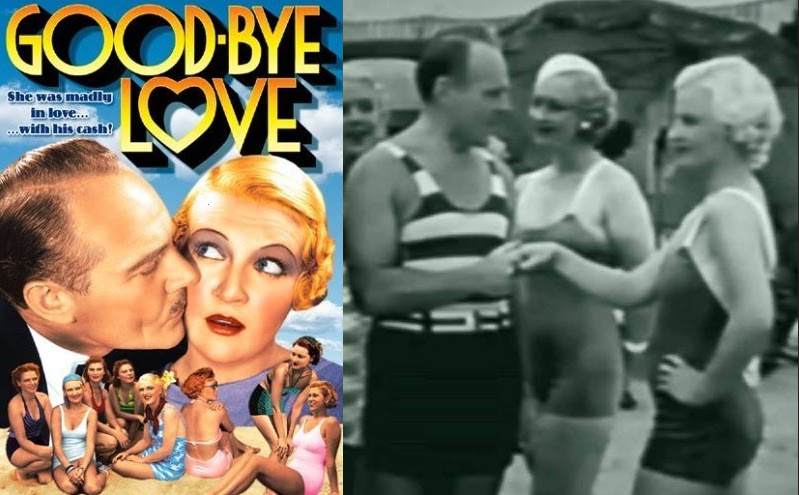
Which of these titles would have convinced you to cough up 40 cents back in 1945?
The flick: Her Favorite Patient (United Artists, 1945)[buy the set] Current IMDb rating: 5.6
Director: Andrew L. Stone (The Last Voyage, Stormy Weather)
Actors of note:
John Carroll (Only Angels Have Wings, Go West)
Ruth Hussey (The Philadelphia Story, The Uninvited)
Charles Ruggles (Goodbye Love, Love Me Tonight, Son of Flubber)
Ann Rutherford (Gone With the Wind, The Secret Life of Walter Mitty, the Andy Hardy series)
The gist of it: Pretty young Dr. Hedy Fredericks (Hussey) is bound for Chicago and a job in a research lab, but she stops by her hometown to visit her bachelor uncle (Ruggles), also a doctor, and brings three hitchhiking Marines -- all named Smith -- along with her. The uncle's medical caseload is overwhelming, so he desperately needs his niece to stay in town. Meanwhile, swaggering local jet pilot Morgan Hale (Carroll) has taken a shine to our lovely doctor, so he and the uncle cook up a scheme to keep her there. To wit: the pilot suffers a minor head injury but then fakes the symptoms of pantophobia (fear of everything) so that she'll stick around to treat him.
My take: Every boy-meets-girl story needs a gimmick, and this one's is that the boy is shamelessly malingering, i.e. exaggerating symptoms for some secondary gain (in this case, love). Her Favorite Patient is a lighthearted little trifle from the waning days of WW2. It's the second Charles Ruggles movie of the collection, but it's not nearly so freewheeling and fleet-footed as Goodbye Love. No, this one is more sentimental and patriotic, with lots of dialogue about serving one's fellow man and, thus, one's country. There's even a serious subplot about a young lady who's been horribly scarred in an accident and desperately needs our young doctor to perform plastic surgery on her so that she won't be disfigured for life.
I think we're supposed to consider the heroine's hometown to be a charming, pleasant place to live, but it looks like hell on earth to me. The local population has exploded, but the town simply isn't equipped to handle the influx of new residents. Parking and lodging are at a premium. Patrons of a downtown cafe have to wait in a long line for a table... and get lousy food for their troubles. Every place you can possibly go is crowded, and there are only two doctors to care for all these people. But everybody's exchanging snappy 1940s movie banter, so I guess they're all okay with it.
More than anything, Her Favorite Patient is a cinematic message-in-a-bottle sent from a long lost age. The hero, who kind of resembles an undernourished Clark Gable, has pomaded hair and a thin mustache, traits that today would mark him as a sleazy criminal but back then rendered him, in the movie's words, "catnip to women." Colorful '40s slang abounds here. Morgan Hale's previous gal pal, Lola (Rutherford), says he's "as true as a $2 cornet," whatever the hell that means. Our leading lady, meanwhile, favors outfits with blocky padded shoulders that form perfect 90-degree angles at her sides. And you know you're in another era entirely when doctors not only drink in the operating room but offer cigarettes to their patients.
Devotees of film music will want to know that the serviceable score for this movie is by Emil Newman, part of the formidable Newman dynasty of film composers. Emil is the brother of Lionel and Alfred and the uncle of Randy. Modern day viewers may want to know why a dwarf actor in a bellboy uniform shows up in one of the restaurant scenes. It's because of Johnny Roventini, the diminutive spokesman for Philip Morris for 40 years, the guy who's always yelling, "Call for Philip Morris!" Pulp Fiction even has a Roventini lookalike working at Jackrabbit Slim's. The real guy was on I Love Lucy, too.
Harvey Korman in Blazing Saddles: "That's Hedley!"
Is it funny: Eh, it could be funnier. Like I said, pretty much everyone makes with the rapid-fire 1940s banter 24/7, but it all feels a bit forced and uninspired. Preston Sturges this ain't... not quite. And John Carroll and Ruth Hussey, while both acceptable, aren't exactly Tracy and Hepburn, either. I was glad to see good old Charlie Ruggles back, too, but he's a kindly supporting character here and exists mainly to service the plot and facilitate the Carroll/Hussey relationship. He hasn't lost his way with a witticism, though, and he gets in a few cynical zingers about bachelorhood and the newspaper industry.
There are a few inspired comedic setpieces here, including a frantic comedic car chase in which Carroll drives alongside Hussey and shouts the Hippocratic Oath to her while they both dodge obstacles, plus a late-in-the-game scene that has Hussey (who has learned the truth about her patient's condition) putting Carroll through some torturous "treatments," including an ice bath, intentional bee stings, and a session in one of those old-timey steam baths in which you sit in a big metal box with only your head sticking out at the top. Her Favorite Patient could have used a few more moments like these,... or else they could have cut maybe 10 minutes from the running time to solve some pacing issues. For you Mel Brooks fans out there, the film offers an additional layer of unintentional enjoyment due to the lead character being named Hedy. She's addressed by name many times throughout the film, and each time, I involuntarily replied, "That's Hedley!" My grade: B- (which is generous)
P.S. - No embarrassing African-American stereotypes here.
William Tracy and Joe Sawyer square off in Hay Foot.
The flick: Hay Foot (United Artists, 1942) [buy the set]
Current IMDb rating: 5.7
Director: Fred Guiol (several Laurel & Hardy shorts including Their Purple Moment, Sailors Beware and Sugar Daddies; later a screenwriter whose credits include Giant and Gunga Din.)
Actors of note:
William Tracy (Angels with Dirty Faces, The Shop Around the Corner)
Joe Sawyer (The Killing, Grapes of Wrath, and much, much more)
James Gleason (Arsenic and Old Lace, Night of the Hunter)
Noah Beery Jr. (Red River, Inherit the Wind, TV's The Rockford Files)
Elyse Knox (The Mummy's Tomb)
Douglas Fowler (Singin' in the Rain, The Thin Man)
The gist of it: Clever young Sgt. "Dodo" Doubleday (Tracy) is long on book smarts but short on street smarts. His encyclopedic knowledge of weaponry and his photographic memory help him win the favor of blustery Col. Barkley and Barkley's pretty daughter, Betty, but the poor dope is too mild-mannered to even fire a real gun. Meanwhile, the more brusque and worldly (read: crude and stupid) Sgt. Ames (Sawyer), who considers himself "the best shot in the Army," wants to prove that Doubleday's a fraud and win the favor of both the colonel and the daughter at the same time.
My take:Hay Foot is sort of an early 1940s military version of Revenge of the Nerds, with a goofy but likable brainiac outwitting some thuggish, dim-witted jock types again and again. This curiously brief feature (clocking in at a mere 43 minutes) feels more like an extended episode of a situation comedy than a feature film.
And, sure enough, UA churned out a whole series of lighthearted service comedies revolving around Sgt. Doubleday and Sgt. Ames from 1941 to 1943 including Tanks a Million, About Face, and Yanks Ahoy. Supporting players like Noah Beery (Jim's dad on The Rockford Files) and James Gleason came and went, but Tracy and Sawyer were in it for the long haul. In 1948, several years after World War II had ended, United Artists brought back Doubleday and Ames one last time as civilians in Here Comes Trouble, which is also included in this Comedy Classics boxed set. A few years later, even-lower-budget Lippert Pictures brought Tracy and Sawyer back for two more military comedies, and the series finally ended in 1952 with Mr. Walkie Talkie, the eighth installment in the "Doubleday" franchise.
It's kind of odd that there's not even a mention of the war in Europe in Hay Foot, the second film in the series, but this is light entertainment, not war propaganda. The strangest thing about this movie is that it seems to end one scene too early. There's a big sharpshooting contest mentioned in the dialogue, but we never get to see it. A shame, too, because it would have been the perfect opportunity for Doubleday to redeem himself as a marksman. As for the film's title, it's never actually said aloud by any of the characters, but it's a Civil War term for a "green recruit," i.e. an inexperienced soldier. Here's an American Heritage article all about it.
Burns & Smithers: One of the great comedy teams.
Is it funny: Yeah, for the most part. I laughed pretty much all the way through Hay Foot at both the verbal and physical humor, and it's always fun to see the little guy make a monkey out of the big guy. Plus the colonel and Doubleday have kind of a "Burns and Smithers" dynamic going on (minus the sexual undertones).
But the film has a bad habit of setting up jokes in a very obvious manner and then repeating them until they lose their appeal. Case in point: Betty sends a dinner invitation addressed only to "the best shot in the Army." It's intended for Doubleday, but Ames and his crony Sgt. Cobb (Beery) find it, too, and since they both consider themselves to be the Army's greatest sharpshooter, all three men show up at Betty's doorstep. Okay, fine, but Hay Foot shows each of the three men discovering the invitation individually, and the script requires them to explain aloud what's happening even though there's no one else in the room to hear it. (The dialogue is always something to the effect of: "What's this? A dinner invitation for the best shot in the Army? That's me!") By the third time, you want to shout, "Yeah, we get it already! Let's move on!"
But I'm nitpicking. Hay Foot has some good-natured fun at the Army's expense (as usual, the top brass are morons), and the movie even has a cute little dog who thinks he's people. He stands on his hind legs and everything! That's always funny. Plus, if you think it's hilarious to watch guys being thrown out of windows, you need to watch this movie immediately. Hay Foot repeats that particular gag so often that it almost plays like defenestration fetish porn.
My grade: B
P.S. - Any negative racial stereotype characters here? Well, there's one heavyset African-American maid, but she doesn't have any dialogue. I'll say no.
Charles Ruggles surrounded by bathing beauties in Goodbye Love.
The flick: Goodbye Love (RKO Radio Pictures, 1933) [buy the set]
Current IMDb rating: 5.1
Director: H. Bruce Humberstone (I Wake Up Screaming, several Charlie Chan films) Actors of note:
Charles Ruggles (Bringing Up Baby, The Parent Trap, TV's Aesop and Son)
Verree Teasdale (A Midsummer Night's Dream)
Sidney Blackmer (Rosemary's Baby, High Society)
Mayo Methot (Mr. Deeds Goes to Town)
Ray Walker (It's a Wonderful Life)
Edward Van Sloan (Frankenstein, Dracula, The Mummy)
Hattie McDaniel (Gone With the Wind, Song of the South)
The gist of it: A bumbling butler (Ruggles) needs some cash to get out of "alimony jail," where his embittered ex-wife has placed him for nonpayment. His wealthy stockbroker boss (Blackmer), a fellow "alimony jail" inmate, advances him $2500 on his salary. The butler, though, gives merely a month's alimony to his ex (an enormous, ill-tempered woman) and spends the rest on a seaside vacation at a rather fancy resort where he passes himself off as a millionaire and big game hunter, attracting the attention of a ruthless golddigger. This very same golddigger, it turns out, is also engaged to the butler's boss, the stockbroker! Several marriages and divorces occur among the cast members before the whole mess is sorted out.
My take: You don't hear the term "alimony jail"much these days, but apparently the idea of husbands providing financial support for ex-spouses was a new, controversial idea back in '33 because this whole film is built around it. It presents ex-wives as lazy, materialistic succubi, draining the life and money out of their beleaguered ex-husbands. Before you cry "sexism," I should point out that the men in this film are no great shakes themselves, horny devils getting in and out of marriages without much forethought and then trying to weasel out of paying spousal support. In fact, I was surprised how refreshingly cynical this 80-year-old film was about the topic of marriage. I didn't even think Hollywood made divorce comedies back then!
The flick is nothing special from a technical standpoint with merely adequate direction, but it looks acceptable for what it is, considering its age and budget. Goodbye Love would work just as well as a stage play. The acting, writing, and plot carry it off nicely, though. Movie buffs will almost certainly recognize two very familiar performers in the supporting cast. First is a pre-Gone With the Wind Hattie McDaneils, playing yet another Mammy-type maid. Classic horror fans, though, will likely be more interested in Edward Van Sloan, a character actor who had appeared in Universal's Frankenstein and Dracula. Here, he's a genial justice of the peace who presides over a couple of chaotic wedding ceremonies and has to look bemused at the wacky goings-on.
Aesop and Son: A prestigious credit for Charles Ruggles.
Is it funny: Yes! For the first time in this project, I've seen a film that actually deserves to be called a "comedy classic." Almost all of that is due to Charles "Charlie" Ruggles, the voice of the toga-wearing, story-telling dad in the Aesop and Son segments of The Bullwinkle Show. (From where I sit, being on Bullwinkle is better than winning an Oscar. And, yes, this film has an actual Oscar winner in the cast, Hattie McDaniels.) Flustered and spineless, yet capable of droll asides, Ruggles is a subtle but very funny comedic presence. There's no real modern equivalent for him. Not long ago, I saw Ruggles playing another butler character in Universal's The Invisible Woman, and he was probably the best thing in that film, too.
The script for Goodbye Love is very sharp with lots of witty one-liners that I will not spoil by repeating them here. Just watch the flick and discover them yourself. The script, while often formulaic, goes off on some admirably weird tangents, too. When the stockbroker's greedy first wife confronts the even-greedier golddigger, for instance, I thought they'd just squabble a little. Instead, they get rip-roaring drunk together (this was only a few months after the end of Prohibition) and plot against their mutual target. Then, there's the scene in which the stockbroker gets thrown in jail. It plays out almost like the middle section of Goodfellas, when Henry Hill and his fellow mobsters go to prison and their biggest concern is how thin their onions should be sliced at dinnertime. Goodbye Love's version of jail is basically a men's supper club, where divorced deadbeats gather around a long table as they feast and sing silly songs about their ex-wives.
Goodbye Love is in no way a perfect picture. The energy sags when Ruggles is off-screen for too long. Meanwhile, the stockbroker is a very dull and lifeless character, and there's an all-too-obvious subplot about his personal secretary, a trustworthy brunette who pines for her employer as he marries one shrewish blonde after another. But all in all, this is by far the best flick I've seen in this project.
My grade: A-
P.S. - It is now clear that I will have to keep a running tally of the negative Negro stereotype characters in these films. Colonel Effingham's Raid had one. Freckles Comes Home had two more. And Goodbye Love has three!
Clearly, the fun never stops in Freckles Comes Home. Actually, this is the funniest scene.
The flick:Freckles Comes Home (Monogram Pictures, 1942) [buy the set]
Current IMDb rating: 5.0 Director: Jean Yarbrough (The Devil Bat, Jack and the Beanstalk, TV's The Abbott and Costello Show) Actors of note:
Johnny Downs (The Crowd, Babes in Toyland)
Gale Storm (It Happened on Fifth Avenue, TV's My Little Margie)
Mantan Moreland (The Palm Beach Story, Spider Baby, the Charlie Chan series)
The gist of it: An impetuous young man, "Freckles" Winslow, returns home from college to tiny Fairfield, IN (pop. 500) to help his gullible friend Danny, who's purchased some real estate with money that wasn't strictly his to invest. To further complicate matters, "Freckles" has also unwittingly convinced a fugitive mobster to hide out in Fairfield. One bad apple soon attracts others to the town who hope to fleece a local banker, and before you know it, there are shootings, stabbings, and robberies galore. Meanwhile, poor "Freckles" has to win back the affection of his girl, who's fallen for one of the gangsters, and ensure that a highway runs through Fairfield. Luckily, a car accident solves everything.
My take: As you can see from that plot summary -- which doesn't even cover half of it -- Freckles Comes Home is quite a busy little picture. Somehow, it still manages to find time for a few totally gratuitous musical numbers and extended comedy sequences in which Mantan Moreland squares off against fellow black menial Laurence Criner. The title implies that the film is a sequel, and the script takes it for granted that we already know and care about most of these characters. As it turns out, the original Freckles was a 1904 novel by Gene Stratton-Porter which has been adapted into a movie at least four times (and also inspired 1992's City Boy), but none of the actors from those films are present in Freckles Comes Home. Instead, this sequel is based on a 1929 novel by Gene's daughter, Jeannette Stratton-Porter, who continued the Freckles saga after her mother died in 1924. I was unfamiliar with any of this, and Freckles Comes Home did not exactly leave me hungry for more.
As the title character, Johnny Downs (who has no freckles that I could see) comes across like a bargain-basement substitute for Jimmy Stewart. The plot twists come fast and furious, but the whole thing seems very contrived, and there is very little sense of what small town life is like.
One of Mantan Moreland's "party records."
Is it funny: Only fitfully. Freckles himself is something of a cipher, and neither pal Danny nor love interest Jane is particularly compelling either. Jane's dad, money-hungry Mr. Potter, is somewhat fun in a Milburn Drysdale kind of way, particularly in a scene in which "Freckles" visits the Potter home with one of the gangsters in tow, only to see the pencil mustache-wearing crook charm the father and the daughter instantly, leaving "Freckles" himself the odd man out.
I'd say the best character in the film is the town's ornery yet totally ineffectual constable, Caleb Weaver, played by the awesomely-named Irving Bacon who appeared as a bit actor insome of Hollywood's greatest classics. Caleb is sort of a proto-Barney Fife, suspicious of everyone and quick to accuse others but never on the right track and not much of a credible threat. He gets what, to me, is the film's funniest line: "Gosh all fishhooks!"
Then we must consider the servile role played in this film by Mantan Moreland, a comedian and actor who was directly influenced by the infamous Stepin Fechit. Moreland is clearly a talented performer with great comic timing and an expressive face he uses to its best advantage. In his highly-recommended book, Toms, Coons, Mulattoes, Mammies, & Bucks: An Interpretive History of Blacks in American Films, historian Donald Bogle credits him with having "the fastest eyes in the West."
But Moreland's style of comic buffoonery has definitely gone out of style in 2013. It had, in fact, fallen out of favor during the actor's own lifetime. His character here -- a hotel porter -- is both slow-witted and dishonest (he buys a fraudulent "gold-divining machine" and then tries to sell it), not to mention cowardly, selfish, and inarticulate. Let's not judge him too harshly, though. Moreland was giving white audiences what they wanted because that's what paid the bills. Incidentally, he had a second career as a stand-up comic catering to the black audience. One of his bits, involving carnal relations with mashed potatoes, has become a classic in some circles.
The poster blatantly gives away the ending of Country Gentlemen, a vehicle for the team of Olsen & Johnson.
The flick: Country Gentlemen (Republic, 1936) [buy the set] Current IMDb rating: 5.2
Director: Ralph Staub (The Mandarin Mystery, Screen Snapshots Series)
Actors of note:
Ole Olsen and Chic Johnson (Hellzapoppin')
Joyce Compton (The Best Years of Our Lives, Mildred Pierce)
Prince the Great Dane (Never Give a Sucker an Even Break)
The gist of it: Two fly-by-night swindlers have to go on the lam after they sell some worthless shares in a gold mine. They abandon the city for small town life in the quaint little community of Chesterville, where they start a new scam selling worthless shares in an oil well. Madcap hijinks ensue, as you might guess.
My take: All diligent students of comedy will eventually come across references to Hellzapoppin', a wild and fast-paced 1938 Broadway revue that became a surrealistic 1941 film. With its rapid-fire pacing, kitchen sink approach to humor, and total lack of plot, Hellzapoppin' is often cited as a precursor to Rowan and Martin's Laugh-In, Saturday Night Live, and Monty Python's Flying Circus. At the center of all this craziness were Ole Olsen and Chic Johnson, two very conventional Vaudeville comics who'd been working as a team since about 1914. Country Gentleman is a pre-Hellzapoppin' vehicle for the boys, but it's a much more timid and traditional story about two scoundrels who accidentally find redemption in a small town. Ole even romances a widow with a cute kid. How cornball can you get? This was a cheapie made by Republic Pictures, so every possible expense was spared in the making of this film. Johnson blatantly flubs a line once and corrects himself before the scene continues.
Ole and Chic: Together forever in Las Vegas.
Is it funny: Eh, it depends on your tolerance for creaky Vaudeville humor and the type of gags typically found in children's joke books. I have to admit I laughed out loud when Johnson said, "You wouldn't hit a man with glasses," while holding up two drinking glasses in front of his face.
At the heart of it, Olsen & Johnson are a second-rate act, nowhere near the Marx Brothers or Laurel and Hardy and taking a back seat to the Three Stooges and Abbott and Costello. Olsen is the slightly more serious of the two and comes off like a cross between Bud Abbott and Shemp Howard. Johnson is the chubbier one -- his character is even called "Chubby" in this film -- and he has a slightly zanier personality, somewhere between Joe Besser and Curly Howard. Laughing at your own jokes is supposedly a comedy no-no, but it's absolutely essential to Olsen & Johson's schtick. Their calling card, in fact, is Johnson's high-pitched giggle, which is heard frequently during Country Gentlemen.
Frankly, the best lines in this film go to Joyce Compton as a ditzy blonde secretary with a pet Great Dane she has whimsically named "Fluffy." By the way, I found it strangely poignant to learn that Ole and Chic were buried side by-side in Las Vegas' Palm Mortuary.
Charles Coburn leads the charge as the irascible Colonel Effingham.
Well, it's taken me long enough,but I've finally gotten around to actually watchingthat Mill Creek comedy boxed setI purchased last year from a grocery store bargain bin. I figured that I might as well write about the films here on the blog before they evaporate from my memory forever. I've decided to be conventional and watch the films in the order they appear in the set, so I'm starting with Disc One, Side A. Won't you join me?
The flick:Colonel Effingham's Raid (20th Century Fox, 1946) [buy the set]
Current IMDb rating: 6.1 Director: Irving Pichel (The Most Dangerous Game, Destination Moon)
Actors of note:
Charles Coburn (Gentlemen Prefer Blondes, Around the World in Eighty Days)
William Eythe (The Ox-Bow Incident)
Joan Bennett (Suspiria, Scarlet Street)
Donald Meek (Stagecoach)
The gist of it:A retired Army colonel (Charles Coburn) returns to his hometown in Virginia to find that the citizens have become apathetic and that the local government is corrupt. He soon jolts the townspeople out of their complancy, first by writing a fiery column in the local newspaper, then by organizing a movement to preserve the city's historic courthouse. In doing so, he inspires a younger relative of his to enlist in the armed services and defend his country overseas.
My take: The most important thing you need to know about Colonel Effingham's Raid is that it was released in January 1946, just five months after V-J Day, but set in the spring of 1940, a year and a half before the bombing of Pearl Harbor. In between 1940 and 1946, of course, was America's involvement in World War II. This film is meant to function as both a rousing propaganda piece and a homespun comedy of manners.
More problematic, though, is that this is also a paean to the glory days of the Old South. It's tough for a modern-day Yankee like me to get too terribly nostalgic for the Confederacy. We hear "Dixie" on the soundtrack a few times, and there's a cowardly, bumbling Negro servant in the cast. Plus, Colonel Effingham feels strongly that the town square should be named in tribute to "our glorious Confederate dead" and not after some "carpetbagger" (i.e. Northern) politician. Strangely enough, for a movie about the South, there's a distinct lack of Southern accents in this film. Charles Coburn seems to be the only actual Southerner in the main cast. The young romantic leads are played by actors from Pennsylvania and New Jersey.
Miracle: a parallel story
Is it funny: Eventually, yes. Sort of. This film reminds me a bit of Miracle on 34th Street, which is also about an irascible but lovable old codger who fires up the imaginations of the citizenry, frustrates the political establishment, and ultimately brings out the best in a promising young man, all by sticking to his principles and never surrendering. At first, the colonel's behavior struck me as so mild that I didn't understand why the other characters found it so shocking. I mean, what's the big deal about writing a column and having your name appear in the newspaper? Today, everyone seems to want as much media attention as they can get. But once I realized just how old-fashioned and conservative these people were, I began to get a kick out of Effingham's antics.
For me, the sleazy politicians, always plotting and scheming behind closed doors, are what make the movie work. They make great, hissable villains, and it's fun to see them get a very public comeuppance at the end. One running joke which did not work for me, though, was that the filmmakers inserted a loud wolf whistleon the soundtrack every time William Eythe checked out Joan Bennett's legs. It's a dumb gag and breaks the reality of the picture. By the way, you Kids in the Hall fans should not confuse "Effingham" with "effing good ham."
My preliminary attempt at mapping the feature films of the Coen Brothers.
With the imminent releaseof Joel and Ethan Coen's next feature, Inside Llewyn Davis, I thought it was a good time to discuss an aspect of the brothers' career which has thus far escaped critical notice. Taken in total, their films provide a portrait of our nation from one coast to the other. Their America is a skewed, surreal and often dangerous place populated by misfits, outlaws, rebels, big shots, and fiercely independent eccentrics.
While American society becomes more and more homogeneous over time, most Coen films heavily emphasize the local customs, accents, and attitudes of the places where they are set. In a sense, the filmmakers have a vested interested in preserving the so-called "old weird America" before it's obliterated by television, the Internet, and nationwide retail and restaurant chains.
I believe that the brothers are fascinated with American iconography above all other themes and have used their movies to explore various American archetypes which loom large in our collective imagination. It goes without saying that a Coen film will be "weird" to one extent or another, but the particular flavor of "weird" depends on where the film is set and which American subculture is being satirized, venerated, or simply observed in the script.
Marge Gunderson and the Dude may be contemporaries, for example, but they do not lead similar lives and would probably not have much to say to one another if they were seated side-by-side on a long bus trip. Meanwhile, Ed Crane's America is not Norville Barnes' America. Geographically, sure, it's the same place but philosophically, it's not even close.
To better understand the Coen Brothers' attitude toward their homeland (or certain sections of it, anyway), I have organized their films geographically.
THE SOUTHWEST (Texas, Arizona, and Arkansas)
M. Emmet Walsh and Dan Hedaya in the relentless Texas heat of Blood Simple.
Films:Blood Simple, Raising Arizona, True Grit, No Country for Old Men
More than any other region of the country -- even their native Minnesota or their adoptive California -- it is the Great American Southwest where the Coen Brothers have done their most potent myth-making. For them, this is a spooky and merciless place where guns, drugs, and money hold sway and where Revenge is often the law.
Their first feature, Blood Simple, famously begins with a monologue by sleazy private eye Loren Visser (M. Emmet Walsh) who explains life in Texas to us: asking your neighbors for help is useless, he says, because "down here, you're on your own." Visser's cynical speech is accompanied by a series of eerily beautiful but foreboding shots of Texas, all composed as meticulously as a Mark Rothko canvas. We see highways, farmers' fields, oil derricks, and a drive-in theater, but not a human being in sight. This sets up a pattern the Coens will repeat in The Hudsucker Proxy and The Big Lebowski: introduce the place first, minus the people, while an off-screen character narrates, and then let the camera "find" the movie's protagonist after a few minutes. The Texas we see in this movie is a desolate, barren, and hopeless place with plenty of wide open stretches where people can commit horrible crimes without police interference.
A little over two decades later, the Cones returned to the Lone Star State for No Country for Old Men, a downbeat crime drama which makes Blood Simple look like a carefree romp in comparison. Here, the law maintains a token presence, represented by Tommy Lee Jones' grizzled Sheriff Bell, but is ultimately impotent against a new breed of pitiless super-criminals like Anton Chigurh (Javier Bardem). "The crime you see now, it's hard to even take its measure," Sheriff Bell wearily tells us.
Raising Arizona: Bounty hunter Leonard Smalls is armed and unafraid.
True Grit and Raising Arizona are rather more optimistic than the Coens' two Texas films. How could they not be? In these movies, at least, the guilty are duly punished and the heroes are (more or less) satisfied at the end. But even here, the protagonists are often at the mercy of violent, ruthless men --Randall "Tex" Cobb's Leonard Smalls in Raising Arizona and Josh Brolin's treacherous Tom Cheney in True Grit -- who are motivated solely by greed and who will gladly kill to further their own ends. These men have no permanent home and do not fear the law, so our heroes must face them and defeat them without help. One blogger, by the way, has actually written an article comparing Leonard Smalls and Anton Chigurh. Give it a read, won't you?
And while you're at it, I invite you to compare and contrast the opening scenes from No Country for Old Men and Blood Simple. Though the films were released 24 years apart, the stories in them occur only four years apart. No Country takes place principally in West Texas, along the Mexican border, while Blood Simple is set somewhere in Central Texas. Both films begin with thoughtful, contemplative monologues, but one of our narrators is an honorable man and the other an opportunistic swine. The question to consider here is: are these men being pessimistic or realistic when they describe the Texas they know?
THE SOUTHEAST (Mississippi)
George Clooney and pals seem about to be lynched in O Brother, Where Art Thou?
Films:O Brother, Where Art Thou?, The Ladykillers
When it comes to covering the American Southeast, also known as the Deep South or the Old South, the Coen Brothers' attitudes are clearly rooted in nostalgia, folklore, and Hollywood romanticism than in any sort of reality. The Coens' South is a quaint, dusty, sepia-toned place where hobos carry bindlestiffs, freshly-baked pies sit cooling on windowsills, and there is nothing more sacred than Sunday service. And music, of course, is everywhere. It's just part of the atmosphere, flowing from every home and generating itself spontaneously in nature.
The Coens have described O Brother as a "hayseed comedy," and term applies just as well to their remake of Ealing Studio's The Ladykillers. Although the former is set during the Great Depression of the 1930s and the latter in the mid-2000s, Mississippi seems not to have changed much in the ensuing seven decades.
In fact, take out the references to rap music (or "hippity hop") and a few other modern-day trappings like convenience stores, and The Ladykillers could take place simultaneously with O Brother. Both films are farces about groups of inept criminals led by motor-mouthed "gentlemen thieves" who never limit themselves to one- or two-word utterances when they could accomplish the same goal with 50 words. Like George Clooney's Ulysses Everett McGill, Tom Hanks' Professor Dorr uses his eccentric vocabulary and serpentine sentence structures to dazzle and disorient those around him. To put it simply, these fellas sure can talk.
As I said earlier, another thread which connects these films is their heavy use of traditional regional music. One group of thieves (in O Brother) actually does form a band along the way, while the other (in The Ladykillers) merely poses as one. It's possible that the Coens made these films simply for the opportunity to use old bluegrass and gospel recordings on the soundtrack. O Brother indeed created a chart-busting, Grammy-winning sensation with its companion album consisting of vintage 78s, field recordings, and songs newly recorded (most notably "Man of Constant Sorrow") in the style of days long past.
Hurt by the film's critical and commercial failure, The Ladykillers soundtrack LP did not manage to do for old-time gospel what O Brother had done for bluegrass. The album is no less astonishing, though, and the music itself manages to raise the stakes of the film's plot. The Ladykillers is a dark comedy in which inept crooks are regularly killed off, but the religious music on the soundtrack constantly reminds us that the characters' actions may have far-reaching consequences in the Next World.
THE EAST COAST (New York, Washington D.C.)
Paul Newman enjoys a Monte Cristo against a backdrop of skyscrapers in The Hudsucker Proxy.
Films:The Hudsucker Proxy, Miller's Crossing [possibly], Burn After Reading, Inside Llewyn Davis
The Coens don't often head out East, but when they do, they tend to include a few common elements: men in well-tailored suits, rapid-fire dialogue peppered with brisk comebacks, copious alcohol consumption, and winner-take-all scenarios in which no quarter is asked or given. After all, it's a jungle out there. If you study the image above, you'll notice a distinct visual change from the Coen films set in the Southwest and Southeast. This being NYC in winter, the temperature has dropped considerably, and the film's color scheme has skewed to a blueish-gray hue in sympathy.
Until Inside Llewyn Davis, which centers around the Greenwich Village folk scene of the 1960s, The Hudsucker Proxy was the Coen Brothers' one-and-only true "New York movie." Woody Allen and Martin Scorsese have basically spent their whole careers in the Big Apple, but the Coens visited the place with great hopes in the 1990s, met with financial ruin there, and didn't return for two decades. Now they're giving the place a second chance.
From what I've seen in the trailer, Llewyn Davis is considerably more realistic than the completely fantastical, dreamlike New York of Hudsucker, a highly-stylized screwball comedy which is arguably the only Coen film to employ elements of the supernatural. The magical character of Moses the Clock Man (Bill Cobbs) is very much a precursor to the Stranger, the genial cowboy portrayed by Sam Elliott in The Big Lebowski. In a way, Moses and the Stranger are East Coast and West Coast variations on the same role. Both are folksy storytellers who narrate their respective movies and watch over all the other characters like benevolent gods. (Perhaps it's telling of the difference between New York and LA that Moses intervenes when the hero, Norville Barnes, is in real trouble, but the Stranger simply watches from the sidelines.) Just as the Stranger kicks off Lebowski by giving us his personal take on Los Angeles, Moses welcomes us to The Hudsucker Proxy with a speech about the perils and pleasures of New York:
Elsewhere in the Coen filmography, we have a couple of hard-to-categorize outliers. Miller's Crossing is the duo's Prohibition-era gangster film, and it takes place in an undisclosed urban locale referred to only as "the city." I have arbitrarily placed the film in New York due to the presence of both Irish and Jewish gangsters, but the story could just as well be occurring in Chicago, Boston, or Philadelphia. It was shot in New Orleans, but no one in the film has any hint of a Louisiana accent so I have ruled it out as a setting. Wherever it takes place, Miller's Crossing is a handsome film which lends its various mob bosses, thugs, and gun molls a sense of old Hollywood glamour. It is interesting that the film, unlike most crime sagas, mixes urban and pastoral settings. The title location, for instance, is a forest clearing where bodies are dumped and executions carried out. Despite its grim function, the crossing still looks sumptuous and inviting due to the rich cinematography of Barry Sonnenfeld. Burn After Reading, on the other hand, does not portray its setting, Washington D.C., in such a flattering manner. This is a cold-blooded comedy of errors whose inept, unsympathetic characters routinely betray, threaten, and deceive one another. Fittingly, they inhabit what seems to be a godless, indifferent, and comfortless universe. This being our nation's capital, there are a number of massive government buildings which figure into the plot (including CIA headquarters and the Russian embassy), but these are portrayed in an unappetizing manner -- they're imposing rather than impressive -- and they must share screen time with such shabby, work-a-day locations as an unremarkable apartment, a blandly ugly gymnasium, and an uninspiring movie multiplex. There are some more photogenic neighborhoods in Burn After Reading, but these are inhabited by some of the movie's nastiest characters.
THE UPPER MIDWEST (Minnesota)
A storm approaches at the end of A Serious Man.
Films:Fargo, A Serious Man
It took a while for the the Coen Brothers to get back to their Minnesota roots, but when they did, they did so in a big way. Interestingly, Ethan Coen's 1998 short story collection, Gates of Eden, contains a fair amount of commentary on his family's home state. Minnesota, in fact, may be called one of the book's primary motifs. One character, for instance, uncharitably describes Minneapolis as a "strange frozen city where people's breath hovers about them, where fingers tingle and go dead, where spit snaps and freezes before it hits the ground." Another narrator is more forgiving:
The city had not much serious crime. It was dotted with scenic lakes. The people were polite. Many owned boats. In the summer they engaged in water sports; in the winter they skied. The solid northern stock seemed immune to the great miseries and grand passions upon which crime traditionally feeds.
Minnesota is the setting for two of the Coen Brothers' most accomplished and fulfilling works: Fargo and A Serious Man. As anyone who has seen these films can confirm, the characters indeed experience "great miseries and grand passions" and are nowhere near "immune" to these emotions, even though they maintain the outward stoicism for which the region is famous. (An old joke: "Did you hear bout the Norwegian who loved his wife so much he almost told her?")
The perceived nothingness of the state, the utter blankness of Minnesota, is what makes the plots of Fargo and Serious all the more shocking. "A lot can happen in the middle of nowhere" went the tagline for the former. When local police chief Marge Gunderson (Frances McDormand) arrives at the site of a grisly roadside shooting, she guesses that the suspects are not from Brainerd. She's right, of course, but Jerry Lundegaard (William H. Macy), the hapless car salesman whose kidnapping scheme is the catalyst for the whole movie, actually is from Brainerd. Evil lurks behind the blandest of facades.
The two films work as a diptych: Minnesota in winter, Minnesota in spring. Fargo gives us seemingly endless terrain blanketed in snow, while Serious lets us see what the place looks like after it's thawed out. Ironically, the lack of snow only serves to emphasize the featureless desolation of the land. A Serious Man largely takes place in a newly-built suburban community, and the lack of trees and vegetation gives the place an unsettling starkness. Struggling with the TV antenna on his roof, ineffectual college math prof Larry Gopnik (Michael Stuhlbarg) is at least as pitiful as Jerry Lundegaard, who loses his composure while scraping the ice from his car window in a dismal parking lot after a business meeting with his father-in-law doesn't go as he'd hoped. Note how the high camera angle at the beginning emphasizes Jerry's laughable insignificance.
What separates Fargo from A Serious Man is ethnicity. Fargo takes us into the world of "Swedes, Poles, and German Lutherans" (Ethan's words again) which comprise much of the population there. The film's two most-noticed details were the characters' heavy Minnesotan accents (with frequent repetitions of "yah" and "you betcha") and their unflagging, almost superhuman politeness (a tradition dubbed "Minnesota Nice").
The use of dialect was the most controversial aspect of the film upon its initial release, with some critics dismissing the film entirely based on that one aspect of the production. However, a great many more were charmed by the accent and found themselves imitating it after seeing the film. It's tough not to. The accent was certainly exaggerated for the film, a point which irked some native Minnesotans, but I feel it was done with affection. This was how the people of Minnesota must have sounded to Joel and Ethan growing up. Which brings us to that other Coen Brothers film set in their home state...
More bad news for Larry Gopnik in A Serious Man.
A Serious Man is very explicitly about the experience of being Jewish in Minnesota in the 1960s, surrounded by skeptical Midwestern Protestants on all sides. It's a world the Coens obviously knew first-hand, and it comes up again and again in Gates of Eden. Some of the details in this movie, such as the sister who spends all of her time in the bathroom, were first described in Ethan's book. Ethan also wrote with great humor about the drudgery of attending Hebrew school with its glowering, humorless rabbis and arcane lessons.
It's no surprise that A Serious Man is the brothers' most openly religious film. The plot is essentially the Book of Job translated to LBJ-era American suburbia: a decent and devout family man, the previously-mentioned Larry Gopnik, suddenly faces a series of familial, professional, legal, and financial setbacks. Towards the end, just as his fortunes seem to be improving somewhat, a whole new set of problems descend upon him and the film ends on a note of dread, with many of Larry's issues left unresolved.
Many viewers and critics intuited that God is personally and unfairly punishing Larry in this film, but that notion presupposes the very existence of God, which I don't necessarily think is a given in the Coen world. Larry might just be having a string of rotten luck. It's up to the viewer to decide whether or not these events have any theological significance. But what we can safely say is that poor Larry Gopnik is denied the solace afforded to Marge Gunderson at the end of Fargo. She can take comfort in her loving husband and soon-to-be born child, while he can only pray for the best to a God who may or may not be listening and who may not even exist.
THE WEST COAST (California)
The Big Lebowski's Tara Reid at home in the land of fruits and nuts.
Films:The Big Lebowski, Intolerable Cruelty, Barton Fink, The Man Who Wasn't There
And now, from the Land of a Thousand Lakes, we travel two-thousand miles westward to the "Land of a Thousand Flakes," as Mad magazine once put it. A mere thousand seems like an awfully low estimate, though, especially from what we see of California in the Coen Brothers' movies. The rest of the country sees the state as a place where America's most shallow, greedy, deluded, and debauched individuals have gathered to take advantage of one another.
The Coens tend to reinforce this idea through their work. Intolerable Cruelty takes place in a number of locations, including Las Vegas, but the film's main action centers around Los Angeles and gives us all the typical targets we'd expect from such a story: conniving lawyers, unfaithful husbands, gold-digging wives, bitter divorce cases, iron-clad prenuptial agreements, ridiculous reality television shows (America's Funniest Divorce Videos), and pets who are treated like spoiled children. In Gates of Eden, Ethan gives us a distinctly Jewish-American spin on the topic as he describes the fate of a Hebrew schoolmate:
For the next several months, Michael was a model student, if somewhat robotic, until his family moved to California, where (it was common knowledge) all meshuggenehs end up.
Of all the characters in the Coen canon, there are two whose lives somewhat mirror those of the brothers themselves. One is Barton Fink (John Turturro) and the other is Bunny Lebowski (Tara Reid). Both Barton and Bunny travel to the Golden State in order to work in the exciting field of motion pictures: he as a writer, she as a starlet. Like the Coens, Barton is a nerdy, socially awkward Jewish writer, while Bunny (the former Fawn Knutsen of Moorhead, MN) is another transplanted Minnesotan*. Unlike Joel and Ethan, however, these two fail to find success in Hollywood.
Having conquered Broadway, Barton is assigned to write a "Wallace Beery wrestling picture" and struggles to complete a first draft while getting embroiled in a gruesome homicide case. His move from New York to Los Angeles, a blatant cash-grab suggested by his unscrupulous agent, seems ill-advised from the start. The actual transition is suggested by an ominous shot of a wave crashing against a rock on the shore of the Pacific Ocean.
Like A Serious Man, Barton Fink can be interpreted as a biblical parable. The dilapidated hotel where Barton lives may be Hell, while his neighbor (John Goodman) and boss (Michael Lerner) make pretty good stand-ins for Satan and God. Like "Hotel California" by the Eagles, Barton Fink makes a case for Los Angeles as a kind of Inferno or Purgatory. Meanwhile, in The Big Lebowski (whose protagonist hates "the fuckin' Eagles"), the only screen work Bunny can get is in a cheaply-produced pornographic film called Logjammin'. The former high school cheerleader winds up a drug-addicted trophy wife who owes a hefty sum of money to the film's Hugh Hefner-esque producer, Jackie Treehorn (Ben Gazzara). To summarize, then, the Coen Brothers do not present Hollywood as a place where people's dreams come true.
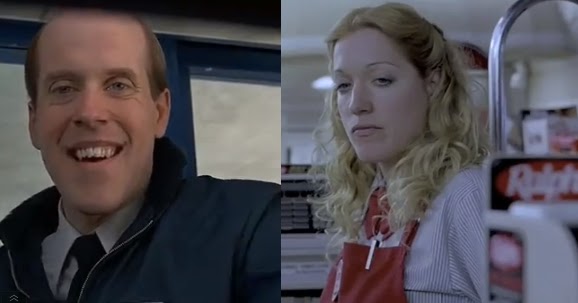
Customer service: Minnesota-style vs. California-style
The Big Lebowski is the Coen Brothers' definitive "California movie," and it serves as both a tribute to and parody of the so-called Land of Fruits and Nuts. While fans across the country and around the world have embraced the laid-back lifestyle of the film's hero, the Dude (Jeff Bridges), the film offers a panoramic view of Los Angeles and its surrounding communities. Those with an intimate knowledge of SoCal culture must experience an extra level of enjoyment when they watch this film. With the Dude as our informal tour guide, we travel to stuffy Pasadena, ultra-casual Venice, ritzy and exclusive Malibu, scuzzy Simi Valley, and humble North Hollywood, where a former television writer wheezes his days away in the iron lung which keeps him alive.
Of course, we have an assortment of California kooks on hand, too, many of whom have convinced themselves they they are somehow part of the art world, music world, or movie industry. The Dude's shy, chubby landlord, Marty, gives an interpretive dance recital and (in classic Hollywood fashion) asks his constantly-in-arrears lodger to attend and give him "notes." Then there are the Nihilists (led by Peter Stormare): three washed-up German techno musicians who, in their desperation, have cooked up a ransom scheme which they hope will net them $1 million. (It won't.)
Much higher up in the food chain is Maude Lebowski (Julianne Moore), a woman whose inheritance from her mother has allowed her to live the life of a bohemian artist in a stylishly-appointed loft where she drizzles paint onto a giant canvas while dangling nude from a harness. Her dear friend, the fey, giggling Knox Harrington (David Thewlis) is supposedly a "video artist" but seems more apt to be a trust-fund-draining layabout. And we haven't even gotten to the film's most celebrated supporting characters: belligerent Vietnam vet Walter (John Goodman), leering pedophile Jesus Quintana (John Turturro), and perpetually bewildered surfer and bowling prodigy Donny (Steve Buscemi).
Before we leave Lebowski, it's worth pointing out that it was the follow-up to the critical and commercial triumph of Fargo. Since the films had several key cast members in common (Buscemi, Goodman, Stormare, and others), the public might have been expecting a quasi-sequel or continuation. The Coens, however, let us know within the first few minutes of The Big Lebowski that we're not in Brainerd anymore. While Fargo was peopled by impossibly cheerful cashiers, waitresses, parking lot attendants, and even prostitutes, Lebowski gives us California's brand of customer service. Apart from the Dude, the first human being we see in the film is an obviously-bored Ralph's checkout girl (Robin Jones) who glares with disgust at our hero as he writes a $0.69 check for his half and half.
* The Big Lebowski's theme music is "The Man in Me" by Bob Dylan, another Minnesota-born Jew who left his home state and, like Bunny Lebowski, adopted a new name (his real moniker is Robert Zimmerman) and a new persona to go with it.
Northern California noir: Frances McDormand and Billy Bob Thornton in The Man Who Wasn't There.
We find a very different California in The Man Who Wasn't There, a James M. Cain-inspired noir tale set in 1949 and presented in gorgeous black-and-white. Our protagonist -- you'd be hard pressed to call him a hero -- is Ed Crane (Billy Bob Thornton), an impossibly reserved and tight-lipped barber who lives with his adulterous bookkeeper wife (Frances McDormand) in the quiet suburban community of Santa Rosa. We're a long way from Los Angeles -- a good 427 miles north of the Dude's slovenly bungalow. These aren't the crackpots and showbiz wannabes of the Coens' other California flicks. These are solid, practical-minded folks, much closer in spirit to the characters in Fargo and A Serious Man.
But just as with those films, the sedate setting of The Man Who Wasn't There is no deterrent to "great passions and grand miseries." Just like Jerry Lundegaard and phony millionaire Jeffrey Lebowski before him, Ed Crane tries to raise some cash through a scheme which directly endangers his own wife. In this case, he plans to blackmail Doris' lover (James Gandolfini) and use the proceeds to go in on a dry-cleaning business. This being a Coen film, the plan backfires spectacularly and the plot goes off on unexpected tangents involving Beethoven, UFOs, and Heisenberg's Uncertainty Principle. Moody and haunting, The Man Who Wasn't There ranks among my very favorite Coen films.
So there you have it folks!
We've managed to cover the United States from the Atlantic to the Pacific through the films of Joel and Ethan Coen. As the map at the beginning shows, there's still plenty more territory for the boys to cover. They've yet to do a film set in the Great Plains, the Pacific Northwest, New England, or anywhere in the Midwest besides Minnesota. Much of the Southeast and Mid-Atlantic regions remain untouched as well. Still in all, their feature films function as a kind of prism through which we can view this wonderful, terrible country of ours -- distorting some of its features and bringing others into sharper focus.