Monday, July 30, 2018

The Rock & Roll Hall of Fame inducts itself into itself

The newest inductee to the Rock & Roll Hall of Fame: the Rock & Roll Hall of Fame

CLEVELAND - In a move that has been met with little surprise and less controversy, the Rock & Roll Hall of Fame has voted unanimously to induct itself into the Rock & Roll Hall of Fame as part of its new Places and Institutions category.

"From Chuck Berry to Nirvana, rock music has been shaped by legendary, innovative performers over the years," says Caroline Hansen, vice president of collections and curatorial affairs for the Cleveland museum, "but in the past we've also recognized the contributions of producers, executives and songwriters in our Non-Performers category. The next logical step was to create a category especially for the buildings and physical locations that truly shaped rock history."

Besides the Rock Hall, the inaugural class of inductees includes: Sun Studio in Memphis, where Elvis Presley, Jerry Lee Lewis, Carl Perkins and others recorded; Yasgur's Farm in Bethel, NY, home of the original Woodstock music festival; Liverpool's Cavern Club, where The Beatles got their start; the Altamont Motor Speedway in Tracy, CA; and the notorious Riot House hotel in West Hollywood.

Dedicated in 1995, the $65 million museum is by far the newest site on that list.

"This may seem incredibly self-serving, even galling, but we put a lot of thought into this," maintains Hansen. "After much debate, we all agreed that the Rock and Roll Hall of Fame, located at 1100 E. 9th St. in Cleveland and open from 10am to 5:30pm Sunday through Tuesday and 10am to 9pm Wednesday through Saturday, is worthy of being inducted into itself. By the way, did I mention that we currently have an entire exhibit dedicated to Neil Young's fringe-y leather jackets from the '70s? Some of them still smell like doob!"

Hansen further argues that the Rock Hall is more, not less, worthy of induction than other buildings. "This place was designed by I.M. Pei. Who designed Sun Studio? Exactly. Some jerk that nobody remembers."

The Rock Hall further announced its intention to create an Inanimate Objects category for such legendary items as the plaster cast of Jimi Hendrix's penis and the Led Zeppelin mudshark.

Wednesday, July 25, 2018

Ed Wood Wednesdays: The Wood Poughkeepsie Odyssey, Part Six by Greg Dziawer

The Sunshine Mountaineers were basically The Soggy Bottom Boys of Poughkeepsie, NY.

Early last year, in "The Wood Poughkeepsie Odyssey, Part Four," I attempted to give you an overview of The Sunshine Mountaineers, a band Edward D. Wood, Jr. played in—and purportedly founded—when he was a teenager. I surmised at the time, incorrectly it turns out, that the Mountaineers were a country-and-western group influenced by hillbilly mountain music. It seemed a logical assumption, since traditional hillbilly music was waning in popularity at the time while more modern C&W was on the rise. But nope. The Sunshine Mountaineers were, in fact, a jug-totin, fake-beard-wearin' hillbilly band, right down to their straw hats and red necks.

In researching The Sunshine Mountaineers further, I found a few press articles mentioning the group from the summer and early fall of 1940. Curiously, Eddie is nowhere to be found in these clippings, suggesting he had left the band by then.
   
Poughkeepsie Eagle-News (June 6): On June 5, the band played a testimonial dinner for Thomas Case, a retired post office engineer. Although the article lists dozens of names of those present, Eddie's father is not among them, although he was then himself a veteran of the Poughkeepsie Post Office, working as a custodian. 

Thomas Case hadn't had a bite in weeks, so they bit him.

Poughkeepsie Eagle-News (July 26): The Mountaineers posed, out of costume, for publicity pictures at radio station WKIP in Poughkeepsie. The accompanying caption noted that the band was then performing twice weekly on the station (Tuesday and Thursday nights at 8:15) and listed eight performers in the group, four boys and four girls, Eddie not among them. Two of the boys just happened to have the same surnames as gentlemen who had attended the Thomas Case testimonial dinner the month prior. So it would seem that the men of the Poughkeepsie post office had spawned a hillbilly band.

On the radio, whoa oh oh. On the radio.

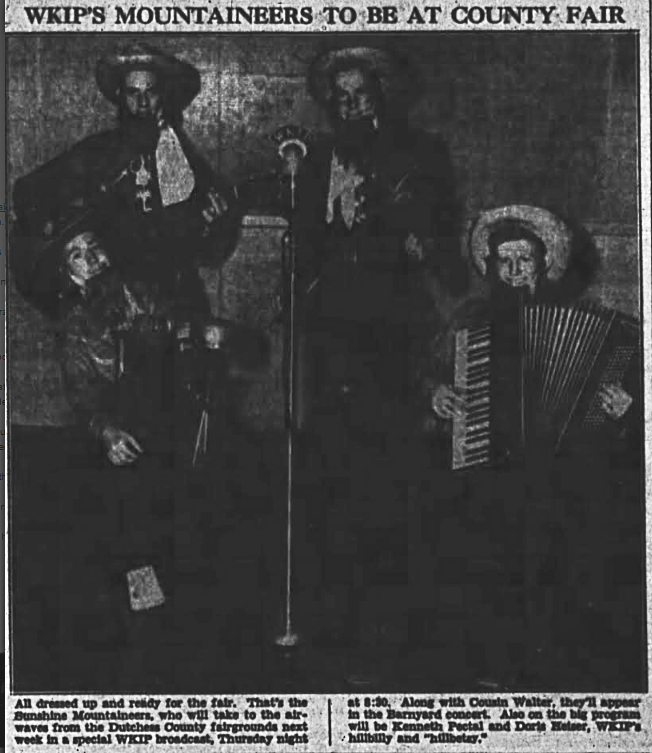
Poughkeepsie Eagle-News (August 26): The paper printed on this day a quintessential snapshot of the fully costumed Mountaineers, promoting their upcoming appearance at the Dutchess County Fair. They appear to be just a quartet of teen boys playing dress up. No names are mentioned, and it looks like mostly the same boys as in the July 26 photo, but the young man in the back on the right has a slight resemblance to Eddie. 

WKIP in Poughkeepsie. Sounds like a sitcom.

Poughkeepsie Eagle-News (August 28): This WKIP ad details the station's live broadcasts from the aforementioned country fair. The Sunshine Mountaineers were playing "every evening" at the fair, and the ad lists them first among the "special attractions." A good gig. President Franklin Roosevelt visited the fair that year, with the Crown Princess of Norway in tow. The fairgrounds were in Rhinebeck, north of Hyde Park. Featuring everything from livestock to sideshows and a baby contest, the Dutchess County Fair was a major annual event in the mid-Hudson Valley and received extensive coverage in the local papers. Note, too, WKIP's proud slogan: "Dutchess County's Only Radio Station."

Bethel, NY had Woodstock. Pougkeepsie had this.

Kingston Daily Freeman (September 19): The city of Kingston, NY lies west of the Hudson River and north of Marbletown, the community that was home to Ed Wood's paternal ancestors. An article in Kingston's local paper mentioned that The Sunshine Pioneers would be playing "songs that some of us remember" at a church musical. This gig must have seemed a comedown for the boys, after they'd already played on the radio and on a big stage at the county fair. Nevertheless, the Daily Freeman promoted the musical several times in the week leading up to the event. And the venue had some history of its own. The New Hurley Reformed Church was built nearly 200 years ago by Dutch settlers and is listed today on the National Register of Historic Places.

What do they do for fun in Kingston, NY? This.

Kingston Daily Freeman (October 2 1940): Thirteen days later, the Daily Freeman published an update on the church musical. Alas, our Sunshine Mountaineers missed the opportunity to perform in front of "a large crowd." The paper vaguely informs us the boys were "detained due to illness" and replaced by "a group of professional musicians."

Down with the sickness.

So what became of The Sunshine Mountaineers after this career setback? And where is Ed Wood in any of these articles? After all, the boys didn't just land a high-profile radio job and a coveted country fair gig only to disappear suddenly without a trace.

In future installments of this series, we'll learn what happened to The Sunshine Mountaineers before and after that heady summer of 1940. Join us!

Tuesday, July 24, 2018

Let's have fun with the funnies! Part Two: Into the Worth-iverse!

Mary Worth: Isn't she lovely? Isn't she wonderful?

There are comic strips I parody, and then there is Mary Worth. I am continually captivated by the saga of Ms. Worth, a sixty-something retiree who counsels the various misbegotten residents in her SoCal condo community of Charterstone. I do more Worth-related takeoffs than nearly all other comic strips combined, so I thought I'd gather some more recent ones into a post of their own.

Let's light this lavender-scented candle, huh?

Let's have fun with the funnies! Part One: The Random Stuff

This is your cultural legacy, America. Don't neglect it.

It's been a while since I've done a post like this. As you know if you follow this blog, I do a lot of parodies and remixes of newspaper comics. Occasionally, I like to collect these and post them here so I can delete them from my hard drive in good conscience. That's what this is: another collection of random junk headed for the incinerator.

Let's go.

Wednesday, July 18, 2018

Ed Wood Wednesdays: The Wood Ancestry Odyssey, Part Three by Greg Dziawer

Ed Wood's uncle Burton (not pictured here) was a dairy farmer until the 1940s.

A one-quart milk bottle
from Moon's Dairy (1950s)
Every now and then, I find myself delving so far into Ed Wood-related ephemera that I forget how I got there. At times like these, it's good to level-set and return to Poughkeepsie, New York, the city of Eddie's youth, where he grew up just a stone's throw east of the Hudson River. And from there we can travel back a generation to Ulster County across the Hudson and visit his father's large family.

I've been to the Hudson Valley before on these research jaunts, but this time I came across a figure who was utterly new to me: Burton Wood. Naturally, I wanted to learn more.

The list of Ed Wood's paternal aunts and uncles varies a bit, depending on the source. Burton is not included among them in the 1905 US Census, for instance, but he is buried at the Wood family plot in Fairview Cemetery in Stone Ridge, on the west side of the Hudson, 25 miles northwest of Poughkeepsie. 

It was in this general area—the farms and quarries of Ulster County—that Eddie's father and namesake grew up. Burton, his older sibling and Eddie's uncle, left his hometown in Ulster County sometime just after the turn of the century. Perhaps barely out his teens at the time, Burton traveled nearly 50 miles west toward more remote farmlands in Catskill. Here, he ran a dairy farm—Moon's Dairy, seemingly no longer in existence—for four decades.

Burton would return home to Poughkeepsie on occasion to visit his mother, but Eddie's uncle largely remains a mystery. He passed on February 3, 1946, at the age of 61. This obituary from the February 5, 1946 edition of The Poughkeepsie Journal matter of factly notes that he was "sitting at the dinner table" at the time. Note that Edward, Sr.'s involvement in the local VFW merits a mention here, too. Meanwhile, Ed, Jr. is dubiously listed as "Captain Edward Wood, United States Marines." The highest rank Eddie achieved while in the service was that of corporal.

Ed Wood's uncle buys the farm.

A judgmental farmer from Glen or Glenda
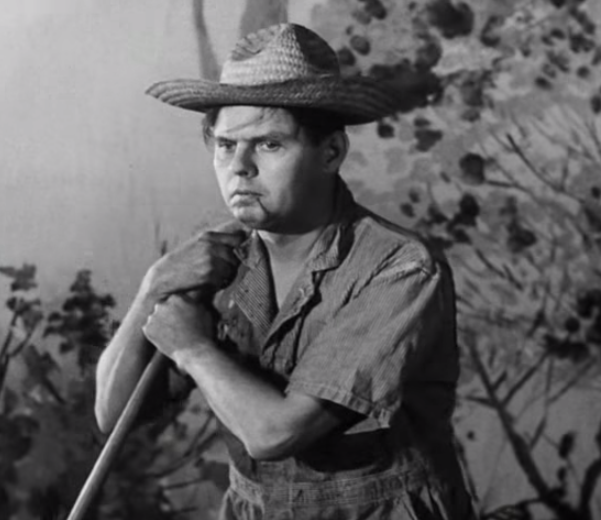
Edward Davis Wood, Jr., was just a little over three months from being discharged from the Marines when Burton died. What impact, if any, this dairy farmer uncle may have had on young Eddie remains unknown. When farm folk are depicted in Ed Wood's movies, it is usually as unsophisticated bumpkins. Think of Farmer Caulder (Karl Johnson), the man with the "spirits" on his breath, in Plan 9 from Outer Space. Then there's the straw-hatted rube in Glen or Glenda who worries that those newfangled automobiles will "scare the hosses."

Burton was preceded in death by his mother, Emily "Emma" Wood née Bunten, who passed in 1940. Emily married Eddie's grandfather Byron, who was also a farmer. And, as it turns out, she also had a half-brother named Edward Davis. 

Clearly it was this intriguing half-brother who inspired the first and middle names of Ed, Sr. and Jr. We'll visit him in a future installment of Ed Wood Wednesdays.

Wednesday, July 11, 2018

Ed Wood Wednesdays: The Wood Collaborator Odyssey, Part 12 by Greg Dziawer

These two explorers are looking for their mummy.

Before Glen or Glenda, there was Tomb Itmay Concern.
A certain degree of resourcefulness is a necessity for any exploitation filmmaker, especially one operating with the lowest of low budgets. As Edward D. Wood, Jr. embarked upon his directing career in the early 1950s, it was the cheapskate exploitation world that afforded him his first big opportunity to write, direct, and star in a feature film: Glen or Glenda (1953). Its producer, George Weiss, is legendary as a prolific filmmaker in this milieu. Exactly when he met Ed is unclear, although Dolores Fuller notes on page 66 in her autobiography A Fuller Life (2009, BearManor Media) that George was "an independent producer Eddie knew" prior to them collaborating on Glen or Glenda

Many of the interiors in Glen or Glenda were shot at Quality Studios, a tiny facility on Santa Monica Blvd. run by W. Merle Connell, who often acted as director and/or cinematographer on the hundreds of shorts and the passel of features shot there. Like Weiss, Connell was adept at shooting on a shoestring and began filming strippers in LA burlesque houses in the early '40s. He adopted the name Quality Pictures for what became a mail-order business in the latter half of that decade. Eventually opening his own studio, he would frequently partner with Weiss, a producer whose office was in the immediate vicinity at 5634 Santa Monica. Many of Weiss' Screen Classics Inc, films, beyond Glen or Glenda, were shot at Quality. Ed Wood shot Plan 9 from Outer Space at Quality a few years later, for instance. And Glen or Glenda's supposed insert scenes of burlesque strippers have since been attributed to Connell. 

The IMDb entries for both Weiss and Connell represent only a small percentage of their total output, with most of their films remaining unlisted. This week, we're documenting one such film, a charming 1950 burlesque short with the improbable title Tomb Itmay Concern. (And, yes, that's "itmay" with no space. It's intentional, as we'll soon see.) 

The film's setup could not be simpler. Two male archaeologists enter a sparse tomb—the sole set—where they use water to revive two sexy female mummies, neither of whom display any wrapping or signs of decay. The water, it seems, has been placed in the tomb specifically to tempt any visitors to bring these women back to life.

Waterboys: Don Mathers (left) and Little Jack Little explore a tomb.

Bela Lugosi and George Weiss on the Glenda set
For audiences in 1950, the plot of Tomb Itmay Concern must have been a reminder of the superstitions that had swirled ever since Lord Carnarvon, the first to enter King Tut's tomb in 1922, passed away due to a supposed "curse" placed upon him for having desecrated the crypt. In fact, in late 1949, the superstition was again at the fore, as another archaeologist had perished not long after entering an Egyptian tomb. Early the following year, the story of Carnarvon's death itself was resurrected, and it was determined that the man had died of normal, non-supernatural causes.

Just as with Glen or Glenda and its ties to the sensational Christine Jorgensen sex change saga, Tomb Itmay Concern had a story ripped from the headlines of the day. Viewers back then would doubtless have these "curse of the tomb" stories flitting around at least at the edges of their consciousness. 

The film's straight man, played by Don Mathers, explains that this is the tomb of Princess Itmay, revealing the title card to have been the film's first joke and not a gaffe. Tomb Itmay Concern, then, is a pun within a pun. "Tomb" being a play on "to whom." The same gag turns up in a 2006 episode of Tom and Jerry Tales and a 2017 short by Adam Taylor.

After quelling his partner's fears, Mathers exits the crypt to explore elsewhere. His sidekick, the "comic" relief, naturally can't resist reviving the girls. Once he does this, the diminutive explorer is no longer frightened, not even for a split second. This sidekick role is essayed by burlesque comedian Little Jack Little, who also appeared in Connell's final feature: a nudie cutie from 1960 called Not Tonight Henry. Mathers, too, appeared in this production.

Pinup queen Inez Claire
Having endured Little's lame jokes, audience members might have expected the proceedings in Tomb Itmay Concern to turn tragic, as in so many of Universal's Mummy movies. The Mummy's Hand (1940) even features a comedic duo (Dick Foran and Wallace Ford) not unlike Mathers and Little. Instead, viewers were surely pleasantly surprised to experience a sexy dance number by the mummified princess.

Itmay is played by Inez Claire, who had been stripping since at least 1944 and who maintained a lengthy and active career in burlesque. According to the credits, her servant is played by one Sally Starr, not to be confused with the 1930s film actress and cheesecake pinup or the 1950s cowgirl. This Sally Starr was a dark-haired stunner. Sadly, she doesn't dance in Tomb Itmay Concern, but she does use a banana as a prop in a joke that goes nowhere. Starr's skin color is also the subject of two of Jack Little's jokes, including the one that ends the movie!

The film, with Connell credited as both producer and director, is filed for copyright under Quality Pictures Co., not Screen Classics. The credits contain no mention of Weiss. But, also mentioned in her autobiography (page 67), Dolores Fuller notes that Weiss ran Quality Pictures. Incidentally, Tomb Itmay Concern runs exactly 10 minutes.

In future articles, I'll untangle the exact working relationship of Wood collaborators Weiss and Connell. I'll also delve into far more of their work that remains little-known to this day. Although we can't say whether Ed Wood was involved in any way in Tomb Itmay Concern—and I doubt he was and am not suggesting it—he was definitely approaching the orbit of Weiss and Connell at the time this short film was made. He may have been there already. Dolores Fuller mentions (page 66) that Eddie "kept abreast of developments" (no pun intended) in the world of low-budget Hollywood filmmakers at the time.

A final thought: The core idea of this short is the same in a nutshell as that for Orgy of the Dead (1965). That film even contains a mummy, albeit a more traditional one with wrappings. Could Tomb Itmay Concern have been a possible source of inspiration for Ed Wood? 

Tomb Itmay Concern is the final short on the jam-packed fifth volume of Something Weird Video's incredible Roadshow Shorts series. The volume contains more than its fair share of other material from Weiss and Connell, for those interested in exploring more of their work.

Wednesday, July 4, 2018

Ed Wood Wednesdays: The Glen or Glenda Odyssey, Part Five by Greg Dziawer

Totally radical! Ed Wood Mania was already in full swing by the 1980s!

Off the Wall as it looked in the 1980s.
Rudolph Grey's Nightmare of Ecstasy and Tim Burton's biopic Ed Wood introduced many viewers to the work of Edward D. Wood, Jr. in the 1990s. But the late writer-director's strange posthumous career was already well underway by then. After the publication of Harry and Michael Medved's The Golden Turkey Awards in 1980, Eddie's older films started to get prominent bookings in theaters across the country. And they were starting to attract serious critical attention as well.

On July 16, 1982, for instance, Glen or Glenda began a two-week engagement at Off the Wall Cinema in Cambridge, MA. Off the Wall was, as its name suggests, an eccentric art theater and coffee house specializing in obscure and bizarre movies. (Unfortunately, this well-loved venue closed in 1986.) Glenda was playing on a double bill with The Little Shop of Horrors, the 1960 Roger Corman cheapie about a killer talking plant. Interestingly, Little Shop was also gaining a new fanbase in the 1980s, due to a stage musical adaptation that had just opened Off-Off-Broadway on May 6, 1982.

Theater and film critic John Engstrom reviewed Glen or Glenda in the July 17, 1982 edition of The Boston Globe. His article is quite a find. Long before Grey or Burton, Engstrom shrewdly identified Glenda as a key Wood work. While pointing out the film's many shortcomings, he also notes that the movie was incredibly forward-thinking for its vintage, hailing it as "compassionate and enlightened."

Here's the article in its entirety. Enjoy. As a little bonus, this newspaper clipping also includes a print ad for another quintessential cult movie of the era: Jean-Jacques Beineix's Diva (1981).

John Engstrom's 1982 review of Glen or Glenda.

"As a movie," Engstrom writes, "[Glen or Glenda] transcends its own incompetence and attains something like dignity." That's a pretty far cry from what the Medveds were saying about Eddie's movies at the time.

Happy Independence Day, everybody!

Wednesday, June 20, 2018

Could 'Solo: A Star Wars Story' have been saved? Maybe not, but let's try anyway.

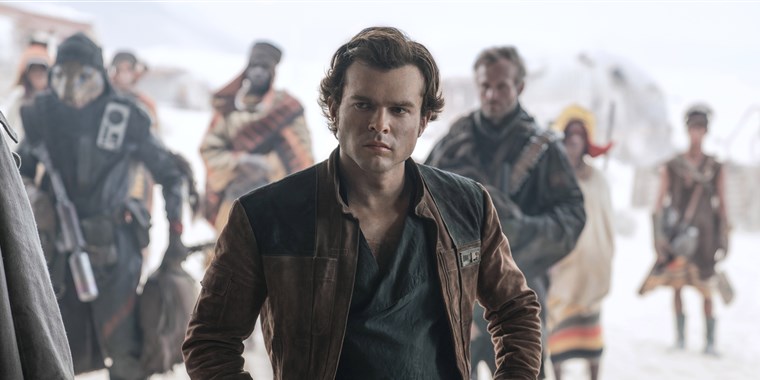
Alden Ehrenreich looks typically blank as Han Solo because he has no character to play.

A typical screening of Solo: A Star Wars Story.
Maybe Solo: A Star Wars Story never had a shot at being good, let alone necessary or impactful, it being yet another unsolicited prequel in a franchise already lousy with exposition. But I don't think it needed to be the pointless, empty, dispiriting slog that it turned out to be. Was I a fool for thinking this thing would actually be fun?

In the wake of the film's underwhelming debut—it "only" earned $84 million at the domestic box office over the Memorial Day weekend—plenty of theories are circulating as to why Solo failed to click with audiences. Franchise fatigue? Backlash from disgruntled fanboys (many of whom are weirdly fixated on their hatred of supporting character Rose Tico, who is not in Solo)? An overcrowded marketplace? All of the above?

I can't tell you with any certainty why certain viewers stayed away from Solo. That's for the industry analysts to decide. What I can tell you is that, for me, watching Solo was almost no fun at all and that I can't imagine this thing being anyone's favorite movie unless they'd only seen three movies and the other two were snuff films. And even then it would be close.

As it happened, I was in Indiana over the Memorial Day holiday, visiting my sister and her family. We all went to see the movie at the local multiplex, and I'll testify from first-hand experience that it played to soporific silence from the entire audience. I even had to fight the urge to nod off during the film's leaden middle passages and found myself wishing I'd brought a caffeinated beverage with me into the theater. The film's timid attempts at humor fell particularly flat. I think the socially-conscious droid L3-37 was supposed to be the film's designated comic relief character, the Jar Jar of Solo: A Star Wars Story. After one of her several failed wisecracks, I exhaled loudly enough with disappointment to make my niece giggle a little. That accounted for the one (1) audible laugh during the entire screening.

Curiously, speaking of Jar Jar, Solo: A Star Wars Story made me pine for the days of George Lucas' much-mocked prequel trilogy of the late '90s and early 2000s. As gratingly stupid as it is, The Phantom Menace at least provides some eye candy: cool-looking cities, cool-looking planets, cool-looking costumes, etc. Solo, on the other hand, is almost perversely drab, underlit, and murky. The title character spends the whole film bouncing from one inhospitable world to another, and we never get a good sense of the terrain in any of these places. It's like: mud world, another mud world, rock world, desert world. Gee, thanks a bunch, movie. A Star Wars movie should seem open and airy, bursting with possibilities. Solo, in sharp contrast, feels cramped and restrictive. There's not even a hint of adventure here.

Our antagonist: a petulant twerp.
I can't comment on the characters, since Solo didn't really have any. Instead, it had placeholders where interesting, well-developed characters would otherwise be. Wide-eyed, baby-faced Alden Ehrenreich bears little resemblance to Harrison Ford, other than being a bipedal mammal. I guess he says his lines all right—it helps that the script doesn't have him say, "Would that it were so simple."—but he's the least dynamic, compelling character in the movie, and that's a problem when the movie is named after him.

Does this movie even have an antagonist? I've heard Paul Bettany's character, stripey-faced gangster Dryden Vos, described as the film's main villain. But he's such a petulant little twerp it was difficult to take him seriously. In a real Star Wars movie, he'd be the lieutenant to the actual antagonist. I'm not sure how he got those scars on his face. I think he might just be a cat owner.

Everyone else? Eh, they're fine, I suppose. It's difficult to judge them properly because the script is so clunky. So many awful lines here. "She's part of the ship now." "You're the good guy." And that idiotic scene in which Han gets his last name. It's a complete ripoff of the scene from Mike Judge's Idiocracy (2006) in which Joe Bauers (Luke Wilson) finds himself being renamed "Not Sure."

While we're talking about that part of the movie, let's discuss the Empire for just a moment. I've written before about how the Empire never makes the least attempt to win over the public's affections. Well, in this movie, there's actually an Empire recruiting film, and I'll be good and goddamned if it isn't seemingly inspired by a Family Guy parody. That's right: Lucasfilm is now taking cues from Fuzzy Door Productions.

A better template for this movie.
Solo even gets the little details wrong. It's a longstanding Star Wars tradition, for instance, to have weird looking bands and singers providing background music. In this movie, I think we get one lame lounge act consisting of a woman with a radio dial over her mouth (?) and a guy who's just a head in a jar. And they're off-key the whole time. Give me the Max Rebo Band or the Modal Nodes over these bozos any day!

Admittedly, I have never given a great deal of thought to what Han and Chewie were like before joining up with Luke and the Rebellion. But, if I'd had to guess, I probably would've said their lives were something like The Dukes of Hazzard.  You know, "making their way the only way they know how. That's just a little bit more than the law will allow." Han and Chewie would be like Bo and Luke. The Millennium Falcon is their General Lee. And Jabba the Hutt (absent from Solo) is their Boss Hogg. I guess that makes Lando their version of, uh, Cooter or something. Look, it's not a one-to-one comparison.

But the way I see it, young Han Solo is a hotshot smuggler and pilot. He digs himself. He thinks he's too much. He has a badass ship. He has a badass sidekick. He has a badass blaster. And he's a handsome, athletic, quick-witted dude who is constantly outsmarting both the gangsters and the Empire. To him, every Stormtrooper might as well be Sheriff Rosco P. Coltrane, i.e. a dope who couldn't hit the broadside of a barn. Han's life is a series of daring escapades and narrow escapes, and that's the way he likes it. In other words, it's a goddamned adventure. The movie starts out with this narration: "It is a lawless time." To which I would have added: "And Han wouldn't have it any other way."

Above all, I thought sure young Han would be a womanizer, a galactic Don Juan constantly seducing ladies (plus occasional aliens and droids) wherever he goes. But no. Solo: A Star Wars Movie gives him a steady girlfriend, Qi'ra (Emilia Clarke), at the beginning of the movie, and Han remains stupidly loyal to her throughout the film. He's so earnest and wholesome, he might as well be a Boy Scout. I was certain there would be at least one scene in which Han is chased by a jealous husband, but Solo definitely isn't that kind of movie.

Instead, Solo wants to be basically a filmed FAQ about its title character. How did Han get his last name? How did he meet Chewbacca? How did he get his famous blaster? I would have structured it around a different question entirely: How did Han get his cynical attitude?

Another good role model for this film.
Let me elaborate. By the time we meet him in A New Hope, Han Solo is a selfish, sarcastic guy who keeps the world at arm's length. I think he does this as a defense mechanism. If he walls himself off emotionally, he can't truly get hurt. My version of his origin story would have explained how exactly he got that way.

Like I said before, my version of young Han Solo is a cocky, arrogant hotshot. But he's still a boy at heart. My script for Solo: A Star Wars Story, then, would be about Han's journey from boyhood into manhood. I would have kept the character of Qi'ra, as well as that of Han's quasi-mentor Beckett (Woody Harrelson), but their roles would have been different. Or, rather, their functions would have been different.

The first part of my Solo movie is about Han being a smuggler and having a grand old time at doing it. But then, he runs afoul of Beckett's gang somehow. Even this, though, seems like yet another lucky break for Han. Beckett has actually heard of Han, he says, and thinks that Han and Chewie would be good additions to the squad. Seeing as how the only alternative is having his head blown off, Han says yes.

Beckett's plan is to rip off some big time warlord, someone like Dryden Vos but not such a prep school punk. (And ixnay on those Garfield stripes on his face.) They have an operative on the inside: the warlord's beautiful mistress Qi'ra. Immediately, Han has the hots for Qi'ra, and soon she and Han are sneaking kisses whenever possible. It's possible that this is the first time Han Solo has ever actually been in love. Normally, he's the "find 'em, fuck 'em, forget 'em" type, but Qi'ra is different.

Beckett tells Han he has potential but that he has only been a small time operator up to now. And so, Han serves an apprenticeship under the more experienced crook, learning the ropes. In the end, the heist goes off successfully, and the warlord is killed, but it turns out Beckett has really only been using Han the whole time and plans to kill him and take his share of the money. Beckett tells Han, "It's a shame, too, kid. Because I was really beginning to like you. In fact..." Han shoots him at this point and casually kicks Beckett's body into a ravine, where it's eaten by animals. This is a key moment when Han starts to become more callous.

But the real moment of change for Han comes when he realizes that Qi'ra, too, was only in this for herself. She needed money to buy her way out of being a kept woman. Now she has it, and she doesn't need Han anymore. This has not been foreshadowed in any way throughout the movie, so the moment should feel like a real gut punch to the audience. We've come to know and like Qi'ra, and it's devastating to watch her dump Han. But she's not been a goody-goody either. She's more like a character out of film noir. I see Han as being analogous to the private eyes from those movies, e.g. Sam Spade or Philip Marlowe. The film, then, would be about how Han lets some dame play him for a chump and how he learns a tough life lesson along the way. That's classic Raymond Chandler/Dashiell Hammett-type stuff.

My movie ends with Han and Chewie in some shithole cantina halfway across the galaxy. Based on the way he's talking, we can see he's already started to develop the cynical persona of the Han we knew from the older movies. Suddenly, a strange emissary (Greedo?) walks up to Han and offers him a business card. It's from Jabba the Hutt. Han looks intrigued. Smash cut to end credits.

So, yeah, that's my take on Solo: A Star Wars Story. The TLDR version is this: Solo should have been Dukes of Hazzard in Outer Space. Just imagine this but with spaceships.