Showing posts sorted by relevance for query red skelton. Sort by date Show all posts

Friday, December 23, 2016

Ed Wood Extra: Ed, Red, Bela, and Slick

Martin Landau begs to differ with Bobby Slayton in this moment from Ed Wood.

INTRODUCTION:
 Before I head out for the Christmas holiday, I thought I'd share a previously unpublished Ed Wood article I had sitting in my "Drafts" folder. I was inspired by Greg Dziawer's article, "The Wood Halloween Odyssey," to share my own thoughts about Bela Lugosi's June 1954 appearance on The Red Skelton Show alongside fellow horror icons Vampira and Lon Chaney, Jr. The episode in question is a fascinating cultural artifact in a number of ways, and I wanted to write about it. Please enjoy and have a safe and happy holiday. J.B.

The published screenplay.
When Larry Karaszewski and Scott Alexander were writing the screenplay for the 1994 biopic Ed Wood, they rifled through Rudolph Grey's 1992 patchwork biography Nightmare of Ecstasy: The Life and Art of Edward D. Wood, Jr. looking for weird details and crazy anecdotes they could use. One passage chosen by the duo appears on page 103 of Grey's book in a chapter called "The Wood Spooks." Here, through new and archival quotes, Maila "Vampira" Nurmi, actor John Andrews, and Ed Wood himself give their thoughts on the time Bela Lugosi guest starred on CBS' long-running comedy series The Red Skelton Show in 1954, allegedly with Ed Wood in tow as his personal dialogue coach.

At that point in history, Skelton had only been with the so-called "Tiffany Network" a single season. A popular radio comedian turned TV star, he'd done two years on NBC before changing networks in 1953, and his show was not yet the ratings powerhouse it would soon be for CBS until its controversial cancellation in 1970. (For its last season, The Red Skelton Show briefly moved back to NBC, finally expiring for good in 1971.) The episode with Lugosi, "Dial 'B' For Brush," occurred as Skelton was in the process of rebuilding his TV brand. Skelton's show was not a Top 30 hit in 1954. In the broadcast, likening himself to a little boat caught in a storm, Skelton elaborately thanks CBS and his chief sponsor, Geritol, for their faith in him.

For Nurmi, this Red Skelton gig occurred during the year-long period when she hosted a celebrated horror show as her Vampira character on Los Angeles television. She showed some of Lugosi's movies on that iconic, now mostly-lost series. But Red Skelton was the first time she actually worked with the legendary Lugosi in the flesh. She'd long since forgotten the script by the time she talked to Rudolph Grey decades later, but she recalled being in "the kind of mausoleum they have where the caskets roll in and out of the wall." She described Lugosi as being an "elegant" and "genteel" man who mostly "stayed in his dressing room alone." The actor clearly made a strong impression on the nascent horror hostess. "He made me feel like a noblewoman," Nurmi enthused. "And here I was, this Hollywood tramp."

It was the contention of actor John Andrews (the werewolf from Orgy of the Dead) that Ed Wood assisted Bela Lugosi on The Red Skelton Show at Lugosi's insistence. "Eddie, they don't know how to write for me. You write. You write," Lugosi is claimed to have said at the time. But Ed himself didn't claim to have written the show.

Ed Wood merely says the following: "I was Lugosi's dialogue consultant. There were certain words which had to be changed because he couldn't form them properly." That's it. A rather modest boast, if it can even be called such.

In the book Bride of the Monster: Scripts from the Crypt by Gary Rhodes and Tom Weaver, this is cited as yet another example of delusional, grandstanding Eddie trying to insert himself into the Lugosi legend where he didn't belong. The skeptical authors won't even acknowledge that Eddie was involved with the show at all. It's important to note that Rhodes and Weaver merely offer their interpretation of the events. But if Wood were trying to make up a tall tale to enhance his own career, couldn't he have done better than saying he was a dialogue consultant on a show that wasn't even that big a hit at the time? One senses that Rhodes and Weaver are overcompensating for the hagiography and hero worship of Ed Wood by consistently portraying Ed as a self-promoting, opportunistic hack.

Comedian Bobby Slayton
Anyway, the story of Ed assisting Bela on The Red Skelton Show—even if apocryphal— must have been convincing enough for Karaszewski and Alexander, because a version of the anecdote makes it into Ed Wood. About a third of the way into Tim Burton's film, Eddie (Johnny Depp) is cold calling potential producers and investors for Bride of the Monster (at that point still called Bride of the Atom), when one respondent asks whether Bela is "available Friday night." Cut to a busy TV studio, where a nervous Bela (Martin Landau) is going over his script with Eddie. The idea that Ed somehow "got" Bela the TV gig is purely an invention of the screenplay. None of the participants, including Eddie, ever made that claim.

Possibly for legal reasons, no direct mention of Red Skelton or The Red Skelton Show is made in Ed Wood. The program Bela is working on is simply "a 1950s variety show" and its brash, gravel-voiced star (Bobby Slayton) is merely identified in the script as "the show host, a cheesy comedian." In reality, Red Skelton was a straight-ahead comedy series consisting of a monologue and some sketches. But here, it's a full-fledged variety showcase, closer to what Ed Sullivan was doing on Toast of the Town on Sunday nights. There are showgirls backstage, and Criswell (Jeffrey Jones) appears on the show to give his incredible, inaccurate predictions about how man will have colonized Mars by 1970.

It is unlikely that Alexander and Karaszewski had seen any footage from the real Red Skelton broadcast from 1954, so -- as with their parallel universe version of Ed's play The Casual Company -- they simply imagined what the vintage broadcast would have been like. In some respects, they weren't too far off the mark, and in others, they were wildly wrong. In their script, the cranky, impatient host appears as "his 'Slick' character, a befuddled moron in a funny hat" in a silly, vaudeville-style sketch opposite Bela Lugosi as "the Count." A sexy female announcer describes the premise to the audience: "And now we take you to a castle in Transylvania. Watch out. The landlord's a real pain in the neck."

In full, the host's character is referred to as "Slick Slomopavitz, seeker of adventure," and he seems to have wandered into Dracula's castle in search of shelter, rousing the centuries-old vampire from his coffin in the process. The idea is for Slick and Lugosi to trade scripted quips, reading from cue cards, but the comedian decides to improvise gags during a live broadcast, and the elderly Lugosi is confused and disoriented. The sketch is cut short, and the furious host storms off, complaining that "we should've got Karloff." Lugosi has thus been humiliated on national television, and it's now Eddie's job to pick him back up again.

It's true that live TV shows in the 1950s were prone to gaffes and unexpected happenings. Sets could topple over. Actors could flub their lines. Complete strangers could wander onto the set. The Lugosi character in Ed Wood is not wrong when he says that "this live television is madness." But it's very unlikely that a professional comedian with his own network show would start improvising brand new lines during an already-in-progress scene with a non-comic who is working from cue cards. It's Slick, not Bela, who would be called on the carpet for this. The surviving footage of the genuine broadcast reveals that nothing remotely like this happened on The Red Skelton Show in 1954. The show went according to schedule, and Lugosi was active and engaged throughout. He really throws himself into the comedy, even singing and dancing a little when necessary.

Red Skelton in character.
And that brings us to the television program itself. The Red Skelton Show is such a product of its time that it may not translate all that gracefully into ours.

The same isn't necessarily true of Skelton's comedic contemporaries of the 1950s. Through numerous series and specials, Sid Caesar set a sketch comedy template that Saturday Night Live would later follow, while giving the next generation of humorists, including Mel Brooks, Larry Gelbart, Neil Simon, and Woody Allen, their start in showbiz. Jackie Gleason's The Honeymooners is still being aped by sitcoms today, while Lucille Ball's I Love Lucy has never left the air in over half a century. Their work isn't as ubiquitous these days, but Jack Benny and Phil Silvers created onscreen personas that still resonate in scattered reruns and YouTube clips. Today's comics may not be directly influenced by Benny and Silvers, but it's still possible to detect elements of their personalities in their work. Ernie Kovacs, too, is still cited as a pioneer, maybe the first comedian who truly understood what made TV different from other media.

But Richard "Red" Skelton is something else: a holdover from a vanished, now almost forgotten era in American entertainment. Television itself was a relatively young medium in Red's day, and its vaudeville roots were in plain sight back then. A veteran of vaudeville (as well as the medicine show and burlesque circuits), Skelton specialized in comedy that was broadly silly, brazenly obvious, and often shamelessly sentimental, verging on bathetic. Slapstick and pantomime were key to his appeal, as was his folksy, friendly manner. Viewers could sense his warmth and sincerity coming through the cathode ray tubes, and they tuned in every week for more.

In a way, it's extremely bizarre casting that aggressive, motormouthed Bobby Slayton, the so-called "Pitbull of Comedy," should essentially stand in for Red Skelton in Ed Wood. These two performers' styles were vastly different. Skelton's classic character, Clem Kadiddlehopper, does have a few things in common with Slick Slomopavitz, including a low IQ and a goofy, ill-fitting costume.

Modern viewers might dismiss The Red Skelton Show as corny and old-fashioned, and they wouldn't be wrong. The host preferred the more gentle label "clown" to "comedian," and he even made a second career out of his cloying clown paintings. Other than being a relatively early adopter to the television medium, Skelton was not really an innovator. He was more of a traditionalist. That extended to his ultra-conservative political views as well. When he was abruptly ousted from CBS in 1970, after years of Top 10 ratings, Skelton blamed the encroachment of the hippie counterculture. Today, the routine for which Skelton is arguably best known, a word-by-word annotation of the Pledge of Allegiance, has virtually no comedy in it. It is simply a statement of unswerving patriotism.

It was Skelton himself who largely kept his own reruns off the air in the 1970s and beyond. He was embittered over the cancellation of The Red Skelton Show and never got over it. So the series did not become a staple of syndication the way I Love Lucy and The Honeymooners did. As a result, several generations grew up without Red as a cultural touchstone. Skelton died in 1997, and there have been various repackages of his vintage shows since then, marketed mostly to people who remember watching the comedian decades ago.

(left) Red Buttons; (right) Red Skelton

Do people even know who Red Skelton is anymore, apart from the "Pledge of Allegiance" routine? I was just listening to an episode of The Best Show With Tom Scharpling this week, and the host spent a good five minutes, maybe 10, absolutely lacerating Skelton as a one-joke hack from the bad old days of show business. "Do you know Red Skelton? He was a comedian... and he sucked." But the person Scharpling was describing (and unkindly imitating) was clearly Red Buttons. It was Buttons who did the "never got a dinner" routine, not Skelton. Really, Buttons and Skelton were not much alike stylistically. But they had similar stage names, looked somewhat alike, and worked at about the same time, so they might as well have been the same guy. That's how cruel time can be. And it gets worse: Scharpling claimed Skelton was in The Star Wars Holiday Special. He wasn't. That was Art Carney. So now, Carney, Buttons, and Skelton have all been folded into one person. Kinda sad.

Wednesday, October 26, 2016

Ed Wood Wednesdays: The Wood Halloween Odyssey by Greg Dziawer

Vampira and Bela Lugosi get comfortable.
 
Red Skelton (left) and Bela Lugosi.
To celebrate the upcoming holiday, we're delving into a crevice of Woodology: the fabled (sometimes claimed nonexistent) TV episode of The Red Skelton Show featuring Bela Lugosi as a guest star in the feature skit "Dial 'B' for Brush." Airing on CBS from 8:30pm-9pm on July 15, 1954, the program also featured Lon Chaney, Jr. and Maila Nurmi, the latter initially unrecognizable from her Vampira persona, excepting the unmistakable, truly bloodcurdling scream, but billed as such in the spoken credits, in addition to the necessarily ubiquitous Red Skelton, again essaying his signature character, "wise fool" Clem Kadiddlehopper.

Let's assemble a brief annotated timeline around this episode:
  • February-March, 1954: Bela, spoofing his vampire persona, headlines a self-titled burlesque revue at the Silver Slipper. Ed Wood is Bela's self-styled (and self-identified) "producer" at the time. His involvement in the revue is likely limited to self-interested promotion and assisting Bela with his dialogue, though Ed variously claims to have "designed" it, scripted it (or part of it), or even to have directed the rehearsals. 
Maila Nurmi as herself.
  • April 30, 1954: The Vampira Show debuts on KABC-TV, ABC's Los Angeles affiliate. A first of its kind, the show stars model Maila Nurmi stars as Vampira, a ghoulish hostess of vintage horror films. Vampira is an immediate sensation, featured in Time, Life and Newsweek. Darkly comic, clearly smarter than the rest of us, and strikingly beautiful, Nurmi's Vampira garnered her an Emmy nomination for 1954, despite the show being abruptly cancelled a little less than a year after it debuted. "Bela Lugosi and Ed Wood sat and watched The Vampira Show in Lugosi's modest suburban home. Lugosi thought that her appearance on the cultural radar screen meant that gothic horror had made a comeback." (Vampira: Dark Goddess of Horror by W. Scott Poole). It's not hard to imagine them enraptured, watching Vampira hosting an airing of Bela's mad scientist programmer The Corpse Vanishes from 1939. 
  • July 15, 1954: Lugosi guest stars on The Red Skelton Show alongside Skelton, Lon Chaney Jr. and Vampira. Not surprisingly, the sketch concentrates on horror comedy and includes everything from dancing skeletons to a musical quotation of J. Bodewalt Lampe’s "Misterioso Pizzicato." Along with standard horror jokes (Lugosi complains, "They don’t make girls like they used to. I know; I take them apart!"), the episode features topical humor, including allusions to Dial M for Murder (1954), Liberace, Ralph Edwards, and -– quite subtly, through Skelton selling a brush from Denmark that can be used for "either his or hers" –- Christine Jorgensen, whose sex change story had partially inspired Wood’s Glen or Glenda
  • October 29, 1954: The episode of The Red Skelton Show featuring Bela airs in repeat on CBS, fittingly two days before Halloween. Bride of the Monster, directed and written by Ed (with Alex Gordon) and starring Bela, had begun shooting earlier that week, on a Tuesday, October 26th.
Gary D. Rhodes and Tom Weaver describe the fateful Red Skelton episode in their highly recommended book, Bride Of The Monster: Scripts From The Crypt (Bear Manor Media, 2015):
"Once again, Wood insinuated himself in Lugosi’s history, later purporting to have acted as Lugosi’s dialogue coach. Perhaps he did; perhaps he didn’t. At any rate, the Skelton episode is curiously (even if coincidentally) prescient in terms of Bride of the Atom. 'Prof. Lugosi' wears a lab coat for two of its three key scenes. He orders about a dumb henchman. And on a threadbare lab set, Lugosi affixes a silly apparatus to Skelton’s head that – after Lugosi throws a switch – transforms Skelton into a monster. These plot points and props would be echoed in Wood’s film."
Red Skelton's film.
The "Dial 'B' for Brush" skit, inspired by Skelton's feature The Fuller Brush Man (1948) , is oft-claimed to feature Peter Lorre. We won't go into all of that now, but suffice it to say that Lorre is not present here. He did, though, appear frequently on Skelton's shows, both TV and radio. Perhaps the historical record has conflated an appearance as a mad scientist in one episode, and alongside a dead-ringer Vampira lookalike in another. Skelton's January 1955 spoof of The Honeymooners, for instance, affords us the priceless opportunity to see Lorre growl, "POW! Right in the kisser!" It also ladles on the requisite, one-note physical "comedy" by Skelton as Norton, more foolish Clem than graceful Carney.

Meanwhile, highlights of the "Brush" skit include Bela dancing off into the commercial break fadeout, and Maila Nurmi's mute (almost), near-motionless intensity throughout, a sharp counterpoint to all of the overacting by everyone else.

And I'll highlight one more moment from the show: At the 14:32 mark, there's this brief pitch from Clem: "This is a genuine Mohair bristle. This is Mohair bristle, and you should have heard Mo scream. This wood is imported from Denmark.This brush is either his or hers." 

Mohair garments, as any self-respecting Woodologist knows, are made from angora fur sourced from sheep. Angora garments are also made of angora fur. Angora from rabbits. This brings to mind a quote from an article called "From Birthday Suits To Shrouds," as published in Flesh & Fantasy, Vol. 4, No.4, 1971 (Pendulum Press):
"Furry sweaters such as angora, mohair and brushed wool are high on the list of fetishes which are desired, tremendously so with the male transvestites. The garments with any fetishist might be worn or they might amply be felt and rubbed or even looked at. It is at such times that the human partner becomes almost secondary as the sexual illusion and stimulation comes strictly from the fetish love-object. The partner is simply a receptacle."
Aggregating newspapers of the era, a site called TakeMeBack.To lists Dial M for Murder as among the most popular films of May 1954 and The Vampira Show as one of the most popular TV shows. Criswell, incidentally, wrote in one of his monumental books of predictions, 1969's Your Next Ten Years, that the top male star of the 20th century, whose fame would last, would be Red Skelton. His female pick? A fact: his friend and benefactor, Mae West. Alas, Criswell is another matter, one to be taken up in the future.

Happy Halloween from Ed Wood Wednesdays!

Bonus: You can catch a full (albeit reconstructed) episode of 1954's The Vampira Show streaming here, featuring The Corpse Vanishes, along with Vampira's intro ("Everyone knows EE-leck-triss-ity is for chairs.") and outro, plus original commercials from that era.

Sunday, January 2, 2022

Ed Wood's When the Topic is Sex: "Behind the Film Scene" (1972)

Phil Cambridge's clever, though hard-to-read logo for "Behind the Film Scene."

NOTE: This article continues my coverage of Ed Wood's When the Topic is Sex (BearManor Media, 2021).

The article: "Behind the Film Scene." Originally published in Blazing Films (Pendulum Publishing), vol. 6, no. 1, January/February 1972. Credited to Edward D. Wood, Jr.

Excerpt: "I doubt very much if today that my old, and very dear friend, Bela Lugosi could carry a picture unless all the ladies he bit in the neck were completely naked and had some kind of a lavish sex scene with the handsome hero beforehand. . . . Or the old gentleman himself became lecherous enough to remove her clothing behind a fence and make her before sucking her blood."

Reflections: This article is very much in the same spirit as "That's Show Biz." Again, Eddie is pontificating and free-associating about the many changes the movie industry has seen over the decades, particularly in regards to the depiction of onscreen sex and the increased demand for realism. What's different this time is that Eddie does mention a few specific film titles, including a few of his own. He talks about Crossroad Avenger (1953), Bride of the Monster (1955), Jail Bait (1954), Revenge of the Dead (1959), and even Take it Out in Trade (1970), which he calls his "first film in the nudie market."

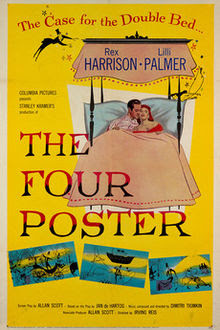
A significant film, according to Ed.
In fact, besides plugging his own movies, the only other title Ed directly references in this article is Irving Reis' The Four Poster (1952)a rather obscure comedy-drama starring Rex Harrison and Lilli Palmer. According to Ed, this movie was significant for its use of a double bed. Previous to this, thanks to the overly-strict Hays Code, directors could only show twin beds onscreen to maintain the fiction that husbands and wives slept separately. Oddly, that aspect of the movie seems to be forgotten today. To the extent that The Four Poster is remembered at all, it is for the animated sequences directed by John Hubley.

People who read a book like When the Topic is Sex probably became fans of Ed Wood through his movies, so they will relish the tidbits of information about those movies that Ed provides here. The director admits that, when he was first making films in the 1950s, he mistakenly thought that stars like Bela Lugosi and Tom Keene would be bigger box office draws than they actually were. He laments the end of the era when a big name on the marquee was enough to sell a movie. Wood further implies that, if Bela were alive in the 1970s, he'd have to make sexually-explicit movies in order to sell tickets. Perhaps it's for the best that this did not come to pass. 

Eddie's memory may have been a little shaky by 1972. In this article, he says that Bela Lugosi starred in Revenge of the Dead (Ed's preferred title for Night of the Ghouls), which is absolutely untrue. The role of Dr. Acula in that film was intended for Bela, but the great Hungarian actor was several years dead by the time the script went into production. Western baddie Kenne Duncan stepped into the role instead and gave one of his most memorable performances as a phony psychic medium who gets his much-deserved comeuppance.

Can we trust Eddie's story about how he was prevented by the censors from showing a gun with a silencer in Jail Bait? How about his recollection of hiring someone just to clean up the horse droppings on Crossroad Avenger? These could well be figments of Eddie's imagination. 

Honestly, it's difficult to summarize "Behind the Film Scene" because Eddie flits from one topic to another without a thought toward coherence. At one point, he discusses the so-called "sweater girls," i.e. the 1940s actresses like Lana Turner and Ann Sheridan who became notorious for their clingy, curve-enhancing cardigans and pullovers. According to Ed, the censors objected to the sweater girls, especially when their movies were shown to members of the military:
The Hays office decided the girls should no longer be dressed in the tight knitted garments because it turned so many of the boys in the service on. And that was one thing which shouldn't happen to them. After all they were in the business of battle. And if the powers that be gave them a little time off to see movies, they most certainly shouldn't see any girls sticking so far out in front. What would happen if they got turned on under such circumstances? Why there might be a whole generation of homosexuals who would come out of the war.
This is dubious reasoning, Eddie. I doubt that the Hays office thought Lana Turner was somehow going to turn a "whole generation" of soldiers into homosexuals. This seems like an out-there idea, even for Ed Wood. 

By the way, this article mentions an infamous blooper from The Red Skelton Hour involving a cow that defecates on the stage during a sketch. "Wonderful cow!" Red enthuses. "Not only does she give milk, but she gives Pet-Ritz pies." For the curious, this classic TV moment is available online. It comes from a 1960 episode entitled "Clem and the Beanstalk." As you might guess from the title, this is a parody of "Jack and the Beanstalk" featuring Red's dimwitted character, Clem Kadiddlehopper. Actor Jack Albertson also appears in the scene as a character named J.B. Throckmorton, which is the kind of name you'd give a businessman back then.


Next: "What Would We Have Done Without Them?" (1972)

Wednesday, June 26, 2013

Mill Creek comedy classics #22: "The Kid" (1921)

Chaplin and Coogan in The Kid.

The flick: The Kid (First National Pictures, 1921) [buy the set]

Current IMDb rating: 8.3 (Top 250: #124)

Director, writer, and producer: Charles Chaplin (Modern Times, The Great Dictator, City Lights, The Gold Rush)

Actors of note:
  • Charlie Chaplin (The Circus, Limelight, Monsieur Verdoux)
  • Edna Purviance (Chaplin's leading lady, appeared in Limelight, Monsieur Verdoux, The Immigrant and more)
  • Jackie Coogan (as a child: Tom Sawyer, Oliver Twist, Peck's Bad Boy; as an adult: The Shakiest Gun in the West, The Space Children, played Uncle Fester on TV's The Addams Family)
  • Carl Miller (A Woman of Paris: A Drama of Fate, The Plainsman)

The gist of it: An unwed mother (Purviance) leaves her newborn son in the back of a limo with a note reading "Please love and care for this orphan child," in the hopes that the car's presumably-wealthy owners will raise the boy in luxury. But the car is stolen by a couple of crooks who abandon the brat in a back alley. A tramp (Chaplin) happens upon the little bundle of joy and -- after making a few attempts to palm the kid off on other people -- decides to raise the tot himself.

Five years go by. The woman is now a famous singer, while the child's biological father (Miller) is a successful artist. The child, meanwhile, has grown into a toddler (Coogan) who lives with the tramp in a grungy but cozy hovel. They've grown quite close, and the child cheerfully assists the tramp with his moneymaking schemes. The boy's mother, who has pined for her child for years, learns of his current whereabouts and places a notice in the newspaper that promises a reward for the boy's safe return. A flophouse owner sees the notice and steals the child in the night, leading the tramp on a frantic search for his missing adopted son.

Chaplin: Pathos and mime.
My take: The Kid is Charles Chaplin's first feature-length production, and it's a universally-acknowledged milestone in comedy and film history. As both a technical achievement and a breakthrough in storytelling, this movie marked a sea change in the film industry. Much more has been written about Chaplin and his films than I could ever hope to convey to you here. So how do I approach this towering monolith of popular culture nearly a century after its release? Well, by considering it in relation to a quote from Chaplin himself: "My only enemy is time." The Kid is certainly revered and respected in 2013, hailed by knowledgeable cinephiles as an all-time masterpiece and analyzed by experts who write thoughtful essays about how this work has forever altered the DNA of screen comedy.

But is it any fun to watch or is it merely a museum piece? The answer, for me, was somewhere in the middle. While watching this movie, I kept flashing back to a classic SCTV skit called "Play It Again, Bob" in which Woody Allen (Rick Moranis) tries to get Bob Hope (Dave Thomas) to do a more serious film that would mix comedy and drama. Hope is dubious. "Pathos worked well for for Red Skelton and Jackie Gleason," he explains, "but I could never get it off the ground, you know? You notice those cats do a lot of mime? Well, I never did that, and I'm glad." Pathos and mime are Chaplin's bread and butter. He doesn't just want to make you laugh; he wants you to cry, too. And he's not shy about admitting it. The Kid begins with this title card: "A picture with a smile -- and perhaps, a tear." That's pretty darned explicit, wouldn't you say? I laughed a bit during The Kid  (as detailed in the next section) but was not moved to tears by it.

Granted, the copy I watched in the Mill Creek set was missing Chaplin's intended (and copyrighted) score. The music in this version is generic instrumental filler and is not timed to match the action or the mood of the film in any way. It occasionally just stops, goes silent, and then picks up again during the middle of a scene. How much this blunts the film's emotional impact, I cannot say.

But no score would change the fact that Chaplin's tramp really isn't that great a father and shouldn't be raising a son on his own in a slum hellhole. The child's very vaguely-drawn mother is more of a plot device than a person, and the father is a completely superfluous character who adds nothing to the narrative. Coogan, the first and biggest of what we'd now call "child stars," is quite good as the scrappy title character. As an actor, Chaplin has an odd, almost alien presence with his stylized white makeup and his (much imitated) peculiar, waddling walk. I think a real-life child might be terrified of such a man. Although the soundtrack has been altered, the picture is clear and fairly crisp, allowing the viewer to appreciate Chaplin's careful compositions, as when the child's mother stops in front of a church window and the stained glass window behind her gives her the appearance of having a halo.

A grown-up Jackie Coogan as Uncle Fester.
Is it funny: The Kid is amiable all the way through and laugh-out-loud funny in a few scattered sequences. The first big laugh is probably when the tramp, all smiles, hands the infant to another fellow then takes off running. I got a kick out of the scam the tramp and the kid are pulling, too. The kid breaks people's windows with a baseball, then the tramp shows up as a windowpane salesman with incredibly fortunate timing. A dream sequence late in the film was so bizarre that it had me laughing, too. The tramp falls asleep in a doorway and dreams that he is reunited with the kid in Heaven, which turns out to be an only slightly-gussied-up version of his own neighborhood where the inhabitants have white robes and wings on their backs. But even Heaven is patrolled by baton-twirling cops, and the angelic tramp still gets into trouble for flirting with the wrong women, just the way he did on earth. ("On earth as it is in heaven," they say.)

The film's comedic centerpiece is a scene in which Coogan gets into a fight with a neighborhood bully, which is treated like a prizefight with the tramp as the kid's corner man. Then the tramp himself gets into a fight with the kid's older brother, a giant, padded-up brute whose punches can smash through brick walls and bend lampposts. Possibly my favorite quick joke in the film -- at least I think it was intended as a joke -- occurs when a wedding party exits a church, and we see that the groom is an elderly man whose young bride looks miserable at the arrangement. The fact that adorable little Jackie Coogan grew up to be TV's creepy, eyebrow-less Uncle Fester adds a layer of surrealism to the production that Chaplin could never have envisioned.

My grade: B+

(I know full well that this grade should be an A+, but if I were seeing this without any previous knowledge of Chaplin's reputation or his career, a B+ is the honest grade I would have given it. I'm not saying that cheapies like Niagara Falls and Goodbye Love are "better" than The Kid, just that I had more fun watching them.)

P.S. - There is only one menial black character in the film, a very young bellhop who grins broadly when he receives a tip for his services. Maybe not one for the Wall of Fame, perhaps, but not terribly offensive either.

Wednesday, March 20, 2024

Ed Wood Wednesdays, week 180: Lee Kolima, Hawaii's answer to Tor Johnson

No, that's not Tor Johnson. It's Lee Kolima.

Ed Wood follows me everywhere. It's true. Eddie's career has become the prism through which I see the rest of the world. Whether I'm watching a movie, reading a book, or just scrolling through internet videos, I'm always looking for connections to the weird, wacky world of Wood. That's what you get when you do a series called Ed Wood Wednesdays for more than a decade.

Just this week, for instance, I saw a clip from The Joe Rogan Experience in which British scientist Matthew Walker describes the effects of alcoholism on sleeping and dreaming. According to Walker, alcohol blocks the dream sleep (or REM sleep) that the brain craves and demands. Eventually, chronic alcoholics will begin to dream while they're awake. "It's this collision of two states of consciousness," Walker says. I've often described Ed Wood's writing as dreamlike, and I naturally wondered if this were a result of his severe alcoholism. Certainly something to think about.

Lee Kolima as Bobo on Get Smart.
But there are less serious examples, too. Yesterday, I was watching a September 1965 episode of Get Smart called "Diplomat's Daughter" when I saw something that amazed me. The episode's villain, The Claw (Leonard Strong), had a bald, hulking henchman named Bobo who was nearly identical to the character of Lobo played by Tor Johnson in Ed Wood's Bride of the Monster (1955) and Night of the Ghouls (1959), plus The Unearthly (1957), directed by Wood associate Boris Petroff. 

The names Lobo and Bobo were too close to each other to be a coincidence. However, I knew that Tor Johnson had never guested on Get Smart and had basically retired from show business after his starring role in Coleman Francis' The Beast from Yucca Flats (1961). So who was this extremely Tor-like guy playing Bobo opposite Don Adams? (In fact, Bobo appeared twice on Get Smart; he was brought back later in the first season for "The Amazing Harry Hoo.")

The answer is Lee Kolima (1920-1995), a Hawaiian-born actor who worked in film and television for nearly twenty years and appeared alongside some very famous people in the process. Like Tor Johnson, Lee was a wrestler, having used such names as Great Toto, Kubla Khan, and Royal Hawaiian during his career. His real name, though, was Charles Howard Zalopany, and he was born on November 20, 1920 in Honolulu, meaning that he was already well into his 40s when he started acting. Young Charles grew up in a rather large family; historical records show he had at least five siblings.

His late start as an actor didn't hamper him. Hollywood is always going to need big, tough-looking dudes to act as thugs, guards, and assorted bad guys. Some might attribute Lee Kolima's career to the James Bond spy craze that captured all of popular culture in the 1960s. Too bad Tor Johnson's career was already over by the time the fad started; he could have made some serious meatball money in the 1960s. As it was, the younger Lee Kolima scooped up roles on such action shows as Voyage to the Bottom of the Sea, I Spy, The Girl from U.N.C.L.E., Garrison's Gorillas, and The Wild Wild West, plus the movies 7 Women (1965), Dimension 5 (1966), and The King's Pirate (1967).

For such a colorful and unusual actor, Lee Kolima's career is shockingly under-documented. In fact, I could find no articles about the man whatsoever—no interviews, no career retrospectives, nothing. His wrestling career is even more obscure than his movie career. I found only a few fleeting references to his matches in newspaper articles from the early 1950s, nearly all from California. An online archive says he had 145 bouts, stood 6'3", and weighed 280 pounds. That makes him the same height as Tor Johnson but 120 pounds lighter. Indeed, he looks more svelte than Tor and moves more easily onscreen. But directors didn't trust either man with much dialogue.

If Lee's famous for anything in particular, it's for his association with that loveable prefabricated pop group, The Monkees. For a while there, Lee was practically the fifth Monkee. He guested twice on their self-titled TV show, appearing as Yakimoto in "The Spy Who Came in from the Cool" in Season 1 and as Attila the Hun (!) in "The Devil and Peter Tork" in Season 2. Lee even turned up as a guard in The Monkees' trippy feature film Head (1968). I've seen rumors on the internet suggesting this is Tor Johnson, but the evidence indicates it was Lee.

The Monkees wasn't Lee's only foray into comedy, by the way. In the late '60s and early '70s, he also appeared on The Red Skelton Show and The Jonathan Winters Show, plus the sitcom That's My Mama. Miraculously, his application to join AFTRA has survived from this era in his career. Notice that this document includes both his stage name and his real name. We can also see that he was living at 16246 Virginia Ave. in Paramount, CA. There's still a charming two-bedroom home with Spanish tiles on the roof at this location.

Lee gets into the union.

The wrestler's career naturally slowed down in the 1970s and '80s as he began to age. As an actor, Lee last turned up onscreen in the notorious Burt Reynolds vehicle Cannonball Run II (1984). But his most lasting contribution to pop culture during the Reagan years was modeling for the cover of Tom Waits' classic album Swordfishtrombones (1983), where he appeared alongside Waits himself and dwarf actor Angelo Rossitto, whom we have discussed previously. All three men look like circus performers here, reminding me of the cover of Strange Days by The Doors (1967). Notice how both albums include a strongman and a dwarf, while Waits' own heavy makeup resembles that of the mime on the Strange Days cover. Just a theory.

Lee Kolima (left) with Angelo Rossitto and Tom Waits on the cover of Swordfishtrombones.

Lee Kolima died at the age of 75 in November 1995, just a year after George "The Animal" Steele portrayed Tor Johnson in Ed Wood (1994).  Lee's death generated no publicity. I cannot even find an obituary for the man, nor any record of how or where he was buried. But the TV shows and movies in which Lee appeared will likely be in circulation for decades to come, and I probably won't be the last to spot him somewhere and think, "Hey, isn't that Tor Johnson?"

Saturday, May 14, 2011

The king of (anti) comedy: Len Cella, cinema's truest auteur

Len Cella, both as himself and as a giant cat

Truffaut's to blame.
If you've ever wondered why movie critics spend so much time yakking about a film's director, as opposed to anyone else in the cast or crew, you can blame Francois Truffaut. Back in 1954, you see, Truffaut came up with something called the auteur theory which holds that a film's director is its primary author. ("Auteur" is French for "author.") This theory helped film be taken seriously as a legitimate artform, but it's problematic. Films are collaborations, after all. There are actors, writers, editors, cinematographers, and dozens of other artists and craftsmen involved in the production of a motion picture.

But what if there were a true cinematic auteur, someone who literally did it all, i.e. wrote, directed, starred, edited, the works? Might that individual be the ultimate cinematic auteur?

Such an artist is Len Cella.

What? You've never heard of Len Cella? He's directed literally hundreds of films, and his work has been seen by (no exaggeration) millions of people. Born in 1937 in Pennsylvania, Cella's first few decades of life were largely undistinguished. He dropped out of the University of Pennsylvania, attempted careers in sportswriting and advertising without much success, and by his mid-forties was living off the $500 a month he was making as a house painter. But all this time, he was still flogging away at his creative pursuits. Three novels went unpublished, and his attempt to start a humor magazine failed. But then in the mid-1980s, Cella got into filmmaking, specifically making ultra-brief homemade comedy films which generally lasted anywhere from 10 to 50 seconds. He called these dadaist creations Moron Movies, and they had self-explanatory titles like Jello Makes a Lousy Doorstop and Pea Abuse.

This, as they say, was the turning point.

There was no Internet to speak of back in 1983 and no sites like YouTube, Funny or Die, Daily Motion, or Metacafe where short comedy clips could find a ready audience. So Len Cella would show his absurd Moron Movies at a small screening room at the Lansdowne Theater, outside Philadelphia. These screenings were successful enough to warrant the release of two VHS compilations, Moron Movies and More Moron Movies. More importantly, though, they caught the eye of a television producer and were featured on The Tonight Show With Johnny Carson from 1983 to 1985. From 1984 to 1988, Len's movies also turned up on another Carson-produced show, TV Bloopers and Practical Jokes, where they were redubbed "Len Cella's Silly Cinema" (a name Cella himself hated).

It was the Bloopers show where I first saw Len's work. The distinctive Cella comedy style is tough to describe but easy to identify and impossible to miss. The man himself plays all the roles, of course, so his face and voice will soon be familiar to any viewer. He looks and talks a bit like Larry David of Curb Your Enthusiasm, but it's like Larry David has been lobotomized, shot up with Novocaine, and left in a freezer overnight. The only emotion Len Cella ever really displays is a kind of low-level, curmudgeonly crankiness. His humor at first seems to be utterly imbecilic, but it's the kind of pure, undiluted stupidity that only a smart-alecky nerd would ever come up with. This is only humor in the most abstract sense of that word. Each of Cella's little movies is like a sub-atomic particle of comedy, a concept so small it barely even counts as a joke. Here, watch a few:


You catch on pretty quickly to the Len Cella formula. A cryptic title card appears, then Cella himself deadpans some kind of absurdist half-joke directly to the camera (or manipulates some incredibly shabby props from off-screen), and then we repeat that process over and over. "Low energy" hardly begins to describe it. On The Tonight Show and Bloopers, these clips were made more "palatable" with the laughter of the studio audience and the selection of more conventionally jokey clips. But on their own, viewed one after another, there's a kind of eerie purity to it all. You start to notice just how much silence there is between Cella's "jokes," and how the man himself seems to have a hopelessly nihilistic view of the world. The clips themselves are generally very quiet and often static, so there's a kind of weirdly hypnotic quality to them. Watching Cella's work for a protracted amount of time is the comedic equivalent of transcendental meditation. Try for yourself:


So whatever became of Len Cella? Well, in 1987, he did use his marginal television fame to finally get a book published. It was titled Things To Worry About (In Case You Run Out), and it's been described as a collection of absurd phobias, which is in keeping with the utterly dour, paranoid pessimism of Cella's film work. As for the man himself, he's about 74 now and still maintains a marginal presence on the Internet. There's his Twitter feed, which consists of seven tweets from March 6, 2009, and absolutely nothing else. (Another example of Cella's minimalism?) He maintains -- and apparently still uses -- his MySpace page, which contains a darkly fascinating anecdote about Red Skelton among other things.

And in 2007, Cella released a new compilation of his short comedic films entitled Crap. He's older and crankier now and his thoughts are much more on sex and scatology, but otherwise the Cella approach has not changed. 

The address given at the end at the end of the CRAP trailer appears to be a private residence, so I'd imagine that Cella is still living in Pennsylvania and distributed the film out of his home. If anything, his accent has gotten thicker over the years.

Len Cella in The Last Temptation o f Fluffy.

In 2010, Len Cella appeared as "Dave Priest" in a comedic sci-fi short entitled The Last Temptation of Fluffy, written and directed by Bob C. Cooke and Larry Dixon. It's the third film in Cooke and Dixon's so-called "Fluffy trilogy" about a cute but deadly alien invader. Fittingly, Len did all his scenes alone in an office. It would be wrong somehow to have cinema's loneliest loner share the screen with anyone else.

Wednesday, October 16, 2013

Ed Wood Wednesdays, Week 15: "Criswell Predicts!" plus "Dad Made Dirty Movies" (2012)

In addition to his work in Ed Wood's films, Criswell had quite a career as a TV personality and author.

"Strange fish swim beneath the sea of the future waves of time!"
-Jeron Criswell Konig (1969)

The saga of Edward D. Wood, Jr. is peopled by a cast of eccentric, colorful, seemingly impossible characters. This week, I am devoting this column to two of them: television psychic and occasional actor Criswell (1907-1982) and director-producer Stephen C. Apostolof (1928-2005). These two men have but a single film in common, the Ed Wood-scripted horror-themed burlesque show called Orgy of the Dead (1965), and their working relationship on this odd, improbable project was less than harmonious. Talking to Wood biographer Rudolph Grey nearly 30 years after the fact, the exasperated Apostolof voiced his discontent with the infamous soothsayer, whose participation was the result of a personal and professional relationship with Ed Wood:
We had problems with Criswell. Eddie tried to help because he felt personally responsible. Criswell didn't know his lines, and the son of a gun gets an entourage around him! It's like, "Bravo!" You can see in the picture that he's reading, looking below the camera where poor Eddie's sitting with the cue cards. During the lunch break, we were looking for Cris. And he was sleeping peacefully -- in his goddamned coffin! The greatest satisfaction I received was when we screened Orgy of the Dead, and Criswell started to cry. "You made me look so regal." And I did, the son of a bitch!
Eddie holds Criswell's cue cards for Orgy of the Dead
Indeed, if one studies the behind-the-scenes photographs taken on the set of Orgy of the Dead, one will find a desperate-looking Ed Wood holding up large-print cue cards for a doddering, dazed-looking Criswell, who seems barely cognizant of his surroundings. Eddie himself, by then firmly in the grasp of alcoholism, tested the director's patience by not showing up for work and by being intoxicated on the set. Stephen Apostolof was a methodical and efficient director who valued pre-planning and had no room in his filming schedule for nonsense. During the course of Orgy's tumultuous production, Steve hired, fired, and rehired Eddie in a pattern that was to repeat itself many times over the course of the next decade.

Criswell, on the other hand, never appeared in another motion picture for Apostolof, Wood, or anyone else after 1965. But this film was only one chapter in the eventful biography of the notorious prognosticator. We will examine the life and career of Mr. Apostolof in good time, dear reader. But first, let us journey back to the year 1907. Teddy Roosevelt is in the White House. New York City sees its first taxicab. And in Princeton, IN (pop. 5,661), a red-haired child named Jeron Criswell Konig is born.

A dapper young Criswell with his wife of 34 years, actress and burlesque dancer Halo Meadows.

"I wasn't always Criswell Predicts," he would write some 62 years hence in the preface to his first published book of predictions, Criswell Predicts from Now to the Year 2000! (Droke House, 1968; republished the next year by Grosset & Dunlap as Criswell Predicts Your Future from Now to the Year 2000!). "Once I was Baby Criswell! And even then I was interested in the future!" It doesn't take the author long before he starts contradicting himself. In one paragraph, he says that his family "thought he would be a cardinal or a governor" due to his tendency to bask in the spotlight. In the next, he admits that he didn't learn to talk until he was four, causing these very same relatives to consider him a "retarded" child who would never speak. So which was it, Cris? Charismatic governor or imbecilic mute?

In the book's quickly-produced, typo-prone sequel, Criswell Predicts Your Next Ten Years (Droke House, 1969), the pseudo-psychic gives us a little more insight into his background with some anecdotes about his early years in Princeton, IN. Apparently, he paid keen attention to the goings-on in his hometown and loved to make gossipy, rather sordid predictions about what its residents would do in the near-future. At the age of 12, he made a detailed study of Princeton's entire citizenry, from the mayor on down, and wrote predictions about all their fates in a scandalous homemade report he called "Short History of the Future." His father, Criswell tells us, took this particular manuscript and burned it. But even then, Cris knew that "The Future" was his future, so to speak. Criswell's family was in the mortuary business, and it was here that the future star began to take comfort from sleeping in coffins, a habit that would last the rest of his life.

Curiously, in Your Next Ten Years, Cris predicts that people will soon start having sex in coffins, and one of the psychic's own caskets was used for just this purpose in Ed Wood's Necromania (1971), a hardcore porn film released just a few years after the book's publication.

Plan 9 begins with an episode of Criswell's TV show.
But it would take this man many decades to become a celebrity. A late bloomer as ever, Criswell would not attain real fame until he was about 46 years old. In 1930, a little over ten years after his ill-fated "Short History of the Future," Criswell married a speakeasy dancer and burlesque star who called herself Halo Meadows (real name: Myrtle Louise Stonesifer) and whose eccentricity reportedly outstripped even his own. Their 34-year marriage ended for unknown reasons in 1974, having resulted in two co-authored books (How Your Play Can Crash Broadway and How to Crash Tin Pan Alley) but no flesh-and-blood children. In his early days, Criswell pursued careers as a radio announcer and news broadcaster, which may not have made him famous but which at least gave him a chance to develop his trademark stentorian voice. Like most flakes with showbiz aspirations, Cris ultimately migrated to Hollywood.

In 1953, Criswell bought some live airtime on a Los Angeles television station called KLAC in order to hawk "Criswell Family Vitamins." The vitamins weren't selling well, however, so he used the opportunity to deliver some on-air predictions instead. This caught the public's attention and led to his own local series, Criswell Predicts, which made him a regional star of sorts in the 1950s. During that time, he befriended another oddball local TV star, Korla Pandit, and became the personal psychic of Ms. Mae West, who immortalized him in song. Criswell later repaid the favor in Your Next Ten Years by naming Mae West the one female star of the 20th century whose fame would last. (His pick for top male star? Red Skelton.)

Several notable showbiz figures worked on Criswell's program. His announcer, Bob Shields, went on to play the judge in the first incarnation of TV's long-running Divorce Court. And then, my friends, there are the show's directors, a roster which includes such "B"-movie legends as Lee Sholen (Catalina Caper, The Doomsday Machine), William "One-Shot" Beaudine (Jesse James Meets Frankenstein's Daughter, Bela Lugosi Meets a Brooklyn Gorilla), and a certain young up-and-comer named Edward D. Wood, Jr. Eddie and Cris likely met while filming this show. And it's no coincidence that Eddie's Plan 9 from Outer Space (1959) begins with what is essentially an episode of Criswell's TV show, complete with its own onscreen title! Since Plan 9 is almost inevitably the first of Eddie's films that most people see, it's fair to say that Criswell is the gatekeeper to the strange, surreal kingdom of Edward D. Wood, Jr. Or at the very least, he's the maitre d', complete with a fancy tuxedo.

Criswell's 1970 LP.
Criswell's fame utterly eclipsed Eddie's in the 1960s. That's when the outlandish prognosticator -- whose public persona was part Nostradamus, part Liberace -- started making appearances on national talk shows, including those hosted by Jack Paar, Mike Douglas, and Merv Griffin. Most famous of all, though, were his guest shots on The Tonight Show Starring Johnny Carson, where he was clearly being used as a comedic stooge. Carson even began imitating Criswell with a character he called Carswell. 

No matter. Criswell seemed to be aware he was the butt of jokes, but he was willing to take whatever fame and attention he could get. And he was quite the careerist, too! Because of The Tonight Show, Criswell's fame spread beyond Los Angeles to the rest of the country. The flagrantly-false prophet managed, for a few years anyway, to turn Criswell Predicts into a multi-media franchise, which included three books for Droke House Publishing, a syndicated newspaper column, personal appearances, and an astonishing LP called The Legendary Criswell Predicts Your Incredible Future (Horoscope Productions, 1970). This album is remarkable because, far from sounding prepared, Criswell seems disoriented and distracted throughout its running time. Even though he's mostly recycling material that appeared in his books, the would-be psychic flubs many lines and loses his train of thought now and again.

The two Criswell books I reviewed for this series.

As for Criswell's books, published by Droke House between 1968 and 1972, I have now read two of them, Your Future from Now to the Year 2000! and Your Next Ten Years, and found them pretty much alike in tone and structure. Those two books and a third, Criswell's Forbidden Predictions, are no longer in print, but used copies are cheap and plentiful. They can be procured at very reasonable rates through Amazon and are highly entertaining and recommended by your blogger. Of course, the usual way of covering Criswell's predictions is to focus on how staggeringly inaccurate and totally outlandish they are. The AV Club's Stephen Thompson did just that in a very amusing article from 1999. One of Cris's most frequently-repeated predictions, of course, was that the world as we know it would come to an end on August 18, 1999. Obviously, this did not come to pass. Nor did most of the predictions in Criswell's books, despite his supposed 87% accuracy rate.

But over the course of watching Ed Wood's movies, I've become rather fond of Criswell. He's like the tipsy, spaced-out, slightly senile uncle I wished I'd had growing up. So while I read his books, I kept rooting for him to "get it right," so to speak. The books follow a very simple pattern, consisting almost entirely of brief pronouncements, each with its own heading in ALL CAPS, generally ranging from a few sentences to several paragraphs in length and almost always starting with the words "I predict...." (One example from his first book: "I predict that all newspapers, magazines, and books will be printed on a spun plastic." I don't know what that means either.)

Occasionally, Criswell slows down to give more detailed, symbolic prophecies, which read like outtakes of the Book of Revelation, only updated to the aesthetic standards of the Laugh-In era. These are more common in his first book, Your Future from Now to the Year 2000!, which almost functions as an anthology of hallucinatory science-fiction stories with an apocalyptic bent. I especially recommend "The Destruction of Denver, Colorado" (pgs. 18-20) in which the great metropolis is destroyed when its buildings and infrastructure turn into a jelly-like substance, engulfing the citizenry. Other offbeat tales here include "The Boiling Lake," "The Lady of Light" (about a woman who dramatically changes the balance of power in the gender war, only to end up a martyr), and "The Great Drought and Flood."

In case you were wondering, though he speaks frequently of his TV appearances and live lectures, Criswell never once mentions his film career in these books, and the name of his good pal Edward D. Wood, Jr. never comes up.

If I were recommending just one Criswell book, though, I'd probably go with Your Next Ten Years from 1969. Not only does it have the introduction in which Cris fills us in on the details of his childhood and his first attempts at predicting the future, it also comes with several eye-catching, surrealistic illustrations by one Lewis N. Schilling, Jr., who seems to have no credits other than this book. To my knowledge, these drawings have never been made available on the internet before, so I am correcting this oversight now with a little help from my trusty scanner. Below, you will find Mr. Schilling's illustrations along with representative excerpts from Criswell's text. Please enjoy:

THE HORNET TERROR
When future historians look back on the momentus [sic] year of 1979, one thing will be certain, and that is the full accounting of the Hornet Family! This vicious family of insects, fed by the gamma rays of hydrogen manufacturing planets, increased their strength to bullet driving power, and laid asunder many parts of the United States! (pg. 123)

REBUILDING OF WOMEN
I predict a new science "Femology" (the rebuilding of women) will soon be most popular, where a woman can go into a free clinic and have her face lifted, a new hair line, reduce many, many pounds, have breasts reshaped and even a vaginal improvement! (pg. 19)

THE AGE OF THE ANIMAL THERAPY -- MINK OIL!
I predict that the greatest discovery will be made from the lowly mink, the animal fat and selected residue. I predict that the center of research, development and marketing of Mink Oil products will be Orlando, Florida, where a new, dynamic company of young men will lead the way to a better future for us all. I predict that the saturated mink oil will be the greatest cosmetic discovery since the Egyptians used olive oil! (pg. 33)

DELIGHTFUL...DELICIOUS...HUMAN FLESH!
In 1975 and 1976, mortuary burial practices will take a strange turn -- that of freezing the dead body for later revival... A strange and loathsome cult will come out of Patoka, Indiana... These crazed men and women, and some children, will raid the Morgues where these bodies are kept at frigid temperature, steal the bodies, and devour them. (pg. 57) 

THE MIND MACHINE
I predict that the treatment of disease will be carried on thru the mind and the mind alone. When you become ill, an electric cap is placed upon your head, and vibratory power is sent to the ailing portion of your brain... I predict huge medical-mind centers will be sold on a franchise basis, as this simple machine can accomplish miracles where medical science has so far failed! (pg 65)

THE AUTOMATIC ATOMIC PLAGUE
I predict that during the next ten years we will be faced with what the Historians will call "the automatic atomic plague" which will sweep certain parts of the world... Skin blotches of purple, shortage of breath and tired aching muscles will be followed by the abdominal muscles giving away and the intestines dropping to the floor, completely unattached! (pg. 113)

True or not, that's some pretty amazing stuff, isn't it? Actually, if you take a very broad interpretation of Criswell's predictions, you can see that the old kook was sort of right about a number of topics. When he looks to the future he sees, among other things:

  • A shift from paper money and coins to credit cards
  • "Instant mail" delivered through electronic means 
  • Constantly-updated news reports, also transmitted electronically
  • Private companies taking over the duties of the postal service
  • Catastrophic storms and other bizarre weather
  • Increased government surveillance
  • Greatly increased reliance on technology (which he refers to as "automation")
  • A generation of "contented discontents" who derive pleasure from complaining
  • Severe restrictions on where, how, and when tobacco can be advertised
  • Scandal, tragedy, and disgrace for the British royal family

All of these have come to pass, to one extent or another. So the old faker wasn't always wrong... just usually wrong. If there is one truly remarkable prediction from Mr. Criswell, it's the following one from Your Next Ten Years. Read it carefully.
I predict that we will soon have another cycle of bad weather! The protective skin surrounding our earth has been punctured, leaving us at the mercy of the elements of the thin, cruel air of the universe! In our eager push for science, we have upset the delicate balance of Mother Nature, and she will turn on us in a wrathful manner! Remember this prediction! (pg. 109)
England's Mother Shipton.
Not bad for a guy who, according to those who knew him intimately, was pulling this stuff right out of his ass and would freely admit to his friends that he couldn't look out the window and tell you what the weather was like. One particular quirk of these books is that Criswell will occasionally use technological breakthroughs as examples of the "fabulous future" or "exciting future" that awaits his readers, even though his chapters are largely filled with dread-inducing prophecies of plagues, famines, floods, droughts, riots, assassinations, outbreaks of cannibalism, acts of sexual perversity, and other horrors. Maybe he was just covering his bases that way. The future is either going to be really great or really terrible, folks!

It's interesting to note the man's incredible, career-long devotion to vitamins. He mentions them throughout both of these books and cites the prophecies of England's famed soothsayer, Mother Agatha Shipton (1488-1566), who seemingly predicted the advent of vitamin pills many years before they were introduced. There's even a vitamin reference in his closing speech from Plan 9 from Outer Space! In addition to quoting Mother Shipton, Cris made quite a study of other predictors from the past -- Nostradamus, obviously, but also Lord Quinley and Edgar Cayce, the so-called "Sleeping Prophet."

For me, it was easy to get lost in the inviting world of Criswell Predicts. As I read these yellowing volumes of pseudo-Biblical nonsense, I could not help but hear the words on the page being read aloud in the voice we all know from Plan 9 from Outer Space, Orgy of the Dead, and Night of the Ghouls. But by the same token, two books of this stuff was definitely enough for me. Like I said, these works are very formulaic and repetitious. One can only read so many sentences that start with "I predict..." and end with an exclamation point before they start to run together into one big psychic blur. The only real difference between the two Criswell books I read is that Your Next Ten Years has those marvelous illustrations and is more overtly conservative in its politics, with frequent denunciations of student protests, "Red Liberals," welfare, marijuana, LSD, and atheists. The author's most frequent bogeymen are, naturally, Mao Tse-Tung and Fidel Castro. As of now, I have not yet felt the need to explore Criswell's third and final book for Droke House. One reason is that I already have so much to occupy my time as I explore the weird and wonderful world of Ed Wood.

Case in point: there's a whole documentary devoted to the Bulgarian sleazemeister who, quite against his better judgment, hired Eddie again and again as a writer and crew member in the 1960s and 1970s. That man was Stephen C. Apostolof. Let us now explore his story...

DAD MADE DIRTY MOVIES (2012)


Alternate titles: None in this country, but its Finnish title means (roughly) Father Made Junk Movies, while its Hungarian title translates delightfully as Dad Did Pig Movies: The Stephen C. Apostolof Story.

Availability: As of right now, Dad Made Dirty Movies is not readily available for purchase or download here in the United States, but it has aired numerous times on television overseas and has appeared at over 30 film festivals. The version I screened came from a broadcast on Australia's SBS public television network. The best way to stay informed about the film's availability and learn of any upcoming screenings is through its regularly-updated Facebook page.

Meanwhile, the film's official site is... well, I'll let you find out for yourself. Meanwhile, if this documentary piques your interest in the films of Stephen Apostolof, you can check out two DVD collections of his work: The Lascivious World of A.C. Stevens & Ed D. Wood, Jr. (S'more Entertainment, 2008) and Big Box of Wood (S'more, 2011). There is some overlap between these sets, though. Fugitive Girls and Drop-Out Wife appear in both collections.

Orgy on VHS.
The backstory: When Rhino Home Video re-released Orgy of the Dead on VHS in 1995, the long-dormant film quickly gained a stubborn cult following with its naive, only-in-the-Sixties combination of sex, horror, and camp. Like all cult items, its utter weirdness inspired devotion from some, annoyance from others, and bafflement from most. Was this an insane masterpiece or one of the worst films of all time? Either way, credit for this one-of-a-kind film generally went to its notorious screenwriter, Edward D. Wood, Jr., who had been the subject of an Oscar-winning Hollywood biopic just the year before. Largely ignored in he hubbub was the film's director, Stephen C. Apostolof (aka A.C. Stephen).

This is unfortunate, as Apostolof had quite a colorful career and life of his own: escaping from communist-controlled Bulgaria, emigrating to the United States, landing a job at Warner Brothers, and ultimately directing and producing about sixteen softcore feature films in the 1960s and 1970s. Orgy, in fact, was only the first of Steve's half-dozen collaborations with Eddie Wood.

So where was the Stephen Apostolof tribute movie? Starting in 2011, Bulgarian film maker Jordan Todorov decided to change that with a documentary devoted to his cinematic countryman. By then, inconveniently enough, Steve had been dead for several years and was nothing more than a bag of ashes in a heavily-lacquered wooden cigar box. But his friends, relatives, and professional associates were still around, and they had plenty of stories to tell about the one-time smut peddler and devoted family man. As its title indicates, Dad Made Dirty Movies focuses most especially on the memories of Apostolof's now-grown children, and one of the main questions the film raises is: "What's it like to have a father who makes his living in the adult film industry?"

An oil portrait of Stephen Apostolof seen in Dad Made Dirty Movies.

To Steve's credit, his sons and daughters seem to have fond memories of the man, although they do express some trepidation over his first couple of marriages, both of which ended in acrimonious divorces. Steve claimed his first wife tried to poison him (she probably didn't), while his second wife took everything he owned, largely out of spite, after their short-lived union went sour. But his third marriage lasted until his death, and Wife #3, Shelly Apostolof, is another one of the movie's main interview subjects. Also appearing are actors Harvey Shane and David Ward, critic Greg Goodsell, Ed Wood biographer Rudolph Grey, cult filmmaker (and former Orgy of the Dead crew member) Ted V. Mikels, and the delightful Nadejda Dobrev, Orgy's infamous Slave Girl, still looking great.

Obviously, the one person missing here is Stephen C. Apostolof himself. If you've seen documentaries about Ed Wood from the '90s, you've likely seen interviews with Steve. Nattily attired, impeccably groomed, and still speaking with a heavy Bulgarian accent, Apostolof struck me as a cross between Hugh Hefner and Count Dracula, with maybe a little Don Corleone thrown in for good measure. In the film's single-biggest narrative conceit, Steve posthumously "narrates" Dad Made Dirty Movies via impersonator D.T. Andersen, who captures both the Eastern European inflection and charmingly-mangled syntax of the late director. Recounting Steve's first meeting with Ed Wood at the Brown Derby in Hollywood, for instance, Andersen tells us that Eddie was "dressed in a drag." The narration is the next best thing to having Apostolof himself in the film. I was reminded of similar beyond-the-grave narrations in movies like Sunset Blvd. (1950) and American Beauty (1999).

"Chipmunk cute" Rene Bond.
Handsomely photographed and well-paced, Todorov's documentary gives us a quick, glossy rundown of Stephen Apostolof's bizarre existence, starting with his convoluted and prolonged escape from communist-controlled Bulgaria, a tale which ultimately inspired his semi-autobiographical screenplay for Journey to Freedom (1957) and thus served as his entrance to the motion picture business. "As much as you can call somebody a Christian or a Muslim or a Jew, he was an anti-communist," Chris Apostolof says of his father. Obviously, though, the bulk of the film is devoted to Apostolof's 13-year run as the producer and director of adults-only "nudie cutie" movies, which he made under the name A.C. Stephen and usually released under the banner of SCA Productions. (Those letters, his initials, also appeared on his personalized licenese plate.)

Of these, Orgy of the Dead gets the most attention today simply by virtue of it being such an odd duck. With its cemetery setting and Universal-style horror trappings, Orgy is quite unlike the other sex films of its era... or of any era, honestly. Apostolof's subsequent "skin flicks," while entertaining and sexy, are more pedestrian, as denoted by their workaday titles: College Girls, Suburbia Confidential, The Snow Bunnies, etc. After 1965, Apostolof would never make an adult movie as extravagantly baroque as Orgy of the Dead ever again, with the possible exception of his 1969 costume drama, Lady Godiva Rides. Steve's resident leading man, Harvey Shane, shows up throughout Dad Made Dirty Movies to offer commentary and relay anecdotes. (And he's got a couple good ones which I won't spoil here. But keep your ears peeled for the aspirin story and the Albert Finney story.)

Todorov has also thoughtfully devoted sequences of the film to two of Stephen Apostolof's most-frequent leading ladies, the "chipmunk cute" Rene Bond and the proto-MILF Marsha Jordan, both of whom were above-average actresses in addition to exuding sex appeal on camera.

Apostolof's own Waterloo.
The era of relatively innocent softcore sex films had been ushered in by Russ Meyer in 1959 with The Immoral Mr. Teas, but these movies became essentially obsolete with the appearance of Gerard Damiano's Deep Throat (1972), the first hardcore film to reach a widespread audience. Apostolof hobbled along for a few more years in the "nudie cutie" game before making a disastrous attempt to break into legitimate, mainstream cinema with a diamond heist film called Hot Ice (1978). After going bust and losing his home, Apostolof essentially retired from the film business and spent his final years, against his will, living on Social Security in Mesa, AZ with his wife Shelly. This is a rather downbeat section of the film, presenting Stephen Apostolof as sort of a modern-day Napoleon Bonaparte living in exile, with the desolate-looking Mesa standing in for the island of St. Helena. Furthering the Napoleon analogy, one could consider Hot Ice to be Steve's personal Waterloo.

The attention lavished on his former employee, Ed Wood, in the 1980s and 1990s was a blessing and a curse to Apostolof. On the one hand, Ed's new-found fame brought some residual attention to Steve's films, mainly Orgy of the Dead. On the other hand, Steve resented the fact that Eddie -- whom he considered a nice guy and a decent writer but a hopeless director -- was getting the lion's share of the credit and the adulation from the public. If it's any consolation to Apostolof, there are several notable pop culture figures, including Criswell, Tor Johnson, and Vampira, who had major careers of their own but whose legacies are now inextricably tied to Ed Wood. Even some of Bela Lugosi's current fandom is rooted in the Wood cult. Such are the quirks of history! At least for this one movie, Ed Wood is a supporting player in Apostolof's story instead of the other way around.

The salad days: Steve Apostolof and his children.
The viewing experience: Satisfying, informative, pleasingly smutty, and even a little poignant. Apart from the goofy quirk of Steve's "ghostly" narration, Dad Made Dirty Movies plays like most pop culture documentaries: a mixture of "talking head" interviews, archival photographs (many of which have been "animated" via computer manipulation), some vintage news footage (Billy Graham walks by New York porno theaters; a bland news reporter talks about X-rated videotapes as if he's discussing grain futures), and plenty of clips from Stephen Apostolof's flesh-filled films. Given the nature of these movies, the viewer can expect a lot of nudity (mainly toplessness) and some tame simulated sex scenes, but nothing too shocking.

In some ways, I had to lament that Stephen Apostolof's timing was off. Sure, Deep Throat may have largely killed off the demand for "nudie cuties" in the theatrical market, but premium cable channels such as Cinemax and HBO would prove to have a ravenous appetite for softcore programming in the 1980s and 1990s. Steve would have done well to ignore Deep Throat and focus instead on Just Jaeckin's Emmanuelle (1974) or Alan Roberts' Young Lady Chatterly (1977). Those films did very nicely in the theaters and then became much-imitated and sequel-ized staples on cable TV. The key to their success was taking a slightly more highbrow, refined approach to screen sex and appealing to women as well as men, something Apostolof seemed unwilling or unable to do. Dad Made Dirty Movies makes it clear that Steve's audience was all-but-exclusively male. With a slightly broader approach, he might have become another Zalman King!

This one's for you,  Steve!

Still in all, it's a shame that Stephen Apostolof never really did get to revive his career as a director after the debacle of Hot Ice. In death, he left behind two intriguing "orphaned" projects: a script called State of Fear, which consumed a great deal of his time and effort to no avail, and even better, a sequel to Orgy of the Dead called Orgy of the Dead, Part 2, which would have given curious viewers some more insight into the lives of the Emperor and the Princess of Darkness and would have updated us on the fates of Bob and Shirley from the first film. Oh, the possibilities! But we are far from done with Stephen C. Apostolof! He worked with Eddie Wood many times, so he will be a major figure in the weeks to come.
NEXT WEEK:  For many years, I thought that Donald A. Davis, usually billed as "Don Davis," was just one of Ed Wood's many pseudonyms. After all, "Davis" was Ed's middle name, and he used the similar-sounding "Daniel Davis" when he starred in Glen or Glenda? in 1953. It made sense to me that they were one and the same. But, no, Donald A. Davis had a shadowy, troubled career all his own. He worked in a variety of capacities for Ed Wood in the 1950s and toiled for Stephen Apostolof in the 1960s. When it came time to direct and produce his own debut feature film, he chose to adapt one of Eddie's paperback novels. Surprisingly, most studies of Ed Wood's career skip over this curious flick, but not mine! Join me here in seven days, when we'll look at For Love & Money (1967)


Dirty Made Dirty Movies can be ordered at AmazonBarnes and Noble
IndieBoundBAM!BookworksMcFarlandWaterstonesIndigoKinokuniya, and other retailers.