Showing posts with label Blood Splatters Quickly. Show all posts

Wednesday, August 2, 2023

Ed Wood Wednesdays, week 161: Contos & Delírios (2022)

A snazzy edition of Ed Wood's short stories in Portuguese.

You might think I have a treasure trove of Ed Wood rarities and memorabilia stashed away somewhere, but you'd be wrong. I live in a fairly small apartment, so I don't have room for much stuff, and I wouldn't have the money to pay for it anyway. Mail room clerks aren't exactly rolling in dough. Most of my Wood collection (Woodiana, if you will) exists only virtually—various videos, pictures, and documents saved to my hard drive. It doesn't take up any extra room in my place, which is nice.

On top of that, I do have some physical objects, including DVDs, videotapes, paperback books (nothing old or valuable), and little novelties like the Drew Friedman-designed Ed Wood, Jr. Players trading cards, a matchbook from the Hunters' Inn, and one of those glow-in-the-dark Criswell dashboard figures. My only truly extravagant Wood purchases were the I Led 2 Lives poster and Mexican Plan 9 lobby cards I bought at auction in 2015. I still don't know what I was thinking when I bought those, and I may well have to sell them someday.

Okay, so maybe I do have a collection of Ed Wood detritus. I don't try to collect Eddie memorabilia, but it does sort of accumulate over the years. Recently, I threw another item onto the pile: a beautifully-designed, hardbound collection of Ed's short stories called Contos & Delírios (2022) from a Brazilian publisher called Darkside. That title translates as Tales & Delusions, and the 33 wild and woody stories contained within this volume are translated into Portuguese, a language I cannot read or speak.

A peek inside the book with an illustration.
So if I don't know any Portuguese, why did I buy Contos & Delírios? How could I hope to understand it? Well, the strange tales in it are taken directly from Blood Splatters Quickly: The Collected Stories of Edward D. Wood, Jr. (2014), a book curated by Wood superfan Bob Blackburn. Contos & Delírios even presents this material in the same order, starting with "Scream Your Bloody Head Off" (1972) and ending with "Final Curtain" (1971).  In case you're wondering, the front matter of Contos & Delírios does acknowledge that it is a translation of Blood Splatters Quickly, and there is a paragraph-long biography of Bob at the end of the volume.

The real reason I had to buy Contos & Delírios was because it's a unique and quite lovely presentation of Ed Wood's best short stories, the likes of which I'd never seen before. The collection is nicely bound and has a striking pink, black, and white color design. Even better, each of the 33 stories has a new illustration by transgender Brazilian cartoonist Laerte Coutinho aka Laerte. As a non-Portuguese speaker, it's fun to flip through Contos & Delírios and try to guess which of Ed's stories is being illustrated. "Hellfire" (aka "Fogo do inferno") has Satan lying on his back with a volcano emerging from his crotch. "To Kill a Saturday Night" ("Matando o sábado") has two anthropomorphic penises, complete with arms and legs, casually chatting. "Breasts of the Chicken" ("Os seios de galinha") has a pudgy restaurant customer picking lobster-sized mermaids out of a glass tank.

As for actually reading the stories within this volume, well, I had to rely very heavily on my copy of Blood Splatters Quickly. I thought my decades-ago college Spanish courses might help me, but they didn't. At least not much. I did find it interesting that "The Wave Off" became "Voando em círculos" or "Flying in Circles," while "Calamity Jane Loves Hosenose Kate Loves Cattle Anne" became simply "O amor delas" or "Their Love." I was also amused to see that the aforementioned "Fogo do inferno" carried a footnote explaining that Ed Wood's "lived/devil" pun was "untranslatable in Portuguese." As for the newly-written introduction ("Preliminales dark") by director Paolo Biscaia Filho, I'm afraid it's lost on me, which is a shame. It looks interesting.

I should mention that getting my hands on a copy of Contos & Delírios was trickier than I expected. I bought it from an Ebay seller in Brazil because the price seemed quite reasonable. (I hadn't factored in shipping, which I should have.) The book took many weeks to reach me, and when it finally arrived at my apartment, the mailman wanted a signature that I was not able to provide because I was at work. After trying without success to use the USPS website and hotline—both useless for international packages, apparently—I made the cataclysmic decision to drive to the local post office. At rush hour. On the hottest day of the year. I was still not able to claim the book immediately, but I did set into motion a series of events that ended with the item in my hands. It was a process, let's say.

This was also the year that I tried (legal) edibles for the first time, and I think it says something that getting those shipped to my apartment was much quicker, cheaper, and easier than getting an Ed Wood book. Seriously, though, Contos & Delírios is a neat keepsake for Wood fans, even those who don't speak Portuguese. I wish more of Eddie's stories would receive this deluxe treatment.

Wednesday, October 21, 2020

Ed Wood Wednesdays, week 109: Revealing your Ed Wood preferences

Ed Wood, surrounded by posters for his films.

Whenever I encounter some new or unfamiliar technology, my first reaction generally is to ask, "How can I make this about Ed Wood?" If it's a video-sharing site, for example, does it have Ed Wood-related clips? If it's a social media platform, are people using it to discuss the life and career of Ed Wood? If it's a database of information, is any of that information about (or applicable to) Eddie and his films? You may remember that, about a year ago, I used the Algorithmia website to colorize some scenes from Jail Bait (1954). That's the effect doing this series has had on me. Eddie has become the prism through which I see the world.

Wednesday, December 17, 2014

Ed Wood Wednesdays, week 52: 'Blood Splatters Quickly: The Collected Stories of Edward D. Wood, Jr.' (2014)

Blood Splatters Quickly offers readers new insight into the mind of Edward D. Wood, Jr.

NOTE: This article concludes my ongoing coverage of Blood Splatters Quickly: The Collected Stories of Edward D. Wood, Jr.

The "angora edition" of Ed's book.
O. Henry of the damned. Washington Irving of the down and out. Edgar Allan Poe gone to hell. That was Edward Davis Wood, Jr. as a short story writer, a career he doggedly pursued in the last, debt-ridden decade of his abbreviated and disappointment plagued life. His much-maligned, ultra-low-budget movie career already in the doldrums by the end of the 1950s, Eddie (barely) kept body and soul together as a writer for hire in the 1960s and 1970s, using his verdant imagination and formidable typing skills to churn out a seemingly inexhaustible supply of scripts for anyone willing to give him a few bucks for his troubles. Generally, though not always, the check-writers were men in the pornography business. The smut industry was by then clearing important legal hurdles and closing in on acceptability if not respectability after decades of legal and social suppression.

In the 1960s, putting his own directing dreams and attendant pride temporarily on the shelf, Ed wrote screenplays for such outside-the-mainstream filmmakers as Boris Petroff (Shotgun Wedding), Stephen C. Apostolof (Orgy of the Dead), Jacques Descent (Operation Redlight), Don Davis (Gunrunners), and surfer-boy-turned-smut-kingpin Ed DePriest (One Million AC/DC). These may not have been the kinds of movies Ed Wood truly wanted to make, nor was he even at the helm of them, but such relatively paltry assignments allowed him to stay at least tangentially connected to the movie industry he so loved. He came to Hollywood to make films, after all, and was determined to do so, whatever the circumstances. Something always trumps nothing, does it not?

During that same dismal decade of diminishing returns, Ed Wood also broke into the adult paperback market, starting in 1963 with his wildly eccentric yet also highly personal crime novel Killer in Drag (aka Black Lace Drag). That marvelously unhinged book set the template for the rest of Eddie's writing career: he'd give his editors and readers the sex and violence they demanded, at least usually, but not at the expense of his own particular fears, fetishes, obsessions, and quirks.

Under his own name, as well as a whole rainbow of pseudonyms like "Dick Trent" and "N.V. Jason," Eddie would produce dozens upon dozens of cheap, salacious softcover books, both fiction and non-fiction, for the rest of his life. One such volume, a 1966 tie-in novelization of Orgy of the Dead (published by Greenleaf Classics), was unique in that it incorporated a few of Eddie's previously-unpublished short stories, including "The Night the Banshee Cried" and "The Day the Mummy Returned."

By the late 1960s, Ed Wood was a busy if underpaid staff writer for Bernie Bloom's Pendulum Publishing, contributing truly oddball short stories to the company's many, many pornographic magazines (including Belly Button, Party Time, and Young Beavers). While a few of Ed's full-length novels staggered back into print in the 1990s, during a wave of nostalgia brought on by Tim Burton's 1994 biopic Ed Wood, those short stories went largely unseen and unread for decades.

Excerpt from my notes.
This year, Hollywood resident Bob Blackburn, co-heir of Ed Wood's estate, helped to change all of that by arranging with New York's O/R Books to publish Blood Splatters Quickly: The Collected Stories of Edward D. Wood, Jr., an anthology with thirty-three of Eddie's short stories dating from 1969 to 1975. The vast majority of these were originally published by the late Bernie Bloom in the magazines he produced through his Pendulum, Calga, and Gallery imprints, all of which operated out of the same office on West Pico Boulevard in Los Angeles.

Since October 29 of this year, I have been very thoroughly reviewing the contents of this newly-published volume, story by story, starting with Bob's own affectionate introduction and then covering each individual title, from the Tales of the Crypt-esque curtain raiser "Scream Your Bloody Head Off" to the haunted and haunting "Final Curtain," which was adapted from the script of an unsuccessful TV pilot Ed had written in the 1950s.

Having studied and analyzed this material for over a month, I can truthfully say I have garnered a great deal of new insight into the so-called "muddled mind" of Edward D. Wood, Jr. This isn't a case of "forget everything you thought you knew about Ed Wood." No, the stories here build on themes and ideas already present in his previously-known film scripts and novels, as well as mirroring certain events in his own life, including his experience as a Marine in World War II and his long, slow descent into alcoholism.

Rather, reading Blood Splatters Quickly, is like watching an artist take a very basic line drawing and add a lot of shading and cross-hatching to it so that the picture becomes more vivid and complex. If nothing else, Eddie's stories offer a more direct pipeline between author and audience than any movie ever could. Ed Wood may have thought he was put on this earth to direct movies, just like his idol Orson Welles, but perhaps his true purpose was to write.

On the page, Eddie could really expound upon his pet themes and launch into qausi-poetic, pseudo-philosophical diatribes to a greater extent than he could even in his famously disorganized screenplays. In fact, my desire to keep track of all of these threads was what led me to write about these stories individually rather than collectively. I started taking a yellow legal pad with me on the train to work so I could take notes on each story, carefully marking down each appearance of an angora sweater and every reference to such prime Wood motifs as thunder, lightning, and snakes. I knew that if I just wrote one big "Ed Wood Wednesdays" article about Blood Splatters Quickly, those kinds of details would get lost in the mix. A one-story-at-a-time approach was the only viable option.

So what did I learn about Ed Wood from these forty-year-old magazine articles, whose main purpose at the time of their original publication was to fill up pages between pictures of naked women (or, in the case of Bernie Bloom's gay-themed magazines like Boy Friends and Boy Play, pictures of naked men)? Plenty. Here are some general conclusions I can draw about Ed Wood based on the stories in Blood Splatters Quickly:

The keywords of Blood Splatters.
CONCLUSION #1: Cross dressing was no mere hobby for Ed.

In Ed Wood, Mad Genius, critic Rob Craig accuses Wood biographer Rudolph Grey of sensationalizing Eddie's transvestism in the book Nightmare of Ecstasy: The Life and Art of Edward D. Wood, Jr. In interviews, Ed's widow, the late Kathy Wood, occasionally tried to downplay her husband's penchant for feminine attire. 

In truth, it would be nearly impossible to overstate Ed Wood's nearly all-consuming monomania for women's clothing, particularly bras, panties, nightgowns, and negligees. There is scarcely a story in Blood Splatters Quickly which does not pause to describe the outfits worn either by women or by cross-dressing men, like the tortured antihero of the title tale, who dons his murdered sister's outfits with the desperation of a heroin junkie craving his next fix. 

What also emerges from the pages of Blood Splatters Quickly is Ed's preference for anything soft and feminine, from a heavy emphasis on the color pink (his favorite) to numerous mentions of such sensual materials as angora, marabou, satin, and silk. So pervasive were these thoughts that Eddie even took pains to point out how plush the interiors of the coffins in his stories were.

CONCLUSION #2: Ed was really feeling the impact of his years when he wrote these stories. 

I took the liberty of doing a keyword density analysis of the text of Blood Splatters Quickly to see which terms Eddie used most often in his writing. Words like "hell," "night," "eyes," and "body" all placed high on the list, but the #1 keyword in the book was "time," which popped up on 252 separate occasions. A half-dead Bela Lugosi had waxed poetic about "the endless reaches of time" in Glen or Glenda? back in 1953, and it's interesting and instructive to see how the years had weighed upon Eddie by the time he wrote these stories roughly 20 years later. 

Ed would have been his late forties and early fifties when these articles first appeared, but decades of alcoholism and poverty had taken a heavy toll on both his body and his mind. Many of the best stories in this collection, appropriately, are about middle-aged men like himself: hard drinkers trapped in a purgatory of disappointment and defeat. See: "To Kill a Saturday Night," "Just One Question," "Pray for Rain," etc.

CONCLUSION #3: Alcohol was never far from Ed Wood's mind. 

Critic Rob Craig also accused Rudolph Grey of paying too much morbid attention to Ed Wood's alcoholism throughout Nightmare of Ecstasy. Again, though, I feel that this charge is unwarranted because alcoholism is the central fact of Edward Davis Wood, Jr.'s life and career. How could its importance in Ed's story possibly be exaggerated? Alcohol influenced seemingly everything Eddie did as an artist and as a man. The nostril-stinging stench of rotgut whiskey clings stubbornly to these stories. 

Saloons, bars, liquor stores, and cocktail lounges are among Eddie's favorite settings, and the consumption of alcohol is the favorite activity of his characters, eclipsing even sex and murder. This ranges from mere social drinking ("The Autograph") to more worrisome intoxication ("To Kill a Saturday Night"), plus the age-old tradition of men gathering in some communal location to swap stories and bond over booze ("Craps," "Epitaph for the Village Drunk"). And from his descriptive passages, it's clear that Ed was concerned about the long-term effects alcoholism can have on the body. Not that there's any mention of quitting here, mind you.

CONCLUSION #4: Ed was experiencing a lot of domestic turmoil in the 1970s. 

One thing which is rare to find in Ed Wood's work is the positive depiction of a heterosexual couple, i.e. a man and a woman who not only share a physical attraction but who also enjoy each other's company and get along well together. Even in 1953's optimistic Glen or Glenda?, in which the central couple (Ed Wood and Dolores Fuller) does eventually find domestic bliss after many tribulations, there is the "divorce court" montage and the cautionary tale of poor Johnny (Charles Crafts) whose shrewish wife leaves him after catching him in drag. 

By 1965, Eddie had seemingly lost all hope for domestic accord. His script for Orgy of the Dead has the central hetero couple (William Bates and Pat Barrington) squabbling with each other from the very first scene onward, only achieving an uneasy peace in the last five minutes. In real life, Eddie's own marriage to Kathy Wood was famously tumultuous, and hair-raising anecdotes about their volcanic arguments pepper the back half of Nightmare of Ecstasy. 

Appropriately, then, Blood Splatters Quickly is filled with stories of domestic discord and domestic abuse, even murder in the case of "Scream Your Bloody Head Off." When wives and live-in girlfriends aren't nagging the men in their lives ("Just One Question"), they're being used as human punching bags, as in the truly upsetting "2 X Double." Living with Eddie could not have been easy.

CONCLUSION #5: Ed was as obsessed with death as he was with booze or angora. 

Of course, murder is a common plot device in horror and crime fiction alike, and Ed Wood assayed both genres as a writer. It's not surprising, then, that his stories are dripping with death. But Eddie's death fetish -- and, believe me, "fetish" is the appropriate word -- goes way beyond what you'd expect from the author of grisly pulp fiction. This is clearly a man who spent far too much time brooding over his own demise and speculating about what happens to us after we expire.

He explores the topic from all angles, from the poetic ("The Night the Banshee Cried") to the practical ("Into My Grave"). Ed knew all too well what happened to bodies buried in the ground, and he devotes many paragraphs to descriptions of rotting, stinking flesh and well-fed maggots. But he was also concerned with loftier issues, like what happens to our souls after we die and how we'll be remembered by those left behind. Stories like "Craps" and "Epitaph for the Village Drunk" read like preemptive auto-obituaries. Beyond this, Eddie was clearly fixated on all the trappings that surround death, fawning over them with the care and attention of a rabid baseball card collector. This lifelong Dracula superfan could positively fawn over gravediggers, cemeteries, tombstones, undertakers, and caskets. 

Sex and death frequently overlap in Ed Wood's short stories.

Necrophilia is another key theme running through Blood Splatters Quickly, with sex and death hopelessly intertwined like knotted-up shoelaces in many of these stories. The protagonist of "In the Stony Lonesome" takes his dates to the graveyard, while the titular bordello of "The Whorehouse Horror" is conveniently cemetery-adjacent. These stories make explicit the necrophilia implicit in films like Plan 9 from Outer Space.

CONCLUSION #6: For a writer of pornography, eroticism was not Ed's specialty. 

I don't know what the man's business practices were, and I assume he paid poor Eddie a pittance, but publisher Bernie Bloom must be commended for the amount of creative freedom he gave Ed Wood. Bloom's magazines were so-called "stroke books," intended as aids to masturbation, yet the stories Eddie turned in to him were often grotesquely anti-erotic. 

Off the top of my head, I can only think of a handful of stories from Blood Splatters Quickly in which the sex is consensual, mutually enjoyable, and free from violence and horror. The two stories which come the closest to being "sexy" are both about the erotic awakening of female characters. There's "Taking Off," in which a bored small-town girl discovers her parents and neighbors having an orgy, and "Sex Star," in which an unsatisfied housewife finds fulfillment as a porno actress. At least these women seem to be having fun. 

Otherwise, Blood Splatters Quickly is a sexual chamber of horrors, from the disease-ridden hookers in "The Whorehouse Horror" to the crude, repulsive, and obese lesbian bar owner in "Calamity Jane Loves Hosenose Kate Loves Cattle Anne." Ed writes frequently about women in the sex trade, including strippers ("Flowers for Flame LeMarr") and prostitutes ("Private Girl"), but his point is usually how harshly women age in these professions and how cruel and insensitive men can be toward them. 

Meanwhile, Ed's most positive depiction of a homosexual tryst occurs in "The Autograph," but it's difficult to imagine readers deriving any real sexual stimulation from that story, since it begins with a lengthy anecdote about flatulence.

Lesbianism in "Calamity Jane."
CONCLUSION #7: Ed's feelings toward homosexuality were tough to figure. 

I would love to tell you that Ed Wood was decades ahead of his time in depicting gay and lesbian characters and that Blood Splatters Quickly is a milestone in LGBT literature. Uh, nope and nope. 

"I, Warlock" depicts some kind of sinister, supernatural gay-recruitment ring with Satan himself in charge. "Superfruit" and "Missionary (Position) Impossible" culminate with silly punchlines based on derogatory slang terms for gay men. The aforementioned lesbian bar owner "Hosenose Kate" is truly repellent and unsanitary. Like his latter-day movies, Ed Wood's short stories are populated by limp-wristed sissies and tough-talking bull-dykes. 

And yet, despite all this, I'm not ready to call Ed Wood a homophobe or gay basher. One consistent theme in his stories is that there are gay men and women who are comfortable with their sexual identities and just want to be afforded the same treatment as anyone else. "Hosenose Kate" feels no shame about her sexual preference, nor does the gay cowboy actor in "The Autograph." And even in "Missionary (Position) Impossible," the story's one gay character at least seems to be happy with his life, while the prudish hetero missionaries are revealed as fools. 

Look, I'm not nominating Ed for any GLAAD awards here. But taking both the tenor of the times (consider the man who was in the White House in the early 1970s) and Ed's own political conservatism into account, the stories in Blood Splatters Quickly are remarkably open-minded and forgiving when it comes to homosexuality. Besides, you know that old excuse, "Some of my best friends are gay?" Well, it manifestly applies to the social circle of Ed Wood. Two words, people: Bunny Breckenridge.

I suppose I cannot end an article of this nature without giving you my picks for the best stories to be found in Blood Splatters Quickly. This is a tough task, as Eddie was extremely varied as a writer, and the stories in this collection run the gamut from wild, outrageous camp to truly well-observed fiction. But after some careful consideration, here are five particular favorites:
5. "Breasts of the Chicken" 
4. "The Gory Details" 
3. "Pray for Rain" 
2. "Scene of the Crime" 
1. "To Kill a Saturday Night"
Honorable mentions: "Blood Splatters Quickly," "Craps," "Never a Stupid Reflection," "Just One Question," "Calamity Jane Loves Hosenose Kate Loves Cattle Anne," "Epitaph for the Village Drunk," and "Scream Your Bloody Head Off."

NEXT: My long-delayed review of the movie The Young Marrieds (1971)

Thursday, December 4, 2014

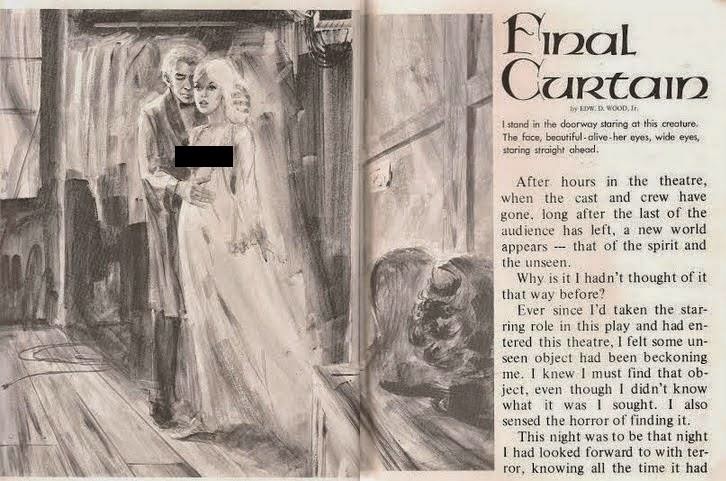
Ed Wood's BLOOD SPLATTERS QUICKLY: 'Final Curtain' (1971)

An actor caresses a blonde-haired vampire dummy in Ed Wood's "Final Curtain."

NOTE: This article is part of my ongoing coverage of Blood Splatters Quickly: The Collected Stories of Edward D. Wood, Jr.

Fresh from the pages of Belly Button!
The story: "Final Curtain," originally published in Belly Button magazine, Vol. 2, No. 2., July/August 1971, Calga Publishers. [Note: Philip R. Frey contends that the story appeared in Belly Button's February 1971 issue.]

Synopsis: After the closing night of his play, an actor wanders around an otherwise-empty and darkened theater, convinced that he is supposed to find some object. At first, his travels take him from his dressing room to the now-deserted stage. All the while, he is seized by eerie hallucinations and senses the presence of the spirits of those long deceased. Every trivial detail he encounters-- the empty theater seats, some burned-out guide lamps, the yowling of a cat -- takes on sinister significance in the man's paranoid imagination. He ascends a staircase to an upper story, where there is a hallway of evenly-spaced storage and rehearsal rooms. In one, he encounters a blonde-wigged female vampire mannequin, which he swears comes to life briefly and smiles at him! He backs out of the room and continues exploring, finally coming to a room where he finds what he had been seeking all along: a big black casket. He climbs inside and closes the lid.

Wood trademarks: Preoccupation with death (cf. this collection's "Into My Grave"); the theater (an important part of Ed Wood's early history); vampires (cf. this collection's "Dracula Revisited"); rambling supernatural monologue (cf. this collection's "I, Warlock," "Dracula Revisted," "The Night the Banshee Cried"); protagonist plagued by spirits and screaming sounds (cf. "Dracula," "Banshee"); quasi-poetic formatting with numerous line breaks (cf. many of the stories in this collection, including "Hellfire," plus the aforementioned monologues); heavy use of ellipses; resurrection of the dead (literal this time, as spirits); a preference for blondes (the "vampire dummy" has blonde hair); character compelled to climb into a coffin (cf. Necromania, "Come Inn"); fetishization of women's clothing (our narrator takes time to appreciate the mannequin's silk dress); fondness for soft fabrics (the casket is also velvet-lined); the "other things.. pleasant things" monologue (recycled as a speech for Criswell in the script for Orgy of the Dead); and one last reference to snakes (a metal railing is compared to "a cold, slimy snake").

Excerpt: "I leave the comforting lights of my dressing room and move to stand on the dark, empty stage. I look out over the blackened auditorium. The seats in front are as I have seen them night after night while acting my lines on this side of the footlights. But now, empty, they appear like squatty little fat men standing row on row, like soldiers in battle formation."

Reflections: More needs to be written about Ed Wood's mid-to-late-1940s theatrical career, which seems to have had a considerable, course-altering effect on his life. Unsurprisingly, the details of this phase of his career are scarce, and the sketchy information one can find in books like Rudolph Grey's Nightmare of Ecstasy is incomplete and often contradictory. What's (generally) agreed-upon is this: in 1946, having been honorably discharged from the Marines, Edward D. Wood, Jr. studied at the King-Smith School of the Creative Arts in Washington, D.C., where he may have received instruction from revered dancer and choreographer Martha Graham (1894-1991), a figure he is said to have admired greatly.

When he moved out to Hollywood the next year, Ed's first professional experiences were not in film but on the stage, acting in his own autobiographical play The Casual Company and portraying a sheriff in a show called The Blackguard Returns, as well as appearing in other, as-yet-unspecified theatrical productions. Chuck La Berge, an actor who appeared with Ed in The Casual Company, recalled to Rudolph Grey: "In the theater, we had a bad night, we'd all sit around and share a bottle of gin. We'd get drunk, and Ed would tell us all this weird stuff." Oh, to have been a fly on that wall, huh?

Duke Moore in "Final Curtain."
Those late, lonely nights in the theater were the inspiration for "Final Curtain," a story that should already be familiar to readers of this blog, as it was the basis for an unsuccessful yet quintessentially Wood-ian television pilot in 1957. Though Ed's would-be anthology series was a non-starter, this material hardly went to waste. Footage from that doomed pilot was shoehorned into Night of the Ghouls in 1959, and a chunk of text from the script was airlifted into Orgy of the Dead in 1965. Finally, in 1971, Eddie reformatted "Final Curtain" as a short story and sold it to Bernie Bloom, who used it to pad out one of his many photo-heavy stroke books.

Judging from the rather lavish illustration accompanying "Final Curtain" in the pages of Belly Button, Bernie gave this particular piece the royal treatment, despite its utter lack of eroticism. Perhaps he sensed how dear this monologue was to Eddie. In its transition from the screen back to the page, the text of "Final Curtain" does not seem to have changed much. Generally, the TV version is wordier than the magazine version, perhaps in an effort to better match Dudley Manlove's over-emotive voice-over narration with the silent footage of actor Duke Moore wandering around an empty building. But generally, the two incarnations of "Final Curtain" match each other, image for image and idea for idea. I won't say "plot point for plot point," because "Final Curtain" is more of a mood piece than it is a traditional narrative. As such, its natural home is on the page rather than the screen, so I'm glad Eddie recycled this one as a short story. Not much actually happens here, which becomes more obvious in the filmed version.

In any format, "Final Curtain" offers further evidence that Edward D. Wood, Jr. spent an inordinate amount of his life fantasizing about death, his own in particular. Wherever you are now, Eddie, I hope you're resting in peace.

Next: My closing thoughts on Blood Splatters Quickly

Wednesday, December 3, 2014

Ed Wood's BLOOD SPLATTERS QUICKLY: 'The Whorehouse Horror: A Touch of Terror' (1972)

Ed goes back the the whore shack in this beautifully-illustrated Gothic tale.

NOTE: This article is part of my ongoing coverage of Blood Splatters Quickly: The Collected Stories of Edward D. Wood, Jr.

The story: "The Whorehouse Horror: A Touch of Terror," originally published in Ecstasy, Vol. 4, No. 1, February/March 1972, Pendulum. Also appeared in Garter magazine, January 1, 1974, Gallery.

Synopsis: Prostitute Sandra Livingston is getting a little too old to be a call girl, and the dangerous life of the streetwalker doesn't appeal to her either, so she's looking for a whorehouse. Unfortunately, those are getting tougher to find. By chance, she goes into a dive bar and encounters a creepy pimp nicknamed Mousy, who says that he'll drive her out to just such an establishment. She agrees but is suspicious when the house of ill repute turns out to be a spooky mansion next to a graveyard. Despite her reservations, she goes in anyway and meets the ancient but friendly-seeming madam. 

Sandra soon finds that she is being held prisoner in the house and that escape is impossible. Only then does the madam reveal the bordello's terrible secret: all the girls are intentionally given venereal diseases which they will then pass on to their clients, who in turn have been sent unawares to the house by their revenge-seeking enemies. Girls who disobey or become too sickly wind up in the graveyard next door.

Wood trademarks: Whorehouse (cf. Take It Out In Trade); relationship between prostitute and pimp (cf. this collection's "Private Girl"); alcohol and bars (Sandra and Mousy meet in a dive bar, where Sandra drinks martinis); graveyard (cf. this collection's "Into My Grave," "In the Stony Lonesome"); juxtaposition of sex and death (cf. "Stony Lonesome," Orgy of the Dead); extremely illegal and perverse business in remote location (cf. this collection's "Breasts of the Chicken"); reference to Bela Lugosi and Boris Karloff horror films (cf. this collection's "The Gory Details"); woman aging in the sex trade (cf. this collection's "Flowers for Flame LeMarr," "Private Girl"); venereal disease (cf. this collection's "Craps," "To Kill a Saturday Night"); use of color pink (the madam wears a "faded pink velvet wrapper"); marabou (angora-like fabric often cited by Ed).

Excerpt: "The sweat had begun to pour from her forehead, even though there was a chill in the air. She felt strongly that she needed a drink. She also felt that she would catch syph or worse if she ventured into the dives she found along the street. But then she knew alcohol was a sterilizer. It probably couldn't hurt her any... especially if she demanded a clean glass."

Reflections: Where does he come up with this stuff? As I mentioned before in this series, Eddie's horror stories tend to have some nasty twist at about the four-fifths mark, and he's come up with some doozies in this collection: an incestuous transvestite alcoholic amnesiac killer, a mad dentist who sells organs on the black market, and a gourmet restaurant for cannibals with a breast fetish. "The Whorehouse Horror" may be the weirdest of them all. 

Try as I may, I cannot quite wrap my brain around this bordello's business model, which somehow combines white slavery with germ warfare. Of my many, many questions about this arrangement, my greatest might be: aren't the johns suspicious of anything? After all, they're instructed to go to a spooky old house right out of Scooby-Doo or The Addams Family, simply to enjoy a free-of-charge session with a prostitute. (The johns don't pay for the service; their enemies are the ones footing the bill.) I guess horny guys are willing to overlook just about anything. All I can think of is Valerie Solanas' scathingly satirical and often dead-on S.C.U.M. Manifesto (1967). It contains a passage that, in retrospect, applies to many of Ed Wood's male characters:
"Eaten up with guilt, shame, fears and insecurities and obtaining, if he's lucky, a barely perceptible physical feeling, the male is, nonetheless, obsessed with screwing; he'll swim through a river of snot, wade nostril-deep through a mile of vomit, if he thinks there'll be a friendly pussy awaiting him. He'll screw a woman he despises, any snaggle-toothed hag, and furthermore, pay for the opportunity. Why? Relieving physical tension isn't the answer, as masturbation suffices for that. It's not ego satisfaction; that doesn't explain screwing corpses and babies."
I've also been thinking about why Ed Wood writes about prostitution so often. There are only hints of this obsession in his movies (e.g. Colleen O'Brien as the eternally doomed streetwalker in 1965's Orgy of the Dead), but it dominates his short stories. Ready for some fan theory spinning? I think Eddie identified with prostitutes because he basically had to sell himself for increasingly paltry sums of money throughout the 1960s and 1970s. 

It wasn't Ed's goal in life to become a writer of pornography or a director of X-rated films, just like most little girls probably don't dream of growing up to be a hooker someday. That's just the way things worked out for him. Life in Hollywood also aged Ed Wood severely, and I think he saw a parallel to that in the lives of prostitutes. This story's Sandra Livingston wants to work in a "house of ill repute" because she could last there until her late forties, as long as she wears enough makeup. I need hardly tell you that Ed Wood was about 48 years old when this story was published. Wonder how thick his makeup was by then.

Next (and last): "Final Curtain" (1971) 

Tuesday, December 2, 2014

Ed Wood's BLOOD SPLATTERS QUICKLY: 'Pray for Rain' (1972)

The men of Wet Hound Fork, AZ endure a drought in Ed Wood's "Pray for Rain."

NOTE: This article is part of my ongoing coverage of Blood Splatters Quickly: The Collected Stories of Edward D. Wood, Jr.

"12 Pages of Tactile Color"
The story: "Pray for Rain," originally published in Skin & Bones magazine, Vol. 4, No. 1, February/March 1972, Calga Publishing. According to Bob Blackburn, this story also appeared in Lusty Lovers, year and other publication data unknown.

Synopsis: The small Arizona community of Wet Hound Fork (population: 200) is in the midst of a months-long drought, and the situation is starting to get desperate. Water, money, food, and booze are all in short supply. The town's wives have taken control of what little money is left, so they can buy the precious, trucked-in food and water their families need.

Only on Saturdays do the menfolk gather at the local saloon to slowly sip their drinks and complain about the lack of rain. During one such bull session, an old-timer recalls the droughts of the 1930s and suggests a remedy to the current problem: the people of Wet Hound Fork should pool their money and hire an Indian Rainmaker*. 

As expected, this idea is met with ridicule and skepticism, but the men still discuss the old-timer's plan in detail. They point out that the Great Depression-era Rainmaker must be long dead by now. The old man says there's another who's still living named Chief War Eagle. The men also say that the Indians on the reservation are suffering the exact same drought and are living on government assistance. The old timer suggests that a Rainmaker  might somehow help Wet Hound Fork receive some federal aid as well or even help get God's attention. The men fall silent at this point as they continue to pray for rain, unaware of the sound of thunder in the distance.
*Throughout "Pray for Rain," the word Rainmaker is consistently capitalized and italicized.
Wood trademarks: Western setting (cf. this collection's "Calamity Jane Loves Hosenose Kate Loves Cattle Anne"); men gathering around to drink and talk (cf. this collection's "Epitaph for the Village Drunk," "Craps," "To Kill a Saturday Night"); conversation dominated by talkative old-timer (cf. "Craps"); domineering women (cf. this collection's "Just One Question"); alcohol (no particular type is named, but the social ritual of drinking is key to this story); bars (like "Calamity Jane," this story is set in a saloon); thunder (a well-known Ed Wood motif in films and literature alike); the phrase "Then one day, like now, it just ain't there no more." (compare to Glen or Glenda?'s "Then one day, it wasn't Halloween any longer."); the existential ennui of small town life (cf. this collection's "Taking Off," "To Kill a Saturday Night"); lack of money (a subject with which Ed was all too familiar).

Excerpt: "Folks get to takin' water as always being right there. They just never think about water as never being around no more. We get to taking it for granted. We get to thinking that the water won't never run out. that is if we think about water at all. When you get to takin' things for granted you just don't think about it no more."

Reflections: "Pray for Rain" is the kind of story that makes me love Edward D. Wood, Jr. Here, Eddie's task was to yet again fill a few pages in one of Bernie Bloom's sleazy skin magazines, the type of publication people definitely weren't buying for the articles, and somehow Eddie produced a miniature tragicomic masterpiece that manages to be funny and sad and thoughtful all at once. 

People tend to stereotype Ed as a clown: a delusional dreamer with ambition but no common sense or talent, totally oblivious to his own faults and failings. The stories in Blood Splatters Quickly show how drastically oversimplified and unfair that image is. Sure, there are gaudy, lurid, and ridiculous stories in this collection, tales glutted with purple prose and highly improbable plot twists. The title story is an excellent example of that. 

But Eddie had a whole other side to his personality: a philosophical, slightly sardonic side that emerges in stories like "Pray for Rain" and its thematic first cousins, "Craps" and "To Kill a Saturday Night." Maybe his dark sense of humor came from his years of alcoholism and career setbacks. Without having to deal with cameras and actors and props and sets and the million-and-one other hassles of low budget filmmaking, Eddie could express himself through his writing in ways that were bold, vivid, shocking, witty, and even graceful.

When Ed Wood dealt with fantastic subjects (vampires or warlocks, for instance), he was apt to let his fevered imagination get the best of him, and the result was extravagant camp. When he tried to capture the language of particular social groups that were essentially foreign to him (slang-slinging teenagers or underworld gangsters, for instance), his grasp of the lingo was often clumsy and ham-handed, and the result was unintended comedy. 

Eddie's words rang the truest when he wrote about characters like himself: hard-drinking, middle-aged men who have been flattened by life and who have very few options still available to them. When he did these kinds of down-to-earth stories, he tended to ditch the flowery, highfalutin language of his pseudo-Gothic horror tales (like, say, "Dracula Revisited") and write in a style that was more economical and spare, yet still left ample room for evocative background details and realistic scene-setting.

These stories feel very personal, almost biographical. In "Pray for Rain," the relationship between the garrulous old storyteller and the scoffing, skeptical, younger men is very similar to the relationship Eddie really had with the other writers at Pendulum Publishing. The men of Wet Hound Fork laugh at their elder's talk of Rainmakers in the 1930s, just as the young bucks at Pendulum snorted at Eddie's anecdotes about working with Bela Lugosi in the 1950s. 

It's not difficult to see the drought in "Pray for Rain" as a metaphor for the brutal, seemingly endless dry spell in Ed Wood's own show business career. The sound of a phone not ringing can be downright deafening in Hollywood, and Eddie's phone wasn't ringing very often by the early 1970s. That is, when he could even afford to maintain a working phone line. Speaking of phones, Eddie gives his readers a perfect little image of futility and desolation in this descriptive passage about the lack of telephones in Wet Hound Fork:
There was no electrical refrigeration units in the small town... no electricity of any kind except for the single telephone in the General Store. Some months ago Hank Kleper tried to get one installed at his single pump gas station, but the expense was too great, then when the drought set in he and the telephone company both felt it wasn't worthwhile. Another telephone in the town of two hundred wasn't necessary at the time.
In other words: no phone, no lights, no motorcars, not a single luxury. Though it doesn't call attention to itself, that passage is, in its own modest way, nearly as bleak and discouraging as anything to be found in Camus' The Plague.

Next: "The Whorehouse Horror: A Touch of Terror" (1972)

Monday, December 1, 2014

Ed Wood's BLOOD SPLATTERS QUICKLY: 'Calamity Jane Loves Hosenose Kate Loves Cattle Anne' (1973)

The real-life Martha Jane Canary (1852-1903), better known as Calamity Jane.

NOTE: This article is part of my ongoing coverage of Blood Splatters Quickly: The Collected Stories of Edward D. Wood, Jr.

A saloon gal services Hosenose Kate.
The story: "Calamity Jane Loves Hosenose Kate Loves Cattle Anne," originally published in Tales for a Sexy Night, Vol. 2, edited by Chuck Kelly and illustrated by Neil Weisbecker, Gallery Press, 1973.

Synopsis: Deadwood, South Dakota, 1876. The legendary gambler and gunfighter Wild Bill Hickok has been shot in the back during a poker game. Mourning him is Calamity Jane, a butch lesbian stagecoach driver who declares that Bill was the only man she would ever love. After making some threats to local undertaker Uncle Zeke, Jane seeks solace at a saloon called the High Dyke, which is owned by notoriously crooked and obese card dealer Hosenose Kate, so named for her booze-bloated face and trademark red nose.

Kate, herself a lesbian, has a frank and sexually explicit conversation with Jane, during which they discuss Wild Bill's death and other local gossip. Vulgar, coarse-mannered Kate, who never leaves her chair, even when being serviced by prostitutes, implies that Will Bill was bisexual and offers the heartbroken Jane a free night with one of the High Dyke's beautiful saloon girls, including newcomer Barbara. Kate is not bothered or offended when Jane repeatedly throws drinks in her face during their talk. Instead, Kate tells Jane that a woman named Cattle Anne, with whom Wild Bill had a sexual relationship, is driving a big herd of cows from Texas and should be in town soon. Jane vows to gun Anne down when she arrives, though Kate advises against it. When Cattle Anne and Calamity Jane finally meet, everyone expects a bloody showdown. Instead, to Hosenose Kate's (and everyone else's) disappointment, the two women break down in tears when they see each other and go off to mourn Wild Bill Hickok together.

Wood trademarks: 
  • Old West setting (cf. Crossroads of Laredo, Crossroads Avenger, Revenge of the Virgins, etc.)
  • comical supporting character named Zeke (cf. Crossroads Avenger)
  • tough women acting and talking in a masculine fashion (cf. The Violent Years, Fugitive Girls)
  • alcohol (both Jane and Kate are described as hard drinkers; Jane throws "rotgut whiskey" at Kate)
  • bars (saloons in this case, predecessors to the modern day bars and lounges of Ed's other work)
  • dildos (cf. this collection's "Come Inn")
  • multiple references to prostitution (saloon girls or "ready meat")
  • the word "fluff" meaning young women ("damned good fluff, them girls")
  • "fluff" meaning soft clothing or accessories ("the fluff and finery," a phrase that also turns up in Glen or Glenda?)
  • a blonde character named Barbara (cf. Glen or Glenda?)
  • "meat whistle" as a euphemism for the penis (cf. this collection's "Sex Star")
  • the now-mandatory references to death and its attendant rituals (Jane and undertaker Zeke discuss Wild Bill's coffin)
  • name-calling directed at homosexual or effeminate men (compare this story's "You know what they calls men that does that kind of thing." to Glen or Glenda?'s "There are names for boys who go around wearing girls' clothes.")

Excerpt: "Why in hell I ever come to this creep dive I don't know. What do you know about anything anyway? You sit there with them big black cigars lettin' the ashes go down between your boobs, and you swig this rot gut all day, and you don't never get out of that chair. What in hell do you know what's going on outside them swinging doors? You ain't seen the street out there since it was a dirt path."

Reflections: The Old West and the colorful characters who populated it were lifelong obsessions for Edward D. Wood, Jr., going back to his childhood in Poughkeepsie, NY, where he was a regular patron of the local movie house in the 1930s and 1940s. Those were boom times for the Western, and those pictures left their mark on little Eddie. Had absolutely everything worked in his favor when he moved to Hollywood, Ed might have carved out a cozy little career making formulaic cowboy pictures for thirty or forty years and been quite happy doing so.

But very little worked in Ed Wood's favor, as we know, so he made a few obscure Westerns for himself and scripted a few more for other directors but never came close to establishing himself as a cut-rate John Ford or Zane Grey. Of all the genres in which Eddie toiled -- horror, science fiction, crime, juvenile delinquent, skin -- Westerns were closest to his heart. You could see it in his casting choices from the 1950s. Why else dredge up D-listers like Tom Keene, Bud Osborne, and Kenne Duncan to act in stories which had absolutely nothing to do with the range? Working with these people, all Western film veterans, gave Eddie the chance to pay tribute to the kinds of movies he truly loved.

Thus far in Blood Splatters Quickly, Ed Wood the short story writer has not made too many trips out to cowboy country for inspiration. "Calamity Jane" is this collection's first clear example of a Western tale, and it shows how both the country and Eddie himself had changed from the 1940s and 1950s to the 1970s. In Ed's aborted first film, Crossroad of Laredo (1948), no-goodnik Tex (played by Don Nagel) frequents the local saloon and carouses with the cheap women there, but Eddie's prudish camera does not follow him past those infamous swinging doors. That film had its own character named Barbara, but she was a wronged woman who finds true love with the film's hero, Lem (Duke Moore), not a newly-debauched prostitute like the Barabara in "Calamity Jane."

In fact, if you follow the trajectory of Ed Wood's further Western career from Crossroads Avenger: The Adventures of the Tucson Kid (1953) to Revenge of the Virgins (1959) to "Calamity Jane Loves Hosenose Kate Loves Cattle Anne" (1973), you can see Ed becoming progressively raunchier and less optimistic. In this story, he gives us an especially grotesque character in the Jabba the Hut-esque Hosenose Kate, whose own alcohol-induced physical decline seems to be a grim parody of Ed Wood's own personal mutation from dashing, Errol Flynn-type loverboy to double-chinned drunken sot. As for the story's sexual politics, the knee-jerk reaction is to say that this is another example of Ed stereotyping lesbians as hyper-masculine "bull-dykes." But a closer inspection shows that the lesbians in this story just want to be able to enjoy the kind of power and freedom that men do, even if that does bring on unwanted prejudice. As evidence, I present this dialogue between Kate and Jane, as the two discuss Wild Bill Hickok's past escapades with other women:
     "You ain't in town all the time. You're always out there on the prairie driving that six up stagecoach of yours."
     "Well I gotta' make a livin'."
     "You live like a man does."
     "That's what I like."
     "And livin' like a man you got to have a woman when you came to town. Now you don't want to live like a man and have a man take you to bed. You know what they calls men that does that kind of thing."
     "What in hell do you think girls that take on girls are called? What in hell about that?"
     "Ain't the same. Some girl thinks like a man, then by the hell's fires she's got to be a man, and a man always needs his woman. Now you was thinkin' like a woman when you got all worried up about the dead man out there takin' on a woman. Yet you sit right over there across from me and you're all dressed up like a man and you smoke cigars like a man... just like me."
Clearly, suggests Ed Wood in this story, some women in the Old West have learned that there are societal advantages to acting and dressing in a masculine fashion. For Calamity Jane and Hosenose Kate, it's a matter of deeply-felt personal identity, and it's every bit as integral to their lives as Glen's angora sweater and blonde wig were to him in Glen or Glenda? To quote that film's wise Dr. Alton: "To take it away from them might do as great a harm as taking away an arm or a leg or life itself."

Next: "Pray for Rain" (1972)

Sunday, November 30, 2014

Ed Wood's BLOOD SPLATTERS QUICKLY: 'Craps' (1973)

A lifelong gambler graduates to the next world, minus his ears, in Ed Wood's "Craps."

NOTE: This article is part of my ongoing coverage of Blood Splatters Quickly: The Collected Stories of Edward D. Wood, Jr.

Gallery's Tales for a Sexy Night.
The story: "Craps," originally published in Tales for a Sexy Night, Vol. 2., 1973, Gallery Press. Edited by Chuck Kelly and illustrated by Neil Weisbecker.

Synopsis: A legendary crap shooter named Makey has been murdered, with his throat slit and his ears cut off. At his funeral, four men, including an 82-year-old codger, gather at his graveside and exchange bawdy stories about their departed comrade, laughing as they remember Makey's drinking, cussing, gambling, and carousing. There is a chip missing from the dead man's marble tombstone, and the men agree that Makey probably used this to fashion a pair of dice for himself in the afterlife. While the preacher talks of Makey's soul and other mourners glare with disapproval at his talkative friends, the four men continue to speculate about who could have killed the champion dice roller. They also wonder whether Makey's equally-legendary penis has been removed.

The old man complains of his hunger, possibly brought on by the thoughts of the worms who will soon be devouring Makey's mortal remains. The men make plans to reconvene at a local watering hole called Venereal Disease Louie's, where Makey has a postmortem tab, and they express regret that Makey will never get to face another famous gambler, Big Ed Smiley. Then, a fifth man arrives at the funeral with shocking news: Big Ed Smiley killed Makey, removed his ears and penis, then felt guilty about it and shot himself. The sound of thunder overhead indicates that Makey and Big Ed are finally having their big showdown... in the next world.

Wood trademarks: Funeral with preacher delivering sermon (cf. Plan 9 from Outer Space); particular obsession with spooky old cemeteries (cf. Orgy of the Dead); grim speculation about what happens to bodies once they're buried (cf. this collection's "Into My Grave"); the word "ma'an" (a common expression in these stories); references to coffins and ghosts (cf. Night of the Ghouls); alcohol and bars (eternal Wood motifs); skeletons (cf. Plan 9, Orgy of the Dead); the word "fluff" (this time in reference to a woman, cf. the character Fluff in The Class Reunion); violent emasculation (cf. this collection's "Breast of the Chicken"); men exchanging stories about a fallen acquaintance (cf. this collection's "Epitaph for the Village Drunk"); reference to the Devil (cf. this collection's "Hellfire"); possible reference to prostitution (the men talk about spending money on women); combination of sex and death (the men talk about Makey's postmortem sex life); thunder (a mainstay in Ed Wood's movies, cf. Glen or Glenda?, Plan 9, etc.)

Excerpt: "He sure as hell would be dead if he can't hear those dice rattlin' like his skeleton will be doing come Winter time. An' on top of that if he can't use that wand of his with some of the dead women he's bound to meet. After all, all them spirits ain't old ones. They's a lot of young stuff gettin' themselves dead every day, and Makey sure had an evil eye for the young stuff. Spent a lot of money on them too. 'Course he won a lotta' money so I guess he could spend a lotta' money."

Stubby Kaye brings his dice to Heaven.
Reflections: "And the Devil will drag you under by the sharp lapel of your checkered coat!" I could not help but think of Stubby Kaye crooning "Sit Down, You're Rockin' the Boat" from Guys & Dolls as I read Ed Wood's "Craps," the story of a (literally) die-hard gambler who actually does bring his dice to Heaven with him, chipped out of his own gravestone even. Well, maybe Makey's destination isn't Heaven exactly, but wherever he winds up in the afterlife, he's still gambling.

I'm now also reminded of the Notorious B.I.G.'s "Suicidal Thoughts," in which the rapper ponders his own postmortem existence and scoffs at Heaven: "Hangin' with the goodie-goodies lounging in Paradise. Fuck that shit, I wanna tote guns and shoot dice."

Though similar in stature, Stubby Kaye and the Notorious B.I.G. deliver exactly opposite messages with their songs. Stubby renounces his sinful ways so he can get into Heaven in the next life, while Biggie enjoys his vices too much to give them up for anyone, God included. Where does Ed Wood fall in this debate? Well, it may be instructive to know that, according to Kathy Wood in Nightmare of Ecstasy, Ed's favorite song was "Amazing Grace," a Christian hymn which centers around a sinner (who self-identifies as "a wretch") finding redemption through God's grace.
"Ed loved that damned song, 'Amazing Grace.' It kind of hit him somehow. And he wrote that book, Saving Grace. It was written when he was getting more and more depressed. They say that people, when they feel they're going to die, that they get kind of religious, and Eddie, something kind of happened to him. I don't know what it was, but he wrote this crazy book. And I felt kind of strange about it, like a chill up my spine."
The fate of the book Saving Grace (seemingly written in the mid-to-late 1970s) is currently unknown, as it was never published during Eddie's lifetime and has not surfaced since his death. "Craps" is not pious or religious in tone at all, however. In fact, the characters in the story actually scoff at the idea of prayer. A sample quote: "Prayers don't help no how, no way for anything else but crap shootin', an' that's a fact." Throughout "Craps," the four men's raunchy conversation serves as an ironic counterpoint to the preacher's well-intended but ultimately meaningless eulogy. Interestingly, the clergyman at Makey's funeral asks the "Good Lord" to show mercy on the deceased gambler. "Gambling wasn't so bad," Wood writes. "Life was all one kind of a gamble or another." Who knew that better than Edward Davis Wood, Jr.?

Considered in total, "Craps" is yet another example of Eddie's all-consuming obsession with death. It's basically a lighter, less-tragic variation on "Epitaph for the Village Drunk," with the protagonist already dead at the beginning of the story and his exploits only revealed through anecdotes shared by the men who remember him. I sincerely hope that, when Eddie himself was cremated in December of 1978, at least a few of his former colleagues and drinking buddies gathered to swap stories about the Man in the Angora Sweater. Eddie would've liked that.

Next: "Calamity Jane Loves Hosenose Kate Loves Cattle Anne" (1973)

Saturday, November 29, 2014

Ed Wood's BLOOD SPLATTERS QUICKLY: '2 X Double' (1973)

A wife finds out she and her husband have a lot in common in Ed Wood's "2 X Double."

NOTE: This article is part of my ongoing coverage of Blood Splatters Quickly: The Collected Stories of Edward D. Wood, Jr.

Ed Wood in Party Time.
The story: "2 X Double," also known as "Two Times Double," originally published in Party Time magazine, February/March 1973, Gallery Press.

Synopsis: The marriage of Jimmy Hare and his shapely wife, Donna, seems to have hit a snag after only two years. The couple argue frequently about their sex life, with Jimmy unable to achieve and maintain an erection and Donna cold and unresponsive in bed. During one particularly violent argument, Jimmy hits Donna, throws her across the room, and beats her backside until her buttocks are raw and bruised. 

While her husband is at work, Donna goes to the bathroom to urinate but dreads sitting on the toilet with her still-sore buttocks. When she does, the pain is excruciating but also exhilarating, and Donna achieves the greatest orgasm of her life. Later, she finds a semen stain on her bed sheets and realizes that Jimmy must have brought himself to orgasm, too, while thinking of the violence he inflicted upon his wife. In the past, he was always "too soft" with her, which was a turnoff. Now she realizes that they are both into rough sex. When Jimmy comes home from work, he's brought something for his wife: a whip, which he says he'll use if she refuses to satisfy him sexually. She feigns horror and directs her husband to follow her into the bedroom, where she disrobes.

Wood trademarks:
  • arguing heterosexual couple (cf. Orgy of the Dead, Necromania, many of the stories in this collection)
  • man unable to maintain or even achieve an erection (cf. this collection's "Come Inn," "To Kill a Saturday Night")
  • woman nagging man about his impotence (cf. The Snow Bunnies, Necromania, "Come Inn")
  • the word "lovely" (one of Ed's favorite adjectives); combination of sex and death ("You lay just there like a stiff... and just about as cold.")
  • mechanical nature of male lovemaking (cf. The Class Reunion, The Cocktail Hostesses)
  • feathers (in this case, in a pillow)
  • multiple references to prostitution (a common motif in these stories)
  • threat of divorce court (cf. Glen or Glenda?, The Cocktail Hostesses)
  • soft things (in this case, a "soft towel")
  • reference to snakes (Jimmy buys a "blacksnake whip")
  • satin (Donna wears a "pink satin housecoat")
  • extremely heavy use of color pink (in addition to Donna's pink fur mules and housecoat, there is a bathroom where literally everything is pink, including the toilet)
  • alcohol (repeated references to "a couple of drinks").

Excerpt: "She bounced her ass harder and harder on the pink toilet seat. Everything in the room was pink... the toilet, the sink, the tub, the shower, the rugs, the curtains, and the pink glow which sent such beautiful pictures, such beautiful fantasies rushing through her mind's eyes was something she had never before experienced..."

Reflections: First, let me make clear that there is no obvious moral justification for a story like "2 X Dobule," in which a horrific act of domestic abuse, resulting in what the writer specifies as "purple" bruises, leads to a consensual and mutually pleasurable sexual experience for a married couple. I acknowledge that sadomasochism (or S&M) plays an active and healthy role in the lives of many couples, straight and gay, married and unmarried. 

I, however, refuse to acknowledge that anything good or positive can come from a situation in which a husband lashes out violently at his wife because of his own sexual inadequacy. This seems to be, on Ed Wood's part, an example of rationalization, i.e. "Sure, I beat the hell out of my wife, but it turned out to be okay because she actually enjoyed it." In the marriage depicted in "2 X Double," loud arguments seem to be so commonplace that the threat of police intervention, based on complaints from the neighbors, is very real. This is much, much too close to Ed Wood's own life, in which he physically abused his wife, Kathy Everett O'Hara Wood. The infamous "It's a Kind of Glow" chapter from Nightmare of Ecstasty is littered with harrowing anecdotes, like this one from friend and actor David Ward:
When they'd start fighting, oh boy, you should have heard the names they'd call each other. And then Eddie would take Kathy's head and bang it against the wall! Then she'd be quiet for a while.
Here's one from Kathy herself:
We were fighting one time. He dragged me over the floor for a couple of minutes, and my left hand, it's pretty well gone now, it doesn't go straight out. It's not Eddie's fault, but it's half his fault...
And another from actor John Andrews:
He called me one morning. We talked to each other, three, four times a day. He says, "I nearly killed O'Hara last night. I..." "Oh no. What happened now?" He says, "She was mouthing off in the kitchen, and she wouldn't shut up. I told her to shut up, and I told her to shut up, and finally I went in there and I let her have it." And -- he knocked her cold.

Those unflattering details were echoing in my head as I made my way through "2 X Double." I tried to make sense of this story by placing it in its proper sociological context and remembering for whom these magazine articles were written. 

Ed Wood's early 1970s stories for Gallery, Pendulum, and Calga appeared in pornographic magazines intended for white, male, middle-aged, middle-class men. That was the target audience for X-rated material in the Free Love era of the late 1960s and early 1970s, according to the Report of the Commission on Obscenity and Pornography, which was presented to then-President Nixon in 1970 and which played a key role in Ed's script for The Undergraduate in 1971. In general, these porn consumers would have been straight, though Eddie wrote for some gay magazines, too. While the kids were out there doing it, the adults were just reading about it and watching movies about it, presumably because their own sex lives at home were dull and unsatisfying.

A publication like Party Time, which was mostly a delivery system for pictures of naked women, provided a little fodder for fantasy in the minds of its frustrated readers, the hard-working Joe Lunchbuckets of America. In a lot of these stories, Ed Wood provides his male readers with surrogate characters with whom they can identify. Generally, these are regular, "manly" guys -- very often endowed with enormous penises -- who have boring office jobs and want their wives to be ready with a strong drink and a hot meal at the end of the day. (Jimmy Hare of "2 X Double" has a fondness for pork chops.) Even the gourmet cannibal of "Breasts of the Chicken" is firmly established as a run-of-the-mill businessman with an otherwise-unremarkable life (and the prerequisite monster penis). 

I can't claim to fully understand Ed Wood's motives as a writer, but my tentative diagnosis is that "2 X Double" was a power fantasy for middle-aged men more so than it was an apologia for domestic abuse. It's okay to read and fantasize about this stuff, I guess, as long as you don't actually put it into action. If you want to experiment with S&M, it's crucial to get your partner's approval in advance.

Next: "Craps" (1973)