Showing posts with label Jail Bait. Show all posts

Wednesday, December 10, 2025

Ed Wood Wednesdays, week 254: Is 'Jail Bait' (1954) film noir?

A moody moment from Ed Wood's semi-obscure crime thriller Jail Bait.
"It has always been easier to recognize a film noir than to define the term."
-James Naremore, film scholar
If you look up Edward D. Wood, Jr. on the Internet Movie Database (as I have done many hundreds of times while writing this column) and sort his credits by genre, you'll see that only two of his films have been designated "film noir" by the site's users: Jail Bait (1954) and The Violent Years (1956). I'd have thought The Sinister Urge (1960) would qualify, too, but currently that one is designated simply a drama. Not moody enough, I suppose. Or maybe no one thought to label it as such.

Noir namer Nino Frank.
Whatever the case, we have just lived through another November or, as film writer Marya E. Gates has famously dubbed it, Noirvember. This is the time each year when cinephiles are encouraged to study and appreciate film noir (literally "dark film"), a genre first named by French film critic Nino Frank in 1946. Appropriately, in keeping with the gloomy spirit of the season, Mike White's podcast The Projection Booth just did four noir-themed episodes last month, and YouTuber James Rolfe posted a thoughtful 23-minute video essay called "Why I Love Film Noir" to his Cinemassacre channel. 

All of this material has been buzzing around in my brain recently, and I started to think about how Ed Wood fits into this whole picture. That's my curse. I have to apply everything to Eddie's career. It's become the prism through which I see the world. He's not thought of as a "noir director," but certainly these movies had an effect on him. It's a topic worth exploring. Should I have done this article back in November? Yes. But I had other articles I was working on at the time, so this one had to wait. I'm getting to it now. We'll call it Noircember, okay?

Since Ed Wood did not direct The Violent Years himself -- those duties were handled by one-and-done director William Morgan -- I am concentrating my attention on Jail Bait, Eddie's oft-overlooked sophomore feature. As I've said before, it remains the neglected middle child of his 1950s films, likely because it does not feature flying saucers, graveyards, or men in angora sweaters. Criswell, Bela Lugosi, and Tor Johnson are AWOL as well. (Since Bela was busy with his Vegas revue, his part was given to the wheezing Herbert Rawlinson.) Even though Eddie made this bleak crime thriller between Glen or Glenda (1953) and Bride of the Monster (1955), the biopic Ed Wood (1994) skips right over it, as if it never existed. Well, it did and does. But is it film noir?

Wednesday, April 26, 2023

Ed Wood Wednesdays, week 149: Delving (once again) into the Huffman Files

What sort of nonsense has Rob sent me now?

What can I say, folks? Between work and some other extracurricular obligations, I have simply not had much time for Ed Wood lately. I know that's become a tired refrain in 2023, but it also happens to be true. Hopefully, in the not too distant future, Eddie will crawl his way back up to the top of my to-do pile. But it hasn't happened yet.

That's okay, though, because an utter madman named Rob Huffman keeps sending me Ed Wood-related detritus. Every couple of days, I'll check my email and see he's sent me even more stuff. Remember just last month when he sent in that 1954 photograph of Ed Wood, Dolores Fuller, Bela Lugosi, Devila (whom Ed was planning to turn into the next Vampira), and LaTanya? Well, this week, he's found  another copy of that same picture. "A little cleaner than the newspaper clipping," he says. "I have no idea of its origin." Here it is for your perusal.

(l to r) Bela Lugosi, Dolores Fuller, LaTanya, Devila, Ed Wood.

Rob also sent this photo, obviously taken at the same event. Note Bela's outfit, Ed's outfit, the Jail Bait (1954) poster in the background, and the mess of photographs on the table. I honestly have no idea who the third man is, but I bet you know and will tell me as soon as this article goes live.

Ed Wood and Bela Lugosi at some kind of publicity event in 1954.

Rob has sent me even more stuff, but that's literally all I have time for right now. Even as I type this sentence, other obligations beckon to me. 

Wednesday, March 8, 2023

Ed Wood Wednesdays, week 144: Ed Wood's odd duck

Is there an odd duck in the Ed Wood filmography?

Every famous director, it seems, has that one movie in his filmography—the one that doesn't quite fit in with its siblings. Whatever the cause, be it thematic or stylistic or both, these movies stand apart from the ones that came before and the ones that came after. They're like little islands unto themselves. Think of Stanley Kubrick's Barry Lyndon (1975), Ingmar Bergman's Hour of the Wolf (1968), John Waters' Desperate Living (1977), and Alfred Hitchcock's Marnie (1964).

I don't want to call these movies black sheep or redheaded stepchildren, because that would imply that they were unwanted or rejected by the public. That's not necessarily true, though these movies often receive less attention and less love than a director's more "typical" films. Let's instead call them odd ducks. I think it's healthy to have at least one of these per career. Maybe more than one. 

It's hard to tell which film might qualify as Robert Altman's odd duck. Popeye (1980) comes to mind. But let's not forget HealtH (1980), Quintet (1979), and O.C. and Stiggs (1985). Lotta odd ducks in Bob's filmography. By contrast, David Lynch is such a well-known eccentric and surrealist that his most conventional movie, The Straight Story (1999), is paradoxically his odd duck. As you can see already, odd duckishness is a difficult thing to define.

So what about Edward D. Wood, Jr.? Is there an odd duck in his career? If so, I'd say it's Jail Bait (1954). I can't tell you why exactly, but there's something about this movie that sets it apart from everything else he did as a director. Maybe it's the fact that it's Eddie's first attempt at film noir. (Does The Sinister Urge [1960] count as his second?) Maybe it's that nerve-jangling music on the soundtrack. Maybe it's the fact that Criswell, Paul Marco, Bela Lugosi, and Tor Johnson are all AWOL.

But I think what really sets Jail Bait apart is its lack of a moral center. It may be Ed's first movie without a true hero. Sure, there are a couple of cops on the case—Inspector Johns (Lyle Talbot) and Lieutenant Lawrence (Steve Reeves)—but they accomplish very little. The solution to the case is basically just handed to them at the end, give or take a poolside shootout. Besides, we spend more time with surly young Don Gregor (Clancy Malone), Jail Bait's sweaty, quavery-voiced antihero. The people in Don's life are of no help to him, either bullying him (the cops, Vic Brady) or nagging him (his father and sister).

In short, Don Gregor has no safe, comfortable place to go. There's nowhere he fits in. Consequently, we in the audience have no place where we feel comfortable during Jail Bait. There are no happy, well-adjusted people in this movie. That alone sets Jail Bait apart from Ed Wood's other 1950s movies. In Glen or Glenda (1953), Bride of the Monster (1955), and Plan 9 from Outer Space (1957), there are romantic couples we are meant to like and empathize with. Whatever else may happen, we know that these sets of characters love each other. Nothing like that in Jail Bait. A halfhearted romance between Dolores Fuller and Steve Reeves is barely hinted at and never materializes. What good would it have done anyway? This isn't that kind of movie.

So that's why I feel Jail Bait qualifies as the odd duck of Ed Wood's career. Perhaps that's why it remains the least shown and least known of his 1950s creations. What do you think?

Saturday, December 17, 2022

The 2022 Ed-Vent Calendar, Day 17: My own personal cutting room floor

Not everything makes it onto this blog... until today, that is.

Jack Haley would scoff when people told him that being in The Wizard of Oz (1939) must've been "fun." He knew better. Wearing a stiff, stifling Tin Man costume under those hot MGM studio lights for hours at a stretch? That was no fun. That was work. "I couldn't even sit in it," he told writer Aljean Harmetz. "I could only lean against a reclining board." Haley did have moments of levity on the Oz set, especially while working with his longtime pal Bert Lahr, but making the beloved children's fantasy film was mostly a grueling experience for the actor.

Jack Haley, not having fun.
I've sometimes felt like Jack Haley while working on this Ed Wood series over the course of the last nine years. At least Mr. Haley was paid for his labors. This has been entirely a labor of love for me. I've put in many hours of work, much of it tedious, and literally given away the results for free. I'm not even sure what has compelled me to keep going with this series—a desire to create something, I guess. But didn't I make some royalties off that Steve Apostolof book a couple of years ago? Yeah, just about enough to buy some laundry tokens. There's simply no money in this particular corner of film scholarship.

Sometimes, I have been less than gracious when fielding complaints or corrections from readers. I'm not proud of that, but I can't help it. There's one guy in particular—a self-styled "Hollywood historian" who frequents an Ed Wood group on Facebook—who always seems to have something negative to say about my work and who has been skeptical of every theory I have ever posited about Ed Wood. I suppose I should be grateful that he bothers to read my stuff at all and form an opinion about it, but mostly I just want him to come down with a mild case of bubonic plague. I thought adding a "big fat disclaimer" to the Ed Wood Wednesdays index page would silence the complainers, including my "historian" nemesis. It didn't. My message to them all remains the same: if you think you can do better, you probably can and should.

Greg Dziawer started contributing material to this series in 2015, and I'm very grateful for the amazing stuff he consistently manages to find, but that doesn't mean I work any less work on this blog. The formatting and copy-editing? That's still all me. Sometimes, Greg will send me a whole passel of pictures (many of which I have to censor) with only a skeletal outline of the text he wants to accompany them. It's up to me to put all that material into some kind of readable, coherent article.

Occasionally, Greg will tell me he's working on a particular article, so I'll start making a header image for it in advance. Here's an unused one for a piece he was writing about Evelyn "Treasure Chest" West, aka "The Hubba Hubba Girl," a legendary burlesque dancer who can be seen in the so-called "director's cut" of Jail Bait (1954). The article never materialized, but I didn't want the header to go to waste.

Evelyn "Treasure Chest" West.

More controversially, Greg wanted to look into the career of Cotton Watts, the blackface performer whose extremely offensive and demeaning act can be seen in Jail Bait. Coincidentally, in that director's cut I mentioned earlier, the Evelyn West footage replaces the Cotton Watts footage. Here's the header I devised. It's meant to shock and provoke. That orange "Cotton Watts" logo is supposed to be reminiscent of Looney Tunes, by the way.

The notorious Cotton Watts.

Yet another unrealized Dziawer article was about Kent and the Candidates, the late 1960s/early 1970s rock group that contributed the theme song to Mrs. Stone's Thing (1970). I must have been really enthusiastic for this one, because I created multiple header images featuring the group's leader, Kent Sprague aka Kent Dubarri aka Butch Dubarri. Here's the one I probably would have used.

Kent Sprague of Kent and the Candidates.

And here's an alternate version, in case I wanted something more stylized/cartoony. Looks like I never got around to adding text to this one. Or maybe I was waiting for Greg to write the article, so I could put the title in that big blue space.

More of Kent Sprague.

Not all of my unused header images are for unfinished or unwritten articles. Sometimes, I'll just have a change of heart in the middle of the process and go in a different direction. Below, for instance, is some scrapped artwork for an episode of The Ed Wood Summit Podcast. You can see the image I actually used right here.

Greg Dziawer lurking in the shadows.

And, just for fun, here's some unused artwork I made for an article in Greg's "Magazine Orbit" series. I'm not sure why I created it in the first place or why I never used it. All I know is that I found it on my computer while doing research for this article and decided to present it to you. As with the Kent Sprague picture, I probably would have put some text in that big blue expanse.

Two gentlemen featured in Boy Friends magazine. Where are they now?

So that's it. Essentially, with this article, I wanted to clean house a little and give you some insight into how this blog is made. I realize this might all be self-indulgent, but what are the holidays for if we can't indulge ourselves a little from time to time? You're still free to send corrections and complaints to me, but maybe think about Jack Haley and his reclining board before you do.

Thursday, December 8, 2022

The 2022 Ed-Vent Calendar, Day 8: The most versatile office in movie history!

This seems like an office where a man could get things done... if he wanted to.

What do doctors do all day? Well, according to Ed Wood, they mainly wear nice suits, sit around in their offices all day (and night), and wait for trouble to come to them. It inevitably does.

The Coen brothers are rightly known for having a lot blustery authority figures behind heavy wooden desks in their movies. From Trey Wilson in Raising Arizona (1987) to David Huddleston in The Big Lebowski (1998), it's one of their favorite stock characters. I can scarcely think of a Coen film that doesn't have some version of this trope.

But Ed Wood liked to put a lot his authority figure characters behind desks, too. Think of Harvey B. Dunn as the slightly dotty, bird-loving Captain Robbins in Bride of the Monster (1955). In that film's quasi-sequel, Night of the Ghouls (1959), the role of Captain Robbins has shifted to Johnny Carpenter, but the dutiful policeman can still be seen parked behind his desk for a good portion of the movie, dully sending his men to what might well be their doom.

There's kind of a neat symmetry in Plan 9 from Outer Space (1957), since both the top-ranking human (Lyle Talbot as General Roberts) and the top-ranking alien (Bunny Breckinridge as the Ruler) are confirmed desk jockeys. And, obviously, the movie is bookended by the ultimate desk-sitter: Criswell.

While doing research for one of these blog posts, I noticed that the office of Dr. Boris Gregor (Herbert Rawlinson) in Ed's seedy crime thriller Jail Bait (1954) looked strangely familiar.

Clancy Malone and Herbert Rawlinson in Jail Bait.

That's when I realized it was the same exact set used by Dr. Alton (Timothy Farrell) in Wood's previous film, Glen or Glenda (1953).

Shirley Sperl and her then-husband Timothy Farrell in Glen or Glenda.

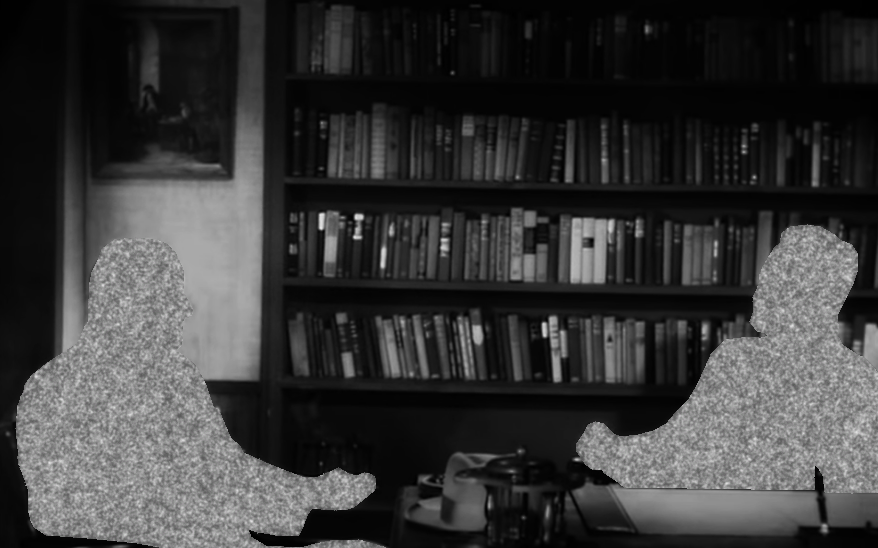
It's all there—the wallpaper, the wood paneling that only goes halfway up, the bookshelves, the desk. All Ed Wood did between Glenda and Jail Bait was move the other chair from the left side of the screen to the right. That's what you call growing as a filmmaker. By the way, I'd give my eye teeth to know the name of that painting in the upper left corner. Do you know what it is?

Wednesday, August 10, 2022

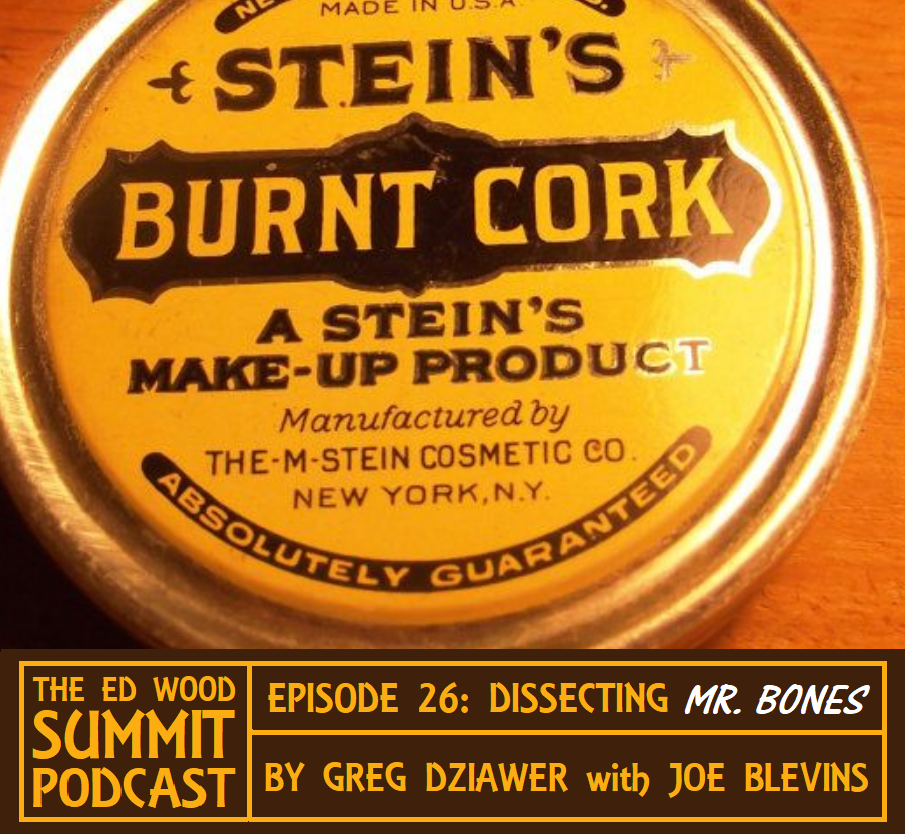
Ed Wood Wednesdays: The Ed Wood Summit Podcast #26 by Greg Dziawer

Burnt cork makeup plays a major role in the film we are discussing this week.

This week on The Ed Wood Summit Podcast, I'm joined by Joe Blevins to discuss Ron Ormond's infamous 1951 blackface film Yes Sir, Mr Bones. While there's no suggestion that Ed Wood had anything to do with this film, it is well-known to be the source of the "comic" routine playing in the theatre immediately before the heist sequence in Ed's Jail Bait (1954).
Note: Due to the controversial nature of this 71-year-old film, we will be discussing subject matter that everyone will find offensive. Please proceed with caution.

Those who wish to check out the film in its entirety can do so here.

Wednesday, April 7, 2021

Ed Wood Wednesdays, week 116: The Harl Foltz Files

Let's figure out who Harl Foltz was.

Is Ed Wood's Jail Bait (1954) a particularly well-lit movie? Eh, by the standards of low-budget 1950s crime movies, it's roughly adequate. Having screened many B-grade flicks over my lifetime, I can definitely say I've seen much worse than this. For the most part, the viewer can actually discern what's happening onscreen. That alone puts Jail Bait ahead of many other independent features of the era. I can't honestly say that the lighting enhances the viewing experience in any noticeable way, however, apart from a few suitably moody shots.

Steve Reeves and Dolores Fuller in Jail Bait. Notice the lighting.

What I can say is that Jail Bait is the first of Ed Wood's movies to give a specific onscreen credit for lighting. In this case, the lighting is attributed to a man named Harl Foltz with no other known film or TV credits. Rudolph Grey's Nightmare of Ecstasy: The Life and Art of Edward D. Wood, Jr. (1992) doesn't mention him at all. So who was this fellow? I thought I'd use the historical records to construct a timeline of Mr. Foltz's life.

Wednesday, March 31, 2021

Ed Wood Wednesdays, week 115: The Wild, Untamed Credits of Ed Wood's 'Jail Bait' (1954)

Jail Bait remains mysterious, all these decades later.

Sixty-seven years after its release, Jail Bait (1954) remains the overlooked middle child of Ed Wood's early filmography. Even with its outrageous plastic-surgery-at-gunpoint plot twist, this low budget noir thriller simply isn't as flashy as Bride of the Monster (1955), Glen or Glenda (1953), or Plan 9 from Outer Space (1959). Jail Bait has no killer octopuses, zombies, or flying saucers to offer its viewers. Criswell, Tor Johnson, and Bela Lugosi are AWOL. The most overtly Wood-ian flourishes are in the wardrobe: Mona McKinnon's furry hat, Dolores Fuller's lacy nightgown, and Theodora Thurman's silk pajamas.

I guess we're not supposed to pay much attention to Jail Bait, kind of like how we're not supposed to focus too much on Zeppo during the Marx Brothers' movies. Perhaps paradoxically, that's why I find it so compelling. I've already written articles about the film's young star, Clancy Malone, and its (sort of) composer, Hoyt Curtin, plus I coauthored a piece about the aforementioned Ms. Thurman. But this week, I just wanted to dive right into the film's credits and see if there were any names that stuck out for whatever reason, preferably names I hadn't given much thought in the past.

Wednesday, October 28, 2020

Ed Wood Wednesdays: The Wood Collaborator Odyssey, Part 21 by Greg Dziawer (with Joe Blevins)

Theodora "Tedi" Thurman during her days as Monitor's weather girl.

Of all the performers to work with Ed Wood during his 1950s heyday, few are more intriguing than Theodora "Tedi" Thurman (1923-2012). She appears in just one of Eddie's movies, playing sultry gun moll Loretta opposite Timothy Farrell's grouchy gangster Vic Brady in 1954's Jail Bait. This eye-catching supporting role was Tedi's lone feature film credit, but it's not her only claim to fame by any means. A striking beauty from Georgia, Tedi Thurman worked as a model and radio personality, gaining acclaim for her husky voice and statuesque looks.

In Rudolph Grey's 1992 book Nightmare of Ecstasy, Thurman remembered Ed Wood as "a very nice, gentle person" and says that she turned down a movie offer from Columbia Pictures in order to model for Vogue in Europe. Ultimately, she decided to forego a film career altogether because she'd heard horror stories about Hollywood. Timothy Farrrell, for one, was quite impressed by Thurman, describing her as "a hell of a good actress" to Grey. Farrell also reported that Thurman attracted lots of attention on the Jail Bait set, which is understandable.

This Jail Bait ad from the April 12, 1955 edition of The Fort Worth Star-Telegram prominently lists Theodora Thurman alongside Dolores Fuller, Lyle Talbot, and Steve Reeves. Interestingly, the ad copy implies that the girls in the film are the titular jail bait, while in the context of the script, that term refers to guns. Note, too, that the woman pictured in the ad is Mona McKinnon instead of Fuller or Thurman.

A 1955 newspaper ad for Jail Bait.

After her brief but memorable experience with Ed Wood, Thurman gained nationwide popularity by delivering sultry, flirtatious weather reports on the radio show Monitor from 1955 to 1961. On that acclaimed series, she was known as "Miss Monitor" and temporarily shared a recording booth with the beloved comedy team of Bob Elliott and Ray Goulding. In the 2013 book Bob and Ray: Keener Than Most Persons by David Pollock, Thurman is described as "five-foot-seven, with cascading red hair." Elliott remembered that she had "a pleasant, slightly offbeat personality" and would sometimes bring in homemade hush puppies. The book also pointed out that Thurman pronounced the word "temperature" as "temper-toor" and was "an instant hit" with listeners. Her popularity extended to The Tonight Show, where she made several on-camera appearances during Jack Paar's troubled reign.

This October 11, 1957 article from The Boston Globe ruminates on Thurman's unusual fame.

Tedi Thurman was making $60,000 doing the weather in 1957.

Tedi Thurman never married, but the 1971 book Whatever Became Of... Third Series by Richard Lamparski states that "Miss Monitor" had "a stormy longtime relationship" with an older woman named Peggy Fears, who had performed in the Ziegfeld Follies in her youth and had eventually become a Broadway producer. Thurman fondly discussed her relationship with Fears in When Ocean Meets Sky, a 2003 documentary about the gay community at New York's Fire Island Pines.

Thurman and Fears had their share of difficult times, however, some of which wound up being reported by the press. The May 12, 1960 edition of New York's Daily News carried an article on page 4 about a violent argument between the lesbian lovers. Apparently in need of backup, Thurman called former college football player William Appel to the Park Ave. apartment she shared with Fears, and Appel ended up catching an assault charge from Fears. Notice how Theodora Thurman is euphemistically described as "a friend of Peggy's."

A domestic quarrel becomes a full-on brawl.

The Thurman/Fears clash must have been a major event in New York, because there was a longer, more elaborate story about it on page 32 of that same edition of the Daily News, this time with a byline by William Federici. In this article, Fears and Thurman are described as "girl roommates." The tone here is considerably more gossipy.

More information on the Fears/Thurman bout of 1960.

This was certainly an unusual and distressing episode in the memorable life of Theodora "Tedi" Thurman, probably one she wouldn't have wanted splashed across the pages of a newspaper. And the duo's wild days were far from over. The September 1, 1963 issue of The Fresno Bee reported that Thurman and Fears were arrested for drunk, disorderly conduct alongside openly gay comedienne Patsy Kelly, who first found fame in the 1930s as a sidekick to Thelma Todd.

Tedi and Peggy were arrested in 1963, alongside Patsy Kelly.
...

Before we leave our little scrapbook about Ms. Thurman, here's another item from the Daily News, this time the December 26, 1949 edition. Here, the "Manhattan fashion model" gives her thoughts on the wolfishness of married men.

Theodora gives her opinion on men.

Wednesday, June 24, 2020

Ed Wood Wednesdays, week 104: The search for Clancy Malone (aka Scott McCloud)

Care to help me solve a mystery this week? Tell me who this man was!

A credit for Scott McCloud in Glen or Glenda.
If there is one thing that this project has taught me, it's that Edward D. Wood, Jr. has the most knowledgeable and persistent fans in all of popular culture. I think that would have pleased him greatly. Though he kept plugging away as a writer and director, always hoping for some measure of success and fame (or at least a little respect), Eddie barely subsisted on the fringes of show business from the late 1940s to the late 1970s. Even though he got his own lavish biopic in 1994, his career is nowhere near as well-documented as that of other, more respectable filmmakers. And so, his loyal acolytes have largely taken it upon themselves to gather information about Ed Wood and his movies. This week, I am hoping that the Eddie experts of the world will come to my aid as I try to solve a mystery that has stumped me for years.

In Ed Wood's woozy, hellish crime drama Jail Bait from 1954, the central character of Don Gregor is played by a young man credited as Clancy Malone. While this is not necessarily a star-making performance, Malone brings a certain nervous, Anthony Perkins-esque intensity to the part. His skinny frame helps, since he always looks too small for his clothes. Don Gregory is a spoiled, immature boy lost in the very grown-up world of crime and death, and that's just how Clancy Malone plays him. If you think about it, this is really a dual role, since Malone also appears at the end of the film as the post-plastic-surgery version of gangster Vic Brady. Unfortunately, the Internet Movie Database says that Malone never played another role, not even for Ed Wood. So who was this guy, anyway?

The only full-length biography of Eddie, Rudolph Grey's Nightmare of Ecstasy (1992), contains a few, fleeting references to Clancy Malone. The book does clarify, for instance, that Malone was also known as Scott McCloud and served under that name as Unit Director on Eddie's feature debut Glen or Glenda (1953). In fact, the book contains a remarkable snapshot (provided by Conrad Brooks) of the Glenda cast and crew posing in the doctor's office set. Clancy/Scott is front row center with a knowing smirk on his face. If you didn't know better, you'd think he was the director!

Scott McCloud (aka Clancy Malone) is the smirking guy in the front row with the script on his lap.

Other information about McCloud/Malone is difficult to come by. On the 2011 DVD collection Big Box of Wood, filmmaker Ted Newsom relates the following anecdote about him:
"The lead guy who plays the profligate son apparently was the guy who delivered groceries to Eddie Wood's apartment. He said he wanted to be an actor, and Eddie said, 'I've got the perfect role for you! Here it is!' And that was it. I don't think he ever acted again. He's okay."
This is very possible. The surest way to gain access to Eddie's entourage was to be in close physical proximity to him. In his later years, as detailed in Nightmare of Ecstasy, Eddie planned to use his neighbor Shannon Dolder in a film. It's not difficult to imagine a plucky delivery boy worming his way into a couple of Ed Wood movies. ("Gee, you're a real live movie maker? That's neat! I've always wanted to be in showbiz myself! Think you could use me?")

Ed Wood obviously took some pride in Mr. Malone's performance, giving the young thespian an "introducing" credit, complete with his character's name.

Prominent billing for Clancy Malone

For some reason, though, the actor was listed as Scott McCloud on the posters and lobby cards for Jail Bait. This particular example features a striking closeup of the newfound star.

This poster for Jail Bait lists Scott McCloud, not Clancy Malone.

So what happened to this guy? People don't just magically disappear. Clancy Malone/Scott McCloud must have had some kind of life before and after working with Ed Wood on Jail Bait and Glenda. Other than those two films, however, and that marvelous behind-the-scenes photo, there is very little to attest to the existence of this human being. If you have more information about him, let me know.

John Avery in Jail Bait.
UPDATE: After sharing this article with an Ed Wood discussion group on Facebook, a few readers have come forward with what they know about Clancy Malone. Ted Newsom, director of the documentary Ed Wood: Look Back in Angora (1994), said he had no more information about the actor and had even forgotten where he'd originally heard abut Malone delivering groceries to Eddie's apartment. "It was obviously someone who had spent time among the Woodites," Newsom speculates about his source.

Meanwhile, artist Stephen B. Whatley, whose work is featured in Dolores Fuller's 2008 autobiography A Fuller Life, shared a 1983 article from Fangoria magazine entitled "I Remember Eddie Wood" by Jail Bait coauthor Alex Gordon. In addition to being Wood's creative partner for a period in the 1950s, Gordon was also Eddie's roommate. In the article, Alex talks about those days with Ed Wood and how their paths crossed with Clancy Malone:
"I had kept up my friendship with Bela Lugosi and saw him several times a week and introduced Eddie to him, and Lugosi was eager to become involved. Eddie and I took a small apartment near Lugosi on Carlton Way [in Hollywood], with two small bedrooms and a kitchen, and two would-be actors, Clancy Malone and John Avery, to help considerably with the rent payments and supply of food."
This is interesting, as it suggests Malone was actually living with Ed Wood for a time. The "supply of food" detail may be the origin of the story about Clancy delivering groceries to Eddie's apartment. Perhaps Clancy was the one in charge of actually getting food and bringing it back to the Carlton Way apartment. John Avery, for the record, played a small role as a police doctor in Jail Bait, reciting his few lines ("Couldn't be any deader.") in a colorless monotone as his arms dangle lifelessly at his sides. Like Clancy, he never acted in a motion picture again. Throughout this research process, I've never been able to determine if this man's real name was "Clancy Malone" or "Scott McCloud." At least one of those is invented. The way Gordon tells the story, I'm beginning to think that the Malone moniker is genuine.

Wednesday, November 27, 2019

Ed Wood Wednesdays, week 93: Let's badly colorize "Jail Bait" (1954)

Tampering with a classic.

NOTE: Let's be real here. It's Thanksgiving week. People are out of town or busy with relatives. It's very unlikely that anyone is even reading this article right now. So let's do something goofy and fun and meaningless. In other words, don't take this seriously. - J.B.

Always a bridesmaid.
When it comes to Ed Wood's filmography, three films tend to get all the attention: Plan 9 from Outer Space (1959), Glen or Glenda (1953), and Bride of the Monster (1955). They're the first of Ed's movies I saw back in 1992. They're also the ones depicted in Tim Burton's Ed Wood (1994). Not surprisingly, these are the titles that have been released the most times in the most formats for home viewing. In short, these are the three films that people know, even if that's pretty much all they know about Edward D. Wood, Jr.

Which means that Eddie's other films, including the 1954 crime drama Jail Bait, tend to get short shrift. Thanks to a company called Legend Films, Plan 9, Glenda, and Bride have all been released in computer-colorized form. While the colorization process deviates from the original intentions of the director and cinematographer, it also manages to bring out some background details that viewers might otherwise ignore. It also allows the films to reach viewers who might be averse to watching a black-and-white film.

To be honest, Jail Bait is probably never going to get the colorization treatment. It's nowhere near as popular as the other three films—Burton's biopic just skips right over it—and that sleazy, salacious title will probably keep many viewers away, even though it refers to a gun. Plus, there's that troubling, outdated blackface sequence featuring comedian Cotton Watts. Not to mention that there's no cross-dressing, nor any sci-fi or horror elements in the script. There's a lot working against Jail Bait.

Wednesday, October 3, 2018

Ed Wood Wednesdays, week 71: Some recent acquisitions to the collection

Thanks to Amazon and Ebay, I do have some Ed Wood-related purchases.

A Jail Bait souvenir.
After all these years, I really don't have that much of an Ed Wood collection, at least not compared to some fans I know. And the reasons for that are pretty simple: I don't have the money to buy memorabilia or any place to put it if I had it. So for the most part, I've settled for some DVDs and books—nothing rare—and little else. Sure, I did buy an I Changed My Sex poster and some Mexican lobby cards for Plan 9 at auction a few years ago, but that was very much an anomaly and something I probably wouldn't do again.

Still in all, there are a variety of Ed Wood-related items that can be snagged pretty cheaply on Amazon and Ebay. Not long ago, for instance, I snapped up a matchbook from The Hunter's Inn, a long-gone bar and restaurant in Temple City, CA where Ed filmed a pivotal scene from his crime melodrama Jail Bait (1954). It's a neat little keepsake, complete with one of those old-timey phone numbers: "ATlantic 6-3441." The matchbook promises that The Hunter's Inn is a place "where good food is a reality" and all dishes (including "choice steaks" and "ocean fresh sea foods") are "tailored to your taste." I don't know about that, but I know the place catered to hoodlums like Vic Brady.

Speaking of Vic Brady, that was just one of many roles brought vividly to life by Timothy Farrell, a busy working actor who also contributed his talents to The Violent Years (1956) and Glen or Glenda (1953). Tim was definitely one of the mainstays of Eddie's repertory company, which makes him a fitting candidate for The Ed Wood, Jr. Players, a collection of 36 trading cards from Kitchen Sink Press with artwork by Drew Friedman. I've long been familiar with Drew's surreal yet hyper-real work, sometimes done in collaboration with his brother Josh Alan Friedman, and I've discussed it several times during this series. But I'd never actually owned a physical copy of the trading cards.

Well, I was able to snag a brand-new copy of the second edition, still in the plastic wrap, for about $15 recently. This was a great purchase. The cards are fantastic to look at, with Drew's marvelous artwork on the front and miniature bios of the actors on the back. The usual suspects are here—Bela, Tor, Criswell, Vampira, Ed himself (both in and out of drag)—but Drew includes people like Charlotte Austin, Herbert Rawlinson, Fawn Silver, and Joanna Lee as well. The biographical information is now a little out of date for some of the performers, but that helps make these cards an artifact of the era (mid-1990s) in which they were produced. In a sense, The Ed Wood, Jr. Players is sort of a biography of Ed Wood, just formatted in a highly unusual way on individual 2.5" x 3.5" cards.

Some of Drew Friedman's incredible cards.

Mostly, though, what I've been purchasing lately have been books related to Ed Wood. Not by him, unfortunately, but tangential to him. Call them "Wood-adjacent" books. I knew for instance, that Eddie's friend and frequent coworker Criswell had penned several volumes of his grandiose predictions, and I reviewed two of them, Criswell Predicts from Now to the Year 2000 (1968) and Your Next Ten Years (1969), in this column already. But I hadn't acquired a copy of his third and final prophetic volume, Criswell's Forbidden Predictions (1972), until very recently.

Let me tell you, this one is a doozy. It's not formatted like Cris' other two books at all. The book claims to be "based on Nostradamus and the tarot" and includes Criswell's loopy account of his face-to-face meeting with Nostradamus himself. There are pages and pages depicting tarot cards and various charts showing how to lay them out. So far, I can't make heads or tails of it, but I'm going to try. Incidentally, Cris dedicates his book to someone named Brad Jayson, apparently a buddy of his, who was also to have appeared in The Dead Never Die (1957), a never-to-be movie written by and starring Criswell and directed by Ed Wood.

Another recent addition to my Ed Wood collection is Richard Bojarski's The Films of Bela Lugosi (1980), a very straightforward movie-by-movie guide to the Hungarian actor's work. I first learned about this book in 2014 when I attended Rudolph Grey's presentation at the Anthology Film Archives in Manhattan. Bojarski was one of the last people to interview Eddie, chatting with him in 1977 about Bela Lugosi's career. The author made audio tapes of these interviews, too, several of which wound up in The Haunted World of Edward D. Wood, Jr. (1995). Bojarski (1935-2009) was a writer-cartoonist whose work appeared in such magazines as Castle of Frankenstein and The Monster Times. He also wrote a volume called The Films of Boris Karloff in 1974. Grey interviewed Bojarski for Nightmare of Ecstasy, and he shared this strange memory of meeting Eddie:

Author Richard Bojarski.
I entered the apartment and introduced myself, and he was very friendly. It was hot and stifling in that apartment and he was lying flat on his back. He offered me a drink, and we both started drinking. I was asking him about Bela, which was the reason I went out there, and he gave me a few standard answers to a few standard questions. Eventually, a stranger came in and exchanged some friendly insults with Ed Wood, threw down a few dollars on the coffee table. After he left, Ed resumed drinking and brought out a 16mm print of Plan 9 from Outer Space. I think he was going to offer it to me for sale, but I didn't push the conversation in that direction. His wife opened a can of spaghetti and warmed it up on the stove. He did say, "It's tough for a guy to make a living in L.A., I should have gone to Oregon. Or Colorado." He said he could make a better living out there, I didn't know what he was talking about. 
I kept on drinking, and I was getting really drunk. I soon found myself very sick, crawling on my hands and knees to the bathroom, that's how sick I was. I heard his wife say, "Dick, why did you drink all that booze, you didn't leave any for me and Ed."

Good times, huh? Ain't we lucky we got 'em.

My final recent purchase is a book I never would have acquired or even known about if it hadn't been for a picture posted to an Ed Wood forum by superfan Bob Blackburn. Bob befriended Ed's widow Kathy near the end of her life and became co-heir to the Wood estate. She shared with him a number of personal family photos, including this incredible snapshot of actor Kenne Duncan's wake in 1972.

A photo of Kenne Duncan's wake. From the collection of Bob Blackburn.

Among the guests that day were actors David Ward, Paul Marco, and Nona Carver, plus Criswell and Hope Lugosi, Bela's fifth wife. In front, naturally, are Kathy and Ed Wood. Eddie appears to be feeling no pain and is cradling a book in his lap. Upon closer inspection, this is The Hall of Fame of Western Film Stars (1969) by Ernest N. Corneau. Little information is available about Mr. Corneau, but his book is a hefty, 300-page reference work about the actors who appeared in Western movies. At the time, such a book was a rarity in the literary world, with most film books concentrating on major figures like Charlie Chaplin or Douglas Fairbanks and overlooking the big screen cowboys.

Idolizing Buck Jones, whose films he watched religiously back in Poughkeepsie, Ed Wood was famously obsessed with Westerns as a child and continued that obsession into his adult years, with projects like Crossroads of Laredo (1948), Crossroad Avenger (1953), Son of the Renegade (1953) and The Lawless Rider (1954). Eddie's aforementioned repertory company included such Western stars as Kenne Duncan, Tom Tyler, Bud Osborne, Tom Keene, and Johnny Carpenter.

For someone like Ed Wood, a book like The Hall of Fame of Western Film Stars, would have been a goldmine of information. It was an odd choice to bring to Kenne Duncan's wake, though. Despite his prolific career, Kenne is only given a brief mention in a chapter called "The Villains We Loved to Hate," where his name is only one of dozens listed. Tyler, Osborne, and Keene are all given complete profiles, however, as is Yakima Canutt, who directed The Lawless Rider. Moreover, the entire book is dedicated to Buck Jones, whose picture takes up a full page. And Osborne, who played the doomed security guard in Jail Bait, is given prominent thanks in the acknowledgements.

Poor Johnny Carpenter doesn't fare so well, though. Here's what Corneau has to say: "He produced, directed and starred in his own horse-operas in the 1950's, but never reached any important status." Ouch.

Wednesday, September 5, 2018

Ed Wood Wednesdays, week 70: 'Jail Bait' and the music of Hoyt Curtin

Hoyt Curtin and his misspelled credit from Jail Bait.

A tribute to Curtin.
For some composers, it pays to specialize. You simply find something the public likes and keep doing that thing for as long as you can. Johann Strauss will forever be known for his waltzes. John Philip Sousa's name is synonymous with marches. For California-born-and-bred composer Hoyt Stoddard "Hoyto" Curtin (1922-2000), that specialty was cartoon music.

As the musical director for Hanna-Barbera from 1957 to 1986—excepting a sabbatical from 1965-1972—Curtin labored on such familiar shows as The Flintstones, Top Cat, The Jetsons, Jonny Quest, The Smurfs, and Superfriends. His themes and background cues are known to generations of viewers and will hopefully be earning royalties for his family for years to come. The marvelous 1996 Rhino boxed set Hanna-Barbera's Pic-A-Nic Basket of Cartoon Classics is a tribute to all that Curtin accomplished. As you'd expect, much of his music is jolly and circus-like, appropriate for cheerful children's programming, but he was adept at writing jazzy or suspenseful music as well. I'm still holding out hope that his indelible score for Challenge of the Superfriends (1978) is released someday.

A World War II Navy veteran, Curtin studied to become a film composer at USC but wound up writing advertising jingles (with great success) instead. Then, in 1957, animators William Hanna and Joseph Barbera asked him to compose a theme for their groundbreaking 1957 series The Ruff and Reddy Show. That series truly established the viability of made-for-television animation. From there, Hanna-Barbera built an empire with Curtin in tow.

But television animation was merely an outgrowth of theatrical animation, and Hanna and Barbera had already been doing plenty of that at MGM before branching out on their own. Hoyt had worked with them (sans screen credit) on numerous Tom & Jerry cartoons since 1954. Before that, he'd been toiling at lower-budget UPA, a studio best known for Mr. Magoo. In other words, he was hardly an animation novice by the time Ruff and Reddy came along.

So how did Hoyt Curtin, the king of cartoon music, wind up working for Edward D. Wood, Jr. on the sordid 1954 crime drama Jail Bait? In short, he didn't. The Jail Bait score is borrowed entirely from Ron Ormond's 1953 film Mesa of Lost Women. The connections between Jail Bait and Mesa are numerous. They were released by Howco Productions just a year apart, with J. Francis (or "Frances") White and Joy N. Houck "presenting" each film. Shared cast members include Lyle Talbot, Dolores Fuller, and Mona McKinnon. Interestingly, Hoyt's name is spelled correctly in Ron's film but rendered as "Hoyt Kurtain" in Ed's.

Spelling aside, this music is shockingly different from the rest of Curtin's music. It's shockingly different from just about all music: a cacophonous, queasy combination of flamenco guitar and avant garde piano jazz. Sometimes, it sounds like two different bands have been locked in a broom closet together and are fighting to get out. Ed Wood ladles on the music very heavily during Jail Bait to the point that it becomes a major distraction, but Curtin's curdled score—even though it was written for a different movie entirely—is perfect for this project. Jail Bait is a story of guilt, restlessness, and discomfort, and the score captures all of that. That trilling guitar sounds like a spider crawling up your back.

A tense moment from Footmen.
Ormond must have liked the score, too. As late as 1971, when he was making the truly outrageous and bizarre anti-communist propaganda film If Footmen Tire You, What Will Horses Do? with Baptist preacher Estus Pirkle, he was still recycling the Mesa of Lost Women music from 1953. At about the halfway point in Footmen, there's a memorable sequence in which a vodka swilling commie soldier staggers into the home of a God-fearing American couple and demands to spend the night with the wife. Curtin's clattering music on the soundtrack tells us that we're a long way from The Jetsons here.

Did Hoyt Curtin have a career outside of cartoons and those early commercials? It should have been possible. After all, he had his own orchestra by the age of 14 and went on to study under Miklos Rozsa, the Hungarian-born composer for such epics as El Cid (1961) and Ben Hur (1959). But, no, it would appear that Curtin did not really flourish outside of the confines of Hanna-Barbera. His live-action credits are vanishingly rare. The top of his IMDb profile now shows the posters for such titles as Pixels (2015) and St. Elmo's Fire (1985), but these are just some of the many movies and shows to recycle Curtin's cartoon music.

Mesa of Lost Women appears to be Curtin's first live-action feature film credit, but it wasn't exactly his last. Over 20 years later, in 1975, Hoyt wrote the score for a very manly lumberjack movie called The Timber Tramps, starring Claude Akins, Tab Hunter, and Leon Ames. Amazingly, this film was originally distributed by Howco, too. Maybe they kept Curtin's name in their Rolodex? I first became aware of this movie in 1999, when I found a musty VHS copy lingering on the shelf of a Family Video in Flushing, Michigan. At the time, my IMDb review called Curtin's jaunty music "totally inappropriate" for this gritty film, but it's closer to what he was doing for Hanna-Barbera at the time. With appearances by Rosey Grier, Cesar Romero, Joseph Cotten, and Stubby Kaye, Timber Tramps is an oddity worth seeing. Based purely on this score, however, Curtin didn't seem to have much of a future as a screen composer.

Hoyt's last big chance to score a non-animated film came in 1979 with C.H.O.M.P.S., a rare attempt by Hanna-Barbera to break into live-action theatrical movies. This largely forgotten children's adventure film centers around a highly advanced robotic guard dog and features a cast chock-full of small screen stars like Conrad Bain, Valerie Bertinelli, and Jim Backus. Neither Hanna nor Barbera was too enthused about this project, but they were talked into it by producer Samuel Z. Arkoff, coincidentally Ed Wood's old business nemesis from the Bride of the Monster days. Curtain's score is exactly what you'd expect for a movie of this vintage: lots of "wocka-chicka" guitars and maybe a faint echo of Henry Mancini's Pink Panther music. Not only did this film fail to establish Hoyt Curtin as a big screen composer, the title character isn't even the most famous robotic dog in the Hanna-Barbera canon. That would be Dynomutt, Dog Wonder from 1976.

Hoyt Curtin retired without regrets in 1986, choosing instead to concentrate on developing lawn sprinklers. (No, really.) When he died in 2000, his obituaries focused solely on his cartoon work for television, neglecting Mesa of Lost Women, Jail Bait, Timber Tramps, and C.H.O.M.P.S. Hoyt's one weird quasi-flamenco score from the 1950s seems to have been an anomaly in a three-decade-long career. That's not an entirely bad thing. While I've come to love the music in Jail Bait, I'm sure Curtin would rather be associated with compositions like his adrenaline-fueled Jonny Quest theme, which continues to challenge trombone sections to this very day.