Wednesday, May 9, 2018

Ed Wood Wednesdays: The Wood Preview Odyssey by Greg Dziawer

Plenty of time to get some popcorn at the refreshment stand.

Things are happening, folks. Exciting things that I can't wait to share with you.

I have a lot of upcoming articles in the works for Ed Wood Wednesdays. In fact, I have too many balls thrown in the air! As we wait for one to come down, I'd like to preview just some of the topics I'll be covering in the coming weeks and months.

  • Ed Wood's career in sponsored and industrial films has gone largely undocumented until now. In addition to discussing Eddie's work with Story-Ad Films in the late 1940s, I'll detail the nature of the closed circuit live television broadcasts that Ed listed on his resume, while working at Autonetics at the dawn of the '60s.
An article from the Poughkeepsie Journal, September 18, 1949.

  • I'll also be covering the distribution history of the final four films that Ed is known to have directed in the 1970s: Take It Out In Trade, The Only House in Town, Necromania, and The Young Marrieds. All four of these adult movies made the rounds before disappearing into decades-long obscurity. We'll find out where and when they played, and ID the films they were paired with. It's quite a wild story. The Young Marrieds, for instance, was astonishingly still playing in theaters into the early 1980s! But more on that to come.
An ad for Take It Out in Trade.

  • In addition, I'll take a closer look at a couple of vital figures from Ed Wood's past: Eddie's young brother Howard William Wood (who typically went by William) and his close friend from high school and beyond, George Keseg.
  • The unseen garage-cinema of Ed and Bela (1986) will finally get its due. Ahead of its time in more than ways than one, this biographical short film's interpretation of Bela Lugosi eerily anticipates Martin Landau's award-winning performance in Tim Burton's Hollywood biopic Ed Wood (1994).
  • If that isn't enough to get your attention, I'll also be attempting the most comprehensive index yet of Tor Johnson's wrestling matches.
Tor with hair, 1936.

All this and much more awaits you, true believer, right here at Ed Wood Wednesdays. Whatever you do, keep watching this space for updates!

Wednesday, April 25, 2018

Ed Wood Wednesdays: The Wood/Dziawer Odyssey, Part Eight by Greg Dziawer

This week, Greg finds himself on the trail of a blue panther.

Reunited and it feels so good.
Increasingly, as I continue this odyssey into the life and work of Edward D. Wood Jr, I find myself overwhelmed. That's certainly been the case recently, as I've spent the last two weeks working on three sprawling articles that just keep falling deeper into rabbit holes. Fortunately, I tell myself the holes are lined with angora.

All these topics have conspired to launch me into a near-existential crisis: Ed's work for Autonetics in the early 1960s; the myriad scandals experienced by some of his key collaborators; and the sheer madness of identifying all the recurring set decorations in his movies.

That was in addition to turning 50 recently, which startled me. My partner Kitten threw the first birthday party for me in nearly 40 years. Somehow, she managed to get my best friend from my youth there, the inestimably wise TStep. After the party he and I hung out. I had not seen him in nearly a quarter of a century. 

Last night, seeking respite from research, reflection and nostalgia, I decided to just surf the internet aimlessly. That entailed looking at screencaps from sex films in the general target zone when Eddie would have been active—the late 1960s through the mid-'70s. I didn't have to look far before finding something interesting. Literally in the first batch of screen captures I examined, I noticed a wall hanging in the background that had already turned up numerous times in my purview.

In one bedroom in Eddie's 1971 feature Necromania, there's a black velvet wall hanging of a greyish panther walking down a stone staircase. We've discussed this set decoration here before, and I knew it was only a matter of time before it showed up again. I was happily surprised to see it more clearly and with brighter colors than previously. At the same time, though, I was frustrated that only the lower half of the painting was visible in the background, since two hippie chicks were getting intimate in the lower foreground, spoiling my view. Yes, I said frustrating. I really have arrived at the point where I'm watching everything in these films except the sex! 

The panther painting turns up in How I Got My Mink (1969).

Still in all, these captures were more than enough for me to cue up the full-length film, a sex comedy called How I Got My Mink. This particular movie was released in 1969, predating Necromania by two years. While Eddie was not involved in this production, the use of that familiar panther painting further substantiates just how ubiquitous Hal Guthu's studio on Santa Monica Blvd. was in the sex films of that era. Guthu's soundstage was home to the interior sets for all three of Ed Wood's final feature films as a director (that we know of): Take It Out In Trade, Necromania, and The Young Marrieds. In addition, this studio was used for dozens—perhaps hundreds—of the 8mm porn loops in which Ed was likely involved in some fashion.

In the latter half of How I Got My Mink, three sex scenes take place just under the panther's gaze and stealthy approach. What I found most interesting here was just how blue the panther looked. Was this the result of color correction or was it the most accurate depiction of the wall hanging? As I regain my focus and continue along other lines of research, I wonder where that velvet painting will turn up next.

Get excited. TStep is back and the Blue Panther is on the loose!

Wednesday, April 11, 2018

Ed Wood Wednesdays: The Glen or Glenda Odyssey, Part Four by Greg Dziawer

The Christine Jorgensen case brought Ed Wood some publicity in 1953.

Christine Jorgensen in 1953.
Back in 2016, I shared with you an interesting wire service story about Ed Wood's debut feature Glen or Glenda. Written by prolific UPI staffer Aline Mosby, this piece explained how Wood's film—which it referred to as I Changed My Sex—shrewdly capitalized on the sensational saga of trans woman Christine Jorgensen. The article was syndicated to papers across (most of) the country on February 19-20, 1953, just a few days after Jorgensen's attention-grabbing return to the United States.

Arriving by jet from Copenhagen, Jorgensen had touched down at Idlewild Airport (now JFK) in Queens on February 13. Mere months prior, on December 1, 1952, the Daily News had run this blaring headline: EX-GI BECOMES BLONDE BEAUTY. And, with that, Christine Jorgensen became the most famous person in the world to have ever undergone sexual reassignment surgery. The native New Yorker's transformation, in fact, would take another year to be complete. For his inaugural directing gig, Edward D. Wood, Jr. utilized the real life Jorgensen drama as a jumping-off point for his highly unique and extremely personal one-of-a-kind masterpiece, Glen or Glenda.

While I was certain at the time that Mosby's article was the earliest public ink ever devoted to Wood's film, I recently found another that had been published only two days earlier. This one had been penned by Los Angeles Times drama critic Edwin Schallert, father of the incredibly prolific and beloved character actor William Schallert. In Edwin's column on February 17, 1953, we read:

ODD SCIENCE FANTASY ON FOOT
LUGOSI TO APPEAR AS WEIRD SCIENTIST
That veteran portrayer of mysterious scoundrels and what-not, Bela Lugosi, will soon be visible on the screen again in a weird science fiction subject titled "Transvestite," which concerns the transformation of men into women in their apparel and other outward manifestations but which does not deal with any sex issue. It's sponsor, Edward D. Wood Jr., declares it has no relation to a case much spotlighted in the news. Lugosi will be the mastermind in the science phase of the picture, which is said to incorporate much symbolism. Others in the cast are Dolores Fuller, whose fiance falls under the Lugosi influence, while Lyle Talbot will be seen as a police inspector and Tim Farrell as a psychiatrist. Roles of the victims are minor. The film is being finished at the Jack Miles studio.
Was Lugosi filmed at Jack Miles Studio?
For such a relatively short blurb, there's a lot to mull over here. 

Edwin Schallert, for instance, refers to Wood's film as Transvestite rather than I Changed My Sex. Although he got to press first, Schallert presumably wrote his column sometime after Aline Mosby had written hers—certainly not by much, likely a few days. The evidence of this is that Schallert states that the film was "being finished at the Jack Miles studio." Mosby, on the other hand, had trailed the production to W. Merle Connell's Quality Studios in Hollywood, where we know the bulk of the interiors for Glen or Glenda were shot. 

Some sources claim that Bela Lugosi's sequences were filmed separately at Jack Miles' Los Angeles studio. If so, it's fair to assume that these scenes were shot last. In her 2009 autobiography A Fuller Life, Dolores Fuller notes that Glen or Glenda was "shot in only five days with no budget." Under those circumstances, it's not difficult to imagine that Wood and company simply moved from Quality Studios to the Jack Miles studio because the latter location possessed the right set for Lugosi's scenes.

It's also interesting to note that, as in the Mosby article, the science-fiction aspect of the production is foregrounded in the Schallert column, and there's a deliberate statement to distance the film from Christine Jorgensen. In Schallert's article, the subject is so obvious that she is not even mentioned by name. My favorite statement, though—and we are doubtless reading Ed's thoughts and/or words throughout both of these articles—is that the film "does not deal with a sex issue." 

For its part, the IMDb notes the film's shooting locations as both the Quality and Jack Miles Studios, along with the Columbia/Sunset Gower Studios in Hollywood. Incidentally, Jack's studio is also credited in the Wood-scripted The Violent Years from 1956, and Miles himself is credited for "settings" or as art director or production designer, depending on the source, for Glen or Glenda

Christine at the Silver Slipper
Jorgensen was frequently in the news throughout December 1952, right through the winter of 1953. On the same day as the Schallert article, she appeared in a syndicated photo feature, which noted that she had "changed her sex." And on February 25, 1953, Oakland Tribune staffer Wood Soanes lifted from the Mosby article, adding fresh details, including producer George Weiss being one of Poverty Row's most successful producers and agent Al Rosen offering Christine Jorgensen the lead in the film. A charming piece, it appears to have resulted from talking to Weiss, himself, sans Eddie. 

I've always wondered if the tale of Jorgensen being offered the lead in Glen or Glenda were apocryphal. This article suggests it wasn't. Connecting the dots, we'll surmise that Weiss himself offered the property to Rosen, who had initiated a seemingly failed attempt to represent Jorgensen in the States within less than two weeks of the BLONDE BEAUTY headline that had started it all. Why do I think this? A syndicated article on December 11, 1952 notes that: 
[Jorgensen] confirmed she had received an offer to star in a new Hollywood version of the comedy "Mary Had A Little," planned by producer Al Rosen. Although Christine denied she already had signed to appear in the picture and make personal stage appearances with it, her Danish manager, Blicher Hansen, indicated the one-time soldier had signed other American contracts. 
Mary Had a Little..., if the same film, was finally made—without Jorgensen—in the UK in 1961. As for Christine herself, she continued on in the entertainment industry but never became the star she had hoped. 

Likewise Ed Wood. A year or so after shooting Glen or Glenda, Ed landed Bela Lugosi a live burlesque gig at the Silver Slipper in Las Vegas. Ironically, this precluded Lugosi from appearing in Wood's next feature, The Hidden Face (better known as Jail Bait). According to Dolores Fuller, Eddie immediately began filming that crime drama as soon as the funding came through. The role intended for Lugosi was instead essayed by the mind-bogglingly prolific Herbert Rawlinson, a former leading man from the silent era, in what would prove to be his final role.

Despite Eddie's claim of Glen or Glenda having no relation to the Christine Jorgensen story, Wood and Jorgensen have been entangled ever since, their careers intersecting in various ways. In December of 1955, for instance, Jorgensen appeared in her own live show at—you guessed it—the Silver Slipper. And in the 1960s, she would be a subject of writer Carlson Wade, whose work is commonly mis-Ed-tributed to our Eddie. Continuing to conflate the transgendered with transvestites, Jorgensen even appeared in drag stage shows with legendary cross-dresser T.C. Jones, who had been "cast" by Ed in his screenplay for the never-filmed 7 Rue Pigalle.

Alas, these are subjects for other odysseys on other days.

Left: T.C. Jones. Right: A poster for Mary Had a Little... (1961).
   
Bonus:
There's a generous selection of newspaper clippings about Christine Jorgensen and Glen or Glenda at the Ed Wood Wednesdays Tumblr.

Wednesday, April 4, 2018

Ed Wood Wednesdays: The Wood Apprenticeship Odyssey, Part One by Greg Dziawer

A young Ed Wood plays a sheriff onstage in The Blackguard Returns (1949).

"The theatre, when all is said and done, is not life in miniature, but life enormously magnified, life hideously exaggerated."
-H.L. Mencken
Ed Wood's Gateway to stardom in 1949?
Ed Wood's earliest years in Hollywood remain a murky period in his biography. After he was discharged from the Marines in 1946, he briefly returned to his hometown of Poughkeepsie, NY. That much, at least, is clear. From there, though, it depends whose version of the events you believe. Some accounts have him attending dance school with Martha Graham. Others have him traveling with a carnival or studying script writing.

The ambitious ex-jarhead finally landed in Hollywood by the end of the decade, of course, and it's there that the stories converge with a well-known and well-documented credit: Ed playing the Sheriff in an otherwise forgotten play called The Blackguard Returns at the Gateway Theatre in Los Angeles in 1949. Yet even this tidbit is problematic, as it contradicts the accepted timeline in the Ed Wood mythology. Wood is sometimes said to have met his first filmmaking partner, John Crawford Thomas—with whom he shot Crossroads of Laredo (aka The Streets of Laredo) and some primitive commercials—in either 1947 or 1948, during a staging of The Blackguard Returns.

Rudolph Grey's timeline in Nightmare of Ecstasy has Eddie making Crossroads of Laredo with Thomas in 1948, the same year he staged The Casual Company at the Village Playhouse in Hollywood. In 1949, according to Grey, Wood did "a long run" playing the Sheriff in The Blackguard Returns at the Gateway Theatre.

Leaving those nebulous chronological details aside, however, I decided to take a closer look at The Blackguard Returns itself. Here are my findings.

I. Definition

First things first, I decided to get a better grip on what constitutes a "blackguard." I found this to be a term with deep roots. Here is what The New American Cyclopædia (1859), edited by G. Ripley and C.A. Dana, has to say:
"BLACKGUARD, originally a semi-contemptuous, semi-jocular name given to the lowest menials of the court of Queen Elizabeth, the carriers of coals and woods, turnspits and laborers in the scullery... The term black garde was [also] applied in Ireland in those times to all abandoned women of violent character, and also both in Ireland and England to low ruffians." 

II. The Play Is the Thing
  
Las Floristas history.

Thanks to the providential survival of The Blackguard's Return's original program—still accessible on auction sites from the last few years—we have a wealth of details about the play, its characters and its cast. The cover of the program lists the play as being in its fifth year, which was reputedly 1949. Going back to June 1944, we find a blurb in The Los Angeles Times about The Blackguard Returns, stating that the play was being sponsored by Las Floristas and anticipating that it would be met with "hisses and boos," likely a reference to its ruffian antagonist(s). 

Beyond this program and a few between-the-lines surmises, however, the play remains invisible beyond its existence at the Gateway. The only reference I could find was a 1949 copyright notice for a play called The Blackguard Returns (aka The Blackguard and identified as "a play in four scenes") in the Library of Congress' Copyright Catalog, where it is credited to Alice Charlotte Newman and Leonard Charles Newman. Presumably husband and wife, the Newmans remain equally invisible today, with only one further title attributed to Leonard. But why would they have filed their play for copyright five years after it started running regularly? Perhaps, sensing its durability, they felt they had something special? And that's if we're even talking about the same play.

Whatever the case, the durability of The Blackguard Returns is evinced by another Times article from nearly a year later. On June 19, 1945, the paper reported that Las Floristas would once again sponsor a staging of the play at the Gateway, this time to benefit the King's Daughters Day Nursery. This, incidentally, was the oldest day nursery in Los Angeles, going all the way back to 1894, well over a decade before the movie colony began to settle the area. 

III. Las Floristas

A vintage news clipping from June 1945 about Las Floristas.

At this point, you are likely wondering: Who are Las Floristas? Well, those aforementioned Los Angeles Times articles depict the group as charitable sponsors and art matrons. Given the "serious" and "artistic" nature of the Gateway's usual fare, the venue's annual stagings of The Blackguard Returns—by all indications a lowbrow comedy—seem atypical. These performances were genuine local events that captured more publicity than the Gateway routinely generated.

Las Floristas continues to this day. On its own website, the charity describes itself as "an all-volunteer group of women" that has been "making a difference in lives since 1938."

IV. Freedom at Last

The Jail Cafe, a gimmicky theater from the 1920s.

"The word theatre comes from the Greeks," wrote Stella Adler (1901-1992), the renowned drama teacher whose students once included Dolores Fuller. "It means the seeing place. It is the place people come to see the truth about life and the social situation. The theatre is a spiritual and social x-ray of its time. The theatre was created to tell people the truth about life and the social situation." 

By 1949, the Gateway Theatre had been in business nearly 20 years at 4212 Sunset Blvd. This historic venue had previously been known in the late 1920s as the Jail Cafe and had specialized in its own unique brand of theater that made its patrons a part of the story. Back then, the building's exterior was made to look like a jail. Inside, patrons were seated at tables located within cells. The waitstaff dressed in stripes. It was quite a gimmick, but in the early '30s stage performers Anne Murray and Francis Josef Hickson took over the place and renamed it the Gateway Theatre. There, they nurtured a steady stream of arty, "accepted" fare, those rowdy annual stagings of The Blackguard Returns in the late 1940s again being a seeming exception.

Dolores Fuller's autobiography
And, just to make an already complicated matter even more so, The Blackguard Returns actually merits a mention in Dolores Fuller's 2009 autobiography, A Fuller Life. In the book's fourth chapter, she describes her life with her new boyfriend Ed Wood, whom she'd met at a casting call in the early 1950s:
"At the time, Eddie was working on scripts for two or three films to star Bela Lugosi: The Ghoul Goes West, The Hidden Face and Bride of the Monster. Eddie assured me that I would have a starring role in The Hidden Face and even took out an ad in The Hollywood Reporter to announce it. Soon Eddie was directing, not a film...but a hackneyed old stage melodrama, The Blackguard Returns, at the Gateway Theatre on Cahuenga just north of Hollywood Boulevard. I soon learned there was nothing original about the production, including the fact that Eddie had done it several years earlier at a theatre on Sunset Boulevard."

It's possible that Dolores is referring here not to another Gateway Theatre, but rather to the Village Theater, which had been launched by Ed and some friends, including actors Don Nagel and Chuck La Berge. Dolores' remembrance is also interesting in noting that The Hidden Face—the working title for Ed's Jail Bait (1954)—was originally supposed to include Bela Lugosi. Bela's role was ultimately played by Herbert Rawlinson. Most interesting, this passage from A Fuller Life suggests that Ed went on to direct the play in which he had previously only performed a supporting role.

Dolores continues:
"Eddie had Chuck La Berge interview me for a part in the non-paying, non-equity play and I went along with it because, at that point, I would have done just about anything he wanted. Our 'pay' for participating in the production was pretzels (all we could eat) and beer (all we could drink, as long as we did not become inebriated and 'lessen the impact of the show')."

This anecdote could have occurred as recently as late 1953, which would mean an intersection of two significant women in Ed Wood's life, longtime girlfriend Dolores Fuller and first wife Norma McCarty, at the Village Theater. But that's another story for another day. Meanwhile, note that the perennially broke Eddie was already in his default "non-paying" mode, even with his significant other.

As for the Gateway Theatre on Sunset, it would eventually become the Cabaret Concert Theatre in 1950. Finally, in 1962, it became the El Cid, the name under which it still operates today.

V. Now

The El Cid as it appears today.

More than 20 years after Ed Wood's performance as a sheriff in The Blackguard Returns, the man's acting career would come full circle. He played representatives of the law—a jailer and a sheriff, respectively—in the infamous porn loop Prisoner Love Making (aka The Jailer, circa 1971) and Steven C. Apostolof's exploitation feature Fugitive Girls (1974). His days at the Gateway had not been in vain.

These were among Ed Wood's final appearances as an actor, but the stage upon which he performed all those years earlier lives on. Still called the El Cid, the name it has now carried for more than half a century, the former Gateway Theatre stage has played host to a variety of performers, including my good friend Mike Hickey back in 2004. Mike is as serious an Ed Wood obsessive as you'll ever meet, with a formidable yen for scouting out authentic Wood locations. And, yes, in this photo, he is wearing a Plan 9 from Outer Space T-shirt.

Mike Hickey onstage at the El Cid on Sunset Blvd.

Special thanks this week go to Mike Hickey, who has proven to be a special friend of Ed Wood Wednesdays, contributing greatly with photos you've seen previously and details yet to come. We are partnering on the upcoming Ed Wood Way Odyssey, a comprehensive tour of Wood locations in film and in life. In the meantime, I invite you to enjoy Mike's superb documentary about another outsider artist, musician Frederick Michael St. Jude.

BONUS: There is a slew of historic images from The Blackguard Returns at the Ed Wood Wednesdays Tumblr. Enjoy.

Wednesday, March 28, 2018

Ed Wood Wednesdays: The Wood Collaborator Odyssey, Part Nine by Greg Dziawer

Valda Hansen, future star of Night of the Ghouls, as she appeared in high school.

Young and innocent: Valda (lower left)
as a junior class officer circa 1950.
A few months back, we took a glimpse at Valda Joanne Hansen, the blonde ingenue who unforgettably played the White Ghost in Ed Wood's Night of the Ghouls (1959). Though she was a delicately beautiful young woman with an otherworldly presence, relatively little has been written about her. And what has been written is contradictory. Depending on what you read, she either met Ed backstage at a play in which she was performing or was his 16-year-old neighbor. This week, we're going back in time to visit Valda and her family before she met Ed, whenever that may have been.

In Rudolph Grey's Nightmare of Ecstasy, Valda Hansen claimed to have been "16 and innocent" when she worked on Night of the Ghouls. She repeated that story in the 1992 documentary Flying Saucers Over Hollywood. Yet the historical records show that Valda was born on November 3, 1932 in Artesia, California, suggesting she was probably in her mid-20s when she first encountered Ed Wood in the 1950s.

Valda's parents, Valdemar and Francine Hansen (née Gero), appear to have had only one child. Since these two were married on May 5, 1932, it means that Francine was already about three months pregnant with Valda when she became Valdemar's wife. By 1940, the family was living on a farm in Downey, about 13 miles southeast of downtown Los Angeles. In the census that year, Valdemar listed his occupation as a "milker." A decade later, we find the Hansen family in the same geography: the suburbs southeast of L.A., in Bellflower, roughly halfway between Norwalk and Compton. By then, Valda was attending the segregated Excelsior Union High School in Norwalk.

Valda's yearbook.
These were years of Cold War tension and an escalating arms race. The Excelsior Union High School yearbooks, the El Aviador from Valda's junior and senior years—1950 and 1951, respectively—play off the atom bomb in a surprisingly lighthearted manner, with cartoon drawings of mushroom clouds and pictures of Lockheed Martin planes. That aerospace defense company was doubtless a principal employer in the suburban Bellflower/Norwalk area.

By the 11th grade, in addition to being a member of the Friendship Committee and the California Scholarship Federation (a West Coast version of the National Honor Society), Valda was a class officer and played the title in the junior play, Kurtz Gordon's three-act comedy Henrietta the Eighth. By her senior year, those school activities appear to have ceased, though Valda's star-making yearbook photo anticipated her post-high school modeling career.

After graduation, Valda went on to work for the modeling agency of actress Rita La Roy, who was a staple of the local L.A. television market in the '50s and '60s and thus a contemporary of Criswell. A memorable photo of Valda appeared in the November 23, 1952 edition of the Long Beach Independent Press-Telegram. This same paper was the original publisher of Criswell's columns and rapidly syndicated them, including both his predictions and his Dear Abby-like advice, six days a week.

The photo of Valda, taken in front of Simms Park Auditorium in Bellflower, is perhaps also anticipatory. The coincidence is striking. It features the young woman—now a blonde—in a "rabbit skin" bikini. She's promoting a "two-day Rabbit Raisers School," including a "rabbit pie banquet." The bikini in the photo is clearly furry. Rabbit fur is best and most affectionately known, especially to Ed Wood obsessives, as angora.


BONUS: There's a passel of Valda Hansen images, including a shot of the young actress in her high school play, right here at the Ed Wood Wednesdays Tumblr. Enjoy.

Wednesday, March 21, 2018

Ed Wood Wednesdays: The Wood Ancestry Odyssey, Part Two by Greg Dziawer

Party animals: Ed Wood's mother, Lillian (right) at a VFW function in 1954.

A striking resemblance.
Ed Wood's mother, Lillian C. Wood (1903-1989), plays an important but slightly vague role in the director's strange mythology. Legend has it that she's the one responsible for Eddie's cross-dressing during his formative years in Poughkeepsie, NY. She reputedly wanted a girl and dressed him up as such.

Is it true? Who knows? But it's a story Ed often told about himself to others, and it has since become one of the accepted "facts" of his life, even making it into the screenplay for the Tim Burton-directed biopic Ed Wood in 1994. "My mom wanted a girl, so she used to dress me up in girly clothing," Ed (Johnny Depp) explains to a shocked Dolores Fuller (Sarah Jessica Parker), once he's revealed his darkest secret to her.

But what of the woman herself? Other than the transvestism story, preciously little else is ever mentioned about Lillian, even though she lived long enough to be one of the interviewees in Rudolph Grey's Nightmare of Ecstasy. This week, let's try to change that a little. First, let's put a face to the name, a literal snapshot. 

While she never received nearly as much attention as her eccentric son, Lillian did get a modicum of press coverage during her lifetime. Through the years, she frequently posted in the local Poughkeepsie newspapers: small blurbs recording her illnesses and various trips to visit relatives. 

Furthermore, both Lillian and her husband, Edward D. Wood, Sr., were active at the local Vail-Wolff VFW Post #170. Edward had been the post's second commandeer for a stint in the early 1940s. And so, supportive wife that she was, Lillian took on numerous assignments as part of the post's Ladies Auxiliary. If there were a party at the VFW back then, it was usually Lillian credited with arranging it.

These activities generated a fair amount of ink in the local papers. In 1954 alone, Lillian was mentioned in eight different articles, nearly all of them about the Ladies Auxiliary or a related club charmingly called the Cootiettes or Cooties. Looking through these old clippings, I was stopped dead in my tracks by one particular photo of Lillian because of how strong a resemblance she bore to her famous son Ed. While this isn't too surprising, considering that they were blood relatives, the similarity of their faces was so uncanny that I wanted to share it with you.

Left: A 1954 press clipping about Lillian Wood. Top right: The Cooties' logo. Bottom right: VFW Post #170.

The article that caught my eye came from the July 15, 1954 edition of the Poughkeepsie New Yorker. The photo caption gives a little insight into what Lillian's life in Pougkeepsie was like while her son Ed was off in Hollywood, making movies like Glen or Glenda (1953) and Jail Bait (1954). To wit:
"Believed to be the oldest past president of Veterans of Foreign Wars auxiliaries in the sate, Mrs. Isabelle West (second from left), 23 Holmes Street, was honored at a surpise party at the Vail-Wolff post home last night, in celebration of her 86th birthday. Shown presenting a corsage to Mrs. West as she cuts her birthday cake is Mrs. Irene Knickerbocker, left, president of the Past Presidents' club of the Ladies Auxiliary of Vail-Wolff post, as Mrs. Lillian Wood, right, chairman for the party, and Mrs. Edith Robbins, second from right, president of the Queen Bee Cootiette club, look on."

If you're wondering about the Cootiettes, incidentally, you can read more about the organization here.

We'll visit Poughkeepsie and Ed's family again in future installments of this column. Stay tuned!

Wednesday, March 14, 2018

Ed Wood Wednesdays: The Wood Dziawer Odyssey, Part Seven by Greg Dziawer

Greg Dziawer's personal copy of The Young Marrieds.

Where's Ed Wood in this thing?
Time flies. Not the most original sentiment, perhaps, but undoubtedly a truism if one lives long enough. I'll be turning 50 in less than three weeks. If I survive just half a decade more, I'll have outlived Edward D. Wood, Jr., the subject of this series. My AARP card even came in the mail last week. I've arrived!

Truthfully, the realization that I'm now over the hump, moving down the other side of the proverbial hill, has increasingly occupied my thoughts in recent years. For a long time, I've found Maslow's hierarchy of needs a viable framework. And although I've long understood—or at least had my own interpretation of—self-actualization, it's only recently that I've come to feel legacy needs. For me, that has taken the shape of writing these articles about Ed Wood over the past two and a half years. Through them, I've endeavored to amplify and extend Ed's legacy. I even crafted my own three-tiered mission statement a few years back. 
  • Recognize Ed as an outsider artist.
  • Index Ed fully. And, no, that's not impossible.
  • Access Ed's work. Clamor for it. It won't rediscover itself.

Last May, thanks to the immense generosity of Vinegar Syndrome co-founder Joe Rubin, I was lucky enough to get my hands on an actual 16mm print of Ed's last-known feature, The Young Marrieds. (The details of obtaining this rare print are another story.) A copy of this 1972 porno film had been discovered more than a decade earlier and identified, perhaps for the first time, as Ed Wood's work by my good friend, self-styled porn archaeologist Dimitrios Otis. Since that watershed moment in Woodology, more prints have emerged—I know of at least six in existence—and The Young Marrieds has been released multiple times on DVD. It can even be streamed over the internet.

Keith Crocker at home.
Soon after getting my print of The Young Marrieds, I e-mailed another good friend, Long Island cult film schlock-teur Keith Crocker, the demented genius behind The Bloody Ape and Blitzkrieg: Escape from Stalag 69, to tell him of my good fortune. Keith graciously offered to host a private screening of the print and invite a small audience. He also proposed that we introduce the film and follow it with a Q&A. I was, naturally, tickled pink. 

We both had a busy summer, but finally the day came. On the last Saturday in August, I hopped in my car and put the big plastic canister containing The Young Marrieds on the back seat and hit the road for Long Island. The guests would be arriving around 7pm, Keith told me, and we planned to eat first and have a few drinks before retiring to the screening room. I live in Northeast Pennsylvania, and the drive took considerably longer than I expected, especially once I crossed the George Washington Bridge. There was a lot more traffic than one would expect for a Saturday afternoon. To make matters worse, the GPS kept recalculating my route owing to accidents. 

But I finally arrived at Keith's place, where my wonderful host and his wife Christina cooked a too-late lunch on the grill. Keith and I then went to work cleaning the print. In one of those "duh!" moments that seem to become more frequent as I get older, I had previously neglected to mention that my copy of film was on a core, not on reels that could be threaded into a projector.

Time now started proving tight as Keith cleaned the film, spliced it, and wound it onto two reels. The hand-lettered leader was curiously dated 1981, the same year The Young Marrieds was first released on videotape in the UK, sans any attribution to Ed Wood. Amid a bit of confusion and some related profanity, we ended up winding the film back and forth a few times, the clock ticking, until we got it right. With no time to spare, we finished just as the first guest arrived at Keith's place.

A copy of The Young Marrieds.
In all, we had a crowd of eight people, including a few students from Keith's film class, a fun and smart bunch who knew their exploitation films well. None, though, had ever seen The Young Marrieds. We ate, talked, and drank before we finally retired to the screening room, where Keith had placed several exhibits, including some 8mm Swedish Erotica films now attributed to Ed Wood and some books and magazines related to Ed.

Among the paperbacks was the 1971 sex education manual The Young Marrieds by Benjamin Blatkin. Billed as "a photographic study of the marital habits of the younger generation," this book was published by Pendulum and carried the company's Atlanta address inside. Although this volume was not actually written by Ed Wood, its orbital proximity to Ed's career and the fact that it shares a title with one of his movies make it an interesting related artifact nevertheless. I'd brought along one of my two copies to give Keith as a gift. But since he already owned it, Keith suggested we give the extra copy away as a prize. Together, he and I agreed on a suitable trivia question to determine who would win the book: What does the sign outside the strip club say? 

As Keith began his introduction to the screening, I was feeling very relaxed and comfortable. I was a few drinks in by that point, and there was a congenial atmosphere with good company as we all prepared to watch an early '70s pornographic film. This wasn't my first rodeo, so to speak. In my high school days, my friends and I would occasionally cut class to visit a small local porno theater. We got a kick out of watching the old guys jerking off in there.

That said, it had been 30 years since I'd watched a porn film with a group this large. More importantly, I was about to screen The Young Marrieds theatrically with an audience, an extremely rare occurrence these days. Keith and I introduced the film, then fielded questions. The audience proved to be a highly engaged bunch with plenty of insights, opinions, and inquiries. As the movie began and I settled down in the back of the screening room, I was a bit surprised to realize that our intro had taken a full half hour.

See no evil? A small crowd, including Greg Dziawer (center), in the screening room of Keith Crocker.

The audience laughed raucously and commented out loud throughout The Young Marrieds. Afterward, Keith led a follow-up discussion lasting well over an hour, far longer than the film itself. We laughed again, noting that the movie's protagonist Ben always gets the primo parking spot right outside the strip club he frequents. It was observed—and not for the first time—that Ben's climactic moment of decision in the film evokes a Twilight Zone-like turnabout.

We also talked about the numerous set decorations shared by The Young Marrieds with 8mm porn loops from the same era. While discussing the loops, I made a straight-faced reference to their dreamlike quality, again comparing these short pornographic films to the works of experimental directors like Stan Brakhage and Maya Deren.

And, yes, one lucky winner went home with a paperback copy of The Young Marrieds. The closest answer was: "Something about a computer." Fairly astute, considering how quickly that sign flashes by.

Looking back on this wonderful evening, it was one of the most memorable experiences I've had in the last year. Or any year. Enjoying Ed's work with a like-minded crowd will validate your obsession, believe me. And if you know a like-minded crowd who would like an Ed-perience of this sort, let me know. This host comes free and works best with complimentary drinks.
BONUS: Some images from this event have been posted to the Ed Wood Wednesdays Tumblr. Enjoy.

Wednesday, March 7, 2018

Ed Wood Wednesdays: Remembering "Jail Bait: The Director's Cut" (1994)

Dolores Fuller scolds Clancy Malone on the VHS cover of Jail Bait.

This sticker was a common sight in the 1990s.
Ed Wood's notoriety from having been named the worst director of all time in The Golden Turkey Awards in 1980 was wearing off just a little by the end of the decade. But his posthumous career would come roaring back in the 1990s, thanks to two major developments: the publication of Rudolph Grey's oral history Nightmare of Ecstasy: The Life and Art of Edward D. Wood, Jr. (1992) and the premiere of Tim Burton's star-studded biopic Ed Wood (1994).

Suddenly, Eddie  was "hot" again, and his comeback happened to coincide with a general resurgence of public interest in all things considered "camp" and "kitsch." This was back when the internet was still fairly primitive, so consumers were much more reliant on physical media, including compact discs and videotapes. This was, therefore, a golden age of reissues. Lots of old albums and movies suddenly came back into prominence and started appearing in spiffy new editions on store shelves. Yesterday's disposable junk was today's marketable "collectors' item."

Leading the charge was a Los Angeles-based reissue label called Rhino Records. Now a part of the Warner Music Group behemoth, Rhino started in 1973 as a quirky, brick-and-mortar record retailer. Within a few years, Rhino was releasing records of its own (generally novelty numbers), and by the 1980s, it was a thriving reissue label with a wide variety of products. It was only natural that they would transition into marketing video tapes as well, again specializing in kitsch and nostalgia.

Some Rhino VHS tapes.
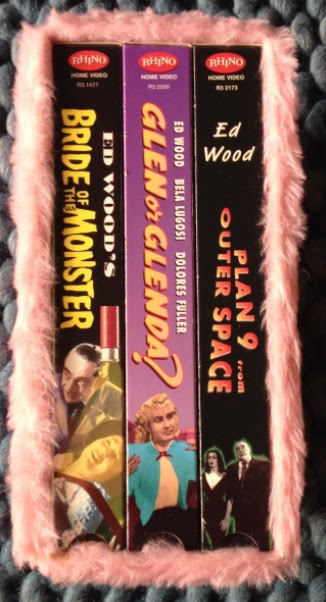
The work of Edward D. Wood, Jr. seemed tailor-made for a company like Rhino. As I remember it, Rhino Video was the preeminent distributor of Eddie's movies in the 1990s during the heyday of Nightmare of Ecstasy and the Burton film. The first VHS editions of Plan 9 from Outer Space (1957), Glen or Glenda (1953), Night of the Ghouls (1959)and Bride of the Monster (1955) that I ever owned were all from Rhino. I even had the three-tape set with the pink faux-angora box. I still have it, in fact.

Rhino also released some titles that Eddie had merely written rather than directed. The Violent Years, for instance, was marketed as part of the company's Teenage Theater series, hosted by 1950s glamour girl Mamie Van Doren. Much to Steve Apostolof's chagrin, Orgy of the Dead bore a garish pink and green sticker marking it as part of "The Ed Wood Collection." Meanwhile, Joe Robertson's Love Feast was regurgitated by Rhino as Pretty Models All in a Row, complete with doctored credits fraudulently suggesting that Ed Wood himself had directed it! And, while we're talking about Wood-related films, let's not forget that Rhino bankrolled its own quirky, humorous documentary about Eddie: Look Back in Angora (1994), directed by Ted Newsom.

One of Rhino's strangest yet least heralded Wood releases from this era was a 1994 "director's cut" of Eddie's turgid 1954 crime drama Jail Bait. Even though it was made during Eddie's golden age and features many of his regulars (Timothy Farrell, Dolores Fuller, Lyle Talbot, Mona McKinnon, Bud Osborne, and Conrad Brooks), not to mention future Hercules star Steve Reeves, Jail Bait has never been as loved as its siblings. It lacks the cross-dressing of Glenda and the sci-fi/horror elements of Bride and Plan 9. It also lacks the commanding screen presence of Bela Lugosi, though Herbert Rawlinson makes a valiant effort, wheezing through his final screen role. For all these reasons, fascinating though it is, Jail Bait just isn't as instantly fun as the other Wood films of the 1950s.
 
Rhino's 1994 version of Jail Bait.
Another problem with Jail Bait, at least for many modern viewers, is that it contains a two-and-a-half-minute blackface sequence lifted wholesale from Ron Ormond's Yes Sir, Mr. Bones (1951). Performed by Cotton Watts and his wife Chick, this comedic routine presents African-Americans as being slow-witted, cowardly, and animal-like. Since the movie's plot revolves around a nighttime robbery of a theater, this footage is supposed to represent a show being staged at the doomed venue.

Rhino's 1994 edition excises the Ormond footage almost entirely -- leaving only a shot of a theater audience and a curtain closing -- and replaces it with a rather tame burlesque routine by Evelyn West (1921-2004), a legendary cabaret performer of the 1940s, '50s, and '60s. (Thanks to Ed Wood superfan Milton Knight for making the initial identification!) My learned colleague Greg Dziawer is currently researching both Cotton Watts and Evelyn West, and he'll have much more to say about both of them in the near future.

Rhino, meanwhile, is vague about how this supposed "director's cut" was assembled, since Ed Wood himself had been dead for nearly 16 years by then. The explanatory notes on the back cover of the VHS tape were penned by Kansas City-based film distributor Wade Williams, who has occasionally claimed to hold a copyright on Ed Wood's 1950s films. You can see from this passage that Williams is playing into Ed's campy "so bad, it's good" image from The Golden Turkey Awards, even mentioning that book by name. Williams openly admits that the Evelyn West footage was "not included with the original release of the picture" but was "discovered when the long-lost narrative was unearthed." It is not identified or credited in any way, but a title card says "FOLLIES THEATRE, LOS ANGELES." And Evelyn West did appear in a 1947 film called A Night at the Follies, directed by W. Merle Connell.

Williams also says Jail Bait was "filmed entirely on location in the underbelly of 1950's Hollywood," which is patently untrue. It was, in fact, shot at various places in Los Angeles County, California. A bar scene, for instance, was shot at the Hunters Inn in Temple City. A robbery was filmed at the Monterey Theatre in Monterey Park. (The film was also previewed there, according to Rudolph Grey.) And a scene at a police station was shot in Alhambra, where cast member Mona McKinnon lived at the time. Lyle Talbot remembered filming the climactic swimming pool scene at a motel on Sunset Boulevard. Much of the film appears to have been shot -- like Eddie's other movies of this period -- on a sound stage. Cast member Theodora Thurman recalled working on "a small set."

Anyway, here are Williams' notes:

Wade Williams describes Jail Bait.

Other than the Cotton Watts sequence, the biggest difference between the 1994 version of Jail Bait and all other versions is the title sequence. In most currently-available prints of the film, the credits roll over some wobbly footage of a police car driving down a street at night. In the Rhino version, however, the credits appear as a series of grainy still images. Apparently the "negative" that Williams "unearthed" was in poor shape, and this part of the movie wasn't quite salvageable.

The "director's cut" of Jail Bait didn't have much of a shelf life beyond this 1994 release. Subsequent DVD releases of the movie have reverted to the Cotton Watts footage and are generally sharper in picture quality than Rhino's version, complete with fully-restored opening credits. The 1994 version, however, was included on a 2007 double-disc set called The Ed Wood Collection: A Salute to Incompetence from a company called Passport.

It is from that collection that I gleaned the following clip, to show you how the Evelyn West footage was incorporated into Jail Bait. The burlesque footage seems to have been shot without sound, so some borrowed music has been dubbed in. Curiously, the last minute of this routine takes its audio directly from the Cotton Watts blackface footage! (It kicks in at about the 1:42 mark.) If you listen carefully, you can even hear the audience laughing. Enjoy!