Thursday, January 6, 2022

Ed Wood's When the Topic is Sex: "Enough Bread for Everybody" (1972)

You wouldn't guess it from the title, but "Enough Bread for Everybody" is really about race relations.

NOTE: This article continues my coverage of Ed Wood's When the Topic is Sex (Bear Manor Media, 2021).

The article: "Enough Bread for Everybody." Originally published in Black and White (Pendulum Publishing), vol. 2, no.1, April/May 1972. Credited to Edward D. Wood, Jr.

Excerpt: "The total earnings for the Negro rose swiftly. In 1962 during July and August the Negro payroll was a minute $3,600. But during that same period in 1963 the rise in the figure started looking like the blacks were in the black . . . $27,000."

Reflections: "Enough Bread for Everybody" will come as an eye-opener to many modern readers, because it proves that the debate over diversity and representation in motion pictures is nothing new. This article was published 50 years ago, but some of the issues in it are still being talked about—and fought about—today.

Put simply, this article is about how Black people (or "Negroes," as Ed puts it) have fought for employment and respect in the motion picture industry over the years. For decades, Black actors and technicians struggled to find work in Hollywood. D.W. Griffith's landmark Birth of a Nation (1915) portrayed its Black characters very negatively, while making the Ku Klux Klan the heroes, but Griffith didn't even employ any actual Black people. As Ed Wood explains, "All the black people were played by black-faced whites." Blacks were similarly denied admittance into the entertainment industry unions.

An important source for Ed Wood.
According to Ed Wood, the situation only began to change because of pressure from the National Association for the Advancement of Colored People (NAACP). Curiously, Eddie points to June 25, 1963 as a particular turning point. That's when the NCAAP's labor secretary, Herbert Hill (1924-2004) met with Beverly Hills chapter president James L. Tolbert (1926-2013) to draft a list of specific demands to present to the major studios. "That's when the stuff hit the fan," says Ed.

Ed Wood's feelings on this issue are complicated and contradictory. On the one hand, he acknowledges that Blacks have been underemployed and grossly misrepresented in Hollywood. On the other hand, he seems to view the protests over Gone with the Wind (1939) and Song of the South (1946) as examples of censorship. And the NAACP's ban on Black actors playing domestic roles might actually be preventing its members from finding employment! Furthermore, he suggests that any political pressure group, including the NAACP, will inevitably demand some form of censorship from the media. 

That's why I say "Enough Bread for Everybody" is a shockingly current article, despite being from a half century ago. Gone with the Wind and Song of the South remain highly controversial today, and social media is consumed with the topic of whether so-called "political correctness" constitutes censorship. The most optimistic part of the article is the title. Eddie seems to be saying that, ultimately, motion pictures generate enough money for people of all races and creeds.

I've said that some of the articles in When the Topic is Sex are vague when it comes to names, dates, titles, etc. That's not the case here. "Enough Bread for Everybody" names plenty of actors and movie titles, including at least one film I'd never heard of: Curtis Bernhardt's comedy Kisses for My President (1964), featuring Polly Bergen as America's first female Commander-in-Chief. Time seems to have forgotten this movie, but Ed deems it noteworthy that the producers hired "40 Negroes."

Also of note here is that Ed Wood repeatedly cites a book called The Face on the Cutting Room Floor: The Story of Movie and Television Censorship (1964) by Murray Schumach. In a great deal of his nonfiction, Ed seems to be "winging it." But, when the situation called for it, he would actually do a modicum of research. I'm guessing Eddie cribbed quite a bit from the Schumach book when writing this article.

Next: "Book Reviews" (1969)

Wednesday, January 5, 2022

Ed Wood's When the Topic is Sex: "The Documentary" (1971)

In this illustration, it looks like Harvey Pekar is making a documentary of his own.

NOTE: This article continues my coverage of Ed Wood's When the Topic is Sex (BearManor Media, 2021).

The article: "The Documentary." Originally published in An Illustrated Study of Voyeurism, vol. 2, no. 3, 1971. Credited to "Dick Trent."

Excerpt:  "Although the man with the camera still travels to far off lands in search of adventure and to bring new sights to the screen, the new scope of realism gives him an insight to the modern world all around us. We also find that the undersea kingdom is of as much interest to us as Africa was to the generation of the thirties. Here we open up possibilities never dreamed of only a few years ago. And since most of us will never dive down to the depths of the seas the filmed reports become our diving suit and helmet. And we can watch the glamour of the scenes without fear of our oxygen supply ever failing us and leaving us trapped down there with the fishes."

A successful documentary from the 1960s.
Reflections: "The Documentary" stands out from the other articles in When the Topic is Sex for a number of reasons. Most obviously, the topic here isn't sex. Instead, Ed Wood writes with great sincerity about his admiration for documentaries and the brave men who make them. I kept waiting for the article to become explicitly sexual—sex being a popular subject for documentaries, then and now—but it never did. Textually, this is Ed at his most G-rated.

Other than the now-lost industrial films he made for Autonetics in the early 1960s, Ed never attempted to make a documentary of his own to my knowledge. I suppose Glen or Glenda (1953) has a somewhat documentary-like tone during certain passages, such as those narrated by Timothy Farrell. The characters in that film, however, are fictional, and the footage is either staged or stock. Perhaps, in this article, Eddie is daydreaming about what it would be like to make unscripted films.

For one thing, as he points out, there are economic advantages to being a documentarian. Reality-based films do not require large crews or expensive equipment. Reshoots, if necessary, will not cost much either. "The scene can be shot over and over again," Ed claims, "and still there won't be too much of a dent in the producer's budget." Again, as with the other articles in the book, Ed constantly has money on his mind.

Ed also mentions that the "newly developed, high speed film" now allows documentarians to shoot with only natural light, such as that provided by the sun and moon. Later, he declares: "With modern technology nothing is beyond the scope of the documentary producer and his camera." Maybe Ed Wood's secret desire was to become the next D.A. Pennebaker.

If Ed were somehow with us in 2022—alive, in his prime, and ready to make movies again—I think he would be amazed by the existence of digital video and excited about its potential. The low-budget (and no-budget) filmmaker of today has technological advantages that Eddie would have killed for. A director can shoot footage on his phone and edit it on his laptop, then distribute it himself on the internet, all without visiting a processing lab or attending a day of film school. Eddie would be in hog heaven. Finally, the independent filmmaker has been set free!

Next: "Enough Bread for Everybody" (1972)

Tuesday, January 4, 2022

Ed Wood's When the Topic is Sex: "Bedroom Scene" (1971)

In the 1970s, you could rent a lovely bedroom like this to make a pornographic movie!

NOTE: This article continues my coverage of Ed Wood's When the Topic is Sex (BearManor Media, 2021).

The article: "Bedroom Scene." Originally published in Swap (Pendulum Publishing), vol. 5, no. 4, October/November 1971. Credited to Edward D. Wood, Jr.

Excerpt: "There are many tricks to the trade and the quickie, cheapie, girlie, nudie, skin flickers are quick to learn them. And that which can't be learned are invented then passed on. There is always something new under the sun and there had better be or we would all become stagnant."

Masking tape: An editor's best friend.
Reflections: His mainstream (or at least semi-mainstream) film career far behind him, Edward D. Wood, Jr. became a prolific director of pornographic movies in the 1970s. Exactly how prolific, we may never know, but we can be certain that he made a handful of adult features, including Necromania (1971) and The Young Marrieds (1972), and dozens, perhaps even hundreds, of short films or loops.

What makes the 1971 article "Bedroom Scene" so interesting is that it offers us Eddie's first-hand account of what it was like to make X-rated movies during this turbulent era, just as censorship laws were weakening and films were becoming bolder in their depiction of sex. This is the view from the trenches, so to speak. I doubt if the readers of Swap, a magazine about the swinging lifestyle, really cared to hear Ed Wood complain about lab costs and limited shooting schedules. But that's what they got.

Actually, Ed does tailor this article to fit the specific theme of this magazine. He talks about the specific challenges of filming orgy scenes:
The larger of the swap parties are about the hardest of the scenes to film because there is so much more of an area needed for filming. That's when the small stages become useless and other settings must be arranged. It can't be the larger studios because they are much too expensive. The small studios run from fifty to seventy-five dollars a day depending upon the equipment and/or sets available.
Okay, maybe that's not terribly sexy, but it is interesting from a historical perspective. Eddie also lets us know that the budget for a typical pornographic movie does not allow for such niceties as fades and dissolves, both of which add to those aforementioned lab costs. Fortunately, editors have figured out how to create crude fade-ins using ordinary black masking tape. "It's not the best way of doing things," Ed explains, "especially if the editor's knife is dull or he has a hang over and can't cut a straight line. But it is still more effective than if there was nothing."

Problems like these were not specific to the porn industry. On the DVD commentary track for his horror film Two-Thousand Maniacs (1964), Herschell Gordon Lewis explains how he did as many effects in-camera as possible, thereby avoiding extra expense at the processing lab. 

For the most part, "Bedroom Scene" is a litany of complaints about how difficult it is to make a dirty movie. The budgets are so low that a director may have to serve as his own cameraman and editor. Sometimes, there isn't even enough time to change the scenery, forcing quick rewrites of the script. A scene that was supposed to take place in a bedroom might take place in an office or vice versa. And that's when there's even a screenplay to start with! These, too, are a luxury. Ed is keenly aware that low-budget porno movies are "lacking in just about everything," leading to "tremendous gripes by some patrons." Fortunately, these movies deliver the sex and nudity the audience demands.

My favorite part of "Bedroom Scene" is this little tragicomic anecdote:
Recently one producer of former "B" pictures was asked to do a skin flick for a new producer. The former producer's pictures were budgeted at between forty and sixty thousand dollars each. Thus when he asked what his budget would be the new, young producer said five thousand dollars and the older man dropped dead on the spot. 
The part about the budgets is likely accurate, but I have a sneaking suspicion that the "producer" Ed Wood is describing is really himself. And we know he didn't drop dead when he started making porno films. That wouldn't happen for a few more years.

P.S. Incidentally, this is the third time this exact issue of Swap has been mentioned on this blog. Back in November 2014, I reviewed "Taking Off," a short story from this same issue. And just a few months ago, Greg Dziawer shared with us an editorial from the contents page. It looks like the October/November 1971 edition of Swap was a veritable goldmine for Ed Wood fans!

Next: "The Documentary" (1971)

Monday, January 3, 2022

Ed Wood's When the Topic is Sex: "The Movies and Sex" (1971)

I think this picture is supposed to be a kinky version of "Little Red Riding Hood."

NOTE: This article continues my coverage of Ed Wood's When the Topic is Sex (BearManor Media, 2021).

The article: "The Movies and Sex." Originally published in Body & Soul (Pendulum Publishing), vol. 5, no. 3, October/November 1971. Credited to Edward D. Wood, Jr. 

Excerpt: "The camera, of the period, did as much as possible to reveal that something was happening. The couple got into the clinch, the kissing routine, then the camera dropped down to their legs as the girl's feet were lifted up off the floor. Or suddenly the lights went out and some moans of delight might have been heard. Then there was always the panning down of the camera to the side of one of the double beds, usually the girls, and her negligee slipped to the floor."

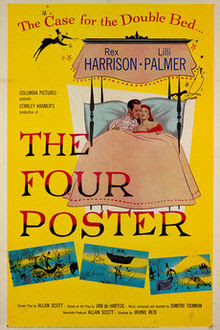
Reflections: Ed Wood must have been experiencing déjà vu in the early 1970s as he wrote the same basic article again and again, with only slight differences each time. "The Movies and Sex" is yet another quasi-historical essay about how the depiction of sex in the movies has changed over the years. It's basically interchangeable with the three previous articles in this collection and even uses some of the same examples. Once again, Eddie points to the forgotten Rex Harrison movie The Four Poster (1952) as a milestone in cinema history because it depicted a married couple sharing a double bed.

Lana Turner: Ed Wood's type of gal.
As with "Behind the Film Scene," Eddie again discusses the so-called "sweater girls" of the late 1930s and early '40s. These were simply attractive actresses such as Lana Turner who wore tight sweaters. For Ed Wood, sweaters were a lifelong obsession, so naturally he'd try to find some way to incorporate them into his writing whenever possible. In this article, he even gets to mention his beloved angora. This might be the first article in When the Topic is Sex to do so.

As before, Ed Wood sneers at conservative politician Will Hays (1874-1954), who used his position as chairman of the Motion Picture Producers and Distributors of America to keep salacious material off the big screen in the 1920s, '30s, and '40s with a set of rules informally known as the Hays Code. This time, however, Eddie also gives props to Eric Johnston (1896-1963), who succeeded Hays as chairman of the MPPDA and quietly attempted to undo much of what the prudish Hays had done to sanitize the movies. 

Another factor that sets "The Movies and Sex" apart is that Eddie uses plenty of real-world examples to make his case that sex—including kinky, deviant sex—has always been an integral part of the movies, no matter what the censors think. He points to both King Kong (1933) and Universal's The Wolf Man (1941) as examples of movies about bestiality. Another Universal horror film, The Mummy (1932), is cited as a story about necrophilia. And Eddie even name drops his idol Bela Lugosi while suggesting that Count Dracula was a hemophiliac. Here, the term "hemophilia" refers not to the blood-clotting disorder but rather to a lust for blood. I'd never seen the word used that way before this.

It's important to remember that Ed Wood was writing these articles decades before the internet existed. He did not have a world of information at his fingertips the way we do today. Some of Eddie's facts in "The Movies and Sex" are accurate, while others are dubious. Let's start with the accurate ones. Yes, the scene from King Kong in which the titular ape strips Fay Wray was censored. (It has since been restored.) And, yes, actress Hedy Lamarr did a celebrated nude scene in Ecstasy (1933), though Eddie mistakenly refers to her famous nude swim as a nude bath. 

Did All's Quiet on the Western Front (1930) or Hell's Angels (1930) originally contain nude scenes that were trimmed from later prints? Ed Wood contends they did, though I can find no evidence of this. (I'm willing to be refuted on this point.)

Likewise, I can find no corroboration for Eddie's story that actor John Barrymore (1882-1942) stuffed bananas and other phallic objects into his trousers. Maybe this is one of those urban legends that circulated for decades in Hollywood. If it's true, however, it would give new meaning to Barrymore's famous nickname, "The Great Profile."

What's really remarkable about "The Movies and Sex" is its defiant tone. Ed Wood contends that the efforts of the censors will always be futile because sex is a natural part of life and cannot be suppressed. You can cover up women's bodies and men's bodies—and the bluenoses have attempted to do both—but the face will always be the sexiest part of the human anatomy. At least, according to Ed:
The strangest part about the whole sexual censorship scene is the fact girls have been beautiful since the beginning of time and the movies would have to put bags over all their heads to keep the sight from the movie goers eyes. And the face is and always has been known to man as the greatest sexual "turn on" object. The face alone is the greatest of all sex symbols. If the face isn't pretty, few men will look any further. The rest is, as the movies have called their extra short subjects, the extra added attractions.
In a weird way, that's a beautiful thought.


Next: "Bedroom Scene" (1971)

Sunday, January 2, 2022

Ed Wood's When the Topic is Sex: "What Would We Have Done Without Them?" (1972)

This illustration depicts some old-timey peep show machines.

NOTE: This article continues my coverage of Ed Wood's When the Topic is Sex (BearManor Media, 2021).

The article: "What Would We Have Done Without Them?" Originally published in Body & Soul (Pendulum Publishing), vol. 6, no. 2., July/August 1972. Credited to Edward D. Wood, Jr.

Excerpt: "Any guy or girl old enough to enter one of those theatres knew what sex was all about . . . and it wasn't simply holding hands in the back seat of some car like a high school kid. They knew what the bed looked like, and they knew what went on under the sheets even if it did look like the producer didn't. The guy and the girl lock into a tight lip kiss without tongue action and they were laughed off the screen. The producers and the owners didn't do much laughing. They were crying when they read the box office receipts."

Reflections: This is Ed Wood's short history of the pornographic film industry, from the peep shows of the 1900s to the full-color X-rated feature films of the 1970s. His only real thesis seems to be: Boy, the porno film sure has changed over the years, huh? As with the previous two articles in this book, Eddie skimps on specifics. He doesn't mention any stars, directors, or producers. Not a single year is listed anywhere, only general time periods. 

Meanwhile, the only titles he supplies are those of nudist camp films: A Day in the Life of a Nudist, Nudist Fun, and Life at a Nudist Camp. I cannot conform the existence of any of these movies, so the titles may be fictitious. Perhaps they're moldering in the archives at Something Weird Video headquarters. Popular in the 1950s and '60s, the nudist camp movie has faded into obscurity, but it has an important place in the history of screen sex. I can never forget John Waters' description of these often-inane movies: "Happy, healthy idiots on pogo sticks with air-brushed crotches."

Like "That's Show Biz," this is an article I have already reviewed on this blog previously. Back in 2019, I offered a fairly thorough summary of this piece and gave my thoughts on it. Two and a half years later, my opinion of it has not really changed much. In retrospect, it's interesting how Eddie viewed the adult film business from a purely economic, almost mercenary standpoint. A lot of the article is about how theater owners have sought to maximize profits with greater and greater efficiency over the decades.
The cheaper the presentation that could be made the more for the producers and the house. This also brought on the quick-house-change-plan. There was no reason for giving the viewer, or the patron two hours of movies for his two to five bucks. Get them in, give them something, and get them out. There was always somebody else waiting for that seat. In the beginning there were lines of patrons waiting to see such films. The presentations were knocked down to fifty-eight minutes of running time. Two guys could occupy that same seat during a two hour period where previously there could only be one. . . . And that meant that seat would bring in four to ten dollars for the two hour period.
The popular image of Ed Wood (especially as he is depicted in Tim Burton's 1994 biopic) is that he was an unrealistic, starry-eyed dreamer who only wanted to express himself through his art. Perhaps, in the 1950s, this was true. But his article shows that Eddie was perfectly capable of thinking like an accountant when he had to.

Next: "The Movies and Sex" (1971)

Ed Wood's When the Topic is Sex: "Behind the Film Scene" (1972)

Phil Cambridge's clever, though hard-to-read logo for "Behind the Film Scene."

NOTE: This article continues my coverage of Ed Wood's When the Topic is Sex (BearManor Media, 2021).

The article: "Behind the Film Scene." Originally published in Blazing Films (Pendulum Publishing), vol. 6, no. 1, January/February 1972. Credited to Edward D. Wood, Jr.

Excerpt: "I doubt very much if today that my old, and very dear friend, Bela Lugosi could carry a picture unless all the ladies he bit in the neck were completely naked and had some kind of a lavish sex scene with the handsome hero beforehand. . . . Or the old gentleman himself became lecherous enough to remove her clothing behind a fence and make her before sucking her blood."

Reflections: This article is very much in the same spirit as "That's Show Biz." Again, Eddie is pontificating and free-associating about the many changes the movie industry has seen over the decades, particularly in regards to the depiction of onscreen sex and the increased demand for realism. What's different this time is that Eddie does mention a few specific film titles, including a few of his own. He talks about Crossroad Avenger (1953), Bride of the Monster (1955), Jail Bait (1954), Revenge of the Dead (1959), and even Take it Out in Trade (1970), which he calls his "first film in the nudie market."

A significant film, according to Ed.
In fact, besides plugging his own movies, the only other title Ed directly references in this article is Irving Reis' The Four Poster (1952), a rather obscure comedy-drama starring Rex Harrison and Lilli Palmer. According to Ed, this movie was significant for its use of a double bed. Previous to this, thanks to the overly-strict Hays Code, directors could only show twin beds onscreen to maintain the fiction that husbands and wives slept separately. Oddly, that aspect of the movie seems to be forgotten today. To the extent that The Four Poster is remembered at all, it is for the animated sequences directed by John Hubley.

People who read a book like When the Topic is Sex probably became fans of Ed Wood through his movies, so they will relish the tidbits of information about those movies that Ed provides here. The director admits that, when he was first making films in the 1950s, he mistakenly thought that stars like Bela Lugosi and Tom Keene would be bigger box office draws than they actually were. He laments the end of the era when a big name on the marquee was enough to sell a movie. Wood further implies that, if Bela were alive in the 1970s, he'd have to make sexually-explicit movies in order to sell tickets. Perhaps it's for the best that this did not come to pass. 

Eddie's memory may have been a little shaky by 1972. In this article, he says that Bela Lugosi starred in Revenge of the Dead (Ed's preferred title for Night of the Ghouls), which is absolutely untrue. The role of Dr. Acula in that film was intended for Bela, but the great Hungarian actor was several years dead by the time the script went into production. Western baddie Kenne Duncan stepped into the role instead and gave one of his most memorable performances as a phony psychic medium who gets his much-deserved comeuppance.

Can we trust Eddie's story about how he was prevented by the censors from showing a gun with a silencer in Jail Bait? How about his recollection of hiring someone just to clean up the horse droppings on Crossroad Avenger? These could well be figments of Eddie's imagination. 

Honestly, it's difficult to summarize "Behind the Film Scene" because Eddie flits from one topic to another without a thought toward coherence. At one point, he discusses the so-called "sweater girls," i.e. the 1940s actresses like Lana Turner and Ann Sheridan who became notorious for their clingy, curve-enhancing cardigans and pullovers. According to Ed, the censors objected to the sweater girls, especially when their movies were shown to members of the military:
The Hays office decided the girls should no longer be dressed in the tight knitted garments because it turned so many of the boys in the service on. And that was one thing which shouldn't happen to them. After all they were in the business of battle. And if the powers that be gave them a little time off to see movies, they most certainly shouldn't see any girls sticking so far out in front. What would happen if they got turned on under such circumstances? Why there might be a whole generation of homosexuals who would come out of the war.
This is dubious reasoning, Eddie. I doubt that the Hays office thought Lana Turner was somehow going to turn a "whole generation" of soldiers into homosexuals. This seems like an out-there idea, even for Ed Wood. 

By the way, this article mentions an infamous blooper from The Red Skelton Hour involving a cow that defecates on the stage during a sketch. "Wonderful cow!" Red enthuses. "Not only does she give milk, but she gives Pet-Ritz pies." For the curious, this classic TV moment is available online. It comes from a 1960 episode entitled "Clem and the Beanstalk." As you might guess from the title, this is a parody of "Jack and the Beanstalk" featuring Red's dimwitted character, Clem Kadiddlehopper. Actor Jack Albertson also appears in the scene as a character named J.B. Throckmorton, which is the kind of name you'd give a businessman back then.


Next: "What Would We Have Done Without Them?" (1972)

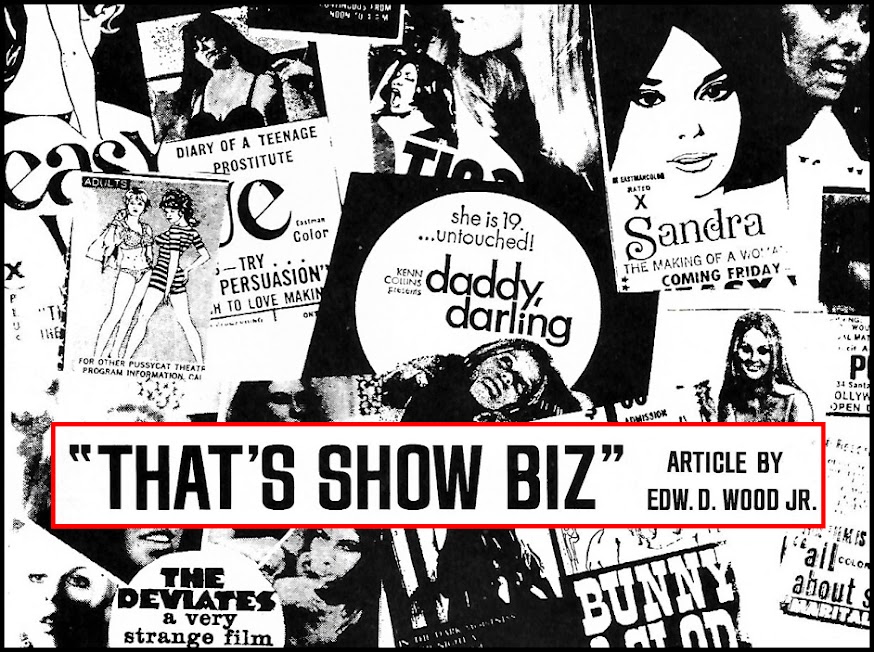
Ed Wood's When the Topic is Sex: "That's Show Biz" (1972)

Ed Wood gives us his unique take on film history in "That's Show Biz."

NOTE: This article continues my coverage of Ed Wood's When the Topic is Sex (BearManor Media, 2021).

An issue of Blazing Films.
The article: "That's Show Biz." Originally published in Blazing Films (Pendulum Publishing), vol. 6, no. 2, April 1972. Credited to Edward D. Wood, Jr.

Excerpt: "Total nudity, both male and female became standard motion picture fare and there was no doubt it was the boost the box office needed. The censors screamed at the top of their lungs and eventually most boards screamed themselves right out of existence . . . and the major boards which did remain started changing their outlook on what they would censor and what they would not censor."

Reflections: This is Ed Wood's capsule history of the American movie industry, mainly concentrating on the challenges that movie studios faced in the decades following World War II—rising production costs, dwindling attendance numbers, fierce competition from television, and outcry from censors over violent and sexually-explicit content. Eddie's basic thesis is that hardcore pornography is temporarily saving the film industry, since it's at least convincing people to leave their homes and travel to the local cineplex. But Eddie warns us that even this trend cannot last forever, since audiences will always demand something new from their entertainment.

"That's Show Biz" is a perfect example of Eddie writing a nonfiction article without doing even a tiny bit of research. He cites no specific dates and uses very few proper names, though he does work in a quick reference to his boyhood hero, cowboy star Buck Jones. Not a single specific movie title or movie studio is invoked here. Eddie only gets specific when it comes to money. He discusses, for instance, the increasing price of movie tickets: "The fifty cent houses climbed to two dollars and fifty cents." And he talks about movie budgets, too: "Three hundred thousand dollar films were starting to cost a million dollars."

This article feels like Ed Wood is pontificating about the movie industry off the top of his head, as if you approached him at a party (when he was already half-bombed) and asked, "Hey, Eddie, where do you think the picture business is headed these days?" And then, he proceeded to answer you in a very rambling fashion for the next 20 minutes or so. Wood's famed stylistic quirks are in full flower here, including his trademark use of ellipses and italics. Here, these elements add to the article's stream-of-conscious feel.

One particularly baffling passage occurs early in the article:
The early builders of the little black box would most certainly have bug-eyes at what has happened to their little invention. From Long Island to the world in seventy years . . . of course it didn't take seventy years for the world to witness the shadow plays up on the silver screen. But throughout the seventy years there has been an ever changing attitude to what is being seen.
I'm not exactly sure what Eddie means by the "little black box" from Long Island. I think he might be referring to wireless radio broadcasts. This article suggests that there were pioneering, historic radio transmissions conducted in Long Island circa 1901, so that would be about 70 years before this article was published. Maybe that's what he's talking about. Otherwise, I'm stumped.

Another interesting aspect of this article is that Ed Wood speculates about the future of home entertainment, well before the home video revolution of the 1980s. As we know, the pornographic loops Eddie made in the 1970s were intended for home use rather than theatrical exhibition, so perhaps that got him thinking about the issue. Obviously, watching an X-rated movie in one's own living room, basement, or rec room provides a degree of privacy that no theater could match. In "That's Show Biz," Ed points out some other advantages to watching movies at home rather than in a theater:
Jack-at-home could rent and view films in the privacy of his home if he didn't like the fare on TV. And he would not fall victim to the parking lot muggers who, about that time, crawled out of the decaying woodwork. Many times the patron found himself paying much more than the high box office demands.
We've all heard the stories of Eddie being mugged on his way to and from the liquor store. So it's natural that he would be wary of thieves wherever he went, even in movie theater parking lots!

Next: "Behind the Film Scene" (1972)

Friday, December 31, 2021

Ed Wood's When the Topic is Sex (2021): An introduction

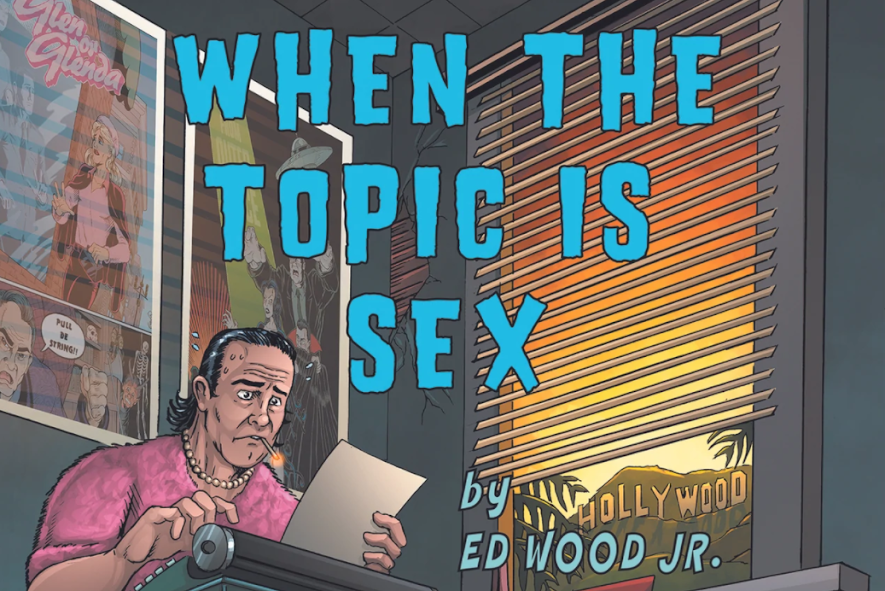
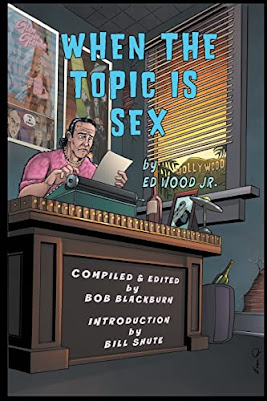
When the Topic is Sex (2021). Cover illustration by Evan Quiring.

Well, it's that time again. A new compilation of Ed Wood's extensive magazine work is upon us, the third of its kind in recent years. This time, it's called When the Topic is Sex, and it is now available from BearManor Media in hardcover or paperback editions. Like the two previous Wood compendiums, Blood Splatters Quickly (2014) and Angora Fever (2019), When the Topic is compiled and edited by Bob Blackburn, the Los Angeles resident who befriended Eddie's widow Kathy Wood in her later years and became co-heir of her estate. 

A new book to devour.
It's nothing short of a small miracle that these volumes exist at all. Bob Blackburn curated these books by purchasing vintage adult magazines containing Eddie's work on the secondary market, sometimes at considerable expense. Ed Wood fanatics owe him a debt of gratitude for that. Simply put, Bob tracked these stories down so that we could enjoy them in the 21st century. Otherwise, a vast swath of Ed Wood's literary output might've been lost to time.

I've repeatedly said that fans who want to familiarize themselves with Ed Wood's writing style—and thus with the man himself—should pick up Blood Splatters Quickly or Angora Fever and read his short stories, most of them written in the early 1970s when Wood was a penniless alcoholic. From these sex-and-violence-strewn tales, you'll get a sense of Eddie's quirks as an author: his stilted syntax, his oddball approach to punctuation, his often surreal and meandering plots, and his love of particular words and phrases. Above all, those short stories demonstrate how Eddie could direct nearly any subject toward his three great muses: death, booze, and women's clothing.

It's true that Eddie churned out dozens of novels in the 1960s and '70s, but these are usually very expensive and difficult to find. Besides, many fans may find these books challenging to read because Ed Wood (he of the notorious "muddled mind") had trouble maintaining a coherent plot over the course of a couple hundred pages. His novels tend to get bogged down with flashbacks and digressions. The great thing about the short story form is that it forces Ed to stay at least somewhat focused on the task at hand. He knows he has to bring his plot to some kind of conclusion after a few pages, so he's more apt to get to the point. Having read many of Ed's novels, I can say with confidence that the short stories contain all of the author's idiosyncrasies, just in a more digestible form.

What sets When the Topic is Sex apart from Blood Splatters Quickly and Angora Fever is that those previous compilations focused on Eddie's short stories, i.e. his brief works of fiction, some of them supernatural. The articles anthologized in this new book, however, are examples of Ed Wood's plentiful but overlooked nonfiction. I use the term "nonfiction" with caveats. As Bob Blackburn points out in his explanatory foreword, some of Ed's supposedly "factual" articles were based on real-world research, while others were entirely concocted from the author's alcohol-soaked imagination. 

Bob further maintains that Eddie's nonfiction articles "more than his short fiction really show more of the real person of Ed Wood in them." I don't know if that's necessarily true—it doesn't gibe with my experience as a reader—but I will say that Wood's nonfiction has a tone of its own, distinct from his novels and short stories. He's slightly more stiff and formal when writing this material, but he's also more optimistic and even-handed. Think back to Glen or Glenda (1953) when kindly Dr. Alton (Timothy Farrell) starts narrating in the style of a high school civics film:
Give this man satin undies, a dress, a sweater and a skirt, or even the lounging outfit he has on, and he's the happiest individual in the world. He can work better, think better. He can play better, and he can be more of a credit to his community and his government because he is happy.
That's the Ed Wood who emerges from the nonfiction. You can also see this side of Ed's personality in the unsigned editorials he wrote for Pendulum Publishing's adult magazines. Greg Dziawer recently wrote about how those "idealistic" articles differ in tone from Eddie's seedy, often downbeat fiction.

Author and publisher Bill Shute further sets the stage with an excellent essay called "Edward D. Wood, Jr.: Professional Writer," which serves as the introduction to When the Topic is Sex. In describing the nonfiction articles, Shute writes: "Wood comes off as thoughtful, measured, and wanting to consider and respect differing viewpoints." Shute also asserts that these allegedly fact-based articles allowed Eddie "to basically riff on a theme in a unified way." 

As you might guess from the compilation's title, many of the articles in this book are about sex (and changing sexual mores), but Eddie sounded off about a number of topics, including the film industry and even school busing. Shute warns us that "some of this material is extremely politically incorrect by today's standards." (Bob Blackburn gives a similar warning in his foreword, though the term he uses is "squirm inducing.") Longtime Wood fans should be able to handle it, though—especially those brave souls who have been willing to explore Eddie's pornographic work, both on screen and in print. Once you've seen Eddie strip down to his jockey shorts in Love Feast (1969), very little should shock you.

Bob Blackburn has pieced When the Topic is Sex together from over 80 individual articles, originally published between 1971 and 1973 in various adult magazines. The two previous Wood compilation books provided many hours of entertainment for me, and I am confident that When the Topic is Sex will do the same. I hope you'll join me as I make my way through this volume and share my thoughts on it. Perhaps along the way, I'll come to agree with Bob Blackburn that these nonfiction articles bring us closer to the "real" Ed Wood.