Wednesday, February 22, 2017

How comic strips use color: A study in contrasts

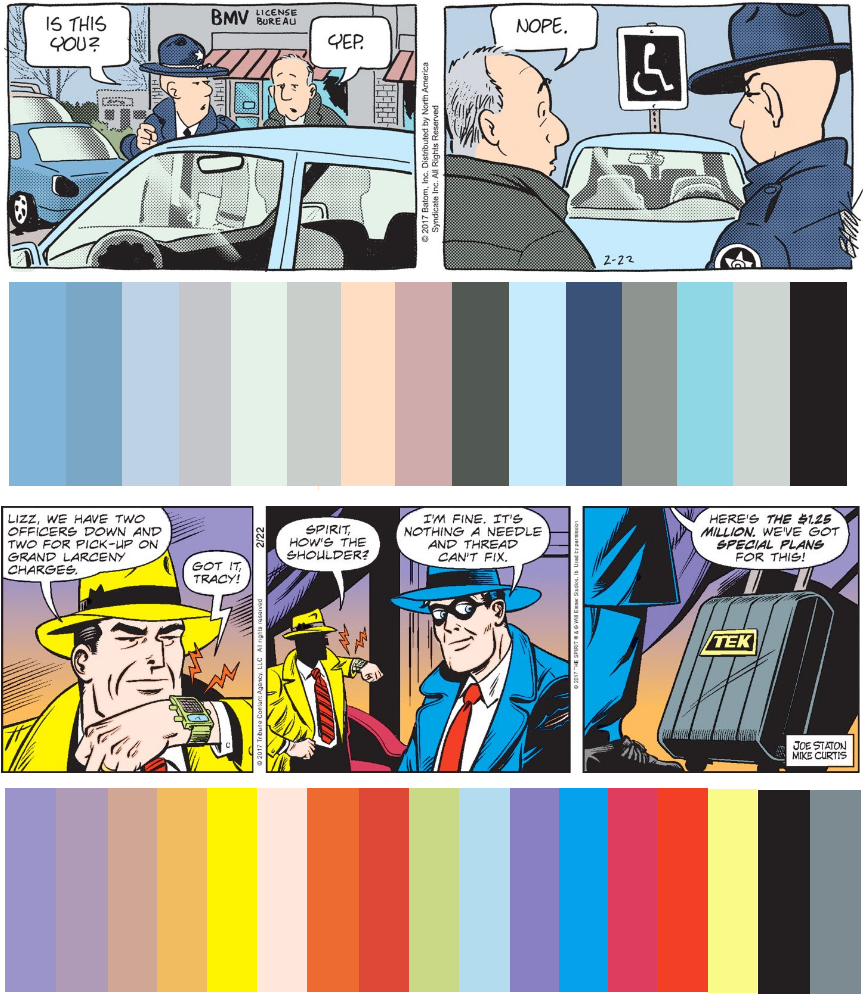
Color charts for Funky Winkerbean and Dick Tracy.

How comics used to look.
When I was growing up, only the Sunday comics were in color.  The rest of the week, the funnies—like most of the newspaper—were in black-and-white. But times change, and papers eventually started incorporating more and more color images in an ultimately futile effort to keep up with other media. It was a messy transition. In the mid-1980s, John Waters joked that color photographs in the newspaper were so blurry they looked like 3D movies without the benefit of glasses. But, today, even the front page of The New York Times (aka "The Old Gray Lady") is in color.

Meanwhile, print media has been all but entirely usurped by the internet, where color presents no added expenses or technical headaches. And since I now read comics online rather than in print, I've become used to seeing daily strips in color. But there is still a schism between weekdays and weekends. On Sundays, the artists themselves color their own strips. From Monday through Saturday, that chore is farmed out to subordinates hired by the syndicates. Comics blogger Josh Fruhlinger refers to these mysterious workers as "coloring drones."

As one might guess, these drones are hit-and-miss in their duties. Most days, they just go through the motions. Comic strips tend to be very repetitive, using the same characters, settings, and scenarios over and over again. It's not uncommon for the characters in these strips to wear the same outfits every day for decades. It gets to be very routine. But occasionally, a coloring drone will do something that stands out. Normally, this means making some boneheaded mistake, like accidentally giving a character blue skin or something. Or maybe it means that a drone put in some extra effort on a strip, e.g. depicting autumn leaves in various shades of red, gold, and brown.

At the top of this post, you'll see two contrasting strips, both of which ran today: Funky Winkerbean and Dick Tracy. You can see at a glance how wildly different these two strips are. Funky is a serialized comedy-drama about depressed, dilapidated, aging adults. It's supposed to be realistic and relatable. The title character, for instance, has spent the past few days at the Bureau of Motor Vehicles. Notice how drab the colors are: so many shades of blue, gray, and blueish-gray. Dick Tracy, on the other hand, is a highly stylized crime/action strip about a violent, trenchcoat-wearing detective who hasn't changed much since the 1940s. He's currently wrapping up a (ridiculous) case that teamed him up with The Spirit, another throwback crimefighter. The riotous color scheme tells you all you need to know about the over-the-top sensibility of this strip.

Just for further elucidation of this topic, here's a breakdown of today's Garfield. You'll notice that the palette is more limited than either Dick Tracy or Funky Winkerbean. This long-running strip goes for broad, obvious jokes, and that dedication to simplicity extends to its color choices. 


Yeah, Garfield only has about six colors.

Ed Wood Wednesdays: The Wood Poughkeepsie Odyssey, Part Three by Greg Dziawer

In the realm of the census: The 1930 US Census records the details of Ed Wood's life and family.

"S" Is For "Street"
Although October 29, 1929 is historically considered the day of the stock market crash, and a key precipitator of the Great Depression, the US economy had been showing signs of ill health in myriad ways throughout 1929. Ed Wood turned five years old in early October 1929, and six months later, in early April, his residence was hand-recorded by a US census taker, Mrs. Van Etten.

In this week's edition of Ed Wood Wednesdays, we're visiting Ed's home in Poughkeepsie in 1930, a year when this country undertook its fifteenth official census. While the popular record of Ed's life in Poughkeepsie from his birth in 1924 until his enlistment in the military in 1942 locates him at 115 Franklin St, in previous Ed Wood Wednesdays, we've found Ed living at 35 Delano St from at least 1935 to 1940, and at 1 Fountain Place in the early '40s. Did Ed reside at any other residence as a kid growing up in Poughkeepsie? Bet your life on it!

The 1930 US Census Records contain over 2,000 pages for Dutchess County, New York, the vast majority listing residents of Ed's hometown of Poughkeepsie. It took me quite a while—a patient three hours or so scanning through the pages—to finally locate the listing for Ed and his family at the bottom of page 701 in one of the files. Not long before, I had run through the listing of residents at 35 Delano St, where I knew Ed resided as early as 1935. I only found a man and wife there, and knowing it was a multi-unit apartment house, I immediately felt deflated. If Ed was living there in 1930, clearly the census record was incomplete and we'd never know for sure.

Undaunted, I quickly bounced back, and it was only minutes and pages later that I found Ed's family listed at yet another residence: another apartment building at 44 Conklin Street. Conklin, like Delano, is a short L-shaped street on the interior of a larger block, in this case Mansion and Catherine Streets, concentrations of apartment houses and single-family homes on opposite sides of the street. The bottom end of Conklin intersects with the East-West Arterial, which takes you right on and over the Mid-Hudson Bridge a dozen or so blocks to the west. Within a couple of blocks of Conklin, there are three churches today: Baptist, Lutheran and Congregational. The neighborhood was designated entirely "W" for "white" in the records. 

House beautiful?: Some interior shots of 44 Conklin Street.
    
Scanning the Poughkeepsie records, I noted a number of interesting things. Wood was not a common family name, for instance. Gentrification was in full effect. And the "race" column in the records often referred to persons of African-American descent, direly, as "Nig."  
44 Conklin St. as it appears today.
44 Conklin is, like Ed's residences at Franklin and Delano, another multi-unit apartment house. The building hails from 1910, housing an upstairs and downstairs unit. Still standing, the original look of the building is now hidden beneath cheap vinyl siding. With four beds/two baths and six beds/two baths, respectively, the units at 44 Conklin were far more spacious than Ed's other residences in Poughkeepsie.

The 1930 Census Record lists the head of household at 44 Conklin St as Frances J. Phillips, Ed's maternal grandmother. She was living with her daughter Lillian and son-in-law Edward, and their two young sons Ed Jr. and Howard. A year and half younger than Ed, Howard W. Wood went by William, but the 1930 and 1940 Census Records corroborate his real first name as Howard.

In the spring of 1930, at the dawn of the Great Depression, Ed's dad was working as a factory machinist, common male employ. Less commonly, Ed and Howard's mom worked, too. The immediate aftermath of the crash necessitated change and adaptation. Living with the in-laws. Working moms.

Lillian was a department store "saleslady."  Among the ephemeral details in the record, the residence had (commonly) a "radio set." Rent was thirty bucks a month. Ed's grandma is most likely listed as "W" for "widow," but the recorder clearly first wrote "M" for "married" and then smudged it over with a nebulous correction.

And the whole Phillips' line of Ed's family was born in New York, at least as far back as Ed's matriarchal great-grandparents. The roots of the Wood family lie deep, in Poughkeepsie and beyond. 
We'll go there, and travel back a millennium to Scotland, dissecting the Wood family coat-of-arms, right here in future Ed Wood Wednesdays.

Before we depart, a few bonus items:
  • Additional maps of Conklin Street in Poughkeepsie

Thursday, February 16, 2017

We all feel a little like Ronan, The Accuser sometimes

Try to imagine Ronan, The Accuser talking like Charlie Brown.

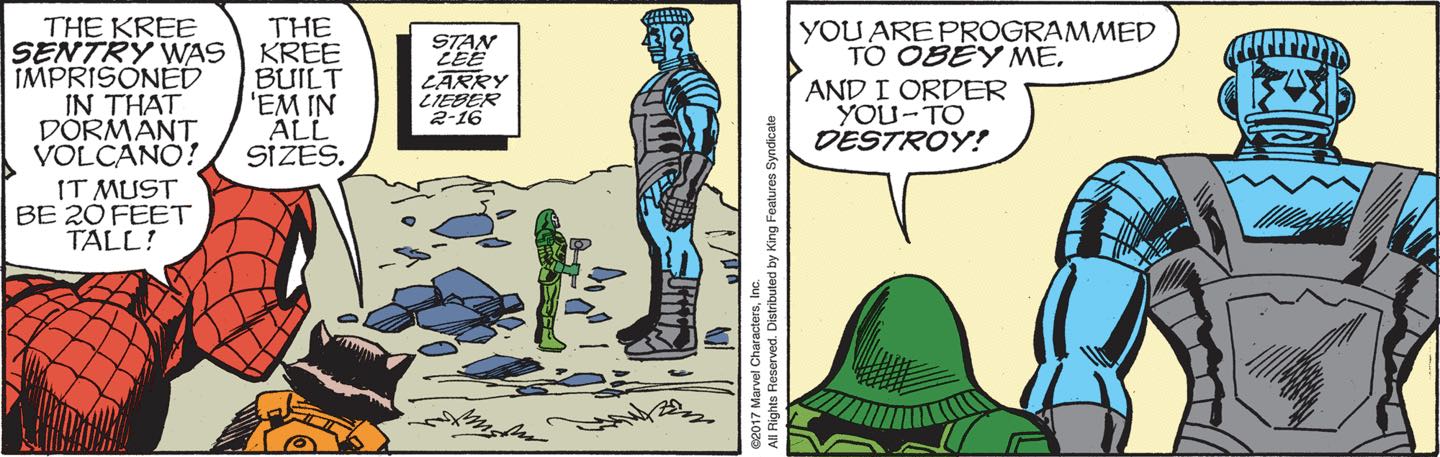
In his newspaper incarnation, Spider-Man has been doing battle with an intergalactic baddie named Ronan, The Accuser lately. It's a dumb Guardians of the Galaxy crossover. Don't worry about it. Anyway, in Thursday's installment, Ronan called on the services of a giant automaton called a Kree Sentry. Presumably, said Sentry will start wailing on Spidey tomorrow, but I thought it would be funny-ish if the big guy didn't obey. I mean, why should he? I went to some trouble to make Ronan hang his head in defeat, but it barely reads at this size.

As long as I have you here, this is another recent comics parody of mine. I made Hi & Lois and Mary Worth swap dialogue. I think both strips are improved.

See, it's funny because the dad in the first one is abandoning his family.

And no one specifically asked for a super depressing Beetle Bailey remix, but here's one anyway.

Gen. Halftrack has seen some stuff, man. He has seen some stuff.

Wednesday, February 15, 2017

Ed Wood Wednesdays: The Wood Winter Odyssey by Greg Dziawer

Ed Wood lived through 54 winters, most of them in California.

The Black Diamond railroad bridge
I was born and raised and still reside after 48 years in northeastern Pennsylvania, currently living in the town of Wilkes-Barre. Wilkes-Barre, like the smaller towns all throughout this area, was once a booming coal town. Remnants of that era survive, including the Black Diamond, still a railroad bridge, visible from my office window as I type this, on the second floor of my house right along the Susquehanna River. In the 19th century, Wilkes-Barre was also a center of the textile industry. These days, just like Ed Wood's hometown of Poughkeepsie, New York, the industries have faded and economic blight is sadly prevalent. And just like Poughkeepsie, by mid-February, it's cold and wintry.

As I've gotten older, I've noted that by the latter part of winter, folks collectively seem beaten down. Getting short with each other. Aloof and preoccupied. It's a genuine affliction called Seasonal Affective Disorder, fittingly SAD for short. The Mayo Clinic describes it as "a type of depression that's related to changes in seasons — SAD begins and ends at about the same times every year. If you're like most people with SAD, your symptoms start in the fall and continue into the winter months, sapping your energy and making you feel moody."

By this time of year, I find myself itching for spring and sunlight, knowing that the stubborn cold will not fully release its grip for another month or so and that more snow is on the way. In fact, my recollections of the biggest nor'easter snowstorms experienced in my lifetime date them to the month of March. A few last kicks while we are down. But the sun came out this afternoon, brighter than I'd seen it in months, a welcome sign of things to come.
 
Worthwhile research.
While I personally don't feel so much affected by the weather this time of year, I do find the interpersonal dynamics of the day-to-day a bummer. A work day in mid-February surrounded by my miserable friends and associates is a veritable Circle of Hell. And it certainly takes its toll. I may not exactly be wracked with self-doubt and torpor, but tonight I do find myself wondering if I am adding anything worthwhile to the realm of Woodology and realizing that my focus is fuzzy and research scattered. 

It's emotion that spurs on these thoughts. Rationally, I know that I've made a dent into understanding the Wood Loop Orbit through the Winter, a vast and uncharted terrain that lies promisingly just ahead. As I read more articles from the Swedish Erotica film review mags of the latter half of the 1970s, I am increasingly confident in recognizing uncredited work by Ed's hand, as well as the distinct signatures of his style in the winter of his years. I could go on and on. I know that my personal odyssey continues to amaze, fascinate and obsess me in surprising ways. 

Ed left Poughkeepsie in 1942, nearly for good, when he and his buddy George Keseg dropped out of the 11th grade at Poughkeepsie High School and enlisted at age 17 in the Marines. Ed's family moved a few times and he lived in at least three residences in Poughkeepsie growing up, all close to the Mid-Hudson bridge, on the river's east side. Although he returned home for a brief stint after the war, he soon left the winter doldrums behind once and for all, ultimately landing in Hollywood.

We'll continue to follow him in his travels and travails, soaking up that southern California sunlight whenever we can, right here in future Ed Wood Wednesdays.

Wednesday, February 8, 2017

Ed Wood Wednesdays: The Wood/Dziawer Odyssey, Part Three by Greg Dziawer

Some alternate cover art for Hollis James' novel, Ed Wood: Taxi Driver.

Editor's Note: This is the third installment in Greg's series about his personal connection to the work of Edward D. Wood, Jr. You can read the previous installments here and here. J.B.

Chosen Paths, Part I

It occurred to me over the course of this last weekend that Ed Wood is all around me, whether I'm actively pursuing him or not. While it's true, ontologically, that Ed was all around me (and all of us) all along, it's clear that somewhere I suffered a cubistic shift in thinking. 

In this week's Ed Wood Wednesdays, we'll begin to look at the result of this shift, as I adjust to seeing a world of Wood with fresh eyes. 

On Saturday afternoon, Kitten, E.B., and I went out. I got my hair cut. We ate at Friday's. We went grocery shopping. Through the afternoon, I worked on hanging a large mirror above the couch in the living room. I had just finally subscribed to Amazon Prime a few nights prior, so I flicked on the TV while I was working. Somehow I arrived on Gangs of New York, it still remaining one of a few of Martin Scorsese's films that I had not yet seen. I turned that on in the background while I was working on the mirror.

Daniel Day Lewis in Martin Scorsese's Gangs of New York.

For context, Taxi Driver is one of my favorite films, and I consider Scorsese one of the great artists of our time. Taxi Driver has evoked Ed, specifically Glen or Glenda?, for others. The originator of Ed Wood Wednesdays, Joe Blevins, visually tied together the shared themes on a private Wood forum. Urban alienation. The albatross of "normal." Hollis James's novel Ed Wood: Taxi Driver or Plan 9 from Mau Mau Land likewise conflates the two films.

(left to right) Glen or Glenda?; a Taxi Driver poster; the cover of Hollis James' novel.

Gangs of New York grabbed my attention, despite myriad flaws, evoking A Clockwork Orange and The Warriors. Daniel Day Lewis is riveting, even quoting Travis Bickle in Taxi Driver when he self-identifies as, "God's Lonely Man."

As evening dawned, Kitten's friend Casey came over. She rescues dogs, the source of our beloved Nelby. Kitten's work husband Mark and his wife Jen adopted Lily that night, a new sister for Lucy. I was, by that time, watching Maila and Me, an affecting documentary about the person behind Vampira that I'd seen numerous times before.

Mark and Jen holding Lucy and Lily.

Fifteen minutes before the end, Kitten came home. We hung the mirror on the hardware I had executed. It was crooked.

I pulled up another movie as it got late. A documentary from 2004 listing the 50 Worst Films Ever Made. Ed made this list three times. I recollected Harry Medved's paperback on the topic. 

I went to bed.

Wednesday, February 1, 2017

Ed Wood Wednesdays: The Wood Loop Orbit, Part Two by Greg Dziawer

Was Ed Wood involved in this loop series? Let's find out together.

It's now widely accepted that the first nineteen Swedish Erotica 8mm home-market loops were "made" by Ed Wood. Ed listed over 700 "short picture subjects" on his resume, produced between 1971 and 1973. In recent Ed Wood Wednesdays, we've dug deep into these loops, identifying common set decorations, transcribing subtitles often containing verbatim lines from other loops, and noting shared cinematic tropes from hundreds of related loops from that era.

In this week's Ed Wood Wednesdays, we're doing it again, focusing on one illustrative loop as our specimen.

Wednesday, January 25, 2017

Ed Wood Wednesdays: The Wood Loop Odyssey, Part Six by Greg Dziawer

Pleasure in a plain brown wrapper: The loops of Edward D. Wood, Jr.

CineFear's new DVD collection.
The originator of Ed Wood Wednesdays, and proprietor of this blog comprehensively covered the first nineteen Swedish Erotica 8mm loops in the summer of 2015. More than a year and a half later, it remains a rare attempt to seriously delve into Ed's involvement in loops. In the realms of Woodology, the loops remain one of the most speculative areas of all. Could Edward D. Wood, Jr. really have directed over 700 loops in a mere three years? Did he only write the subtitles accompanying these silent loops? What about the box covers? They often sound Ed-like. It's now generally accepted that he "made" the first nineteen Swedish Erotica loops—and some believe also #20 and #21, but that's another story—so why aren't those listed on his own resume?

In this week's Ed Wood Wednesdays, we're eliding all of those questions to consider the latest development in the realm of the loops: a brand spanking new DVD release of loops attributed to Ed.

Right here at the Loop Odyssey, a growing testament to my obsession with the topic, or condemnation of my research methodologies, take your pick, we recently overviewed a first of its kind: a disc of 8mm loops attributed to Ed. This DVD compilation includes 12 of the first 19 aforementioned Swedish Erotica loops, hereafter referred to by the code SE19.

The remaining seven loops of SE19 not included on CineFear's previous disc are presented in Ed's Wood, Volume II: Get Your Wood On! More Lost Loops 1973-75 in order of their catalog/index numbers. For the record, the onscreen titles are as listed below, along with my overheated editorializing:

  • #7 Park Lovers  - John Holmes on a date at the zoo.
  • #11 Morning Walk - Opening shot of female petting dog with a pink brush.
  • #12 Big John Part One - Master.
  • #13 Big John (Continued From Part One) - Piece.
  • #17 15" Commercial - Guess who?
  • #18 Wives At Play - "WATCH OUT THE OIL TURNS HER ON"
  • #19 Two Hot To Handle - "LET'S GET UNDRESSED AND TAKE A BATH"

The familiar Adult Cinema logo.
After the ubiquitous logo for Adult Cinema—seen across SE19 and hundreds of related loops and dozens of 8mm series by the same principal creators—the opening shot of the loop Park Lovers is of the female protagonist walking away from the camera out of blackness, in mid-closeup. Though perfectly setting the mood for what's to come on the disc, a surprisingly mannerist approach to proto-porn, before there were cinematic rules, a few seconds of this opening footage is missing, including shots of and a comment on the polar bears. The loops, overall, otherwise seem fully intact, and the transfers overall are better-framed than on the previous disc, all of the subtitles visible.

The sources are, likewise the first disc, variable, but generally serviceable, at minimum. All are the original subtitled—silent with appropriate era/genre music added—stateside release versions. Seeing the two parts of Big John in their original, awe-inspiring form was a first for me. Previously I had only seen the German-dubbed re-edit Super Stud, from Color Climax Corporation's Expo Films series. Happily spent, I can now say I have seen them all!

But wait, there's more! Keith Crocker, the founder of indie boutique label CineFear, goes even further out on a limb, including an additional three loops from three different series:

  • 69 Park Lane Drive- #7 from the loop series John's Girlsreleased as late as 1975 but clearly shot years earlier. This was one of only two loops in that series—Two Legged Deer with Holmes still outstanding—I had yet to see. Starring Saundra, whose sole appearances are in the larger family of loops, and who nearly always appears with John Holmes or Keith Erickson aka Luther Worth. Holmes still looks young and sort of innocent. Verbatim subtitles and signature cinematic tropes circa 1973. Color Climax distributed this internationally in 1976, one of their Pussycat Film loops (#PC434), as Fat Whopper.
  • Camper Pickup - #8 and last in the John's Girls series. Though commonly listed as hailing from 1975, the loops in this series appear to have been shot circa 1973-74. Saundra appears again, the subtitles identifying her by her other nom de porn: "LET'S SUCK THEM, BRIDGETT." Color Climax released it in 1976 under their Exciting Film label, as #920, Cocky Campers. The pickup and camper appeared in other related loops. Split-screen editing. Holmes and Worth appear here, subtitled: "UMMM!!!" I'd seen this loop before, with virgin eyes.
  • Hot Triangle- A loop from the Garter Girls series, not coincidentally recalling the long-running Pendulum magazine Garter Girls, a flagship title from 1968 that ran into the early '70s, spanning the West Coast Pendulum titles. One of a handful of instances of loop series and magazine titles sharing titles across the Wood Bloom Orbit. Saundra again, playing Poker and Threesome, with subtitles.

Rugs, pillows, furniture and bric-à-brac connect the large(r) family of loops to each other, if the verbatim repeat of subtitles and dreamy dissolve edits have not already converted you into a believer. Go ahead and ask yourself that age-old question: How much Wood could a Woodchuck chuck if a Woodchuck could chuck Wood?

Special thanks to Keith Crocker at CineFear for providing a review copy of the disc, still white-hot from hitting the street just last week.

Monday, January 23, 2017

Damn you, Burger Chef! I blame you for all the disappointments in my life!

See? I even desecrated your crummy logo!

Do you remember Burger Chef? Of course you don't. It was a crummy, substandard fast food chain that went out of business over 20 years ago and for good reason. But I remember Burger Chef. Oh how I remember. When I was growing up in the suburbs of Flint, MI, the only Burger Chef location anywhere near our house was at the Genesee Valley shopping mall, but we never went there. This was because McDonald's and Burger King existed. Why, unless those places (and every other fast food chain on the planet) disappeared overnight, would anyone voluntarily eat at Burger Chef?

The executives at Burger Chef knew that their restaurant chain was unwanted and unloved, so they came up with a marketing gimmick: "We'll lure the kids in with promises of Star Wars merchandise!" And so, cruel bastards that they were, they unleashed the following TV spot. You'll notice that it contains appearances by C-3PO (Anthony Daniels) and R2-D2 (probably Kenny Baker). And if that's not enough, the supposed Burger Chef employee is played by Denise Nickerson, who played Violet Beuregarde in Willy Wonka And The Chocolate Factory and was also a regular on The Electric Company, a show I was very much into at the time.


Now that's the kind of commercial that fires up a child's imagination. I could just imagine getting one of those posters and then taping it directly to the drywall in my bedroom with scotch tape. So I lobbied my (already overworked) mother to take me to Burger Chef. And she did. So what did I get for my trouble? Nothing. When we got there, the Burger Chef employee -- not Denise Nickerson, I might add -- blandly informed us that the restaurant was "out" of posters. We did not stay to eat or drink anything, I need hardly add. In fact, to this day, I have no idea what Burger Chef's food was like. I'm guessing it tasted like the ashes of a burned-down orphanage.

Who knows why kids remember certain incidents from their childhood? All I know is that the pain of the "Burger Chef betrayal" never left me. I've carried it with me for decades. I believe this devastating setback caused me to lose faith in the grownup world. My long-ago failure to attain a Burger Chef Star Wars poster is at the root of all my current problems. Or at least that's the excuse I've settled on. And it's not like I'm being bitter over nothing. Those posters were awesome. Just check 'em out:

One of these should have been mine. It was my birthright!

Incidentally, in researching this article, I found something bizarre about Denise Nickerson. In 1971, the very same year she was a human blueberry in Willy Wonka, she played the title role in a stage musical called Lolita, My Love, based on the infamous Nabokov novel. Does that sound right to you? An all-singing, all-dancing Lolita? With Violet Beauregarde in the lead? The songs were by John Barry (best known for scoring 11 of the James Bond movies) and musical theater legend Alan Jay Lerner. With his ex-partner Frederick Loewe, Lerner had produced such hits as My Fair Lady, Brigadoon, Paint Your Wagon, and Camelot. Clearly, the Lerner/Barry partnership was not as successful. The Lolita musical rightfully flopped, closing before it ever even reached Broadway. But somehow, there's a cast album for it anyway. Here's Denise's big number:


Remember: someone did this on purpose.