Showing posts sorted by relevance for query hollywood rat race. Sort by date Show all posts

Wednesday, August 28, 2013

Ed Wood Wednesdays, week 8: "Hollywood Rat Race" (1998) plus "Trick Shooting with Kenne Duncan"

Hollywood Rat Race was published 33 years after it was written... and 20 years after its author had died.

"Who are these people who hate Hollywood? Perhaps a bunch of communists?"
-Edward D. Wood, Jr.

John Huston with the cast of 1982's Annie.
Every movie is a documentary, and every film a director makes is autobiographical to some degree.

Take the great John Huston as an example. He directed some of Hollywood's all-time classics in the course of his 46-year career, including The Maltese Falcon (1941, his directorial debut!), The Treasure of the Sierra Madre (1948), and The African Queen (1951). Working as an actor and director until 1987, the year of his death, Huston helmed some well-received films in his final years, such as Prizzi's Honor (1985), The Dead (1987), and Under the Volcano (1984).

But that last decade also included one of Huston's most-puzzling, least-characteristic projects: Annie (1982), the expensive, gaudy, and utterly frivolous adaptation of a successful Broadway musical, which in turn was based on a long-running comic strip. The film barely earned back its then-astronomical $50 million budget and was considered a letdown for Columbia Pictures.

Many critics, including Roger Ebert, wondered what a respected dramatic director like Huston was doing with this silly cotton candy musical. But there's his name in the opening credits just the same. Huston even does a bit part as a radio actor, adding his own personal signature to the film in that manner. So when you sit down to watch Annie, you are witnessing not only a chapter of John Huston's autobiography but a snapshot of popular culture in 1982. Whether you end up liking the film or not (I can't wholly endorse it but feel the film has its merits), Annie does have value as a historical document. All movies do, to one degree or another.

Consciously or not, each film documents its own making as well as the era that brought it into being. We sometimes talk about separating "the artist" from "the work," but perhaps this is not possible or even advisable. An artist's life and work are conjoined twins. That is what I have learned in my study of Ed Wood's singular career in Hollywood. Even apart from the blatantly autobiographical Glen or Glenda? (1953), Ed Wood's screenplays and novels reflect the man's experiences, fears, obsessions, and tastes.

This is especially clear in the case of one posthumously published manuscript which was intended as an insider's guide to Hollywood but now reads like a case study in Ed Wood-ology 101. Of course, I am referring to...

HOLLYWOOD RAT RACE 
(written circa 1965; published 1998)

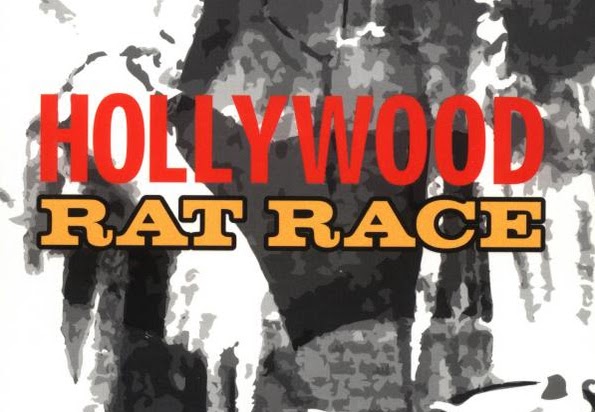
An uncorrected proof of Ed Wood's Hollywood Rat Race.
  
Ed's posthumous work.
Alternate titles: None.

Availability: Hollywood Rat Race (Four Walls Eight Windows, 1998; Da Capo Press, 1999) is still easy to acquire and quite affordable.

The backstory: "When I took on this project, I wanted to reminisce as well as get the point across as to what it's really like in my Tinsel Town." So wrote Edward Davis Wood, Jr. in Hollywood Rat Race, a most curious manuscript he penned during the LBJ years but which did not actually see publication until 1998, a full two decades after his death. The available edition has no introduction or explanatory notes, so relatively little is known of its existence. From clues in the text, however, it seems all but certain that it was written circa 1965. Ed mentions that he arrived in Hollywood in 1947 and has been there 18 years. He also mentions that the moon landing will occur in four years and repeatedly references the film Orgy of the Dead (1965) as being a new release.

The fact that the manuscript survived at all is a minor miracle, considering that many of Ed's personal belongings were thrown away during his sad and tumultuous final years as he slipped further into obscurity, poverty, and alcoholism. The book's edition notice grants a copyright to the "Estate of Edward D Wood, Jr.," and the photo of Ed on the back cover was supplied by his widow, Kathy, so evidently she either discovered this book among her late husband's personal effects or merely held onto it until she could find a publisher.

The book is partially a how-to guide for aspiring actresses and actors (mainly the former) who hope to move to Hollywood and break into the motion picture business. Most of his advice boils down to two oft-repeated words: "stay home." Essentially, he advises young starlets to try to get acting and modeling work near their own hometown because work is tough to come by in Tinsel Town. Newcomers will find that there's a lot of competition for each assignment. Living expenses are high in Hollywood, and the town isn't as glamorous as it used to be anyway.

For those who insist on coming to Hollywood, Ed has a few bits of practical advice. He says to be wary of sleazy scam artists, phony screen tests, disreputable beauty contests, and lustful movie producers who just want to get into your angora sweater (literally). He recommends getting professional headshots and says that screen actors will likely need an agent and a publicist if they're going to make any headway in the industry.

A last hurrah: Bela Lugosi in Plan 9.
Along the way, Ed manages to work in many details about his own life and career, including anecdotes about his films and the actors and actresses who starred in them. There are tidbits here about Criswell (pg. 20 and pg. 138, both about going to the Brown Derby with the famed psychic), Lyle Talbot (pg. 50), Tom Keene (pgs. 66-68), Kenne Duncan (pgs 104-105), plus the story of a truly harrowing accident which occurred on the set of one of Bud Osborne's westerns (pgs. 57-60).

Above all, though, Eddie's thoughts were with Bela Lugosi when he wrote this book. "A personal weakness stole his life and his fortune," Ed writes euphemistically on page 32, "but not his talents." By far, the book's single-longest showbiz anecdote (pgs. 93-104) concerns a personal appearance Bela made at a movie theater in San Bernadino, CA, accompanied by Ed Wood and Dolores Fuller (identified here as Bela's "lovely assistant" and a "motion picture actress in her own right" -- this was more than a decade after she and Eddie had split up).

Apparently, Bela was forlorn because his movies were making a splash on television, yet younger viewers didn't know whether he was alive or not. So Eddie decided that a personal appearance was the cure and set up the date for Bela, who was nervous because he had no "act" to speak of. But the appearance was a smash success, leading to Bela's own comedic Las Vegas revue (written by Eddie), which was contracted for four weeks but ran seven. "This was February of 1954," Ed writes, "so close to the end of Bela's life." You get the feeling Ed was proud of having the opportunity to give his hero, Lugosi, one last hurrah.

Speaking of which, elsewhere in Hollywood Rat Race, Ed dishes on the making of Plan 9 from Outer Space, although he still clearly prefers the title Grave Robbers from Outer Space. He confirms most of the usual bits of Wood-ian trivia (pgs. 118-120). Yes, the film was funded by Baptists. Yes, he and Tor Johnson were baptized in a swimming pool. And, yes, the script was written around footage of Bela Lugosi which had been shot for another project entirely. What I didn't know is that the infamous "Solarnite bomb" was a late-arriving inspiration which Eddie didn't conceive until the eighth day of a twelve-day shooting schedule (pg. 128). Ed also lets us know that Bride of the Monster was inspired, as one might guess, by a dream, while Final Curtain was written originally as a short story while Ed was studying drama in Washington D.C. (both pg. 125).

It's also rather amusing to learn (on pgs 115-116) that he thought Orgy of the Dead "looked pretty bad" when he was on the set but turned out great thanks to its director (Stephen Apostolof, not mentioned by name) and "could well become a classic" in its genre. As indeed it has... at least to me.

Jack Norton.
Perhaps most valuably, this book sheds some light on some of the lesser-known eras of Ed Wood's career. For instance, he discusses his campaign work for controversial LA mayor Sam Yorty (pg. 46; pg. 130). He fills us in on his stint making technical documentaries for the Autonetics technical research facility in the early 1960s (pg. 129). And he mentions any number of lost or forgotten projects, including a novel called The Inconvenient Corpse, a book inspired by character actor Jack Norton, who specialized in playing drunks but who sadly died before getting to read it (pg. 34). Most fascinatingly, on page 69, Ed tells us he wrote three films (The Gunslinger, War Dance, and Double Noose) for Tom Keene, the bland cowboy actor who had played an insurance investigator in Ed's Crossroad Avenger and who went on to be a real-life insurance salesman when his film career petered out. Wonder whatever happened to these?

The reading experience: Pure Eddie. The first mention of angora sweaters arrives on page four, and there are many to follow. Those looking for classic Ed Wood quotes will find many sentences in this manuscript which are written in his signature style -- stilted and convoluted, yes, but also strangely poetic. A few favorites:
  • The atomic bomb didn't just happen. Many people of many trades, skilled people of long apprenticeship and longer study were commissioned for such a magnificent undertaking. (page 62)
  • I liked the television series The Bell Brothers starring the Bell Brothers. (page 79)
  • Sex! It becomes all important. Sex! (page 79)
  • It's not the dark I fear -- it's the things that move around in it! (page 89)
  • By 1953, the baby art called television was a baby no longer, but a skeleton filling out toward the giant it was to become. (page 93)
  • Writing fiction is great fun. It's much like God creating his world and his people, putting them in a situation, then directing their every movement. (page 128)

One of Criswell's books
With lines like that, it's kind of a shame that Criswell wasn't around in 1998 to record the book on tape version of Hollywood Rat Race. Actually, this book is quite sensible and reasonable for the most part, other than some truly egregious references to angora sweaters... and one green taffeta dress (pg. 97). Well, there is one truly nutty suggestion. In a chapter called "How to Live in Hollywood Without Money," he semi-seriously advises his readers to sleep in Griffith Park (coincidentally, the location for "Lake Marsh" in Bride of the Monster).

It's hard to divine Ed Wood's true feelings toward Tinsel Town, as they change throughout this book. In a chapter called "Hate," Eddie rails against Hollywood's "haters" (half a century before that become a popular slang term) and says that those who complain about the town are likely to be commies (pg. 105). Just five pages later, though, he's more pragmatic: "Ah, our world, as well as my town is changing...and it's all because we're growing up." Throughout Hollywood Rat Race, there are references to the fact that androgynous "beatniks" are taking over the once-glamorous Sunset Strip, which would become a key plot element in Death of a Transvestite (1967).

By the end of the book, in a chapter simply called "Hollywood," Eddie's mood has become apocalyptic. He states on page 136: "Actually, there is no Hollywood any longer. It's become a kaleidoscope of meaningless ectoplasms which abound between reality and the unreality." He ends the book two pages later with this ultimate pronouncement: "That's the Hollywood as an insider knows it. Trouble. Problems. Heartache. Believe it or not, your life is more real than the Hollywood scene." Kinda makes you want to catch the next Greyhound bus headed west, doesn't it?

And now, I think it's as good a time as any to cover one of Ed's most obscure little films, since he mentions it rather prominently in Hollywood Rat Race.

TRICK SHOOTING WITH KENNE DUNCAN
(1952? 1961? mid-1960s?)


Alternate title: Kenne Duncan: The Face That is Known to Millions of TV and Western Movie Fans. The title under which this film is commonly known, i.e. Trick Shooting with Kenne Duncan, appears nowhere in the credits and seems to have been bestowed upon it ex post facto, possibly for DVD release.

Availability: The DVD collection Big Box of Wood (S'more Entertainment, 2010)

A smiling Kenne Duncan
The backstory: Sour-faced Kenne Duncan had been a C-list baddie in cheap western films for about 20 years when he appeared as yet another ornery desperado in Ed Wood's unsold TV pilot, Crossroad Avenger: The Adventures of the Tucson Kid (1953). He would go on to play the lead role of Dr. Acula, a part intended for Bela Lugosi, in Ed's Night of the Ghouls (1959). Kenne and Eddie were friends and socialized throughout the 1950s and 1960s, bonding over Ed's love of cowboy pictures and their shared fondness for booze.

No one seems to agree exactly when Eddie and Kenne made this short promotional film for Remington firearms. The IMDb has it as 1961. A very good Ed Wood tribute site places it in 1952, a fact repeated by Rob Craig's excellent book, Ed Wood: Mad Genius. But Ed himself talks about the Remington film in Hollywood Rat Race, which likely was written in 1965. As Wood states on page 105: "In 1951 Kenne even rode Emperor Hirohito's white horse down Tokyo's main street and he has color newsreel film to prove it. We recently used this footage in a film about Kenne's act." This tells me that the Japanese footage in Trick Shooting is from the early 1950s but that the rest of the movie was probably not made until the 1960s. Therefore I'm guessing the IMDb's date is closer to the truth.

Kenne shoots Necco wafers just to watch 'em die.
The viewing experience: Intriguing at first, then ultimately monotonous and stultifying.

The film sets up its pattern early, then repeats it over and over. In an unenthusiastic voiceover, Kenne tells us about some trick shot that he's going to perform, which almost always involves hitting a Necco wafer carefully positioned inside a small booth, then he does the trick shot successfully, we hear a metallic "PING!" on the soundtrack, and the process begins anew. Occasionally, he'll stop to give a pitch for Remington directly to the camera.

Throughout the film, there are cutaways to stills and posters from Kenne's movies (all obscure cowboy flicks) and personal appearances. It's like they're constantly trying to convince us that this guy is a star. His sharpshooting act, while impressive in a purely theoretical sense, is not very visually appealing. The infamous Japan footage arrives about eight minutes into this nine-minute movie, and it's not in color, as Ed had promised. It is rather amusing, though, to hear the Japanese newsreel announcer say the name "Kenne Duncan," which sticks out like a hot coal from the rest of his speech.

I guess the main point of interest for me, other than Kenne's "rhinestone cowboy" outfits, was the fact that his targets were Necco wafers. Kenne likes these because they shatter so well when shot, but for many Catholic kids, these candies are used as playtime substitutes for the eucharist wafers, lending the film a slightly sacrilegious air. Anyway, Kenne must have gotten tired of shooting candy wafers at state fairs, because he committed suicide by barbiturate overdose in 1972. His wake was held by the pool at Ed's place, with mourners delivering their eulogies from the diving board. I'd like to think Necco wafers were served -- or used as targets in a 21-gun salute.
Next week: I promised that once August was over, I'd jump back into Ed's movies. Guess what? I lied. You see, Ed wrote some short stories, too, and I want to devote at least one week of this series to those, since I've now gotten to read a few of them. Let's meet back here in seven days and talk all about it, huh?

Wednesday, March 25, 2026

Ed Wood Wednesdays, week 267 The great 'Hollywood Rat Race' auction of 2026

This eBay auction is a veritable smorgasbord.
NOTE: The following article is about the sale of some rare Ed Wood material. Because this sale is happening on eBay (an auction site) and because the seller is willing to entertain offers (or bids) from interested parties, I am referring to this as sale an "auction." JB.
This is not the article I planned to write this week. I actually wanted to get back to my ongoing series about Tim Burton's Ed Wood (1994). But something unusual has happened in the world of Ed Wood fandom, and I feel it is my responsibility to record it for the sake of posterity before we all forget that this ever happened. I strongly suspect that this is the kind of one-off oddity destined to fall down the memory hole never to be recalled again.

On March 16, 2026, Bob Blackburn (co-inheritor of the Ed Wood estate) posted on Facebook about a very intriguing eBay auction he'd learned about through fellow fan Patrick McCabe. It seems that a legitimate memorabilia dealer called NEOvintage was selling a treasure trove of rare Ed Wood materials from the 1960s, including a manuscript of Hollywood Rat Race typed by Eddie himself and some ultra-rare cassette tapes including unreleased interviews with Ed and others talking about Bela Lugosi. The asking price for these precious goodies? A mere quarter of a million dollars, though the seller is willing to offer a $50,000 discount to the right buyer. If you have a spare vacation home you're not using or perhaps a Scrooge McDuck vault of gold coins, maybe consider it.

Wednesday, November 12, 2014

Ed Wood's BLOOD SPLATTERS QUICKLY: 'Taking Off' (1971)

Tell me about it, girlfriend: a woman experiences sexual regret in Ed Wood's "Taking Off."
NOTE: This article is part of my ongoing coverage of Blood Splatters Quickly: The Collected Stories of Edward D. Wood, Jr.

Swap, a magazine for swingers.
The story: "Taking Off," originally published in Swap, October/November 1971, Pendulum.

Synopsis: Pretty but restless 17-year-old Emily Porterhouse feels like she is going to waste in her sleepy little hometown of Gartersville, a village whose only claim to fame is a nearby auto plant. It's Saturday night, and she has nothing to do. She can't even hang around the house, since her parents are hosting their weekly bridge party and have invited many neighbors to their home. She thinks about her early sexual explorations with her boyfriend, Tommy Rich, a car owner who is kind to her despite acting tough around his friends.

But Emily doesn't want to marry Tommy or any of the boys in Gartersville because none of them will be important in life. Instead, she dreams of moving to Hollywood, where her talent and beauty will finally be appreciated. Desiring to change clothes, Emily decides to enter her own home, regardless of the fact that her parents are hosting a party. Once inside, she sees that the grown ups are not playing bridge but, rather, participating in an orgy! For the first time, Emily understands how the adult world works. "She had simply entered life," the narrator tells us.

Wood trademarks:
  • An angora sweater (baby blue in color this time)
  • Having nothing to do on a Saturday night in a small town (cf. this collection's "To Kill a Saturday Night")
  • Young girl planning to move to Hollywood to become a star (cf. Hollywood Rat Race)
  • The local movie house as escape from suburban boredom (similar to Ed Wood's own childhood in Poughkeepsie, NY)
  • Reference to prostitution (the expression "whore in church")
  • Lingering attention to a woman's body and wardrobe, especially undergarments (this story focuses on Emily's breasts, panties, and brassiere)
  • Reference to snakes (orgy compared to writhing snake pit)
  • Seemingly average folks participating in an orgy (a staple of Ed's 1970s movies with Stephen Apostolof, cf. The Cocktail Hostesses, The Beach Bunnies, The Class Reunion)
  • Female character as irresistible object of male lust
  • A couple whose surname is Trent (cf. Plan 9 from Outer Space)
  • Character named Barbara (common Wood character name since Glen or Glenda?)
  • Speed typing (Ed's own talent).

Excerpt: "A man and a woman were supposed to have sex, that's the way babies were made. They get married and a boy and a girl mate and pretty soon they have a house full of kids... screaming brats running all around the place... screaming house apes with grubby asses and dirty faces. There would be no kids for her."

Ed offers new uses for 7 Up!
Reflections: As I make my way through this collection, I'm coming to realize that Ed Wood was pornography's answer to the Swiss Army knife. Any kind of story you want, whatever your sexual preference or predilection, he's your man. A real Johnny-on-the-spot of smut, you might say. The Pendulum/Gallery/Calga publishing empire released a whole slew of erotically-diverse titles in the early 1970s, and Ed Wood wrote for as many of them as he could, bouncing from one sexual orientation to another. Swap was Pendulum's magazine devoted to the "swinging" lifestyle.

The wonderful Bob Blackburn, the man responsible for getting Blood Splatters Quickly into print, has been kindly sending me artwork and contents pages from the original magazines, and I've noticed that Pendulum wanted to indulge its readers' fetishes and reassure them that whatever they were into was normal and acceptable. Besides running pictures and articles that catered to readers' specialized interests (even if that interest was sex with the Devil or whatever), Pendulum also tended to run supportive editorials on its magazines' contents pages, many of them written by Ed Wood himself. Here's what Swap has to say about swinging, for instance:
The swinging swappers have made a whole new thing out of the ancient and traditional institution of marriage. It has long been apparent that swappers -- married persons who switch off mates with one another -- have been eating away at the foundations of that traditional edifice called marriage, but some experts in the field are now beginning to wonder if they really are the termites they once seemed to be. Might it be that they are having the opposite effect, shoring up what's left of the old structure?
With that in mind, you might think that Ed Wood's story for a swingers magazine would be written from the perspective of the swingers themselves, in this case the grown-ups of Gartersville (and how about that name, huh?) who gather every Saturday night and pretend they're "playing bridge" when they're really swapping partners. All week, they toil in the automobile plant -- rather like the foundry workers in Glen or Glenda? -- then cut loose on the weekends because they've earned a little fun.

But the story isn't really about swinging or swingers at all. It's about a young woman who feels stifled in a small town and yearns for the excitement and glamour of Hollywood. If Eddie has a surrogate in "Taking Off," it's would-be starlet Emily Porterhouse, who possesses the perfect feminine beauty Ed always dreamed of achieving himself. He even makes Emily a super-fast typist, just like he was! Curiously, Ed's showbiz manual, Hollywood Rat Race (ca. 1965), contains numerous cautionary tales about girls just like Emily who move to Tinseltown only to find rejection, poverty, and humiliation there. You might be a big deal in your home town, Ed repeatedly suggests in that book, but you'll find that there are thousands just like you in Los Angeles.

The most common bit of advice in Hollywood Rat Race is "stay home," but you can tell from this story that Ed still sympathizes with the dreamers of the world, particularly young girls, who look West and think that the Hollywood dream factory still offers something better than they can find at the local gas station or malt shop. The ending of this story is presented as a birth or rebirth for Emily. If Alan/Ann from Glen or Glenda? is "a woman born at the age of 24," then Emily Porterhouse is a woman born at the age of 17.

By the way, in "Taking Off," Professor Ed offers one bit of helpful, little-heard sex advice for you ladies out there: a freshly shaken-up bottle of 7 Up makes a good post-coital douche for those times when you want to prevent pregnancy. Just make sure to have a handkerchief handy for afterwards!

Next: "Sex Star" (1973)

Wednesday, August 23, 2017

Ed Wood Wednesdays: The Wood Photo Odyssey, Part One by Greg Dziawer

Bela Lugosi, Dolores Fuller, and Ed Wood on New Year's Eve, 1953.

The famous photo from 1953.
A few days ago, artist and fellow Ed Wood fan Milton Knight posted a historic photograph to a private Facebook forum devoted to Ed. I had doubtless seen this image before, but I'd never thought twice about it. (I now realize I've seriously neglected to study these old photographs.)

This particular black-and-white snapshot depicts Bela Lugosi, Dolores Fuller, and Ed Wood, all dressed to the proverbial nines. Ed looks sharp in a light-colored tie against a light-colored shirt. Dolores has something wonderfully fuzzy draped over her arm. And Bela seems to be dressed as Dracula. I initially replied that it could be from 1953 or '54, maybe from Bela's Silver Slipper Revue in Las Vegas. I was close.

Soon after this image was posted, another version of the photo was posted by a Wood fan who had purchased his copy from Dolores herself at a fan convention. This version included a caption:  "Bela Lugosi, Dolores Fuller and Ed Wood, San Bernardino, California, New Year's Eve, 1953." While most of the caption is printed, the year is handwritten. (A correction, perhaps?) 

While this image had been posted many times online, both with and without the caption, its source had never been properly identified. The fan who had purchased a copy subsequently told me that Dolores "sold many copies" of it. Dolores' penchant for marketing herself and her work in later years is a subject for another time. Suffice it to say that she excelled at it, and it's likely thanks to her that this image survived at all. 

What is the backstory of this photo, you are likely wondering? I had somehow forgotten that this incident was recorded in previous Lugosi biographies that I'd already read, as well as Ed Wood's own posthumously published Hollywood Rat Race.

In Arthur Lennig's The Immortal Count: The Films of Bela Lugosi (1974), we suffer the painful details of this fallow period of Bela's life. Lillian Arch, his wife of 20 years and mother of his only child, left him in the spring of 1953. Ed was acting as Bela's agent at this time. The Hungarian actor made a guest appearance on the July 27, 1953 edition of You Wanted To See It, a live TV series in which host Art Baker fulfilled various mailed-in requests from viewers. After appearing in a six-minute sketch as—what else?—a vampire, Lugosi told Baker that he was working on "a few things," including a film called The Phantom Ghoul and a TV series called Dr. Acula. As most Wood fans know, these were both projects that Eddie initiated but sadly never completed. By October, unfortunately, Bela struggled to find work, selling possessions at public auction and moving to a more modest apartment in Los Angeles.


After Lillian's departure, Bela became depressed, drank, ate poorly, and lost weight. These changes are evident in his gaunt features and skeletal hands in the New Year's Eve photo. It was then, as Lennig tells it, that Bela "was roused from his misery by the indefatigable Ed Wood, who booked Lugosi into a New Year's show in San Bernardino, California, to usher in 1954." The tone of this statement confirms Tim Burton's Ed Wood biopic, reinforcing the theme that Ed rose above his challenging reality.

Robert Cremer's Bela bio Lugosi: The Man Behind the Cape (1976) likewise notes that, at the New Year's Eve show, "sandwiched between films, Lugosi gave a well-received speech, after which he remained to shake hands and sign autographs."

Article about the West Coast Theatre.
By far, the most thorough account of the night was included in Ed Wood's Hollywood Rat Race. Wood used the New Year's Eve show as a parable about redemption and determination. It is up to the reader to decide how much of Wood's story is true and how much is wishful thinking.

In any event, as part of a chapter called "Hate," Wood describes a 71-year-old Bela Lugosi as being "despondent" and "outwardly ready to quit" due to his dire financial circumstances in late 1953. His older films had started playing on television by then, but young viewers watching these classics didn't know whether Lugosi was alive or dead. Wood specifically mentions Maila "Vampira" Nurmi hosting a broadcast of White Zombie (1932) on Los Angeles' KHJ-TV. This incident seems to have been the basis for a memorable scene in Burton's film, with Bela (Martin Landau) and Ed (Johnny Depp) watching Vampira's show from a lumpy couch in Bela's cluttered home.

Desperate to find work for Lugosi, who by then was too frail to appear in stage plays, Wood hit upon the idea of having the legendary actor make a personal appearance where he would interact with his fans directly. The elderly actor, Wood reports, was enthusiastic about this plan. But Lugosi had no real act, in the traditional vaudeville sense, so it was difficult at first to find a proper venue for him. Luckily, Wood had previously done business with a gentlemanly exhibitor named Albert Stetson, who owned several movie theaters in or near Los Angeles at the time. It was Stetson, Wood says, who devised the New Year's Eve program at his San Bernardino location, about 61 miles outside of L.A.

Wood goes on to describe the hoopla preceding the big night, with Lugosi giving numerous interviews, attending various club functions, and even meeting George Blair, the mayor of San Bernardino. The day of the show, Ed and Bela drove out to the theater, braving cold, misty weather along the way. They were accompanied by Dolores Fuller, described by Wood as Lugosi's "lovely assistant." Once he arrived in San Bernardino, Lugosi was immediately corralled into doing yet another radio interview instead of being allowed to relax.

After that ordeal, Bela, Dolores, and Ed all attended a "final cocktail party for the press" held at a nearby hotel. Wood makes a point of saying that Lugosi diligently refrained from drinking that day, even though the actor "had always enjoyed his scotch and room temperature beer." But the party dragged on and on, Wood says, and Lugosi was getting tired. Finally, the actor was allowed to go to his hotel room to put on his "full dress suit" and prepare for the evening. Wood tells us that Bela "demanded solitude even from his friends" before a show.

An ad for Bela Lugosi's New Years show.
According to Hollywood Rat Race, the bill of fare that memorable evening consisted of "five features, several cartoons, and a hundred-dollar bank night drawing." The program, Wood alleges, began at 9:00 that night with a screening of Arabian Nights (1942) with Jon Hall. Bela had not yet arrived. Dolores had been dispatched to retrieve him from the hotel. Attendance was initially sparse to nil but picked up substantially within the first hour until the box office had to display a "Standing Room Only" sign. Wood says that the local police and fire departments were brought in to handle the crowds and traffic generated by the show.

After Arabian Nights and an obscure Terrytoons short called Runaway Mouse (1953) had ended, Lugosi finally pulled up in a limousine, only to be mobbed by autograph seekers. There was no longer any doubt, Wood says, that the audience was there specifically to see the aged actor. "A rerun movie and a gross of cartoons hadn't attracted people from parties on New Year's Eve," Wood writes. "It was the great Lugosi who had come out of hiding after all those years." Finally, at 10:58, Lugosi took the stage and tearfully delivered the following short speech:
My dear friends: I greet you here tonight on a new, great, New Year. May the coming year bring the joy and success deserved. I wish, with all my heart, that I might meet each of you on the mezzanine in a few minutes where I might personally shake your hand and say ... God bless you.
Lugosi's "performance" that night lasted less than a minute by Wood's reckoning. Bela had disregarded the three-minute speech Eddie had written and instead "designed his own speech." The Dracula star then ascended to the mezzanine, where he and Dolores distributed autographed photographs to waiting fans.

This show business fairy tale ends with Albert Stetson sending Ed Wood a letter thanking him for breaking box office records at the venue. The letter, as quoted in Hollywood Rat Race, is effusive in its praise: "Mr. Bela Lugosi's personal appearance at the West Coast Theater [sic] has truly given our theater a wonderful evening."

The now-demolished West Coast Theatre (later the Crest) was an ornate house hailing from the height of the silent era. Despite its auspicious beginnings in 1925, the place was no longer showing first-run features by 1954. The ad for the New Year's show in The San Bernardino Sun (December 30, 1953) lists only two of the five promised features. It was one of the smaller ads on the page, dwarfed by promotions for New Year's floor shows elsewhere as well as for John Wayne's Hondo, admittance to which would cost you $1.25. The West Coast, meanwhile, advertised 50 cents for an entire show. And the ad tells us that the show—with Bela present and presenting "speeches" that could very well have been penned by Ed, alongside an assortment of B and second-run features—ran for an incredible four days.

Acknowledgements
  • Special thanks this week to artist and illustrator Milton Knight for instigating, unwittingly or not, both a whole new Wood Odyssey and a brand new space in my head. Make sure to check out his incredible blog, The World of Knight.

Wednesday, April 29, 2015

Ed Wood Wednesdays, week 60: 'The Lawless Rider' (1954)

Johnny Carpenter (center) in the Ed Wood-written-and-produced The Lawless Rider.

"What is acting? It is to portray with all your ability and sincerity a character, a person, with all your heart and soul. Who is this character? Say she is a horse woman! How can you play a horse woman if you don't know the first thing about horses, or riding them?"
-Edward D. Wood, Jr., Hollywood Rat Race
"I got so bugged I turned it off and turned on another show.
But there was the same old shoot-'em-up and the same old rodeo.
Salty Sam was tryin' to stuff Sweet Sue in a burlap sack.
He said, 'If you don't give me the deed to your ranch,
I'm gonna throw you on the railroad track!'"

-The Coasters, "Along Came Jones"

A posse of sorts.
Imagine for a moment how exciting the Old West -- or at least Hollywood's approximation of it -- must have seemed to a suggestible, excitable kid growing up in unexciting Poughkeepsie, New York during the Great Depression. Today, Edward Davis Wood, Jr. is best known for his one-and-only movie about outer space. But for little Eddie, a faithful attendee and later usher and ticket taker at his hometown movie theater, the wide open, untamed territory left of the Mississippi River on the map provided all the space he could possibly want or need. He saw Universal's take on Dracula when he was seven years old, and it left a permanent mark on his psyche. But it was the cowboy pictures, particularly the cheap ones, which truly and permanently won his heart with their white-hatted heroes, hissable villains, and cut-and-dried moral certainty.

Westerns had a major impact on several generations of Americans, including some who grew up to become titans of science fiction. There are echoes of John Ford throughout George Lucas' Star Wars saga, for instance, while Gene Roddenberry famously pitched Star Trek to network executives as a celestial variation on Wagon Train. Ed Wood, meanwhile, grew up to write and direct Plan 9 from Outer Space, an interplanetary struggle which climaxes with an earthbound, O.K. Corral-style showdown and common barroom fisticuffs. The film's ad hoc trio of earthling heroes (an airline pilot, a military man, and a cop) could even be considered a posse. Their ultimate mission, like that of John Wayne in The Searchers, is to rescue a kidnapped white woman from the clutches of a race of outsiders whom they regard with suspicion and contempt.

By the time Ed Wood reached Hollywood in 1947, the uncomplicated and unambiguous Westerns he preferred were on the wane, chased out of cinemas and onto television by grittier fare, a fact he would lament repeatedly in his circa-1965 showbiz primer Hollywood Rat Race, which is chock full of references to and anecdotes about B-list cowboy stars. As both a writer and a filmmaker, Ed Wood was beholden to the demands of the marketplace, which is why he bounced around from genre to genre throughout his career like a common claim jumper. But Eddie kept trying to return to the range however he could, be it as a director (Crossroads of Laredo; Crossroad Avenger), a scenarist (Revenge of the Virgins), or even a stuntman (The Baron of Arizona). He also forged personal and professional alliances with such obsolete screen cowboys as Tom Keene, Tom Tyler, Bud Osborne, and badman Kenne Duncan, throwing film and TV roles their way whenever possible, often in non-Westerns.

But now, we must turn our attentions to another Western would-have-been, a pretender to the thrones of Autry, Rogers, and Cassidy who went by the professional name of Johnny Carpenter, though his true forename was Jasper. For it was with the late Mr. Carpenter that Ed Wood made this week's nearly-forgotten film.

THE LAWLESS RIDER (1954)

A lobby card possibly designed to trick viewers into thinking The Lawless Rider was in color.

A poster touting costar
Texas Rose Bascom
Alternate titles: Outlaw Marshal [working title]

Availability: To my knowledge, The Lawless Rider has never been released on VHS, DVD, or laserdisc. It is only through the benevolence of Ed Wood historian Phillip R. Frey that I was able to view a print of this exceedingly rare film.

The backstory: Let's go back a century to the fateful year of 1915. The era of American History we now call the "Old West" or the "Wild West" had just ended back then. Even so, the mythologizing of the period was already in full swing. The bookish Democrat Woodrow Wilson occupied the Oval Office, but he hadn't gotten his country into the already-in-progress World War I quite yet. Babe Ruth, not yet a Yankee, was making his unsuccessful debut as a pitcher for the Boston Red Sox. (He'd get better.) And Thomas Edison, still vital at 68, had invented some newfangled gizmo for recording telephone conversations.

Meanwhile, the future screen star known as Johnny Carpenter was still Jasper Carpenter, a year-old infant growing up on his daddy's modest farm in Debinsville, Arkansas, a town so small it's since been swallowed up by nearby Russellville just south of Route 40. Jasper grew up riding horses but dreaming of baseball, not knowing his future lay in the former rather than the latter. A horrific hit-and-run accident in 1936 permanently derailed Jasper's baseball dreams and sent him packing for Hollywood, where he'd try to become the next cowboy matinee idol under a semi-new name. (Or, briefly, an entirely new one: John Forbes.) Carpenter's future friend and partner, Edward D. Wood, Jr., wouldn't even be born for nearly another decade and wouldn't make it to the Left Coast until 1947.

Yakima Canutt, stuntman supreme
But the motion picture business was well underway by 1915, even without Ed Wood or Johnny Carpenter to help it along. That was the year of  D.W. Griffith's landmark, still-controversial The Birth of a Nation (also known as The Clansman). And there were already Westerns... and Western stars, for that matter! Most prominent among these was Tom Mix, headliner of nearly 300 silent cowboy films, many of them self-directed. Foreman of Bar Z Ranch, one of about 40 films Mix made in 1915, was the first-ever production to employ the services of a brash, 20-year-old rodeo champion with the memorable moniker of Yakima Canutt.

In truth, Enos Edward "Yakima" Canutt (1895-1986) had been busting broncos since the age of 11 and was among the first rodeo stars to invade the fledgling movie industry in its early days. With his bravery and skill, however, he eclipsed all his rope-slinging contemporaries in the field. Starting from that early Tom Mix short, Canutt's truly legendary career as a stuntman, stunt coordinator, and second unit director lasted sixty action-packed years, finally ending with Breakheart Pass (1975), a Charles Bronson picture distributed by United Artists. In between, along with too many cowboy films to count, he provided his services to Gone with the Wind, Ben-Hur, Spartacus, Stagecoach (which contains his single most famous stunt), Rio Bravo, Old Yeller, and dozens more. For about half a century, when Hollywood needed to pull off a tricky or dangerous action sequence in a motion picture, they turned to Yakima Canutt because they knew he was the man for the job. More than most, Mr. Canutt truly earned his star on the Hollywood Walk of Fame. Steven Spielberg was enough of a fan to work a Canutt-inspired stunt sequence into Raiders of the Lost Ark (1981).

Despite crossing paths with John Wayne and Stanley Kubrick, Yakima Canutt's own directing career never really amounted to a whole hell of a lot: only about a dozen fairly obscure theatrically-released features, mostly clustered together in the mid-to-late 1940s. And on many of these, Canutt had a credited co-director, usually Spencer Gordon Bennet or Fred C. Brannon. (Canutt and Brannon even co-directed some made-for-TV flicks in the 1960s.) Feature films with Yakima Canutt as a solo director are relatively rare. I can only find five, among the literally hundreds of films on his resume. There's 1945's Sheriff of Cimarron with Sunset Carson; 1948's Oklahoma Badlands and Carson City Raiders, both vehicles for Allan "Rocky" Lane (best known today as the voice of TV's talking horse, Mr. Ed); 1948's Sons of Adventure; and finally the movie we're covering this week, The Lawless Rider from 1954. As near as I can tell, the great Yakima Canutt never again helmed a theatrical feature after Lawless. The second-unit and stunt jobs kept coming, though, and those were what paid the bills and made him famous anyway.

A recipe for failure.
In my article about another Wood/Carpenter collaboration of similar vintage, Son of the Renegade (1953), I explained the essential, tragicomic conundrum of Johnny Carpenter's muddled screen career. Simply put, he was about two decades behind the times and was creating antiquated product for a market which had either ceased to exist or which, at best, had moved on to other distractions. Carpenter's big push for screen stardom didn't come until the 1950s when he, then about 40, produced and starred in a series of low-budget, independently-financed Westerns, of which The Lawless Rider was one. By that time, though, the genre had gone through considerable changes, and Carpenter hadn't or perhaps couldn't adapt. This very problem is an important motif throughout Ed Wood's Hollywood Rat Race. To read that book is to understand why The Lawless Rider ultimately failed. Some cogent examples of Ed's complaints:
  • [T]he Western itself ... changed so fantastically. The cowboy film was no longer a cowboy film, it was a "Western." It wasn't a clear battle between hero and villain, good and evil. Now the hero had to have doubts about his achievements. Everyone needed a dose of neurosis, and be up to their ears in Freudian, subconscious problems. (page 68)
  • Even the Westerns got into the swing of sex. No longer did the cleanly dressed cowboy kiss his horse and ride off into the sunset to begin another adventure. Instead, he began to wear the dirtiest clothing, kick his horse in the ass, and take the roughest dance hall broad into the hayloft with him. (page 108)
  • Take the simple Western of the 1930s. It's almost impossible, even with a petition signed by thousands of names, to get one on the Saturday morning kiddie shows. Unless the hero wears a black hat and dirty clothes, rides a black horse, rapes his leading lady, and visits his psychiatrist once a week "it just ain't got it." (page 130)
The Lawless Rider is the exact opposite of everything Wood describes above. It most certainly is a clear battle between a hero (Carpenter) and a villain (Kenne Duncan, forever the heel), and it is never ambiguous for whom the audience is meant to be rooting. Furthermore, Carpenter's uncomplicated, straight-shooting protagonist has no inner life to speak of, hence no subconscious or pesky Freudian doubts. Nor does the hero have any sex life. The movie provides him with a sort-of-romantic interest in the wholesome person of "internationally famous trick roping champion" Texas Rose Bascom, whose husband, Weldon, and brother-in-law, Earl, are also in the Lawless cast. In terms of physical intimacy, however, Johnny and Rose never progress beyond cordial greetings. At least the previous year's Son of the Renegade had given Johnny Carpenter some more interesting sexual options, even if he did not take advantage of them. ("I just don't have time for anybody," he said in that film.)

As for wearing "a black hat and dirty clothes," Johnny Carpenter's morally upright character only dons such items when he is impersonating a hired killer as part of a plan to infiltrate the villain's gang. Otherwise, his clothing, like his hygiene and manners, is impeccable.

This credit makes it official. This is an Ed Wood movie.
Filming for The Lawless Rider seems to have taken place at the same all-purpose movie ranch in the Hollywood Hills where Son of the Renegade and countless other movies and TV shows were shot. Based on what's visible onscreen, there is every indication that this should have been a quick, uncomplicated production which came in on time and on budget. But this website says differently. According to the information there, the movie exceeded its $20,000 budget and experienced "legal troubles" that delayed its release by two years. This is also said to be the first project to unite Alex Gordon with B-movie kingpin Samuel Z. Arkoff, who allegedly negotiated the movie's tardy release. I cannot confirm any of that, but I thought I'd pass it along. You're welcome.

Though ultimately distributed by United Artists, the movie was made through a limited partnership dubbed Royal West Productions. All of the buildings we can see, including a blacksmith's shop and a sheriff's office, look like generic facades with no distinguishing features. All of Ed's Westerns, including Crossroad Avenger and Crossroads of Laredo, share this assembly-line quality, as if they all took place at some cowboy-themed amusement park somewhere off the Interstate.

Eddie's fans, however, will likely have their imaginations ignited by the opening credits. While Ed Wood himself is wrongfully denied even partial credit for the screenplay, he is listed prominently as an "Associate Producer" along with Weldon Bascom. That means The Lawless Rider is not some "apocryphal" or "speculative" Ed Wood movie, like Married Too Young (1962) or Revenge of the Virgins (1959). Nope, it's a bona fide, iron-clad, board-certified addition to the Wood filmography, as deserving of inclusion on that roster as Plan 9 from Outer Space. Appropriately, the cast and crew is dotted with "golden age" Wood regulars. Alex Gordon is the film's executive producer, for instance, while William C. Thompson is the cinematographer. Besides lead baddie Kenne Duncan, grizzled old Bud Osborne is also in the cast. Of course, all of these folks are overshadowed by the headliner's trusty steed, "Skipper, the Fastest Horse in the Movies," who is only second billed to Carpenter himself. That's just the kind of movie this is.

Ringers: Noel Neill and Frankie Darro
Like Ed Wood, Johnny Carpenter had an entourage of his own, and it's not surprising that several of them -- including Bill Coontz, Roy Canada, Bill Chaney, and Lennie Smith -- turn up in The Lawless Rider. As a producer, Carpenter had a habit of bringing in one or two ringers to play supporting parts. When it comes time to distribute and market a motion picture, it's always handy to have a few recognizable and therefore exploitable names in the cast. (That practice continues among independent filmmakers to this very day.)

In Lawless, these were Noel Neill and Frankie Darro. Neill, who portrays a tough, proto-feminist journalist named Nancy James, is best known as one of the two actresses* to portray Lois Lane on TV's The Adventures of Superman with George Reeves. Frankie Darro, who plays the troubled kid brother of heroine Texas Rose, was a former child star and stuntman turned character actor specializing in nervy, loudmouthed punks. His most famous performance, in fact, was as the voice of delinquent-turned-donkey Lampwick in Disney's Pinocchio (1940).

It is no surprise, especially with such bland leads as Johnny Carpenter and Rose Bascom, that Noel Neill and Frankie Darro are easily the most interesting people in The Lawless Rider. Neill's storyline -- she's a frontier journalist who bravely challenges a cattle-thieving crime boss -- deserves more screen time than it gets here.

As for Darro, in my review of his 1941 comedy The Gang's All Here, I called him "a yappy little Chihuahua who goes around snapping at pit bulls." And that's exactly what he plays here, too, to fairly good comedic effect. In fact, the very best scene in the entire movie comes when Johnny Carpenter shoots the guns right out of would-be hotshot Frankie Darro's hands before sending the chastened youngster home with his tail between his legs. It uncannily presages that moment in Kill Bill: Vol. 1 (2003) when Uma Thurman's Bride disarms and then spanks an unworthy opponent before telling him, "Go home to your mother!" It's highly unlikely that Quentin Tarantino ever saw The Lawless Rider, but you never know. He obviously watches a lot of movies.

* The other, Phyllis Coates, was in Ed Wood's The Sun Was Setting. Yes, Eddie worked with both Lois Lanes.

Carpenter and company on the Lawless Rider set.
The viewing experience: Surprisingly tame, if reasonably enjoyable. If nothing else, the film is helped along by its economical hour-long running time and relatively brisk pace. Had I chanced upon The Lawless Rider playing at some off hour on TCM and missed the opening credits, I would not have immediately guessed that Ed Wood had anything to do with it or that the movie was special or significant in any way.

Although Bill Thompson is the cinematographer, there are no striking or unusual images here as there are in the '50s films he lensed for Ed Wood. And despite the presence of Yakima Canutt in the director's chair, the action scenes in this film, mostly fistfights with some trick shooting and plenty of horseback riding, seem rote and by-the-book. Lawless is, at heart, a cheaply-made and largely unexceptional Western morality play, more akin with the tastes of the 1930s than the 1950s. Only its naivete distinguishes it.

It is difficult to imagine anyone but a cap-gun-toting child of the Eisenhower era, the kind who wears a toy sheriff's badge on his pajamas at night, becoming truly engrossed in this standard issue shoot-'em-up. As I have already explained, this film proudly eschews the complexity and ambiguity which were the norm in theatrically-released Westerns by the 1950s in favor of the moral certainty of an earlier era. But, unlike most of Eddie's other work, Western or otherwise, this one does not make any hairpin turns or pause for philosophical diatribes. Not even the dialogue is particularly Wood-ian. Let us, then, return to Johnny Carpenter's comment in Nightmare of Ecstasy: The Life and Art of Edward D. Wood, Jr. about how this script was written:
"We were writing The Lawless Rider in [Ed's] house at Riverside Drive and Victory Boulevard. Ed did everything. He was writer, production assistant, helped get people for me. We worked for each other for nothing. He would write a line of dialogue, and I would tear it up and throw it away. His dialogue was a little bit too perfect. The choice of words was not correct for the frontier."
Actor Henry Bederski contradicts this ("Johnny Carpenter couldn't write a story to save his life."), but a viewing of The Lawless Rider backs up Carpenter's version of the events. Having sorted through many, many examples of Ed Wood's writing, I can say that this script does not bear Wood's usual trademark expressions or his patented brand of stilted quasi-formality. I only counted a single, definitive Wood-ism: a spare "So what?" uttered by a thug. (This is also a catchphrase in the Wood-scripted The Violent Years.) It seems possible that someone, likely Carpenter himself (who else would have cared?), must have rewritten the dialogue line by line, systematically removing nearly all traces of Wood's weirdness in order to make the movie as normal and coherent as possible.

In their Cult Movies interview from 1994, Frank Henenlotter and Rudolph Grey accused director Stephen C. Apostolof of doing the same basic thing with Eddie's 1970s scripts, but the Apostolof films are much more eccentric in their own way than The Lawless Rider and allow for more of Eddie's personality to shine through, as well as his language. Since Steve Apostolof was not a native speaker of English, he might have deferred to Eddie when it came to dialogue. As the quote above indicates, on the other hand, Johnny Carpenter had some definite ideas about how the characters in his movies should speak.

Nancy James meets Freno Frost.
Let's set aside the dialogue, then, and focus on the plot, since Ed's presence may still be felt there. What exactly happens in The Lawless Rider? Well, the film takes place in 1896 in a fictional locale called Loma County, presumably in California. (The name is reminiscent of the real-life city of Loma Linda.) A crusading newspaperwoman named Nancy James (Noel Neill) arrives in town and tries to set up shop, only to be harassed and threatened by conniving crime boss Freno Frost (Kenne Duncan) and his gang of henchmen.

Although the local sheriff (Weldon Bascom) and Marshal Brady (Douglass Dumbrille) try to keep the peace, the greedy, violence-loving Frost really runs the town. He makes his money through cattle rustling, and he wants to wrangle a controlling interest in a cattle ranch owned and operated by Texas Rose Bascom (herself). He intends to do this through Rose's punk kid brother, Jim (Frankie Darro), who already owes Frost money and who seems poised to fall into a life of crime in his foolish quest for status and power. Rose has no intention of kowtowing to Frost, however, and violently rejects Frost's sleazy, opportunistic offer of marriage. Meanwhile, virtuous Deputy Marshal Johnny Carpenter (himself) has reluctantly tendered his resignation to Marshal Brady so that he may return home to the family ranch and help his sister.

Another dual role for Johnny Carpenter
Freno Frost buys Jim's interest in the Bascom ranch for a buck, and Frost's men start rustling cattle with newfound boldness from all the ranchers in the area. Rose sends a telegram to Johnny, her ex-boyfriend, asking for his help. The telegram informs Johnny that Freno Frost has sent for a notorious hired killer named Rod Tatum (also played by Johnny Carpenter), which suggests he is up to something particularly nefarious.

By this time, though, Johnny is no longer a lawman and is instead working on his sister's ranch. Johnny learns from his sister that Tatum is currently locked up in jail, so he decides to impersonate the killer and return to Loma County in disguise. (It's a good thing Johnny Carpenter and Rod Tatum look so much alike!) His first assignment as "Tatum" is to kill Jim Bascom! Obviously, he's not about to do that. He merely scares the bejeezus out of the kid and sends him on his way. Once in Loma County, the disguised Carpenter convinces Freno Frost and his thugs that he's really Rod Tatum. Things get a little confusing, however, when the genuine Rod Tatum breaks out of jail and rides into town. The "two" Tatums have a gunfight from which Johnny, the faker, emerges victorious.

In the film's turbulent and rather rushed final act, Texas Rose Bascom  holds a talent show in Loma County to benefit the ranchers who have suffered financial disaster at the hands of the Frost gang. The concert includes (somewhat underwhelming) rope tricks from Rose herself and Western music by Hank Caldwell and His Saddle Kings. In attendance, along with the local gangsters, are some of Johnny's own sidekicks. (He'd secretly gotten a message to them in case he needed backup.) Freno Frost doesn't want the show to go well, so he sends one of his goons, Black Jack (Lou Roberson), to interrupt it. Johnny and Black Jack get into a fight, during which the former's fake mustache falls off. The jig, as they say, is up.

This leads to an all-out melee between the good guys and bad guys: fisticuffs at first, but soon escalating to gunfire. During the chaotic battle, Freno Frost fatally shoots Rose's wayward brother, Jim, but Johnny Carpenter manages to finally kill Frost with a stick of dynamite. This, I guess, solves everything. Once the dust settles, Johnny discovers that Rose's ranch is rich with silver deposits, a fact that Freno Frost had known months earlier. His work done, the newly reborn Deputy Marshal Carpenter rides off toward his next assignment for Marshal Brady. The end.

Clancy Malone as doomed Don Gregor.
Does any of this seem particularly Wood-ian to you, reader? I will admit that, in very vague terms, Johnny Carpenter's The Lawless Rider bears some superficial resemblance to Ed Wood's own Jail Bait from the very same year. It's significant that these were both products of the period in the early 1950s during which Ed Wood was partnered with Alex Gordon. (Gordon, again, was a producer on Lawless and a co-writer on Jail Bait).

In both movies, we have a swaggering, tough-talking gangster type (Freno Frost/Vic Brady), an impetuous, trigger-happy young man (Jim Bascom/Don Gregor) who falls under his sway, and a justifiably-worried older sister (Rose Bascom/Marilyn Gregor) caught between them. I suppose this analogy makes Johnny Carpenter's character in The Lawless Rider the equivalent of Steve Reeves' bland Lt. Bob Lawrence, which is actually a pretty fair comparison.

Furthermore, both Lawless and Jail stop dead for several minutes so that we can watch a variety show act. In Lawless, it's Rose Bascom's lasso-swinging and the amiable music of Hank Caldwell, while in Jail, we are "treated" to several minutes of a minstrel show featuring Cotton Watts and Chick.

And finally, the plots of both films hinge on a man's outrageous and implausible plan to change his appearance and impersonate someone else. In Lawless, Johnny Carpenter slaps on a fake mustache and some black clothes to "become" Rod Tatum. And in Jail, of course, Vic Brady undergoes plastic surgery so he cannot be recognized by the police or identified by an eyewitness.

And yet, for the most part, The Lawless Rider is more of a historical curiosity for Ed Wood completists than it is a truly compelling narrative. Certainly, the prominent inclusion of Eddie's name in the credits and the participation of several key Wood cronies makes it a keeper. Ultimately, though, this is a Johnny Carpenter movie more than it is an Ed Wood movie. As such, Johnny Carpenter got his way on this production, and the finished movie suffers for it, as does the audience.

Carpenter must have considered himself quite the thespian in those days, because he attempts dual roles in both Son of the Renegade and The Lawless Rider. (This was well before comedian Peter Sellers became famous for playing multiple parts within the same film.) In Renegade, if you'll remember, Carpenter played a father and a son both nicknamed "Red River Johnny." Here, in Lawless, his part almost amounts to a triple role: the main good guy, a secondary bad guy, and the main good guy pretending to be a secondary bad guy. The trouble is, he plays all three of these parts pretty much the same.

Johnny Carpenter's riding and shooting skills may have been top notch, but he lacked the charisma to bring a creaky, past-its-sell-by-date affair like The Lawless Rider to life. While watching it, I found myself wishing Ed Wood had been given a freer hand in crafting this script.

Next: Another generous donation from the Phillip R. Frey Foundation! Like The Lawless Rider, this is a film I have been wanting to see and review for years but have never been able to find. It is one of the very few movies -- perhaps the only one -- in which Edward D. Wood, Jr. is simply an actor for hire. Curious yet? Does it pique your interest if I were to say that this is another film from the director of Nympho Cycler and The Love Feast, the legendary Joe Robertson? If so, or even if not, please join me in a fortnight for my dissection of Mrs. Stone's Thing (1970).