Wednesday, March 15, 2017

Ed Wood Wednesdays: The Wood Poughkeepsie Odyssey, Part Four by Greg Dziawer

Add caEd Wood, country crooner? It could have gone that way.ption

Mountain Music

Ed does his part for war bonds.
When we think of young Ed Wood growing up in Poughkeepsie, envisioning what he will someday be, we'd be forgiven for imagining a movie-mad boy dreaming of fame in Hollywood. The requisite elements of that story are there: getting a job as usher at a movie theater, childhood idols including Buck Jones and Bela Lugosi, and—the clincher—receiving a home movie camera as a birthday present. The seeds were sown, back home in Poughkeepsie, of the Hollywood filmmaker.

The story does, though, neglect the very real possibility that things could have gone another way. In this week's Ed Wood Wednesdays, we're taking a peek at Ed Wood's career (yes, that's a fair designation) in music, where he had his first breakthrough in the entertainment industry.

The Poughkeepsie New Yorker from October 24, 1943 includes a brief article in which Ed Wood urges the public to buy more war bonds. It's a curious piece, quoting a letter from Ed to the paper. After his war bond pitch, the article goes on to mention a recent letter to Ed's parents, before closing with the detail that's relevant here: He was one of the "original" Sunshine Mountaineers heard over WGY radio. 

The detail that Ed started a band called the Sunshine Mountaineers isn't new; that little factoid is generally mentioned in concert with information that Ed started his own band called Eddie Wood's Little Splinters in his teens and that he played several instruments. Both bands consisted of Ed and his friends, and it appears the Splinters came first. By the name of the band, you'd be hard pressed to know what sort of music they played. A big band, a jazz combo? I found reference to the Splinters being a Country and Western band. And that would make sense, as Ed's hero was cowboy film star Buck Jones. 

Going back even further into Ed's musical roots, 1924, the year of his birth, was also the dawning of traditional mountain music upon the popular landscape. Scottish immigrants brought their musical traditions to North America centuries prior, leaving England in fear of religious persecution, where they had settled after the Norman Conquest of 1066. Settling from Quebec to Nova Scotia and across the Catskills, the Scots' traditional musical forms merged and morphed through the years, from barn dance music to Northern Woods lumber camp folk songs. The name Wood, indicating one who lives near a wood, incidentally, has its roots in Scotland before the migration to England. The motto of the family coat-of-arms is to defend. 

Ed Wood's boyhood hero Buck Jones
By the early part of the 20th century, two forms of mountain music had emerged: the "hillbilly" style out of Southern Appalachia, and the more somber strain hailing from the Catskills. It was then, in the latter half of the 1920s, that the hillbilly stereotype came into being. Popular radio and record bands included The Rex Cole Mountaineers, and some bands took the stereotype to its extreme, dressing in straw hats and overalls, bearded and barefoot, toting jugs in addition to their string instruments. In your typical mountain music band, you are likely to find a guitar or two, a banjo or bluegrass mandolin (in Appalachia) or dulcimer (in the Catskills), a fiddle and/or a bass fiddle. 

This style of mountain music would remain popular right into World War II. By the late '30s, however, both country and western influences began to take root in America. In the post-war years, the genre eventually known as Country and Western would supplant traditional mountain music. Naming his band—or possibly renaming the Splinters—The Sunshine Mountaineers would situate a particular style of music in the minds of the audience. Though mountain music was waning, the Catskills, the mountains west of the Hudson River, remained a foothold of the tradition. 

Debuting in 1922, the pioneering WGY was the first radio station launched by General Electric. The station could boast of its range, reaching London and Havana, as well as its accomplishments. Within mere months after launch, WGY performed the first full-length live drama on radio—two and a half hours long, complete with the medium's first-ever use of foley effects. The station's home was Schenectady, New York, just north of the state capital of Albany, and an hour and a half's drive due North from Ed's hometown of Poughkeepsie. 

The Wood family—as we know from the 1930 US Census Record that oddly captures this bit of information—possessed a "radio set" Before he fell in love with movies, Ed was surely introduced to the world of entertainment via the radio. And it's worth noting, too, that the Bardavon Theatre, where Ed worked as an usher in high school, was also a full-fledged performing arts venue, staging vaudeville acts and playing host to every form of popular music. 

While the details behind Ed being "heard over" WGY as one of the "original" Sunshine Mountaineers remain unknown, we can surmise a few things: 
  • Of the instruments Ed could play, a string instrument or two was likely among them. 
  • Ed's initial artistic ambition, and breakthrough, was musical, heading a band.
  • The style of music Ed's bands played was country and western, to a significant if-not-dominant degree influenced by the popular regional mountain music styles popular on the radio when he was a child. 
  • The Sunshine Mountaineers continued performing even after Ed left the group.

The pioneering WGY. Note the GE logo on the side.
WGY increased its broadcasting signal strength a few times through the years, and in 1938 built the largest radio tower in the world, standing half the height of the Empire State Building. WGY dropped all programming immediately after Pearl Harbor, devoting itself entirely to the war effort (and no doubt urging listeners to buy war bonds). 

Exactly when and how often The Sunshine Mountaineers played on WGY, we can't say. (Presumably Ed and his friends would have driven north to the studio and performed live, as was customary) Nor do we know how The Sunshine Mountaineers scored the gig or what their background was. What we can say is that, sometime circa 1938-1941, Ed played in a band heard by what could fairly be described as a worldwide audience. 

Fighting in the South Pacific came next, and then a brief pursuit of life in the theater after he returned from the war. Finally, Ed began work in the medium for which he is best-remembered: film. Years later, in 1963, he would script Shotgun Wedding, drawing on hillbilly stereotypes, as had become common practice in the pop culture from Betty Boop to Hee Haw. He even purportedly wrote a spec script for the TV series The Beverly Hillbillies that was never produced. (Side note: The Beverly Hill Billies was also the name of a mountain music band that made its first recordings in 1930.) Little did we know that his kinship with this iconography lay deeper.

And little do we still know about Ed's career as a musician in his teen years. But we'll keep digging, and we'll travel back again to Poughkeepsie, right here at Ed Wood Wednesdays.

Special thanks to Raleigh Bronkowski, who shared the newspaper article of Ed hawking war bonds, and whose blog The Scene of Screen 13 is a mind-boggling treasure-trove of exploitation film newspaper ads. Further thanks go to Bob Blackburn, co-heir of the Wood estate, who shared priceless scans from an original copy of Buck Jones sheet music.

Sunday, March 12, 2017

Sgt. Snorkel is ready for his closeup

I find this version much more true to life.

Barney Google, Olive Oyl, Blondie Bumstead, Fritzi Ritz. What do they all have in common? They were all the stars of their own comic strips before being pushed aside in favor of more exciting, audience-pleasing characters. Fritzi became Nancy's aunt. Olive became Popeye's girlfriend. Blondie has long toiled in the shadow of her lazy, sandwich-scarfing husband Dagwood. And poor Barney was reduced to rare cameos in a strip he nominally co-headlines with Snuffy Smith. And this phenomenon isn't limited to old-timey funnies either. Such latter-day strips as Funky Winkerbean and Bloom County gradually changed focus, too. Funky is still an important character in the strip that bears his name, but his friend and former classmate Les Moore is now arguably the protagonist. And wry, bespectacled Milo Bloom never left Bloom County, but he couldn't compete with the likes of Opus the Penguin or Bill the Cat for the public's affections.

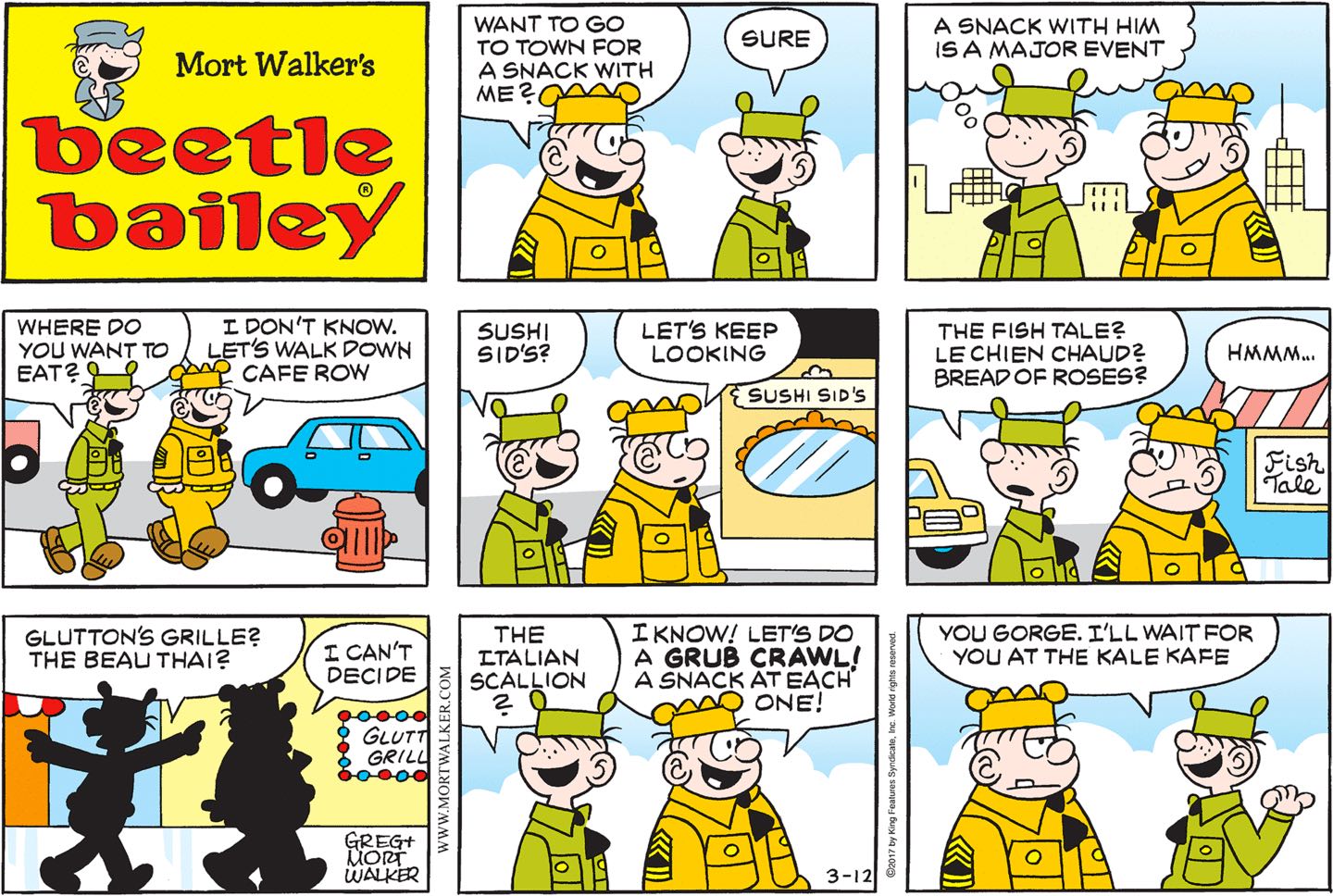
Could such a thing happen to Mort Walker's super-long-lived military farce Beetle Bailey? After all, the strip already underwent a major format change in 1951 when its title character dropped out of college to join the military. Is it time for Beetle himself to step aside and make room for one of his co-stars at center stage? Above you will see a pilot episode for a proposed revamp called Sarge, concerning the adventures of Sgt. 1st Class Orville P. Snorkel, long a second banana and comic foil to Beetle. I think this new version compares quite favorably to the original

Wednesday, March 8, 2017

Ed Wood Wednesdays: The Wood Magazine Orbit, Part Two by Greg Dziawer

A reader prepares to enjoy Tod's First Time from 1972.

Thevis Like Us

When I think of Ed Wood's work for Pendulum Publishing in the 1960s and '70s, I generally think first of the company's many adult-oriented magazines. Eddie penned hundreds, perhaps thousands, of short stories and articles for Pendulum, not to mention endless editorials, pictorial texts, and photo captions. Then I ponder, perhaps too fondly, Pendulum's numerous illustrated "socio-sex" paperbacks, the ones rooted in the work of the fabled sex expert T. K. Peters. While Ed wrote nearly a quarter of these psuedo-educational texts, I suspect he wrote just about all of the photo captions (80 or so per book) across the roughly 50 paperbacks in the two Peters' series.

And there were Pendulum's X-rated films, including not only features like Ed Wood's Necromania but also hundreds if not thousands of 8mm home market loops. Ed wrote subtitles for these short silent films sold through mail order. He wrote the box cover and catalog summaries for them, too, and contributed in as-yet-undiscovered ways to their making. 
A kingpin of the porn biz.

Pendulum's magazines, though, are the constant throughline in the last decade or so of Ed Wood's life. Ed unequivocally wrote across hundreds and hundreds of issues, sometimes using his own name, other times working pseudonymously or anonymously. Eventually, Pendulum Publishing morphed into Calga, then Gallery Press. The company also spawned offshoot imprints like Edusex and Libra Press, in addition to churning out generic "triple-dot" magazines (identifiable because of the tall-tale ellipsis on the cover). The Pendulum empire finally reached its zenith with the multimedia Swedish Erotica franchise, comprised of both pornographic loops and magazines.

The Pendulum story is a long and involving one that we have been chipping away at, one week at a time, in these articles. But we have thus far neglected the genesis of the company. No more. It's a story that starts with a colorful yet infamous businessman named Michael George Thevis, born in 1932 in Raleigh, North Carolina.

A key figure at the dawn of the Golden Age of Porn in the 1960s, Thevis rapidly grew his company, Peachtree Books of Atlanta, into a major distributor of adult magazines and paperbacks. By the end of the decade, he had diversified his enterprise into a multimedia porn conglomerate. Pendulum Publishing, also originally based in Atlanta, grew out of Thevis' Peachtree operation.

Seeking to expand his geographical reach and increase in-house production, Thevis bankrolled a Southern California branch for Pendulum. Placed in charge of that operation was Bernie Bloom, who at that time had been a managing editor for a preeminent West Coast mag distributor and sometimes-publisher called Golden State News Ed was already working for Bernie at GSN, writing both paperbacks (many still not identified) and texts for magazines. Incorporating Pendulum's Los Angeles operation in the spring of 1968, Bernie hired Ed first. Their first products for Pendulum were Ed Wood's illustrated paperbacks Raped in the Grass (1968) and Bye Bye Broadie (1968).

Thevis' Atlanta operation also produced illustrated socio-sex paperbacks that served as templates for the ones Bernie Bloom would later produce in Los Angeles. (It was Bernie's innovation to use T.K. Peters' work as source material.) Meanwhile, the Atlanta publisher also released numerous gay-themed magazines, including the one I'll be discussing this week.

Judging by the handful of magazines I have been able to locate, Pendulum's Atlanta branch had no writing staff to speak of in 1972. These issues typically consist of photos only -- no captions, no editorials, no stories. But Tod's First Time, a one-time only "stroke book" from that same year, is an anomaly in that it includes a freewheeling (read: inebriate) text. Who could have written it? Keep in mind that some of Pendulum's early Los Angeles output still carries the Atlanta address. 

In any event, the text from Tod's First Time is presented below, spelling and other typographical errors intact, for the first time in 45 years. Read it for yourself.

Wednesday, March 1, 2017

Ed Wood Wednesdays, week 65: The 'Glen or Glenda' Transcript

Ed Wood and Dolores Fuller share a tender moment in Glen Or Glenda.

Here's what made this project possible.
Greg Dziawer, that tireless chronicler of all things Ed Wood, is taking a much-deserved week off. So no new "Orbit" or "Odyssey" from him today. He will return next week with more fascinating findings. In the meanwhile, as a poor but ready substitute, I offer a vintage document from my own archives, one that dates back nearly 20 years. Apparently, back in June 1997, I was whiling away the summer days by painstakingly transcribing my VHS copy of Glen Or Glenda from Rhino Home Video. Ah, youth! On the road to ruin! May it ever be so adventurous! 

If I really concentrate, I can even remember exactly how the transcription process went. I recorded the audio from my TV directly onto a boombox with a dual cassette deck. Back then, I had a cassette adapter that could plug directly into the headphone jack on my TV. I took the resulting recording and played it back on my trusty Aiwa Super Bass stereo radio cassette player. (Essentially a Walkman.) The Aiwa did not have a pause button, so I'd play a few seconds, STOP, type what I'd heard, REWIND, play a few more seconds, STOP, etc. Even with a relatively brief movie like Glen or Glenda, this was a slow, arduous task. I was inspired in this madness by a similar transcript of Monty Python and the Holy Grail that had been floating around cyberspace in the early to mid-1990s.

You have to remember, this was in the very primitive days of the internet. Facebook, YouTube, Twitter, Wikipedia, and even Google were still in the future when I started. The Internet Movie Database, Amazon, and Ebay existed but were relatively primitive. Instead, my online life revolved around text-based Usenet newsgroups. There was even one called alt.fan.ed-wood. Like most Usenet groups, it's all spam and garbage now. Twenty years ago, however, it was actually home to a small but fervent community of Ed Wood fans, trading what little information was available to us in that benighted era. And it was there that I first posted the transcript you are now (hopefully) about to read.

I vouch for the accuracy of none of this. The formatting is atrocious and inconsistent. I'm sure this document is riddled with errors of all kinds. But maybe, just maybe, you will find it an interesting keepsake from a bygone epoch of Ed Wood fandom. Since it's based on the Rhino edition of the film, it contains a few scraps of dialogue that do not appear in the current DVD version. This material is denoted in RED type.

Enjoy with my compliments.

Wednesday, February 22, 2017

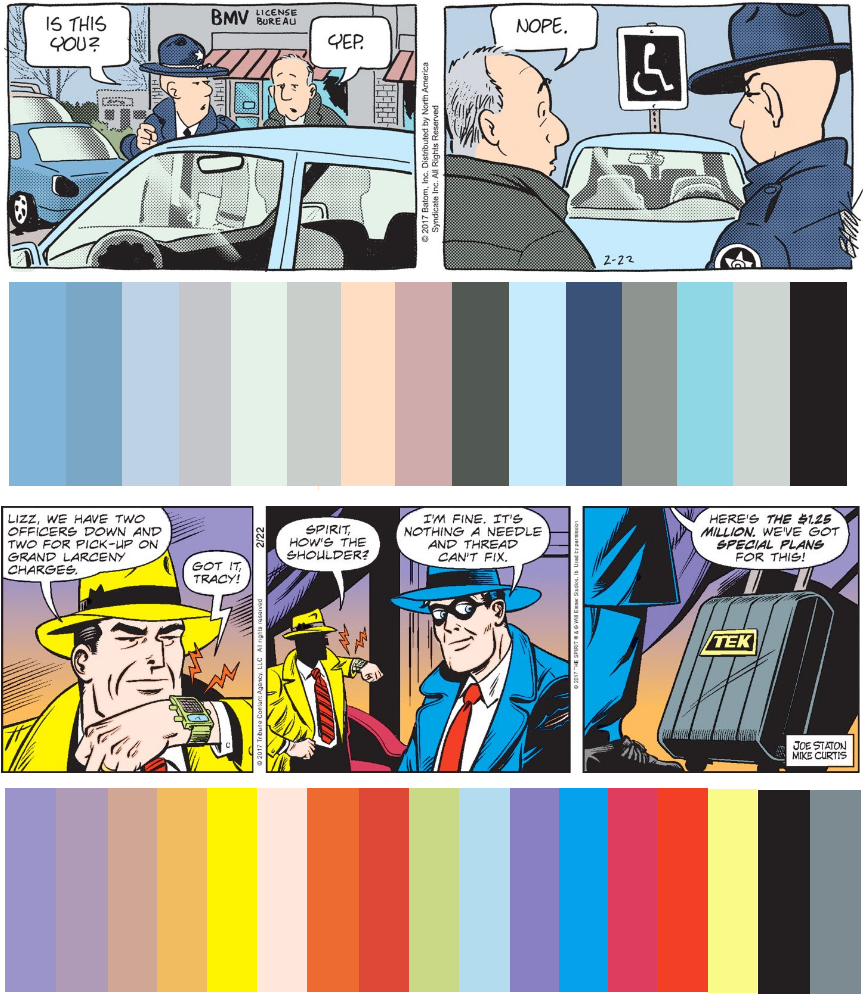
How comic strips use color: A study in contrasts

Color charts for Funky Winkerbean and Dick Tracy.

How comics used to look.
When I was growing up, only the Sunday comics were in color.  The rest of the week, the funnies—like most of the newspaper—were in black-and-white. But times change, and papers eventually started incorporating more and more color images in an ultimately futile effort to keep up with other media. It was a messy transition. In the mid-1980s, John Waters joked that color photographs in the newspaper were so blurry they looked like 3D movies without the benefit of glasses. But, today, even the front page of The New York Times (aka "The Old Gray Lady") is in color.

Meanwhile, print media has been all but entirely usurped by the internet, where color presents no added expenses or technical headaches. And since I now read comics online rather than in print, I've become used to seeing daily strips in color. But there is still a schism between weekdays and weekends. On Sundays, the artists themselves color their own strips. From Monday through Saturday, that chore is farmed out to subordinates hired by the syndicates. Comics blogger Josh Fruhlinger refers to these mysterious workers as "coloring drones."

As one might guess, these drones are hit-and-miss in their duties. Most days, they just go through the motions. Comic strips tend to be very repetitive, using the same characters, settings, and scenarios over and over again. It's not uncommon for the characters in these strips to wear the same outfits every day for decades. It gets to be very routine. But occasionally, a coloring drone will do something that stands out. Normally, this means making some boneheaded mistake, like accidentally giving a character blue skin or something. Or maybe it means that a drone put in some extra effort on a strip, e.g. depicting autumn leaves in various shades of red, gold, and brown.

At the top of this post, you'll see two contrasting strips, both of which ran today: Funky Winkerbean and Dick Tracy. You can see at a glance how wildly different these two strips are. Funky is a serialized comedy-drama about depressed, dilapidated, aging adults. It's supposed to be realistic and relatable. The title character, for instance, has spent the past few days at the Bureau of Motor Vehicles. Notice how drab the colors are: so many shades of blue, gray, and blueish-gray. Dick Tracy, on the other hand, is a highly stylized crime/action strip about a violent, trenchcoat-wearing detective who hasn't changed much since the 1940s. He's currently wrapping up a (ridiculous) case that teamed him up with The Spirit, another throwback crimefighter. The riotous color scheme tells you all you need to know about the over-the-top sensibility of this strip.

Just for further elucidation of this topic, here's a breakdown of today's Garfield. You'll notice that the palette is more limited than either Dick Tracy or Funky Winkerbean. This long-running strip goes for broad, obvious jokes, and that dedication to simplicity extends to its color choices. 


Yeah, Garfield only has about six colors.

Ed Wood Wednesdays: The Wood Poughkeepsie Odyssey, Part Three by Greg Dziawer

In the realm of the census: The 1930 US Census records the details of Ed Wood's life and family.

"S" Is For "Street"
Although October 29, 1929 is historically considered the day of the stock market crash, and a key precipitator of the Great Depression, the US economy had been showing signs of ill health in myriad ways throughout 1929. Ed Wood turned five years old in early October 1929, and six months later, in early April, his residence was hand-recorded by a US census taker, Mrs. Van Etten.

In this week's edition of Ed Wood Wednesdays, we're visiting Ed's home in Poughkeepsie in 1930, a year when this country undertook its fifteenth official census. While the popular record of Ed's life in Poughkeepsie from his birth in 1924 until his enlistment in the military in 1942 locates him at 115 Franklin St, in previous Ed Wood Wednesdays, we've found Ed living at 35 Delano St from at least 1935 to 1940, and at 1 Fountain Place in the early '40s. Did Ed reside at any other residence as a kid growing up in Poughkeepsie? Bet your life on it!

The 1930 US Census Records contain over 2,000 pages for Dutchess County, New York, the vast majority listing residents of Ed's hometown of Poughkeepsie. It took me quite a while—a patient three hours or so scanning through the pages—to finally locate the listing for Ed and his family at the bottom of page 701 in one of the files. Not long before, I had run through the listing of residents at 35 Delano St, where I knew Ed resided as early as 1935. I only found a man and wife there, and knowing it was a multi-unit apartment house, I immediately felt deflated. If Ed was living there in 1930, clearly the census record was incomplete and we'd never know for sure.

Undaunted, I quickly bounced back, and it was only minutes and pages later that I found Ed's family listed at yet another residence: another apartment building at 44 Conklin Street. Conklin, like Delano, is a short L-shaped street on the interior of a larger block, in this case Mansion and Catherine Streets, concentrations of apartment houses and single-family homes on opposite sides of the street. The bottom end of Conklin intersects with the East-West Arterial, which takes you right on and over the Mid-Hudson Bridge a dozen or so blocks to the west. Within a couple of blocks of Conklin, there are three churches today: Baptist, Lutheran and Congregational. The neighborhood was designated entirely "W" for "white" in the records. 

House beautiful?: Some interior shots of 44 Conklin Street.
    
Scanning the Poughkeepsie records, I noted a number of interesting things. Wood was not a common family name, for instance. Gentrification was in full effect. And the "race" column in the records often referred to persons of African-American descent, direly, as "Nig."  
44 Conklin St. as it appears today.
44 Conklin is, like Ed's residences at Franklin and Delano, another multi-unit apartment house. The building hails from 1910, housing an upstairs and downstairs unit. Still standing, the original look of the building is now hidden beneath cheap vinyl siding. With four beds/two baths and six beds/two baths, respectively, the units at 44 Conklin were far more spacious than Ed's other residences in Poughkeepsie.

The 1930 Census Record lists the head of household at 44 Conklin St as Frances J. Phillips, Ed's maternal grandmother. She was living with her daughter Lillian and son-in-law Edward, and their two young sons Ed Jr. and Howard. A year and half younger than Ed, Howard W. Wood went by William, but the 1930 and 1940 Census Records corroborate his real first name as Howard.

In the spring of 1930, at the dawn of the Great Depression, Ed's dad was working as a factory machinist, common male employ. Less commonly, Ed and Howard's mom worked, too. The immediate aftermath of the crash necessitated change and adaptation. Living with the in-laws. Working moms.

Lillian was a department store "saleslady."  Among the ephemeral details in the record, the residence had (commonly) a "radio set." Rent was thirty bucks a month. Ed's grandma is most likely listed as "W" for "widow," but the recorder clearly first wrote "M" for "married" and then smudged it over with a nebulous correction.

And the whole Phillips' line of Ed's family was born in New York, at least as far back as Ed's matriarchal great-grandparents. The roots of the Wood family lie deep, in Poughkeepsie and beyond. 
We'll go there, and travel back a millennium to Scotland, dissecting the Wood family coat-of-arms, right here in future Ed Wood Wednesdays.

Before we depart, a few bonus items:
  • Additional maps of Conklin Street in Poughkeepsie

Thursday, February 16, 2017

We all feel a little like Ronan, The Accuser sometimes

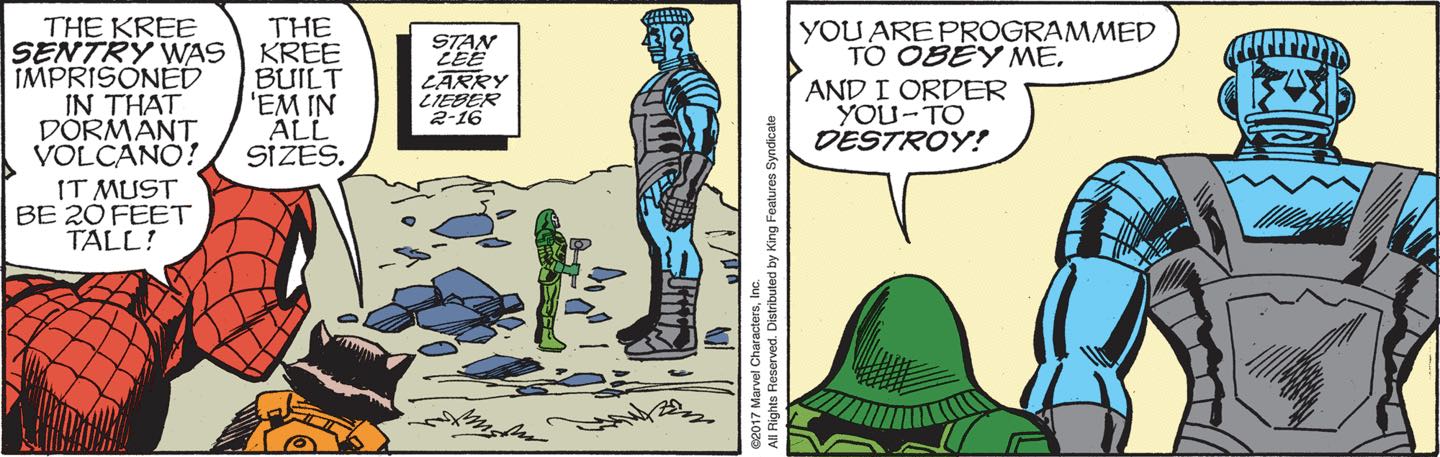
Try to imagine Ronan, The Accuser talking like Charlie Brown.

In his newspaper incarnation, Spider-Man has been doing battle with an intergalactic baddie named Ronan, The Accuser lately. It's a dumb Guardians of the Galaxy crossover. Don't worry about it. Anyway, in Thursday's installment, Ronan called on the services of a giant automaton called a Kree Sentry. Presumably, said Sentry will start wailing on Spidey tomorrow, but I thought it would be funny-ish if the big guy didn't obey. I mean, why should he? I went to some trouble to make Ronan hang his head in defeat, but it barely reads at this size.

As long as I have you here, this is another recent comics parody of mine. I made Hi & Lois and Mary Worth swap dialogue. I think both strips are improved.

See, it's funny because the dad in the first one is abandoning his family.

And no one specifically asked for a super depressing Beetle Bailey remix, but here's one anyway.

Gen. Halftrack has seen some stuff, man. He has seen some stuff.

Wednesday, February 15, 2017

Ed Wood Wednesdays: The Wood Winter Odyssey by Greg Dziawer

Ed Wood lived through 54 winters, most of them in California.

The Black Diamond railroad bridge
I was born and raised and still reside after 48 years in northeastern Pennsylvania, currently living in the town of Wilkes-Barre. Wilkes-Barre, like the smaller towns all throughout this area, was once a booming coal town. Remnants of that era survive, including the Black Diamond, still a railroad bridge, visible from my office window as I type this, on the second floor of my house right along the Susquehanna River. In the 19th century, Wilkes-Barre was also a center of the textile industry. These days, just like Ed Wood's hometown of Poughkeepsie, New York, the industries have faded and economic blight is sadly prevalent. And just like Poughkeepsie, by mid-February, it's cold and wintry.

As I've gotten older, I've noted that by the latter part of winter, folks collectively seem beaten down. Getting short with each other. Aloof and preoccupied. It's a genuine affliction called Seasonal Affective Disorder, fittingly SAD for short. The Mayo Clinic describes it as "a type of depression that's related to changes in seasons — SAD begins and ends at about the same times every year. If you're like most people with SAD, your symptoms start in the fall and continue into the winter months, sapping your energy and making you feel moody."

By this time of year, I find myself itching for spring and sunlight, knowing that the stubborn cold will not fully release its grip for another month or so and that more snow is on the way. In fact, my recollections of the biggest nor'easter snowstorms experienced in my lifetime date them to the month of March. A few last kicks while we are down. But the sun came out this afternoon, brighter than I'd seen it in months, a welcome sign of things to come.
 
Worthwhile research.
While I personally don't feel so much affected by the weather this time of year, I do find the interpersonal dynamics of the day-to-day a bummer. A work day in mid-February surrounded by my miserable friends and associates is a veritable Circle of Hell. And it certainly takes its toll. I may not exactly be wracked with self-doubt and torpor, but tonight I do find myself wondering if I am adding anything worthwhile to the realm of Woodology and realizing that my focus is fuzzy and research scattered. 

It's emotion that spurs on these thoughts. Rationally, I know that I've made a dent into understanding the Wood Loop Orbit through the Winter, a vast and uncharted terrain that lies promisingly just ahead. As I read more articles from the Swedish Erotica film review mags of the latter half of the 1970s, I am increasingly confident in recognizing uncredited work by Ed's hand, as well as the distinct signatures of his style in the winter of his years. I could go on and on. I know that my personal odyssey continues to amaze, fascinate and obsess me in surprising ways. 

Ed left Poughkeepsie in 1942, nearly for good, when he and his buddy George Keseg dropped out of the 11th grade at Poughkeepsie High School and enlisted at age 17 in the Marines. Ed's family moved a few times and he lived in at least three residences in Poughkeepsie growing up, all close to the Mid-Hudson bridge, on the river's east side. Although he returned home for a brief stint after the war, he soon left the winter doldrums behind once and for all, ultimately landing in Hollywood.

We'll continue to follow him in his travels and travails, soaking up that southern California sunlight whenever we can, right here in future Ed Wood Wednesdays.