Wednesday, February 7, 2018

Ed Wood Wednesdays: The Wood Collaborator Odyssey, Part Eight by Greg Dziawer

Paula shows off some Victor Most-designed duds in The Violent Years (1956)

"I felt myself a victim rather than a victor in the realm of pictures."
-Gloria Swanson
I.

Victor's onscreen credit in The Violent Years.
A few weeks ago, I popped in the new Blu-ray release of the Ed Wood-scripted crime thriller The Violent Years (1956, dir. William Morgan) from the American Genre Film Archive and Something Weird Video for the first time. We'll review that disc here in the near future, but first, indulge me a tangent.

The surprisingly profitable film, written when Eddie was at the peak of his creative powers, concerns the descent of flippant, spoiled Paula Parkins (Playboy Playmate Jean Moor(e)head) and three of her female classmates (Theresa Hancock, Joanne Cangi, and Gloria Farr) into juvenile delinquency. It's meant as a stern cautionary tale for those in the audience, since the wrongdoers come from a "respectable" suburban upbringing. And yet, The Violent Years lends its wayward, amoral characters a definite sense of glamour and excitement.

Watching the ill-fated "teenage" girl gang in their clingy sweaters, calf-length skirts, and shiny leather jackets, exploding from the screen in pristine HD, my 14-year-old daughter Elyse remarked, "Wow! They're all sooo pretty!"

Indeed they are. And they possess some really tremendous outfits. That thought led me to wonder about the film's intriguing wardrobe credit: Victor Most of California. Who was this man who'd supplied these fabulous clothes? What was his story? I decided to find out. Again, census records and old newspapers tell much of the tale.

II.

Details from the 1940 census.
Before he was Victor Most, he was Victor Mostowy, born in New York City on August 17, 1918, to Morris and Fannie Mostowy, two immigrants who'd only gotten here from Russia earlier that decade. Victor's sister Millie was three and a half years older. When Morris filled out his draft registration card in 1917, he listed a Cleveland address and his employ as bricklayer. By 1920, the family, still carrying the name Mostowy, was recorded living on East 110th Street in Manhattan in the US Federal Census. 

Flash forward two decades: Victor, now 21, is still living with his father Morris, but they've relocated to San Jose, CA. The family surname is recorded as Most in the 1940 Census. By this time, Morris is on his second wife: Aida, also of Russian descent. In the process, Victor has picked up a couple of siblings: a 17-year-old stepbrother named Leonard and a baby half-sister named Zondra, only a year old.

So over the course of 20 years, a New Yorker named Victor Mostowy became a Californian named Victor Most. What could be more American than moving 3,000 miles to the west with a de-ethnicized surname? That's American history in a nutshell.

III.

A Most garment from the '60s.
Victor Most's eventual entrée into the fashion world came during a prosperous and exciting time for that industry. 

As noted in the mammoth, four-volume work Clothing and Fashion: American Fashion from Head to Toe (2015; coauthored by José F Blanco, Patricia Kay Hunt-Hurst, Heather Vaughan Lee, and Mary Doering): "Greater prosperity after the Great Depression meant that consumers could spend more on clothing, entertainment, and recreation. The increase in consumption also allowed department stores to prosper." The authors note that many of these new shoppers were women. Teens, too, were now employed and had money to spend on clothes.

And Victor was living in one of America's fashion hubs. "Southern California was considered the Riviera of the United States," the authors further declare, "and designers and manufacturers sprouted up in California during the early 1940s." These designers created what was dubbed the "California Look," a style that found favor with the movie industry because it "exuded youth, celebrity and leisure and pioneered a movement toward more casual fashions."

By 1944, Victor was living on Beverly Blvd. in Los Angeles and working as a salesman. He married in 1951, and by 1953 he was living in Hollywood. His address then was 919 Screenland Drive in Burbank, a block or so off Magnolia, in a four-room/four-bath house newly built in 1951. At just over 2,000 feet of living space, the modest digs occupy pricey terrain today, the house valued at three-quarters of a million bucks. 

The following year, Victor moved to 1927 N. Bronson St (now a retail storefront) in Los Angeles, just a few blocks from Hollywood Blvd. He registered to vote as a Democrat. Within a few years, he had landed the only film credit of his that I can locate: dressing Paula Parkins, et al. in The Violent Years.

IV. 

A Long Beach newspaper ad from 1963.
Though his film resume is scant, Victor Most would remain, right through the 1960s, an everyday name brand in casual mainstream retail fashion, his affordable "California Look" obtaining on the shelves and racks at strip mall storefronts and in suburban malls.

While garments carrying his label still turn up (very sporadically) across the vintage fashion market niche, Victor Most's lasting legacy will certainly be those costumes in The Violent Years, defining of their era and burned into the brains of those privileged to have seen it.

He passed on November 24, 1984, in Woodland Hills, CA, a short drive west of the Hollywood sign. Like Ed Wood, he had toiled mightily in its long shadow.

We'll probably never know, but could Ed have ever worn a piece by Victor Most?

Note: Additional images for this week's article have been posted to the Ed Wood Wednesdays Tumblr. You can check out some of Victor Most's costumes for The Violent Years right here. And you can peruse some ads and labels from Victor's fashion career right here. Enjoy.

Wednesday, January 31, 2018

Ed Wood Wednesdays: The Plan 9 Odyssey, Part 2 by Greg Dziawer

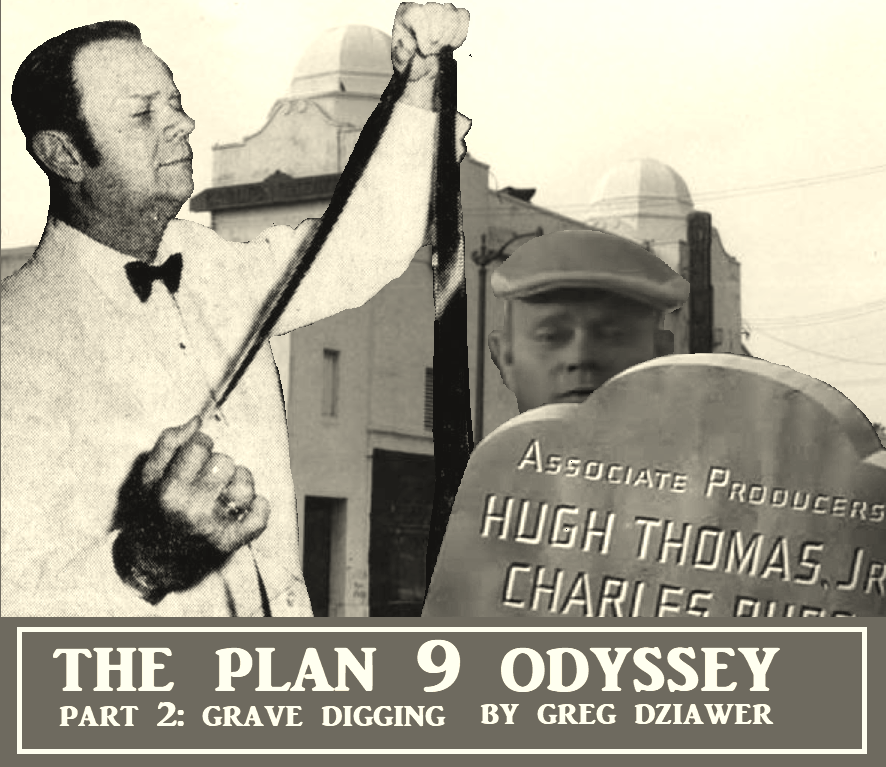
Plan 9 producer/gravedigger Hugh Thomas; (background) the Carlton Theatre.

It's time once again to delve into the hidden history of Edward D. Wood, Jr.'s most well-known film, the one that serves as the cornerstone of his cult stardom: the unique sci-fi/horror hodgepodge known as Plan 9 from Outer Space. Some might assume that everything worth saying about this patched-together 1957 film has already been said, especially since Plan 9 has inspired a documentary of its own (1992's Flying Saucers Over Hollywood) as well as countless articles and essays. The making of Plan 9 was also memorably dramatized in Tim Burton's fanciful biopic Ed Wood (1994). But even after all that, my research continues to turn up interesting little gems about this misunderstood classic.

In our first Plan 9 Odyssey, for instance, I shared a 1959 ad for the film that contained a statement from one of the film's associate producers, Hugh Thomas, Jr.

Well, it turns out that ad was for a showing at the Siesta Drive-In in Sarasota, Florida in 1959, and as this September 16, 1970 newspaper article indicates, Hugh Thomas himself had designed and fully engineered the Siesta years prior. 


In addition to the background information about the Siesta, this article brings to light many startling things. To wit:

1. Although it's often presumed that Hugh Thomas was a member of the Southern Baptist Convention of Beverly Hills, he makes no mention of it here. That particular religious institution looms large in the Plan 9 myth, as all Wood fans know. Thomas is said to have been a member in the 1950s, along with his Plan 9 producer and costar J. Edward Reynolds, who passed in early 1959 and was thus robbed of the gratification of what the film would become. Plan 9 associate producer Charles Burg was also alleged to have been part of this congregation. Interestingly, in this article, Thomas firmly places himself in roles working in and around managing movie theaters for his entire career. 
2. Given Thomas' pioneering and jubilant celebration of Plan 9 for its "bad" qualities in his statement in the ad in 1959, his estimation here over a decade later that the film was a "success" is either ballyhoo or bespeaks its financial ROI. The latter, never calculated to my knowledge, must be estimable, given the film's ubiquity in drive-ins and then TV syndication for more than two decades, only to rise again and remain so since as prototypical cult object. That said, it's apparent that Thomas was no more a financial benefactor of that "success" than Ed was. 
3. The Peacemaker (1956) appears to have been the only film into which the Southern Baptist Convention successfully trojan-horsed its religious views. Although he is not credited, and the IMDb claims the crew to be complete, Thomas mentions himself as producer both here and in the 1959 ad. In this article, he says that he co- produced it with Hal R. Makelim, the credited producer. And here, he claims that Plan 9 was another co-production by the pair. I can find no evidence of Makelim ever being involved in Plan 9 from Outer Space.  
4. Hal R. Makelim was, like Ed, another would-be entrepreneur trying to catch a big break in Hollywood. Beyond The Peacemaker, his scant credits include the forgotten programmer Man of Conflict from 1953—also his sole directorial credit—starring John Agar. Makelim served as Agar's manager at the time. Agar never appeared in a Wood film, though he likewise still gets his fair share of "worst actor" attributions owing to the bargain-basement run of schlock he indiscriminately appeared in throughout the '50s. By the early '70s, if not considerably earlier, Agar and Ed had become drinking buddies.  
5. Agar and Thomas were, like Eddie the Marine, WWII vets, John in the Navy and Hugh in the Army. This correspondence demonstrates, in the proverbial bigger picture, just how commonly that conflict was a doubtless crucial part of the lives of so many people, remaining so today. 
6. After his "failed" partnership with Makelim, Hugh Thomas bought the 1,200-seat Carlton Theatre in Los Angeles. If that name rings a bell, it was the venue for the world premiere of (then-titled) Grave Robbers from Outer Space, on Friday, March 15, 1957, then (per this article) under Thomas' ownership. A survey card from the premiere sold on Ebay for almost $1300 a little less than a year ago.  
7. The Carlton occupied 5411 South Western in Los Angeles from the '20s through its closure in 1959. The building was demolished by the early '70s, making way for a McDonald's. 

Besides serving as producers and financiers on Plan 9, Hugh Thomas and J. Edward Reynolds are best known and loved by Wood fans today for their memorable roles as the film's ill-fated gravediggers. These two bumblers die an offscreen death, dispatched violently by Vampira, but not before delivering this characteristically Woodian exchange:

Hugh (the tall and younger gentleman on the left): You hear anything? 
J. Edward: Thought I did. 
Hugh: Don't like hearing noises, especially when there ain't supposed to be any. 
J. Edward: Yeah, kinda spooky-like. 
Hugh: Maybe we're getting old. 
J. Edward: Well, whatever it is, it's gone now. 
Hugh: That's the best thing for us, too, gone. 
J. Edward: Yeah, let's go.

Incidentally, as the historical record indicates, these guys are not the narrow-minded, uptight autocrats as depicted in Tim Burton's Ed Wood. They are clearly regular joes, magically appearing in a soon-to-be and unbeknownst-to-them exalted circumstance.

Wednesday, January 24, 2018

Take away the characters, and 'Family Circus' becomes a haunting series of still-life images (UPDATED)

Disused Jungle Gym (2016)

Where have they gone, the lovable, melon-headed characters who normally populate The Family Circus? Where are rambunctious Billy, inquisitive Dolly, sensitive Jeffy, and dear, sweet, hopeless PJ? For that matter, where are their parents: long-suffering Thel and checked-out Bill? All of them seem to have mysteriously vanished. Were they raptured into Heaven to be with their dear departed Grandfather? It's unknown, but the world they inhabited -- at least the buildings, furniture, and other non-living objects -- seem to be just fine. Perfectly intact. It's a puzzler, this one. But aren't these images eerily beautiful?

The Lonely Ottoman (2016)
The Rack (2016)
Couch on the Edge of Oblivion (2016)

UPDATE: Just in case you followed a link from somewhere else to get here, I thought I'd add a couple more of these that I've done over the years. As always, enjoy.

Stille Nacht (2018)

Confusing Doors (2017)

Thursday, January 11, 2018

Ed Wood Extra: To those we lost in 2017

Rance Howard, Martin Landau, Conrad Brooks, David Ward, and Steve Apostolof.

Before we get too far into 2018, I thought it only proper that we should acknowledge a few of those who died in 2017, specifically those whose lives intersected in some way with that of Ed Wood. Sadly, the number of people who knew Eddie or who worked with him directly is getting smaller and smaller each year. And even Tim Burton's Ed Wood is now 24 years old, if you can believe it, and a number of cast and crew members from that biopic have since died. In brief, 2017 took a hell of a toll on the Ed Wood community. It was nice, I suppose, to have some new books and BluRay releases, but they're a poor substitute for these extraordinary people.

Let's deal with the Burton film first. Two of the principal cast members of Ed Wood passed away in 2017. The one who got the lion's share of the headlines, naturally, was Martin Landau, who died at the advanced age of 89 on July 15 of last year. A native New Yorker whose career in film and television spanned an astonishing 64 years, Landau finally won an Oscar in 1995 for his portrayal of a cranky, crumbling Bela Lugosi, turning to Ed Wood for employment and companionship in his final years. Aided by Rick Baker's award-winning makeup, Landau managed to bring new insight and vulnerability to the much-imitated and caricatured Lugosi. Whenever I see Bela in a movie -- whether it's one of Wood's movies or not -- I think of Landau.

Departing our realm, too, was character actor Rance Howard, who played straight-shooting moneyman Donald McCoy in Ed Wood. (He wants Eddie's movie to end with a "sky full of smoke" and gazes up dreamily as he imagines the glorious destruction.) Father of Clint and Ron Howard, Rance was one of the most familiar faces in Hollywood, appearing in nearly 300 movies and television shows starting in the mid-1950s. He had an honest face and a slight Oklahoma drawl that served him well in dozens upon dozens of roles. Rance worked so often and with so many people, in fact, he comes much closer than Kevin Bacon to being the center of the Hollywood universe. Rance Howard died on November 25, 2017. He, too, was 89.

Perhaps the most significant Wood-related death of 2017 was of actor turned filmmaker Conrad "Connie" Brooks, who died just last month at the age of 86. An irreplaceable link to the past, Brooks was truly the last surviving member of Eddie's inner circle, having appeared in Glen or Glenda, Plan 9 from Outer Space, Bride of the Monster, The Sinister Urge, and Jail Bait. Since Eddie's personal and professional lives were so intricately intertwined, Conrad Brooks can safely be called one of Ed's cronies. Who knows how many more movies they would have made together if there were but world enough and time, not to mention cash? A staple of documentaries about Wood, always popping up to talk about his departed pal, Brooks was a B-movie lifer. Even without Eddie, the incorrigible, garrulous Connie appeared in dozens of low-budget flicks (as well as Burton's Ed Wood) and eventually wrote and directed a few of his own.

Attention should also be paid to the passing of stage and screen actor David Ward, who died in August at the age of 84. He'd been a resident of a Los Angeles nursing home for years, and Ed Wood superfan Bob Blackburn stayed in contact with him and visited him frequently until the end of his life. Ward was another of Wood's Hollywood cronies, especially during Eddie's boozy final years in the 1970s, though the two didn't really work on many movies together. Ward was also a personal friend of Bulgarian-born filmmaker Stephen C. Apostolof and made cameos in at least two of Apostolof's movies, The Cocktail Hostesses and Drop Out Wife, both scripted by Eddie. And Ed had other plans for David, including an adaptation of his short story "To Kill a Saturday Night," that never came to pass. The David Ward saga is an incredible one, inspiring the unproduced screenplay Edward Ford, which I thoroughly discussed here.

Speaking of Apostolof, the late filmmaker's oldest son Steve Apostolof died unexpectedly after a brief illness in Simi Valley, CA at the age of 60 on November 19, 2017. Like all of Apostolof's children, Steve made numerous visits to his father's sets and even made an onscreen appearance in 1978's Hot Ice, canonically the last film Ed Wood ever worked on. (Eddie was credited as an assistant director and was slated to make a cameo but was too drunk to do so.) In addition, Steve was one of the interviewees in Jordan Todorov's documentary Dad Made Dirty Movies. He took great amusement in his father's colorful career and helped keep the Wood-Apostolof legend alive by sharing his stories of those bygone days of the 1960s and '70s.

Rest in peace, one and all.

Wednesday, January 10, 2018

Ed Wood Wednesdays: The Wood Collaborator Odyssey, Part Seven

She was only in one Ed Wood feature, but Valda Hansen casts a long shadow. Art by Drew Friedman.

Among the circle of fascinating personalities appearing prominently in Ed Wood's first half-dozen films—the work for which he is best and "worst" remembered—Valda Hansen (1932-1993) stands out as a fixture of the group despite making only one relatively brief appearance. As The White Ghost in Night of the Ghouls, moll to the scheming Dr. Acula (Kenne Duncan), she projects a delicate beauty and ethereal presence. That film also featured another key player in the Wood repertory company, Criswell, in one of his most memorable roles. In my research, I've discovered a fascinating old newspaper clipping that involves both Criswell and Ms. Hansen, and I'd like to share it with you this week.

The Long Beach Independent and Independent Press Telegram were Criswell's first homes as a regular newspaper columnist in 1949, as he laid the foundation for his persona. These papers covered him often, and it's not hard to imagine that his pull was largely responsible for a full page feature in the Telegram from December 7, 1958, featuring Valda and coverage of the "recently-released" (?) Night of the Ghouls ("...which carried her up to stardom"?). While there are no mentions of writer-director Ed Wood, there are priceless details about Valda that have gone unrecorded elsewhere. And then there's that photo of Cris as "Dead Man." (!) Enjoy.


We'll return to Valda Hansen, and to Night of the Ghouls, among a host of topics all related to Ed Wood, this coming year here at Ed Wood Wednesdays!
NOTE: The original layout for this vintage article can be seen here at the Ed Wood Wednesdays Tumblr.

Wednesday, December 20, 2017

Ed Wood Wednesdays: The Woodologist Odyssey, Part One by Greg Dziawer

Author James Pontolillo has been delving into Ed Wood's war record.

The work of a true Woodologist.
As we approach a new year, it seems as good an opportunity as any to introduce a new Odyssey. In the 2+ years that I have been writing articles here, my research has led me to cross paths with a number of folks who, like me, are more than just casual fans of Edward D. Wood, Jr. The most seriously afflicted of these people can even be affectionately termed Woodologists.

Just what does being a Woodologist entail? To my mind, it means possessing not only (1) an abiding interest in Ed, the man and his work, but moreso (2) a desire to learn more about Ed than we previously knew. Most critically, a Woodologist will (3) endeavor to take action upon that desire to learn more. People like Rudolph Grey, author of Nightmare of Ecstasy, and Joe Blevins, who started this very series way back in July 2013, are just a few folks you will surely recognize as Woodologists. I aspire to be one some day, and as I continue being privileged enough to meet many of them, I decided to introduce them here to the world as such.

First up, I am happy to introduce my friend, author and researcher James "Jimbo" Pontolillo, who has graciously agreed to be my first willing subject.

Before getting into James' answers to my 10 questions, however I must issue a spoiler alert for those who have yet to read Pontolillo's book The Unknown War Of Edward D. Wood, Jr.: 1942-1946. While the following interview is short on details, the overarching direction of the work can be clearly inferred from James' answers nevertheless. Stop now and return here later if you plan to read it. I suggest you go over to Amazon and get yourself a copy. Containing Ed's full military record and a superb editorial apparatus throughout by Pontolillo, this is and will doubtless remain the foundational work regarding Ed's years in the military during WWII. For more on the book, you can read an overview here

10 Questions With James Pontolillo
The author as a young man.
1. Have you ever worn an angora sweater? 
No, I have not. Although I did briefly entertain the idea of writing my Ed Wood book while wearing an angora sweater. I went onto Ebay, and the variety of angora sweaters available was so overwhelming that I quickly dropped the idea. Probably for the best; sweaters don’t do much for my figure nowadays. Cross dressing is a slim, young guy’s game. I would just look like a scary extra from the movie Wigstock.

2. You expressed to me, before the publication of the book—and addressed your initial worries in the book itself—that sharing documentary proof of Ed's wartime activity might piss people off. Have you received any angry missives since publication?
 
Not yet. The Ed Wood community has been incredibly supportive so far. At worst, some people have said they are somewhat saddened by my deflation of the Ed Wood combat legend. But there is still plenty of time for angry responses. After all, my book has yet to crack the New York Times bestseller list. LOL. 
3. Why Ed Wood? 
I’ve always had an interest in idiosyncratic visionaries and extremists—people who chart a course way outside of the mainstream. You have to be someone special to decide to run far off the rails in a new, unusual, and interesting way. Eddie was nothing if not an idiosyncratic visionary. I first saw Plan 9 when I was a kid and knew nothing about Eddie. Years later, I discovered him through the Medved Brothers' Golden Turkey Awards book, and the rest is history. 
4. The book contains Ed's entire military record, from mundane to starling and new. What startled you most? 
Well, what was most startling was the night and day contrast between what he did during the war and what he claimed to have done during the war. The contrast could not be much starker. While I was expecting some of the received legend to be BS, I was not expecting it to be virtually complete BS. But when you look at his wartime story as a whole, it is understandable why he manufactured the legend that he did. 
5. If there is one mystery about Ed or his work that you would love to solve, what is it? 
Well, there is a certain scene that recurs in many of Ed’s short stories and novels. You know what I’m talking about—a very unusual type of reveal that occurs to the sound of a camera shutter going off. It is such a constant element of his work that I’m convinced it must be based on a personal experience. I’d really like to know the true story behind that scene. God, I hope that it’s not another one of his fanciful inventions.
6. You've also interrogated Ed's paperbacks with a combination of incredibly knowing discernment and predictive analytics, effectively answering questions about Ed's authorship. Beyond what he wrote, did you garner any insight into who he was? 
I read Eddie largely for sheer enjoyment without giving too much thought to what the text may be telling me about him. This is true for other authors that I am stuck on like Philip K. Dick, H.P. Lovecraft, etc. When I read, I place myself inside the work. I don’t stand outside and try to examine it. 
7. How much wood could a woodchuck chuck if a woodchuck could chuck wood? 
You think I was born yesterday? I see what you are trying to do here. This is the low IQ version of the famous Zen koan, “What is the sound of one hand clapping?" You are not going to lead me into a Rorschach dead end that easily. Let’s see how this grates your carrot. Let’s talk Ed Wood gematria. Coincidence or not, by full reduction gematria "Edward D. Wood Jr." equals: 
Dantes Inferno
Symbolic logic
Gender neutral
Screw magazine
Alien invasion
Drunk driver
Ruby slippers
 
8. What's next on your personal Woodology horizon? 
I have been collaborating with a renowned Woodologist on a revised and expanded reissue of David Hayes’ classic Muddled Mind. Not sure when that will come out, though. Other than that, I have no other Eddie projects going on. I’m actually in the midst of a writing break at the present time. After publishing four books in as many years, I am overdue for an extended research and writing break.  
9. You self-published The Unknown War on Amazon, among numerous other scholarly publications. Based upon those experiences, Universal Access or Penetration? 
When online print-on-demand publishers (Amazon, Lulu) tell you that their distribution network will increase your sales, don’t believe it. From a sales perspective, there is usually no substitute for releasing your book through established channels. The real advantage of POD is being your own boss and editor. For better or worse, you get to publish exactly what you want irrespective of commercial viability. However, if you manage to hit a popular vein and sell in any quantity, like the short-lived dino-porn fad on Amazon, the POD publishers pay much better royalties than traditional publishers. I haven’t answered the question yet, have I? Let’s go with Penetration. 
Belinda in cold cream.
10. Glen or Glenda? 
Definitely Glenda. After all, women’s clothes are designed for their comfort. Hats that give no obstruction to the blood flow, hats that do not crush the hair. Interesting thought, isn't it? Hell, back in the day I went to a Halloween party as Belinda Carlisle off the cover of the first Go-Go’s album. You know, wrapped in a bath towel with cold cream on my face. As far as I know, pictures (thankfully) do not exist! 

Special thanks to author James Pontolillo, for subjecting himself to our first 10 Questions. Check out more of his diverse and challenging work here.  I can definitely relate to his last answer. For Halloween 2005, two friends and I attended a party as the group TLC. I was T-Boz. When I was a much younger man, I briefly entertained a crush on Belinda Carlisle, during the savage and tumultuous throes of puberty.

Apart from those correspondences, my friend Jimbo and I initially connected via our shared love of Ed nearly two years ago. As we began talking, I mentioned that I was working on revising David Hayes' invaluable index, Muddled Mind: The Complete Works of Edward D. Wood, Jr. Thanks both to the internet and the increasing number of serious (and seriously obsessive) Ed Wood fans, knowledge about Ed's life and work have continued to expand four decades after his passing. David graciously invited me to update his index to reflect this newfound information.

While that revision continues to challenge me, Jimbo and I began talking about his interest in using text analysis to solve the problem of identifying exactly which books were written by Ed Wood. After a burst of amazingly creative and scientifically rigorous work, Jimbo—I initially called him the "Mad Scientist"—quickly submitted to me a series of such reports to supplement the index I was compiling. Now is not the time to get into his full methodology. Suffice it to say, Jimbo utilized four software text analysis tools as well as his own ridiculously big brain in the process. He deployed a battery of predictive analytics to Ed's known and suspected work, solving outstanding questions of authorship. This has helped me avoid mis-Ed-tributions while also making new discoveries.

James Pontolillo has been charting Ed Wood's work.

Additionally, he and I have dug deep into researching Ed's early years in Poughkeepsie, and it was Jimbo who first noted to me the common narrative element he mentions in his answer to Question #5. He and I have privately referred to this Wood-ian trope as "the boner in the face." If you've read your fair share of Ed's short stories and paperbacks, you know what we're talking about.

Although he says he is not currently and actively working on anything regarding Ed, I advise readers to stay tuned. A certain self-styled foreseer, a friend and associate of Ed's who more primitively employed predictive analytics of his own, might just be on Jimbo's periphery.

Tuesday, December 12, 2017

This is just a bunch of comics parodies and remixes, okay?

This book never existed, but don't you kind of remember it in bookstores anyway?

Look, I'll level with you. I was going through the images saved to my hard drive, deciding which ones to chuck, and I found some  comics parodies that I hadn't posted here yet. So I wanted to collect them in one big post before deleting them from my computer forever. That's what this post is. There's nothing else to this, so don't expect any incisive commentary.

Wednesday, December 6, 2017

Ed Wood Wednesdays: The Wood Loop Orbit, Part Twelve by Greg Dziawer

Skulls and shackles figure into this week's article. Enjoy!

As supernaturalism of a wide variety crops up regularly in Ed Wood's films and writings, it stands to reason that it would also appear in the 8mm silent porn loops produced and distributed by Noel Bloom. Particularly if it were a loop with strong ties to Ed in other ways. This week, we submit a specimen for your consideration, certainly within the orbit of Ed's work, and suggesting his possible involvement.

When I first viewed the loop Sex & Magic, a number of things immediately jumped out at me, literally from all sides. The loop commences with the title spelled out in small plastic letters on an undersized pegboard. This is immediately recognizable as the same board used in just about every other Cinema Classics loop I've ever seen. Sometimes, as in this film, the board is filmed as part of a larger scene. At other times, shot in close-up, it is authoritative, the titles looking like an industrial grid of some sort, belying the nickel and dime nature of the actual prop.

This week's loop is quite a find.

The title board sits atop a table, a white skull to its right and shackles in front of it, hanging over the front edge of the table. The title and props quickly conspire to create intrigue. The skull, naturally, is the very same one that appears in Necromania and dozens of other Bloom-family loops. This identifies the set as Hal Guthu's studio on Santa Monica Blvd, where interior sets for Necromania were shot. The shackles, no doubt, were a prop easily found lying around. My friend Jack Descent had been at Guthu's studio at the time, and recalls that he had two soundstages on the ground floor of the facility, and two dungeon sets on the basement floor.

The altar, featuring two skulls, an inverted cross, and shackles.

The film opens with a medium shot: the same table, skull and shackles now joined by a second white skull and an inverted wooden cross. The cross, spray-painted a different color, also appears in Necromania. A blonde woman in a black leather dress enters from the right, a book in her hand. In close-up, as she leafs through the book, we see captioned hardcore photos on the right-hand facing pages and text on the left-hand pages, the images showing all variety of sex. I knew right away that this was a Pendulum/Calga illustrated sociosex paperback. As she places the book on the makeshift altar, we can briefly see that it is part of Calga's Everything You Wanted to See and Read series of six paperbacks, part of the larger Sexual Enlightenment Series credited to T.K. Peters. 

The second book in the series.
The first three entries in this series carried the title Everything You Wanted to See and Read About Love and Sex. That name is briefly visible here on the cover. I have Book Three, which has a red cover, but the one in this loop appears yellow. Book One and Book Two in the series I have not seen, but images of Book Two have an orange cover. Book One, unfortunately, I can find no trace of, save its copyright listing. Although the more appropriate pick at this altar may have been A Study in Sexual Practices and Black Magic, as we'll see, any T.K. Peters book will do the trick! 

In any event, the volume seen in Sex & Magic is either Everything You Wanted to See and Read About Love And Sex, Book One, or the film print I viewed is faded enough to distort the color and it's really Book Two. For the record, those paperbacks were penned by, respectively, William D. "Bill" Jones and Robin Eagle, who commonly used the pseudonym "Robert Elgin." Both books were filed for copyright on the same day: October 7, 1970. At that time, in addition to Jones and Eagle, the Pendulum magazine writing staff, who wrote these paperbacks for bonuses, also consisted of Leo Eaton and Ed Wood. Although Ed Wood did not write the Love and Sex book that appears here, he likely penned the photo captions in it. These captions remain consistent throughout two lengthy T.K. Peters series of illustrated sociosex paperbacks and contain enough stylistic signatures to surmise that Wood was their author.

But back to the film. After placing the book on the altar, the woman gets on her knees and bows and prays in front of it. The actress (as identified by an eagle-eyed viewer in a private forum) is Lynn Holmes, whose smattering of known credits includes the 1971 feature The Undergraduate, produced by Jack Descent from a script by Ed Wood. Holmes picks up the shackles and one skull and takes them into a bedroom with deep pink and fuzzy blankets not only on the bed, but even up the wall behind the bed where the headboard would normally be. Simply and cheaply, the set succeeds in creating an otherworldly atmosphere. She places the shackles and skull on the bed and steps back to conjure. As she does, her hand movements Lugosi-like, we cut to a close-up of the skull. It disappears, and in its place, a naked man appears, one hand shackled and chained to another shackle around his neck. While a simple effect, it works, again the sort of economy of means Ed was accustomed to employing.

Lynn Holmes in action: (a) Casting her spell; (b) Drinking from a wine glass.

She removes the shackles, and you can guess what happens next. After this carefully crafted build-up—relatively speaking, and largely superfluous given the intended audience—the two have sex in the usual manner, nothing very magical about it. 

Judging by the spartan sets and functional camerawork, this is certainly one of the Blooms' first-phase loops. And, as with many of these very early films, the female lead is given to overacting. The male is a near-total cipher, also purely functional. The actress' black leather boots remain on throughout. We are almost six minutes in before actual intercourse begins. We get little more than a minute, and just one position, before returning to oral sex and soon after the literal climax. He ejaculates into a wine glass, and she drinks from it, savoring it, the purpose of her ritual. (Otherwise we'd have gotten the typical facial.) She rises, and conjures again, turning him back into the white skull. She lies back and begins masturbating as she makes out with the skull.

The final title card of the film. Note the logo in the upper right corner.

We then cut to a title card reading The End in a fanciful font that anticipates some Swedish Erotica loops that were just around the corner. In the upper right sits the second and final logo used by Cinema Classics, Bloom's flagship series of loops, which ran for approximately 100 installments between 1969 and 1971. The series started as softcore but quickly transitioned into hardcore, just in advance of the hardcore feature industry. By the time the series ended in '71, other series had begun to appear and the Cinema Classics line disappeared for good. Sex & Magic is a later title in the Cinema Classics series, shot no earlier than late 1970. 

With this film, we are on the cusp of the second phase of loops, which not only feature the subtitles and signature artistic tropes of the series  but also include numerous items of set dressing recycled from Ed Wood's final two features as a writer director, Necromania and The Young Marrieds. Sex & Magic stands at the doorstep of Ed's more certain involvement in the loops. Could he have been on set, personally arranging the altar and providing stage directions from offscreen? We may never know for certain, but for me, the answer is a confident yes.