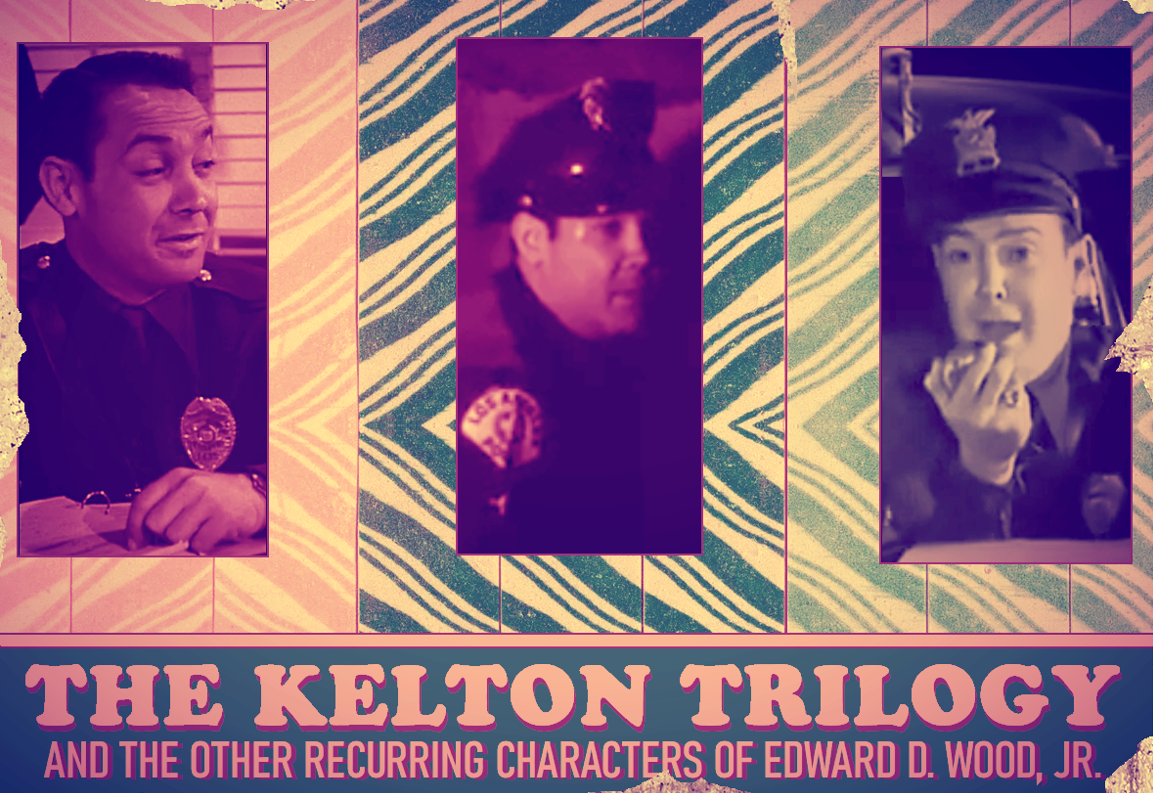
Showing posts sorted by relevance for query night of the ghouls. Sort by date Show all posts

Wednesday, September 18, 2013

Ed Wood Wednesdays, Week 11: "Night of the Ghouls" (1959)

Tor Johnson reprises the role of Lobo in 1959's Night of the Ghouls.

"I've been lucky. None of my films have been left on the laboratory shelf."
-Edward D. Wood, Jr.

Ed's nearly "lost" classic.
In late 1978, just a few weeks shy of Christmas, a penniless Edward D. Wood, Jr. was evicted from his seedy apartment at the intersection of Yucca Street and Cahuenga Boulevard in Los Angeles, leaving the writer-director and his wife Kathy homeless. In desperation, he called a friend, actor Peter Coe, who agreed to let the Woods stay with him. It was at Coe's home, 5635 Laurel Canyon Boulevard, that Ed died on December 10. What was on Eddie's mind during these dark final days? Perhaps his legacy. 

According to David C. Hayes' book Muddled Mind, Ed Wood's last-known bit of writing was an essay for the liner notes of a Plan 9 from Outer Space soundtrack LP. In these notes, Eddie speaks euphemistically about his current living situation, as if to assure his fans that he was doing just fine. Here is the crucial passage:
Finally, a note to all of my special friends. I am retired now, and living comfortably in the home of a good friend. I still keep a watchful eye on the Hollywood scene, and I still dream of the day when my sequel to "Plan 9," "The Night of the Ghouls," will be rescued from the Pathe Laboratory for all my fans to see and enjoy. Until that time, I plan to occupy myself by puttering in the garden and watching football on television.
Whether or not this piece of writing is genuine (and it probably isn't), there are a number of interesting points here. Ed's well-intended fib about "watching football" is especially poignant. "Eddie didn't like football," his wife Kathy testifies in the incredibly sad final chapter of Rudolph Grey's Nightmare of Ecstasy: The Life and Art of Edward D. Wood, Jr. On the fateful day of December 10, 1978, Ed retreated into a bedroom specifically to avoid a football game the other occupants of the house were watching. From within that room, he complained to Kathy that he couldn't breathe, but the two had been arguing that day, and she merely "cussed him out." Later, he was found dead there, a look of horror frozen on his face.

But the Plan 9 liner notes, allegedly penned only two weeks before this tragic incident, show that Eddie had not lost his lifelong sense of optimism and was eager for a 'lost" film of his, Night of the Ghouls (1959), also known as Revenge of the Dead, to finally see legitimate release. Of course, one could point out that in Hollywood Rat Race (written circa 1965), Ed Wood boasted that none of his films had ever failed to achieve release or been held up in a film lab. Obviously, Ed's memory was selective in this instance. But what's more important is that, in the waning days of his life, the ever-proud auteur was still thinking about a movie he'd made and loved twenty years earlier. And "loved" is truly the appropriate word. Ed Wood told one of the film's cast members, Valda Hansen, "I love this movie so much, it's almost like a part of me."

Ted Newsom: Not a fan of
Wade H. Williams III
The circuitous path Night of the Ghouls took in reaching the public is perhaps one of the most famous anecdotes in the curious, patchwork legend of Ed Wood, Jr. The short version goes like this: the movie, although completed in 1959, did not actually get released until 1983 -- five years after Ed's death -- because the cash-strapped director simply couldn't pay the lab fees. The truth is somewhat more complex. The film's belated benefactor was one Wade H. Williams III (1942-  ), a Missouri-born film producer and exhibitor who is said to possess the world's largest collection of independent science fiction films. His name is certainly familiar to anyone who routinely watches low-budget sci-fi and horror movies from the 1950s and 1960s because he's plastered it on VHS and DVD re-releases of such films since the 1980s. If you're still reading this article, chances are high that you have at least one "Wade Williams Collection" DVD in your possession.

Some fans and critics, including Rob Craig, the author of Ed Wood, Mad Genius: A Critical Study of the Films (McFarland, 2009), have praised Williams highly for preserving many obscure films, including those of Ed Wood, which might have disappeared forever without his intervention. However, others in the "B"-movie community have grumbled about Williams' attempts to exercise copyright control over films (including Plan 9) which are really in the public domain, efforts which seem all the more petty considering Williams' great personal wealth. One of his detractors, in fact, is filmmaker Ted Newsom, the director of Look Back in Angora (Rhino Video, 1994) and the host and presenter of the Ed Wood DVD collection, Big Box of Wood (S'more Entertainment, 2010).

Not being involved in the making or distribution of motion pictures, I cannot tell you who's "right" and who's "wrong" here. But to paraphrase Plan 9 from Outer Space's quizzical Lt. Harper (Duke Moore): "One thing's for sure. Night of the Ghouls is easily available to the public... and Wade Williams is responsible!"

Is that a good thing? I first saw Night of the Ghouls over twenty years ago when it was added to the roster of the Ed Wood movie marathons which were an annual event back then in my economically-blighted hometown of Flint, Michigan. That evening in October 1992 began with Bride of the Monster, then progressed to Glen or Glenda? and Plan 9 from Outer Space. The organizers of the event had wisely scheduled Ghouls as the last film of the night, because it proved to be a room-clearer, sending fed-up patrons shuffling back to their cars in a stupor.

Although only about 70 minutes in length, the oddly claustrophobic and static film felt much longer than that. In particular, the movie's pivotal "seance" sequences, with slide whistles and trumpet blasts on the soundtrack, seemed to test the audience's patience. I somehow managed to stick it out but was not eager to ever see the film again. Oh, sure, I dutifully bought the DVD when it came out ten years ago, but until this project, I'm not sure I'd ever really watched the film from beginning-to-end since first seeing it at that marathon in the '90s. Did this project change my opinion of Night of the Ghouls?

The answer awaits you below, gentle reader...

NIGHT OF THE GHOULS (1959)

This Nostalgia Merchant VHS tape may be overselling the "badness" of Ghouls just a bit.

Alternate title: Revenge of the Dead

Availability: The Wade Williams Collection version, with a clearly-altered title sequence, is available as a standalone DVD (Image Entertainment, 2002) or as part of The Ed Wood Box (Image, 2004).

Johnny Carpenter in his natural habitat.
The backstory: Roughly a decade after his ill-fated partnership with John Crawford Thomas, which yielded only the primitive, semi-finished Crossroads of Laredo (1948), Ed Wood formed a new business venture, Atomic Productions, with a retired Marine named Major J.C. Foxworthy in 1958. Ed's plans for Atomic were, as usual, ambitious: a slate of eighteen potential films. Only one of these, however, came to fruition: a sequel to 1955's Bride of the Monster originally entitled Revenge of the Dead.

The star of Bride, horror legend Bela Lugosi, had inconveniently died in 1956, but Ed brought back at least two of the film's cast, recreating their memorable earlier roles: Paul Marco as cowardly, bumbling Officer Kelton and Tor Johnson as the hulking, mute Lobo. Harvey B. Dunn returned, too, but as a different character: a rattled near-victim of a mysterious ghostly apparition. His previous role, Police Captain Robbins, was now inexplicably played by Johnny Carpenter, another of the B-list cowboy actors Ed adored. (Wood even allegedly ghostwrote a couple of Carpenter's second-tier westerns.) Revenge also had plum roles for several of Wood's most prominent acolytes: sourpuss Kenne Duncan (portraying the "Dr. Acula" character intended for Lugosi), flamboyant pseudo-psychic Criswell (both narrating and participating in the story this time), chiropractor Tom Mason (once Bela Lugosi's unconvincing Plan 9 stand-in, now upgraded to a speaking role), and the old reliables Duke Moore and Don Nagel (as usual, portraying cops).

The most exciting new addition to the cast was a sexy blonde ingenue named Valda Hansen, whom Ed had known since she was a teenager. MST3K fans will also note the participation of Anthony "Tony" Cardoza, again playing an oily-looking sad sack. As in most (or all) of his other films, Cardoza was a financial backer of Night of the Ghouls as well, having been persuaded by Ed to invest in this production rather than an apartment building. Mason, too, invested in the film, thus earning roles for both himself and his wife, Margaret, who plays the hysterical, overreacting spouse of Harvey B. Dunn's character.

Wood's abandoned JD flick.
In the process of making Revenge of the Dead, Ed "Waste Not, Want Not" Wood cannibalized two of his previous failed projects from the late '50s: the unsold Final Curtain pilot (1957) and the unfinished juvenile delinquency film Hellborn (aka Rock & Roll Hell). While Ed made some attempt at seamlessly incorporating the Final Curtain footage into Revenge, namely by having Duke Moore wear a tuxedo similar to (perhaps the same as) the one he wore in that obscure pilot, the Hellborn footage is a complete non sequitir; narrator Criswell momentarily veers away from the film's main topic, i.e. ghosts and the supernatural, to lecture us about juvenile crime and traffic fatalities.

Interestingly, Ed Wood himself appears in the scenes lifted from Hellborn, fighting with Conrad Brooks in front of a crazed "teenage" audience. The material from Final Curtain, of course, is easy to spot: Duke Moore in a tuxedo wandering around the darkened theater, which here is passed off as a creepy haunted mansion.

Valda Hansen as "The White Ghost."
The new footage for Revenge of the Dead, filmed over a few weeks in April and May of 1958, weaves a convoluted new story around the existing footage. A sleazy, ill-tempered con artist named Karl (Duncan) and his sexy blonde girlfriend Sheila (Hansen) have set up shop in a house built on the site of the creepy mansion where Bela Lugosi's Dr. Eric Vornoff had carried out his fiendish experiments in Bride of the Monster. (The sinister location is called "Willows Lake" here. Diligent Ed Wood fans will remember that Bela's home in Bride was the Old Willows place on Lake Marsh, but whatever.) Dubbing himself "Dr. Acula" and posing as a powerful spirit guide who can communicate with the dead, Karl uses cheap theatrical trickery to fool elderly, gullible customers into signing over great sums of money to him so that he can "raise" their departed spouses from the dead.

Sheila, meanwhile, scares people away from the home by stalking the fog-shrouded property in the eerie guise of the "White Ghost." The relationship between these two is much like that of gangster Vic Brady (Timothy Farrell) and his gun moll Loretta (Theodora Thurman) in Wood's Jail Bait (1954). While Vic's favorite expression was "shut up," Karl's is "so what?" (Yes, this is also the pet expression of the anti-heroine played by Jean Moorhead in the Wood-scripted "roughie" The Violent Years.) Early in the film, Sheila becomes aware that a real spirit, the Black Ghost (Jeannie Stevens, another holdover from Final Curtain) is also roaming the grounds, though cynical Karl doesn't believe her. Karl and Sheila have also apparently inherited or adopted Dr. Vornoff's former assistant Lobo, his face now half-melted as a result of the explosive finale of Bride of the Monster. 

Captain Robbins has apparently heard enough about the ghoulish goings-on at Willows Lake that he sends world-weary Lt. Bradford (Moore) and panicky, inept Kelton (Marco, in his final and most prominent appearance in a Wood film) to investigate. Eventually, Dr. Acula's lucrative but heartless scheme backfires on him. The police interference is certainly unwelcome, but Acula's bigger problem is that his fraudulent seances have inadvertently succeeded in supernatural ways he could not have imagined, with horrifying consequences for himself and his girlfriend. Tragically, in all the confusion, the film's most innocent and likable character, Lobo, is gunned down.

Dr. Acula (Kenne Duncan) presides over an absurd seance.
The making of Revenge of the Dead was typically chaotic. As bad a businessman as ever, Ed was almost always on the verge of bankruptcy, and at one point Tor Johnson refused to work until he was paid. Valda Hansen, meanwhile, was sexually harassed on a continual basis both by the male crew members and by her lecherous co-star, Kenne Duncan, who would make vulgar suggestions to her between takes.Valda and Ed, however, were quite close and seemed to have a deep, spiritual connection based on a shared interest in the paranormal. Based on what I've read, I get the sense that perhaps the attractive actress and her director (who still maintained some of his Errol Flynn-like good looks at that point) had a romantic relationship on the side, but I cannot confirm this.

In any event, there is ample evidence that the movie did premiere under its original title in 1959 and may have played a few times in Los Angeles back then, too. There are photos of the film's premiere showing cast members Criswell, Tor Johnson, Valda Hansen, and Paul Marco mugging for the camera. It's possible that the version which premiered in '59 was not quite finished. There are a couple of letters from August and September 1959 from Ed Wood to Tony Cardoza in which Wood suggests re-editing and re-titling the film, possibly removing some of the Criswell scenes from the beginning and replacing them with footage of Bela Lugosi, which he was planning to acquire from Glen or Glenda? producer George Weiss. (These letters also sadly reveal that Wood was too poor at the time to afford a home telephone.)

Rob Craig's book Ed Wood, Mad Genius suggests that the title Night of the Ghouls was the creation of Wade Williams, but some of the existing scripts and letters excerpted in Rudolph Grey's Nightmare of Ecstasy dispute that theory. More likely is that Ed himself wanted to change the title to Night of the Ghouls but never got around to doing so. Whatever the case, Revenge of the Dead was quickly withdrawn from circulation and went missing until Wade Williams paid the film's outstanding lab bills and released on home video in 1983 as Night of the Ghouls, with the new title crudely pasted over the old one.

As it happened, by virtue of debuting decades after it was shot, Ghouls counts as the last-released film of William C. Thompson, the colorblind cameraman who had been Ed's cinematographer on The Violent Years, Final Curtain, Bride of the Monster, Glen or Glenda?, and Plan 9 from Outer Space. The New Jersey-born photographer died in LA at the age of 74 in 1963.

Alternate cover spotted on Ebay.
The viewing experience: Completely baffling, engrossing, and charming all at once. I don't know what's changed in my brain over the last two decades, but I have eagerly sat through Night of the Ghouls about four times in the last few months as I've researched Ed Wood's life and career for this project. Twenty years ago, I had to summon every bit of my inner strength to sit through it even once. What was wrong with me back then? What's wrong with me now? Certainly, the film is stately in its pacing and relies on pages and pages of expository dialogue rather than action for long stretches at a time. Early in the proceedings, there are some long-ish scenes at the front desk of the police station (with a crudely-fashioned "WANTED" poster of Ed Wood taped to the wall) which are filmed in protracted, unbroken takes from one less-than-ideal angle, while the boom mic seems just slightly too far away to capture what's being said with perfect clarity. And, yes, there are the same stock shots of lightning-filled skies and zooming police cars which we've already seen in about half a dozen Wood films.

But even during these less-appetizing passages, we can enjoy the kind of stilted,  improbable, lovely and occasionally profound Wood-ian dialogue. This kind of stuff doesn't just grow on trees, folks. I refer you to Ed Wood, Mad Genius for Rob Craig's compelling religious interpretation of the film's plot, which again focuses on death and resurrection like most of Ed's best-loved creations.

Duke Moore, playing two roles simultaneously.
All of the really exciting stuff, of course, happens in and around the house on Willows Lake. In many ways, Night of the Ghouls makes a perfect send-off for William C. Thompson, who did as much as anyone to shape the look of the film's from Ed's "classic period" of the 1950s. Thompson makes these scenes, shot in crisp black-and-white, moody, mysterious, foreboding, and yet also quite alluring -- qualities also displayed by the great Universal horror features of the 1930s and 1940s. This is a world I'd love to live in. As he proved with Vampira (Maila Nurmi) in Plan 9 from Outer Space, Thompson had an incredible knack for capturing feminine beauty, and what a muse he has here in lovely Valda Hansen.

The house itself is one of Ed Wood's most wonderfully impossible locations. As with the spaceship in Plan 9, there is no logical or visual correspondence between the interior and the exterior of this house. From what we see of the exterior, the place seems to be a rather small, semi-dilapidated shack. Inside, however, the place is immeasurably vast and seems to have no beginning and no end. Viewers of Night of the Ghouls will, therefore, feel as if they are in a dream state with no grounding in real-world geography or architecture. Wood combines a few modest studio sets and the rather grand theater seen in Final Curtain, with its two distinct levels connected by a spiral staircase.

To provide the film's connective tissue, so to speak, Wood merely has his actors walk in front of a black background, giving the impression that they are existing in a shapeless void outside of time and space. The end result is one of the most fascinating and confounding interior spaces in cinema, rivaled only by the titular locale in Mel Stuart's Willy Wonka and the Chocolate Factory (1971).

Adding further to the disorientation of the viewer is the fact that the footage from Final Curtain is completely at odds with the narrative Wood is trying to impose upon it through narration from Criswell and inner monologues from Duke Moore. In Night of the Ghouls, Moore is supposed to be a hardened, seen-it-all policeman who is snooping around Dr. Acula's house looking for clues. But, of course, the actor he had portrayed in Final Curtain was confused and terrified by his surroundings. So in effect, the audio is conveying one story while the video is conveying another. Pretty heady stuff for a low-budget "haunted house" movie from the Eisenhower era.

For Ed Wood fans and seekers of cinematic curiosities, Night of the Ghouls is a veritable treasure trove, a phantasmagoria of sight and sound. When it is boring, it is transcendentally boring. When it is ridiculous, it is triumphantly ridiculous. I love it to pieces. See it at your earliest convenience.

NEXT WEEK: One curious statistic I've heard in some documentaries about Ed Wood is that he only directed five movies. How could anyone arrive at that low number? Well, it depends on what kinds of movies you choose to count towards your total. As far as some critics and historians are concerned, Ed Wood's directing career effectively ended in 1960 with The Sinister Urge, his last "mainstream" movie before his permanent descent into sexploitation (discounting his brief foray into technical and industrial films). Interestingly, the plot of The Sinister Urge revolves around pornography and, thus, serves as a harbinger of Wood's future. Join me here in a week for a discussion of that strange film, which like The Violent Years and Bride of the Monster ultimately wound up on MST3K.

Wednesday, December 8, 2021

Ed Wood Wednesdays, week 125: The floating trumpet in 'Night of the Ghouls' (1959)

Let's talk about that trumpet.

I will never forget my first screening of Night of the Ghouls (1959). I saw it on Friday, October 30, 1992 as part of an Ed Wood quadruple feature, alongside Glen or Glenda (1953), Bride of the Monster (1955) and Plan 9 from Outer Space (1957). This was my first time seeing any of Eddie's movies, and it was the night that made me a fan for life.

Accessibly weird and endlessly quotable, Glenda and Plan 9 were the hits of the evening, as you might expect. The organizers of the marathon wisely scheduled Night of the Ghouls (aka Revenge of the Dead) to run last. The supernatural thriller, a film both sluggish in its pace and confounding in its construction, just about cleared the room. I stuck it out and have since come to love Ghouls, though I admit that my first viewing was an endurance test.

In particular, the séance scenes in Night of the Ghouls caused multiple walkouts. If you'll recall, the film's plot revolves around a fraudulent psychic called Dr. Acula (Kenne Duncan), who bilks customers out of their money by pretending to communicate with their dead relatives. The con artist demonstrates his "skills" through a variety of cheap theatrical tricks, the kind a Scooby Doo villain might use to scare meddling kids away from an amusement park. One particularly obscure detail: a trumpet dangling from wires so that it looks like it's floating in midair.

Friday, November 7, 2014

Ed Wood's BLOOD SPLATTERS QUICKLY: 'The Night the Banshee Cried' (1971)

Unlike the figures depicted in this illustration, the characters in "The Night the Banshee Cried" are female.

NOTE: This article is part of my ongoing coverage of Blood Splatters Quickly: The Collected Stories of Edward D. Wood, Jr.

Lezo magazine, where this story resurfaced.
The story: "The Night the Banshee Cried," originally published as part of the Orgy of the Dead paperback novel from Greenleaf Classics in 1966. Revised and reprinted in Lezo, Vol. 5, No. 3 from Pendulum. Based on a screenplay written by Ed Wood circa 1957.

Synopsis: A beautiful young woman is aware that she is dead but does not seem to understand why she has been summoned back to the swamp behind her father's now-decaying home. She can hear the anguished screaming of the banshee who has traditionally haunted the property. The woman scans her memory in search of clues as to why she was dragged from her peaceful grave. Suddenly, the reason becomes clear: she is to replace the banshee.

Wood trademarks: An overabundance of fog (cf. Orgy of the Dead); swamp (Bride of the Monster, Night of the Ghouls); full moon (cf. Orgy); souls who are denied peace in the afterlife (cf. Orgy, Plan 9 from Outer Space, Night of the Ghouls; this collection's "Hellfire" and "Dracula Revisited"); wiggling fingers with long fingernails (cf. Vampira in Plan 9, Valda Hansen in Night of the Ghouls, even the dream sequence in Glen or Glenda?); meandering monologue by a disturbed person (cf. Final Curtain); numerous references to death, graves, and rotting flesh; a woman whose beauty makes her irresistible to men (cf. "Glenda" in Killer in Drag, many other female and transvestite characters in the Wood canon); Irish mythology (cf. Meatcleaver Massacre); yes, more snakes. Stylistically, it must be said at this point that a hallmark of Wood's writing is the use of ellipses.

Excerpt: "I was beautiful in life. People fell to my every wish. Men would die at my very command. What has death brought to my figure? The once lovely breasts do not seem to have sagged. My hips are as round as ever."

Valda Hansen: Ed's ideal Banshee?
Reflections: This short story, which eventually appeared in one of Pendulum's lesbian-themed magazines in the early 1970s, has quite a history. 

It seems to have begun life as a screenplay in the late 1950s. In Rudolph Grey's Nightmare of Ecstasy, actress Valda Hansen reminisced about her experience working for Ed Wood, who cast her as the White Ghost/Sheila in the ill-fated Night of the Ghouls (1959): "Ed had known me before Night of the Ghouls. He had seen me as an ingenue, and he said, 'I want to do a movie called The Night the Banshee Cried,' and I said, 'Would you like me to read something for you and record it?' And he said yes, and he gave me this long speech, and I acted it on a tape. I'm the Banshee, and I come out, and I go, 'It's been so long ago ... I lived on this Earth...' I'm dispossessed and I moan and everything. That was it." 

Grey's annotated Wood filmography lists a 22-minute movie from 1957 called The Night the Banshee Cried, written, produced, and directed by Eddie for Atomic Productions, the same company which produced both Night of the Ghouls and Final Curtain, the former a full-length feature and the latter intended as the pilot of an anthology series called Portraits in Terror. While both Ghouls and Curtain eventually surfaced, Banshee never did. (It has an IMDb listing, though.) 

Meanwhile, under the heading of "Unrealized Projects," Grey includes a 1963 omnibus-type film also called Portraits in Terror, which was to have consisted of Curtain, Banshee, and Into My Grave, "an unfilmed premature burial-inspired story." In 1966, Eddie turned Banshee into a chapter* of the tie-in paperback for Orgy of the Dead, and it later appeared in a slightly different form in Lezo in 1973. In a way, then, the story itself has a lot in common with its own narrator. Both were rudely dredged up from the grave, only to be denied true satisfaction.
*I covered this version of the story in my review of Muddled Mind: The Complete Works of Edward D. Wood, Jr. Though basically the same, the Orgy version of "The Night the Banshee Cried" is slightly shorter and missing some of Ed Wood's eccentric punctuation and repetition.
Thematically and stylistically, "The Night the Banshee Cried" is notable for being a monologue delivered from the perspective of a female character. The strongest women in the Wood canon tend to be those who are quite aware of their own sex appeal and use it to control the weak-willed men around them. Such is the case with the "Banshee" narrator, who is so beauty-conscious that she frets about her looks even from beyond the grave. 

There is not a hint of lesbianism between the woman and the screaming Banshee,  however. The latter, in fact, stays away from the narrator throughout the story. "She is coming no closer!" Wood writes. "She just stands, staring... staring...staring... at me..." Is the Banshee looking at the woman with lustful longing? No. She's just upset about losing her job. "Her time of reign was finished. I am to take the Banshee's place..." 

One might be tempted to see this an example of jealousy between an older woman and a younger, sexier replacement. Perhaps this is a supernatural parody of Joseph L. Mankiewicz's All About Eve (1950). The one snag with this theory is that being a Banshee on a run-down, decrepit estate seems like a lousy assignment, hardly something to envy.

Next: "The Wave Off" (1971)

Wednesday, March 15, 2023

Ed Wood Wednesdays, week 145: The Mads: Night of the Ghouls (2023)

Some really cool artwork by Carmen Cerra depicting Dr. Acula's gruesome death.

Well, that was fun. 

Back in 2020, at the height of the pandemic, I watched a livestream of MST3K veterans Trace Beaulieu and Frank Conniff—collectively known as The Mads—riffing Ed Wood's Glen or Glenda (1953). Frank was in his apartment, Trace was in his, and they commented on the film via Zoom. Frank and Trace have kept doing these livestreams for the last few years, and I've checked in occasionally. I'd watch more of them, but they're pay-per-view. I somehow missed or ignored their livestream of Bride of the Monster (1955) last September.

This week, however, they made me an offer I simply couldn't refuse. On Tuesday, March 14, they riffed Ed's sadly overlooked Night of the Ghouls (1959), the final entry in the so-called Kelton Trilogy. To my knowledge, Ghouls has never received this treatment before. The film was never used on MST3K itself, and it's been ignored by such MST3K derivatives as Rifftrax and Cinematic Titanic. I've long felt that Ghouls would be perfect fodder for riffing, at least as good as Plan 9 or Bride. (Trace himself admitted that Plan 9 in particular has been riffed to death.)

The marvelous Marcelle Hemphill.
Last night's livestream proved that my suspicions were correct. Trace and Frank, both avowed fans of the film and of Ed Wood, were in fine form as they picked apart the many, many absurdities of Night of the Ghouls: its disjoined editing, its heavy reliance on voiceover narration, its stagy acting, its many narrative digressions, and its overabundance of scenes in which police cars race across the screen. The riffs were what you'd expect from two MST3K graduates, albeit with a bit more profanity. 

Frank is the more politically-oriented of the two Mads, so he made topical references to Marjorie Taylor Greene, Ron DeSantis, and defunding the police, but these were kept to a minimum. I appreciated the numerous deep cut references to the Marx Brothers and Frank Zappa. Every time the name "Lucille" was mentioned in the movie, for example, Trace sang a bit of "Lucille Has Messed My Mind Up" from Zappa's Joe's Garage album. Meanwhile, Frank showed off his extensive knowledge of Woodology with shoutouts to Nightmare of Ecstasy (1992) and Take It Out in Trade (1970). 

One great thing about events like this is that they give me the opportunity to see new things in movies I've watched dozens of times already. I had somehow missed, for instance, that there is an obvious movie light in front of the sheriff's office at the beginning of the film. (Ed must've wanted to make sure the sign outside was visible at night.) For whatever reason, I found myself focusing on some of the magnificent 1950s automobiles in Night of the Ghouls, especially the gigantic 1958 Pontiac Bonneville driven by Duke Moore's character, Lt. Bradford.

I've already written a great deal about the movie's leading actors: Tor Johnson, Valda Hansen, Kenne Duncan, etc. And their performances in Ghouls are as mesmerizing as ever. During this viewing, however, my attention was diverted by some of the unsung supporting players. I was particularly taken with Marcelle Hemphill (1888-1981) as Mrs. Wingate Yates Foster, the gullible old lady being bilked out of her money by Duncan's scheming Dr. Acula. Marcelle seemed like the prototypical "wealthy dowager" type, yet this is somehow her only known screen credit. She may be a topic of further research.

Look, your enjoyment of a livestream like this really depends on your tolerance for MST3K and its lampooning of old B-movies. Personally, seeing Bride of the Monster on MST3K in the '90s deepened my appreciation of that movie and made my Ed Wood fandom even stronger. Since then, I've enjoyed seeing Ed's other films given similar treatment, including Rifftrax's version of Revenge of Dr. X (1970). But I can understand if you find all this stuff disrespectful or just distracting. If you like both MST3K and Ed Wood, I'm just making you aware of it. If you don't, forget I said anything.

You can find hours of material by Frank Conniff and Trace Beaulieu right here. As of this writing, their version of Night of the Ghouls has not yet been made available for download at their site, but I imagine it soon will be. In the meantime, you can snag their versions of Glenda and Bride.

Wednesday, September 6, 2023

Ed Wood Wednesdays: Jean Stevens in White and Black (Guest Author: James Pontolillo)

Ed Wood gave us two sides of actress Jean Stevens.

In his magnum opus Plan 9 from Outer Space (1957), writer-director-producer Edward D. Wood, Jr. summoned an iconic femme fatale – TV horror hostess Vampira as the striking Vampire Girl – to haunt men for decades to come. Plan 9’s cult status and the fervor directed toward Vampira have caused Ed’s other femme fatales to be largely overlooked. 

Two of his lesser-regarded films – Final Curtain (1957) and Night of the Ghouls (1959) – feature a [White] Vampire and a Black Ghost, respectively. Each role was played by the same little-known actress who managed to exude a mysterious, foreboding air of eroticism not unlike that of Vampira herself. A large measure of credit must be given to the cinematographer, William C. Thompson, whose knack for capturing feminine beauty in crisp, moody black-and-white mirrored the timeless Universal horror classics of the 1930s and 1940s. The young actress in question, Jean Stevens, was no newcomer as far as Ed was concerned. He had known her since his earliest days in Hollywood.

Wednesday, May 26, 2021

Ed Wood Wednesdays, week 118: 'Hellborn' (1956/1993)

Hellborn is like a jigsaw puzzle with missing pieces.

One of the strangest passages in Ed Wood's Night of the Ghouls (1959) occurs just four and a half minutes into the film. Ostensibly a follow-up to Bride of the Monster (1955), Ghouls is another of Wood's supernatural horror thrillers. The plot revolves around a phony medium, Dr. Acula (Kenne Duncan), who inadvertently manages to summon the dead while performing fraudulent seances in a spooky mansion. For some reason, though, narrator Criswell takes a few minutes to talk to us about juvenile delinquency:
Your daily newspapers, radio, and television dares to relate the latest in juvenile delinquency. At times, it seems juvenile delinquency is a major problem of our law enforcement officers. But is this the major horror of our time? Is this violence and terror a small few perpetrate the most horrible, terrifying of all crimes our civil servants must investigate? 
The National Safety Council keeps accurate records on highway fatalities. They can even predict how many deaths will come on a drunken holiday weekend. But what records are kept? What information is there? How many of you know the horror, the terror I will now reveal to you?
As we hear this voice-over monologue, accompanied by hot jazz drumming and a wailing siren, Wood shows us flashes of seemingly unrelated footage: a police car whizzing from somewhere to somewhere else; young people dancing and eating at a pizzeria called Jake's Pizza Joint; two men (Ed Wood and Conrad Brooks) fighting in a pit as a crowd watches; a gang of three men beating the tar out of a fourth man as a girl stands off to the side; a car going off the road and tumbling down a cliff before crashing into a tree, etc. Apart from the shots of the police car—this is another of Ed's many police procedurals—none of this footage belongs in Night of the Ghouls. So what's it doing there? 

Wednesday, May 27, 2026

Ed Wood Wednesdays, week 276: "Paul Marco Remembers Ed Wood Jr." (1987)

Friends 'til the end: Paul Marco (right) and Ed Wood.

Something wonderful has been happening recently in the online Ed Wood fan community. A gentleman named Jason Insalaco has been sharing some rarely-seen photographs of his great-uncle, eccentric character actor Paul Marco (1927-2006), to an Ed Wood discussion group on Facebook. We all remember Paul as the bumbling, cowardly Officer Kelton in three of Eddie's best-known films: Bride of the Monster (1955), Plan 9 from Outer Space (1957), and Night of the Ghouls (1959). Kelton reminds me of those wacky comic relief sidekicks they'd put into every action-adventure cartoon I watched as a kid. He's the Ed Wood equivalent of Snarf on Thundercats, Gleek on Superfriends, or Orko on He-Man and the Masters of the Universe.

But we should remember that there's more to Paul Marco than just being Officer Kelton. In addition to having a life and career all his own, he was a key member of Ed Wood's personal and professional circle for many years. In Tim Burton's Ed Wood (1994), Paul is portrayed by Doogie Howser star Max Casella as an eager but not-too-bright young man who will blindly follow Eddie (Johnny Depp) wherever he chooses to go, even if it's straight off a cliff. While this makes for some amusing scenes, it hardly gives us a complete picture of who Paul Marco was. The reality was more nuanced and complex than that.

Wednesday, May 15, 2024

Ed Wood Wednesdays, week 188: Ed Wood's recurring characters (including Kelton and Lobo)

For some reason, Ed Wood kept bringing Officer Kelton back.

Three of Ed Wood's 1950s filmsBride of the Monster (1955), Plan 9 from Outer Space (1957), and Night of the Ghouls (1959)—are collectively known as "The Kelton Trilogy" because they all feature actor Paul Marco as bumbling, cowardly Officer Kelton, a uniformed cop who repeatedly comes into contact with the otherworldly and supernatural. In Ghouls, narrator Criswell gives us a succinct description of the character:
Patrolman Paul Kelton, 29 years of age, four years with the department, eager for the glory of the uniform but wide-eyed with fear at the thought of actually being on special duty. Unfortunately, though eager, not what the department usually looks for in their officers.
Ouch. The other characters in these movies tend to treat Kelton with utter contempt. In Night of the Ghouls, the character even describes himself as "the whipping boy of the whole police force." He's basically the Jar Jar Binks of the Ed Wood universe. So why did Ed keep bringing back Officer Kelton, reusing him the way Shakespeare reused Falstaff? A few reasons, I think. First, Paul Marco was one of his closest buddies and wasn't exactly drowning in work outside of Eddie's films. I'm certain the zany Kelton character was written especially with Paul Marco in mind. ("Hey, Paul, I've got a great part for you in my next picture!")

Beyond that, Ed Wood was heavily inspired by the Universal horror movies of the 1930s and '40s, and those films tend to include broad comic relief provided by wacky supporting characters—chambermaids, English bobbies, villagers, etc. It seems like a Universal movie isn't complete until some Cockney-accented stooge gets spooked by the monster du jour and trips over his own feet trying to run away. Paul Marco's scaredy-cat Officer Kelton is very much in that tradition. As unnecessary as the character may seem to modern viewers, he has his roots in classic horror.

Wednesday, February 18, 2026

Ed Wood Wednesdays, week 264: How accurate is 'Ed Wood' (1994) [PART 1]

Jeffrey Jones in Ed Wood. Inset: Criswell in Night of the Ghouls.

Ed Wood Wednesdays is, by far, the longest-running series in the history of this blog. It may be the most significant project of my entire life. I started it nearly 13 years ago, and it's nowhere near completion. But within that one big project, there have been a lot of smaller sub-projects, like my reviews of every story in Blood Splatters Quickly (2014) and my 2022 Ed-Vent Calendar. These have been some of the most enjoyable articles for me to write, so I'm always on the lookout for the next possible series-within-a-series. And now I think I've found it.

What I plan to do for the next however many weeks is go through Tim Burton's glossy biopic Ed Wood (1994) scene by scene and discuss how accurate—or inaccurate—it is, compared to the real life and career of Edward Davis Wood, Jr. (1924-1978). Before you get upset, please know that I am doing this purely as a tribute to the movie. I am not trying to criticize director Tim Burton or writers Scott Alexander and Larry Karaszewski for taking liberties with the facts. I'm completely fine with them taking liberties with the facts, and I love Ed Wood just the way it is. But this series will (hopefully) allow me to talk about numerous aspects of Eddie's real life and work in an entertaining way.

Oh, and I fully expect to be corrected and nitpicked along the way by you, the readers. If you feel I've made a misstatement, let me know and I'll update the article. Anyway, let's get started.

Wednesday, September 4, 2013

Ed Wood Wednesdays, week 9: "Muddled Mind: The Complete Works of Edward D. Wood, Jr." (2001)

A whimsical illustration by your humble blogger in tribute to Ed Wood's writing career.

"Is there a perfect reader somewhere, a total reader... so that my reading is in a way pointless? Well, I hope not."
-Julian Barnes, Flaubert's Parrot

Flaubert's Parrot
Geoffrey Braithwaite, MD, the protagonist and narrator of Julian Barnes' extraordinary novel Flaubert's Parrot (Jonathan Cape, Ltd., 1984) goes on the trail of his favorite author, the late French novelist Gustave Flaubert, visiting the famed writer's old haunts, talking with other Flaubert fans and consulting various literary and historical experts to gain perspective on his hero's life and work. 

In particular, the retired doctor hopes to find one bizarre souvenir: a colorful stuffed parrot Flaubert used as inspiration during the writing of a story called "A Simple Heart." Braithwaite ultimately finds two likely candidates for "the real parrot," each one with an owner who vouches for its authenticity, but he never really does find out which one was genuine and ultimately learns to live with that uncertainty.

At one point in his travels, however, he ponders the fact that many before him have studied Flaubert and may, thus, have made his own inquiries redundant. So why does he continue? "My reading might be pointless in the history of literary criticism," he concludes, "but it's not pointless in terms of pleasure."

In the process of writing the Ed Wood Wednesdays series, I've often felt a bit like the good doctor of Barnes' novel. There are at least a dozen documentaries about the eccentric writer-director and several thoroughly-researched books about the man and his career, in particular Rudolph Grey's Nightmare of Ecstasy (1992), an exhaustive oral history ten years in the making, and Rob Craig's Ed Wood, Mad Genius (2009), a methodical, often-revelatory critical analysis of Ed's films. Anyone interested in the life and work of Edward D. Wood, Jr. should own those two volumes.

I have neither the time nor the resources to truly compete with Grey or Craig. In some ways, it would be impossible. Wood had only been dead a few years when Grey began his research. The trail is much colder now. Eddie's ashes were scattered at sea about 35 years ago. Many, perhaps most, of the interview subjects in Nightmare of Ecstasy have died since its publication. And because Ed's career was not well-documented during his own lifetime, it can be extremely tricky to even identify his work, let alone obtain copies of his films and books for review. In short, bringing it back to the Barnes novel, the amateur Woodologist may search and search and yet never find "the real parrot."

But still I continue, perhaps in the hope that by delving into as much of Ed Wood's career as possible (that is to say, possible for me given my work schedule and income), I will emerge with a better understanding of this fascinating, troubled, contradictory man. Vicariously, Eddie and I have spent a lot of time together these past couple of months. Since much of his literary output is currently unavailable to me, however, I have had to rely on the reportings of others to explore the gloomier corners of Ed's career.

Case in point:

MUDDLED MIND: THE COMPLETE WORKS OF EDWARD D. WOOD, JR. (2001)

David C. Hayes' Muddled Mind: Think of it as Cliffs Notes for budget-minded Ed Wood fans.

Alternate Titles: None.

Availability: The book is available directly from the publisher in paperback and hardcover editions.

Author David C. Hayes.
Backstory: As of 2013, only a handful of Ed Wood's books are widely available and affordable to the average consumer. Any reader with a computer can easily procure used copies of Death of a Transvestite (1967), Killer in Drag (1963), Devil Girls (1967), and Hollywood Rat Race (1998) for less than the cost of postage. After that, though, it gets rough. Small-time publisher Ramble House reprinted several of Wood's books in the mid-2000s, but these editions have largely vanished from the primary and secondary markets. With luck, patience, and a great deal of money, fans might be able to purchase a few vintage Ed Wood paperbacks on eBay.

For most of us, though, these works remain frustratingly out of reach. David C. Hayes' Muddled Mind: The Complete Works of Edward D. Wood, Jr. (Ramble House, 2001; revised 2006) does what it can to correct that sad situation. To my knowledge, this is the only guidebook devoted to Ed Wood's writing career rather than his films. 

Author-filmmaker Hayes, who also appeared as both Rev. Steele and Lobo in Ed Wood's Devil Girls (1999), gives a fairly thorough overview of Wood's writing career, summarizing and providing excerpts from many of Ed's novels, nonfiction books, magazine articles, and short stories. He tries to give readers a sense of what these books and stories are like and how they fit into the overall arc of Ed's life and career. Along the way, Hayes also critiques these works in a mildly satirical style, razzing Ed somewhat for his logical flaws, his narrative inconsistencies, and above all, his unconventional grammar and syntax. Likely inspired by Ed Wood's many professional pseudonyms, Hayes occasionally credits certain chapters, including an article on the making of the Devil Girls movie, to a deranged alter ego, "Hayden Davis, Ph.D." These intrusions, mercifully, are brief and rare.

Arranged chronologically, Muddled Mind also includes information on where and how to track down Ed's books (including price estimates) as well as a thorough index of Wood-related films, recordings, and publications.

The reading experience: For those of us who cannot afford to spend hundreds of dollars on obscure paperback novels from the 1960s and 1970s, Muddled Mind: The Complete Works of Edward D. Wood, Jr. is an extremely helpful volume. While I'd someday love to own full-length versions of Hell Chicks (1968), Side-Show Siren (1966), TV Lust (1977), and the many other books synopsized in this career-spanning catalog, at least now I feel that I have a more complete picture of Ed's tremendously productive and eccentric literary life. Hayes' tone is slightly irreverent, but Muddled Mind is clearly intended as a tribute to Ed Wood.

While not as substantial and enlightening as Nightmare of Ecstasy or Ed Wood, Mad Genius, this book is still a handy reference work for the struggling Woodologist. By far, the book's greatest selling point is that it actually includes three verified short stories by Edward D. Wood, Jr. himself. (He wrote hundreds more, many of which have yet to be located or identified.) This was an area of Wood's career that was entirely new to me. I would like now to discuss these three stories individually and give you my impressions of each, as well as some background information about them.

"The Night the Banshee Cried" (1966)

"The Night the Banshee Cried" was originally published as part of Ed Wood's Orgy of the Dead.

Originally published: In Orgy of the Dead (Greenleaf Classics, 1966), a short story collection produced as a tie-in with the 1965 film of the same name, written by Ed Wood and directed by Stephen Apostolof (aka A.C. Stephen).

Comments: Most Ed Wood fans know that the infamous "monster nudie" film Orgy of the Dead (1965) had a tie-in paperback book. I had always been led to believe that the book was a novelization of the film, but this turns out not to be the case. In fact, while it does contain a textual version of the film's story, the Orgy of the Dead paperback book actually functions as a treasury of Ed Wood's strange "spooky" stories, not all of them erotic in nature. An example of such a non-erotic horror story is "The Night the Banshee Cried," which Ed had written several years earlier.

Actress Valda Hansen, a blonde ingenue who memorably starred in Ed Wood's Night of the Ghouls (1959), told biographer Rudolph Grey that Ed wanted to make "The Night the Banshee Cried" into a film and asked her to make a recording of the monologue he had written for it. The Wood filmography at the end of Nightmare of Ecstasy actually includes a listing for a 22-minute short film adaptation of the story that Ed wrote, produced and directed in 1957. This film has since gone missing, but as late as 1963, Ed still planned to use it, along with the unsold Final Curtain pilot and a third, yet-to-be-filmed tale called "Into My Grave" as components of a feature-length anthology film called Portraits in Terror. None of this ever came to be.

The version of "Banshee" which did reach the public -- and which now graces this book -- seems to be the same monologue that Valda Hansen recorded for Ed back in the '50s. It's a paranoid, rambling soliloquy by a tormented soul who has been mysteriously summoned from her grave and has now returned to her former homestead in order to replace the banshee who has long haunted the premises. The incumbent banshee, naturally, is quite displeased by these events and is not shy about expressing her feelings.

With its emphasis on death and resurrection, "Banshee" is quintessential Wood. In Irish mythology, incidentally, a banshee is a female spirit or fairy whose screams are an omen of an impending death. Ed, naturally, takes this myth and makes it thoroughly his own. As far as this story is concerned, being a banshee is a full-time job and retirement is obviously unwelcome. Tonally, this story is highly reminiscent of both Final Curtain and Criswell's speeches from Plan 9 from Outer Space (1957), Orgy of the Dead, and Night of the Ghouls (1959).

"To Kill a Saturday Night" (1971)

Ed Wood's disturbing, tragicomic "To Kill a Saturday Night" deals with sex, booze, and violence.

Originally published: According to Hayes, this story first appeared in the February 1971 issue of Black and White from Pendulum Press. However, Rudolph Grey's book says that this particular edition of Black and White was released in 1972. Not having an original copy of this magazine, I cannot tell you which date is accurate.

John Carradine: an ideal wino.
Comments: A pitch-black story of two hard-drinking farmhands whose Saturday night plans may include murdering prostitutes, "To Kill a Saturday Night" was also (quite inappropriately) reprinted in Tales for a Sexy Night, Vol. 2 (Gallery Press, 1973). Rudolph Grey says "Saturday Night" was based on one of Ed's many unproduced screenplays. In 1973, Ed tried unsuccessfully to film this story, along with two others, as part of yet another never-to-be anthology film. Supposedly, he wanted John Carradine and David Ward for the lead roles of winos Pete and Art.

Bracingly nasty and yet somehow grimly comic as well, "To Kill a Saturday Night" reminded me a bit of Beckett's Waiting for Godot. There's no real plot to speak of, just a circular, semi-coherent dialogue between two highly intoxicated, small town working stiffs who sit on a curb and discuss what they should do to kill the time on Saturday night. Pete, the more vicious of the two, suggests killing and robbing a couple of "whores" named Lulu and Maizie. The slightly-dim Art is skeptical of the plan at first, but Pete makes a convincing -- or at least forceful -- case. These two desperate, hopeless losers seem to inhabit a hellish nightmare world of cheap, bitter-tasting wine and unsanitary, unsightly, and disease-ridden prostitutes.

Ed Wood presents us with a rancid slice of Americana with this memorably sleazy tale. "To Kill a Saturday Night" shows American society at its worst. Pete, in his own sick and misguided way, is kind of a philosopher. Certainly, his views on personal hygiene are unique. (Sweating profusely, he argues is as good as bathing since sweat is water.) I would have loved to have seen John Carradine play this role. "To Kill a Saturday Night" is quite a discovery and justifies the purchase of Muddled Mind all by itself.

"Pearl Hart and the Last Stage" (1973)

Female stagecoach robber Pearl Hart is among the historical figures chronicled in Outlaws of the Old West.

Originally published: As part of the book Outlaws of the Old West (Mankind, 1973), edited by Charles D. Anderson.

Comments: Charles D. Anderson was one of Ed Wood's friends in the publishing business (mostly pornography), and the two had worked together on many disreputable projects. But Anderson also knew of Ed's love of cowboy movies and gave him the opportunity to write a chapter of the 1973 non-fiction book, Outlaws of the Old West. Specifically, Ed's portion of the book is devoted to Pearl Hart, who was both the last stagecoach robber in American history and the first female in this particular line of work.

Much gentler than the previous two stories, "Pearl Hart and the Last Stage" is still very much in keeping with the rest of Ed's career. For instance, Ed tells us that Hart wore men's clothing during the infamous robbery and was originally misidentified as being a boy. This is very similar to the gender-bending female criminals in Wood's script for The Violent Years (1956).

Moreover, "Last Stage" is really a show business story about the pains and pleasures of fleeting fame. Hart modeled herself after the stagecoach robbers she'd read about in magazines, idolizing them just as Ed had idolized movie stars as a child. After she'd been arrested (she and her male accomplice got lost in a storm and thereby bungled their getaway) and convicted, Pearl reveled in the attention she received from the public and the press.

After her release from jail, Pearl Hart toured the country as a star attraction for about a year, until the crowds began to dwindle and she disappeared into obscurity. The chapter is bookended by the image of an aged Pearl in the year 1924, visiting the courthouse where she'd been a well-known prisoner so long ago. Apparently, she was nostalgic for her days of youth and fame. Perhaps Ed, only five years away from his own demise, could identify with that longing.

Next week: In one short week, I'll be jumping back into Ed Wood's filmography with a look at his most famous creation, Plan 9 from Outer Space (1957). Be there or be... well, somewhere else I suppose.

Wednesday, May 13, 2015

Ed Wood Wednesdays, week 60.5: A roundup of Wood news!

The cover of a soon-to-be-released book about Ed Wood's movies.

NOTE: It had been my intention today to present my findings on Mrs. Stone's Thing (1970), an extraordinary film whose cast features Mr. Edward D. Wood, Jr. However, some heavier-than-expected work commitments have forced me to reschedule that posting. Rather than shortchange Mrs. Stone's Thing with a sloppy or incomplete analysis, I have decided to postpone that article one week. It will appear in this space on May 20, 2015. In the meantime, I have accumulated a few bits of Ed Wood-related news which I wanted to present to you. Please enjoy. - J.B.

Try as he might, our boy Eddie just can't stay out of the news for long. You might think that it would be easy keeping up with a guy who's been dead since December 1978, but that's just not the case with Mr. Edward Davis Wood, Jr. You see, dear readers, Eddie's is a restless spirit which the afterlife simply cannot contain. That's the only explanation I can offer for the man's remarkably busy post-death career. 

The actress Valda Hansen, who sexily starred in Eddie's 1959 classic Night of the Ghouls, repeatedly claimed that she had felt the ghostly presence of Ed Wood in her life and that Eddie had appeared to her in her dreams long after his demise. 

While he was alive, Eddie repeatedly wrote stories and scripts about supposedly "dead" people who enjoy no solace in their own graves. The female narrator of "The Night the Banshee Cried" is summoned back to our world, for instance, to haunt the grounds near her ancestral family home. The protagonist of "Into My Grave," on the other hand, is able to give us a blow-by-blow description of his funeral as it happens. The dancers in Orgy of the Dead, all purportedly deceased, are condemned to thrust and gyrate for all eternity in order to please Criswell, Emperor of the Dark World. The scam artists in the aforementioned Night of the Ghouls are so adept at pretending to contact dead people that they inadvertently manage to attract some of the genuine articles. And, of course, Plan 9 from Outer Space has its trio of shambling human zombies in the thrall of some snooty space aliens. Death, then, is rarely "the end" in an Ed Wood story.

I don't wish to give the impression that there is a geyser or deluge or downpour of Wood news to share. It's more like a slow, steady trickle which never quite ends. If you have a slightly leaky roof and you leave an empty bucket on the floor beneath the source of the seepage, the water will accumulate deliberately, drop by drop. After a while, when the bucket is full or half-full, you can dump it out and start over again. That's basically how I deal with the Ed Wood-related news items which accrue in my e-mail inbox: I let them build up for a while, then dump 'em out all at once.

To wit:

I. A new book about Ed Wood is on its way.

A body of work: These are among the films covered in The Cinematic Misadventures of Ed Wood.

The big news, obviously, is the imminent release of a brand-spanking-new, career-spanning critical study of the films of Edward D. Wood, Jr. The Cinematic Misadventures of Ed Wood (Bear Manor Media) by Andrew J. Rausch and Charles E. Pratt, Jr. is scheduled to ship on June 15, 2015. That's just over a month away, folks! Ted Newsom, the director of the Wood documentary Look Back in Angora and the genial host of the Big Box of Wood DVD collection, provides the book's foreword. The cost is about $35 for the hardcover edition and $25 for the paperback. Tonally, this looks to be rather less formal and academic than Rob Craig's Ed Wood, Mad Genius from 2009, but the general scope of the new book seems to be about the same as Craig's. The focus is on Ed's canonical feature films as a director and writer. The book's Amazon page states that the authors will be "providing in-depth looks at the 29 existing films written and/or directed by Wood." While Craig's book is largely quite serious, this one claims to be "hilarious and reverential." We'll see. I'd certainly be curious to learn which movies constitute "the 29 existing films" in the eyes of Messrs. Rausch and Pratt, since I'd put the total at around 40.

In any event, The Cinematic Misadventures of Ed Wood is a book long in the making. I first heard about this project way back in January 2014, when Andrew Rausch was a guest on the Projection Booth podcast for an episode devoted to Orgy of the Dead. Rausch's subsequent health problems have likely delayed the release of Cinematic Misadventures, and for a while I thought the book had just vanished into the ether, but now it looks like it's really going to happen. I can't wait to read it. Here, for the curious, is Bear Manor's official description:
Coming June 2015! 
Tim Burton's Ed Wood (1994), a critically acclaimed film starring Johnny Depp that earned two Academy Awards, only told part of the fascinating story of the strange American screenwriter, director, producer, actor, author, and film editor. Now, authors Andrew J. Rausch and Charles E. Pratt Jr. unreel the unreal back stories of the much-maligned “Worst Filmmaker of All Time” and his 29 films that sometimes outshone Wood’s off screen shenanigans.

In the 1950s, audiences cringed at Glen or Glenda, Jail Bait with Steve Reeves, Bride of the Monster and Plan 9 From Outer Space with Bela Lugosi, The Violent Years, and Night of the Ghouls. In the 1960s, moviegoers winced at The Sinister Urge and Orgy of the Dead. Though his films sometimes shocked the delicate sensibilities of post-war audiences, modern moviegoers often love the good, bad, and ugly movie millstones.
 
The authors share a passion for all things Ed Wood and wanted to explore, deplore, and implore the always unvarnished facts about the born loser, who continually defied odds to achieve each scrap of success in Hollywood. Wood refused to allow his dreams to die, despite the seemingly-insurmountable hurdles he faced in life and with his own lack of talent, yet he found a way to continue making movies. Discover his daring deeds in detail, from the crowd favorites to the more obscure nudie films that Wood made late in life. 
Illustrated. 293 pages, 42 chapters, and 10 interviews with a variety of people involved with Ed Wood films.
Rausch, incidentally, is the author of such books as Dirty Talk: Conversations with Porn Stars (2015) and The Godfather of Gore Speaks: Herschell Gordon Lewis Discusses His Films (2012). Wood fans, however, will likely take note of another intriguing title in Rausch's back catalog. In 2008, he co-wrote Gary Graver's Making Movies with Orson Welles: A Memoir. Welles, of course, was Eddie's role model and hero, as memorably depicted in Tim Burton's Ed Wood. Graver, on the other hand, directed the Wood-scripted (and still missing) Excited in 1970 and may have been the cinematographer on One Million AC/DC in 1969. That makes him one of the few people who worked with both Ed Wood and Orson Welles! A fascinating figure, this Gary Graver, and one definitely deserving of further study. Meanwhile, though I may be looking in the wrong places, I cannot find any other books by Charles E. Pratt, Jr.

II. So what happened to Ed's possessions after that auction?

Anyone who has been following the Ed Wood Wednesdays series will know all about the recent auction of Eddie's personal belongings which took place in Boston back in March. I was very excited about it at the time, especially the prospect of bidding on Ed's monogrammed trunk from the 1950s. Apart from some old movie posters and lobby cards, however, I didn't win anything from that particular sale. Too rich for my blood, as they say. But who did end up with that stuff? 

Well, I was contacted recently by Jason Insalaco, the grand-nephew of Plan 9 actor Paul Marco. Jason is the one who helped restore Ed Wood's Final Curtain pilot from 1957, which makes him a saint in the field of Wood-ology. In his e-mail to me, Jason wrote: "I recently purchased Ed's personal items, including many items from western star Kenne Duncan that Ed inherited." He also sent me a link to a very neat Los Angeles Magazine article about the auctioned items and how Jason was sorting through them, along with Ed Wood scripters Scott Alexander and Larry Karaszewski. And at the beginning of this month, Ed Wood's co-heir, Bob Blackburn, posted to an Ed Wood Facebook group about the items. Bob knows a lot more about this subject than I do, so I'll let him take over for a while:

A peek inside Ed Wood's suitcase.
Okay, so yesterday I met up with Jason Insalaco, a friend I have known for about 10 years or so. Jason is Paul Marco's grand nephew. Some of you may know that he and his friend found and restored a copy of  Final Curtain that was shown at the Slamdance Film Festival a couple of years ago. I brought him a CD of the current music in the Ed Wood musical, some of which I'd given him about four years ago when I first got involved with Rick Tell. So the basis of our get together was twofold. We hope to be able to work together in the future to display some of the items we both have related to Ed Wood. I have a few, and Jason, well, now he has the mother lode! Yep, it was he who won the trunk filled with Ed's personal items in the auction last month. he already has a ton of items from Paul, including Paul's working script for Bride of the Atom, yep, under the original title, as well as tons of photos. Now he has the trunk. He brought with him a few items to show me, one of Ed's scrapbooks with unpublished 8x10 B&W production photos from Grave Robbers [from Outer Space], also clippings and ads for [The] Violent Years, I Changed My Sex, etc., etc. It was/is amazing, and this is the tip of the iceberg. 
Ed Wood's personal letterhead.
I hope to get together with him with in a few weeks to see the collection in person. He said Ed was the executor of Kenne Duncan's estate and there's a lot of material from there, which he and I hope to take over to [actor and Wood associate] David Ward to show and get his thoughts and comments. There are a lot of photos that have never been published. He also showed me Ed's resume, which I only have a copy of. This was Ed's personal copy. He was surprised that the lot didn't go for more, as I would assume most of us were. 
But I know just from seeing the small amount that he brought me, that the overall value if sold separately would be close to that $20,000-$30,000 that the auction house thought it would sell for. Anyway, I asked him if I could mention his name on here, and he said that was okay. We hope to work together down the road. Would love to screen some of Ed's films here in L.A. and have a lobby exhibit, and also sell a few copies of Blood [Splatters Quickly], but I had to share as I was sooooooooooo excited that the trunk is with someone who has a connection to Ed through Paul Marco and who is now the owner of the largest collection of Ed Wood memorabilia in the world. I can say that because it's true. I hope we can get some pictures up here, and I would love to see if Joe Blevins might be able to see this and write about it. Anyway, there ya go. Will keep this group up to date on whatever I can regarding this goldmine.
Thanks for the news, Bob. We'll be waiting to see what eventuates from this.

III. Yes, the Plan 9 studio is for sale.

Interested in a real estate investment? This place is for sale if you want it.


Read all about it in L.A. Weekly. 

An interesting bit of Los Angeles real estate hit the market recently: 5628½ Santa Monica Boulevard. Back in the 1950s, this was the site of Quality Studios, a tiny little cheapjack soundstage where Ed Wood filmed portions of Glen or Glenda? and Plan 9 from Outer Space. Anyone who has seen the documentary Flying Saucers Over Hollywood: The Plan 9 Companion (1992) will be instantly familiar with this particular spot, because the filmmakers visited it and brought actor Conrad Brooks along for the ride. It didn't look like much when Conrad visited back then: just a dark little room at the back of an alley with a broken cymbal on the floor. That last detail makes sense because, after its days as a movie studio were done, the building became a rehearsal space for rock bands. Musicians including the Doors, Jimi Hendrix, and Guns N' Roses are said to have played there. I don't know whether they did or they didn't. Conrad Brooks remembered that Quality Studios was next door to a bar called Gold Diggers. Remarkably, that extremely skeevy-looking establishment was still standing in 1992 and even seems to have survived to 2015. Such longevity!

I know that this will be terribly old news for anyone who is even vaguely interested in Edward D. Wood, Jr. You're probably all sick to death of this item by now. But you know what? I maintain an Ed Wood-themed blog, and this was sent to my inbox about half a dozen times, so I figured I had to include it here at least once. And now I have.

IV.  Here's an Ed Wood DVD set worth purchasing!

A good purchase for $10.
This is not "news" in the traditional sense, just an interesting little discovery I made last week. As if I don't have enough Ed Wood detritus in my life and in my apartment, I occasionally browse through Amazon looking for more of it. What can I say? It's a sickness. 

Recently, I decided to take a gamble on a two-disc DVD set from Passport Video called The Ed Wood Collection: A Salute to Incompetence. It carries a 2007 copyright, but I remember something very similar to it in the DVD bargain bins back in the late '90s or early 2000s. I never purchased it back then, but I decided I had to have it now. For some reason, Amazon's price has shot up very recently to the $30-$50 range, but I was able to get it for less than ten bucks (shipping included) on May 4, 2015. 

Anyway, it contains six films (Glen or Glenda? Plan 9 from Outer Space, Bride of the Monster, Jail Bait, Night of the Ghouls, and The Violent Years), plus a little documentary featurette called The Ed Wood Story with Dolores Fuller, Johnny Depp, and Martin Landau. I haven't gotten around to viewing that quite yet, but I did make a cursory examination of the films themselves and was delighted with what I found. Though the transfers are just adequate and carry an "Ed Wood Collection" watermark in the corner, the Passport Video versions contain some material which I had not seen on other Ed Wood DVD sets. Namely:

  • Jail Bait is presented in the Rhino Video "Director's Cut," meaning that the minstrel show footage has been replaced by saucy striptease footage. According to Rhino, the burlesque sequence was "discovered when the long-lost negative was unearthed." All previous DVDs of Jail Bait that I've ever seen contain the Cotton Watts and Chick routine from Ron Ormond's Yes Sir, Mr. Bones (1951).
  • The Violent Years actually has a title sequence featuring a still shot of the girl gang. The Big Box of Wood version, the only one previously in my collection, skipped this altogether and started with the chalkboard scene. Score two for The Ed Wood Collection!
  • Most amazingly of all, the cut of Glen or Glenda? is not the censored, shortened version on the Wade Williams and Legend Films DVDs. I'll have to make a more thorough study of this DVD, but it seems to be the longer version I remember seeing back in the 1990s. Anyway, it passed my initial test. Whenever I get ahold of any digital copy of Glenda, either in disc form or streaming on the Internet, I immediately fast-forward to the first big scene with Timothy Farrell as Dr. Alton and Lyle Talbot as Inspector Warren. Then I wait for the part where Farrell says, "Yes, but I wonder if it rated the death warrant it received." In the longer version of the film, Farrell adds, "I don't think so." Meaning that he doesn't think a transvestite deserved to die. In the censored version, after Farrell says the words "death warrant it received," the film cuts immediately to Lyle Talbot saying, "Well, that's why I'm here today, doctor." Passport Video's version was the first DVD to pass my test.

And that, my friends, is all the Ed Wood news I have for now. The bucket is empty. Time to set it back down on the floor and let it fill up again. 

Drip.

Drip.

Drip.

Drip.